
I spend Monday flying all over Arizona and taking care of odd jobs.
I think I have the flying bug out of my system, at least for a while. I should. I spent about 4 hours in the air yesterday.
I started out with a flight to Prescott. It was time for my annual medical. As a commercial pilot, I need a Class 2 medical certificate, which must be renewed every year. January is my renewal month.
These days, I go to Dr. Ritter at Prescott airport. (I used to go to Dr. McCarvel — whose name I probably just misspelled — down in Phoenix, but that’s another [weird] story.) Dr. Ritter’s office is right across the road from Prescott tower. Although I could land on the ramp behind his office, I decided to fly in to Guidance Helicopter’s ramp on the other side of the airport. I keep my 1987 Toyota MR-2 in the parking lot there and I hadn’t driven or even seen it since I brought it there from the Grand Canyon in October. I figured it was high time to see if it 1) was still there and 2) still ran. Besides, I had to talk to John Stonecipher, who runs Guidance, about a number of things. And heck, it’s always nice to show off a new helicopter where helicopter pilots will see it.
So I flew into Guidance and parked on the ramp. I was running late, so I just gave Lisa and the guy in the office a quick hello, telling them I’d be back in an hour or so. My Toyota was right where I’d left it. I got in, removed the sunshades, and turned the key. The darn thing started right up. The engine sounded like the car was staying, “Hey! Finally! Where the heck have you been? Let’s go!” I love that car.
Although Dr. Ritter’s office is right across the airport, you can’t get there from Guidance. Not on the airport property, anyway. You have to go out and around. In fact, you have to get on a highway (the Pioneer Parkway) and get off at the first exit. It’s about a 10-minute drive, with traffic lights.
I’d been worried about my medical this year. Last week, I stopped by the blood pressure machine at Safeway and put my arm in. The number it came up with was a bit on the high side. Dr. Ritter always seems to find my blood pressure high, even when Dr. Miller here in Wickenburg doesn’t. Maybe it has something to do with elevation. (Wickenburg is 2400 feet; Prescott is 5000 feet.) Anyway, I figured that if I saw it high down in Wickenburg, Dr. Ritter would see it high up in Prescott. And with a new helicopter to pay for, I couldn’t afford to have any questions about my medical certificate.
So I was nervous that Monday morning in Dr. Ritter’s waiting room. Nervousness doesn’t do anything positive for blood pressure, either. And the thought of that was making me more nervous.
I wasn’t the only person waiting. Dr. Ritter does a booming business. In the hour I was there, he saw at least 10 people. At $75 to $95 each, that’s not bad. He has a receptionist who gives you the form you fill out, gives you a cup to pee into, and retrieves the cup when you’re done. His son Garth takes your blood pressure. Then the doctor himself spends about 5 minutes with you, checking your eyesight, listening to your heart, and taking your blood pressure.
Yes, the doctor took my blood pressure, too. When Garth did it with the machine, the numbers he came up with didn’t make sense. At least that’s what he said after he did it the first, second, and third times. Seemed I had a nice slow pulse rate but high blood pressure numbers. “Better let the doctor do it,” he told me, leaving his form blank.
Of course, that only made me more nervous.
But in the doctor’s office, the nervousness subsided. He took my blood pressure and the numbers must have been good. I didn’t ask what they were because I didn’t want to start a conversation about blood pressure. He said my pulse was soft and hard to hear. I’d heard that before when I gave blood, so it didn’t surprise me.
I discovered that my left eye sees better than my right eye and that my short vision is still very good.
I looked out the window while we were chatting and saw a huge hangar under construction. I pointed that out to the doctor.
“Yes, that’s mine,” he said proudly.
“What are you going to do with it?” I asked. I couldn’t imagine how many aircraft it would take to fill it.
“Lease it,” he said. “Are you interested?”
“Could I put living quarters in there?”
“Sure.”
“That would be nice,” I mused. “Living at Prescott Airport with my helicopter.” Then reality hit me. “You must want a lot of money for it, though.”
“Six thousand a month,” he told me.
“I’ll pass,” I said. That’s all I needed. Another $6K of monthly expenses. I still wasn’t sure where I was going to come up with the $4K a month I needed to keep Zero-Mike-Lima.
Back in the waiting room, the receptionist was typing up my new medical certificate.
“I guess I don’t need this anymore,” I said, extracting my old medical certificate from my wallet.
“Would you like me to shred it for you?” she said, without looking up.
“I think I’ve already taken care of that,” I replied. She looked up and saw the mangled condition of the little piece of paper that I held up. I’d been caught in a rainstorm at the Grand Canyon over the summer and my medical certificate, which had been folded in my shirt pocket, had been soaked with the rest of my clothes. It was torn and barely legible. Everyone in the waiting room had a good laugh.
Mission accomplished. I was good for another year.
I drove my Toyota back to the other side of the airport. I went into the FBO, ordered fuel, and changed the N-number for my credit card record on file. This made it possible to order fuel for my helicopter at Prescott without coming into the FBO to pay or even hanging around while it was being fueled. Then I went into the restaurant for a nice breakfast sandwich: bacon, egg, and cheese on an English muffin. Sodium! Yum!
Over at Guidance, I chatted with John S about the drug testing plan I needed for my Part 135 certificate, a bird strike I’d had on Saturday, and miscellaneous other helicopter-related things. He brought me into the hangar to show me “R44 Pods” — skid-mounted storage units. They were very impressive, but very expensive: about $6K for a pair. He told me they make a golf-club sized pod that he hasn’t gotten yet. That interested me. One of the things I’ve been wanting to do is take golfers to/from Los Caballeros and valley golf courses via helicopter. I think that if I pushed hard enough, I could create a market for it. Right now, however, I don’t have time to push and, even if I did, I don’t have the $8K needed to buy the big pods.
After speaking with John, I called Paul Alukonis, my first flight instructor. He works for Westcor Aviation, down in Scottsdale, flying charters. I was going to Scottsdale later in the day but had time to kill. I thought I’d kill it down there with him, showing off Zero-Mike-Lima and having lunch at the airport. But Paul had the day off (it was ML King day) and was spending it with his family. When he heard what I had in mind, I think he was on the verge of saying that he’d come meet me. But I didn’t give him the chance. I’d show it to him another time.
So now I had at least three hours to kill before meeting George for some practice. I decided to spend it by putting a couple of waypoints in my GPS.
I took off from Prescott and flew north, to my property at Howard Mesa. I was quite pleased to see that the ugly double-wide across the street still had a For Sale sign in front of it. One of my biggest fears is that some weirdo, anarchist drug maker will buy the place, set up a meth lab, and fill the yard with junk. It’s bad enough I have to look at that double-wide. I sometimes fantasize about winning the lottery (which I do play relatively regularly) and buying the place, tearing out the double-wide to restore my view and using the excellent solar system for my own home on my own lot. They say the best way to assure that you like your neighbors is to buy their property. If only I had the money to do it. That place would be history. I’d have that doublewide towed away before the ink on the title papers dried.
I landed on the gravel helipad we’d put in over the summer. The weeds I’d sprayed with poison were dead, but still rooted firmly. There were patches of snow on the ground. It was 10°C and breezy. I set up a waypoint and named it HMESA. Then I spun up and took off. I headed out toward a house on the other side of the mesa where some people we met had decided to live year-round. It didn’t seem as if anyone was home. So I dialed Sedona into the GPS and headed southeast.
The flight to Sedona was pleasant. The closer to I-40 that I got, the more ice and snow was on the ground. A huge field that I-40 cuts through was so covered with ice and snow that it looked like a lake from the air, with the highway cutting through it on a causeway. I reached a small canyon where snow melt was running off. I followed the canyon as it grew, looking below me for waterfalls. I wanted to fly in the canyon, but didn’t have a chart handy and couldn’t be sure that there weren’t wires running across it somewhere. So I stayed above it and enjoyed the view from there. The wind was doing weird things over the hills and the ride got a bit bumpy. The kind of bumps that scare first-time helicopter passengers. Nothing serious. But it was the first bumpy flying I’d done in the new ship.
Sedona was pretty quiet. As I approached from the northwest, I heard a plane land and another take off. As I got closer, I saw one of the tour helicopters flying alongside the red rocks north of the airport. I realized that I could also apply for a summer job with that outfit. That would be plan E or F. I had to work through other summer job plans first. The Grand Canyon, I had already decided, would be plan Z.
I crossed over the top of Sedona airport and headed south, flying right beside Bell Rock near Oak Creek. There were tourists parked alongside the road below me and I wondered whether any of them took a picture of me. I also wondered how the red helicopter would look next to the red rocks.
I picked up the Verde River, which was flowing pretty good with brown, silty water, and followed it to Camp Verde. Along the way, I crossed over two paved runways that were not on my GPS. I saw the Montezuma Castle National Monument (or Park?) and got a glimpse of the cliff dwellings from the air. Someone had suggested hooking up the tribe that runs the Cliff Castle Casino near there for tours and that was high on my list of plans for a summer job. I think it was Plan C. A friend of mine who trains horses is living on a ranch in the area and told me I could park my trailer there. She’d train my horses while I gave rides for the casino and lived in the trailer. Now that may not sound glamorous, but if you remember that my main goal is to escape the worst of the summer’s heat, it doesn’t sound bad at all.
I followed the Verde to Red Creek, which is southeast of Payson. Red Creek has a landing strip and a few amenities that make it a nice place to stop for a picnic or camp overnight. I’d tried to arrange a heli outing there on Sunday, but no one could come. (Which is why I wound up going to Quartzsite; covered in another blog entry.) I landed on the strip, which was in terrible condition, and created a GPS waypoint I named REDCK. (With only five characters to work with, you get creative.) Then I took off and continued down the river to the first big lake, which was full. I hopped over the mountains there, crossed over the top of Carefree Skyranch, flew to Scottsdale Road, and made my approach and landing at Scottsdale Airport.
It was just after 1 PM. I had two things to do in Scottsdale. First, I needed to contact the avionics people at Corporate Jets to see whether they could program my GPS and Transponder to talk to each other. I had a Garmin 420 GPS and Garmin 330 Mode S Transponder in my ship. If they’re properly connected to each other and programmed, the transponder will take traffic information provided by ATC in metro areas and put it on the GPS as targets. I bought the system not because I was interested in seeing traffic on my GPS — although I admit that could be useful and was definitely cool — but because this was cutting edge technology that could increase the value of my aircraft when it was time to be sold. The problem is, Robinson Helicopter does not support this technology, so they don’t properly install the two units to work with each other. And they don’t tell you what they don’t do. For example, is it wired but not programmed? Or not even wired? This is what I needed to find out. I’d been advised to have a Garmin dealer attempt to program it to see what would happen.
I called and was told that the avionics guy would be right out. I waited. And waited. And cleaned the bubble. And waited. And got fuel. And waited. It was about 1:45 when the avionics guy drove up in a tug. He had the document I’d e-mailed to Corporate Jets the day before, but that was it. It described how to program the transponder, but not the GPS. So we went back to Corporate Jets where I paid for my fuel and he got the information he wanted. Then back in the tug for a slow ride to Zero-Mike-Lima. Then more playing with the transponder and GPS. The message on the screen clearly indicated that no traffic information was available. But the avionics guy said it might work in flight.
Meanwhile, 2:30 had rolled around and I was late for my other appointment in Scottsdale, to meet with George McNeil of Universal Helicopters for some practice autorotations. I’m taking my Part 135 check ride soon — maybe even next week — and I wanted some more practice before the ride. The avionics guy gave me a lift in the tug, and we passed George on his way out to get me. I swapped seats and went back to Universal’s offices with George. He said he we had to talk first.
“So we’re flying into Sky Harbor,” he said.
My eyes must have opened as wide as platters. I’d completely forgotten my request to do a landing at Sky Harbor, Phoenix’s busy Class B airport. “I forgot all about it,” I said. I gave him my excuse for forgetting: that I’d been so concerned with my blood pressure for my medical that I’d couldn’t think of much else. “Pretty lame excuse, huh?” I finished.
“Yes,” he replied.
“But it’s true,” I protested. “We don’t have to do it today.”
He talked me into it. And we reviewed what we’d have to do to cross all three runways and land at Cutter on the southwest corner of the field. And then we went out to the helicopter to do it.
It wasn’t really a big deal. We called into Phoenix’s north tower while we were still about 8 miles north. We were given a squawk code and I punched it in. George reminded me that we couldn’t enter the airspace unless we were given clearance, so I started to circle, I was about 1/4 through the turn when we got clearance to enter and hold short of the north runway (26). Before we got there, the controller pointed out an Airbus on final and asked me if I saw it. How could I miss it? I confirmed I saw it and he told me to cross the runway behind it and hold short of the south runways (25 L and R). That’s where it got tricky. There isn’t much space between runway 26 and runway 25R. It’s the amount of space needed for the terminals and roads to access them. So although I could have done a circle there, it would have been tight. George advised me to hover. So I brought it into a 500 foot hover, not far from the tower, switched to the south tower frequency, and told the controller I was with him. No response at first, just some instructions to other aircraft. I called again. After a moment, the controller (who must have seen me hovering outside his window) told me about a Dash 8 on final. I told him I saw it. He told me to pass behind it and proceed to Cutter, remaining south of the runway 25L. We landed without incident.
Piece of cake.
We departed to the south. I had some trouble getting altitude quickly for our transition over I-10, but I managed it. George took pictures of the Salt River, which was running. We headed out to South Mountain, got a frequency change, and dropped into the valley there. Then we headed west, flew past the casino, got more pictures of the Salt River, and headed north to Deer Valley, where we’d practice the autos.
The south tower controller at Deer Valley was crazed and told us to go around the airspace to the north tower’s territory. Once in the airspace, we did a steep approach to the compass rose, followed by a bunch of straight in autorotations and a bunch of 180 autorotations. Then we headed out to the practice area to try something I’d never done before: autorotation from a high hover. This required me to bring it into a 600 foot hover, then dump the collective, and point the nose down to gain airspeed. There’s an awful moment when you’re looking right down at the ground and it’s rushing toward you at about 60 knots. Then you nose up to hold the airspeed and finish up like any other autorotation. George did the first one and I did the next two. In a way, they were kind of fun. The only thing I didn’t like about them was the high hover stuff. I never did like coming to a hover way up in the air; it always feels as if I’m falling backwards.
We had some trouble getting back into Scottsdale. It appeared there was a new controller in the tower and he couldn’t handle the load. It wasn’t much of a load, though. As a result, we were stuck circling north of the airspace along with two airplanes. One of them was circling at our altitude, which made me very nervous. George doesn’t like flying low, but I’ll be damned if I circle in the same space as an airplane. So I brought it down to 500 feet AGL. We were stuck out there at least ten minutes. Finally, George reminded the tower we were out there and he let us in.
I paid George and accepted his ride back to Corporate Jet to settle my avionics bill. The GPS traffic reporting did not work, but it had cost me a hefty $90 for the avionics guy to spend 30 minutes fooling around with it. A minimum of one hour labor, I was told. I didn’t tell them what I was thinking: that I wouldn’t be back to Corporate Jet for either avionics work or fuel.
I took off from Scottsdale just after sunset. It was a quick flight home — about 35 minutes. It was pretty dark at Wickenburg, but I didn’t have much trouble getting the helicopter put away.
It had been a long day with lots of flying, but I’d learned a lot. And I’d had some fun.
 I pulled Zero-Mike-Lima out of the hangar, grabbed a water bottle and the emergency kit, closed up the hangar, and towed Zero-Mike-Lima to one of the jet parking spots on the ramp. I had it all disconnected and was taking photos of it when Nancy and Bill showed up, all ready to go.
 We circled the town a few times. Nancy took photos with my Canon digital, which I’d left in the back. Remember, I was looking for landing zones. She took a perfect shot of Mr. Cloud’s property on the east side of town on the north side of the property. The RV sellers hadn’t filled it (yet) and there was a nice gate on the far east side that would offer easy yet restricted access to passenger. I could call Mr. Cloud back and offer to e-mail the photo with my proposed LZ drawn in on it. I also saw some land adjacent to Mr. Cloud’s property on the north side of the highway. I’d try getting a permit for that with the state later in the week.
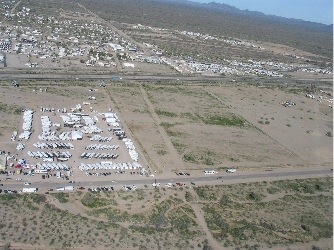 I also saw a perfect LZ with a “No Camping” sign in it (yes, I was low enough to read it from the air) and wondered how I could find out who owned it. (It’s not as if lot numbers were printed on the land like on a map.) I liked it because there was some grass on it to keep down the dust and no power lines in sight. it was also on a heavily-trafficked road with plenty of parking on the roadside.
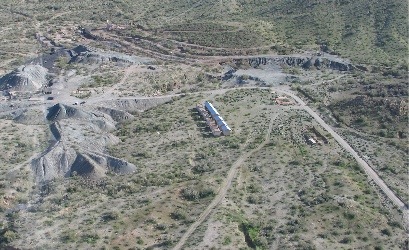 I made several course adjustments before I thought I was following the right road to Swansea. I wasn’t. We ended up on the Bill Williams River, west of Swansea. We followed the river east. The river was flowing hard and had done some damage to farmland in the valley. Lots of silt. We came upon Swansea a few minutes later. There were a few Jeeps and ATVs on the roads there. I was very surprised to see that half the old worker’s houses had brand new metal roofs on them. It appeared that BLM was not only taking care of the place but it was restoring it. Swansea is one of my intended destinations from Wickenburg when I get my Part 135 certificate. Of course, I’m only two weeks into the six month application process, so I don’t even know whether they’ll let me land there with paying passengers.
 What can I say? I’m awed, flabbergasted, thrilled! I brought Zero-Mike-Lima out to Robson’s Mining World for its Anniversary Celebration. Every year, the folks at Robson’s open the gates for a day of free admission to the property. They invite a number of western art vendors, artists, and entertainers to sell goods and entertain the visitors. They sell hamburgers and hot dogs and other food items. They open all the doors to tours, do gold panning, and on occasion, get the old steam engine running for a glimpse into the 1800s.
 I need to thank my ground crew for this event, John, Lorna, and Mike. John and Lorna are winter visitors from Maine who are good friends of ours. They helped out last year at Robson’s and at an outing at Stanton. Lorna usually handles the finances while John and Mike do the passenger briefings and load/unload the passengers. They won’t take money from me for their services — they’re just glad to help out. Lorna likes talking to the people who, this time of year, are from all over the country.
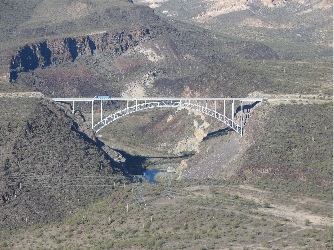 From there, we buzzed out over the desert toward the Santa Maria River. We followed the river east to 93, then headed up 93 to the bridge at Burro Creek (shown here in a photo I took several years ago). ADOT is doing construction in that area, building another two lanes on the bridge. We made a right turn and flew up Burro Creek, dropping into the canyon to get a better look at the things we flew over. Jim wanted to show me a few mining sites he and Ray had spotted on another trip. He thinks I can do tours to these places and let passengers off to explore. I know I need to track down ownership and get permissions. (I’m in the process of doing that with BLM for Swansea Townsite and it’s a lengthy process.) I’m always interested in seeing new places.