
How two companies make things harder and another tries to fix their problems.
While most folks seem very impressed with the income potential of my summer cherry drying gigs this year, no one seems to have considered the startup costs of this endeavor. Sure, I already had the helicopter, but there were other investments necessary to get started this first season. For example, I had to cough up another $8K for insurance that would cover cherry drying (and I’ll have to do this every year), $800 for a helmet, and another $150 for a Nomex flight suit. I also had to buy a pickup truck and have a fuel tank and pump installed.
The Truck and Tank
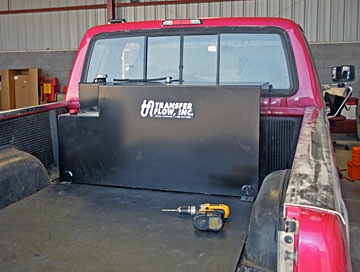 If you follow this blog, you already know about my new old truck. It’s a 1994 Ford F150 with 4WD. It has just enough power to pull my travel trailer and its short bed was just large enough to fit a DOT-legal fuel tank between the wheel wells and the cab.
On the recommendation of another cherry drying pilot, I purchased an 82-gallon tank from Company X. (No, that’s not their real name. The average reader here doesn’t need to know. I can provide specifics to people who really need it.) Two of the features of this tank were a built-in suction pipe and a cutout notch that positioned the fuel pump below the tank’s top. Rather than buy the pump, hose, and nozzle that my friend bought, I though I’d make it easy by buying the complete pump/hose/nozzle setup that Company X sold with it. To my way of thinking, this would guarantee that the pieces all fit together and that they’d work. The pump setup was made by Company Y. Then, to make sure it was all set up properly with the special aviation fuel filter I needed, I figured I’d get it set up by a company that specialized in aviation fuel systems, Company Z based in nearby Peoria, AZ.
Mike and I ordered the tank and other parts and took delivery of it. We then spent most of a morning installing the tank on the truck. It required a lot of drilling through the truck bed and the purchase of extra long bolts because of the bed mats in the back of the truck. Mike did an excellent job. That 300+ pound tank wasn’t going anywhere without the truck.
Company Z Installs the Pump
I made an appointment with Company Z to get the pump, etc. installed with a filter and grounding cable. I was told to bring it down in the morning.
I should comment here that I know the owner of Company Z. He had done some work for us at Wickenburg Airport when I owned the FBO. I never had any complaints about his work. We’d always gotten along well and I felt comfortable giving him my business.
I made the 40-mile drive and was introduced to the guy who would be doing the work. I dont’ remember his name. We’ll call him Joe. He seemed a bit goofy, but I didn’t think anything about it. I asked him how long it would take and he said, “a few hours.” We talked about testing it afterward by driving it over to Glendale Airport and filling it up with AvGas.
There was a strip mall nearby and one of the women who worked there kindly drove me over. I figured I’d spend the waiting time picking up a few things for my trip.
About 30 minutes later, Joe called. He was done. I was shocked. He said he’d come pick me up and I told him where I was. But when he arrived, it was in his truck, not mine. I thought we’d go right to GEU to test it out, but apparently, he wanted to go back to his workshop first.
Good thing we did. All he did was put the pump and hose and flow meter on the tank. The aviation fuel filter, which is what I’d come there primarily to get, was not installed. The static line wasn’t installed either. He’d basically done everything that Mike and I could have done on our own.
I held my temper and reminded him that I’d come for the fuel filter and static line. That he hadn’t done anything that we couldn’t have done ourselves.
“Oh,” he said. “I was wondering why you came to us.”
Evidently, there was no internal communication in the company. Rather than ask me what I wanted, he just assumed that I wanted the pump pieces in the box I’d brought installed.
I waited in the office while he installed the filter and a static line with a clip. He came out multiple times to ask me about the size of the filter (there were two sizes), the length of the static line, the type of clip, and whether I wanted a reel for the hose or the line. Each time he came out to ask a question, I felt a little more of my patience slipping away. I’d been there more than two hours. I’d come down to get the system professionally installed and wasn’t happy about the work being done by someone who appeared to be a moron.
So when he finished and tried to sell me stickers for the tank that didn’t fit, I was ready to get out of there. The installation looked fine. I was not interested in spending any more time with him. I was also not interested in putting 82 gallons of AvGas into a tank that I’d be driving 1300 miles. I thanked him and asked about payment. I was told I’d be billed. He asked if I wanted to test it and I told him I didn’t.
That was my second mistake with Company Z. The first mistake had been going to them in the first place, as you’ll see shortly.
For the record, Joe never told me that it was company policy to test all installations. He didn’t press me to test it at all. He seemed perfectly happy that I was going to leave without testing it.
We [Try to] Test the Tank
Before leaving Wickenburg, Mike and I attempted to test the tank. I had some fuel in gas cans in my hangar that I needed to use up, so we poured that in. The pump wouldn’t suck. We added another 10 gallons. The pump still wouldn’t suck. We looked at the manual and followed the instructions for priming the pump. It still wouldn’t suck. We assumed that the pump wouldn’t suck because there wasn’t enough fuel in the tank to prime it properly. Since I wasn’t prepared to lug 82 gallons of AvGas up to Washington State, we stopped testing.
It turned out, we were wrong.
I [Try to] Fill the Tank
Fast forward a week or so. It’s Thursday I’ve settled in at the campground in Quincy, WA and my cherry drying contracts are due to start within a few days. I needed to fill the tank. I drove out to Ephrata where there’s a bulk fuel provider who has been recommended to me by (oddly enough) the same pilot who advised me on the tank. I set up an account, then pulled over to the pump to get filled up. I already had 20 gallons in the tank from my aborted tests. When the meter said they’d added another 53.1 gallons, we noticed that fuel was leaking out of the fitting between the pump and the tank.
Leaking is actually a weak word. It was almost gushing out. All over the back of my truck. Fuel that I was paying $5.35/gallon for.
They stopped pumping and got some spill rags to soak it up. I hurriedly paid up. They gave me the information for a guy in Moses Lake, which is 18 miles south, who could fix it. I stopped at an auto parts store and got a 5-gallon plastic gas can. I used a siphon hose that I happened to have in the truck to suck 5 gallons out so the fuel level was below the leaky fitting. Then I drove down to Moses Lake.
How Company Z Screwed Up
 The guy in Moses Lake, Don, removed the pump and laughed. “Here’s part of your problem,” he said. And he pointed to the bright red plastic plug in the bottom of the pump — the plug that Moron Joe had neglected to remove when he installed the pump. “And there should be a gasket or something here,” he said, pointing inside the fitting. We looked at the paperwork for the tank and pump. There’s an exploded view parts diagram. Sure enough, the gasket that’s supposed to go inside the fitting was missing.
So much for a professional installation by a company that should know how to get the job done right.
Don went through his stock of gaskets and tried to find one that would fit. He found one, slipped it in, fastened it down, and tried the pump. It still leaked.
I got on the phone and called Company Y, the maker of the pump. I told them that the gasket was not installed and that I’m not sure whether it’s because the moron who set up the pump lost it or it was never in the box. It’s a $1.20 part. I offered a credit card. The guy on the phone said he’ll just mail it to me. I gave him my General Delivery address in Quincy and hung up.
Don put a cap where the pump should go so I wouldn’t lose any more fuel. We laid the pump assembly in the bed of the truck, wrapping the spill rags around it. I paid Don $53 for his time and started the 50-mile drive back to Quincy.
How Company Z Loses Me as a Customer
I called my contact at Company Z to complain about his moron worker. I had to leave a message. When he called back, he was on the offensive. He claimed that it’s company policy to test all installations. He claimed that his guy had said I insisted on leaving without testing it.
I told him that wasn’t the case, that his guy had never told me it was company policy. I also told him that his guy was a moron for leaving the plug in. Then I said, “I can see where this is going. You don’t give a shit about this. Don’t expect to hear from me again.”
His response: “Thanks.”
My comeback cannot be printed.
Too bad I paid them promptly. Between the $250+ I’d paid them, the $53 I paid Don, the 3 to 5 gallons of AvGas I’d lost, and the fuel for the drive to Moses Lake and back, he’d cost me close to $400 — and the system didn’t work.
How Company X Screwed Up
The post office in Quincy is closed on Saturday. On Monday, the gasket still hadn’t arrived. I called Company Y to confirm that they’ve sent it.
I talked to another guy, Brian. After a discussion of the situation, he said, “Is the pump lower than the top of the tank?”
I confirmed that it is.
“Well, that pump isn’t designed to be mounted below the tank fill level. The gasket is designed to prevent leakage due to sloshing, not to the pressure of fuel above it.”
And that’s when I realized that Company X had sold me a pump that wasn’t designed to work with their tank.
Brian and I discussed this some more. He asked me questions about the tank configuration. He seemed surprised that there was a built-in suction tube and that the connection at the top of the outflow was male threaded rather than female threaded. I think that for a few minutes, he simply didn’t believe me. But after I answered a few more questions, he realized that I did indeed know what I was talking about. He asked for the phone number for Company X and I gave it to him.
How Company Y [Hopefully] Saves the Day
My cherry-drying contract requires that I have fuel available at my base. Fortunately, the cherry blocks for my early contracts are only 12-14 miles from Wenatchee, where there’s fuel at the airport. I can carry 3 hours worth of fuel in the helicopter. Until I got the tank fixed, I figured that I’d top off the tank in the helicopter and then refuel at Wenatchee when I needed to. So I flew the helicopter to Ephrata, which is only 15 miles from Quincy Airport, and topped off the tanks. It was a .2 hour flight back to Quincy, so I still had nearly 3 hours of fuel on board.
Tuesday was rainy and cold. I spent most of the morning at the airport, ready to pull out the helicopter and launch if I got a call from a grower. That didn’t happen. But I did get a call from Brian at Company Y.
He’d spoken extensively with both the support people at Company X and his own technicians. They’d decided that if I added a second, different type of gasket to the fitting, the pump should fit without leaking. He was sending me the two gaskets that day.
As I type this, the gaskets have still not arrived. It’s only Wednesday, though. I expect them to get here tomorrow. (Fortunately, the weather looks great for the next few days, so I don’t expect to need to fly.) I’m pretty sure they’ll work. I’m also pretty sure that if they don’t, I can depend on Company Y for further assistance.
Tip of the hat to them. Wag of the finger to the others.

 I took photos as I flew. Most of them didn’t come out very well. The ones you see here are passable. In this shot, I’ve just left the Bellevue/Renton area. You can see the thick clouds hanging low over snow-capped peaks beyond Preston.
 As I neared Snoqualmie Pass, the space between the mountains narrowed. I-90 wound along mountain slopes in a canyon. The clouds seemed lower. I began to wonder whether I’d be clouded in after all.
 But then I was through the pass and descending past a series of long, narrow lakes on the east side of the pass. Beautiful scenery. I caught sight of a few grass airstrips along the way and found them on the sectional chart I’d left folded open on the passenger seat. I took a picture of one of them, but it was too out of focus to keep, let alone share here.
 I continued my descent. Soon I was coming out of the Cascades, approaching the rolling hills so similar to those around Quincy. I overflew Ellenburg Airport and continued east along I-90.
 I crossed the river 1,000 feet above it, just south of the I-90 bridge. Then I headed south through a gap in basalt cliffs. And that’s when I caught sight (and took a photo) of a typically nighmarish orchard setup. In this photo, you see fruit trees separated by tall poplar trees planted as wind breaks. The tall trees might be 80 feet tall; the trees in the orchard blocks between them might be 10 to 20 feet tall. If any of those trees were cherry trees, some poor pilot would be maneuvering between the tall trees after a rainfall to dry the shorter ones. I’m just glad none of these orchard blocks are mine.
 Although I’d planned to stop at Wenatchee, I decided to go straight to Quincy instead. I’d fuel up the next day. I was tired and just wanted to put the helicopter away and go home to my camper. So I punched Quincy (80T) into my GPS, flew up the river past the Gorge Amphitheater (shown here), and homed in on Quincy, flying over my trailer at the golf course on the way.
 The 30-acre orchard climbed up the side of a hill. There wasn’t much in the way of obstructions — just a set of power lines along the road on the bottom edge of the field. I noted that when I dried one side of the orchard, I’d be in the backyards of a few houses on the other side of a chain link fence.
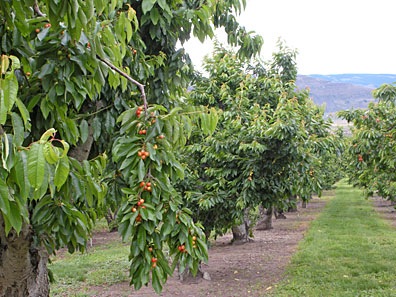 The trees looked old, with thick trunks and branches cut by aggressive pruning. The cherries were mostly reddening, although some were still greenish yellow. They looked tasty, but I didn’t touch them. I climbed one side of the field and started across the top, which sloped down. I noticed an empty wire animal trap at the base of a tree. The next trap had a large raccoon in it. It looked healthy enough — at least then. Who knows what the grower would do with it? I don’t want to know.
 I could immediately see that this block of trees would be a nightmare. The trees were planted beneath two sets of high tension power lines that crossed the block diagonally. The wires from one set hung low over the block. A tower for the other set stood in the middle of the trees on one end of the block. And just for good measure, there was a drying fan in the field, too.
 The other 10.5 acre block in the same orchard was completely different — and a lot easier to find. It lay in almost flat terrain with just two fans and some low wires on one side to worry about. The aerial photo I had showed tall poplar trees on one side of the field; these had been taken down since the photo was taken. I took this photo from the road that wound down to the river. The outlined area is what I’ll be drying. I was lucky; a road wound all the way around the orchard so I drove it instead of walking it.