Fine Dining in Wickenburg

One of the drawbacks to living on the edge of nowhere.

One of the gripes most people who didn’t grow up in Wickenburg share is its amazing lack of dining opportunities. You’d think that in a town with a population that swells to 10,000 people in the winter months, a town that’s the biggest thing around for the tiny towns within 20 miles of it, a town with people from all over the country and at all income levels — you’d think a town like that would have more than a few good restaurants. You’d think, right? Well, we have less than a few. I could count the ones I’d eat at on both hands; I could count the ones I actually like on one hand.

We have some friends who eat out all the time. It think it’s because Judith (the wife of this couple) doesn’t like to cook and Jim (the husband) probably can’t. They live in Wickenburg and money is not a problem. I know they’d love to spend money on a truly good meal — a meal that might appear on the cover of Sunset magazine or as a handful of recipes culled from back issues of Gourmet. Heck, I’d love to join them at that meal. At least once a week.

Anyway, they cycle among their favorite four or five restaurants in town, visiting each of them at least once a week on average. They’re regulars in these places. They go out to eat early and spend at least an hour on cocktails before ordering. Most of the restaurants understand this routine and cater to it. Occasionally, a new waitress won’t get it right away and Jim has to get loud. We’ve been with him when this happens and it’s kind of funny to see the reactions of other diners.

Jim and Judith recently invited us to join them at one of Wickenburg’s “fine dining” establishments. I put “fine dining” in quotes because that’s how the restaurant advertises itself. That’s not how I would describe it.

Mike and I had sworn off this restaurant several times. But without much variety in town, we always talked ourselves into trying it again. Midway through the meal that we’d come back for, we’d swear we’d never return. But four or six months later, there we were again, ordering overpriced food served by an under-trained waitress.

This is the same restaurant where I had my classic Wickenburg wine tasting experience. I tell this story to people who don’t understand what we’re dealing with here in Wickenburg.

I went out to eat with another couple. It was just me and the other couple at the table: two women and a man. The waitress brought menus and I asked for wine list. She brought it to me. While she was doing something else at other tables, I discussed the wine options (which were limited) with my friends. We decided on a bottle of wine. The waitress came back and I ordered the wine. I also gave back the wine list. The waitress went away. She came back a few minutes later with three glasses, the bottle of wine, and a corkscrew. She distributed the glasses, then opened the wine, placing the cork on the table in a neutral position. I can’t remember if I reached for the cork to examine it. She then proceeded to pour a sample of the wine into the glass in front of the man at the table so he could sample it.

The three of us were in shock. My friend tasted the wine, said it was okay, and then let her pour the rest. She went away. And the three of us put our heads together and talked about what she had done.

Now if you don’t know what the waitress did wrong here, you’re reading the wrong blog. You probably don’t get much about what I say anyway. This weekend, get dressed up, take your significant other, and go out to the nearest five star restaurant. Make sure you order a bottle of wine and observe the way it is served. Just for kicks, let the woman at your table (if there is one) do the ordering. Not only will you get a great meal prepared by a chef who knows what he’s doing and has a little imagination, but you’ll have great service. You’ll pay for both, of course. And you’ll learn how wine should be served.

On that day, my friends and I agreed that either she should have let me taste the wine since I ordered it or she should have asked who would like to taste it. To automatically assume that it’s the man’s job to taste the wine is old fashioned, sexist, and completely uninformed.

But that’s what we’re dealing with here.

Jim and Judith go to this restaurant on one particular day of the week for their special. It’s the same every week: fried chicken. Yes, fried chicken in a “fine dining” establishment. So when Judith invited us to join them, I tried to focus on the social part of the outing. Jim and Judith are lots of fun. Jim talks helicopters, Judith grills us on our lives, and Mike teases them both about Junior Bush. We always have a good night out with them no matter where we eat.

Jim and Judith were there before us that evening with drinks in front of them. When the waitress came, she didn’t seem too happy to see us. Maybe she knows my reputation in town. (If I cared about that, do you think I’d be writing this?) Mike ordered a Tanqueray and tonic (always wise to specify brand name for alchohol in Wickenburg) and I ordered a martini.

“On the rocks?” the waitress asked me.

Now I fully admit that I don’t drink martinis very often and I don’t know very much about how they’re served. But I’ve never seen a martini served on the rocks. Usually, they’re put in shaker with ice, shaken, and strained out into a martini glass.

“Straight up,” I told her. “But very cold.” That was my attempt to hint about the shaker and ice. “With an olive.”

She brought Mike’s gin and tonic without a lime, which he had to ask for. And she brought my martini in the kind of glass you might see a Manhattan served in. It was definitely not a martini glass. But okay, maybe they were out of martini glasses. Maybe the dishwasher hadn’t gotten around to them yet. You can’t criticize a restaurant for the wrong choice of glass, can you?

At least that’s what I was telling myself when Mike’s lime squeezed onto my forehead.

I looked around the restaurant. “I’m the youngest one here again,” I told Judith. I’m forty-four. This was one of Mike’s complaints about the place — that only old people ate there.

She looked around. “You and me,” she said.

Funny how being the youngest person in the room still doesn’t make you feel young.

After a while, when Jim was ready to order, the waitress came back. Jim, Judith, and I ordered the fried chicken. Mike ordered the fettucini.

“The alfredo?” the waitress asked him.

He looked at her blankly and reopened his menu. “What other kind of fettucini is there?” he asked, obviously surprised that he’d missed it. After all there were only a dozen entree choices on the menu.

“Well, there’s another dish that has fettucini on the side,” she said.

He stared at her. “Alfredo,” he told her calmly, closing the menu.

The waitress went away. We didn’t talk about her behind her back. It just wasn’t worth it.

The owner came by our table for a visit. He was obviously very chummy with Jim and Judith. “Did you order the chicken?” he asked.

They told him they had.

“Good thing you got your order in. There isn’t much left.”

Then he disappeared back toward the bar.

“I don’t see what the big deal is,” Mike said. “It’s Swanson’s.”

We sat through the restaurant’s unusual salad ritual. The waitress comes with four plates of mixed lettuces and a cart with salad fixings. Things like cherry tomatoes, red onions, beets, croutons, and dressings. She then asks each person what they want on their salad. Whatever you say you want, she puts exactly two of them on your plate. Two tomatoes, two cucumber slices, two beet slices — you get the idea. I think she might be more generous with the croutons, but I don’t know — I’ve never eaten with anyone who has asked for them. She repeats this process for each person at the table. I’m pretty sure the dressings are bottled.

Did you ever eat at a Lowry’s restaurant? Its a rather nice restaurant that specializes in prime rib. I’ve eaten at Lowry’s in Chicago twice and Beverly Hills three times. They have a weird salad ritual, too. They come to the table with a cart that has a big bowl of salad on it. The salad bowl is sitting on an even bigger bowl of ice. While you watch, the waitress, who is wearing a plain gray uniform with a white apron and a very low cut neckline, spins the salad bowl on the ice bowl, pouring in the Lowry’s dressing (available for sale in the lobby) from as far up as she can reach. She then tosses the salad, dishes it out, and retreats.

This Wickenburg restaurant reminds me of that. But at Lowry’s the salad (and the rest of the food) is good.

The food came a while later. The waitress gave Jim and Judith nice looking plates with plump pieces of chicken and good helpings of vegetables. She gave me a plate that looked like the chicken pieces had been collected from other people’s plates. Okay, so it didn’t look that bad. If it did, I wouldn’t have eaten it. Mike’s fettucini looked like it was absolutely smothered in a thick white sauce. He asked the waitress for fresh ground pepper and she didn’t look very happy to bring it.

We were in the middle of the meal when the owner came back. He started chatting us up and I had a strong suspicion that he’d had a few drinks at the bar. Before we knew it, he was talking loudly about the 10 acres of land he owned in town, telling Jim he ought to buy it and build a house there.

“Not likely,” I said.

Jim and Judith have their house on the market for a cool $3.5 million. When that sells, I don’t think they’ll be spending much time eating fried chicken in Wickenburg.

The owner looked at Mike. “You’re a pilot, too?” he asked.

Mike confirmed that he was.

No one told the man that I was also a pilot. I don’t think he would have comprehended that anyway. A woman flying an aircraft? A helicopter? How could that be? She can’t even sample the wine at dinner!

He continued talking loudly about stuff that wasn’t important, passing an inappropriate comment about his wife hating him along the way. I concluded that he was drunk and hoped he’d go away soon. Maybe I sent him some silent messages that penetrated, because after a while he left.

The busboy (who was younger than me), offered to take Mike’s plate away. Mike said he wasn’t finished eating yet. I laughed a bit louder than I should have. I think I was beginning to lose it.

We finished eating and the waitress came over with the dessert tray. I’d been watching this dessert tray since we came in. It was on a stand not far from our table, just outside the kitchen door. The waitress would bring the tray to the table and, if you wanted something, she’d pull it off the tray and give it to you. Then someone would replace whatever had been taken with a fresh portion from the kitchen.

Now I had a serious problem with this. Suppose I wanted a piece of Boston cream pie. But suppose that no one else had wanted a piece of Boston cream pie all evening. So at 6:30 PM, I’d be getting a piece of Boston cream pie that had been put out on the tray at 4 or 5 PM when the tray was made up and had been sitting there all evening. One to two and a half hours, in this example. I wouldn’t eat Boston cream pie at home that had been sitting out that long. Why would I eat it in a restaurant?

None of us had dessert.

We left not long after that. Mike and I swore once again we’d never go back. I decided to invite Jim and Judith over for Swanson’s fried chicken one night.

Mike was up half the night, making trips to the bathroom. There’s something to be said about ordering the special.

Maria Speaks Goes Online

I finally start publishing my own podcast.

Maria SpeaksI’ve been wanting to do it for weeks, but I just haven’t found the time. You see, I don’t want to sound like an idiot, so I need to compose everything I want to say in a podcast episode before I record it. So I need time to think things out, write them down, and record them. I suspect I’m not the only one who does this, although I’m willing to bet that a lot of podcasters skip the first two steps.
I published two back-dated podcasts this evening. One is an introduction to the podcast. The other provides information about my eBook on podcasting. I’m working on another one now, about using the Mac OS Command key. Maybe I’ll get that online this week, too.

Interested in podcasting stats? I found this information in the most recent issue of Technology Review.

  • By the end of June, there were over 25,000 podcast feeds. That’s up from less than 2,000 in January. Wowser!
  • The iTunes Music Store’s Podcast Directory listed about 6,000 podcast feeds with about 6 million subscribers as of July 18.
  • Most podcasts categories have more listings than views (percentage-wise, anyway). The notable exceptions include radio (such as KBSZ), News, Health/Fitness, Books, Hobbies, Games, Food/Drink, Travel, Art, Erotica, Environment, Variety, and Fashion.

Jeez, I love stats.

Want some more stats? Here’s a quickie: the KBSZ podcast I set up in August now has 20 regular subscribers. That’s not bad for a radio station on the edge on nowhere.

Anyway, if you want to subscribe to my Podcast, here’s the URL: http://feeds.feedburner.com/mariaspeaks — just pop that URL into iTunes or another Podcast client to tune in. Or use your Web browser to access the RSS feed and click the title of an episode to download it.

The Mohave County Fair

We give Kingman residents and visitors helicopter rides.

I started planning for the Mohave County Fair at least a year ago. I exchanged phone calls and e-mails with the folks who handle the concessions for the fair, including Betty Watters and her son Phil Richardson. I flew up to Kingman in June to check out possible landing zones. That’s when I paid the fee for my “booth” in the north parking area. The dates September 15-18 went from pencil to ink on my calendar.

Mike and I went up to Kingman early Thursday morning. I flew, Mike drove. Mike brought our camper up there. It’s a 3-horse slant trailer with living quarters. I left about an hour after Mike and arrived at the fairgrounds the same time he did. I did a lap around Kingman, planning my route for rides, while Mike parked and secured my landing zone. Then I landed in a huge cloud of dust, cooled down the engine and shut down. We spent the next two hours setting up boundaries for the landing zone, putting up banners and signs, and doing housekeeping chores in the camper. The nice folks at the fairgrounds allowed us to park the camper at one end of the landing zone. On the other side of the fence were a few portable toilets (which we wouldn’t need) and the trailers and living quarters for the carnival folks. Beyond that were the carnival rides and attractions. And beyond that was the rest of the fair.

Photo

Mike made a trip to the local True Value hardware store to pick up a sprinkler and another hose. Phil had run his own hoses to the landing zone and we decided to use a sprinkler, which we’d move periodically throughout the day, to keep the landing zone damp. That would keep dust down. Mike also had to take a trip to town to fill the camper’s two gas bottles so we’d have refrigerator, hot water, and stove use. The camper also has a full bathroom with two holding tanks, so we could use our own clean toilet and shower daily.

We also had Jack the Dog and Alex the Bird with us. Jack had to stay on a leash. Alex stayed under the trailer’s awning in his cage. Neither of them were bothered by a helicopter taking off and landing about 150 feet away from them.

Betty had asked her neighbor, Tony, to give us a hand. Tony is on permanent disability after being hit by a truck years ago, but he was fully capable of helping us with the things we needed to do. He wound up working with us on Thursday and Friday and lending moral support on Saturday.

By 2 PM, we were ready to do rides. The only thing we needed were passengers. That was the problem. It was 2 PM on a weekday. Kids were in school, parents were at work. No one was interested in the carnival or our rides.

The ride took off from the north parking area. I had to make a crosswind departure, since heading into the wind would have taken me right over the carnival rides. From there, we flew up the east side of Centennial Park, north of Wal-Mart, just north of the I-40 pass through the mountains, down to the Beale Street exit on I-40, along the south side of Andy Devine Boulevard, across Hualapai Mountain Road, and up the east side of the fairgrounds. I made a 1807deg; turn at a cell tower north of I-40, then came straight in to the landing zone, landing right into the wind. Total time was about 6-8 minutes.

I’d priced the rides at $25 per person including tax. This was before fuel prices went up, so it was a real bargain. My usual ride prices are $30 to $35 per person for an 8-10 minute flight, but the fair folks practically begged me to keep the price down. So I did, depending on the cheaper price to attract more passengers and shorter ride length to make it profitable.

We managed to give 11 rides on Thursday. Very disappointing. We went to the Dambar restaurant for a good dinner, though.

On Friday, things weren’t much different. I walked over to the nearby junior high school around 10 AM, suggesting that a few of the teachers might want to walk students over to see the helicopter and get one of my presentations on aerodynamics or how helicopters fly. The school was very interested, but Fridays are half days so classes are shorter. There wouldn’t be enough time for any of the classes to walk over and back and get the presentation.

Things picked up late Friday afternoon. We did 10 rides, most of which were after sunset. The moon was big and full and beautiful and the carnival rides looked great from the sky.

By that time, our two helpers, Alex and his college buddy Ryan, had come to help out. There wasn’t much for them to do. They pitched their tent behind our camper, uncomfortably close to those portable toilets on the other side of the fence. We ate carnival food for dinner and walked around the fair.

We were pretty disappointed at the turnout so far.

Saturday changed everything. Although I wasn’t supposed to start flying until 10 AM, my first passenger arrived at 9, before the fair even opened. Heck, I didn’t care. I gave him a ride. For the next two hours, I did a few rides. Then the dam burst (so to speak) and I had a nonstop flow of passengers. Mike, Alex, and Ryan loaded 2 or 3 people on board for each flight. The only time I shut down was to get fuel at the local airport 5 miles away (three times!) and to take a 20-minute lunch/bathroom break. I put 5.5 hours on the helicopter’s hobbs meter that day — quite a bit when you consider that the hobbs only ticks when I’m in flight so my time spinning on the ground didn’t count. I figure I took about 100 passengers for rides that day. Most of them were in a helicopter for their very first time. I gave all the kids who flew with me helicopter toys (while they lasted). One guy liked it so much he went up twice.

We celebrated with four steak dinners at the Dambar.

Sunday looked as if it might be a repeat of Saturday, but the flow of passengers was starting later. The wind was stronger than the previous few days and it was warmer, so taking off with a crosswind (rather than a headwind) when I was heavy was tough. I did about 20 rides before we decided to call it quits. It was 1:30 PM. We packed up, said goodbye, and got ready to go.

I stopped off at the carnival office to leave a card for the carnival owner. I’d had a good event and was interested in working with carnivals to do it more often.

Mike left with the camper and I took off with Alex and Ryan. We took the scenic route home: to Bullhead City and down the Colorado River to Parker, where we refueled (at $4.54 per gallon!). From there, we hooked up with the Bill Williams River, overflew Swansea and the Alamo Dam, and returned to Wickenburg.

We’ll go back to the Mohave County Fair next year. But we’ll just spend all day Saturday and Sunday. I’m already looking forward to it.

My thanks to Betty and Phil for all their help.

Back to the Desert

Day 13 brings me to the mountainous desert around Salt Lake.

Despite my less than perfect accommodations, I slept reasonably well. I think it’s because of the sound of flowing water that came in through the door to the back deck. I’d left the door open a few inches, trusting the lock on the screen door to keep out any hotel guests who might be wandering around on the deck. I was in the end room, so the chance of someone walking by my door on their way to another room was remote.

I showered. It was the first motel shower I’d encountered in a long time that couldn’t keep a steady water temperature. Every time one of my neighbors flushed the toilet, I’d come close to getting scalded. The third time this happened, I shut the water off and called it quits.

I packed up the car, checked out, and headed south on 89. I had a Doubleshot to meet my caffeine needs. (My friend Lorna, who has been reading these entries faithfully from her home in Maine, e-mailed me to ask what a Doubleshot is. In case you don’t know, here’s the scoop. A Doubleshot is a canned Starbucks coffee drink. It’s an easy way to get a caffeine fix when I’m on the road. I usually buy a couple of them when I’m in a supermarket and keep them in my cooler. When I can’t find decent coffee elsewhere, I drink a doubleshot. I don’t really like them — they’re too sweet for my taste — but they’re easy.)The road began by following the Snake River through a canyon. When it reached the town of Alpine, WY, the Snake River curved to the northwest while I headed south. Alpine was a nice little town with a lot of tasteful new construction and small businesses. The town was very quiet — it wasn’t even 8 AM yet. I almost passed a drive-up coffee stand. When I spotted it, I hit my brakes hard and pulled in for a latte.

The building was tall and it was quite a reach up to the woman inside it. My Clarkston reused coffee grinds experience had left me a little leery of coffee stands, but I had nothing to worry about here. The woman, who was very friendly, made me an excellent large triple latte. I asked her whether she owned the booth and she told me she didn’t. In fact, it was her last day at work. She was moving back to Spokane, WA. The woman who owned the booth was doing okay, but it was hard to do well in the town because of its heavy Mormon population. I later discovered that Mormons don’t drink coffee. I guess a coffee shop in a Mormon town would be like opening up a pork store in New York’s Lower East Side.

From Alpine, I headed due south on 89, which lies on the east side of the Wyoming/Idaho border. I was in farmland again, but at an elevation well over 5,000 feet. Wheat and alfalfa seemed to be the big crops. One alfalfa field had just been cut — probably the previous day — and the smell of the fresh alfalfa was rich and sweet.

I think I was in Afton when I saw the car wash and pulled in. I’d managed to call Megg on my cell phone and arrange to go to her house in North Salt Lake City that afternoon. My car was dirty and I didn’t want to make a bad impression. So I washed it for the third time on my trip. This time, it was the dirtiest it had been so far. The bug situation in Idaho, Montana, and Wyoming is bad and the front of the car was pretty much plastered with dead bugs of all shapes, sizes, and colors. It took six minutes worth of car wash time to get it all off. I dried it with my rags and dusted off the dashboard. Much better.

I crossed into Idaho at Geneva Summit, which was 6,938 feet. That put me into a long valley with a succession of towns: Montpelier, Ovid, Paris, St. Charles, Fish Haven, and Garden City. Every town I drove through was remarkably quiet — nothing seemed to be open. Except the church, of course. All the church parking lots were full and I saw more than a few well-dressed people out on the streets, walking to or from church. Things changed a bit when I got near Bear Lake. Lots of people were out and about at the lake, in boats and in public access areas. There was a lot of housing on the lake side of the road with plenty of Private and No Beach Access signs to keep people out.

Bear Lake

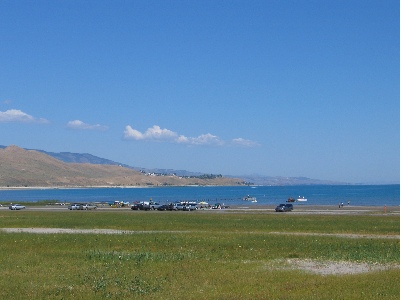
Somewhere between Fish Haven and Garden City, I passed into Utah, the ninth state I’d visited on my trip. At Garden City, I got on route 30 and followed that around the south end of the lake. I climbed a hill and immediately realized that I had slipped into high desert terrain. The vegetation on both sides of the road consisted of tall grass, sage, and a variety of other desert plants. I was getting closer to home, leaving the water wonderland I’d enjoyed since entering Oregon more than a week before. I felt disappointed and did not look forward to what I’d drive through ahead: dry desert, hot sun, empty riverbeds. I realized that I’d fallen out of love with the desert.

I turned right on route 16 with a bunch of other cars, heading southbound. More farmland, but not much more. I passed the bunch of cars, tired of breathing their exhaust. Later, I turned right again onto route 39, heading west. The road climbed and climbed and climbed. I kept checking my GPS for elevation information and the number kept going up. I was certain that when I reached the top of the mountains, there would be a lookout where I could see Salt Lake. I crossed over the Monte Cristo Summit, at 9000 feet, and started down. There was no lookout. The road dropped into a canyon with a small stream on either side. It twisted and turned as it descended. I passed two pickup trucks and some kind of Volkswagen — a Jetta, maybe? — blew past me.

I spotted a restaurant on the left and made a harrowing turn into a parking space. I needed a bathroom and lunch, in that order. I asked for them in reverse order. It would be a 20 minute wait to eat outside on the patio, which looked like a good place to eat. I got directions to the ladies room and while I was doing my business, decided I didn’t feel like waiting. Instead, I’d find a shady spot in a park and eat some of the food in my cooler. So I left and continued on my way.

Trouble was, there was no shady spot in a park. All I passed were campgrounds, and since it was Sunday at midday, all of the campgrounds were full. So I kept driving.

The road dumped me down in Ogden. I got on a main avenue that was also labeled route 89 and headed south toward Salt Lake. I wasn’t in a hurry. I was supposed to meet Megg at around four and it was only 1:30. That meant I had time to kill.

I should have killed time up in Ogden, because when I got closer to North Salt Lake, all of the shops and businesses were closed again. It would not be a good place to kill time. I drove all the way down to the city, then came all the way back up to Bountiful, where I found a Barnes and Noble that was open. I killed over an hour in there, buying books for myself (as if I needed them) and for Megg’s son, Cooper. Then I hopped over to the Taco Bell for a bite to eat. Then I drove around some more. It was around four and I was in a Smith’s parking lot, after buying two pies for Megg and her family, when I finally connected with Megg. I was five minutes from her house. She gave me directions and I made my way over there.

Megg is one of my editors. She works with me on my Quicken Official Guide books, which I’ve been revising faithfully since the Quicken 99 edition back in 1998. Megg hasn’t been stuck with me that long. She inherited me from my first editor on that book, Joanne, about five years ago.

Megg has a lovely and very large house on a hill overlooking the North Salt Lake area. Excellent views, plenty of space. And a very comfy guest room. I met her son and her husband. I then proceeded to join her for a very relaxing afternoon and evening.

Elk and Bison and Bears — Oh, My!

Day 12 takes me through two national parks on my way south.

I slept better at Lynn’s house than anywhere I’d been so far. The bed was warm and cosy, the air was clean and fresh, and the sound of the creek rushing by the house was the perfect white noise for sleep.

I got up my usual time and soon realized that Lynn was awake, too. I had some coffee and Lynn had some tea and we chatted. Then I went up to take a shower while she put the horses back out to pasture.

She drove me to a town called Alder for breakfast. On the way, we stopped at a town called Laurin (which is not pronounced the way it’s spelled, but I can’t remember how to pronounce it) where Lynn showed me two small houses that had been built inside metal grain silos. She said that when she and Ray had farmed down near Klamath Falls, they’d had a bunch of those silos and never knew what to do with them — they didn’t grow grain and no one else in the area did either, anymore. This seemed to be a perfect solution.

We had egg sandwiches at a local farmer cafe and I picked up the tab. Then we went back to her place, where I packed up the car, said goodbye, and headed out.

I gassed up in Sheridan, at the only gas station. I then retraced our miles through Laurin and Alder on route 278. Along the way, I saw a bald eagle. It looked exactly like all the photos I’d seen of bald eagles, but it was picking on some road kill when I approached. It flew off to wait atop a fence post until I was gone so it could continue its meal.

I passed Nevada City along the way. My map indicates that it’s a ghost town, but there was plenty of activity there. Perhaps someone had fixed up the buildings alongside the road as a tourist attraction? Or built them from scratch to look like old western buildings? In either case, there were an awful lot of them and they were right on the road. A sign said that there would be living history events that day. A bunch of tourists had already gathered, including three motorcyclists who had found it necessary to take up a full parking spot for each of their Harleys. Ah, the good old American “I’m all that matters” attitude in action.

A few minutes later, I passed Virginia City, which has to be the most authentic western town I’ve seen so far. There were plenty of old buildings, in wonderful condition, housing shops and museums. Makes me sick to remember how Wickenburg tries to promote itself as “the west’s most western town,” when I pass through one that makes Wickenburg look like a shadowy imitation of something out of a sixties western. Somehow, the fast food joints ruin the effect.

Quake LakeI reached Ennis, which Lynn had told me was very touristy. I didn’t really notice that, but I made my turn there, so I may have missed that part of town. I was still on route 287, but it was heading southbound now. After a while, the road joined up with the Madison River, which I followed for quite some time. When I got to the turnoff for Quake Lake, I turned in. Lynn had told me a little about the place and said she’d wanted to see it when she and Ray had driven past. Ray hadn’t been interested at the time, so they’d gone past without stopping. The place was situated in a canyon where the Madison River flows. In the late 1950s, an earthquake had caused a landslide that dumped debris into the river bed. Twenty-eight people had been killed, although I don’t know how. Perhaps they were on the road there? In any case, the natural dam caused by the landslide had created Quake Lake. I read all this on the sign outside the visitor center. It was all I needed to know, so I didn’t go in. I took a picture of the little lake, then got back into the car and continued on the road as it wound alongside it. There were lots of dead trees sticking out of the water. I imagined a heavily forested canyon suddenly filled with water and the slow death of the trees that were submerged.

The road passed on the north side of Hebron Lake, a manmade lake along the Madison River. There were lots of homes on its shores, a few marinas, and some fishermen. Then, at the junction for route 191, I turned right, heading south.

My car’s odometer turned 14,000 miles about a mile outside of West Yellowstone, MT.

I was going to just drive through West Yellowstone when I spotted an IMAX theater. I enjoy IMAX movies — except the 3D ones, which look blurry to me — so I pulled in. They were showing three different movies: Yellowstone, Lewis and Clark, and Coral Reef. Although I wanted to see Lewis and Clark, Yellowstone was next up, so I bought a ticket to that. Since my cell phone finally had a decent signal, I called Mike while I waited and left him a message telling him where I was and where I was going.

The movie was good. Grand Canyon, which plays at Tusayan near the South Rim, was better, though.

YellowstoneI headed into the park, crossing over the border into Wyoming, the eighth state I’d visited so far. My National Parks pass got me in without a fee. (It works at Yellowstone but not Mt. St. Helens? What kind of bull is that?) I took the map and gave it a quick look. My objective was not to visit the park. My objective was to take a nice, scenic ride south toward Salt Lake City. The problem was, it was a Saturday in August. The park was full. And the tourists were of the most annoying variety: drive-through tourists who will stop their car anyplace someone else has stopped, just to take a picture of whatever that other person is taking a picture of. When I wanted to drive slowly, there was someone on my butt. When I wanted to drive faster, there was someone in front of me. When I wanted to stop in a place where no one else was stopped, two or three other cars immediately appeared, spewing occupants armed with cameras to take the same picture I was trying to take. At one point, I reached a traffic jam on a narrow, one-way road as at least 30 cars had stopped to photograph a grizzly bear on the other side of a creek. I was so wigged out by the crowd that I neither stopped nor saw the bear.

BisonI did see plenty of elk, though. The first herd was right inside the park, grazing along the Madison River. I guess seeing tourists have tamed them, to a certain extent, because some very gutsy tourists were approaching quite close and the elk didn’t seem to care. I also saw a few bison. Most of the bison, as I recall, are on the grassy east side of the park. I was on the west side. I saw four individual animals, each of which were the subject of many tourist photos. But the one that amazed me the most was the one walking alongside the road in a forested area. I think he was lost. But he was walking on the pavement, forcing vehicles to go around him. That, of course, caused a traffic jam because everyone wants the thrill of driving alongside a walking bison. When it was my turn to pass him, I didn’t stop. I just aimed my camera and pushed the button while I kept driving. He was so close that someone sitting in my passenger seat could have reached out and touched him. Although he didn’t seem interested in me (or anyone else), I could imagine what those horns would do to my car’s paint job if he decided he didn’t like the color red. I wondered what he thought of the long line of campers and SUVs and cars filing past him in slow motion. I also wondered where he was going. Probably to the administrative offices to complain about all the traffic and exhaust.

Old FaithfulI took the exit to the Old Faithful Inn, in search of a decent lunch. I got a great parking spot in the shade and got out with my camera. There was a huge crowd of people sitting on benches, facing the Old Faithful Geiser, which was spewing out various amounts of steam to keep them entertained. I tried two places and found a cafeteria and a buffet. I checked out the buffet and was surprised to find that the cafeteria food had looked better (although it didn’t smell better). As I was walking back to my car, Old Faithful let go and I managed to get a bunch of good photos. It was still bubbling water when I left. ChipmunkI also managed to get a photo of this little fellow. It’s unfortunate, but people at national parks find it necessary to feed the wildlife. As a result, they become tame, like this guy probably was, and they forget how to forage for themselves. In the winter, when there are fewer tourists around, they starve. That is if they don’t get sick and die from the junk the tourists feed them.

I found a restaurant with table service at the Snow Lodge. I had a nice salad with warm goat cheese cakes on it. Tasty. Then I got back into the car and made my way out, before a new post Old Faithful eruption could start another traffic jam.

I followed the signs to Grant Village, crossing the Continental Divide twice along the way. At one point, I caught a glimpse of Yellowstone Lake. I was surprised — I didn’t remember it being so big. And I saw plenty of evidence of forest fires: where I’d first come into the park, near Old Faithful, and now as I left the park, driving toward the South Entrance. I passed Lewis Falls, on the Snake River, the first waterfall Mike and I had seen when we’d come into the park from the south years before. I clearly remember the fresh forest fire damage at the falls — there was nothing alive back then. Now the dead trees were still there, but new pines were growing in. It would take a long time for the park’s forests to recover.

Grand TetonsThe road followed the Snake River down to Jackson Lake and Grand Teton National Park. The main feature of Grand Teton is the mountain with the same name, on the southwest side of the lake. It’s 13,770 feet tall, very rocky, and has a glacier not far from the top. In this photo, it’s the mountain that’s farthest away. It was after 3 PM and the sun was moving to the west, making it difficult to get a good photo of the mountains from the east. I followed the road, choosing the path that kept me close to the lake rather than the faster road that went direct to Jackson. A scenic drive.

I passed through the southern boundary of the park and, a while later, was approaching Jackson. By this time, I was exhausted. I’d left the top down most of the day and I had been slow-roasted by the sun. All I wanted was a clean, quiet motel room. I stopped about about a half-dozen places on the north side of town and was told that they only rooms left were either smoking or very expensive. I drove through Jackson, figuring I’d find a place somewhere outside of town, on the south side. Jackson, WY, is a tourist processing plant. Tourists go there, park their vehicles, and then proceed through a series of shops and restaurants and tourist attractions designed to wring their money out of them. I couldn’t believe the number of people on the streets. Traffic was horrendous. And I couldn’t understand what attracted these people, like flies to honey. The real tourist attraction was north of town, the lakes and mountains and wildlife. Gift shops and cheap t-shirt joints can be found anywhere. When I finally got out of town, I was glad I hadn’t found a room there.

I wound up at a motel along a creek, just where the creek merges with the Snake River. I took an upstairs room facing the creek. After getting some dinner at a restaurant 3 miles away, I sat on my patio with my maps and a bottle of wine, trying to figure out where I’d go next. I was on my way home — that was for sure. After nearly two weeks and over 3,000 miles on the road, I was ready for my own bed.