Pastina

Comfort food from my childhood.

I find that the older I get, the more I look back with fond memories on certain aspects of my childhood. And since eating has always been high on my list of life priorities, it’s no wonder that I think back about food.

Last month, Mike and I went to the New York City area where I grew up to be tourists and spend Thanksgiving with our families. I took the opportunity to buy some of the foods I enjoyed as a kid that simply don’t seem to be available in Arizona.

PastinaOne of these is Pastina. I bought two boxes of Barilla Pastina, which is the only one I could find. (I think we used to buy Ronzoni.) The Barilla Web site, where I found this nice box shot, has a good description:

There are few children in Italy who do not grow up eating Pastina, the classic tiny pasta stars that parents first serve as a child’s introduction to the delicious world of pasta. Here in America, parents choose Barilla Pastina for their young children because it is made from 100% highest quality durum wheat; is enriched with essential nutrients, such as thiamin, iron, riboflavin and niacin; and is easily digested. And grown-ups love the deliciously nutty flavor of Barilla Pastina, too, especially in soups and simple broths.

When they say “tiny,” they’re not kidding. Pastina makes rice look huge.

We ate Pastina for breakfast many times, usually at my grandmother’s house after a sleepover. My mother’s mother was second-generation Italian; her parents had come to New York with the wave of Italian immigrants in the early 1900s. My mother was born in the Bronx and lived in a true Italian neighborhood until she was 8, when my grandparents moved to northern New Jersey. The Italian influence was pretty heavy on that side of my family, although my mother was fully Americanized. Her brother, who was 16 when they made the move, stayed more Italian. He married a second-generation Italian woman who tried hard to keep the family as Italian as possible throughout the subsequent years.

I’m the product of a third generation Italian mother and second generation German father. I don’t consider myself either nationality; I’m American — whatever that really means.

Back to Pastina. When my grandparents made Pastina, they didn’t follow package directions, which called for the usual boiling and straining of the pasta. Instead, they used far less water and let the tiny pasta soak it all up in cooking. Then, before cooking was done, they dropped a raw egg into the pot and stirred the mixture until the egg was cooked. They served it in bowls with butter. I’m not sure if this is how everyone served Pastina to kids, but it’s the way we had it.

My grandparents are gone now, so I couldn’t call them for a recipe. Instead, I sort of winged it. What I came up with works and is very tasty. Here’s the recipe/instructions for one serving:

Ingredients:

  • 1/3 cup Pastina
  • 2/3 cup water
  • 1 Tbsp butter
  • 1 egg
  • salt and pepper to taste

Cooking Instructions:

  1. Combine Pastina and water in a large, deep bowl.
  2. Cook on high in microwave for 2 minutes.
  3. Stir, add butter.
  4. Return to microwave and cook on high 1 minute.
  5. Stir, break egg into mixture and stir again to scramble and mix it in.
  6. Return to microwave and cook on high 1 minute.
  7. Stir one more time.
  8. Return to microwave and cook on high 1 more minute.
  9. Add salt and pepper to taste and serve.

Please keep in mind that my microwave is 21 years old. I think it’s only 700 watts. So you might have to adjust the cooking times shown here.

After about 3 minutes of cooking, the Pastina should have soaked up most of the water and be tender. (Remember, this pasta is really tiny.) The last two minutes are primarily to cook the egg.

I really like this — it’s true comfort food. If you give it a try or have had it in the past, please share your comments about it here. Use the Comments link or form for this post. I’d love to hear from you — especially if you grew up in an Italian household and enjoyed this for breakfast, as I did.

Oatmeal Chocolate Chip Cookies

The best of both worlds.

I love chocolate chip cookies. I also love oatmeal cookies. So what could be better than two cookies in one?

  • 1 cup (2 sticks) margarine or butter. (I admit I usually use margarine, but sometimes I use one stick of each.)
  • 1-1/4 cups firmly packed brown sugar
  • 1/2 cup granulated sugar
  • 2 eggs
  • 2 tablespoons milk
  • 2 teaspoons vanilla
  • 1-3/4 cups all-purpose flour
  • 1 teaspoon baking soda
  • 1/2 teaspoon salt (optional; I include it)
  • 2-1/2 cups uncooked oatmeal. You can use either quick or old fashioned, but I think it tastes better with old fashioned.
  • 1 12-oz package semi-sweet chocolate morsels
  • 1 cup coarsely chopped nuts (optional; I don’t include them)

Heat oven to 375°F. Beat together margarine and sugars until creamy. Add eggs, milk, and vanilla; beat well. Add combined flour, baking soda, and salt; mix well. Stir in oats, chocolate morsels, and nuts; mix well.

Baking instructions when you have time to spare:
Drop by rounded teaspoonfuls onto ungreased cookie sheet. Bake 9 to 10 minutes for a chewy cookie or 12 to 13 minutes for a crisp cookie. Cool 1 minute on cookie sheet; remove to wire rack.

Baking instructions when you’re busy with other things:
Lay a sheet of wax paper or aluminum foil on the bottom of a standard-sized sheet pan. Spread the batter evenly over the paper, making sure you bring the batter right to the lip of the pan. Bake about 15 minutes or until batter starts to brown. Cool 5 minutes on pan, then lift paper out to flat surface such as a large cutting board. Using downward strokes with a large knife, cut into squares.

Baking instructions when you want to bake it another day:
Using floured hands on a floured surface, roll the batter into one or more log-shaped rolls about 1-1/2 to 2 inches in diameter. Wrap rolls tightly in aluminum foil. Refrigerate up to 2 days. (I’m not sure about freezing this; you might want to give it a try with a small quantity of batter.) When ready to bake, unwrap and slice rolls into 1/2-inch thick slices. Bake on ungreased baking sheet for 10 to 12 minutes.

Cool completely. Store in tightly covered container.

Yields: about 5 dozen cookies (or equivalent bars).

Impressions of New York: An Assault on the Senses

A former New Yorker sees the City through a tourist’s eyes.

I spent the first 36 years of my life in the New York City metro area, living in New Jersey, Long Island, and Queens, NY itself. I even worked in downtown Manhattan, near the financial district, for five years. I grew to know New York, to understand it and to make myself part of its rhythm. It made me strong and helped turn me into the zero-tolerance for bullshit person that I am today.

I left the New York area in the late 1990s in search of a more laid-back lifestyle, one where I could keep more of the money I earned, instead of spending it on property taxes and car insurance. I wanted warm winters and friendly people. I wanted space between my home and the next, privacy, quiet. I wound up in a small town in Arizona where, until recently, I’ve been very happy.

But Arizona is completely different from New York — like black is different from white or day is different from night. I didn’t realize just how different the two were until this week, when I returned as a tourist, and spent two days in midtown Manhattan. For the first time ever, I was able to see New York through the eyes of someone who didn’t know it quite so well — through the eyes of a tourist.

The Sound of New York

View from the Sheraton Hotel and TowersThe first thing I noticed as we settled down for the night in our hotel room was the sound of the city. New York, you see, has a background noise, like a soundtrack. At its very base is a low rumble, like a low frequency hum. It’s the conglomeration of the movement of cars on city streets and the hum of climate control systems on rooftops and restaurant exhaust fans at street level. It includes subways rumbling under the streets and bus and truck engines and planes and the odd helicopter. Sometimes it includes the sound of the wind whistling down streets and around buildings. During the day, it includes voices: people in conversation as they walk the streets, whether it’s with a physical companion or the virtual companion on a cell phone.

The sound is punctuated, day and night, by other, louder sounds. Listen and you’ll hear them and often be able to identify them. There is, of course, the orchestra of car and truck horns. (It’s impossible for a New Yorker to drive for more than 15 minutes without using his car horn at least once and taxi drivers must use their horns at least three times per fare.) A bus engine revs, a heavy sheet of metal drops, a jackhammer breaks up a sidewalk. A truck backs up with a stead beep, beep, beep. A police car, ambulance, or fire truck — or sometimes all three together — speed to their destination, sirens wailing. A policeman blows his whistle, someone shouts. This time of year, Christmas music blares from speakers outside the windows of Saks, Lord & Taylor, and Macy’s.

To be fair, the sound does seem to calm a little at night, but the underlying rumble of noise is always there. The sound is the pulse of the City. If it were to stop, surely the City would be dead.

The sound is clearly audible to anyone who cares to listen — as long as that person has the experience of true silence to compare it to. I know true silence — the utter soundlessness of a still night atop a high desert mesa, a silence so complete you can hear your heart beat. That’s why the sound of the city is the first thing I noticed when we settled down for our first night here. Even 37 stories above the streets, closed in behind the thick glass of the hotel’s windows, we could still hear that sound. Open the window a crack and it fills the room.

The Lights & Sights of New York

The next thing I noticed was the brightness. True, our hotel is less than ten blocks from Times Square, but the brightness still surprised me. SImply stated: it doesn’t get dark here.

Times SquareThe light comes from the lights in building windows — office lights that are apparently never extinguished. It comes from the hundreds of television screens, many of which are larger than my two-story house, that display a never ending barrage of advertisements at anyone who glances at them. It comes from neon signs at street level or high atop skyscrapers: Ernst & Young, Kodak, Reuters, UBS, GE — these are just the few I see with a quick look out my window. The light comes from search lights that dance off buildings and pierce the sky, drawing attention to some new nightclub or the Christmas decorations on a posh shop. It comes from the Christmas decorations themselves: snowflakes twenty or thirty feet across, strings of lights wound around windows and trees and buildings, flashing lights forming wreaths and reindeer and Christmas trees. The scene pulsates with colored lights.
There may be streetlights — I don’t know; I didn’t notice them. They’re not needed here.

Dawn is so gradual here that it’s a non-event. The gray sky of night gets brighter and brighter until it becomes the gray sky of day. Only the clock can confirm that it’s daytime. But that’s just because it’s been cloudy since we arrived. I remember blue skies in New York and the shafts of sunlight between the buildings. Sadly, I think we’ll miss that sight on this visit.

And what does all this light reveal? Hundreds of buildings fifty or more stories tall with narrow, canyon-like streets in a grid pattern between them. Brick buildings a hundred years old standing proud beside steel and glass towers. Bright yellow taxicabs speeding down the avenues (with car horns blaring, of course), followed by lumbering, ad-wrapped buses. Thousands of pedestrians walking down sidewalks, gathering at street corners, ignoring traffic signals to cross when the time is right. People from every race and walk of life: white, black, asian, rich, poor.

At street level are shops showing off their inventories in bright, creative displays. In the tourist-trafficked areas, the merchandise spills out into the street with brightly colored signs and shop employees calling out bargains to lure the tourists in.

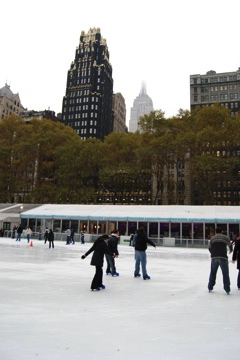
Bryant Park SkatingAround every corner is another surprise: a landmark building, a skating rink, a park, a farmer’s market, a holiday crafts market. The Public Library offers an exhibit of Jack Kerouac’s notebooks and his famous scroll, along with permanent displays of artworks and a real Guttenburg Bible (one of fewer than 200 made). There’s a fresh food market between corridors deep inside Grand Central Terminal. On Vanderbilt, there’s a public display of proposed designs for land development over the west side’s train yard — at least these developers understand the importance of open space park land. Step inside the lobby or study the facades of buildings on Sixth Avenue to see a WPA mural or art deco entrance or mosaic history. It’s impossible to be bored in a city like this.

At night the horse-drawn carriages come out to pick up tourists at Rockefeller Center and whisk them away to Central Park or Times Square or some other destination. The horses blend into traffic, stopping behind taxis at traffic lights, clomping along at their own pace while the cars and buses and trucks whirl around them. Stopped at a traffic light in front of Saint Patrick’s Cathedral, a horse urinates on the city street. The carriage driver looks at the police officer standing nearby and says, “He’s overheating.” Everyone laughs.

The Smell of New York

New York can keep any sensitive nose awake and alive. From the sickly smell of steam rising from the street to the sweet smell of carmel roasted nuts in a vendor’s cart, it’s all there, good and bad. You can smell a Chinese restaurant or pizza parlor long before you reach it — if the breeze is blowing just right.

Walk down an avenue and the smells parade past your nose: flowers in a park, perfume from a shop front, food from a restaurant or vendor car. Things can be less pleasant on side streets, depending on whether it’s garbage day, but with cold weather, pedestrians are usually spared the worst of the smells. But come summer time, pray the sanitation workers don’t strike.

The Feel of New York

The feel of New York depends mostly on the season and weather. This visit is overcast and damp, with some light rain. It’s not windy or cold enough to be really cold — which is good, because I no longer own a winter coat. Instead, it’s what I’d consider typical late autumn.

But come in August during a heat wave and be prepared for the “Three H’s”: hazy, hot, and humid. I’ll take 100°F in Phoenix in June over an 80°/80% humidity day in New York. Or try January, when the temperatures dip below freezing and the wind is howling down the streets or avenues. As you walk leaned into the wind, you feel as if your nose is going to freeze off before you reach your destination.

The air, of course, is filled with a fine dirt that coats you, your clothes, your skin, your car, and anything else exposed to it. Wash your face after a day walking on the streets and you’ll see the grime on your washcloth. Its especially bad when you ride the subway. It isn’t a gritty dust like you’ll find in the desert. It’s real dirt: a mixture of exhaust residue and pollution and plain, old-fashioned filth.

The Taste of New York

I’ve saved the best for last. I told friends I planned to eat my way through New York. So far, we are.

Every kind of food is available here, probably within walking distance of our hotel. On Monday night, we had Spanish food at a tapas bar on 53rd Street between 2nd and 3rd Avenues. Yesterday at lunch, we had Italian food at a restaurant overlooking the main concourse at Grand Central Terminal. Last night, we had Cuban food at a place on 52nd Street between Broadway and 8th Avenue. Today, for lunch, its dim sum in Chinatown followed up with Italian pastries from Little Italy. (I couldn’t resist buying a real New York black and white cookie at Grand Central yesterday; it was heaven.) Tonight, probably Rodizio at a place near my brother’s home in New Jersey.

We haven’t been picky about where we eat. The restaurants are all over the place. You can’t walk two blocks without finding some kind of interesting ethnic food. One glance in the window, to see how many people are inside, is enough to tell us whether it’s good. Last night’s Cuban restaurant, Victor’s Cafe, has been in business in the Theater District since 1963. A bad restaurant wouldn’t last that long in New York.

Or, as I pointed out to my husband, even if it’s bad, it has to be better than what we can get at home.

And sure, there’s the usual collection of chain restaurants: Applebees, Olive Garden, Hard Rock Cafe, McDonalds. But they’re all in the tourist areas — Times Square is full of them — and crowded with the same midwesterners who fill the same places in Arizona. Go figure.

What I’ve Learned

I’ve learned that I still have a love-hate relationship with New York. That it’s a nice place to visit, but I know I could never live there again.

I’ve learned that I could easily make myself go broke just by eating in New York. I’d also gain 10 pounds a week until I exploded. So it’s a good thing I don’t live here.

I’ve also learned that I’d like to come visit New York as a tourist more often. I may eat a lot here, but I also walk a lot. There’s just so much to see and do.

And that has to be good for something.

A Tale of Three Meals — Not!

My software ate my blog entry.

Yesterday morning, I spent about an hour writing a blog post about three very different meals I had while down in the Casa Grande, AZ area for the Copperstate Fly-In. The entry was finished and about to be posted when the software I use to compose my blog entires — ecto — started acting weird. I saved the blog entry — I know I did — and quit the software to clear out memory. When I restarted the software, the blog entry was gone.

I really hate when that happens.

Although the entry included my usual long and rambling stories and descriptions, I can summarize it in three bullet points:

  • Kai, the restaurant at the Wild Horse Pass Resort and Spa, offers possibly the best service I’ve ever received in a restaurant. And the food is good, too. It was an incredible and very memorable dining experience. But the cost? Well, let’s just say we won’t be eating there too often.
  • Mr. K’s Food & Spirits at the Casa Grande Holiday Inn had absolutely terrible service and inedible food. I wouldn’t eat there if I was paid to eat there — primarily because I couldn’t eat what they put in front of me. It’s also difficult to eat without silverware, which is apparently only provided on request.
  • Chili’s, a nationwide chain restaurant, reminded me why people go to chain restaurants: because they know exactly what they’re going to get. No surprises or ruined meals a la Mr. K’s. Although I generally don’t like to eat in chain restaurants — I like to support the independents — it’s good to have some level of confidence when you go to a restaurant, especially when the previous night’s experience was such a disaster.

You’re not likely to read the whole story of our experiences here. It’s difficult for me to rewrite something from scratch. And once I’ve written something, it’s filed away as far as my brain is concerned.

But let’s face it: do you need to read yet another blog post with one of my long and rambling tales?

Maybe you should just consider yourself lucky that ecto sent the post to digital heaven before it got online.

Eating Habits

I think we eat well. Probably too well.

The other day, I had to journey down to Phoenix to meet with a compounding pharmacist about women’s health issues. Sheesh. Now that’s not something that’s normally part of my life.

As I’m aging, my body is changing. (Duh.) My metabolism has slowed down and it’s difficult to keep the pounds and inches off. But that’s only a small part of what I went to see the pharmacist for. The rest was that women’s stuff that starts becoming an issue once a woman gets into her 40s.

VeggiesThe subject of diet and eating habits came up in our conversation. I told her that we eat pretty well — perhaps too well. Our diet consists primarily of fresh food prepared at home. We don’t eat a lot of prepared foods at all. While we haven’t bought into the organic thing yet — mostly because it defeats part of the purpose when those organic foods are shipped 2,000 miles to get to our store — we do eat a lot of fresh vegetables. And since I’m one of those people who won’t eat fresh food after it’s been sitting in the fridge for a few days, we hit the local supermarket once every day or so to get a few things for our next few meals.

Variety is the Spice of Life. Or it Should be.

One of the disappointments we’re constantly struggling with is the lack of diversity in food available here at the edge of nowhere. Fresh fish is simply not an option — it all comes to Wickenburg previously frozen, no matter how “fresh” it looks in the butcher case. Veal is seldom available and, when it is, we can expect to pay $14.99/pound or more for it. Special cuts of meat — for example, veal shank (for osso bucco) or ground lamb (for one of Mike’s Armenian dishes) — must be ordered at least a few days before you want to eat it. Italian greens like the ones I grew up with — including escarole, chicory, and broccoli rabe — simply don’t make it to Wickenburg. I remember the first time I bought an eggplant in Wickenburg — the first time I’d ever seen one in the store. I had to tell the girl at the checkout counter what it was. She’d never seen one before. The supermarket recently stopped carrying the frozen edamame (soy bean pods) because they simply weren’t selling enough. Alex the Bird is very disappointed, since that’s one of his favorite foods.

What really kills me, however, is that they have these Safeway magazines in the store, filled with recipes. Lots of mouth-watering photos to really motivate me to cook. Yet in half the recipes on the magazine’s pages, there’s at least one ingredient that can’t be found in our local Safeway store.

Yet you can buy all kinds of beer in 12-packs and the “snack” aisle is completely full of every kind of chip you can imagine.

So although we eat well in general, our diet lacks the diversity we’ve had in the past.

And don’t talk to me about local restaurants. I’ll whine about that again in another post one day soon.

Why I’m Overweight

Of course, my problem keeping the pounds off is threefold:

  • As my metabolism has decreased, my food portions have not. Simply stated: I eat too much. This is unfortunate because I really do like to eat.
  • Since I spend the majority of my day sitting on my butt (currently working on two book revisions) and I don’t participate in outdoor activities this time of year — would you, with temperatures exceeding 100°F every day? — I don’t get enough physical activity (AKA, exercise) to get my metabolism back up, even a little.
  • The whole mid-life hormonal thing is further throwing my body out of whack, thus making it impossible to get a grip on what I need to do to fight back and start losing some of this weight.

Don’t Talk to Me about Dieting

Now I don’t want to hear the word diet as applied to that kind of activity where you starve yourself of one or more kinds of food (or all kinds of food) to drop pounds. I don’t weigh or measure my portions. I don’t count calories.

Recent studies have shown that dieting is not successful in the long term. You lose weight, you gain it back. It becomes a roller coaster lifestyle, with multiple sets of clothes so you don’t need to shop when your weight is back up or down.

I can vouch for this. Sure, I lost 20 pounds in 3 months on Atkins back in 2004. But since then, I’ve gained back 30 pounds. And let’s face it: not all diets are pleasant or healthy. What I need is to get my hormones stabilized and to change my lifestyle to eat less and exercise more.

The Silver Lining: Dining in Phoenix

One of the good things about going down to Phoenix for errands — like seeing this compounding pharmacist the other day — is the opportunity to eat out and enjoy something different. (Yes, it always comes back to food with me.) The other day, after finishing up my business, I drove through a dust storm to meet Mike down at the Biltmore Fashion Center. After a quick visit to the Apple Store to finally see an iPhone first hand (I wasn’t terribly impressed and I’m sorry about that) and a stop in the Williams Sonoma shop for a new martini shaker, we headed over to Tarbell’s on 32nd Avenue and Camelback.

Tarbell’s is a great little restaurant that specializes in fresh, local (whenever possible), organic foods. (They also have a great bar; when you ask for a Grey Goose martini, that’s what you’re going to get.) Mike and I shared a tuna tartar appetizer, which we’d had there before. The tiny bits of tuna were arranged on the plate with taro chips and ginger cucumber relish. Yum. For my main course, I hadpan-Seared Sea Scallops with organic butternut squash risotto, crispy sage, and roasted chestnuts. Mike had pan-Seared Alaskan Halibut and organic peach, spinach, and pancetta hash with smoked tomato sauce. These tastes were well matched and quite a treat from what’s available at home and in Wickenburg’s restaurants. For desert, we shared a warm, soft chocolate cake with pistachio ice cream. Very rich.

We finished dinner just before 6 PM — which is when the organic bakery in the same shopping center closes. We popped in and bought a loaf of fresh multigrain bread. One look at the ingredients told me we’d made a good purchase decision — I actually knew (and could pronounce) every ingredient! Imagine that! (I only wish I could remember the name of the place. But if you go to Tarbell’s you’ll see it in the same shopping center.) Oh, and did I mention that it was delicious?

Now don’t get the idea that I’m all hot for organic foods. I’m not. But I do like to know what I’m eating. And I also think that Americans buy too much food that’s shipped from somewhere far away when local alternatives are better for so many reasons. That’s one of the reasons I prefer shopping at small specialized stores — like bakeries and produce shops — than in huge name-brand supermarkets that truck in their food from who knows where.

Where Do You Eat?

Any suggestions for good restaurants with interesting food down in the Phoenix area? Don’t keep them to yourself. Use the Comments link or form to share them. I’m especially interested in learning about places on the west side of Phoenix, since that’s closer to home.