No Uncertain Terms

A slow but enjoyable read.

In No Uncertain TermsI’m currently wading through William Safire’s book, No Uncertain Terms: More Writing from the Popular On Language Column in The New York Times Magazine. The odd thing is, I’ve been reading it for over a month.

William Safire writes the “On Language” column in the New York Times Magazine. That’s the magazine that comes with Sunday’s New York Times. When we lived in New York and New Jersey, we were occasional subscribers and I’d read the column whenever I got my hands on the magazine.

“On Language” points out recent word or phrase usage in the press, usually quotes by politicians and other oft-quoted people. (I had to look up oft-quoted just to make sure it was a correct usage; it wouldn’t do to make a mistake in usage in this particular entry.) Mr. Safire basically tears the victim word or phrase apart, discussing its development throughout the years and pointing out first recorded usages for each meaning that applies. It’s like reading an entry of the Oxford English Dictionary, but it’s full of puns and things to make you smile — if you catch them. And, of course, it points out whether the word was correctly or incorrectly used and why.

I’ve been reading the book at bedtime and I must admit that I can’t read more than four or five pages before my eyelids grow heavy and I have to put the book down. This isn’t because it’s boring. I think it’s because it’s forcing me to read slowly and carefully and think about almost every word.

This isn’t an exercise I’m accustomed to. When I read novels, I breeze through them so quickly that I just don’t get my money’s worth when I buy the darn things. But this book, which was a “bargain book” on BN.com (and was part of my Christmas list so I didn’t actually pay for it anyway) is definitely worth the money. It’s helped keep me entertained and enlighted — and made it easier to fall asleep — for the past month! That certainly says something.

It’s also taught me a lot about words that I use and other words that I’ll probably never use. It’s made me realize that the English language is even richer than I thought. And although I’m a writer — a real one who actually writes for a living — my knowledge of vocabulary is not nearly what I think it should be.

Perhaps that’s why I often pause while writing these entries, trying to find the right word to say what I mean. (And in most cases failing.)

But then again, it’s hard to build a strong vocabulary when you spend most of your time writing sentences like: “The Save dialog appears. Enter a name for the file in the Name box and click Save.”

Sheesh. I think that sentence appears in every single book I’ve written.

Anyway, I think this book is helping me to build my vocabulary and understanding of word usage. If you’re a word lover, I think you might like it, too.

Merry Christmas or Happy Holidays?

Another example of the religious right taking offense at nothing.

I was born and raised Catholic. I don’t practice it these days, but I still consider myself “Christian.” The winter solstice holiday I celebrate is Christmas.

Almost every year, I send out Christmas cards. Well, to be fair, they’re not all Christmas cards. Some of them are holiday cards. Because not all of my friends celebrate Christmas. Some of them are Jewish and celebrate Chanukah. And I’ll admit that I’m not even sure what some of them celebrate because I don’t go around asking my friends about their religion.

I have a collection of Merry Christmas and Happy Holidays cards. I send them out primarily based on the picture on the card or the sentiment inside the card. I don’t, however, send a Merry Christmas card to someone who I know is Jewish. Or someone who might be Jewish. I do this out of respect for their religious beliefs. After all, why should I wish them a Merry Christmas — a holiday celebrating the birth of Jesus Christ, who isn’t anyone terribly special to them — when I could wish them a Happy Holidays?

I guess what I’m trying to say here is that the wish I’d like to share is for a happy and healthy holiday season. Isn’t that what we all wish everyone this time of year?

Now I’m definitely not a supporter of George Bush Jr. In fact, I don’t like him at all. But I think he’s taking a lot of undeserved grief with the White House Christmas card debate. I think the card is fine — a Happy Holidays wish covers everyone, without offending anyone. Christmas is a Christian holiday. Not everyone who received the card is Christian. Why should it wish everyone a Merry Christmas? And what the hell is wrong with a Happy Holidays wish?

Come on guys. Is it really that important? Don’t you think homelessness, unemployment, and hunger within this country are more important than the words that appear on a White House Christmas (or Holiday) card? Yet I don’t hear any of the religious right whining about any of that.

And, for the record, it is a Christmas tree. Sheesh. What other holiday puts a pine tree (or a fake pine tree) in people’s living rooms every December?

The Chickies are Here!

A day late, but twice as many as I expected.

If you know anything about me, you know that I live in a rather rural area and have been keeping a small flock of chickens for the past six or seven years. My first flock was the best: eight hens who were tame and friendly because I’d raised them from chicks. Coyotes got three of them in a day (which is why I have a coyote tail hanging from the rearview mirror in my S2000), and, as a result, I had to keep them cooped up all day long, first in their relatively small chicken coop and later in a fenced in chicken yard my friend John built for me alongside the coop. The remaining five chickens produced, on average, four eggs a day. We’re not really big egg eaters, so we wound up giving away fresh eggs to just about anyone who showed up at our door — the farrier, the FedEx man, and the APS meter reader — as well as friends and neighbors.

Time passed. I got more chickens and coyotes and neighborhood dogs took some chickens away. We got a rooster from my friend Janet. I hatched one chick on my own, then bought two more to keep it company. One my my hens hatched her own brood of chicks, all of which were killed by the rest of the flock. Later on, I started replacing chickens with older birds that were less likely to be killed by the flock. Neighborhood dogs dug their way into the yard and killed all my chickens but one; we later electrified the outside of the yard fence to keep them out.

As I write this, I have two hens and a rooster that I got from my hairdresser, Sue. She was moving and looking for a home for her flock. When I got the hens from her, one of them was laying. But now neither of them do. We say they’re lazy chickens. And I’ve already decided that they’ll soon go to a new home in Wenden, where my Mexican friend Celia will turn them into enchiladas. She says fresh chicken is a lot better than store-bought. I don’t doubt her, but I’m not about to wring their necks, pluck them, and gut them to find out for sure.

When I decided to replace my little flock, I decided to start from scratch again — no pun intended — with a fresh batch of chicks. I ordered from Ideal Poultry in Texas. They’re one of the few hatcheries that will ship small orders (less than 25 chicks) and will vaccinate for Marek’s disease (which killed a few of my chickens a few years back). I ordered Ameraucanas (Araucanas), which are also known as the “Easter Egg Chicken.” Why? Because they lay colored eggs: brown, green, and sometimes even blue.

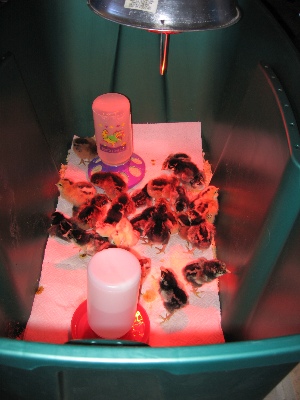
I’d had Ameraucanas before and I loved the green eggs. One of my hens laid a beautiful sage green colored egg that was almost the same color I’d painted my kitchen. The colored eggs are a novelty, but what’s nice is that this breed is a pretty good producer. All of my chickens laid regularly until their untimely deaths.I ordered 10 hens and 2 males from Ideal Poultry. I got an e-mail message a few days later, saying my chicks would be shipped out on December 7. Ideal ships via Priority Mail and I knew from experience that I could expect a call from the local post office on Friday morning, around 6 AM, telling me that my chicks had arrived. I prepared a large plastic storage container with pine shavings and paper towel sheets on the bottom. Bought new a new chick waterer and chick feeder, and bought the smallest bag of chick starter I could: 25 lbs. I also set up the heat lamp over my makeshift brooder. All I’d have to do when the call came was to plug in the heat lamp, fill the waterer and feeder, and bring the chicks home.

But the call never came on Friday. I went to the post office to try to track down the chicks, but without a tracking number, it was impossible. I was told to wait for the 11 AM express mail truck. It arrived at 1 PM. No chicks aboard.

Meanwhile, I’d called the hatchery and left numerous messages and e-mail messages. Chicks can survive without problems for up to 48 hours after hatching without food or water. After that, nothing’s guaranteed. All I could think of was a box arriving at Wickenburg Post Office the next day with a dozen dead chicks in it.

But there was nothing I could do. I had to be in Tempe that evening for Mike’s company Christmas party. The plan was to spend the night at the Embassy Suites on South Rural. I was hoping to do some Christmas shopping while I was down there — I needed a Lowe’s gift certificate for my brother and his wife — but I was already out of time. So I hopped in my Honda and zipped down to Tempe.

The hatchery called my cell phone just after I checked in at the hotel. The guy who called was probably the owner and he had a thick Texan drawl. He told me that the shipment had probably been delayed on Wednesday because of an ice storm in Dallas. (I guess I missed that on the news.) A lot of flights were cancelled. But the chicks, which had been hatched after noon on Wednesday, definitely went out. They should arrive by Saturday morning. The hatchery would replace them if they died enroute.

Not much I could do in Tempe, so I tried not to think about them.

We went to bed around midnight, which is almost like staying up all night for me.

Mike had a bad night. Neither of us drank very much at the party, but something he ate didn’t agree with him and he was up half the night. I woke at 7:30 AM and left him to sleep for a while. We had a suite, so I surfed the channels on the television in the other room while drinking coffee I brewed in the tiny pot in our kitchenette. I wanted to go home and get the chicks settled in — if they were still alive — but I was worried about Mike.

We finally checked out at about 9:30 AM. We each had our own car, so we went our separate ways. I got in to Wickenburg at about 10:45 AM and went right to the post office. I heard my new little babies peeping as soon as I got in the door.

The post office folks had been kind enough to cut down a plastic cup, put some water in it, and give it to the chickies. So I think some of them got something to drink. At this point, they were nearly 72 hours old and very vocal. I thanked the post office folks, put the box of chicks in the car, and drove home.

Ideal Poultry ships chicks in a small cardboard box with plenty of air holes. The box is held closed by a plastic strap, making it easy to open up the sides and peek in. The box is small on purpose; it forces the chicks close together so they keep each other warm. And it probably prevents them from falling over all the time. Normally, Ideal puts a rolled up straw thing in one side of the box, since I always place small orders. This time, it decided to fill the empty space with extra chicks. So when I started pulling them out, I didn’t stop until I had more than 20 of them in their new home.

There were two dead chicks on the bottom of the box; they’d obviously died early in transit because they were very small and their brethren had stomped them into the hay. Normally, I’d feel pretty sad about this, but with so many live chicks to occupy my mind, it didn’t bother me as much as it should have.

Most of the chicks were very active. I went through my ritual: taking each one and dipping its beak into the water to teach it how to drink. It sounds silly, but they really don’t know how to drink until you show them. And that’s kind of what gets them started on their unaided lives. Kind of like slapping a newborn baby on its butt to get it to breathe.

I haven’t gotten an exact count yet, but I think I have 28 chicks. The hatchery may have thought it was doing me a favor by shipping so many extras for free, but I have a definite space problem. The plastic bin I bought to house them for their first 3 to 4 weeks won’t last more than a week now. I’m already scrambling for a large box to move them into. Maybe they thought I had a nice, warm Arizona yard to keep them in. In reality, they’ll live in my garage for at least two months. That’s when they’ll have enough feathers and down to handle the cold winter nights.

They are cute. No doubt about it. Most of them already have feathers growing on the ends of their tiny wings. They’re babies, so they’ll walk around and eat and drink and jump over each other and then suddenly get tired and fall asleep. They’re fun to watch. And when they’re all awake, they make a ton of noise.

As for my current adult flock: their days are numbered. I’ll see Celia again right before Christmas. Although I already gave her her Christmas present, she might be taking three bonus birds home with her that day. Enchiladas? Tamales? Or just roast chicken? If those girls don’t start laying eggs soon, they’ll be the main course on Celia’s table one day soon.

A Ride in the Desert

We spend three hours on horseback, enjoying perfect weather.

Mike and I have two quarter horses. Jake, a retired ranch horse, is now about 24 years old and is starting to show his age. He’s sorrel (that’s brown) with some white on his feet. He’s also swayback — that means that the place you put his saddle is way lower than it should be on a normal horse —  and has very high withers. Mike bought a special saddle pad for him and then had his saddle custom made to fit the horse. I got Jake for a good price and I think I know why. He’s an alpha male and likes to boss around the other horses he lives with. He’ll bite them and chase them and generally annoy them. That must have really been a nuisance for his previous owners, so they sold him off. But he’s an excellent horse, serious about work, and can be ridden by almost anyone at all. As far as I’m concerned, he was a bargain.

Cherokee, is another story. Cherokee’s main problem is that he’s beautiful. He’s a paint horse, brown and white, and his face is just so pretty, with big gentle eyes and a forelock that’s just the right length. He was 11 when I bought him six or so years ago, and he’d already had at least three previous owners. They evidently spoiled the hell out of him because when I got him, he was lazy, poorly trained, and extremely spooky. That horse taught me more about staying in the saddle during a Cherokee-style rodeo than any other horse I’ve ridden (or fallen off of). To add insult to injury, he cost more than I should have paid. But like his previous owners, I was suckered in by his good looks.

Jake and Cherokee have completely opposite personalities. Jake was always very standoffish — he didn’t really want anything to do with people on his time off. His definition of time off was any time there wasn’t a lead rope or saddle on him. Cherokee is incredibly friendly and curious and loves to be petted. When Jake is ready for work, he works. He’ll do anything you tell him to. When Cherokee is saddled up and ready for work, he’ll do everything he can to get out of doing it. While they both like to be fed treats, Cherokee will actually beg for them. At least that’s what it looks like to me. And if you’ve been reading these blogs for a while, you’ve probably seen the photo of him eating dropped bird food out of the bottom of Alex’s cage.

Cherokee is a big eater and it shows. He’s fat. Jake’s thin. Now if you recall what I said about Jake being the alpha male and consider that they both share the same space, you might wonder how it is that Jake can’t scare Cherokee away from the food. It isn’t like he doesn’t try. He puts his ears back (a horse’s way of saying “f*ck off”) and chases Cherokee. He even bites Cherokee once in a while, putting three or four rows of parallel teeth marks on that beautiful coat. But Cherokee is accustomed to his place at the bottom of the pecking order and is very stubborn. He also eats very fast. So as Jake ages and seems to get thinner and thinner, we’ve taken to separating them at dinner time and overnight, giving Jake more food than he can eat and plenty of time to eat it. Cherokee, of course, doesn’t like this, and after he gobbles up his food, spends the rest of the night pacing around outside the gate to Jake’s enclosure. Over the years, they’ve both changed a bit. Jake is now more friendly. Although his previous owners probably hit him in the face (he was very hand shy when we first got him), he now lets us pet him, even around his head. Cherokee has calmed down and isn’t afraid of rabbits anymore, so I haven’t had any rodeo practice lately. He’s also been trained to walk when I tell him to — without the use of a riding crop! — and to let me position him so I can open and close gates while on horseback. And a few years back, they both posed for a Christmas photo, wearing antlers on their heads.

Photo
Christmas Horses

Anyway, yesterday Mike and I went for a long horseback ride out in the desert. The horses seemed very pleased about going. Of course, when we got to the top of the hill, Cherokee thought we were going to Uncle Pete’s house. That’s where they stay while we’re away and I think he spoils them. When he realized we were turning left instead of right, heading down the trail instead of down the road, he did some Cherokee dancing. In the end, he just followed Jake, like I knew he would.

We live on the edge of town, about two lots from state land. So we normally saddle up and ride out from our house. We have two choices for a ride in the desert: turn down Cemetery Wash, which runs through our property, and take that or any of the trails that go into it or ride up the easement road from our house just past our neighbor’s house on 328th Avenue to a trail that goes right into the state land. We usually follow the second route, since there are far more trails closer to our house when we go that way. That’s also the same trails that the wranglers at Rancho de los Caballeros use for rides, so most of the trails are well worn in — perhaps too worn in in some cases — and easy to follow.

Jack the Dog came with us, of course. Jack likes to go horseback riding. He doesn’t ride a horse. He just runs along on the trail in front of us, chasing rabbits and birds. We realized that he liked horseback riding more than us when we sent two of our friends out for a ride on our horses and he went with them instead of coming back up to the house with us.

We went through the gate in the fence that separates state land from private property. The fence is there more to keep cattle out of people’s back yards than to prevent people from coming in or out of the state land. It also helps keep quads off the horse trails, although it doesn’t help enough. Every once in a while, a couple of quads will get in there and tear up the narrow trails with their wide wheels. There are so many places the quad riders can ride in town — hell, the hills are just criss-crossed with old mining roads and surrounded by sandy washes. Why do they insist on ruining the horse trails and going through people’s private property?We took the “golf course trail” west along the edge of the state land to Los Cab’s golf course, then we turned south to go around Los Cab’s property. We passed through another gate and followed a trail we’d followed a hundred times toward the west again. Spotting a new trail, we took that toward the east, climbing a small ridge that offered nice views of Los Cab. Then back down onto familiar trails, heading west again.

We spent three hours mixing old trails that we knew well with new trails. More than once, we were on trails I’d never been on before. And we wound up going a lot further southwest than we thought we were. I won’t say we were lost — that’s too strong a word — but at one point we were definitely not where we thought we were.

The ride was wonderful. Cherokee had settled down into a good pace and wasn’t the least bit jumpy. Jack chased rabbits and even a few deer. The temperature was perfect: warm enough that a long-sleeved shirt was fine without a jacket. There was some wind on the hills, but the air was quite still near the ground. We found one trail that took us high up onto a mountain, with incredible views of the town far below us, to the northeast. And we didn’t pass another soul.

It was the first time I’d been out for a good, long ride in a while. I’ve been so busy lately with work on my books, building up the helicopter business, and doing flights that I just haven’t had time to ride. And I seem too good at making excuses: it’s too hot, too cold, too windy, too early, too late. Sheesh. I’m an excuse machine when it comes to riding. I think that the truth of the matter is that I’m just too lazy to saddle up. But the reality is that it really isn’t that much work and it’s worth every minute once you get out into the desert on a nice trail.

I’d like to find a riding partner here in town who’d be willing to ride one day a week for about 2 hours. Sometime around noon or early afternoon. But it seems that few of the new people coming into town have horses and many of the ones who do prefer riding with big groups, so they can show off their riding clothes, saddles, and horse’s grooming. I like to ride in small groups, with people who don’t fuss about the terrain being too steep or rocky, with people who know how to control their horses, with people who have enough sense to wear the right clothes and bring enough water for the ride.

Anyway, there are two things about yesterday’s ride that I regret: 1) I didn’t bring my camera. How stupid is that? There were lots of photo ops and I think this entry would have been a lot more interesting with photos. 2) I didn’t bring my GPS. A few years back, I’d started a trail mapping project. Now I’m determined to finish it. And with 3 hours worth of riding yesterday, I could have mapped a lot of trails.

Anyone out there want to go riding on Wednesday afternoons? Get in touch. Experienced riders only, please. And don’t worry; I have a spare horse if you need one.

House Guests: Feast or Famine

On how it seems to be everyone or no one when it comes to guests.

Mike and I moved to Arizona about eight years ago now and moved into our current house about nine months later. Both of our families still live back east — in New York, New Jersey, and Florida (where old New Yorkers go). None of them could understand why we’d made the move out west. We told them about the improved quality of life and the reduced cost of living. We told them about having horses and chickens, about seeing billions of stars in clear skies almost every night, about warm weather in the winter time. But it wasn’t until they started coming out here to visit that they began to understand.

They’d come alone or in pairs at first. Mike and I worked out of the house so two of our three bedrooms were home offices. Mike’s was the easiest to convert to a spare bedroom, with a futon that flattened out to a queen sized bed. My office was too full of computer equipment and related junk to make a good guest room. (Sometimes I even had trouble with it as an office.) People would come and stay a few days. Occasionally, they’d stay longer. Mike’s mom stayed 10 days once.

We had a flood of house guests one Christmas. Mike’s entire family came: mother, brother, sister, niece. No one wanted to share the part-time guest room with Mike’s mom, so we wound up sticking people all over the house and elsewhere. Mike’s niece on the queen-sized sofa bed in the upstairs den. Mike’s brother on the living room sofa. Mike’s sister — well, she wanted her own room, so we stuck her in the Log Wagon Inn. She wasn’t very happy with that, either, but frankly I’m not sure if anything would have made her happy.

When we moved the offices out of the house, we fixed up the two bedrooms. One of them became a full-time guest room, with a full-sized bed, dresser, night table, chair, and tiny bookshelf. We even cleared out most of the closet so guests could hang their clothes. The other room became a library, with bookshelves, Mike’s old desk, and that futon. It didn’t take much to turn that into a guest room when we needed it.

Oddly enough, we had very few visitors for a long time. (I think we were all still trying to recover from Mike’s family’s visit.) Mike’s cousin Ricky, who, like us, discovered the benefits of going west, lives in Seattle and visited regularly almost every year. He goes to the Gem and Mineral show in Tucson every winter and we can usually convince him to come with us to Quartzsite for a few days. We also had a friend from back east stop in for a few days. He was the perfect house guest because we hardly ever saw him. He’d get up, join us for coffee in the morning, then take his rental car out for the day. He’d return after dinner, spend some time chatting with us, and hit the sack. No need for us to miss work, plan day trips, and fret over meals.

My dad came for a visit with his wife, too. They actually came twice in the same year. The first time, I think they had some plane tickets they had to use up and decided to use them to see us. My dad hardly ever flies — he prefers to drive everywhere — but even he wasn’t prepared to drive from Florida. They spent a few days with us, then moved on to Las Vegas to spend a few days with distant members of her family. The second time, they went to Las Vegas, then came back to spend a few days with us.

Family PhotoThis year, the flood returned. My brother and his wife had been wanting to visit for a long time. I suggested that they come for Thanksgiving. Somehow the idea came up that it would be nice to have the whole family out, including my sister, mother, and stepfather. My mother and stepfather live in Florida (not near my father; that would be too weird) and don’t get up north to see my sister and brother in New Jersey very often. I made a bet with my brother that if I invited my mother, she wouldn’t come. I lost the bet. And my sister came, too. So for five days, I had all five of them in the house. It was the first time we made full use of both guest rooms. My sister was a good sport and slept on the living room sofa.

Julia & MildredThe flood continued, two days after the last of that group departed, Mike’s mom and her friend arrived. That was yesterday and they’re staying for a week. They’re both in their eighties and they move slowly. Very slowly. They have trouble with the four steps that lead down to the two guest rooms. Coming upstairs to admire the view from our den and our new bedroom furniture was like taking them on a trip to the top of K2. Well, maybe not that bad.

So here it is, December 3, and we’ve had almost nonstop house guests since November 20. It’s difficult for me. I’m basically a loner and need a certain amount of time to myself. I normally get that in the morning. I wake up around 4:30 AM, go downstairs, make coffee, and make Alex the Bird his breakfast. I have until 5:45, when Mike comes down, to write blog entries, organize my day, and put things into perspective. But with house guests, when I wake up and go down, Alex’s whistles and chattering wakes up the house guests. In no time at all, they’re wandering into the kitchen, complaining about how early we wake up (and go to sleep), and needing coffee, food, entertainment. And asking questions.

It’s the questions that are the toughest for me. It seems like a nonstop barrage of questions. Questions about Alex, questions about what they see outside the window, questions about little noises the house makes. Questions about breakfast, plans for the day, the temperature outside. Questions about Alex and Jack and the horses and the chickens. Questions about the neighbor’s dogs and horses and kids. Questions about things around the house that aren’t common in houses back east, like the garbage disposal and compactor. Questions about what I’m doing and what they can do to help.

It’s this last question that really kills me. I work efficiently, accustomed to doing things on my own, with no one in my way. Suddenly there are offers to help me. But to get the help they’re offering, I have to help them. For example, imagine this exchange:

“Do you want me to set the table for dinner?”

“Sure. Thanks.”

“Okay, where are the plates?”

I stop what I’m doing to open the cabinet.

A moment later: “And the silverware is in this drawer?” They open the wrong drawer.

“Next to that drawer.”

They open another wrong drawer.

I come over and open the right drawer.

“Oh. Which knives should I use?”

“I don’t care. Either one.”

A running narrative follows, concerning the pros and cons of steak knives over table knives, which are commonly known as butter knives in my family. I have to pay attention and make appropriate comments. I then have to verbally confirm that the table setter has made the correct choice, even though I just said I didn’t care which knives were selected.

“Do you have napkins?”

“The drawer under the silverware.”

“These are cloth napkins. Don’t you have paper?”

“Cloth is fine. We always use cloth.”

“But we don’t need cloth napkins. Don’t you have paper napkins?”

“Don’t you like cloth napkins?”

“Yeah, but we don’t use them at home.”

“Well we do. Use the cloth napkins.”

They put out the cloth napkins, commenting on how paper napkins are good enough for them and that it’s a lot of work to wash all those napkins. Then: “How about glasses? Where are they?”

“In the cabinet with the plates.”

“Oh, yeah.” They open the cabinet again. “Which ones should I use?”

“The big ones.”

“You mean the tall ones?””Yes, that’s fine.”

“There’s only six of them. There are seven of us. Are there any in the dishwasher?”

“I don’t know.”

“Well, if there is, I can wash one. Then we’ll have enough.”

“You can use the short ones. There should be enough.”

“Well, it’s no bother to wash a glass if you have one in the dishwasher. Should I look?”

“Yeah. Go ahead.”

They attempt to open the dishwasher, but it’s latched. “I can’t get this open. How do you open it?”

Get the idea? Obviously, I’d rather not have help that requires so much help to get. And frankly, it bugs me that there needs to be so much conversation over what I think are trivial things. The cloth napkins are a perfect example. Almost every single house guest this year has made a big deal over my napkins. They aren’t anything special. They’re restaurant style cloth napkins that I throw into the laundry with the rest of my dirty wash and fold when they come out of the dryer. I don’t iron them, I don’t starch them. It takes only a few moments extra to deal with them and they’re so much nicer than paper. Why wouldn’t I use cloth napkins if I like them? Why make a big deal about them? Why ask so many questions?

I guess my stress level is beginning to show.

Anyway, Mike and I rate guests on their maintenance level. The less maintenance a guest requires, the more pleasant the guest is to have in the house. So far this year, my mother and stepfather have rated highest. We just stuck them in the guest room, showed them where the towels were, and let them do their thing. They made their own breakfast, went on their own day trips, and even set the table without asking questions. They got a high rating. My sister also rated pretty high, although she didn’t do much in the way of entertaining herself. My brother and his wife were down a bit on the scale. Too many questions! And I don’t think they would have done anything without someone taking the lead. And Mike’s mom and her friend will definitely rate very low. Mike’s mom has already asked more questions in three hours of waking time than my whole family combined. And we really can’t expect them to entertain themselves when they have so much trouble just walking around.

Ah, I hear my house guests stirring down below. Time to put up the decaf coffee and debate what’s for breakfast.