Snowbirding 2021: The Drive South

A longer than usual drive made tolerable by recorded books.

As usual, I went south for the winter this year. And as of this week, I’ve already been away from home for a full month. I thought I’d write a few blog posts to catch you up on this year’s trip, starting with the drive south.

My Departure: Early on the Calendar, Late on the Clock

I left earlier than usual this year: Sunday, November 15. Earlier in the month, I’d made the decision to go — I’d been on the fence about it for months — and as the days got ever shorter I found myself eager to go. We’d already had some snow at home and I dreaded the thought of dealing with more on my trip. I was driving with my truck, truck camper, and 12-foot cargo trailer outfitted as a jewelry studio and had no desire to deal with slippery road conditions along the way.

The goal was to get deep into Oregon on that first day, but I had too much last-minute packing to do. By the time my rigs were packed, the camper was on the truck, and the trailer was hooked up, it was after 2 PM. Since I prefer not to drive in the dark these days, I knew I wouldn’t get far. I considered waiting until the next morning to depart, but my house-sitter was already installed and did not relish sleeping on the sofa while he slept in my bed. So I loaded up my pups, turned on the heated seat, and headed out.

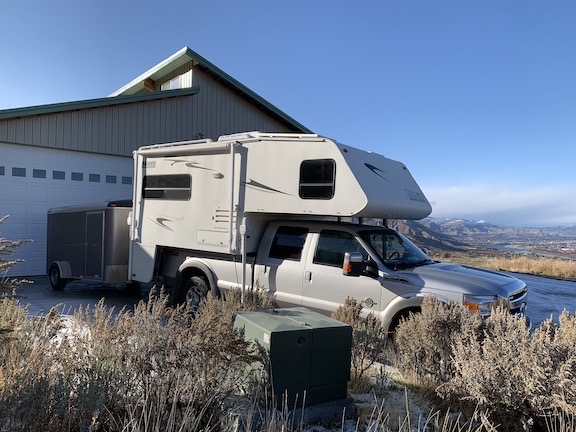
Truck at Home
I snapped this photo before leaving on Sunday afternoon. My house sitter was watching from the deck, which is hidden from view in this shot.

I needed 4WD to get out of my driveway. There was just enough ice at the top of the little hill there to almost send me sliding backwards.

Although I’d skipped lunch and was really hungry, I didn’t stop until we reached my first overnight spot: Marysville State Park on the Columbia River at Route 97. Regular readers of my blog know that this is one of my preferred stops for winter driving with the camper. It’s cheap, there are pull-through spots, and the power is turned on (although not the water) at campsites. It was full dark when I arrived after 6 PM and I nearly missed the turn. I pulled in and slipped into a nice spot along the river. After a quick dinner of reheated leftovers, I took the girls for a walk through the fallen leaves to get a registration envelope. I’d pay on the way out.

You might be wondering why I was taking a route that would bring me through central Oregon rather that the much fast route through Idaho and down through Nevada. Two things. First, I had hopes of visiting a friend in the Sacramento area who is moving to Texas in the spring. Second, I wanted to visit a business where I was considering trying to get a job — remote, of course — in south central California. Route 97, which I’d taken many time when I worked in Central California in the spring, was not only a good direct route to both places, but it avoided the high elevation areas where it would be super cold and possibly snowy. I’ve had to stop for fuel in Jackpot, NV when it was -19°F and it wasn’t fun. Neither is dealing with frozen pipes in a camper.

Day 2: Oregon into California

We left just after dawn on Monday morning. I made one stop on the way out to pay the overnight fee and to use the central “winter water” spigot to top off my fresh water tanks.

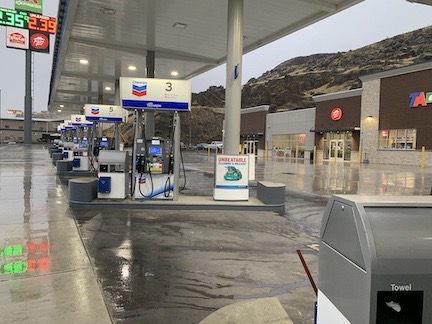
Brand New Truckstop
This gas station looked brand new but wasn’t very busy at 7:30 AM.

Across the river, in Biggs Junction, I fueled up at what I think was a brand new fuel station. Fuel was much cheaper there than in Washington. I grabbed a McDonald’s breakfast at that truck stop town and got back on Route 97 south.

It rained.

There was fog.

The road was mostly empty, as it usually is, getting busy only by big towns like Redmond and Bend. I made a stop in a shopping center parking lot with some grassy islands and took my pups for a quick walk. Then back on the road.

The drive would have been boring if I wasn’t listening to an audiobook. I was working my way though Stephen King’s Dark Tower series, which I had been getting as audio books from the library. There’s nothing that makes a drive go faster than having something good to listen to. These books took a turn for the weird — even by King’s standards — in volume 5 or 6 but I did listen to them all by the time I got into Arizona.

I stopped for fuel just north of Klamath Falls. My pups walked a bit on a leash but didn’t do any business. I got back on the road. I figured I’d stop at a rest area I knew farther up where I could let them run off-leash. But when I asked about it at the agricultural inspection stop at the California border, they told me that rest area was closed. (And, fortunately, they didn’t take the 40-pounds of Honeycrisp apples I’d bought in Wenatchee to eat and give as gifts to friends.)

I passed a closed Forest Service Ranger Station with a big empty parking lot bordering on empty land and made a U-turn to go back to it. I let the girls have a run and do their business. I cut up one of those apples for a snack. We got back into the truck and continued on our way.

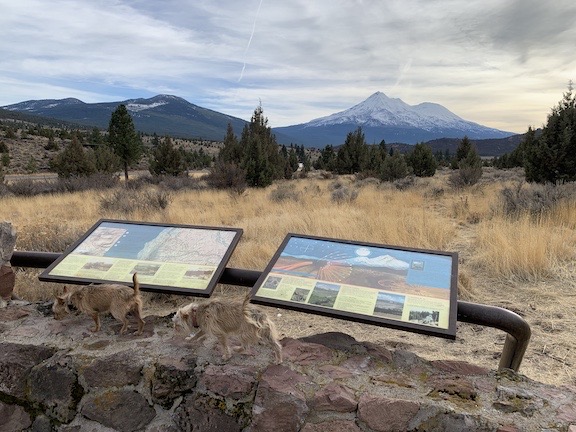
We eventually drove through Weed, CA and got onto the I-5 freeway. We’d been getting great views of Mt. Shasta for miles and miles and remembered a view area along the way. I found one — probably not the one I was thinking of, though — and pulled off, despite the NO RVS sign. It was empty. I parked where I could easily turn around and got out with the girls. On the way to the interpretive sign, I found traces of party gear: hypodermic needles, empty beer cans, and broken liquor bottles. We didn’t stay long.

Mt Shasta
My girls had plenty to sniff when we stopped at the lookout area for Mt. Shasta.

It was around 4 PM in the Redding, CA area that I decided I’d better find a place to stay. I’d covered more miles than I expected to, but not nearly as many as I needed to reach the possible overnight destination near Woodland I’d been thinking of. I saw a sign for a casino and got off the freeway. Casinos often allow free overnight RV parking and they have the added bonus of good security.

This casino had overnight parking, but it wasn’t free. Part of their lot had been set up with drive-through RV spaces, each equipped with water, power, and sewer hookups. The fee was $30 — not much more than I’d paid the night before for power only. There was an exercise trail, a golf cart shuttle to the casino (which had a restaurant), and good security I decided to stay.

I had to go into the casino to register and pay. That was an odd experience. Inside the door, I had to stop and stand at a sort of test station. An automatic system took my temperature while I pulled off my mask and got my picture taken. Inside, the place was packed and rules said you didn’t have to wear a mask if you were sitting down. All the slots were filled with unmasked people, half of whom were smoking. I made a bee-line to the registration desk and paid up, eager to be out of there. Even my idea of getting a meal to go from the restaurant evaporated. I wanted out.

That evening, after walking the dogs, I heard some guy walking around the parking area loudly calling out a woman’s name. When it didn’t stop after 20 minutes, I called the casino front desk and told them what was going on and that I was a little freaked out. (Honestly, I wasn’t frightened but it was annoying.) In less than 5 minutes, security arrived and the shouting guy was gone.

I took advantage of the hookups to use my microwave, wash all accumulated dishes, take a shower, and then dump both tanks before departing in the morning. My pups and I also took advantage of a nice trail that wound through the woods around the property, including down by a stream that feeds the Sacramento River.

Then it was back on the road.

Day 3: California All Day

By this time, my Sacramento friend had cancelled. She was feeling under the weather and at high risk for COVID. Although I’d suggested we get food to go somewhere and eat outdoors, she just wasn’t feeling up to it. That was fine. I had a lot of miles to cover anyway.

I’d originally considered stopping at an Apple store to buy a new iPad — mine has definitely seen better days — and a Trader Joe’s to stock up on some staples I wanted over the winter, but I decided against both things. I was planning to go to the Phoenix area over the weekend and could do both then. Instead, I just got on I-5 and headed south.

I tried to stop for fuel and a bite to eat in Woodland but couldn’t seem to find an easy-access fuel station that sold diesel. So I continued through the Sacramento area as my truck’s computer ticked down the miles until empty. I think I was on 12 when I finally found a truck stop in Lodi, CA. I fueled up, parked away from the pumps, and went inside to use the bathroom and get something to eat. I was on line at a Subway inside the truck stop when I realized that the food prep person wasn’t wearing a mask. I wound up getting lunch at another fast food place across the road.

I need to make it clear here that I really don’t like fast food and normally don’t eat it. But when you’re on the road, eager to put miles behind you, you take whatever you can get that’s quick and easy. So I ate a lot of crap on my trip south.

I continued down I-5 through California’s Central Valley. The freeway was in rough condition in some places — it’s such a shame we can’t take care of our infrastructure — and there was mostly farmland on both sides. Boring. I don’t like freeway driving, but it is usually the fastest way to travel. And by that time, I just wanted to be there.

But I did have one more stop: that business I mentioned earlier. I don’t want to go into details here. I’ll just say that I needed to visit the factory for a company I thought was up-and-coming based on information I’d gotten from an insider. I was hoping for a job doing communications work, including making videos of their products in production and use. I was thinking that a salaried job that paid me for getting work done (instead of punching a clock) and included benefits like a healthcare plan would be a good thing to transition into over time.

All that changed when I arrived at the factory. It wasn’t at all what I expected. And as the manager gave me a tour of the place and I realized how far behind they were in production, any thoughts I had of joining the team vanished. There was no place for me there. I wondered about my insider friend and how he could possibly believe the overly optimistic things he’d told me.

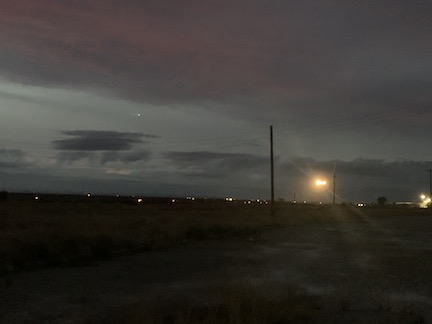
Cropduster at Night
Crop-dusters in southern California fly after dark. This plane had FOUR headlights.

Anyway, I got permission to camp in the parking lot overnight, so I did. It was in a weird industrial place near an airport. I got to watch a crop-duster come and go until long after sunset. Otherwise, it was pretty quiet. I slept well and as soon as the manager opened the gate and came into work, I pulled out of the lot and continued my drive.

Day 4: Arizona, Finally!

It rained on me as I drove east along the farm roads to Route 99. I was planning on crossing the mountains at Tehachapi, not wanting to deal with the Freeway traffic of southern California. The rain stopped before I’d reach the pass. I stopped for gas and a pee at an absolutely disgusting gas station in Tehachapi before getting back on the road. GoogleMaps took me on a detour I don’t think I needed to take, then dumped me in a desert city, putting me on roads with traffic lights and suburban stop-and-go traffic. After a half hour of that, I left the traffic behind me and headed east on Pearblossom Highway. Eventually, I hit I-15 and took that to I-10. We continued through the Palm Springs area and climbed up from sea level toward Arizona.

It had been a long time since I’d driven on most of those roads and I don’t think I would have chosen them myself. But I was so disillusioned about my factory visit the day before that all I could think about was ending the drive and starting my winter vacation. I was tired of driving. I just wanted to be there already. So I let GoogleMaps pick the route and went with it. Other than the unnecessary detour, it was pretty direct.

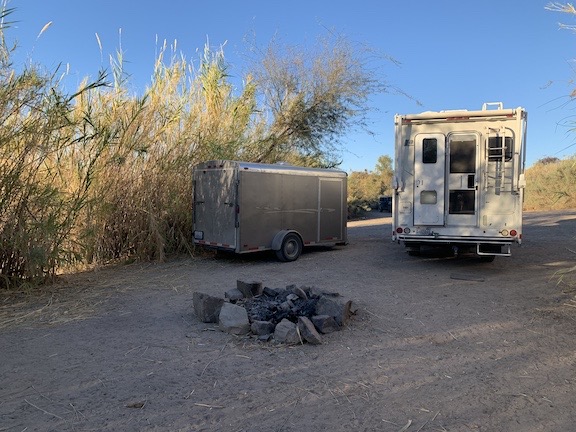
I was down to 60 miles left on my truck’s computer when I crossed the Colorado River on I-10 and took Exit 1. I had two different campsites in mind: the one we’d occupied the year before and another one about 5 miles south. Timing was everything, I knew, and I’d take the first one I found open. That was the one we’d been in the year before. I backed the trailer in, unhooked it, and repositioned my truck for the night, relieved to be done driving.

The Campsite

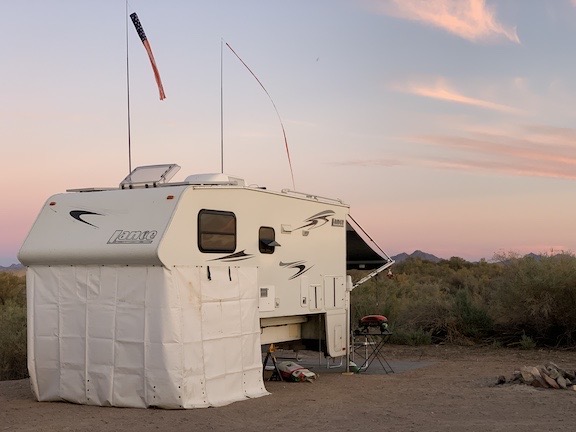
I didn’t drop the camper off the truck. Why? Well, my friend Janet would be joining me for part of my stay and she didn’t want to camp in that site. There wasn’t enough sun for her; although my solar panels are on my camper’s roof, she uses a portable solar panel that she puts on the ground. That site is surrounded by tall reeds so the sun doesn’t hit her panel until after 9 AM. She had no interest in putting her panel on her camper’s roof, even though that had worked for her the previous year.

The site I was parked on was one of a pair separated from each other by a boat ramp. Friends of ours had occupied that site the previous year. The other spot was larger and a bit sunnier. But it was also occupied. I figured I could keep the camper on the truck and slip into the other spot when the folks in it left.

Campsite One
Here I am after landing at the first campsite and finally disconnecting the trailer. I was glad to be done driving.

But, at the same time, I’d just driven 1,300 miles in four days, much of it through rain, and I wasn’t interested in searching for another campsite. So I spent the night there, with my camper still atop my rig.

In the morning, I felt rested and ready to stock up on a few supplies. I didn’t mind driving with the camper on my truck — hell, I’d just spent the past four days doing it. But, at the same time, I wondered whether the other site I’d been interested was available and, if so, what kind of condition it was in. The area was heavily used during the summer and some of the sites accumulated a lot of trash. It wasn’t uncommon for us to spend a bunch of time cleaning up after others when we camped. The site I was interested in had had a car wreck in the middle of it the last time I’d visited. I could only imagine what else was there.

But I didn’t need to imagine. I got into my truck and, leaving the trailer behind to hold the campsite for me, headed south on the gravel road.

Most of the campsites along the way were occupied and looked as if they had been for some time. One site along the road was available, but I knew how dusty it could get. I drove for miles along the river. The road was in dismal condition, with washboarding and potholes. I bounced along at 20 miles per hour, wondering how much cleaning up I’d have to do in my camper when I parked. Finally, I reached the turn for the site I liked. I peeked down its road before turning in. Nothing. I turned and drove to the end.

It was empty. It was even clean. Even the wrecked car had been moved.

I called Janet and asked if that site would work for her, knowing it would. It was a lot sunnier. Like the other site, it had a boat ramp that led down to a backwater channel where we could paddle our boats and fish. This channel didn’t exit to the river — it was fed from culvert pipes that ran between it and the river and another channel — but it was about a mile long. I’d camped there in the past with her once and I think she’d camped there several times.

She gave me the green light. I chose a spot for my camper and backed in. 15 minutes later, it was parked on its legs in a level spot and my truck was free of its burden.

I drove back up the road to fetch my trailer and parked it a short distance away in the new campsite. Then, making sure everything was locked up, I drove back up the road and into Blythe for some groceries.

I got back to my new camp just after 2 PM and spent the rest of the day setting up camp. It was great to be done driving.

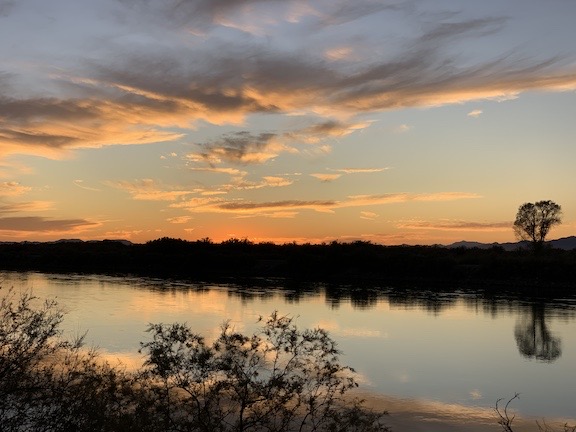
Sunset
The view of sunset across the Colorado River from the main road a few hundred yards from camp. Arizona has been treating us to quite a few magnificent sunrises and sunsets since we’ve been here.

Janet would join me with her rigs four days later.

Snowbirding 2020: The Drive Plan

Another trip down an all-too-familiar route.

Posts in this series:
The Big Plan
The Drive Plan

On Tuesday, I plan to start by drive to — of all places — Wickenburg, AZ. It’s a drive I’ve taken many times. After all, I started spending my summers up here in Washington in 2008, the year I got my first cherry drying gig. Back in those days, I’d make two drives north in the spring — one in my helicopter and a second in a truck pulling a trailer to live in. Then, at the end of the season, I’d make two drives home to get everything back to my Wickenburg hangar.

The Preferred Route

During those years, I tried all kinds of routes north or south and I discovered the one truth about the drive: the shortest route involves route 93 between Wickenburg and Twin Falls, ID and I-84 between Twin Falls and the Tri-Cities area of Washington. Ask Google Maps — it’ll tell you. And even if you don’t believe it, I can confirm in. I’ve driven just about every other possible route.

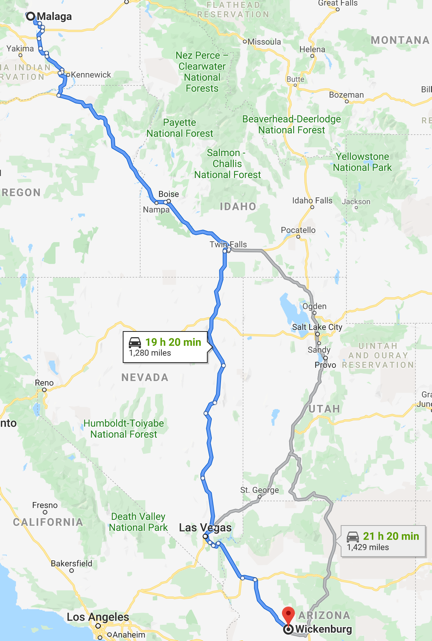
Map of Route
Google Maps knows the fastest routes. This map even shows the route 6 shortcut.

I-84 is a freeway that goes from Portland to Salt Lake City, leaving the relatively flat land of eastern Washington to climb the Green Mountains east of Pendleton, OR (of blanket fame) before descending southeast bound into the Boise, ID area and crossing rolling prairie land. The terrain climbs and descends again and again as I head south on the two-lane route 93 from Twin Falls, which I mostly stick to, taking advantage of a shortcut on route 6 between Ely and Crystal Springs, NV.

Route 93 is one of those remote roads that frighten city people. Towns aren’t much more than a handful of homes — if that. Gas stations are few and far between. If you miss a fuel stop you could be in serious trouble, waiting hours for the AAA guy to bring you five gallons. I’ve never run out of fuel on this route, but I’ve had more than a few close calls. If diesel wasn’t so damn stinky, I’d bring along a spare 5 gallons just in case.

Once I get to I-15, I’m back on the freeway and in very familiar area just outside of Las Vegas. Then, near Boulder City, NV, I leave freeways behind again for the long drive down route 93 to Kingman, a short stint on I-40, and more route 93 all the way down to Wickenburg. It’s 1,280 miles and should take about 20 hours with fuel stops if I stick to the speed limit — which I do when I’m towing these days. I used to be able to do it all in two days, with Jackpot, NV on Idaho’s border as my preferred overnight stop. That’s where I’d sleep in my RV in the truck parking lot outside of Cactus Pete’s casino. When the trip north stretched to three days due to weather or a late start or, in one case, illness, I’d try other overnight stops including a lakeside campsite at Pahranagat National Wildlife Refuge just south of Alamo, NV; a casino parking lot in West Wendover, NV; a campsite at Farewell Bend State Recreation area near Huntington, OR; or a state park campground somewhere in the Green Mountains. I’m not opposed to overnighting in a Walmart parking lot, but I’d prefer not to.

The Challenge of Driving When Days are Short

Driving south in late autumn is a whole different story. I can’t do it in two days mostly because I prefer not to travel in the dark. That means it’s always three days and I need two stops along the way. So not only do I have to plan my route around the weather, but I should have a damn good idea of where I’m going to stop along the way to make cold weather camping bearable.

And that’s the challenge. My truck camper is not winterized and I don’t want its pipes to freeze. I also don’t want to worry about running out of battery power at night when the heater would likely run nonstop to keep the poorly insulated camper warm enough for me to sleep. The answer is to find a campground with a power hookup that’s right on my route, close enough to reach before it gets dark.

I found such a place last year: the tiny Three Island Crossing State Park in Glenns Ferry, ID. Although the water is turned off in this campground and the bathrooms are closed and locked, the power is still turned on and available. I can pull into a campsite, plug in, and use my quiet electric heater to keep the camper warm all night. I get the added benefit of being able to use my microwave to heat up some dinner and my electric coffee maker to make coffee in the morning. The forecast says Tuesday night’s low will be 25°F so I really will appreciate that electric hookup.

Three Island Crossing is 491 miles from Malaga and will take about 8 hours to get to with one fuel stop along the way. That means that if I leave here at 7 AM sharp, I’ll get there by 4 PM local time. Sunset there will be around 5 PM. I arrived after dark last year and left in the morning before sunrise so I never got a chance to actually see the place. It would be nice to see it this year. I plan on hitting the road long before the 8 AM sunrise the next morning.

The Las Vegas Stop

My next stop is a no-brainer of sorts: Las Vegas, NV. If you think it’s weird camping in Las Vegas, you’re right. It is.

I stay at the KOA at Sam’s Town. In general, I dislike KOAs — they’re glorified parking lots. But this isn’t a camping trip. It’s an overnight stop before I’ll be spending weeks off the grid. I found the KOA years ago and have been staying there every trip south since. I get a full hookup site, plug in, and get a good night’s sleep. In the morning, I use the clean, warm, completely underutilized shower facilities to get a good, long, hot shower. Then I top off my water tanks and dump my black and gray water. If I need propane, I buy it there and the attendant helps me load it back into the compartment where the tanks go. There’s Sam’s Town next door if I want a good dinner or breakfast that I don’t have to cook. There’s a Walmart across the street if I want to stock up on anything I might have trouble finding in the weeks to come. And if I get there early enough, I can take a free shuttle or an Uber out to the strip to see what’s changed since my last visit. I admit that the chances of that happening are minimal; the 555 mile drive will take about 9 hours with fuel stops and I’ll likely be exhausted after two full days on the road.

KOA Great Outdoors
This screenshot from an email confirmation is what prompted this blog post. I love the way KOA refers to a campground in Las Vegas as “the great outdoors.” 🙄

This particular stop — especially this year — will be my most expensive overnight stop this year, coming in at just about $55 for the night. Ouch. The reason it’s so costly: it’s not just my truck camper this year. I’ll be pulling my cargo trailer, which makes my rig a lot longer than it normally would be and really encourages me to find a pull-through spot. (Backing a trailer is hard enough when you can see it but it’s nearly impossible when a truck camper hides it from view.) Because most of the folks who stay at that KOA are driving big rigs — hence the underutilized shower facilities — all of the smaller pull-throughs are taken. The only one available was a 72-foot long spot. I shouldn’t have any trouble fitting my roughly 40-foot total length rig into it, but it’ll cost me. Big spots cost big money.

The high cost also encourages me to stay just one night when I might have stayed two. I haven’t really enjoyed a trip to Vegas in a while. I suppose I’ll have to wait for the next time HeliExpo comes to town.

The Home Stretch

The rest of the drive is very familiar. As I write this, I’m planning a stop in Wickenburg where I might be participating in a holiday art show. It’s still unclear on whether they have room for me; I applied late (as usual). If I’m in, I go to Wickenburg. If I’m not in, I might go straight down to our usual camping area on the Colorado River. That means taking route 95 south from Vegas, all the way into California at I-10 or possibly crossing the river at I-40 and heading south from Lake Havasu. I’ve gone both ways and they both work.

Either way, it’s a short travel day with less than 300 miles to cover so I’ll definitely get to my destination.

And by that time, I should be back in t-shirt weather with very few worries about keeping my camper from freezing overnight.

That’s the plan. Stay tuned to see if I stick to it.

Gyroplane Flight: Pattern Work at Watts-Woodland

A video from the Flying M Air YouTube channel.

SIT ON THE MAST OF AN OPEN COCKPIT GYROPLANE as I take it around the traffic pattern three times in Woodland, CA.

I dug deep into my archives for this video from April 2014, which first appeared, in part, on my personal YouTube channel. In it, I’m flying a Magni M-16 gyroplane with a GoPro camera mounted on the mast. There is a bunch of vibration in this video; removing it with stabilization software reduced the video resolution without significantly improving the video quality, so I let it stay as is.

I learned to fly a gyro back in 2014 and got as far as my first solo before calling it quits. (No reason to go on since there’s no gyro in my future and it would be nearly impossible to keep current.) My flight instructor was an anesthesiologist friend who has three planes, including this one, and flies on his days off. He said I was the most difficult pilot to teach and we realized it was because was a helicopter pilot and not an airplane pilot — the idea of touching down when you’re still speeding along at 60 knots or more scared the heck out of me so I kept trying to slow down on final. You can learn more about my lessons here: https://aneclecticmind.com/2014/04/24/learning-to-fly-gyros/

About Me, the Flight Instructor, and the Gyroplane

  • I have been flying since 1998. My nearly 4,000 hours of flight time (as of 2019) is in Robinson R44, Robinson R22, and Bell 206L (Long Ranger) helicopters.
  • My flight instructor, who sat behind me in this video, is George, who makes his living as an anesthesiologist. He also owns and flies two other planes and is rated to fly helicopters. The last time I saw him was the day we flew together from Malaga to Woodland in 2016. (Long story there.)
  • The gyroplane is a Magni M-16 that belonged to George. I don’t know anything about it other than it has a flashy Angry Birds theme paint job that seemed a lot more relevant in 2014 than it does now. It was in perfect condition and well maintained by George, who was its second owner. You can see a photo of the gyroplane in the title screen of this video; that’s me after my first (and only, I think) solo flight.

About the Video

  • The video and sound was recorded with a GoPro Hero 3 camera mounted with an adhesive mount to the gyroplane’s mast. This is obviously not the best setup given the vibrations you see in the video.
  • The video was edited on a Macintosh using Screenflow software. Learn more about it here: https://www.telestream.net/screenflow/overview.htm
  • The intro music is by Bob Levitus, famed “Dr. Mac.” You can find him here: http://www.boblevitus.com/

I try to drop cockpit POV videos every Sunday morning and “extras” with more info about owning and operating a helicopter midweek. (Some channel members and patrons get early access to some of these videos.) I also host occasional livestreams with Q&A chats. Subscribe so you don’t miss anything new! And tell your friends. The more subscribers I have, the more motivated I am to keep producing videos like this one.

Any Amazon links on my channel are affiliate links (https://amzn.to/32PLHTD). If you click one of them and buy something, Amazon sends me a few pennies. Enough pennies make a dollar. Enough dollars buy new equipment. It doesn’t cost you anything so I hope you’ll shop with one of those links. Thanks.

Want to support the FlyingMAir channel? Here are four suggestions:

Snowbirding 2019: At the “Old Fogey Hot Springs”

I make a short visit to a favorite hot spring and meet up with a friend.

Note: I started this post back in March and just finished it today. My blog has been having permalink issues that made it difficult to keep it up to date. I think the problems are mostly resolved; I hope to catch up a bit and share a bunch of new content.

Posts in this series:
The Long Drive
At the Backwaters Campsite
In Mesa and Gilbert
A Quick Stop in Wickenburg and Forepaugh
Off Plomosa Road
• Camping at the Big RV Show
• A Trip to Organ Pipe with the WINs
The Tucson Gem & Mineral Shows
Wickenburg Gold Rush Days
• Constellation Park Interlude
• White Tank Mountain Park
Bumming It in Phoenix and Apache Junction
A Dose of Civilization
Return to the Backwaters

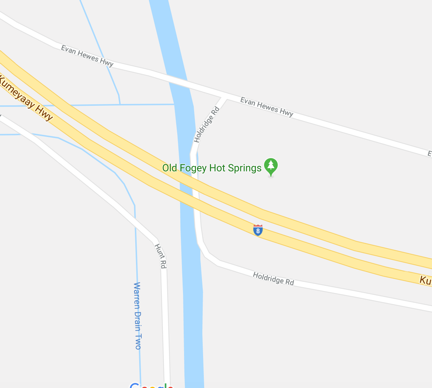
One of my favorite snowbirding destinations is a hot springs right off I-8 near Holtville, CA. On BLM land and maintained by the government, it’s a pair of concrete tubs beside a palm-lined pond that are all fed from a tapped natural hot spring. Although I’ve always known this place as Holtville Hot Spring, some nasty asshole has apparently renamed it on Google Maps as “Old Fogey Hot Springs,” apparently referencing the fact that most people at the spring are retirees camped out in the long term camping area across the street.

I was supposed to meet my friend Janet, who was showing and selling her artwork at a weekend show in Casa Grande, AZ, on Monday. We’d planned to do some hiking out at Borrego Springs, CA before she attended an art show there. (Sadly, although I applied I didn’t get in; too much jewelry already.) Since Casa Grande is on I-8 and the hot spring is on the way to Borrego Springs, it made sense to meet up there. I figured I’d get there a day early to enjoy the hot spring a few times before Janet arrived.

So that’s where I headed after leaving .

The Drive

I stopped in Blythe (or Blight, as we often call it) for groceries on the way, then let Google Maps guide me along mostly back roads south and west. I drove through mile after mile of farmland before leaving that behind and entering unirrigated desert with sparse vegetation and many hills.

There was little traffic going in my direction on the way — at least for a while. There were many RVs — mostly toy haulers passing me going north. That all changed when I approached Glamis.

is the site of an enormous sand dunes area that stretches northwest to southeast from Tortuga, CA to over the U.S. border with Mexico at Los Algodones. The road I was on, state route 78, cut right across it at Glamis. That’s where all the toy haulers were coming from. Glamis is a playground for dune buggies, sand rails, and other four-wheel-drive vehicles. From that point on, I was driving with departing off-roaders, who were calling it quits early on a Sunday and taking their toys home.

After crossing the dunes, I descended down out of the desert and into the irrigated farmland of the Imperial Valley. Google directed me on a zig-zag path through the farmland to my destination: the Holtville Hot Springs just off of I-8.

“Old Fogey” My Ass

Holtville Hot Springs Map
I’d like to kick the guy who changed the name of the hot springs on Google Maps. I’ve been trying to change it back ever since.

The Holtville Hot Spring is adjacent to the (LTRA). This is a kind of special BLM camping area where you’re allowed to stay more than the usual 14 days — if you pay a fee. The previous year, I’d paid the fee with the idea of staying there for a while and then moving over to another LTRA near a lake in Arizona. But worries about electrical issues (which turned out to be non-issues) on my camper sent me to Quartzsite in search of repairs instead. So I’d only spent a few days there.

This was actually my third visit to the hot spring, which I’d learned about from another seasonal camper somewhere back in the winter of 2016/17.

The spring has two tubs — one large and deep and the other small and shallow — a weird shower head to rinse off before getting in, and a hose you can use to fill jugs with “clean” spring water. It’s cleaned once a week by the BLM (I believe) who drain the tubs, power wash them, add bromine (a spa chemical), and allow them to refill from the source. Access is free, dogs and glass containers are not allowed, and I think it closes at night but reopens very early. I’ve never seen it closed. It’s adjacent to a beautiful palm ringed pond where water birds can be seen swimming. I shared a photo of that back in 2017 in a postcards post.

The jerk who added the springs to Google Maps with the name “Old Fogey Hot Springs” was likely motivated by the simple fact that the vast majority of hot springs users are retirees who are living seasonally at the LTVA across the road. So yes, there are a lot of older folk in the tubs. But I’ve seen people of all ages there, including kids.

A Couple of Soaks

I parked alongside the road near the hots springs parking lot. It was midday and the outside temperature was in the low 60s. I put Penny on her leash and walked her down to the area to take a look. There were about a dozen people in and around the tubs — about my limit for a crowd. I went back to the camper, put on my bathing suit, grabbed my towel and went back. A while later, with Penny tied up at the other side of the fence, I was soaking in the big tub, standing with water right up to my chin.

The temperature of the water in the big tub can be pretty hot. I’m guessing at least 105°F. It’s common for people to soak for a while, then get out and sit at the edge of the tub or on one of the block stools nearby. That’s what I did. Then another hot soak. Then I decided to give the smaller tub, which is fed from the large one and is usually much cooler, a try. In that one, I sat on the bottom to get the water halfway up my chest. It’s a lot shallower.

While I was there, I chatted with the folks around me. I’ve come to realize that the best way to learn about new destinations is to talk to other travelers. While I was in the small tub, I chatted with a woman who was staying in the LTVA area with her husband in a small motorhome. They were full-timers — people who don’t have a regular home and travel all the time. They spend half the year on the road in the motorhome and half the year on their 47-foot sailboat, which is moored at San Diego. We got to talking about my upcoming cruise up the inside passage from Bellingham, WA to Ketchikan, AK and the boat I’m thinking of buying when I sell my helicopter.

Eventually, she asked what I considered an odd question: “Is your husband as adventurous as you are?” It never ceases to amaze me that people assume I’m traveling with a spouse even though I don’t wear a wedding ring. “No,” I told her. “One of the reasons my husband is my ex-husband is because he isn’t adventurous at all. In fact, I’ll bet that at this very moment he’s sitting on a sofa somewhere watching television.” We both had a good laugh about that and then she started telling me about how great cruising the inside passage in a small boat is.

After a while, I’d had enough soaking. I rinsed off at the funky shower, wrapped my towel around me, and headed back to my camper with Penny. I dried off, had some lunch, and spent some time catching up on email and other tablet things. Then I took a short nap.

At about 4:30 PM, the parking lot looked pretty empty. I figured I’d go for another soak. I wrapped my damp towel around my bathing suited body and walked down with Penny, parking her outside the fence on her leash again. I’d obviously underestimated the crowd, most of whom probably walked over from the LTVA. Although there weren’t many people, a lot of those people were kids.

I soaked in the big tub. I got into a conversation with the man who was there with his wife and three kids. They were full-timers — they lived on the road in a bumper-pull trailer and home schooled their kids. Then I got into a conversation with a man who happened to be a pilot. He turned out to be the husband of the woman I’d chatted with earlier in the day. We talked about flying and why he stopped: his twin engine plane burned 25 gallons per hour of fuel. Ouch.

After about an hour, I’d had enough soaking. I showered off again, wrapped the towel around me, and headed back to the camper with Penny.

First Night Campsite

I knew the area pretty well. I knew that if I camped north of the road, I’d have to pay for a long term spot, even if I just stayed a day or two. If I camped south of the road within about a half mile of the hot spring, the story was the same. But if I went beyond that half mile, I’d be out of the LTVA and I could camp for free for up to 14 days.

I had already scouted out the area on Google Maps satellite view. I realized that if I followed a canal road south and turned at a certain place, I would probably find a decent site for the night. I wasn’t picky. All I wanted was a place to park that was easy to get in and out of and wasn’t close to anyone likely to run a generator.

Google Maps got me there. I made the turn and found the spot I’d seen in satellite view empty. It was good enough for me, despite the fact that there was a motorhome parked a few hundred yards away. I pulled in and killed the engine, then climbed back into the camper to put on some dry clothes and start thinking about dinner.

The spot turned out to be so quiet that all I could hear was the occasional bee flying by and my tinnitus.

I enjoyed a great Internet connection that evening for the first time in a while. I also slept great. I think the hot springs really sucks a lot of energy out of me.

In the morning, after breakfast, Penny and I went for a walk. That’s when I found a better campsite about a half mile farther down the road. I thought it would make a good site for that night when my friend Janet would be joining us in her camper.

Movie Matinee

After the walk, we left the camping area and headed west on I-8. My destination was a movie theater in a mall in El Centro where I planned to see Captain Marvel. Oddly, I’d been to that theater the previous year, although I can’t remember what I saw.

I left Penny locked up in the camper where she had food, water, and her bed.

The 9:40 AM matinee cost just $5 and there were only eight of us in the theater — just three days after this record-breaking movie was released. My popcorn cost more than the movie ticket.

And it was a good movie, although I can’t understand how a superhero can be that powerful.

I made a few other stops in the area: Michael’s, a craft supply store, where I picked up a texture plate for the precious metal clay work I plan to do when I get home, and Best Buy, where I picked up a 4-port 12 volt USB recharger for my truck or camper. I was tired of dealing with 1 amp rechargers; this one had four 2 amp rechargers so I could charge four devices at once.

Trailer Trouble

Getting Penny out of the trailer, I accidentally knocked the crank handle on my trailer jack. Just my luck: the handle fell off.

I picked up the handle and the screw that secured it. The nut was nowhere in sight. I couldn’t see how to fix it then and there so I just stowed it in the truck. I’d deal with it later in the day.

The trailer had other ideas. I was about 200 feet short of my parking spot back in front of the hot spring when I went over a bump and the hitch jack leg dropped and started dragging. I stopped in the middle of the road to check it out and realized immediately what was happening. Shit.

I managed to pull the hitch jack leg up enough to continue driving and secured it with a bungee cord. Then I eased into my parking spot.

The jack leg was bent and could no longer be cranked back into its sleeve, even if I was able to secure the handle. This meant two things: (1) I’d have to remove the jack since I couldn’t drive on the highway with the leg only inches from the ground and (2) I would not be able to unhitch the trailer from my truck until the jack was replaced.

Okay.

I put Penny on a leash and let her stretch out in the sun. Then I got out my toolbox. Miraculously, I had all the tools I needed to remove the hitch jack. It took about 45 minutes, mostly because one of the three bolts was tough to get out. I tossed the jack into the back of my truck.

That done, I had lunch.

Another Soak

I changed back into my bathing suit, grabbed a towel, and walked down to the tubs. I tied Penny up to the outside of the fence, as I’d done quite a few times before, and went in. After a shower under that funky shower head, I was back in the hot tub, soaking with a few other people.

More conversation, although at this point I can’t remember what it was about. (I’m finishing this blog post two months after the fact. Oops.) I do recall that the hotter tub was super hot and I’d decided to soak in the smaller tub, which was cooler but not crowded. A while later, Janet walked up in a bathing suit and towel, went through the shower ritual, and joined us in the tubs.

I think we soaked for another 30 minutes or so. By that time, it was late afternoon. Janet had spent the day packing up from her show in Casa Grande and driving in on-again, off-again rain. We were both ready to find a campsite for the night.

Another Night, Another Campsite

Janet followed me back down the canal road to the spot I’d observed that morning on my walk. After some discussion, we decided that I’d back in and she’d nose in. That accomplished, we went about setting up camp and making dinner. She put out her awning, which turned out to be a good thing because it started raining.

We called it a night early; we had a relatively long drive ahead of us the next day and were hoping to get another soak in the tubs before we left the area.

Cleaning Day

We had a nice walk along the canal in the morning. Janet really wanted to cast a line into it — she loves to fish — but she didn’t have a California fishing license.

As I suspected, the soak was not going to happen. Tuesday is cleaning day. Although we arrived back at the tubs after the BLM cleaning guy had done his thing, the big tub was only half filled. There were a few people soaking in it anyway. My first year out there, I’d been one of those people and had walked around with the stench of bromine or chlorine all day. We could smell it in the air. Neither of us were interested in soaking in chemicals.

So we left.

I led the way out of town, following Google’s directions to an RV supply shop in Brawley. I still needed a jack for my trailer. Once I had that on board, Janet took the lead. I’d follow her through empty dessert into the Anzo-Borrego State Park, where a superbloom was in progress.

More on that in another blog post. Maybe.

Arizona to Washington by Helicopter, Again

About 950 nautical miles in one day.

I flew commercial down to Arizona on April 11 to pick up my new old helicopter, N7534D. If you missed my blog post about my purchase process and what went into the decision to buy this helicopter, you can find it here. This blog post pretty much picks up where that one left off.

Flying South

I treated myself to a first class ticket, which I sometimes do when I’ve got a job ahead of me that might or might not be difficult. And instead of departing Wenatchee on the 5:55 AM flight, which, via a connection through Seattle, gets into Phoenix at 10:43 AM, I took the 11:35 AM flight with a connection at 1:42 to arrive in Phoenix at 4:30. Unfortunately, weather moved into Seattle that morning and they delayed our flight from leaving Wenatchee. For a short time, it looked like I’d miss my connection. But Alaska Air had my back (at least this time). Not only did they automatically add a booking on the next flight to Phoenix, but they made sure they gave me a first class seat there, too. So even if I missed my flight, I’d travel in the comfort I paid for.

Flying First Class
I had the salad. It was good. And have I ever mentioned how much I enjoy flying First Class? (Another perk of the single lifestyle; only one plane ticket to buy means airline travel is more affordable.)

But I didn’t miss the connection. I was the third to last person on board. I felt bad for Penny since I didn’t let her out of her bag — as I usually do — when hurrying across the airport to make the connection. She settled under the seat in front of me, still in her bag, on the Seattle to Phoenix flight while I settled in to a spacious and comfy seat and accepted the lunch menu the flight attendant handed me.

I enjoy flying First Class on Alaska Air. (Not so much with other airlines.) The food is always good and they have an excellent Bloody Mary mix. The seats are very comfortable. And I’ve discovered that the best way to make a long flight shorter — no matter where you’re sitting — is to watch a movie on a tablet. This time, I watched Coco, which I highly recommend.

Some Lurking Stress

Watching the movie also got my mind off the stress of my upcoming meeting with a new helicopter. There were a few things feeding it.

First, I hadn’t flown since my accident back on February 24. That was about six weeks. I’ve gone a lot longer between flights — heck, I went from December 4, 2017 to February 15, 2018 (ten weeks) and October 30, 2016 to February 22, 2017 (nearly four months) — but this was different. It was the elephant in the room — my crash — and the uneasiness was growing on me every day.

Logically, this didn’t make sense. I knew what caused the crash and I could easily prevent it from happening again. I had no uncertainty about my skills or the aircraft. But I think the people who were encouraging me to “get back in the saddle” were starting to make me wonder why they thought I wouldn’t. Maybe I was missing something?

This nagging concern got to a head about a week before I was supposed to pick up the helicopter. I actually asked Paul, the Director of Maintenance at Quantum who was handling the sale, to schedule a flight instructor to fly with me for about an hour before I left with the ship. Why not get a little refresher?

The other stress had to do with my route home and the weather. I’d been thinking a lot about my route for the flight and even blogged about the pros and cons of each option. I was very motivated to minimize flight time, but I was not interested in crossing the vast emptiness of central Nevada, which was the shortest route. And then there was a perceived need to go through California to pick up my old cockpit cover and floor mats, which were still in the custody of the aircraft salvage guy.

The trouble was, the forecast was calling for crazy high winds on Thursday and Friday. A front was coming through on the night of my arrival and the forecast was showing winds as high as 40 miles per hour. Although I tried to change my schedule to come in early on Wednesday for departure the same day, hoping to beat the winds out of the area, it was pretty clear that I would hit those high winds somewhere on my route . Besides, the helicopter wouldn’t be ready. The earliest I could pick it up would be Thursday, right when those high winds were scheduled to really ramp up.

Normally, a day or two delay wouldn’t matter. After all, I was staying with some friends in Gilbert, AZ and it was always nice to hang out with them. But on this trip, I’d be accompanied by my good friend Janet, who would then stay a day or two with me in Washington before flying back to Phoenix on Alaska Air. Her 5:55 AM Tuesday ticket could not be changed and I was really hoping to have her as a guest for more than just a day. In addition to that, I had some freshly hatched chicks in the brooder of my chicken coop and didn’t like the idea of leaving them for longer than absolutely necessary. Leaving Phoenix on Saturday would probably mean getting home by Sunday. And there was unsettled weather forecasted for northern Oregon and Washington on Sunday that could delay us further.

So the long flight home and weather-related delays were stressing me out, too.

And then there was the added stress of flying a helicopter that wasn’t mine. How would it fly? What would it sound like? I knew every quirk in the late, great Zero-Mike-Lima but didn’t know this one at all. (And yes, every aircraft has quirks.) That was made a little worse by a friend suggesting that there might be issues with the “rigging” (WTF?) and that I should fly it around locally before leaving the area in case anything needed to be fixed. More delays?

I kept telling myself that with Paul in charge of maintenance and the aircraft always being owned by Quantum, there wouldn’t be any mechanical issues. There was no way Paul would let an aircraft go that wasn’t perfectly safe and functional. That’s why I’d bought this helicopter instead of one of the other options — it came with peace of mind. Quirks were quirks and I’d figure them out over time.

Still, all these little things were accumulating in my brain, giving me more stress than I really should have had. Fortunately, I was able to switch off that stress on the flight to Phoenix and for the rest of the evening, which I spent with my friends.

The Pickup

The forecast was right. The wind kicked in on Thursday morning. I still had hopes of picking up the helicopter and getting it to Wickenburg — which is where I’d be meeting Janet — before things got too rough, but Paul texted to say that they’d found a small problem with the radios and the avionics guys still had to do their inspections. So I waited at Falcon Field, the Mesa airport where my friends have a flight school, watching the flag I could see through the window. The wind got rougher. They started cancelling their flights.

We went out for Thai food for lunch. Then back to Falcon Field. The helicopter was ready, but I probably couldn’t fly away. Still, I had paperwork to do and there were a few things I could do to prep the helicopter for its departure. My friends gave me their car keys. I loaded Penny up and we drove to Chandler.

The wind was very bad there. And because Chandler is close to the edge of the desert, the blowing wind had kicked up a lot of dust. Visibility was down to about a mile: IMC (Instrument Meteorological Conditions). No one was flying. Quantum’s door was locked with a sign to knock. When the girl at the desk came to open it for me, she explained that the wind and air pressure made the door swing open if it wasn’t latched.

I saw Paul and Doug and Neil, all of whom I’ve known since my primary flight training days in the late 1990s. We did the socializing thing. Then Paul brought me out to see the helicopter I’d come to buy. It was optimistically hooked up to the tow cart, parked right in the middle of the hangar.

First Look at N7534D
N7534D was waiting for me when I arrived. And I don’t know why, but almost every photo I take with my iPhone makes the helicopter look black. It isn’t. It’s actually a dark blue with a flat black stripe. Also parked in the hangar: at least three R22s that I’d flown during my flight training in 1998 through 2000; two of them have over 20,000 hours!

I went over for a good look. When I opened the pilot door and looked at the interior all worries about it not being my helicopter were washed away. It was virtually identical to Zero-Mike-Lima, from the tan carpeting and leather seats to the layout of the instrument panel. The only difference I saw — and didn’t even notice until I was nearly home — is that the Hobbs meter and clock are switched on the instrument panel. Paul had even installed the bar across the footwell on the pilot’s seat where I’d use RAM mounts to install my phone and iPad.

There were differences, of course. The gyros, which switched on automatically when Paul turned on the master switch, were louder. The glass on a few of the instruments looked a little hazy. There were tiny bits of damage on the pilot seat, almost like cigarette burns. Just enough to remind me that it wasn’t Zero-Mike-Lima. But it was close enough that any worries I’d had about flying again immediately went away. Of course I could fly this.

Penny in N7534D
Penny wanted to sit in the helicopter so I put her in there. Note that I’ve already got my hat hung on the cyclic. Home sweet home?

I put Penny in the front passenger seat, where she really wanted to sit, and did a walk-around with Paul. He answered any questions I had. Then I took the canvas bag I’d brought with two headsets and my RAM mounts and began setting up the cockpit for my flight. It was a real relief to see that the helicopter had been hardwired for Bose headsets, since the ones I use in the front two seats are Bose without battery packs.

Meanwhile, Paul gathered up the paperwork and other things that came with the helicopter. This included a brand new, still in its original packaging, full cockpit cover, blade tie-towns, and ground handling wheels. (All of a sudden, I had no pressing need to fly though California on my way home.) I stowed all of it under the rear seats so I’d have plenty of room for luggage on top of the seats.

Sometime while all this was happening, I handed over the big certified check I’d picked up from the bank the day before. The purchase price did not include the cost of the USB ports Paul had put on that bar to keep my iPad and phone charged in flight and a few other things, so I fully expected to pay a bit more. But I did have money on account with Quantum for Zero-Mike-Lima’s core returns during overhaul the year before. So they cut me a new check for $700+, which I actually forgot about until I found it just yesterday.

Back in the office, I filled out forms and signed papers. I chatted with Paul and Doug and Neil. I looked out the door and saw the thick blowing dust. I knew damn well I wouldn’t be flying to Wickenburg that afternoon. I told them I’d be back in the morning, probably around 7:30 AM. Although the wind was supposed to pick up again, I was hoping I could get it out of the Phoenix area before that happened.

Then I hopped back into my friend’s car and went back to Falcon Field, stopping for a DQ hot fudge sundae along the way.

Chandler to Wickenburg

I spent a second night with my friends in Gilbert. We went to the Monastery, a local pilot hangout, for drinks after work, when back to their house for leftover Chinese food. It was nice to relax. I felt good about my upcoming trip, although I still didn’t know when I’d be able to head out beyond Wickenburg and which route I’d take. Heck, I wasn’t even sure I’d be able to leave Chandler.

But in the morning, the wind was relatively calm and the sky was clear. I had coffee with my friends, turned down their offer for a ride to Chandler Municipal because I didn’t want to wait or have them drive so far out of their way on the way to work, and caught a ride with Lyft instead. I was at Quantum’s unlocked door at 8 AM.

Doug came in just as I was heading to the hangar with my wheelie bag with Penny in trail. But the helicopter was gone. One of the guys in the hangar told me they’d put it outside for me. The big hangar door was closed. I went through a man door to the ramp. N7534D was parked right there on one of the pads.

N7534D
It almost looks blue in this photo. I should mention here that the N-number is painted on in the same black as the stripe. Can you see the stripe? Well, the painted N-number is just as visible. Because the FAA would definitely balk at that, Paul used decals cover them with the same numbers in white.

To my surprise, Penny ran right over to it. Well, why shouldn’t she? It was ours, after all.

I was pleasantly surprised to find a small pile of Quantum swag on the front passenger seat, including a slick-looking jacket, two tee shirts (one long sleeve and the other short sleeve), and two baseball caps. I put on the jacket — it was cold that morning! — and stowed the other things in my suitcase.

I put Penny inside on the front seat on the small dog bed I’d brought along for her. (She doesn’t like sitting on leather.) Then I loaded up the luggage and did a preflight. The oil dipstick, which is shorter than the one in Zero-Mike-Lima was, showed just under 7 quarts of very clean oil. Robinson are funny about oil. The manual says 9 quarts, but if you put in more than 7, it usually just blows it out when the engine is running. I kept Zero-Mike-Lima’s right at 7. I figured I’d check this one again when I got to Wickenburg to see if it got lower. But I did go back into the hangar and ask Doug if I could buy some oil. He gave me two quarts of W100Plus; according to the log book I had on board, that’s what Paul’s team had put in it. (It’s also what I’ve always used.)

By this time, the wind was about 12-15 miles per hour out of the northwest — just the direction I had to go. Out on the edges of the ramp, two or three R22s were practicing hovering right into the wind. It was blowing right up my helicopter’s tail. That meant my first pickup in this ship would be with a nice little tailwind. Nothing like getting back into the saddle — on an unbroke horse.

I got my iPad EFB all set up with my flight plan filed. Then I started it up. It caught on the second try; I knew it would be a while before I learned exactly how much priming I’d need in different conditions. The engine sounded different. The blades spun up silently — no squealing drive belts! The idle was low. When the needles matched, I had to add throttle to keep it at 55% RPM until the clutch light went out.

My mind noted all of these things automatically. It was different from Zero-Mike-Lima, but not wildly different. I listened to Chandler’s ATIS on the GPS radio while the engine warmed up. Although I felt as if I should be in a hurry, I reminded myself repeatedly that I was not. I dialed in both of Chandler’s tower frequencies on the main radio in case I needed to switch when I crossed the runway. I listened to the tower frequency; there was just one plane on the radio and he landed before I was ready to take off.

I brought the RPM up to 100% and carefully lifted the collective, mindful of that strong tailwind. My feet were firm on the pedals, prepared for the dance I might have to do. But if there was any dancing, it was instinctive. I picked it up off the ground smoothly with virtually no yaw or wiggle. I gave it some right pedal and turned around smoothly, pointing it into the wind.

Just like riding a bike.

I called the tower and asked for departure to the north. He asked if I wanted departure from present position or from the helipad. I told him I preferred present position; I really saw no reason to waste time or fuel hover taxing over to the pad. He gave me the usual “departure is at your own risk” disclaimer and cleared me northbound over both runways. Somewhere during our exchange, I used the wrong N-number and quickly corrected myself, adding “new helicopter.” Then I was airborne above and between the two light posts on the north edge of the helicopter parking area, climbing away from Quantum.

I took one of my “usual” routes to Wickenburg — north just outside of the Phoenix surface airspace, then west along Camelback Road, then northwest direct to Wickenburg. I hit some moderate turbulence between Camelback Mountain and North Mountain that were likely caused by wind over the mountains north of me, but that cleared up by the time I passed Piestewa (formerly Squaw) Peak. There was a little more turbulence along the way. Otherwise, it was a pretty uneventful flight. I skirted around the special Luke Air Force base surface training area southeast of Wickenburg so I wouldn’t have to talk to Luke Approach. The flight path was familiar — I’d flown it at least a hundred times when I lived and flew regularly in Arizona.

Chandler to Wickenburg
My route from Chandler (CHD) to Wickenburg (E25) on Friday morning.

When I got within radio range of Wickenburg, I flipped on the AWOS on my second radio. Winds were 15 gusting to 23. Whatever. I flew over my old house — which I have to say looks a hell of a lot better than when I lived there with my wasband — but didn’t see any sign of Jeff or Mary, who now live there. I came in over the golf course and made a short right base to the taxiway parallel to Runway 23.

I set down temporarily near the taxiway as my friend (and insurance agent) Dave towed his helicopter past on a cart for departure from the helipads on the far west end of the ramp. Then I hover-taxied over to one of the two fuel trucks parked near the big fuel tanks adjacent to the parking area and shut down. I caught Dave on the radio just as he was taking off. “I thought the new helicopter was red,” he said as he made his departure toward Scottsdale.

I’d hear that a lot over the next few days, and likely in weeks to come.

Overnight at Wickenburg

I got fuel and although I’m tempted to tell you the saga of the Town of Wickenburg’s stupidity at installing a costly fuel system that won’t work property, I won’t waste your time or mine. Short version is, fuel came from a truck that can’t move and when fueling was done, I was told I couldn’t keep the helicopter parked there overnight, despite the fact that I’d purposely parked it out of the way. Okay. I wasn’t sure if I’d be spending the night anyway. I was told I could park there until noon; if I needed to stay longer, I’d have to move it. Fair enough.

The good news is, the fuel was only $3.95/gallon. They’re trying to empty the tanks so they can get them fixed in June. The bad news is, it was a short flight so I didn’t need much fuel to top off both tanks.

I called my friend Janet to come get me, then locked up the helicopter. That’s when I discovered that the front passenger door wasn’t seated quite right. I suspect that whoever put the swag into the helicopter that morning had let the door get caught by that tailwind. It would need some work with a screwdriver and pair of pliers to fix it. I also discovered that that door lock was kind of funky; normally you turn the key 1/4 turn to lock it but this one has to turn 1/2 way around.

Remember what I said about quirks? I was learning them.

I went to a late breakfast with Janet in town. While there, I checked the weather. No matter which way we went, we’d hit high winds that day. So after breakfast and a few errands, we stopped at the airport so I could reposition the helicopter on a far east ramp that hadn’t existed when I was based at Wickenburg. We used the brand new blade tie-downs and the tailgate of her truck to secure the blades against the wind. Then we headed out to the off-the-grid ranch she and her spouse, Steve, and their animals were living at.

The wind howled all day, making it very unpleasant outside. We chatted in the living room of the fifth wheel they now live in full time. I made a piece of jewelry. She read. We met with Steve when he returned from riding drag on a horseback ride for four city slickers. Janet cooked the pizza we’d picked up at the supermarket.

Meanwhile, I kept checking the weather — I had a barely acceptable connection on my iPad that switched from 3G to LTE — and thinking about routes. We planned to depart by 8 AM the following morning. I was starting to lean toward the one route I hadn’t completely done before: the western Nevada route. The weather looked doable, but I didn’t like the forecast nearer to home for Sunday. I’d want to get as far north as possible before stopping for the night.

I left them to spend the night in the little travel trailer they’d bought for small trips Janet often needs to make throughout the year. I had the whole place to myself and slept like the dead.

The Long Flight

I was already awake when the generator went on just before 6 AM. I immediately plugged in my iPad, then went out in search of coffee.

By this time, I had pretty much decided on the western Nevada route, which would save at least 2 hours over the California route. Time is money, especially when flying a helicopter.

Both Janet and I were ready to go at 6:30, so rather than sit around and waste time, we loaded up the truck and let Steve take us to the airport.

Using the truck tailgate again — I really do need to get my collapsible stool on board — we pulled off the blade tie-downs. I did a preflight and added a quart of oil, kind of surprised to see that there was absolutely no sign of dripping under the ship. (Most Robinsons let a few drops of oil go from the drain port when parked; this was a quirk I could certainly live with.) Then we loaded up all the luggage, moved Penny’s bed to the back passenger side seat, and prepped to go. Steve watched us start up and take off.

I flew over my friend Jim’s house but saw no sign of life.

Then we were on course northwest bound, heading 301° toward our first fuel stop in Pahrump, 209nm away. We were originally supposed to stop at Jean for fuel — that’s just southwest of Las Vegas on I-15 — but unlike too many other pilots, I did read the NOTAMs, which informed me that there was no fuel at Jean until June. (I didn’t believe the NOTAM, so I called the phone number and got connected with someone at Henderson Executive Airport who confirmed there was no fuel.) Seriously, pilots: read the NOTAMs. (There’s also this old blog post about an idiot pilot who didn’t read the NOTAMs and unsuspectingly flew into a busy airport hosting an EAA Young Eagles event.)

Wickenburg to Pahrump
Our route from Wickenburg (E25) to Pahrump (74P) cut through miles of empty Arizona and Nevada desert, crossing the Colorado River at the south end of Lake Mohave.

Our flight path put us just east of Route 93 to the west of Alamo Lake. And that’s the only place we hit turbulence — a pretty good roller coaster ride as we passed near some hills about 10 minutes out of Wickenburg. My first thought was: this better not be an all-day thing. Janet later told me that it bothered her a lot more than she let on. I suspect that’s because after many years of flying with passengers in all kind of conditions, I’m very careful to never look annoyed or scared in turbulence or other weather-related conditions. Passengers take their cue from the pilot; if the pilot doesn’t look bothered, there’s obviously nothing to worry about.

There were pilots landing at the dirt strip out at the Wayside Inn south of Lake Alamo. I didn’t see them, but I heard them on the radio. Weekend pilots, meeting up for breakfast. I wished, in a way, that we could stop and join them.

We passed the old grid of lots in the big, broad valley east of Crossman Peak (east of Lake Havasu). It’s flat and sparsely populated and I can bet it was full of blowing dust the day before. I’d been over the area before and was always amazed that people would buy land all the way out there. It had to be 10 to 20 miles or more on graded dirt roads to get to any pavement in any direction. And even then, where was the closest town with a supermarket and other services? Needles, NV? Kingman, AZ? People think I’m crazy living 10 miles from the nearest supermarket but that’s only because they haven’t seen these middle of nowhere homes. It’s all relative.

I talked briefly to Bullhead City’s tower, telling them I wanted to transition on the east edge of their space northwest bound. Then we crossed the Colorado River just upstream from the Davis Dam, at the south end of Lake Mohave. We had entered Nevada.

We crossed a few more mountains and I climbed to avoid the possibility of mechanical turbulence. It also gave me a chance to play with my radio altimeter (which I never wanted). As I consulted it periodically through the trip, I soon learned that it lagged in its readout of altitude changes and would be, as I suspected, completely useless in my operation. I’m sure the manufacturer of the device is still patting itself on the back for successfully lobbying the FAA to require them. How much additional revenue have they managed to squeeze out of VFR pilots who don’t need such a device for safe operation?

We passed to the east of Searchlight, NV; I saw it’s huge American flag fluttering in the breeze.

Janet pointed out the big solar farms in California near Primm. I remembered driving past those on I-15 just a few weeks before. They use mirrors to focus sunlight on a tower that heats oil (I think) to run a turbine and generate electricity. As the VFR sectional chart for the area warns, there’s the possibility of “ocular glare” from the tower which glows brightly in the desert.

We passed over the top of Jean and kept going. We could see Las Vegas off in the distance. Then we were flying up the valley west of the Spring Mountains and Mount Charleston, over Pahrump for landing at Calvada Meadows (74P).

Of course, just before landing, there was a guy on the radio who reported in at about the same position we were. I tried to get him to provide his altitude or other information that would help me spot him, but he had a heavy accent and I think he was having trouble understanding me. I kept slowing down and flying lower and lower; helicopter pilots know that airplanes generally don’t fly below 500 feet AGL. Finally, I was abeam the airport and needed to fly across the runway. I looked both ways and darted across. It wasn’t until we’d taxied up to the weird little fuel ramp that Janet pointed out a powered hang-glider — is that what you call those things? — about a mile from the airport. I don’t know where he landed, but it wasn’t near us.

N7534D at Pahrump
Here’s Janet, sitting in the front passenger seat at Pahrump. Okay, so it looks blue here. Kind of.

I let Penny out and fueled up while Janet used the restroom, which was an ancient looking port-a-potty. She said it was pretty gross. I had to go so I wound up using it. I’d been in a lot worse ones than that.

A small twin came in and pulled up behind me on the one-lane ramp. A car came out to meet him. By the time I’d checked the oil — which seemed low but was hard to read because it was so darn clean — and was ready to go, he was parked on the dirt beside the ramp. There are tie-downs there and I hadn’t even seen them.

We took off and continued northwest, now heading 307°. Our next planned fuel stop was Hawthorne, NV, only 186nm away. I had originally been worried about making this leg from Jean, but when we switched to Pahrump, the distance got shorter. We probably could have stretched the leg out to Silver Springs. But I had already told my friend Jim to let our mutual friend Betty at Hawthorne know that we were coming. So with Betty expecting us, I had to stop there.

Pahrump to Hawthorne
Our route from Pahrump (74P) to Hawthorne (HTH), NV took us over some pretty barren desert.

The stretch between Pahrump and Hawthorne was pretty remote and kind of dull, especially when you’ve already spent hundreds of flight hours low-level over southwestern desert. The only highlight I can think of was near Beatty, NV, when I drifted off course and Janet caught sight of the old ghost town of Rhyolite. I’d been there on the ground twice and this time I dropped down to fly over it so Janet could have a look. Then we climbed out of the dead end valley, over some hills, and into the area known as the Sarcobatus Flat, just west of route 95.

The terrain was typical desert with a mixture of rocky outcroppings, eroded hillsides, dry lake beds, and sand dunes. There were few roads and even fewer paved roads. We caught sight of another Solar Farm off in the distance to the east. We skirted around mountains rather than going over the tops of them. My GPS showed a tailwind that ranged from 5 to 20 knots. There was no turbulence.

It wasn’t long before we were descending over the hills and old munitions storage areas to the town of Hawthorne, with Walker Lake beyond it. Although I’d driven through Hawthorne at least twice — most recently in late 2016 — I’d never flown in and had trouble finding the airport. But then I saw it and with almost no wind came in for landing on the ramp near the very large and impressive fuel island. Betty, who had heard my radio calls, was waiting in a golf cart to greet us. It was about 11:30 AM.

If you’ve never stopped at Hawthorne, it’s worth it just to meet Betty. I don’t know how old she is, but she’s probably got at least 15 years on me. She’s tiny and she knows everything about the airport and most of the aircraft that come and go. My friend Jim, who used to fly for Continental (and then United) met her on a cross-country trip in a general aviation aircraft with a friend and became friends with her. He used to talk to her from 30,000 feet when he overflew the area in a jet. (Ever wonder how pilots kill time in the cockpit on those commercial flights?) She’s not an airport employee — she’s a volunteer — but she’s worth her weight in gold and is more enthusiastic and helpful than just about any airport employee I’ve ever met.

After helping me figure out the quirks in the fuel system and chatting with us as I fueled, she drove us over to the FBO building and handed over the keys to the courtesy car. We drove over to McDonalds to grab a quick lunch from the drive up window and brought it back to the airport to eat. Betty kept us company, telling us about her new Doberman puppy. Then, after an hour had gone by, I reminded everyone that we had more distance to cover before nightfall.

Betty drove us back to the helicopter. I checked the oil and it looked the same. We loaded up and took off. Betty took pictures of our departure, which I fully expect to see in the newsletter she publishes every week.

N7534D at Hawthorne
Here’s N7534D, still not looking very blue, at Hawthorne. It was a gorgeous day there.

The next leg was from Hawthorne to someplace called Lakeview, on Goose Lake, just over the Oregon border on a heading of 326° for 231nm. We didn’t fly it exactly as planned. Instead, we went up the east side of Walker Lake and the west side of Pyramid Lake. (I really don’t like flying long distances over open water.) By the time we got near the Oregon border, we’d drifted so far west of our plotted course that we wound up west of Eagle Peak and the South Warner Wilderness area, which turned out to be a good thing.

Hawthorne to Lakeview
Here’s our plotted course from Hawthorne (HTH) to Lakeview (LKV). We wound up flying mostly a little west of this course.

Of all the legs of this journey, I think this was the most interesting — at least to me. I really enjoyed flying up the two lakeshores, especially up Pyramid Lake, which I’d never flown or driven by before. (My only Pyramid Lake experience was on my so-called “midlife crisis road trip” back in 2005, but I’d drive up the valley to the east of there, up the longest dry lake bed I’d ever driven along.) Looking down at the folks camping and fishing along the shore — especially near the town of Sutcliffe — I really wished I could just drive up with my truck camper and boat and join them.

After Pyramid Lake, the scenery got kind of dull and then interesting and then dull again. It’s the monotony of the desert terrain. Just when it starts to get boring, all of a sudden you notice a change and then it’s interesting again. In this area, it was most mostly weird colors and erosion patterns in the desert that caught our eyes.

And then, in the northeastern corner of California, just west of the South Warner Wilderness area, I caught sight of the first herd of wild horses. I pointed them out to Janet, who didn’t see them right away, and then lowered the collective, pulled back on the cyclic, and started a descending left turn to go back to them, putting them on Janet’s side. Thinking back on that moment now, the entire maneuver — which was far beyond the straight and level flying I’d mostly been doing all day — was done without a moment of thought. Heck, why not? How many times had I done the same thing in Zero-Mike-Lima? This helicopter responded exactly the same way and I didn’t give anything a second thought. I wanted to slow down, swing around, and descend for a closer look and my hands and feet did what needed to be done to make that happen.

Janet saw the horses and then another bunch and another. Soon we realized that the entire desert was covered with small herds of horses. Janet figures at least 50 horses, but I think there had to be over a hundred in the multiple groups I spotted from the air. I got back on course, feeling happy about it. After all, who doesn’t like seeing wild horses in the middle of nowhere from the air?

We passed to the east of Alturas, CA, and flew up the east shore of Goose Lake. The wind had picked up a bit but it was still a tailwind. We were making good time. I approached the airport, making all my radio calls, and came in from the west, landing into the wind in front of the fuel island.

The place was nearly deserted. There was a big hangar with its door open and a guy working inside on the shell of an old Huey helicopter. A partially disassembled R44 was parked beside it. Later, when I went in for a chat, I’d see that the R44 had bright red leather seats in perfect condition.

I fueled while Janet and Penny stretched their legs. Janet had been having some back pain and really needed to move around. I added that second quart of oil. I went to chat with the guy in the hangar — I really can’t remember why. I might have been looking for Penny. Then, with nothing much else to do, we loaded up and headed out.

The next leg was also short and it was supposed to be the last for the day: Lakeview to Madras, OR. I had already called ahead and discovered they had a courtesy car we could use overnight. I figured we’d fuel up, park, and drive into town for dinner and a motel room.

But it was still early in the day and sunset at home wasn’t expected until 7:50 PM. I wasn’t sure how long the leg from Madras to Malaga was, but it couldn’t be longer than 2 hours. If we got to Madras before 5 PM and I still felt fresh enough to fly, maybe we’d continue the trip and get home the same day we left. Was that even possible?

We still had to get to Madras, though. That was just 154nm away heading 337°. I took off into the wind and got right on course.

Lakeview to Madras
Our plotted course from Lakeview (LKV) to Madras (S33), OR. We pretty much followed this route exactly.

More boring desert mountains and valleys. Honestly, I was really done with it. It was only the lava fields that perked us up. They started when we were abeam the half-full Summer Lake and reappeared sporadically all the way to Redmond.

By the time we got near Redmond, we were back in civilization. We flew over a bunch of really nice homes along the river just east of Redmond that looked impractically large for anyone with fewer than a dozen kids but also beautiful. I talked to Redmond tower to tell them I wanted to transition along the east side of their airspace to Madras and got permission to do so. The only other pilots flying were flight school students with heavy Asian accents.

By this time, I was back over familiar ground. I’d flown Zero-Mike-Lima between the Wenatchee area and Bend, just south of Redmond, at least a dozen times. Although I had never landed at Redmond or Madras, I’d visited both on my midlife crisis road trip. (I really need to repost all the blog posts I wrote way back then and explain again why I made that trip.) Even though I was still quite a distance from home, I felt like I was close.

We touched down at Madras at about 4:30 PM.

Other than a backache from sitting in the same position for so long, I felt fine. I fueled up and worked Foreflight to plan the last leg of the trip. It told me the total flight time would be about 90 minutes. Shit. That was a no-brainer. I could certainly do another hour and a half of flying. We’d get home long before sunset, save the cost of a night in a motel, and be able to have a nice relaxing dinner at home. Best of all, I’d be able to sleep in my own bed and we could get an early start at fun things the next morning.

Janet agreed. Seriously, I think Janet is the best travel companion I’ve ever had. She’s realistic, adventurous, and has good ideas. And unlike one person I’ve traveled with extensively in the past — and he knows who he is — she doesn’t start an argument over every change of plans by saying, “But I thought we were going to….” [Insert eye roll emoji here.]

So after stopping in the very nice FBO to tell the woman there that I wouldn’t need the courtesy car after all, we climbed back on board and headed the rest of the way home. That meant steering 359° and flying just 166nm.

Madras to Home
He’s the last leg of our trip, plotted on Foreflight.

This was mostly very familiar terrain. Although I’d flown this way before, I’d never started from Madras, so my flight path was a little farther west than it normally would be. We got great views of the Deshutes River that I normally don’t get. We still passed right over the top of Biggs, OR before crossing the Columbia River. That’s when Janet got her first glimpse of our extensive wind farms; there are literally hundreds of wind turbines between northern Oregon and the Wenatchee area.

I think it was on this leg that we started talking about a name for the helicopter. Janet names all her vehicles; I seldom name mine. But although Three-Four-Delta is pretty easy coming off the tongue, it just doesn’t seem quite right. We talked about naming it Blue or Blew or Bleu. Or one of those with “Mr.” in front of it. That got me thinking of the old ELO song, Mr. Blue Sky. Now that might seem like a deep cut to you, but I was an ELO fan and really loved this song — back in the 1980s. The chorus seems right:

Hey there mister blue
We’re so pleased to be with you
Look around see what you do
Everybody smiles at you

(Weren’t the 1980s grand in a funny sort of way? We were so innocent back then.)

Anyway, that’s what I was thinking of. I don’t think I mentioned it to Janet. I didn’t think she’d know the song. As I write this, I think Mr. Bleu might be a good name. Not Mr. Blue because the damn thing doesn’t look blue in most of the photos I take.

Meanwhile, the weather was deteriorating. The sun had been behind clouds for much of the previous leg of the trip and came out for a short time in northern Oregon. Then it slipped behind the clouds again. We caught a few glimpses of the top of Mount Hood but didn’t see any sign of Mount Adams or Mount Rainier, both of which would be in-your-face visible on a clear day. The only wind was a tailwind and there was no turbulence. But the farther north we got, the closer the clouds were to the ground. There was mountain obscuration west of Goldendale (hiding Mount Adams) and I started wondering whether we’d have to make any detours on our planned route.

Meanwhile, we saw wild horses on the Yakama Indian Reservation, which is no surprise to me. I always see wild horses there. There are actually stretches where you can see them from the road (route 97) when you’re driving though.

South of Yakima, I called the tower and told them I wanted to transition on the east side of their space. The controller cleared me and I continued north. I showed Janet where a big pieces of a mountainside has been sliding and will likely come down within the next few years, blocking the freeway and possibly the Yakima River there. (It’s been on the news.) The drop was pretty easy to see from the air.

Then we were flying up the Yakima River toward Ellensburg. When we flew over the last mountain ridge before the valley at Ellensburg, I could see the back side of Mission Ridge. The clouds were touching the ground there. I’d be crossing the ridge not far from there, but so far, it looked clear enough to keep going. So I did.

We climbed with the terrain, always staying east of where the clouds were touching the ground. I had hoped to come over Jumpoff Ridge just behind my home, but miscalculated and came over west of there, not far from Stemilt Hill. So I descended as I steered northeast, flying past my neighbors homes on the west end of the road to announce my arrival. The few that heard me told me later that they were happy to see me back with a replacement helicopter. (There are only a few Seattle-spoiled NIMBY assholes here who give me grief.) I showed Janet my home from the air and then came in for a landing at a neighbor’s home nearby. We’d already established a landing zone for me so I came right in and set down where I was supposed to.

Mr Bleu
Mr. Bleu in its temporary parking space. I shot this the other day when I went back to put in its cockpit cover.

It was 6:30 PM.

We’d been traveling for just under 11-1/2 hours and, if you figure the time spent on fuel stops, the total flight time was about 9-1/2 hours. I was tired, but not exhausted. It was glad to be home, glad not to have to deal with finding a decent hotel room at a decent price at a place that wouldn’t give me grief about staying with a dog. And I was especially glad to not have to fly again in the morning. I had had enough.

We unloaded the helicopter and loaded up my truck. I used the tailgate to put on the blade tie-downs. I locked the doors. I’d put the cockpit cover on another day.

Ten minutes later, we were home and I was opening a bottle of sparkling wine to celebrate the new arrival of Zero-Mike-Lima’s replacement.