Not as bad as it seems.
As I type this, I’m sitting on a leather sofa in the second floor “pilot lounge” area of a friend’s hangar. The hangar is at a San Diego-area airport and the three large windows on this side of the room face out over one of the airport’s three runways. Outside it’s dark. From undefined glow of the lights across the runway that fade into the darkness, I can tell that it’s foggy. I can barely see the sweep of the white and green rotating beacon atop the control tower on the other side of the runway.
It’s 5 AM local time. I get up early no matter where I am.
If I look down out the closest window to the pavement outside the hangar, I can see my helicopter. I tied down the blades — needlessly, it appears; there doesn’t seem to be any wind here — and pushed it over to a level spot on the ramp area, clear of the taxiway. Seems weird to have it parked there, but it’s been there two nights now and no one has bugged me about it. After all, other folks park cars and other vehicles in the same place at the end of their hangars.
In looking at that fog, I’m sure I’ll be wiping the helicopter down with a towel later today. You get spoiled living in the desert.
You might wonder why I don’t put the helicopter in the hangar I’m camped out above. I could. But there’s already a Hughes 500c helicopter, a Diamondstar airplane, Jaguar sedan, and a GT40 sports car in there. There’s still a big empty space where the hangar’s third aircraft occupant usually parks his Twinstar and I probably could have fit in that space. But it didn’t seem worth the bother. A few days out on the sun won’t kill my helicopter. But with this salt-laden fog coming in, I’ll definitely be washing down the helicopter before I put it away at home later on today.
It’s wonderfully quiet here, with just some white noise — a distant hum that could be someone’s heat pump or even a generator. The heat inside the lounge, which just went on, is a lot noisier. The space I’m in takes up half the depth and the full width of the hangar below me. It’s completely enclosed and insulated, finished with nice plaster walls and carpeting. There are windows that open with screens on all four sides of the space; on one side, they open into the hangar’s main area.
There are three rooms up here, including a full bathroom, and one of the rooms has a little kitchen area, with certain conveniences conspicuously missing. There’s no stove or oven or dishwasher, but there’s a double sink and microwave and the small refrigerator has an ice maker in it. There isn’t much in the way of food in the cabinets other than coffee and the non-perishable condiments that go with it. But there’s a Starbucks off-airport, walking distance away, and I know the owner of this hangar frequently drives across the runway in his well-equiped golf cart to get his meals at the airport restaurant.
In all honestly, the second floor of this hangar is very museum-like. My friends collect Mexican, South American, and Native American art. Although their best and most valuable pieces are in their two other homes, there’s a lot of it here. There’s also a lot of weird items you’d expect to find in a museum: a copper diving mask, pull-down wall maps dating from the 1950s and 1960s, a fully restored glass-tanked fuel pump, an old Coke machine that takes dimes (with a small bowl of dimes on top and bottles of Corona beer inside), two free-standing and fully restored wood popcorn machines — the list goes on and on. Sometimes it’s neat just to look at these things. But when you pop a dime into the Coke machine and pull out a Corona, you remember that all of these things are still fully functional.
I’d take a picture and include it here, but I really think that would be a serious invasion of my friend’s privacy.
My friend is not here, although his helicopter is. He used to spend a lot of time here when the place was first built. He and his wife had lived in Wickenburg before then. His wife fell out of love with the town when the Good Old Boy bullshit that makes Wickenburg what it is started directly affecting her. From that point on, it was just weeks before she was desperate to get out of town and continue life elsewhere. She started spending more and more time in California with her daughter and less and less time at home with her husband. The hangar was a temporary solution, followed by an apartment on the coast and then a condo in Beverly Hills with a second apartment in Las Vegas. They spend most of their time in those places now, although my friend uses the hangar as a kind of getaway place when he has a few days off and wants to go flying. They still own their home in Wickenburg and have tried three Realtors in the past two years to sell it. But there isn’t much demand for a $1 million home in Wickenburg these days, even when it has a separate guest house, hangar and helipad, horse setup and plenty of acreage around it for privacy.
They want us to buy it, of course, but I’m not prepared to go into debt to buy a home and I’m certainly not going to sink myself any deeper into Wickenburg.
Mike and I have been camping out here in the hangar for a few days. Supposedly, it’s against federal regulations to live on the property of a Federally-funded airport — which is why this “pilot lounge” is missing a few necessities of life, like a bed. So we’re sleeping on an air mattress. We’re not living here, of course. Just sleeping over. We have business in the area during the say and just needed a cheap place to spend the night. My friend was kind enough to let us camp out here.
It’s a wonderful place to hang out. This airport, unlike a few I could name, has a lively population of tenants in the hangars. When I went out for coffee yesterday morning, I walked by a hangar where a man was busy preflighting a Cessna in preparation for an early morning flight. He greeted me as if he knew me and we shared pleasantries about the weather: “Great day to fly.” “Sure is.”
After lunch, we decided to drop by the hangar to put our leftovers in the fridge. We were very surprised to find our big hangar door wide open. Inside, tending to the Diamondstar, were three Brits. We introduced ourselves by name and were immediately offered coffee. It later came out that we were friends of the hangar’s owner. “Oh, well then you must come by at 5 for cocktails,” the woman said. “We have such fun.” When I mentioned I was in the area working on a video project, she hurriedly took me to meet a man named Steve who is also in film. He was stretched out on a leather sofa in his modest hangar, watching a game on a big television. The TV’s rabbit ears antenna was out of the pavement beside a gas BBQ grill. Inside the hangar was the neatest and cleanest Cessna 140 that I’d ever seen.
Later, when we returned — too late for cocktails, I’m sorry to say; I could have used one — we were treated to stories of other dinner parties in the hangar’s big lower area, with unknown pilots stopping by to join in the fun. There’s a real sense of community here. It’s more than just a place to store your aircraft. It’s a place to hang out and meet people with similar interests. It’s a place to watch the world — and the planes — go by.
It’s nearly 6 AM now and I can see a tiny bit of light in the sky. The fog is still thick on the runway; the rotating beacon is now invisible. If the tower controller have come on duty, there’s not much for them to do. It’s IFC — Instrument Meteorological Conditions — here and I’d be very, very surprised if we saw or heard a plane outside until the fog lifted. But I’ll get dressed and make a run for coffee. We have more work to do today. Then, at about noon, we’ll start the 2-1/2 hour flight back to Wickenburg.
I’m looking forward to camping out here again.


Our course took us quite close to 
I punched Boeing Field (BFI) into the GPS and we got back on course. We passed far to the west of Mount Rainier, then headed inbound. Louis had done much of his training at Boeing Field, which is squeezed into a tight area north of Seattle-Tacoma International (SEA) and Renton (RNT), I so I turned all navigation and communication over to him.
The morning was cool with a very gentle breeze as we headed north. We were at the northern end of Sonoma Valley, where it narrowed. We climbed into the hills.
As we climbed, the landscape changed. There were tall pine trees, rocky outcroppings, and rushing rivers below us. At one point, we crossed over a new bridge under construction. Louis circled it at my request so I could get a decent picture of it.
We continued up route 101 until it dumped us into a valley at Eureka. In the distance, beyond numerous farm fields, we could see the ocean with a marine layer moving it. It appeared that we’d have the same coastal clouds we’d had the day before, farther south. I wasn’t interested in flying over the tops of clouds along unfamiliar coastal terrain. I wanted to go inland. But with fuel at half tanks, I also wanted to top off fuel before we changed course. According to the chart, Murray Field at Eureka had fuel. So we headed in and landed at the field.
By this time, the wind was coming off the ocean, bringing clouds inland with it. You could see wisps of clouds speeding east, over the airport. We were advised to head north along the coast until we got to Crescent City, then follow route 199 (I think) inland to Grant Pass. That’s where we could pick up I-5 north to Portland. I was doubtful; I really didn’t want to fly over the clouds for the 50 to 60 miles to Crescent City. But I decided to take a look. We said some quick goodbyes and started up. I took off, climbing steeply at 1000 feet per minute through a scattered 200-foot ceiling of clouds. From that vantage point, it was easy to see where the clouds ended and the land began. Sometimes the clouds would be out over the ocean. Other times they stretched inland into the mountains. I handed over the controls to Louis and we continued north along the edge of the cloud bank at about 1,500 feet.
The cloud bank had shifted out a bit to the ocean by the time we reached Crescent City. It was very tempting to continue north along the coast. But when I looked out beyond the nearest clouds, it seemed to me that the clouds were thickening, climbing higher into the sky. I didn’t want to have to climb with them. And I certainly didn’t want to lose sight of the ground. So I decided to head inland, following the advice of the guy at the FBO. We turned east, found route 199, and followed it.
About 20 miles south of Portland, I dialed in Portland Approach and told them where we were and where we wanted to go. Although we were landing at Portland, it wasn’t Portland International. It was Troutdale (TTD), which sits on the Columbia River just east of Portland. Neither Louis nor I knew the area, so I used the magic word: “unfamiliar.” We got a squawk code for our transponder and vectors toward Troutdale. When we got closer, we were handed off to Troutdale Tower. I told the controller we wanted to land at “TV Land” — which is what I’d been told — and he guided us in to a ramp near the east end of the runway. The grassy field I’d been told to park in was clearly visible and I told the controller we’d land there. Louis set us down and we shut down.
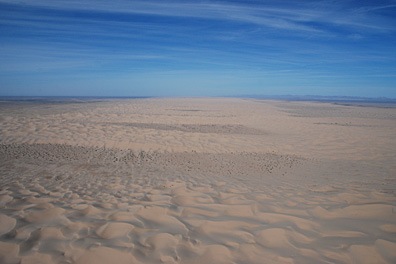
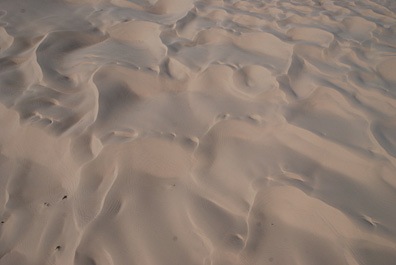
I took this shot over the Cactus Plains east of Parker, deep in the old training area. No tank tracks here — the ground is a sea of old sand dunes finally stabilized by the growth of small desert bushes and other vegetation. You can clearly see the patterns of the shifting sands. I included part of the instrument panel in this shot to give an idea of scale; we were flying at about 1,000 feet up, where Louis seems to be most comfortable. This shot also shows how barren the area is.
A short while later, we reached Parker, AZ, along the Colorado River. This shot shows most of the town. The end of the airport’s new runway is on the right. The mountains in the distance are in California. The river is always beautiful and blue here because of the filtering action of the Parker dam less than 20 miles upriver that forms Lake Havasu.
This shot is a view looking south from just south of town. The area along the Colorado river is a heavily farmed on the Arizona side here; farther south near Blythe, CA, the farming activity is primarily on the west side of the river, in California.
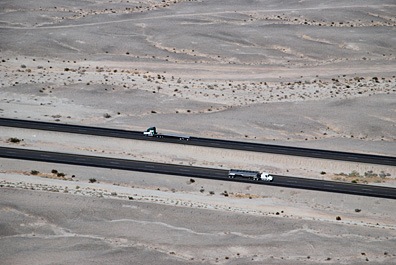
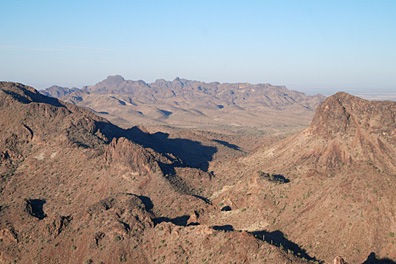
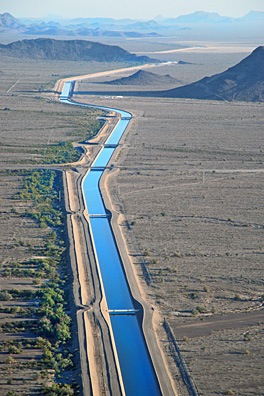
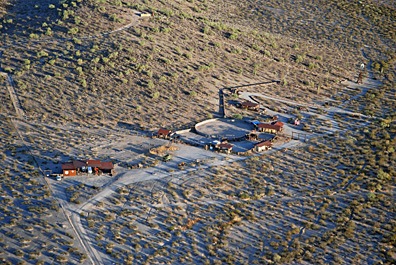
From Parker, we continued west toward Twentynine Palms, CA. This was probably the most dreary part of the flight — mile after mile of empty desert. I didn’t take many photos. This shot of Iron Mountain gives you an idea. The cluster of buildings is a “substation” (according to my charts), but I don’t know what kind of substation it is. The open canal winds its way to the base of the mountain and enters it there, coming out of the mountain on the opposite side. Are they generating electricity there? Or is it a pumping station? Either way, Louis and I agreed that it was weird for the canal to take a detour through the mountain when it could have easily followed the road. I’d love to learn more about this if anyone has info; I came up blank on a quick Google search.
We continued west. The area beneath us was now densely packed with homes. We passed south of Palmdale Airport, flying between the canal and the main road. A while later, we were climbing into the foothills of the mountains. We passed just south of the Gorman VOR at Grapevine and continued on up a valley. It was a pleasant flight between rolling hills covered with green and tan grass and billions of orange flowers. Beneath us were ranches and small lakes — and the same road Mike and I had driven on two years before on a trip to Napa, CA.
Once away from San Luis Obispo, we headed northwest, intersecting the coast at Morro Bay. Anyone who has driven the Pacific Coast Highway (the PCH; Route 1) can tell you how incredibly beautiful it is from the road. But that’s nothing compared to the view from 1,000 feet up, just off the coast. I took quite a few pictures; this is one of the funkier ones I took with my fisheye lens.
A while later, we took a detour past Hearst Castle at San Simeon. My camera was having trouble focusing through the Plexiglas — I really should have taken the door off — but I managed to get a pretty good shot of this monstrosity, despite the glare. Mike and I had visited it years ago and it really is amazing inside.
We continued north, hugging the coast. Although we were wearing life jackets — which insisted on — I didn’t want to be beyond gliding distance of shore. Louis, who lives and trained in Seattle, is used to flying over water; I’m not. If we had a problem, I wanted to come down on dry land. Of course, for much of the distance, the only suitable landing zone on the coast was the thin ribbon of the PCH. An emergency landing would not be pretty.
We flew past Monterey and Pebble Beach, cutting across the peninsula to save time. On the other side, the tower instructed us to head due north, right across the bay. We were about three miles offshore, only 1,000 feet off the water, when I started getting nervous. I asked the tower if we could either come in closer to shore or climb. (I really do hate flying over open water.) The controller sounded annoyed, but let us come back to shore. Then he cut us loose, telling us to call NorCal Approach. I was glad to be rid of the Monterey area.
So we climbed to 2,000 feet and I managed to get the Flight Service Station on the radio. I asked if the low cloud condition persisted all the way to the Golden Gate. She told me that her satellite image was not that detailed. So we decided to take a more inland route. When she told us she couldn’t give us flight following at our altitude, I volunteered to climb to 3,000 feet so she could see me on radar. I don’t think she was happy about it. She turned us over to NorCal Approach just as we passed Half Moon Bay. I was glad we hadn’t landed there for fuel, since the clouds had already covered half the runway.
NorCal approach gave us a squawk code and confirmed that it saw us on radar. Then it turned us over to San Francisco Tower. They asked us to climb to 3,500 feet. That’s like nosebleed territory for me, but we complied without complaint.
The view from up there was absolutely amazing, with the marine layer coming in from the west like a thick, white, wooly blanket. To the east, however, the airport and city remained perfectly clear. I got a few good shots as we flew through.
I also got a chance to show off my traffic information system (TIS), which only works in Class Bravo Airspace. It clearly identified a number of targets that we were able to see in the air. With the fog coming in through the Golden Gate, all the sightseers were out in their planes. The tower warned us about a small Cessna at our altitude as we approached the bridge area. He recommended that we climb, but since we were already a bit lower, I told him we’d descend. Louis dropped us down another two hundred feet and we passed behind him. I don’t even think he saw us. I really don’t like flying high because of the planes that are up there. There are seldom any planes down at 500 to 1,000 feet AGL.