Who Really Wrote the Blog Posts You Read?

Copyright infringement is far more prevalent than I thought.

This morning, while going through my weekly routine of checking out who’s been visiting my site, I found myself on another site that featured an article I’d written under another blogger’s byline.

My article, written back in March, can be found here: https://aneclecticmind.com/2007/03/29/how-many-sites-link-to-yours/. It’s a relatively short piece that includes a screenshot. The content thief not only stole every single word of the article, but he also stole the screenshot, which clearly shows my domain name in the Google results. Yet he didn’t even have the courtesy to mention that I’d written the article or link back to my site.

And the article included his byline, as if he’d written it.

I’m sure you can understand my anger at this. As stated in my © page:

The contents of this site are copyright ©1997-2007 by Maria Langer (except where otherwise indicated).

This Web site’s content is licensed under a Creative Commons Attribution-Noncommercial-No Derivative Works 3.0 License.

I have sent a takedown notice to him via e-mail. I copied the folks at Plagiarism Today, Google AdSense (since he is violating their terms of service), MyBlogLog (which he is a member of), his ISP, and my lawyer.

But this got me wondering: how much of the other content on his site is stolen? And how much of the content on sites we all read is stolen from someone else’s site?

Has your work been stolen and passed off as someone else’s? If so, please use the Comments link or form to tell us about it. Please don’t include the Web URL of the offending party — I don’t think thieves deserve free publicity.

8:30 AM Update: I received an apology from the thief. He claims he didn’t know it was copyrighted. (That still doesn’t explain why he copied it word-for-word and put his byline on it. I wonder if he went through school like that, too.) I sent him links to Plagiarism Today and Creative Commons, hoping to educate him.

Blog, Defined VERY Broadly

A definition I can live with.

I try very hard to follow a number of blogs. Unfortunately, there aren’t enough hours in a day for me to keep up with the ones worth following. But Deep Jive Interests is one of them.

In a post today, Tony Hung wrote an excellent rebuttal to Jakob Nielsen’s recent article urging people to write white papers instead of blogs. In it, he defined the term blog. From Jakob Nielson — With The Humblest Respect? You Don’t Understand Blogging, Sir. on Deep Jive Interests:

I like to define it in the broadest way possible, independent of the content, or things like comments. A blog is simply a way of distributing content in reverse chronological order.

Now this is something I can live with. It leaves bloggers open to write about whatever they like, using any format they like. And that’s what I try to do here — which is why this blog is such a hodgepodge of information and ideas.

I recommend Tony’s article. If you’re a serious blogger, check it out — and subscribe to the feed for his blog, Deep Jive Interests.

As for Mr. Nielsen…well, my opinion of him has dropped somewhat after reading “Write Articles, Not Blog Postings” on his site. Too bad he doesn’t allow comments on his site. I’m sure plenty of bloggers would help set him straight.

Twitter Sluts

A new term defined.

Okay, so maybe this isn’t a new term. And maybe I’m not qualified to define terms like these. But as I get an e-mail to inform me of yet another Twitter follower who has nothing in common with me, I came up with this term and felt a need to share it and its definition with the blogosphere.

A Twitter slut is a Twitter member who indiscriminately adds Twitter friends to his (or her) account. He may be doing this for one or more of the following reasons:

  • He’s believes that all of the people he adds as friends will reciprocate and add him as a friend so he has a large audience for his tweets. I discussed this phenomena in my “Twitter Spam” post.
  • He’s hoping that other people will respond directly to his tweets using the standard @membername format so other people will make him their friend.
  • He’s desperate to follow the tweets of anyone who can type intelligible comments into Twitter. That is a minority that I am apparently part of.

Twitter sluts can easily be identified by their friends to followers ratio. If that ratio exceeds 3:1 (that is, 3 friends for each 1 follower), that person is may be a Twitter slut. If the ratio is around 5:1 (5 friends for each 1 follower), that person is likely to be a Twitter slut. It the ratio is closer to (or higher than) 10:1 (10 friends for each 1 follower), that person is definitely a Twitter slut.

Twitter Ratio.jpgHere’s an example. This person has been a member of Twitter for only 9 days. Yet he’s added over 4,000 members as friends. With only 9 updates to his name, he has apparently attracted 398 suckers to reciprocate his friendship.
(Okay, okay. I’ll try to tune down the cynicism. But it’s very difficult sometimes.)

The other day, a Twitter member on the public timeline asked, “Am I the only one who gets a bunch of new friends every time I post a tweet?”

The answer: no, you’re not. Like the rest of us, you’ve just been discovered by a handful of Twitter sluts.

Twitter "Friendships"

Can following a person’s tweets make him a real friend?

Sometime last night or this morning — I can’t keep track with the time zone thing — Andy Piper posted a Twitter tweet with a link to an article by Clive Thompson about Twitter. Because the article reinforces something I’d mentioned in my most recent post here about Twitter, I thought I’d share it.

The key paragraph (as far as I’m concerned) from “Clive Thompson on How Twitter Creates a Social Sixth Sense” on Wired.com is this:

When I see that my friend Misha is “waiting at Genius Bar to send my MacBook to the shop,” that’s not much information. But when I get such granular updates every day for a month, I know a lot more about her. And when my four closest friends and worldmates send me dozens of updates a week for five months, I begin to develop an almost telepathic awareness of the people most important to me.

This is pretty much I was trying to say in the introduction of my post. But I can go on to say that even though many of these people started out as strangers, reading their tweets day after day have given me a certain awareness about them that a real friend — but perhaps not a good friend — would have.

Twitter as a Way to Make Friends

I see Twitter as a way to make friends across the world. Although, I don’t ever expect to ever meet most of these people in person, there is a chance that I might actually make real friends with one or two.

For example, I’m actively seeking out interesting Twitter members who live in Arizona to follow. By following their tweets, I can get a sense of what these people are all about. If we have a lot in common, it’s easy enough to take the next step to start a real friendship. And it’s easy enough for them to respond or ignore me.

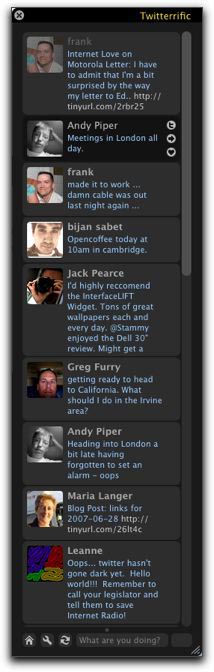
TwitterificI’m not talking instant friendships here. I’m talking about possibly months of watching tweets as part of my day. In my case, that means having Twitterific open on my Mac’s desktop and peeking at the tweets of a handful of people as they come in. I delete “friends” who really don’t seem to be on the same wavelength with me and add “friends” who might. Over time, the ones who remain on my desktop are the ones that could become real friends. If they’re in the area, why not get together for coffee or a hike or a museum trip?

It All Comes Down to Being Picky

It all comes down to using Twitter seriously, which I’ve discussed in at least one other blog post about Twitter. Use a Twitter tool (like Twitterific or some other program that selectively tracks tweets) to track only the tweets of people who interest you. Obviously, real friends should be included — if you can get them to use Twitter.

To find new people to follow, I’ll occasionally watch Twittervision and read the tweets posted in the US, especially in my area. I’ll add one or two “friends” to track for a while. I also use the Public Timeline to find interesting tweets and add corresponding Twitter members. In both cases, I limit my time to about 5 minutes — without setting a limit, either of these monitoring tools could suck hours away from your life.

My biggest problem: Most Twitter users are between 18 and 27 years old. That really shows in their posts. (Take that any way you like.) My goal is to find mature, interesting people to follow.

And, little by little, I think I’m building up a good group of Twitter “friends.”

But the question remains: will any of these people become real friends? We’ll see.