Snowbirding 2020 Postcards: Paddling with Penny

We take the boats out into the backwater.
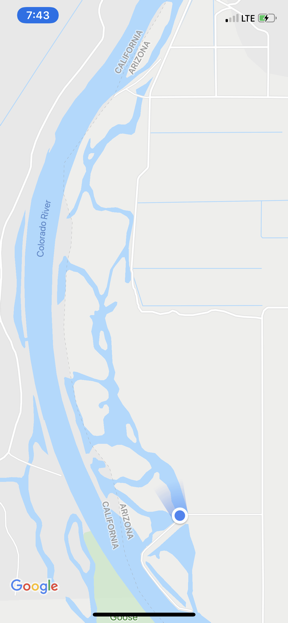
Backwaters
Here’s a Google Maps image of the backwaters in the area. Keep in mind that not all of the channels actually go as far as they appear to on the map due to the growth of tall reeds and bamboo along the shore. We’re at the blue dot.

One of the things I like most about our campsite this year is that it’s right on one of the longest backwater channels off the Colorado River. Last year I’d camped near this site, which has its own boat ramp, and had launched my inflatable Hobie pedal/paddle kayak into it, so I was already familiar with the waterway. I knew that I could go at least two miles north with very little current in either direction. It was perfect for a casual afternoon out in the kayak.

My friend Janet, who is sharing the same site, also brought her fishing boat along. It’s an inflatable one-seat affair — I’ll have to get a picture for a future post — designed for fishing. We both inflated our boats Tuesday afternoon and launched them, despite the chill in the air and a pretty stiff wind from the north.

Penny came along, of course, I prepped the boat by securing her fleece blanket on the bow so she’d have some traction when she stood or sat there. I also put her life jacket on so I wouldn’t have to worry about her trying to swim if she fell in. Because the water had virtually no current, I didn’t bother tethering her to the boat. She’s only fallen in once and that was a long time ago in my old kayak. I didn’t expect her to fall in today, but if she did, I knew she wouldn’t get swept away.

We headed out around 2 PM, with me pedaling and Janet rowing against the breeze. Penny soon settled down on the bow, which is when I got this photo.
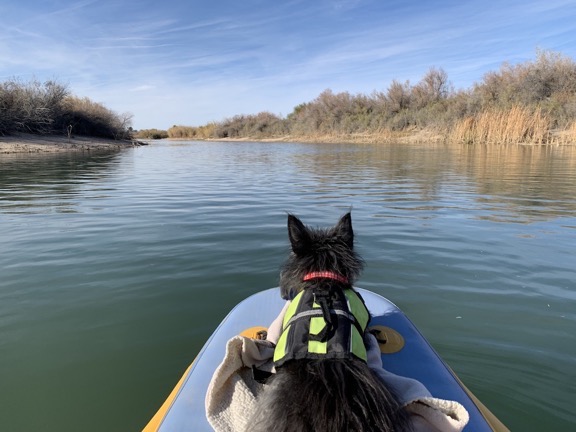
Tiny dog on bow of kayak
Penny the Tiny Dog settled down on the bow and remained in place for most of the trip.

We were out a lot longer than I think we expected to be. Janet’s boat goes fastest when she rows backwards, but that’s not always enjoyable so she kept switching. Also, her boat seemed to have a bit more trouble battling the wind than mine did. My boat, on the other hand, rode very well yesterday, with its speed wholly dependent on how fast I pedaled. It didn’t take much to get it moving at a decent clip. But I was cold when moving into the wind and I suspect I’ll suffer for that later this week.

We got nearly to the end — Janet wanted to see a fishing spot she calls “the walk in” from the water — and then turned around and headed back. Although we were looking forward to the wind at our backs, the wind didn’t cooperate. Instead, it died down. We didn’t get back until nearly 5 PM.

More pictures to come; we’ll be here for the next two weeks and I’m sure we’ll do a lot more boating.
Snowbirding 2020 Postcards: Another Colorado River Sunset

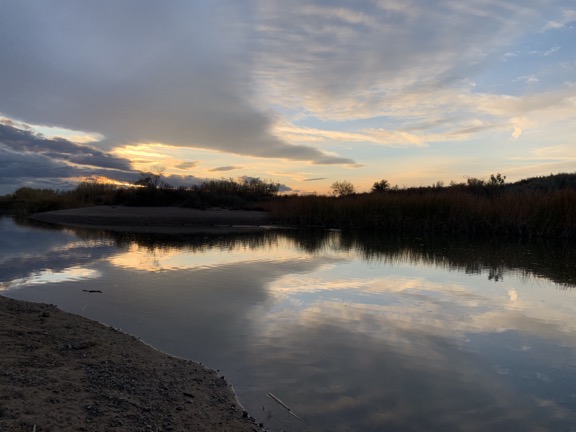
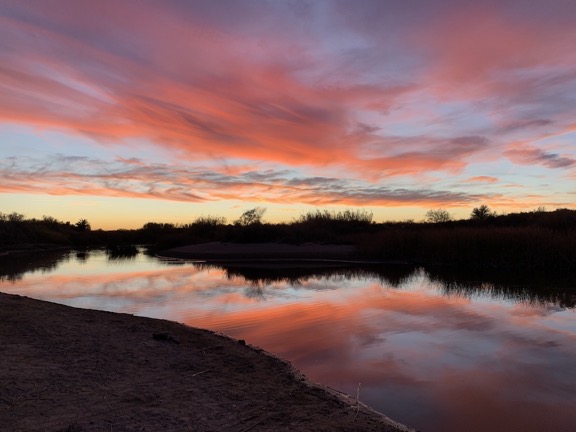
Another gorgeous sunset as seen from our campsite.

I’m going to try very hard not to share photos of every single beautiful sunset we’re seeing from our Colorado River campsite, but this one was too good not to share. With just enough clouds and smooth water to reflect them, Thursday’s sunset was the best I’d watched in a very long time.

Sunset 12/12/19
What a light show!

Snowbirding 2020 Postcards: The Cotton Field

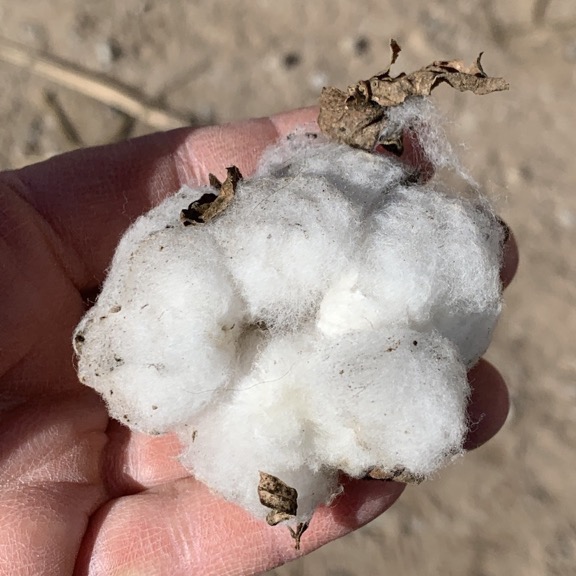
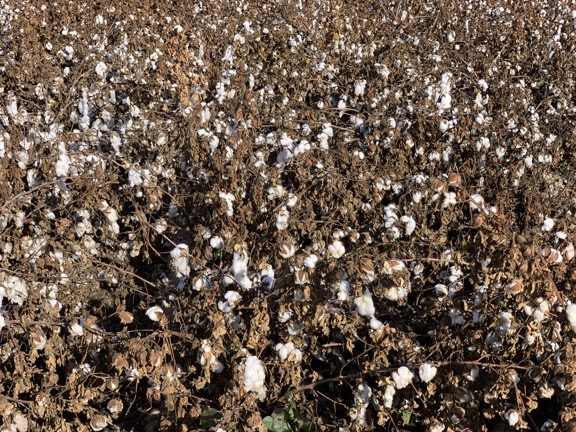
A closer look at a nearby cotton field.

From Wikipedia’s Cotton entry:

Cotton is a soft, fluffy staple fiber that grows in a boll, or protective case, around the seeds of the cotton plants of the genus Gossypium in the mallow family Malvaceae. The fiber is almost pure cellulose. Under natural conditions, the cotton bolls will increase the dispersal of the seeds.

We’re camped in BLM land a few miles south of I-10 in western Arizona. On our way to or from the campsite, we pass a cotton field (and an alfalfa field) that’s ready for harvest when we arrive. This year, for the first time ever, I stopped alongside it for a closer look before harvest.

It looks to me as if they either cut the water supply or apply a herbicide (as they do to potatoes) after the cotton bolls have formed. As you can see in the first photo, the plants are pretty much dead, although there was some green at the bases of some plants.

Cotton Field, Close Up
A close view of a cotton field.

I stepped into the field and grabbed a cotton boll for a closer look and to share online. I remember seeing cotton bolls like this packaged as souvenirs in tourist shops in the southeast. The cotton felt soft, like a cotton ball. (I don’t know why I found that surprising, but I did.) I knew that deep inside the boll were seeds that had to be removed to use the cotton, but I didn’t tear it apart to find them. I liked its natural look.

Cotton Boll
A closer look at a cotton boll. I found a tiny yellow spider in the middle of the boll.

I’ll try to get photos of the harvest, but it all depends on if I happen to be driving by when they’re working. I know this field is completely cleared by Christmas every year.

You can learn more about cotton production in the United States, which has a history closely tied with slavery, on Wikipedia.

Snowbirding 2020 Postcards: Colorado River Sunset

A late afternoon photo from this year’s campsite.

I managed to get an excellent campsite right along the Colorado River backwaters for this year’s December vacation with a friend. I must have arrived within a short while of the previous occupants’ departure — the tire tracks leading out were still fresh when I arrived. This is the site I’d been hoping to get; I can launch my kayak right from the site.

Backwaters Sunset
This is what Sunday’s sunset looked like from our campsite. The body of water is one of the longer backwater channels along the Colorado River; the water level rises and falls with water releases from the Parker Dam 50+ miles upriver.

First Show of the 2020/21 Winter Season

Not quite what I was hoping for, but I can’t complain.

I did my first show of the season this weekend. It was a Friday through Saturday show in Wickenburg, AZ and I signed up for a few reasons:

  • I wanted to maximize the number of shows I’d do before Christmas. This was the first full weekend in December.
  • My friend Janet was showing there. It would be nice to hang out with her.
  • It was in Wickenburg, where I had other friends I wanted to visit, including one who had two small packages for me.
  • It was free. Yes, there was no fee charged to vendors.

The event was the first “Cowboy Christmas” fair at Flying E Ranch, one of the few surviving “dude ranches” in Wickenburg. It was thrown together by a crew that had little show experience but tried very hard to bring it all together. In general, I think they did a good job, especially as a first effort. They managed to bring together at least 50 vendors so there was an actual reason for people to come.

I know Janet and our other friends (Steve and Karen) who showed their work were disappointed in the collection of vendors, though. They produce fine art paintings that sell for hundreds or even thousands of dollars and they were side by side with some booths that looked like they’d be better suited at a swap meet. My work isn’t quite as “fine arty” as theirs and there were enough vendors at my level or above to satisfy me.

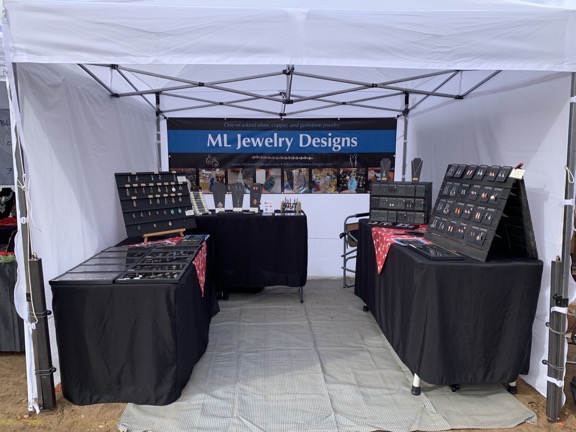
My Booth
Here’s my booth for the show. I had to put down my camper patio mat to provide a decent floor; the surface was well worn desert earth with just enough decomposed horse manure to give it character. What do you think of my new banner in back?

The bigger problem was the attendees. Friday was an absolute bust for me — I didn’t sell a single thing. Janet sold a few note cards. I think Steve and Karen might have sold a painting. (Their work is definitely western with lots of realistically painted horses.) There was some horsey event going on after we all closed; I didn’t know much about it and didn’t really care given that I was dealing with a cold and just wanted to rest.

Saturday was a little better. There was the annual Las Damas ride that day so there were plenty of women around — perfect audience for my work, you’d think. But although folks were looking, they weren’t really buying. I sold a silver ring early in the day and then nothing for a while. What saved me was a woman who came by wanting a pendant that matched a ring she wore. We found a stone in my collection that she liked and I made her a pendant while she walked around. Because they stone she picked was costly — $35! — the sale came to $74, bringing my daily (and show) total to a whopping $100.

As amazing as this might sound, I actually did better than Janet. I suspect that’s the only time that’ll ever happen.

Steve and Karen would up delivering a painting to some customers who had put a deposit down at an earlier show in Arizona. They were happy; they’d made some money and had two fewer paintings to pack up at the end of the show.

Of course, the show was free and they did feed us lunch every day. (I won’t go into detail on that.) And we were able to camp at the ranch walking distance from our booths for free. So I’d consider this first show a win — although a tiny one — with some revenue, free food, free camping, and no costs.

Would I do it again? It really depends on whether I have something better to do. The folks who set this up need to work on marketing if they want to do this again. A show with vendors is great, but not if you can’t get shoppers. Even though I had no costs to do this show, it’s a lot of effort to set up a booth and sit in it all day; I like to bring in an average of $250 or more per day (over show costs) on a show. And I really do think they need to be a bit pickier about what they allow to be sold. I can think of at least five booths that had no place being at a “Cowboy Christmas” event — folks setting up what looked like a garage sale. They really brought the overall quality of the show down to a level even I don’t want to be associated with.

My next show is in Phoenix and should be an entirely different kind of event. I’ll report back on that when it’s over.