John McCain’s Miracle Fence

McCain uses his vast ignorance to mislead the public.

Lately, the radio here in Arizona has been full of commercials for John McCain. You know. That Senator from Arizona who gave Sarah Palin her ticket to wealth and fame? The man with the creepy smile who lost to Barack Obama in the 2008 Presidential Election? The man who’s trying hard to stay in the public eye by speaking out against everything our President is in favor of, even when the President’s plan would benefit his constituents?

John McCain: Angry Old ManYeah. That guy.

Although I usually switch channels when a McCain commercial comes on, I actually listened to one yesterday. It was old Johnny, talking about his immigration plan. And what pissed me off was his promises to “build a fence” along the Arizona – Mexico border.

I’ve flown the Arizona border in a helicopter 300 feet off the ground from Yuma to Nogales — a distance of 230 statute miles. (There’s another 100 miles of border beyond that before you get to New Mexico.) Although the first bunch of miles are flat and already have some sort of fence, there are long stretches of mountainous terrain where the erection of a fence would be downright impossible. The landscape is rocky and rugged with towering cliffs and tall peaks. Other than white markers positioned more than a mile apart, the border is impossible to see. (I actually slipped over to the Mexican side during the flight because I couldn’t see the next marker.) It’s Sonoran desert, home to cactus, rattlesnakes, and coyotes. There are few roads on the U.S. side. It would take a miracle to build a fence there — and if one were constructed, it would be a crime against nature.

Arizona-Mexico Border

Yet John McCain continuously promises to build this miracle fence, leading people who haven’t seen the border first hand — 99+% of the population, including, no doubt, John McCain himself — to believe that such a task is not only possible, but it’s reasonable.

It’s neither.

In fact, even attempting such a feat would be a blatant misuse of public funds. Arizona’s own “Bridge to Nowhere.”

I believe that the Arizona-Mexico border is impossible to fully secure. Even if fences were built, they’d be cut, tunneled under, or torn down — as they already are. Illegals will get into the country from Mexico. That’s a fact of life in Arizona. Don’t get the idea that it’s easy to get it; it’s not. But it is possible and it will always be so — just as it’s possible to get across the Canadian border. Building a fence will not deter those who are serious about crossing the border.

What’s the answer? I don’t know.

But I do know that I’m sick of listening to John McCain mislead the American public into thinking that the solution is as easy as putting up a fence.

Flight Planning Realities

It’s more than just drawing a straight line.

Every week I get at least one weird helicopter flight request. Yesterday’s was for a flight from Scottsdale to Four Corners and back.

Four Corners

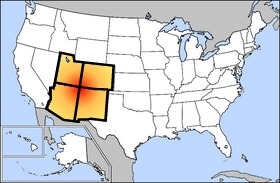
Four Corners, on a map. (Wikipedia image.)

When I say Four Corners, I’m talking about the place on the map where Arizona, Colorado, Utah, and New Mexico meet. In drawing their rather arbitrary state lines years ago, the mapmakers created this manmade point of interest: the only place in the United State where four state boundaries meet at one point. There’s a monument there that supposedly marks the exact point where the states meet. Tourists like to drive in and get down on all fours for photos with one limb in each state.

These days, the monument is managed by the Navajo Nation, which has land on three of the four states. The Colorado section is on Ute Indian land. I’m pretty sure there’s a fee to get in, but I could be wrong. I’ve driven past the point and flown over it, but have never stopped there.

So the passengers wanted to land at Four Corners, which is on Navajo land. That means I need permission from the Navajo Nation to land there. That’s the first hurdle the booking agent has to jump. (I won’t get permits for my passengers; I’ve wasted enough time trying for flights that didn’t happen.)

The booking agent evidently uses some kind of flight planning tool to estimate flight time. He estimated 2-1/2 hours each way. But the booking agent didn’t take into account the realities of endurance, refueling locations, weather, and FAA reserve fuel requirements.

I used SkyVector — highly recommended! — to come up with a basic flight plan — something I could use to estimate the cost of the flight. Its built-in aeronautical charts make it easy to identify places to stop for fuel if needed.

I learned that a direct flight from Scottsdale to Four Corners would take approximately 2-1/2 hours — just as he’d estimated. But this didn’t take into consideration the possibility of headwinds and my aircraft’s endurance. I roughly estimate 3 hours endurance on full tanks of fuel. But could I fill the tanks? I had no idea what the passengers weighed yet. And with my 20 minutes of required reserve fuel, planning a direct flight was not a good idea.

But what made it a really bad idea is that there is no fuel available between Winslow, AZ and Four Corners — a distance of 143 NM or 1-1/2 hour of flight time. Indeed, the closest fuel to Four Corners is 42 NM to the east — not on our way back — at Farmington.

My Flight Plan

SkyVector makes preliminary flight planning very quick and easy.

That meant I needed to plan three fuel stops: Winslow (INW) on the way up and Farmington (FMN) plus Winslow (INW) or Payson (PAN) on the way back. The resulting flight path is a narrow triangle totaling 549 NM and at least 5-1/2 hours of flight time. To be on the safe side, I’d estimate 6 hours.

This is what kills me about some of these booking agents. This particular one is based in Atlanta, GA. I can pretty much guarantee he’s never spent any time in an aircraft over the Navajo Reservation — which is where at least half this flight would be conducted. He has no concept of the vast distances and empty terrain a route like this would cover. He — and likely his passengers — can’t conceive of the utter boredom of six hours flying over this area. Sure, there are scenic parts, but not six hours worth. They’d be paying me close to $3,000 for this one-day adventure.

And all for what? A photo opportunity at a manmade “monument” in the middle of nowhere? Heck, look at it on GoogleMaps! There’s nothing there or anywhere near it!

Yet the booking agent will sell it to them if he can. And I’ll provide the service if it’s paid for.

I think the booking agent could do them a better service by selling them a Sedona tour or a trip up to the Grand Canyon. Or even Lake Powell, for Pete’s sake! Closer, cheaper to visit, and far more interesting.

Of course the weird requests of uninformed passengers or booking agents isn’t really my point.

My point is this: There’s a lot more to flight planning than simply measuring the distance between two points. The preliminary flight plan I cooked up here is just the first part of a lengthy planning process I have to go through if I get this job.

I have to admit that I find it a bit annoying when a booking agent oversimplifies the requirements of a flight — especially if he fails to inform his clients about what they’re getting into. In this case, it’s a long and expensive flight over the high desert of Arizona with very little of interest to see along the way.

PhotoJeeping: A Trip to Dragon Mine

I’m almost surprised we found it.

The wildflowers in the Sonoran desert around Wickenburg have been amazing lately — too amazing to ignore. So yesterday afternoon, I decided to tack a little PhotoJeeping excursion onto the end of my errands. Along the way, I picked up my friend Janet, who is an artist and likes photographing the desert almost as much as I do. We also squeezed in Jack the Dog and Janet’s dog, Maggie; they sat on the back seat beside the recycling bins.

Backlit Lupines

Lupines, backlit with late afternoon sunlight. (Click for larger view.)

At first, I’d considered another trip up Constellation Road. The last two times I was up there, the flowers hadn’t been blooming yet. Surely they must be blooming now. But when my errands called for a stop at the Shell gas station just south of town (they stock AeroShell aviation oil, if you can believe that), I thought about the desert southeast of Wickenburg. Dragon Mine was an old mine site I’d visited by Jeep years before with some friends. I thought that perhaps the juxtaposition of mining ruins and wildflowers might make a good subject.

Trouble was, I didn’t remember how to get there and hadn’t brought along my GPS.

So after one wrong turn that dead-ended in a subdivision, we tried another left turn off Grand Avenue and headed eastbound. The road wound through a subdivision and, at its east end, we spotted a dirt road winding down the side of a shallow canyon wall into San Domingo Wash. I followed the road.

Although this particular road had tire tread prints on it, the tracks were very close together. It wasn’t a Jeep road, it was an ATV road. It was painfully narrow at places — so narrow that I almost turned back several times. But I squeezed the Jeep through one narrow place after another, trying not to be bothered by the sound of branches scraping up against the side. I was glad I’d left the doors on; we would have been beaten up by thorny branches if I had taken them off. The floor of the canyon was rocky and then sandy and then rocky again, with short, steep climbs and tight turns. The Jeep, in 4H, performed admirably, as usual. The wheels spun just enough in those turns to give the illusion of a 90° turning radius sometimes. It was fun.

We stopped a few times to photograph flowers here and there. At one place, I captured a so-so image of lupines backlit by the sun, along with a shot of owl clover. The whole time, however, I was really looking for a trail that would take us out of the narrow track we were in. Something that would be easier to drive and get us to our destination — if we could find it — quicker.

Janet scouted ahead a one photo stop and found where the ATV trail climbed up a short hill to intersect with a nice dirt road. This was probably the road we were supposed to be on. I pulled up onto its relatively smooth and definitely wide surface, glad to be out of the wash.

We continued mostly eastbound, heading toward the low mountains in line with San Domingo Peak. As we drove, we kept a sharp eye out for the wildflowers we wanted to photography. The light was behind us and relatively low; it was nearly 5 PM and the sun would set in less than two hours. That gave us a great view of the scenes on either side of the road as we traveled east.

Strawberry Hedgehog Cactus

This “Desert Still Life” features a strawberry hedgehog cactus, the “skeleton” of a cholla cactus, a blooming creosote bush, and an iconic saguaro cactus, all under a perfectly blue Arizona sky. (Click for a larger view.)

I caught sight of a blooming hedgehog cactus about 100 feet off the side of the road and pulled to a stop. We got out and explored the area on foot. I’ve been trying hard to do all my photos with a tripod these days and although it’s a bit of a pain in the butt, I admit that I am getting used to it. After doing a few ho-hum horizontal shots of the cactus and its flowers, I scrunched down on the ground and took a look though the lens, holding it vertically. I liked what I saw. I made several shots, with and without a polarizing filter and at different angles to get the photo you see here.

There’s a certain feeling I get when I know I’ve captured a good image. I’ve felt it before, several times. I can see the image in the tiny video screen at the back of the camera, but as I age, my close vision is deteriorating so I can never really see it to be sure. It’s only when I get back home to my computer and can view it on a 24″ monitor that I know whether it’s good. I’ve been disappointed many times, but not this one. I’m very pleased with this image and think it might just be the best I’ve ever captured.

I didn’t know that for sure yet, so the rest of the trip was a slow drive toward our intended destination with me wondering whether I’d be disappointed. We made several stops and took more photos along the way. For a while, it seemed to me that the road was getting too close to the mountains. But then it swung to the north and we passed a big flat area that I remembered being south of the mine. A while later, we rolled up to the mine site and climbed out.

Marigold Steps

Desert marigolds bloom alongside the ruins of a long-abandoned mine. (Click for larger view.)

The shots I took there weren’t anything special. There’s a lot of concrete shapes, such as the stairs you see here, and plenty of metal and wood. There are two mine shafts — a vertical one at the top of a small hill and a horizontal one that enters the area from the small wash on the north side. They might join somewhere under ground; I don’t know and don’t plan on every finding out. (Exploring mines is dangerous, folks.)

It was nearly 6 PM when we were ready to move on. I was hoping to take a different and better route back. So we continued along a road that headed west from the mine. I was pretty sure it was the road I’d taken back on our last visit years before. But it swung around to the north and then the northeast. This was wrong. We wanted to head west or northwest. My gut told me to follow it, but my brain reminded me we were headed in the wrong direction. Sunset was in less than an hour and the light wouldn’t last long afterward. I told Janet that she should never allow me to take her out in the desert again without my GPS.

We followed the road for another five minutes. It headed east and north and northeast. Just when I was getting ready to turn around, it intersected with a broad, sandy wash. The tire tracks of previous travelers headed up and down the wash. Down the wash was west, so we made the left turn. I threw the Jeep back into 4H and we sped down the wash.

Topo Map

This topo map offers an overview of the path we took. I was able to map it pretty well using the points plotted by my GPS data logger. (Click to see a larger view.)

It was a long drive — maybe as many as 5 miles. The wash twisted and turned, but always headed mostly west. The sun, now very low in the sky, cast long shadows that shielded our eyes from the glare when the canyon walls were high, then blinded us when the canyon walls dropped. It turns out that we were in Monarch Wash. We passed through a gate that had been left open — without a “Keep Gate Closed” sign, we left it that way — and eventually wound up on Grand Avenue, about a mile north of where we’d turned off nearly three hours before.

It was a good little trip that might have been made better by having my GPS along. (Frankly, I still can’t figure out why so many people depend on them when traveling on paved roads with signs. But that’s another blog post.) Best of all, I managed to capture one of the best images I’ve made so far. That’s plenty of reward for the dust in my hair and clothes.
How a Tripod Can Make You a Better Photographer

My take.

Last month, my husband Mike and I went to a photography lecture at the Desert Botanical Gardens in Phoenix. (If you’re in the Phoenix area and have never been to the DBG, treat yourself; you won’t be disappointed.) The lecture was given by Arizona Highways magazine photo editor Jeff Kida and covered photographing wildflowers. (Jeff took the excellent portrait of me that you’ll find on this Web site and elsewhere; I wrote more about him and this photo in February.) We’d had a very wet winter and although the desert was greening up at the time, no one was sure whether we’d have a good wildflower season. So far, it’s turned out to be spectacular in certain parts of the Phoenix area, including Wickenburg, where I live.

Poppies and Desert Chicory

Desert chicory’s white flowers among golden poppies. (Click for a larger image.)

The lecture included a discussion of equipment and that equipment list included a tripod. I have a tripod — in fact, I’m ashamed to say that I have numerous tripods, far more than any one person should have. (I was always looking for the right tripod and have finally zeroed in on a good combination with a Manfrotto tripod and ball head.) And I agree that everyone serious photographer should have a tripod.

But then Jeff said something I’d never thought about. I wish I could remember his exact words. The gist was that using a tripod would automatically improve your photographs.

Whoa. This was something that interested me. Although I have all these darn tripods, I don’t use them very often. Maybe I should.

A Tripod Eliminates Camera Shake

I mostly use them for low-light situations when I absolutely must have a tripod. After all, a tripod’s main purpose is to hold the camera steady to take the shot. When used with a cable release (or similar device) or the camera’s built-in timer, motion from external sources should be eliminated. The final image should be clearer. But that was low light. Surely on a bright sunny day — just about every day here in Arizona — a tripod wouldn’t be necessary.

I also put a lot of faith in my camera’s VR (vibration reduction) lenses. I have two of them now and I can clearly hear the VR motor kicking in when I prepare to take a shot. Surely that would help keep my camera steady for each shot.

Poppy Blanket

A blanket of poppies and other wildflowers cover a hillside in the Sonoran desert near my home. (Click for a larger image.)

But since that lecture, I’ve been giving my photography a lot of thought. For the past two years, I’ve noticed a serious decline in the clarity of my photos. I was beginning to think it was the camera (a Nikon D80, now 3-1/2 years old) or my preferred lens (a Nikon 16mm-85mm zoom). Perhaps one or both of them needed adjustment or cleaning. I even went so far as to print out warranty repair authorizations for both of them in preparation for sending them back to Nikon for inspection, cleaning, and possible repair.

Perhaps the problem wasn’t my equipment. Perhaps it was me. Maybe I think I’m holding the camera steady for each shot or that there’s enough light to get the image, but maybe I’m moving the camera when I “snap” the photo by pressing down on the shutter release. Maybe I’m ruining my own photos. Or at least preventing them from being as good as they could be.

I decided to experiment by using my tripods and cable release more often. By ensuring that there’s no camera shake when images are being captured, I can eliminate camera shake as a cause of my problem. If the problem persists, I know it’s either bad focusing on my part or the camera’s. Since I don’t have the best vision, I trust my camera’s autofocus feature to get the focus right. So either I’m not telling the camera to focus on the right thing (my fault) or the camera can’t focus properly (the camera’s fault). Using a tripod would help me troubleshoot the source of the problem.

Using a Tripod Forces You to Slow Down and Compose Properly

Vulture Peak Poppies

This is my secret poppy place on the east side of Vulture Peak near Wickenburg, AZ. (Click for a larger image.)

I went on a photo shoot the other day out in the desert near my home. The poppies were blooming and I knew exactly where to find a lot of them. (Hint: Getting there requires a Jeep, ATV, or horse.) We took the Jeep out and found the poppies right where I expected them. We also found lupines, chicory, and a bunch of other flowers I didn’t even know existed.

The big problem with the site is that the flowers covered a steep hillside. Setting up a tripod was a royal pain in the butt. I admit that I cheated and took quite a few shots the lazy way. But then I remembered my mission and went through the bother of setting up my tripod and cable release and framing the photos. It slowed me down considerably. But I reminded myself that I wasn’t in a race. The best light was already gone for most of the day and the flowers weren’t going anywhere.

And that’s when I realized that using a tripod had yet another benefit: it forced me to slow down and pay close attention to what I was doing. It forced me to try harder to make every shot count. Because of all the extra time and effort required to make each photograph, I was motivated to put more effort into composition.

Could that be what Jeff meant?

The Jury is Still Out

The few photos on this post are among those I made that day. In general, I’m more pleased with the quality of the images. But I’m not done testing to see if the problem is with me or my camera. It’ll take more photo shoots with the tripod to convince me.

In the meantime, it’ll be interesting to see if I can shoot better photos just because I’m using a tripod.

Any thoughts on this? I’d really like to get some feedback from other photographers.

Walking the Fence

Part of ranch maintenance — even for our tiny “spread.”

About 10 years ago, interested in finding a summer place where we could go with our horses to escape the summer heat of the Phoenix area, we purchased 40 acres of ranch land in northern Arizona. Our lot at Howard Mesa Ranch is high desert land atop a mesa between Williams and Valle, AZ, about 40 miles south of the Grand Canyon.

Originally, we had high hopes of putting a vacation home up there. Our lot has 360° views that include Red Butte and the north rim of the Grand Canyon to the north, Mount Trumbull and its companion mountains on the Arizona strip to the west, Bill Williams Mountain to the south, and the snow-covered San Francisco Peaks to the east. We envisioned a 2-story home with a loft bedroom and big windows looking out over the views.

In preparation, we got a pair of water tanks, put in a septic system, and had the entire place fenced off with a 4-strand wire fence (smooth wire top and bottom, barbed wire in the middle per the CC&Rs). When we came up with our horses, they had 40 acres to wander and graze on.

But things change. We never built our vacation home. Maybe we will one day in the future, but I don’t know when that day will come. In the meantime, we camp out there on long weekends throughout the year. We’ve spent numerous July 4th weekends, several Christmases, and even one Thanksgiving at our off-the-grid retreat.

Like this weekend. We came up, mostly to check on the place and take care of some maintenance tasks. There’s a shed on the property that needs to be checked on regularly. And, of course, the fence.

Mike at Fence

Mike standing by the east side of our fence. That’s the San Francisco Peaks in the distance.

We walk the fence each time we’re up here. There’s over a mile of it, so it makes a nice walk. We’d put up the fence to keep our horses in, but now it worked primarily to keep the open range cattle out. I didn’t keep the elk out, though. They could — and did — jump the fence. Sometimes, their weight on that top strand of wire would shift the fence posts and bend the stays between them. Walking the fence meant repairing problems caused primarily by the elk.

In the old days, when we still had horses, Mike would ride the fence on horseback. He’d saddle up his horse and my horse would follow them. I’d busy myself with some other task, leaving them to get the job done without me. But with the horses gone, the walk would take longer. Jack the Dog wouldn’t be enough company for Mike. So I went along with them.

I carried a roll of wire, Mike carried the fencing tool. We walked the fence line, stopping occasionally to straighten stays, bang post deeper into the earth with a big rock, or tighten wires. It was easy to see where the elk had jumped the fence. It wasn’t just one or two elk, either. It was likely an entire herd. We didn’t mind the elk on our property. After all, they didn’t damage anything, like cows would.

Except the fence, of course.

Frost Heave

The southeast corner fence post. Over the years, frost heave has pushed the post up.

The fence had been professionally installed by a company based down near our Wickenburg home. They’d come up about a year after we’d brought the property and camped out until the job was done. The workers probably enjoyed being away from the low desert heat for a week or so. I wonder what they thought of the dark sky with its billions and billions of stars at night, or the coyotes that trot through the property as if they own it.

On the whole, the fence guys did a great job. Where they dropped the ball, however, is on the corners. Sure, they dug about three feet into the ground and secured those corner fence posts with concrete. But what they didn’t count on was frost heave, which is something you just don’t see down in the Phoenix area. Each winter, the ground freezes solid. As the soil freezes, it expands. It pushes up whatever it can to make room. Over the years, it has pushed the corner fence posts out of the ground. The fence is still sound, but the four corner posts no longer stand properly. One of these days, we’ll have to fix them.

Dead Animal

One of two partial skeletons we found while walking the fence.

Along the way, I caught sight of something odd about 200 feet from the fence. I went to investigate. It was the partial skeleton of a medium sized animal. Based on its size, skull, and the length of its neck, I think it may have been a young elk or perhaps a mule deer. There was no sign of antlers, so I don’t think it was an antelope. The bones had been picked clean, as you can see in this photo. The legs and entire hindquarters were missing. Mike found the lower jaw about 30 feet away. We think it may have been injured jumping the fence — or perhaps had starved when the ground was snow-covered — and the coyotes and birds had finished it off. Later, not far from the north side of the fence, we found another partial skeleton that also included the neck and part of the skull. Another unfortunate animal. I wonder how many others are within our 40 acres — or beyond it.

As we walked, it was clear that a lot of snow had laid upon the ground for a long time. The long, dried grasses were flattened out as if they’d borne the weight of deep, heavy snow for weeks on end. I could imagine animals jumping the fence, looking for food. I could imagine young or weak or injured ones dying, providing food for the carnivores and carrion eaters.

It took about 90 minutes to walk the fence and make the necessary repairs. By then, it had clouded up a bit and we were ready to take a break in the warmth of our camping shed. The job was done — until next time.