Could it be? A building on our place at Howard Mesa?

Our soon-to-be cabin was finally delivered to Howard Mesa.

If you’ve been reading these blogs for a while, you may know that Mike and I own 40 acres of “ranch land” at the top of Howard Mesa, about 40 miles south of the Grand Canyon. The place got a lot of coverage in last year’s blog entries because I lived in our travel trailer there while I worked at the Grand Canyon. During those months, I grew to hate the confined space of the horse trailer with living quarters and dream of a more permanent structure that we could go to at any time, without a lot of preparation, to get away from home.

Yes, I’m talking about trading life at the edge of nowhere for life in the middle of nowhere.

A vacation cabin. After all, that’s why we bought the place five or six years ago. As a place we could go in the summertime, to escape the heat. But also, as a place to get away to when we needed to get away. And I need to get away a lot more than the average person does.

The trouble with the trailer is its cramped space — half of its 35 feet is set aside for horse transportation — and the difficulty in getting it up there. Our last trip up there, in April, was difficult (to say the least) and cost me about $200 in repairs. As Mike attempted to drive up the unmaintained road to the place, the trailer’s left wheels dropped into a ditch, smashing the gray water release and the holding tank valve. Thank heaven the black water (sewer) tank’s valve or pipe weren’t affected! Then the right wheels dropped into a different ditch, smashing the drop-down step. Sheesh. Mike had his share of expenses that weekend when he skidded off another road at Howard Mesa and had to pay a tow truck operator $250 to get it out. I was my at my bitchy New Yorker best at the association meeting the next day, demanding that the roads be properly maintained. I must have scared them, because they have since made the road we use most of the time better than it has ever been. You know what they say about the squeaky wheel. And I really do know how to squeak when I have to.

After much debate on different options — including a single-wide trailer (yuck), a double-wide trailer (double-yuck), a “park model” trailer, and a custom cabin, we settled on a compromise: a portable building that could be fixed up as living space. We ordered a custom shed, with a loft, to be delivered right to Howard Mesa.

I won’t go into details about how the deliver was screwed up twice. I may have already griped about that in these blogs. If not, you’re not missing anything. Let’s just say that we drove up to Howard Mesa twice — a distance of about 150 miles from Wickenburg — to receive the shed and both deliveries were cancelled.

But third time’s the charm, right?

This latest delivery date was set for Saturday morning. The delivery guy (who sold us the thing), said he was going to leave Wickenburg at 4:30 AM to meet us at Howard Mesa at 9:00 AM.

My problem was a scheduling conflict: I had to be in Chandler, AZ at 1:30 PM to do an Apple Store appearance. Chandler is 140 miles south (as the crow flies, mind you) from Howard Mesa. By car, it’s about a 4-hour drive.

You can probably figure out what the solution was. We took Zero-Mike-Lima to Howard Mesa with the idea of flying directly to Chandler afterwards.

We left Wickenburg at 7:15 AM. It was a nice flight — smooth, cool, and uneventful. We were at Howard Mesa by 8:20 AM. But David — the person we were supposed to meet, wasn’t there yet.

We decided to fly to nearby Valle Airport for fuel. While the guy was fueling us, Mike called David. He hadn’t even made it to Flagstaff yet. (He was taking I-17 to avoid the twisty roads near Yarnell and Prescott.) I seriously doubt that he left at 4:30 AM. So Mike and I took the airport courtesy car (which evidently does not have a reverse gear) and went to breakfast in Valle. At 9:15 AM, just as I was spinning up, David called. He’d just turned onto route 64, just 15 miles south of our rendezvous point. Perfect timing. We passed the rendezvous point before David got there and found him about five miles down the road. He was hard to miss. The building was huge on the trailer behind his truck. It’s 12 x 24 with a tall, barn-style roof. I circled around him and raced back to the turnoff for Howard Mesa. I circled my landing zone near the road once to check for wires and wind, then set down. Mike got out and I took off again, before anyone could wonder what I was doing there.

Zero Mike Lima at Howard MesaI flew over Larry Fox’s place with the idea of offering him a ride, but didn’t see his truck outside. I think his wife was working in the garden. So I just kept going, up to our place on top of the mesa. I was there in less than 4 minutes. It would take Mike and Dave and the soon-to-be cabin considerably longer. I landed on the far edge of the gravel helipad we’d made the previous season and shut down. Then I made some trips to and from the helicopter to unload the supplies we’d brought: primer, paint, paint rollers, curtain rods, wood patch, etc. I opened the trailer and immediately smelled something nasty. A quick glance in the fridge gave me the bad news: I’d forgotten to take home that leftover prime rib from dinner the weekend before. Oops. It had become a science project. I brought it outside and went back into open some windows. Then I turned on the stereo and brought out a book with the idea of reading.

Instead, I took a few pictures and went down to open the gate. I came back and adjusted the pink ribbon we’d used to mark out the area where the building was supposed to go. It was a beautiful day: clear, calm, and cool. The three Cs. (Beats the 3 Hs anytime.) I was excited about the arrival of the building. And I really didn’t want to go to Chandler. I was prepared to spend the weekend. But that was not an option.

Shed on ApproachAfter a while, I heard the sound of a laboring engine. The sound seemed to be coming from the direction of the road up the mesa. I remembered how the road grader had been parked partially in the road and wondered whether they were having trouble getting around it. But there was nothing I could do so I just waited. Then I saw it: the building! It was moving past the big metal tank about a half-mile from our place. It was about a three quarters of a mile drive from that point. Then I saw it again, further along the road. Then at the “four corners” intersection. Then it was coming up the road!They turned the corner into our driveway without falling into the ditch at the end of our culvert. Then they squeezed through the gate — I guess it was a 16-foot wide gate after all. Then they were on their way up the driveway to our living area at the top.

David looked thrilled to be up there. He immediately got out of the truck and lit a cigarette. So did his companion. Then they got to work, with Mike’s help.

I noticed an SUV at my neighbor’s house. The only people to build near us put in a gawd-awful looking doublewide (double-yuck) right across the road from our place. Then the husband and wife decided to get a divorce and put the place up for sale. If I won the lottery (which I now play quite faithfully), I’d buy the damn place and donate the house to a charity just to get it out of my sight. The SUV was likely to be a Realtor’s with customers. As I watched, they pulled out of the driveway, came up the road, and pulled into ours.

Damn. Look what happens when you leave the gate open.

“Get rid of them,” Mike told me.

No problem. I began psyching myself up to deliver a New York style, rude reminder that the no trespassing sign meant what it said. The car drove up to me and I bent over to look into the passenger window. A nasty “Can I help you with something?” was in my throat, ready to emerge. But the SUV contained our friends, Matt and Elizabeth, who now live year-round on the other side of the mesa. Heck, they were certainly welcome! It was the first time they’d visited us. I swallowed to clear my throat and greeted them enthusiastically.
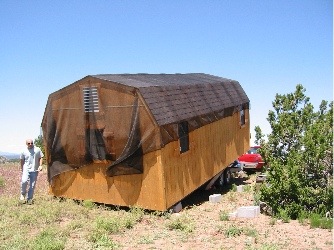
Delivering ShedThey joined me to watch Mike, David, and David’s Spanish-speaking helper as they positioned the trailer over the spot where the building was supposed to go. It was a nice spot — the same spot I’d parked the trailer the summer before — with views out to the west and easy access to the fire pit we’d built the first year we came to Howard Mesa. Then they tilted the bed of the trailer and started to move the truck forward, gently sliding the building down. A short while later, the building was sitting on top of the cinderblocks we’d bought to keep if off the ground.

David and his helper took the protective netting off the roof and remove the screws that were making sure the door stayed closed. And then Elizabeth stepped inside, becoming the first official visitor to our soon-to-be cabin.

Howard Mesa from AirOf course, the building still needed to be leveled. And it was about 11:30 AM, a full 30 minutes after the time we’d promised to start our trip to Chandler. David promised to level it and close the gate behind him when he left. Matt and Elizabeth left. Mike and I locked up the trailer, hopped in Zero-Mike-Lima, started up, warmed up, and took off. Mike got this great picture of the site as we were leaving. We’ll be moving the trailer closer to the soon-to-be cabin next time we bring Mike’s truck up there. It’ll probably go perpendicular to the building, facing south, so they can both access the same septic system pipe and water line. The idea is to live in the trailer while fixing up the building to add amenities like a tiny bathroom, kitchen area, and solar powered electricity. (Howard Mesa is “off the grid.”) By the end of the season, the soon-to-be cabin should be a cabin and the trailer won’t be necessary. At that point, we’ll probably sell it or exchange it for a smaller pull trailer that trades horse space for living space. I’m thinking of a 18-foot model with a slide out or pop-out bed.

At this moment, my plans are to return to Howard Mesa with the horses, Alex the Bird, and maybe Jack the Dog at month-end, after revising a book for Osborne, and spending the summer as a carpenter/plumber/electrician. Keep checking in to see how I do.
Aunt Stella’s Last Flight

I fly my first ash scattering mission.

I was sitting in Stan’s hangar down in the high-rent district of Wickenburg Airport, enjoying a latte with a bunch of pilots and their wives, when two men and a boy approached us. They were on foot, far from the terminal building, and appeared as if they were on a mission. I wasn’t surprised when they came into the hangar and one of them said, “Maria?”

“That’s me,” I replied, rising. I met them halfway to the table to see what they wanted without disturbing the others.

What they wanted was a pilot who could help them scatter their aunt’s ashes over Vulture Mine. That’s where her husband’s ashes had been scattered, from an airplane, years ago. I asked if they had the permission of the folks who owned Vulture Mine. They told me they didn’t. I told them that I’m sure the owners would say it was okay and that I wasn’t comfortable hovering over private property to scatter ashes without getting the permission. They told me they’d talk to the owners. Then they set up a time for the ceremony: 3 PM that day. And they left.

I rejoined the coffee gang and told them about the assignment. I mentioned that I was heavy on fuel and, because of the time of day and weight of two of the three passengers, I had too much fuel on board. I’d have to siphon some off. Dave offered me his siphon hose and fetched it from his hangar across the way. They we talked about the pilot who had landed very long and very fast in what looked like a King Air and how he must have needed to clean his shorts when he finally got his plane to a stop at the end of the runway.

I went back to my hangar and tried the siphon hose. But I’m a nervous nellie when it comes to sucking gasoline out of a tank, so I went to Stewart Hardware and bought a siphon pump. It was fancier than what I had in mind (which was a hose with a bulb on it) but it did the job. I also bought an 8-foot length of 4″ plastic duct, with the idea of using that to send the ashes on their way, and a long necked oil funnel. I went back to the airport.

The siphon worked fine, although I did manage to get about a pint of fuel on the hangar floor and my right pants leg. 100LL evaporates quickly, so it wasn’t a big deal. I filled my two 5-gallon storage cans and checked my fuel gauges. Much better.

Then I started fooling around with the hose. About an hour later, I had it secured at the vent for the door behind mine — opposite the tail rotor, of course. The vent was completely sealed off with white duct tape and the bottom end of the duct was attached to the skid, right in front of the front leg.

Oh, did I mention that I had to run back to Stewart Hardware for duct tape and wire ties? I did.

Why all this bother? Well, any pilot can tell you stories about ash scatterings and none of the stories are pleasant. Most have the deceased’s ashes coming back into the aircraft or, worse yet, flying around inside the aircraft when the container is opened in preparation for the scattering. I didn’t want these people’s aunt in my hair or my carpet. She deserved better than that. So I had to come up with a solution for getting her out without 1) causing a hazard to the aircraft and 2) getting all over the inside of the aircraft.

I looked at my ductwork design. I started imagining the helicopter in flight, doing 80 knots. I imagined the plastic duct tearing off. I imagined looking very unprofessional in front of my clients.

There had to be a better solution.

I made a phone call to Guidance Helicopters in Prescott to give them my credit card number for a 100-hour inspection I’d had done the week before. “Is John there?” I asked when I was done. I was told he was out on a flight. “Tell him that I called and that I’m doing my first ash scattering mission. Tell him I’d appreciate any advice he has.”

The guy who answered the phone told me what he knew about it. It seems that he was a CFI doing duty on Fridays at the desk. He advised using a paper bag and suggested that I put an M-80 in it so it explodes in the air, scattering the ashes. I hope he wasn’t serious.

I’d already decided on a bag. I’d sew one up out of fabric. We’d put the ashes in and I’d attach it to the skid. One of the passengers would hold the top closed, using a drawstring. At the right time, he’d pull out the drawsting and push out the bag. The ashes would go out the bag.

I needed to make a bag. So I locked up my hangar and drove to Alco, where I bought some flowery fabric, ribbon, fishing weights, glue remover, and two other things I didn’t need but bought anyway. I went home, took out my sewing machine and ironing board, and sewed up the bag, hand-stitching fishing weights into the top end, out of sight behind a hem. It looked pretty and functional. I drove back to the airport and, while I was on the road, doing about 40 miles per hour, dangled the bag out the window. It whipped around dangerously. I started to realize that the weights might cause more harm than good.

I showed the bag to Ed Taylor, my Wickenburg mechanic. He’d been in on every step of the process and had cut the funnel for me for the original design. Twice. He admired the bag but seemed doubtful about the way it would work. I was already doubtful.

I took the ductwork off the helicopter and cleaned off the duct tape residue with the glue remover. I fiddled around with how the bag would attach to the helicopter. I didn’t like any of the methods.

Plan C began to look like the only obvious solution. A paper bag. Toss it out with the top open and the ashes should scatter. But it couldn’t be any old bag — like Ed’s lunch bag. It had to be a pretty bag. I hopped back in the Jeep and drove to Osco.

By now, of course, the day was more than half gone. It was 2:00 PM and the clients were expected in an hour. I was nervous about the flight, primarily because I wasn’t sure about the solution.

I looked around Osco for a pretty paper bag and came up empty. Then I tried Alco. Bingo. They had a bunch of very pretty little shopping bags, designed for gift giving. I picked one with colorful flowers, paid for it, and started back to the airport. Again.

My cell phone rang. It was John Stonecipher. He told me the best thing to do was to put the ashes in a paper bag, bring the helicopter into an out-of-ground effect hover over the site, and toss out the bag. The bag would open and the ashes would scatter. No danger to the helicopter, no messy remains in your face. Although he hadn’t used this technique, a friend of his had when scattering the remains of a close friend. John was sure that this was the best way.

That made me feel a lot better. I returned to the airport with the bag and waited for my clients.

When they arrived, they were all dressed up as if they’d just come from…well, a funeral. They were quiet, but in good spirits. But they gave me quite a scare when I saw the little trunk one of the held. It looked as if it were alligator skin and it was large enough to contain about six copies of my latest book (720 pages a pop). My bag was not going to be big enough. But then they opened the trunk and there was a much smaller plastic box inside. It looked as if I still had a chance. And when they opened that box, I breathed a sign of relief. Aunt Stella, as they told me her name was, fit into a small plastic bag. She’d certainly fit in the pretty paper bag I’d bought.

We transferred most of Aunt Stella into the paper bag and one of the men held onto her. The rest of Aunt Stella went back into the plastic box and the alligator skin box and was stored in the trunk of the convertible they were driving. We went over to the helicopter, where it was waiting on the ramp. I’d already taken off the door for the seat behind mine. I gave them a safety briefing, described how we were going to release Aunt Stella, and we climbed aboard. The kid — well, all dressed up, he looked like a young man — sat up front because it was his first helicopter ride. The two men sat in back.

We took off and headed south. I pointed out a few sights of interest, but headed straight toward Vulture Mine, climbing the whole time. I wanted us to be at least 1500 feet up when we took care of business. Aunt Stella’s nephew asked me again how to release the ashes and I told him. Then I brought the helicopter into a high hover, one of the men said a few words, and Aunt Stella was launched.

“Oh, shit!” It was the man who’d tossed Aunt Stella out. “It didn’t open.”

I was watching the bag and saw it fall. It did indeed look as if it hadn’t opened, but I was sure it had. There’s no way it couldn’t have. I think the problem was that we were watching a brightly colored bag tumble through the air and the light colored ashes were just not visible. I assured everyone that the bag had opened. Next time, I won’t use such a bright bag. Then the ashes will be more visible as they scatter.

The bag landed right near Vulture Mine.

I asked if they wanted to circle once, and they said no. So I gave them a little tour of the area. I have a half-hour minimum for flights and this was an opportunity for my youngest passenger to turn a sad day into a positive experience. So we did a modified Grand Tour, returning to the airport about 30 minutes after we’d departed.

My passengers were satisfied, if not happy. They’d honored Aunt Stella’s wishes, to be scattered in the area where her husband’s ashes had been scattered years before. I like to image tiny particles of their remains mingling together right now, on the desert floor.

And, as one of the men said, “We got away cheap. Where else could you bury someone for two hundred bucks?”

Fifteen Years as a Freelancer

I realize (belatedly) that my fifteenth anniversary of being my own boss has just gone by.

May 29, 1990. That’s the day I left my last “real job” and began my life as a freelancer.

The job was at Automatic Data Processing (ADP) and I worked in the Corporate Headquarters in Roseland, NJ. I was a senior financial analyst, moved into that position after doing my required 2-year sentence as an internal auditor. I hated being an auditor, despite the fact that I was very good at it. No one likes a job where people are constantly trying to avoid you. Hell, men used to run into the men’s room when they saw me coming, just because they knew I couldn’t follow them there.

I’d been doing the 9 to 5 (well, actually 8 to 4 whenever possible) thing since graduating from college in May 1982. The ADP position was a good one, with benefits, a good paycheck, and a clear upward path in the corporate hierarchy. If I stayed and continued to play the corporate game — pretending, of course, that it wasn’t a game and that I liked it — I’d probably be some kind of vice president by now. I’ve seen the annual report — I still have 282 shares of ADP stock from the employee stock purchase program — and have recognized one or two co-workers in those coveted top-floor office positions.

But that’s not what I wanted. Heck, I didn’t want the corporate thing at all. I never did. I wanted to be a writer since I was a kid. My family pushed me into a career I showed some interest in, just because it would come with a big paycheck. Accounting was (and still is) something I enjoyed, but I wound up as an auditor and got burned out before I could escape. By the time I’d finally achieved the financial analyst position and spent my days crunching numbers with Lotus 1-2-3, I was sick of the whole 9 to 5 joke and tired of playing the games I was expected to play to move up. I wanted out.

My ticket to leave came in the form of a contract to write a 4-1/2 day course for the Institute of Internal Auditors (IIA). Ironic, isn’t it, that auditing got me into the corporate world and auditing got me out. There was a $10,000 paycheck attached to the contract, enough to keep me for a few months. I asked for a leave of absence, was told I couldn’t have it, and resigned. No hard feelings, just get me out of this place.

My mother freaked. How could I give up my career to be a writer? Watch me.

To help make ends meet, I got a job as a per diem computer applications instructor with a New Jersey-based computer company. The rate was $250 per day — not too shabby — and, at times, I would work as many as four days in a week. I averaged about 10 days a month and that really helped to pay the bills. They called me when they needed me, preferring their full-time employees because they were cheaper. They tried about four times to make me an employee and I kept turning them down.

I finished the course, wrote another one based on it, and got another job as an assistant trainer for a Macintosh troubleshooting course. That one had a nicer paycheck — $700 a day for two-day courses — and I got to travel all over the country. One year, in June, I did six courses in six different cities. I remember riding in the Club car of an Amtrack train on my birthday, admiring a rainbow as we approached the Delaware River from Washington, DC to Newark, NJ. Although I was allowed to fly to Washington, I preferred the train and took it whenever I could. It’s far more relaxing and comfortable.

Somewhere along the line, I started to write. First some articles for little or no money. Then a few chapters of a book as a ghostwriter. Then half a book as a coauthor. Then a whole book at an author. That first book with just my name on the cover came out in 1992 and I haven’t looked back since.

I did some FileMaker Pro consulting work for a while, too. I built a custom solution for Union Carbide. Not a big deal, but they needed me to update it each year and didn’t balk at $85/hour, so who am I to complain? I also did consulting work for Letraset at the same nice hourly rate. That was good because they were only 15 minutes from my house.

The trick to freelancing successfully is to not put all your eggs in one basket. I never — not once in 15 years — had only one source of income. I’d be training for two companies and writing articles. Or training for one company and writing books and articles. Or consulting and training. You get the idea. There was always more than one client, more than one editor, and more than one project in the works. Before I finished one book, I was negotiating a contract for the next. I remember one day not long after coming to Wickenburg when I signed four book contracts. Four, in one day. That was guaranteed income of $32K within the next six to eight months. And that didn’t count the other income producing tasks I was doing.

For some people, it’s difficult to stop getting a regular paycheck. I don’t recall it ever being difficult for me. I do remember the second year after leaving ADP having a dismal year and only making $19,500. That was a far cry from the $45K/year I pulled in that last year at ADP. But things improved quickly, I got out of that slump, and have since brought in considerably more every year. I’ve been pulling in six digits for the past seven years, a fact I’m rather proud of. I’m certain that I’m earning more now as a freelancer than I would have earned if I’d stayed at ADP to climb that corporate ladder. And I don’t have to wear a business suit or pantyhose to do it.

But no matter how you slice it, it’s not as smooth and easy as a weekly or biweekly paycheck. Advances come four to eight weeks after they’re due, royalties normally come quarterly, consulting clients pay a month after you bill them, magazines pay when they get around to it. You learn to earn first and collect later. You learn to avoid clients who don’t pay promptly, no matter how hard you need the work. If you’re good, you’ll find someone else who will pay on time.

The freelance life is not the easy life. Not only are you constantly on the prowl for paying assignments, but when you get them, you’re working your butt off to get them done on time in a way that’s satisfactory to the client. Anyone who thinks they can succeed as a technical writer — which is what I guess I am — without meeting deadlines and keeping editors happy is sadly mistaken. There are hundreds, if not thousands, of people out there who want the same job and all it takes is one who can do it a little better to get his foot in your editor’s door. I succeeded as a technical writer because I gave my editors what they wanted quicker than anyone else could, with a format and writing style that required very little editing or modification. My editors love me and, when they treat me with the respect I think I’ve earned, I love them right back.

By comparison, the cushy corporate job is the lazy way to earn a living. Show up, do what they tell you, collect a paycheck. No looking for work, selling yourself, and collecting.

Don’t get me wrong — being a freelancer gives me benefits that far outweigh those I’d have in a corporate job. No one is counting my days off. They’re not watching a clock, noting when I arrive late or leave early. I typically take one to two weeks off between books — if not more — just to clear my head. During that time, I goof off, fly, write blog entries, or go on road trips. Or all of the above.

But when I’m working on a project, I’m working long days, working hard in my solitary office. There’s no chat at the water cooler, no long lunches with friends, no personal telephone calls. Just work. I start at 6:30 AM and quit after 4:00 PM. Every weekday and more than a few weekends.

It’s a trade-off, but I don’t mind. I love it and couldn’t think of any other way to earn a living.

Last summer, I had the first real job I’d had since 1990. I was a pilot on a 7 on/7 off schedule at the Grand Canyon. I had to be at work at 6:55 AM and I worked until about 6:30 PM. Seven days in a row, with seven days off after that. It didn’t matter how busy we were or how much I was needed. I had to come to work and be there, all day long, even if there wasn’t a damn thing for me to do. Sometimes it drove me batty. I’d much rather sit in a cockpit and fly all day long than sit in a chair in front of a television. Some people liked being paid to sit around and wait. I didn’t. I hated it. But what bothered me the most was having to come to work on a schedule, even if I wasn’t needed. Such a waste of time. I don’t do that as a freelancer. I go to work when there’s work to do. When there isn’t, I don’t.

I suspect that I’ll never be able to work at a “real job” again.

But hell, I’m a freelancer. Who needs a real job?

Red Mountain

We “walk inside a mountain” near Flagstaff.

We spent Memorial Day weekend — or what was left of it after my Biltmore Apple Store gig — at our place on Howard Mesa. We bought 40 acres up there, fenced it in a few years ago, and added a septic system two years ago. This year, we’re adding a small, one-room cabin.

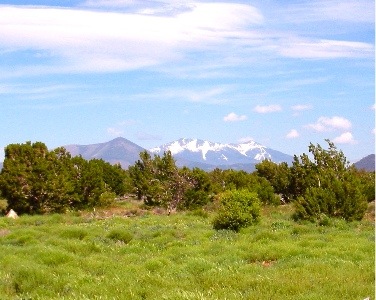
Howrd MesaHoward Mesa was beautiful. Or maybe I should say that it was more beautiful than usual. The grass was knee-high and green and the seed tops swayed with the wind. The San Francisco Peaks were still snow-covered, off in the distance. Best of all, we seemed to have the whole place to ourselves — as usual.
We spent Sunday doing odd jobs and relaxing around the camper. We went out for dinner that night in a restaurant in Parks, about 35 miles from our place. The place, called Rack and Bull, had probably been set up as a moderate-to-high priced dining experience that featured wild game, lamb, and ribs. It had since succumbed to the need to attract a wider range of clientele. The menu wasn’t anything special and they offered pizza. But the decor was very nice, the service was excellent, the food was good, and the value for the dollar was right on target. Why can’t we have a few places like that in Wickenburg? Heck, Parks must have a fraction of the population. But let’s not go there.

On Sunday, after a nice long walk, we decided to hop in the truck and take 180 toward Flagstaff. The idea was to take the aerial tram at the Snowbowl to the top of the peak. But I had a booklet called 99 Things to Do in Northern Arizona and it suggested a few more interesting things (as well as many far less interesting things). The one I was thinking about was headed “Walk Into a Mountain.” It appeared that northwest of Flag was a mountain that had collapsed long ago, forming a natural amphitheater filled with interesting rock formations, trees, and not much else. The booklet compared its formations to the hoodoos at Bryce Canyon. Sounded interesting to me.

We saw the place on the right side of the road before we saw the promised signs for it. I’ve been up and down that road over 20 times and various times of the day and night and I can’t recall ever seeing that mountain. But there it was, red mountain, looking exactly as the description promised.

We pulled into a parking lot that had about six other vehicles in it. Jack the dog was with us, but there weren’t any NO DOGS or DOGS ON LEASH signs, so I stuck his leash in my pocket and let him run loose. He’s very well behaved on the trail — better than Spot ever was — and he absolutely loves hiking with us. He runs ahead, chases rabbits, then comes tearing back to us, only to take off in another direction. He probably runs four times the distrance we walk, but that’s okay. He’s younger and in better shape. Mike took a bottle of water, which he hung on his belt loop with a bungee cord. (How’s that for high-tech hiking equipment?) Then we started the 1-1/2 mile hike to the opening in the mountain.

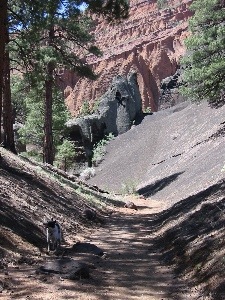
At Red MountainThe trail, which was wide enough for hikers, bikers (the pedal kind, that is), or horseback riders, was smooth and covered with crushed red cinders. In places, it was heavily eroded, but not enough to make walking a problem. That was a good thing, because I hadn’t brought hiking shoes. I was wearing my red Keds and that’s probably the only kind of surface I could have walked 3 miles on. The trail climbed gently most of the way. It wound through the trees, then dropped into a smooth-bottomed wash and climbed toward the mountain in that. Soon, we were in a canyon with slopes of dark grey volcanic gravel on either side of us. It was fine stuff, like the red cinders we walked on. There were a few interesting formations right at the mountain’s entrance. Beyond them, we could see the red hoodoos inside the mountain.
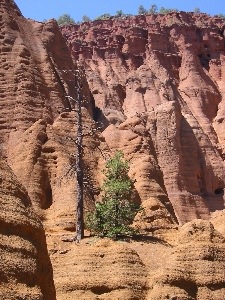
Inside Red MountainIt appears to me that Red Mountain had once been a plain old mountain. Volcanic activity on one side had caused black lava to spew out of the ground. This undermined the mountain, causing a slide that took out about 1/3 of the mountain side. The result was the amphitheater the booklet told us about. Of course, this is all conjecture based on what it looked like. There was no interpretive sign in the parking area or elsewhere and no ranger to explain what we were seeing. I could have it completely wrong.
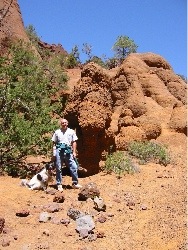
Inside Red MountainThere are two ways into the mountain, both of which were described in the book. At the head of the wash we’d been following, someone had built a neat rock dam. A ladder climbed the six or eight feet up to the top of the dam where silt had backed up, raising the ground to the top of the dam. That’s how we went. Jack took the ladder like a champ. The other way was to climb up over a gray cinders covered slope. That’s probably the only way you could get in with a horse. (I know my horse doesn’t climb ladders.) Our way was easier. Inside the mountain’s amphitheater was exactly as the booklet had described. Lots of rock formations made of red sandstone carved by wind and water, with a bunch of dark gray formations just to make things interesting. We walked up to the head of the canyon, passing a family having lunch with their dogs. One dog, a Corgi, came yapping out after us, followed by a dog that looked like a mix of every dog breed in the world. Jack had some sniffing with them, then followed us.
We rested in the shade for a while, taking in the view. I took a few photos. The sun was high and the light was harsh. But it certainly did remind me of Bryce Canyon. After exploring the area for a while, we headed back out the way we’d come. Jack was unbelievable on the ladder, taking it just like one of the Lassie actors. The return hike seemed longer, but it was almost all downhill. There was enough shade to make it a comfortable walk, even in jeans and a long-sleeved shirt. Back in Wickenburg, it was in the 90s; up in the mountains near Flag, it was in the 70s. It was the same, strong sun — some people argue that it’s stronger at altitude because you’re closer to it (I can’t make this stuff up) — but the cool mountain air made it pleasant.

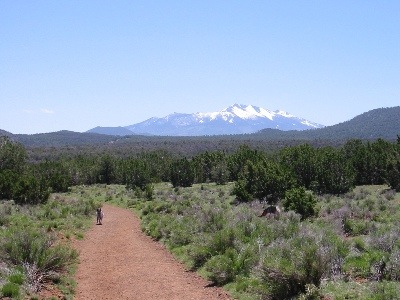
Jack at Red MountainI took this photo of Jack as we neared the parking area. It’s the new desktop picture on my laptop. That’s the San Francisco Peaks in the background; you can see Jack running on the trail, tongue hanging out, on the left.

From here, we headed over to the Snowbowl, where we took the 7-mile road up to the lift. We had lunch at the restaurant there while Jack the Dog rested in the car. We didn’t take the lift because 1) it was open-air, 2) it was windy, and 3) it was 25°F with the wind chill at the top. Instead, we sat and enjoyed lunch on the outdoor patio, watching people climb aboard the lift and watching other people climb off, shedding blankets and rubbing the warmth back into their bodies. We’ll return in the hottest part of the summer, take the lift up, and hike back down. It’s an elevation change of 2,000 feet (9,500 to 11,500) and I’m sure it’ll get my blood flowing.

As for Red Mountain, I’d like to return one day with my good camera and a picnic lunch. It’s the kind of place where a photographer can spend the day, moving from place to place to capture the formations with just the right light.

Return of the Toyota

My 1987 Toyota MR-2 returns to Wickenburg for an oil change.

“The oil pan is damaged,” the oil change guy in Prescott said. “I can’t change the oil.”

“Can I see?” I replied.

He escorted me to the secret underground chamber where the oil change guys who do the under-the-car stuff perform their magic. Everything was covered with a thin coat of oil that slicked up the bottoms of my Keds. I looked up at the underside of my 1987 Toyota MR-2 and marveled at how old, rusty, and dirty it looked.

“There,” the oil change guy said, pointing.

Pointing was not necessary. The oil pan was clearly bashed in. The bash was at least six inches across and four inches wide and probably reduced my total oil capacity by a pint. I was lucky it hadn’t bashed about two inches farther back, where it would have bashed off the drain bolt. Or that the rock that had done the damage hadn’t bashed right through the metal.

I pulled out my digital camera and tried to take a picture, but the battery was dead. Figures. How often do I get a chance to photograph the underside of one of my cars?

“I’m afraid I won’t be able to get the plug back in,” the oil change guy explained. “Sorry.”

We climbed up into the garage and he pulled the car back out into the Prescott sunshine. He took out the paper floor mat and plastic seat cover and left the car there for me to take away.

I went for a second opinion, pretending I didn’t know anything about the bashed in oil pan. A few minutes after they pulled the car into the garage, the shop manager came out looking upset. “I hate to break this to you,” he started.

“My oil pan is bashed in,” I told him.

“You know?”

“Sure.”

“Well, we can’t change the oil.”

“Because you’re afraid you won’t be able to get the plug back in,” I finished for him.

He looked stunned. I was a mind reader.

I drove off, now just about out of time. I’d gone up to Prescott to drop off my helicopter for service and had spent the day shopping, filling the Toyota’s passenger seat with all kinds of things. The oil change was my last task of the day. It had been over a year and 1,000 miles since I last had the oil changed and I didn’t want the car to feel as if I was totally neglecting it. (I got it washed last time I drove it, two months ago.) But no one would change the oil and now it was time to go back to get Zero-Mike-Lima.

I’d have to get the oil pan fixed. I wasn’t about to do that in Prescott. I’d bring it back to Wickenburg to the only mechanic the MR-2 loves: Dan.

But not that day.

I offloaded my purchases at the airport and stuffed them into Zero-Mike-Lima, then flew home.

This past weekend, Mike and I drove up to Howard Mesa to drop off our camper. We were supposed to have our shed delivered (again) but the holiday weekend made that impossible, so it was postponed (again). But on the way home, we had to drive right past Prescott Airport, where the MR-2 lives. Mike dropped me off and I hopped into the MR-2.

“Surprise!” I told it, as I removed the sunshades.

As usual, it started right up. I love that car.

We had dinner at a new Asian fusion restaurant in Prescott that I can’t recommend. The scores, based on a scale of 1 to 10, are as follows: Atmosphere/Decor: 8; Service: 3; Food Quality: 4; Value for Dollar: 5. We can cross that one off our list.

Then we drove home.

Now there are two ways to get from Prescott to Wickenburg. We call them the curvy way (White Spar Road – route 89) and the straighter way (Iron Springs Road). Mike wanted to go the straighter way, but we were in town, closer to get to the curvy way. It would have taken 15-20 minutes just to get to the other side of town. So I voted for the curvy way, presented my logic, and won. I led the way.

Now the Toyota may be 18-1/2 years old and it may have 132,000 miles on it and it may also have its original clutch, but it was born a sports car and it hasn’t forgotten how sports cars are supposed to perform on curvy roads. And I certainly haven’t forgotten how to make that baby perform. We took off on White Spar Road, settled into second gear, and screamed around every one of the curves. Fortunately, there was no one in front of me — I hate passing on double yellows (just kidding, officer!) — so there was no real reason to use the brakes. Just keep those RPMs up and let the engine do all the work. I had a blast. And I beat Mike to Wilhoit — fifteen miles down that curvy road — by about three minutes.

God, I love that car.

I waited at the side of the road in Wilhoit for him, then let him pull out in front of me to set the pace for the straight part of the drive. He set a quick pace: about 75 mph. The MR-2 handled it nicely. I’m glad he kept it below 80, because I’ve noticed a serious increase in fuel consumption when the speedometer needle moves past that 12:00 position on the dial. (Yes, 80 mph is straight up on that car’s dash.) The stereo, which had been tuned into a classic rock station based in Prescott, stopped picking up a signal, but the Scan feature locked in on a Dewey/Humbolt-based station that was playing late 1970s disco. I’m talking about We Are Family, Kung-Fu Fighting, Copacabana, and other big AM-radio hits from my early college days, when my tastes in music were somewhat confused by the Top-40 thing and my job at a retail clothing store. Although the stereo’s two back speakers are dead and I have them turned off, I still cranked up the volume so I could reminisce while driving 75 mph into a high desert sunset.

For the record: I don’t like disco. But listening to it for short lengths of time does bring me back to a simpler time of life, when I only had one car to worry about (a 1970 Volkswagen Beetle that would never be reliable) and having $20 in my pocket made me feel rich.

I started smelling something weird at Kirkland Junction. Engine smell. Now the MR-2’s engine is behind the passenger cabin — it’s a mid-engine car — so I don’t usually smell the car’s engine problems. I figured it was the car in front of me, which was Mike’s truck. I got a little worried about it, but there didn’t seem to be a problem because he was keeping up his pace, probably listening to some blues music as loudly as I was listening to disco on crummy speakers.

On one of my glances in the rearview mirror, I noticed some brown splashed on my back window. Shit. My MR-2 was bleeding.

I checked my gauges. Everything was fine. But the smell was still there and there was definitely some kind of fluid splashing up from the engine compartment’s vent onto my back window.

I flashed my lights at Mike’s tail end. He was grooving with the blues band and didn’t see me. I slowed down. I wondered if my cell phone would work up there. Then I came around a bend and saw that Mike had also slowed down. He started to speed up, but I flashed him again and pulled over. I came to a stop behind him on the shoulder and turned on my 4-ways.

“My car is bleeding,” I told him, stepping out. “I’m afraid that if I shut off the engine it won’t start.”

“Pop the engine lid.”

I did as he instructed.

“Oh, shit,” he said. “Turn it off.”

I turned it off. “What is it?”

“It looks like those guys who were going to do the oil change didn’t screw the cap on tight,” he told me.

The engine had been spitting oil out the filler cap, probably for the past five or ten miles. There was oil all over the top of the engine.

Fortunately, the cap had wedged itself on top of the engine. He got a paper towel from his truck and came back to the car, then pulled out the cap and screwed it on tight. Then he closed the lid.

“Start it up.”

I started it.

“How’s your oil pressure?”

“Low, I told him. “But it wasn’t low when I was driving.”

“Rev it up.”

I revved. The pressure needle climbed.

“It should be okay,” he said. “Keep an eye on it. And keep your RPMs down.”

We continued on our way. He kept his speed down to just around the speed limit. My oil pressure looked good. The radio station switched from disco to 50s rock. Ick.

I left the Toyota in the parking lot next to Dan’s place. Dan has a gate at his place that he locks at night.

Let me tell you about Dan.

Dan used to run a car fix-it place in Wickenburg called Dan’s Automotive. Mike and I took all our cars to him. He’s always been able to fix them and he doesn’t charge an arm and a leg. More than once I went to him with a stupid little problem when Mike was away — the kind of thing where someone knowledgeable about cars will just look at or listen to, adjust one thing, and the problem goes away — and he worked his magic on it without charging me a dime. He’s a laid back kind of guy, the kind of guy that Mike and I can deal with.

Then Dan sold the place to someone else.

I won’t mention names because I don’t have anything nice to say about the buyer. I continued to bring my cars to him. The Toyota was first. I had a nasty vibration at around 55 miles per hour that couldn’t be fixed with a tire balancing. He did something to it, and it seemed to be better. Then he asked if I’d ever had the timing belt replaced. The car had over 120,000 miles on it and I had to say no. He told me that the belt could go at any time and then it would be a costly repair. Changing it now could save money down the road. I bit and told him to change it. I also asked him to fix my air conditioner, which hadn’t worked right in about eight years. Four hundred plus dollars later, I got the car back. The air conditioning worked. But the car didn’t drive right. It had no power at all until I got to about 4800 RPM. Then the power kicked in. It was very noticeable in the lower gears. I brought the car back to him and told him about the problem. He had it for a few days and claimed to have fixed it. But he didn’t. The car now drove like shit and I was heartbroken.

I took it back up to Prescott. Every time I flew up to Prescott and drove the car, my heart ached. It had always been a sporty thing, one that was such a pleasure to drive. Now it drove worse than the VW Bug I’d had in college. And when I had a passenger on board, the added weight made things even worse.

To further add insult to injury, the air conditioner didn’t work very well, either.

Then we discovered that Dan had taken over the car fix-it place across the street from his old place. The guy he’d sold Dan’s to was not only a poor mechanic, but he was a poor businessman. He didn’t include a Covenant Not to Compete in the purchase agreement for Dan’s. Now Dan was back in business.

I brought the Toyota back down from Prescott to Dan at his new place and told him my sad story. “It’s breaking my heart every time I drive it,” I told him. “Please, please look at it and see what you can do.”

He did better than that. He fixed it. It appears that the timing belt was off by two notches. He set it the way it should be and the car was back to its fun-loving, tire-screeching, curve-blasting self. Woo-hoo!

So it was to this wrench-wielding hero that I brought the Toyota. I stopped in this morning to tell him why it was there.

“You know my Toyota loves you, don’t you?” I began.

He just smiled at me, probably wondering how such a wacko could be left roaming the streets.

“I tried to get the oil changed,” I said, “But they told me the oil pan was bashed in.”

“It’s been bashed in for a few years,” he told me. “You just have to work a little with the plug to get it back in.”

“Well, then can you just change the oil? And give it a look-over to make sure there’s nothing else wrong with it?”

“Sure.”

We talked a little about “restoring” it. It’s a kind of dream I have. Fixing it up so it looks like new. After all, it’ll be a classic car in just another six years. He was very non-commital, probably because he was wondering how such a wacko could be left roaming the streets.

“No rush,” I told him. “I’d like to have it back by Friday. It’s spending the summer in Williams.”

He promised to have it finished by then.

Now I’m thinking about the family photo I want to take: all my red cars and my red helicopter, together on the ramp at Wickenburg.

I’d better call the detailers. The Toyota and Jeep can really use a good cleaning.

As for the Toyota’s air conditioning, it doesn’t work at all anymore and probably never will.

June 3 Update: Apparently, the oil pan’s condition is worse than Dan thought. (I guess I bashed it a few more times since Dan last saw it.) He had to order a new oil pan from Toyota. Special order — can you imagine? So the Toyota will have at least one shiny part this summer. And this will be a costly oil change. Guess I won’t be driving it to my place on Howard Mesa anymore.