Flight to Sky Harbor…at Night

A pickup at the Terminal 3 helipad.

Last week, I had my first passenger pickup at Sky Harbor’s Terminal 3 helipad. This was an unusual gig for several reasons:

  • I’d only flown into the Terminal 3 helipad once before, and that was with a flight instructor. I’d asked for the flight so I could learn the approach in case I ever had to do it. A full year went by before I had a call for a pickup there.
  • The Terminal 3 helipad is on top of Terminal 3 (hence the name), in an area that’s in the middle of the top level of a parking structure. To reach it, you have to cross one runway (from the north) or two runways (from the south) where commercial airliners are landing and taking off. (The airport diagram below shows its location beside the Control tower in the middle of this busy Class Bravo airport.)
  • This particular pickup was at 8 PM. Since it was February, that means it was night.
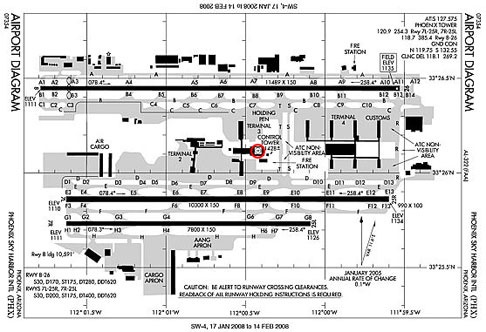
Sky Harbor Airport Diagram

So I was going to land at a helipad I’d landed on only once before, at the top of a 6-story building, in the middle of busy airport, at night.

The terminal 3 helipad is far more convenient for my passengers than where I usually land on the southwest corner of the airport at one of the FBOs. (I usually use Cutter, but Swift is there, too.) Landing at an FBO requires my passengers to get a free shuttle from their terminal to the FBO. You can’t beat the cost, but the amount of time you wait for the shuttle and then ride it takes away from the convenience of being picked up at Sky Harbor and whisked to your destination. My passengers were arriving via U.S. Airways (formerly America West), which had gates at Terminal 4. They’d still need to take a shuttle to meet me, but at least they didn’t have to go around the airport to do it.

The Flight

My passengers were supposed to land at 8:07 PM. I figured that by the time they got to the gate and retrieved their luggage, it would be at least 8:30. Then at least 15 minutes to get to me. Still, I don’t like to make people wait for me, so I decided to get there by 8:15 PM. That means I needed to start up at Wickenburg Airport by 7:30 or so.

Mike dropped me off. I’d pulled the helicopter out and fueled it up earlier in the day so it was sitting on a helipad, ready to go when we arrived. There was still a little glow to the west where the sun had set. Mike waited until I took off. Our friend Dave pulled up in his Jeep and chatted with him while I warmed up the helicopter. Then I took off, turning on the runway lights as I lifted off. I climbed to 3,000 feet and turned to the southeast where I could see the glow of Phoenix.
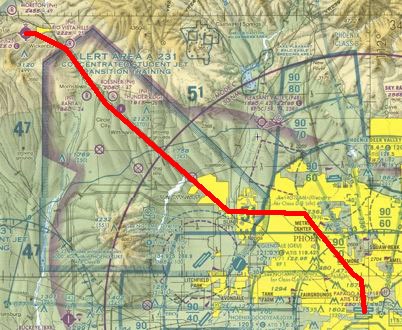
Route to PHXMy flight path would take me from the darkness of Wickenburg along Route 60 (Grand Avenue) to Bell Road. By then, I’d be in the brightness of the Phoenix area, flying at about 2,000 feet in over its lower elevations. I planned to turn east along Bell Road and follow that to I-17. I’d call Phoenix Tower from the Metro Center Mall at I-17 and Dunlap.

Yes, I follow roads.

The flight worked just as I intended, although I did have to head southeast toward the mall sooner than I expected to avoid Deer Valley’s airspace. It wasn’t worth calling them for the 3 minutes I’d be in their space, so I just avoided it. My GPS made it easy to see where the space was so I didn’t slip in by mistake.

I’d been listening to Phoenix Tower talking to the incoming airliners since I was 20 miles out. I had nothing else to listen to. I’d purposely left my iPod behind so I wouldn’t be distracted by it. I don’t fly at night that often — maybe once or twice a month — and I was nervous about flying into the helipad at night.

Don’t think you can recite what I’ve written here to land at the T-3 Helispot. In March 2012, the tower management at PHX realized that a lot of pilots were claiming they were signatories to the Sharp Echo letter of agreement when they, in fact, were not. As a result, they instituted a new letter of agreement and required all signatories to attend a meeting at the tower. If you plan on operating a helicopter in the Phoenix Class Bravo airspace, you need to meet with Phoenix tower management and get signed up with the new letter of agreement to take advantage of the options it offers pilots.

I tuned my transponder to 0400. “Phoenix Tower, helicopter Six-Three-Zero-Mike-Lima is over Metro Center Mall, Sharp Echo with November for landing at the Terminal Three helipad.” This call to the tower identified me and my position, indicated that I was a signatory to the Sharp Echo letter of agreement for helicopter pilots, verified that I’d listened to the airport’s ATIS recording so I knew conditions, and state what I wanted.

The female controller’s voice came back in a moment. “Helicopter Zero-Mike-Lima, squawk zero-four-zero-zero and ident.”

She was telling me to tune my transponder as I already had and press the Ident button. That button makes my radar blip brighter than the others for a short time so she can see which blip I am.

“Zero-Mike-Lima is identing,” I said, pressing the button.

I was still quite a distance from her space, so I continued, now heading southeast. Hopefully, she’d see me and clear me to enter the class bravo airspace. But she didn’t. Instead, she gave some instructions to incoming airliners. I waited about two long minutes, then pressed the Ident button again, convinced that I was flying too low for her to see me.

“Helicopter Zero-Mike-Lima, say position again.”

“Zero-Mike-Lima is about three miles southeast of Metro Center.”

“Helicopter Zero-Mike-Lima, radar contact. Cleared into Class Bravo airspace. Proceed via Sharp Echo to midfield for crossing to Terminal Three helipad. Remain north of Runway Two-Six.” This call verified that the Tower could see me on radar and gave me the all-important clearance into the surface airspace. It also told me how I should proceed inbound: toward the airport, north of midfield.

I confirmed that I’d received the instructions by reading back the most important ones: “Zero-Mike-Lima proceeding. Will remain north of Runway Two-Six.”

I continued on my way, now looking for the airport. I was still at least ten miles out and all I could see were lights. After a while, I could see airplanes coming in for a landing and airplanes departing. I figured the airport had to be between them. My GPS confirmed that, but I really wanted to see where I’d be going.

I also wanted to see the tower. The Terminal Three helipad is less than 100 yards west of the tower. If I could see the tower, I could find the helipad. I wanted to make my approach directly to the helipad to minimize my time over the runway.

I heard the incoming jets talking with the tower as I continued in. One of them was being told to wait in the holding area. The pilot came on the radio and said, “Tower, we have a medical emergency and need to get to the gate immediately.” She cleared him to the gate.

I was three miles out and down to about 1500 feet when I saw the tower quite clearly. I adjusted my course. A moment later, the controller came on the radio again.

“Helicopter Zero-Mike-Lima, do you have that Airbus on short final in sight?”

“Zero-Mike-Lima has the traffic in sight.” How could I not? Two bright headlights were about a quarter mile from the runway end, closing on it quickly.”

“Helicopter Zero-Mike-Lima, cross behind that traffic and cleared to land at the Terminal Three Helipad.”

“Zero-Mike-Lima crossing the runway behind the traffic.”

I adjusted my speed to reach the runway just as the airbus passed by me and began my descent. I was already pretty low, so my descent wasn’t very steep. I crossed the runway with the quickest glance at the landing lights of about five more jets on their way in. I felt my cell phone vibrate and ignored it.

At first, I couldn’t see the helipad. I saw the rooftop parking structure and headed toward it. I was about 50 yards away when I saw the lighted helipad. I glided over to it and set down diagonally in the square, unsure of where my passengers would be coming from. I don’t like to park with the helicopter’s tail rotor facing where people might be walking or waiting.

It wasn’t until later that I saw the tri-colored rotating beacon in the southwest corner of the area that identified a civil aviation helipad. It was the first time I’d ever seen one.

On the Helipad

I cooled down the engine and shut down. A message on my cell phone was from my passengers. They’d landed but couldn’t get to the gate. It turned out that their gate had been handed over to a plane with a medical emergency. (I can’t make this stuff up.)

The terminal 3 helipad is a big, square landing area on top of the building. There’s enough room for one helicopter. If a helicopter is sitting on it, no one else can land on it. For that reason, a helicopter pilot who is parked there cannot leave the area.

Of course, I had my engine shut down and my radio off. If they needed me to move, they’d probably have to get someone out there to tell me. There was a security guy watching me for the first fifteen minutes or so of my wait. But then he got as bored as I did and, able to relocate, did.

I was aware of a few things up there. First, the smell of burning rubber. At first, it was so strong, I thought it was my helicopter. But then I realized it was the smell of the tires of the big planes heating up as they hit the tarmac on landing. The wind was blowing the smell from the south runways right to me. Not long afterward, I started smelling their brakes, too.

I was also aware of how nice the view is from up there. Great view of most runways. Phoenix skyline off to the northwest. The lights of Phoenix’s urban sprawl spread out in every direction around me, punctuated by blackness where rocky mountains rose too steeply to build upon. The antennas atop South Mountain looking like so many floating red lights. A nice breeze blowing kept the air feeling fresh and clean (despite the tire/brake smell).

The helipad is an excellent place to hang out and watch traffic come and go. It was quite entertaining — at least for the first fifteen or twenty minutes. Then it got just plain boring. I spent some time tweeting updates on Twitter and reading what others were writing. The Oscars were on television and most folks seemed tuned into that.

After about 45 minutes, I called my passengers again. They’d retrieved their luggage and were now waiting for the van from the guest ranch they were staying at to come pick it up. I guess I should explain. There’s enough room in my helicopter for them and some small pieces of luggage, but not enough room for them and enough luggage for two people for two weeks. It turned out to be cheaper and easier to have the ranch send a van down for their bags than to book them on another charter carrier. This was also a good idea in case the weather turned bad and I couldn’t come get them at all. They could always take the van to the ranch. Why not just take the van? My client wanted to fly and he didn’t even care that he’d arrive at the ranch before his luggage. (Why can’t I have about 20 clients like that every season?)

I told them to have the van drop them off at Terminal 3 as it was leaving the airport. This would save them the hassle of catching the Inter-terminal shuttle bus. Then we hung up and I went back to waiting.

The Flight Back

My passengers arrived suddenly about 15 minutes later. I greeted them and bundled them on board, seating them both on the left side. I planned fly fly past downtown Phoenix on the way to Wickenburg, to give them a little night tour of the area. I started up and warmed up the engine, listening to the ATIS recording before switching to the tower frequency. I must have timed it just right because when I requested a departure to the northwest past downtown Phoenix, she immediately cleared me across the runway. I saw the landing lights of at least another five jets bearing down on us as I scooted across, climbing.
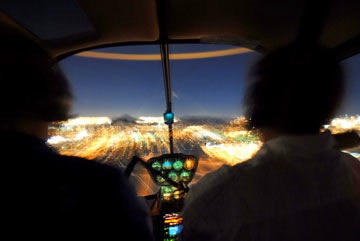
Phoenix at Night by Jon DavisonAfter clearing the runway area, I turned to the west. The roof on Chase Field was open and there were some lights on in there. Maybe they were doing some kind of maintenance. I didn’t fly close enough to see. I turned north to follow 7th Street past the tall buildings, then headed northwest. I wanted to hook up with Grand Avenue again before we left the brightness of the city. This photo by Jon Davison gives you an idea of what it might have looked like from the back seat.

The flight back was uneventful. As we reached Sun City and left the lights behind us, a sort of haze seemed to fill the cockpit. The first time I’d experienced this phenomena, it had scared me. Now I knew what caused it: my eyes adjusting to the lower light levels. I dimmed the cockpit’s instrument lights even more to prevent reflection on the inside of the bubble. My passengers were awed by the darkness we had to fly through.

Then we could clearly see the line of white that marked route 93: cars returning from Las Vegas on that Sunday night. They’d pass right through Wickenburg. We followed route 60 at an altitude of about 3,000 feet into town. Then I turned along the dark corridor of Sols Wash, keyed the mike button, and brought the airport lights to life. A while later, we were on the ground on one of the two helipads and Mike was driving up to give them a lift to the ranch and bring me home.

It was just after 10:00 PM.

This particular flight will be one of those that stays with me for a long time. Not because it was frightening or dangerous or beyond my skill level. It was none of those things. But it was a new experience that offered new and unique challenges. Any time I take on a reasonable challenge and succeed, I learn and become a better person.

And when it’s a flying challenge, I become a better pilot.

On Small-Minded, Nasty People

And why I have no use for them.

This morning, I reviewed an interesting comment left in this blog’s Guest Book. It had been held for moderation, which means I have to review and approve it before it appears online.

Nasty for No Reason

The comment was one of the nastiest I’ve ever read. The person who decided to try to ruin my day told me that this site was like a garage that needed clearing out — or something like that; I didn’t preserve his words for posterity. He told me I should delete anything over six months old. He said he’d come to find information about my books but that he wasn’t willing to use the “convoluted” (his word) methods needed to find content here. He finished up by saying he was an editor — imagine that! — and that he now has no interest in any of my books.

Whew!

He evidently forgot to mention the problem with his eyesight that prevented him from seeing links clearly marked “Books” and “Articles” in the NavBar at the top of the page. He also appeared to miss the note in the description of this site — which appears “above the fold” on the Home page — that clearly said support for my books had been moved to Maria’s Guides. And that Search feature at the top of the site navigation column — I suppose the label “Search This Site” isn’t clear enough. And I guess I couldn’t expect him to scroll down on any page of the site to see the list of books supported with the links to content related to those books.

Convoluted? The only way I could make this site easier to navigate is to take control of his computer while he’s online here and guide his mouse to the link he needs.

He probably spent more time wording and editing his comment than he did looking around the site for the content he evidently wasn’t so interested in in the first place.

I deleted his comment, as I do with any other nasty comment that serves no purpose other than to rudely criticize me or someone else. I think that if he had presented his opinions more courteously, I would have given them some real consideration. But since his comment was obviously posted as a personal attack on me, I threw it away with the rest of the crap I encounter online.

On Bottom Dwellers

But it reminded me that there’s a lot of bottom-dwellers out there, looking to bring other people down to their level. The Internet is full of them and the worst thing you can give any of them is a keyboard and a form to fill in with their rude and destructive comments. I know bloggers who have turned off the commenting feature on their blogs because of the amount of crap like this that they get. Other bloggers let it run rampant in their comments, letting it feed the other bottom dwellers lurking out there until there’s nothing mature or civil about their blogs. As we’ve seen in the past, that can quickly get out of hand.

What these bottom-dwellers clearly do not understand is that my blog is mine. I decide on the design, I decide on the content, I decide on how long to keep blog posts, I even decide whether a comment is appropriate on a post. If he doesn’t like my site, he can go somewhere else — there’s enough content out there for everyone. As my mother would say, “Don’t let the door hit you in the ass on the way out.”

POV from Helicopter, Test Video

Here’s the first video I shot with my POV.1 camera from my helicopter.

I mounted the camera on the bar between the two front seats, using a camera mount I’d bought a few years back for my camcorder. I pointed it pretty much straight out the front. This is the view someone sitting in the back would have if he stuck his face between the two front seats.

The best I could do for sound was to run a small tape recorder microphone into the earpiece of my headset. This works by picking up all the sound I hear and has the added benefit of muffling the aircraft noise. The microphone goes directly into the Mic port on the POV.1. You’ll hear me and Ed talking about the video and various things around town. You’ll also hear all radio communications.

The original video was 14 minutes long — the amount of time it took to take off from Wickenburg, swing past the west side of Vulture Peak, fly over Vulture Mine, fly past the east side of Vulture Peak (low), and land back at the airport. I edited out about half of it.

I know it isn’t the greatest video, but it is my first try. (Be gentle with your comments.) I’m hoping to build up a little library of clips and someday turn them into something good.

Thinking Outside the Book

A print author’s revelations about electronic book publishing.

As the print publishing industry suffers the pain of ever-higher costs and competition from other media, I’ve been doing a lot of thinking about electronic books or ebooks.

You’re probably familiar with the concept. An ebook is roughly defined as text and image content — like you’d find in a traditional printed book — that’s distributed as a computer-compatible file or series of files. So rather than read the book on paper, you’d read it onscreen.

KindleRecently, Sony and Amazon.com have been pushing their versions of existing titles as ebooks for their Sony Reader and Amazon Kindle. This is the most basic idea of an ebook — take the text found in the original book and reformat it for use in an electronic device to make it portable. Project Gutenberg has been doing this for years, with a huge team of volunteers transcribing out-of-copyright works to plain text format readable by almost any electronic device. (I have a handful of classics on my Treo 700p so I’m never without something interesting to read.)

Pros and Cons of Ebooks

A properly prepared ebook has numerous benefits over a traditional print book:

  • Ebooks don’t require paper to produce, so they’re “greener” than paper books.
  • Because ebooks don’t require paper, they’re less expensive to produce and ship. (Note that I said less expensive, not cost-free.)
  • Ebooks are much more easily corrected for errors or changes in the content.
  • Ebooks can be extremely portable, depending on the type of device they are designed for.
  • Since ebooks are less expensive to produce, they should be less expensive for readers to buy.

Likewise, print books still have a few benefits over ebooks:

  • Print books are generally easier to read, “thumb through,” and refer to, especially for those of us who learned to read with just paper books.
  • Print books don’t require a computer (or reader) or the expertise that goes with using such a device.
  • Print books can be read almost anywhere.
  • Print books are properly formatted for their content and the reader can consult an entire page or two-page spread at once.

So while I think the time has come for ebooks to rise as a serious method for distributing information, I don’t see printed books going away any time soon.

Dawn of the Ebook Revolution?

Although the idea of ebooks has been around for quite a while — and there are several failed ebook readers out there to prove it — a number of technological developments have made ebooks more popular than ever:

  • The ever-increasing adoption of the Internet and World Wide Web as a tool for finding information.
  • The ever-increasing speed of Internet connections, making it possible to get more information — including information in more advanced media formats such as audio and video — more quickly.
  • The ever-decreasing size and cost of computers. Smaller, less expensive computers make computers more attractive as a device for reading ebooks.
  • The ever-increasing computer savviness of readers. Not long ago, the “average” computer user didn’t have the technical know-how to download, open, and navigate the pages of an ebook.
  • The development of electronic publishing platforms, both local (such as portable document format or PDF) or onscreen (such as Safari) and digital rights management (DRM) to protect copyrights.
  • The development of devices such as the Sony Reader and Amazon Kindle — both of which are considered “successes” — as well as the improvements to those devices and new competing devices.

As more and more readers adopt ebooks as a medium for reading content, more and more content will be made available in ebook format. Imagine a snowball rolling down a snow-covered slope. The ebook snowball has just started its roll.

Print Publishers Jump On Board — Sometimes in Attack Mode

Not willing to miss out on their piece of the ebook pie — and perhaps glimpsing the demise of print publishing in the distant future — traditional print publishers have begun offering books directly to the public in a variety of ebook formats. They see their competition not only from other ebook publishers, but from the Internet itself.

Product ImageInterestingly, rather than concentrate on creating an electronically published product that will appeal to readers, some publishers have been concentrating on efforts to discredit their Internet-based competition. For example, one of my publishers cites the ideas set forth and expounded on in Cult of the Amateur: How Today’s Internet is Killing our Culture by Andrew Keen as a testament for why content published on the Internet should not be trusted or relied upon. Although I have not yet read the book — and frankly, after seeing what a jerk Keen seemed to be during interviews on various talk shows, I’m not anxious to read it — the book apparently claims that “Web 2.0” has put online publishing in everyone’s hands and too many people are trying to pass themselves off as “experts.” From the book jacket:

In today’s self-broadcasting culture, where amateurism is celebrated and anyone with an opinion, however ill-informed, can publish a blog, post a video on YouTube, or change an entry on Wikipedia, the distinction between trained expert and uninformed amateur becomes dangerously blurred. When anonymous bloggers and videographers, unconstrained by professional standards or editorial filters, can alter the public debate and manipulate public opinion, truth becomes a commodity to be bought, sold, packaged, and reinvented.

Well, that’s certainly one way to look at it. And while the folks quoted on the back cover of the book tend to agree with this view — as my publisher does — there are quite a few highly respected people who don’t. Author Kevin Keohane wrote “Unpopular opinion: everyone’s an expert on the Internet. Is that such a bad thing?” for Communication World earlier this year. In it, he argues that “Keen ignores the fact that for every recognized expert, there are a dozen other passionate experts who have just as much information and insight.” Other critics all over the Web point out the holes and problems of Keen’s arguments.

To my publisher, it becomes more important to get the work of its professional, highly trained, and well edited authors into the electronic publishing world to compete with the “amateurs” out there than to produce the ebooks that people actually want to buy and read. It doesn’t seem to take into consideration that many of its “expert” authors — including me — are completely self-taught, just like the “amateurs” also providing online content. Even the editors, in many cases, began their careers doing something other than editing books. What makes me an “expert” is the 70 books and hundreds of articles under my belt. But back in 1992, when I hopped on this publishing roller coaster, I was no more an expert than today’s bloggers writing how-to pieces on their Web sites.

So my publishers have jumped into the world of ebook publishing by republishing their printed books both as as PDFs and online-viewable documents. And, in doing so, they’ve made several major errors that are losing readers and sales.

What’s Wrong with Most Ebooks

There are several problems with the way my publishers are republishing my work, but to understand what the problems are, you need to have a good handle on how the work is being republished.

One of my publishers is currently republishing my work in two formats:

Safari, an online content distributor, reproduces each page of a printed book by reassembling smaller images to build the book’s page. Imagine this: take the page of a book and use a paper cutter to cut it into a dozen squares. Now take those squares and shuffle them up, and place them on a grid, in the proper order to rebuild the page. This is what Safari does electronically.

There are multiple problems with this approach:

  • You must have an active connection to the Internet to read a book.
  • If your connection is slow (512 Kbps or less), you have to wait while each piece of a page is loaded and placed to read the page.
  • If you have a monitor less than 20 or 24 inches, you probably will not see the length of an entire page onscreen. That means you need to scroll and you need to wait while the rest of the page is assembled.

This is obviously not the best way to read a book. In fact, I fail to see why anyone would read a book this way. I have a free subscription to Safari and still buy the books I want to read. All Safari does is help me choose the one that’s likely to be best for me.

There are other problems with Safari that authors don’t like, but since they’re related to sales and royalties, I’ll leave them for another article.

My publisher also republishes my books in DRM-protected PDF format. This also provides readers with a page-by-page view of the printed book. And it also introduces multiple problems:

  • As I write this, Adobe’s DRM doesn’t work with the latest version of Adobe Reader. It doesn’t work with Preview or any other PDF reader software either. So readers are forced to use a specific version of Adobe Reader software.
  • The DRM prevents book buyers from copying the book to another device. So if you bought the book from your desktop computer and started reading it there, you can pretty much forget about copying it to your laptop to read while away from your office.
  • Although you can scale the book’s page size to fit your screen, if you don’t have a big screen, the print size might be too small to see. That means a larger scale and vertical scrolling. You can’t see a whole page at once.

Oddly enough, neither of these formats take advantage of electronic publishing features that would enhance the books. Other than hyperlinking table of contents entries on Safari and enabling search features on the DRM-protected PDFs, the ebooks are identical to the printed books — right down to their black and white screenshots — but presented onscreen instead of on paper.

Do the Pirates Have the Right Idea?

For the past two or so years, I’ve been suffering the heartache of having the electronic versions of my books appear as unprotected PDFs or CHM files on pirate Web sites. The PDF version, when printed, reproduces the entire book, from the [ignored] copyright page to the last page of the index. You have no idea how violated that makes me feel, especially when my ebook royalties from these same titles are so dismally low.

Interestingly enough, the CHM version of a book, if available, is a better product than the original book. Sure, it’s not formatted the same way, but it contains all the content — including the screenshots — and has the added benefit of being searchable and containing hypertext links to other book content. Like the PDF version, it’s portable in that it can be copied to and read on any computer. This makes it possible for the reader to put the book on a laptop and take it on a trip, to read during a long plane ride or consult when working offsite and print books are not available.

Readers Revolt

Product ImageRecently, a reader e-mailed me with some comments about the ebook version of my Mac OS X 10.5 Leopard book. Although she didn’t blame me, she was angry about the purchase and the product she received. She didn’t like the DRM limitations, especially since she doesn’t like to use Adobe Reader. And although she’d bought the ebook version to save money — there was a special deal going on at the time — she didn’t feel as if she’d saved enough money to make the purchase worthwhile. She concluded in her message that she’d never buy another ebook from that publisher again.

And that reminded me of something that most publishers seem to have forgotten these days: we’re creating a product for our customers. How can we expect to sell a product that our customers don’t want?

The Way an Ebook Should Be

These two developments — pirated book formats and ebook reader feedback — got me thinking seriously about the whole ebook situation. I realized several things:

  • Ebooks should be designed to be read onscreen. (Duh.) That means a landscape (wide) layout rather than a portrait (tall) layout. The entire page should fit on a screen so scrolling is not required. Type should be sized so it’s readable even when the page is viewed on a relatively low resolution screen (for example, 800×600 pixels).
  • Ebook formats should take advantage of all commonly-used technology available. That means including color images (which are often too costly for printed books), hyperlinked references, and possibly even multimedia content such as sound and video. Imagine having an ebook with live links to additional content online! Why not?
  • Ebooks should not be protected by DRM. Readers hate DRM because it limits their access to the content. For a reader to get the most from the ebook experience, he should not be held back by limitations and the frustrations of poorly designed DRM software. If you buy an ebook, you should be able to read it on any of your devices that support that format.
  • Ebooks should be priced low enough that anyone can afford them. I believe that most people want to be honest and will not steal content. But people don’t understand why an ebook costs the same (or nearly the same) as a printed book when there’s no paper, printing, or shipping costs. They’re right — ebooks should be cheaper! (They should not, however, be free because a great deal of effort on the part of authors, editors, and layout folks goes into the book.) Fairly pricing an ebook will encourage people who want to read it to pay for it rather than possibly obtain a pirated copy.

And this is where I’ve apparently locked heads with my publisher. I don’t like the way my books are being republished as ebooks. I don’t like dissatisfying or upsetting my readers. I don’t want my readers going to another publisher’s ebooks and authors because my publisher can’t produce a product that meets their needs at a price they’re willing to pay. And I’m not the only author who feels this way.

Thinking Outside the Book

Simply put, my publisher cannot think “outside the book.”

They insist on regurgitating printed books in primitive and inconvenient electronic formats. They insist on sticking to the same price points when the average reader simply doesn’t believe that a paperless book is worth as much as one printed on paper. And they wonder why the books don’t sell, why the authors are angry, why the readers are staying away.

I believe that to succeed in today’s publishing world, publishing organizations need to stop thinking of books in terms of paper and print-friendly layouts. They need to think about the best way to disseminate information to the people who are willing to pay for it. They need to provide quality content in a format that’s convenient for readers. If that’s a printed book, fine. But if it’s an unprotected PDF with hyperlinks to internal and online content, publishers need to accept that — and make their ebooks the ones readers look for when they need information.

What do you think?

I’d love to get feedback from authors and readers about the ebook situation. Use the Comments link or form for this post to share your ideas. You can remain anonymous if you wish.