Troubleshooting and fixing a pesky strobe light.
My helicopter — like all helicopters, I assume — has an anti-collision or “strobe” light on the tailcone. This light serves two purposes:
- On the ground, the strobe light helps alert bystanders that the helicopter’s engine is running or that its blades are turning. This is an important function, especially when you consider what would likely happen if a person walked into a spinning tail rotor. The strobe light is positioned atop the tailcone, just forward of the tail rotor, so it’s a pretty good in-your-face reminder.
- In the air, the strobe light helps make the helicopter more visible to other aircraft. This is especially true at night, when the bright flashing light seems to scream out, “Here I am!” That’s probably why they call it an anti-collision light.
The Non-Strobing Strobe
I’d just returned from my last cherry drying flight on July 4 when Mike commented, “You know, your strobe light isn’t working.”
I didn’t know.
We went through the motions of checking it. Powering it up and down, resetting the circuit breaker, etc. It wouldn’t work and there was no obvious reason for it.
 I wasn’t too bothered. The helicopter was parked on the lawn beside the Lake Pateros Inn. The tail rotor was hanging over the river bank. Although there were a few people around, there wasn’t much of a chance of someone walking into it while I was starting up or shutting down.
I called my mechanic. He said it was probably just the bulb. He said he’d ship me one. Since I would be back in Quincy by the time it arrived, I told him to send it there.
Three days later, I flew the helicopter back to Quincy. I put it away in the hangar I was renting. The weather was perfect and the forecast called for more of the same. It didn’t seem likely that I’d dry cherries anytime soon. But I needed the strobe light working in case I did any passenger work. Although it isn’t technically required for Part 91 tours, it’s definitely required for Part 135 work. In fact, every single piece of equipment on the helicopter has to be properly functioning for Part 135, since I don’t have a minimum equipment list (MEL). In any case, I considered it an important safety item, especially if I operated anywhere where there might be people on the ground.
The Bulb and the Canadians
I picked up the bulb at the post office on Thursday as I headed out of town in my truck for a day in Wenatchee, about 30 miles away. I got back too late to put the bulb in. On Friday morning, I worked on a book. Around four, I headed out to the airport to put the new bulb in.
There was a twin Cessna on the ramp when I arrived. Six people stood around it. As I slid open my hangar door, a taxi drove in. A few minutes later, it drove out. I was organizing my tools and dragging a chair to stand on over to the tailcone when two men appeared in the doorway.
“You have a helicopter in here,” one of them said. I could hear the surprise in his voice.
They were two Canadian pilots. They’d just flown a rich guy, the girl he was trying to impress, and another couple from Toronto to Quincy for the Police concert at the Gorge Amphitheater. Now they had to wait around until their passengers returned for the flight back. They figured that would be around 10:30 or 11:00 PM. That meant they’d be waiting about six hours.
At Quincy Municipal Airport.
Let me tell you a little more about Quincy Airport. It’s a 3000 or so foot paved runway and I think it has lights. The taxiway parallels it for about half its length. At one end is the ramp area with an ancient hangar building that contains exactly six T-hangars. There’s a plastic port-o-potty structure that’s so old and dirty that I’d prefer squatting in poison ivy. There’s also a small storage container where the local Elks or VFW or some other community organization has stored stuff. There’s no FBO so there’s no FBO office. All around is farmland, growing potatoes, feed corn, wheat, and alfalfa. Town is 2-1/2 miles away.
I felt bad for these guys.
Meanwhile, I’d pulled out my MAC ratchet screwdriver — the tool I usually use to prove to men that I don’t believe in buying junk tools — and was attempting to remove the red lens from the strobe light’s bulb. The lens was held in place with a plastic ring, held closed tight with a small philips screw and a tiny nut. I wasn’t getting far. When I turned the screw, the nut turned. I was just realizing my problem when one of the guys took notice.
“Got a pair of needle-nose pliers?”
Of course I did. I didn’t think there was enough room to use them to hold the nut steady. But there was. And before I could stop him, he went to work on the screw, holding the nut in place with the pliers.
In another mood, I would have been annoyed. After all, I could eventually do it. But I was hot and these guys would soon be bored out of their minds. I figured I’d let them do their male thing: helping the female in distress. Frankly, I don’t get as much of that as I did when I was younger and thinner so it’s actually kind of nice to experience it again.
He got the lens off. The bulb was still inside it. I carefully unplugged its three-pronged plug from the hole now in my tailcone. Then I pried the bulb’s base from the lens bottom with a fingernail. I laid the bulb aside and carefully inserted the new one, being sure to keep my fingers off the bulb surface. Skin oils on the glass could overheat when the bulb was turned on and damage the bulb. I took the assembly, plugged it back in firmly. My “assistant,” whose name was Howie, verified that it was plugged in. We then set it back into place.
“I’d better try it,” I said.
I went into the cockpit, turned on the Master switch, and flicked the strobe switch. “Blinking?” I called out. I knew the answer. Even though I couldn’t see the strobe from the cockpit, I would have been able to see its flash on the hangar’s inside walls.
“No,” he called back.
I recycled the switch and the circuit breakers. No joy. Then I went back and we both confirmed that the plug was in all the way and it could only go in one way. So unless the new bulb was bad — which was doubtful — it wasn’t the bulb.
“Well, I can’t leave this hanging,” I said. We put the plastic ring around the base of the lens and Howie tightened it down.
Mexican with Canadians
I called my mechanic and left a message on his voicemail. Then I drove the Canadians into town. I really did feel sorry for them. And frankly, the only thing I had to do was go for a bike ride. This would be a good excuse not to do that.
I only knew one restaurant in town that would be a good place to hang out: Tijuana. It’s a Mexican place near downtown Quincy. I went in with them. They bought me dinner. I’d been planning to skip dinner, so I ordered a quesadilla appetizer. It was huge. One of my companions said he’d never heard of half the things on the menu. I guess they don’t have as many Mexicans up there in the Great White North as we do here.
We talked pilot talk. Howie was retired from the airlines. He worked with the other guy’s company (can’t remember his name!) as the second in command on some flights. He wasn’t doing it for the money. He was just doing it to get out and fly once in a while.
My mechanic, Rich, called back. He listed a bunch of other things it could be: loose plug under the cowl, bad charger box, bad switch, bad circuit breaker, bad bulb. I’d have to check what I could.
We went back to the airport. It was about 8 PM and still daylight. (The sun sets here around 8:45 PM these days and my hangar faces west.) They went into the hangar with me and we started checking connections. I used a flashlight to really get a good look under the rear cowl. Rich had told me to check the gray wire that was fastened to the frame inside the helicopter. That’s the wire for the strobe. I looked at a bundle of wires fastened with wire ties to the frame. None of them appeared to be gray, but one was black. I figured that was it. In any case, they were all securely fastened and plugged into their plugs. Snug as a bug in a rug.
I thanked my new friends for their help and dinner, closed up my hangar, and drove back to my trailer. When I left the Canadians, they were walking the runway.
Troubleshooting with a Pro
After considering and then discarding the notion of flying the helicopter to Seattle for Rich to troubleshoot and fix it, I called Rich back the next day and reported my findings. He said it might be the strobe’s power supply then. He’d send me a used one to swap out.
It arrived in Wednesday’s mail. I was on my way out for a late afternoon/evening in Leavenworth. The next morning, I headed out to the airport. I planned to swap out the part before the sun started beating on the roof of the hangar.
This particular part goes behind the right passenger seat back. It required me to remove about a dozen small black philips screws. I got all of them except one. But I was able to pivot the seat back and see the part.
And that’s when I turned chicken. You see, I am absolutely terrified of electricity. Three people had warned me that the strobe’s power unit packed a lot of voltage. The damn thing even had a warning on it. Rich had told me about losing the feeling in a few fingers for two weeks after getting zapped by one of these things. So even though the master switch was off, the strobe switch was off, and the strobe circuit breaker was pulled, I was afraid to even touch the damn thing.
I got on the phone and called my friend, Jim. He was in Chelan, also waiting for it to rain. But rather than being stuck in a pretty dull farm town, he was stuck in a resort town on a mountain lake. Rather than get his Internet connection through a cell phone’s dial-up connection that frequently dropped, he walked to the local Starbucks and logged on while sipping a latte. (Do I sound jealous? What do you think?)
Anyway, Jim is an electronics wiz. I asked him what he was doing that day and he said he had nothing planned. I told him I needed help with my strobe problem, which he knew about. I said I could be there by 10 AM. He said to give him a call before I headed out.
I was running late. You see, while I was fiddling around with my screwdriver, a Cirrus had landed and discharged two passengers. The pilot was hanging around. We got talking and it turned out that he was weathered out of Renton, which had 600-foot ceilings. He had to wait until the marine layer moved out.
I felt sorry for the guy, so I took him into town and dropped him off at McDonald’s. Then I went back to the trailer, changed my clothes, grabbed my laptops, and locked up. I drove back into town, stopped at the post office, and picked up the pilot at McDonalds. All that burned about 40 minutes.
It was a 30-minute flight to Chelan Airport. I went the most direct route, over the plateau. (You can see a slightly-edited, narrated video of the route here.) I parked in the field where Jim and Mark had their R44s parked. (Sadly, I forgot to take a picture of the three of us all lined up, but here’s a shot of the rock hill at the end of the ramp; the airport’s rotating beacon is on top, which I think is weird.) Then I called Jim. He arrived a few minutes later.
He removed the stubborn screw and pulled aside the seat back. Then he plugged my old bulb directly into the strobe power unit that was installed. When I pushed the breaker back in and powered it up, it flashed. So that meant it wasn’t the power unit. It also meant there was nothing wrong with bulb.
Next, we looked under the hood again. He confirmed that the plugs I’d checked were tight. But when he checked the color of the wire from the power unit, he realized we were checking the wrong wires. We removed part of the cowling to get a better look. And that’s when I could have slapped myself on the head.
There was another wire with a plug fastened to another part of the frame that wasn’t visible with the cowling on. And it was unplugged.
We plugged it in and powered it up. It worked.
Do you know how embarrassed I would have been if I’d flown all the way to Seattle to get this plug plugged in?
In my defense, I want to mention that I did have the Robinson Maintenance Manual with me. I’d brought it along just to troubleshoot any problems I had during the trip. And although it did have a wiring diagram that included the strobe, it did not identify where the wires ran on the aircraft. We had to trace the wires to see the right color and where they ran.
But yes, I admit it: I’m an idiot.
I put the cowling back on and refastened the seat back while Jim insisted on waxing the grease off the helicopter’s back end. Then he cleaned the area around the cowling panel I replaced. I think that if I’d really taken my time about it, he might have cleaned the whole helicopter while he was waiting.
Then I grabbed my laptops, locked up my ship, and spent the day in his neck of the woods. Not only did I get lunch, but I used the restaurant’s Internet connection to download two episodes of the Daily Show for later viewing. Then Starbucks for a new beverage. Then dinner at a winery (sans wine). I flew out of Chelan after 7 PM and was back in my camper before sunset.
So I guess you can say that the strobe light experience had a very happy ending.

 After studying the various displays, I went outside. There we numerous petrified logs between the building and the parking area. I had my good camera with me and tried to get some shots of the textures of these logs. Here’s one of them. What I find most interesting about petrified wood is the colors. While I’m sure there’s a good chemical and geological explanation for all the colors, it would probably be lost on me. I don’t really care how they got the colors. I just like the colors.
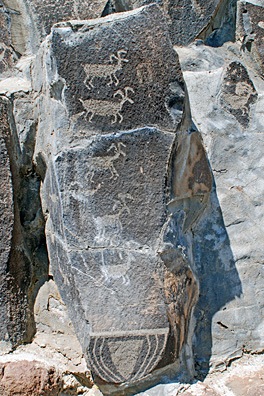 Around the side of the building is a display, behind an iron fence, of some petroglyphs that were rescued from floodwaters when the Wanapum dam was completed downriver in 1963. But to understand why the rocks these drawing appear on look so uniform, I need to discuss the geology of the area a bit.
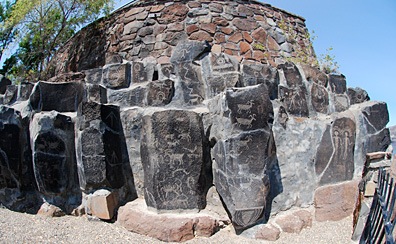 From 1000 to 300 years ago, native people drew on these columns of dark rock near the river’s edge. There’s actually an impressive variety of petroglyph drawings. About 300 of them were physically moved from what would soon be Lake Wanapum to the side of the Interpretive Center at the park. That’s what I saw and what is pictured here. (And no, the building isn’t curved. I was using my silly fisheye lens in an effort to capture more petroglyphs in a tight space.)
 I wasn’t too bothered. The helicopter was parked on the lawn beside the Lake Pateros Inn. The tail rotor was hanging over the river bank. Although there were a few people around, there wasn’t much of a chance of someone walking into it while I was starting up or shutting down.
 Meanwhile, I’d pulled out my MAC ratchet screwdriver — the tool I usually use to prove to men that I don’t believe in buying junk tools — and was attempting to remove the red lens from the strobe light’s bulb. The lens was held in place with a plastic ring, held closed tight with a small philips screw and a tiny nut. I wasn’t getting far. When I turned the screw, the nut turned. I was just realizing my problem when one of the guys took notice.
 It was a 30-minute flight to Chelan Airport. I went the most direct route, over the plateau. (You can see a slightly-edited, narrated video of the route
 I’m not sure if this is a Bell 212 or a Huey. I never could get my helicopter models straight. In this first shot, it’s coming down to the river to dip its bucket in the Columbia River. You can see the burned hills and smoke behind him.
  In this shot, the same helicopter is dropping on flames. (That would have been a great shot if the damn camera would have focused properly! Ugh!) The precision of these guys was incredible. They hit the flames 9 times out of 10 and the fire would turn to a huge cloud of steam. Note the power lines. They were all over the area. Not only did the pilots have to avoid the lines with the aircraft, but also with the bucket and line beneath them.
 Here’s a shot of a beautiful red K-Max heavy lift helicopter dipping in the Columbia River. The pilot completely submerges the bucket, then pulls up slowly so as not to overtorque the engine as it lifts. I don’t know the size of these buckets, but I know they make them 600 gallons and more. At 8 pounds per gallon, that’s a heavy weight. The K-Max is an unusual helicopter with two sets of main rotor blades mounted overhead at an angle to each other. The blades spin in opposite directions, making a tail rotor unnecessary, and intermesh with each other. The aircraft sounds very cool when it flies by.