
Could Obama be a team player in the global political scene?
I guess you can say I’m an Obama supporter. After all, I’d rather see him in the Oval Office than McCain. Like so many other people, I think McCain (1) is too old and (2) will give us yet another 4 years of Bush-like decision making. And although I may be part of the higher-income group that won’t benefit from Obama’s economic plan, I really think it’s time to stop letting the ultra-rich ride the U.S. economy without paying their fair share.
When it was Obama vs. Hillary, I couldn’t decide. I’m not registered as a Democrat, so I couldn’t vote in the primaries. I had to let others decide. I don’t even know which one Arizona chose. It didn’t matter. What mattered was the final result. When Hillary dropped out, I felt relief — not because I preferred Obama, but because I (like most other Americans) was sick of the media coverage on the race.
But since then, I have yet to be convinced that Obama is a better candidate than Hillary. (Or that Hillary would be better than Obama, for that matter.)
And no, I don’t subscribe to any of the bullshit satirized on the New Yorker cover. Although I found the illustration distasteful, I certainly do understand the concept of satire. Unfortunately, much of middle America doesn’t and is likely to find the illustration confirmation of their misguided beliefs.
On the pro side, I believe Obama does represent hope and change. He’s young, he gets people excited, and he does not represent the same political establishment we’ve been looking at for years. I believe he does have the country’s well-being at the top of his list of interests.
But on the con side, I think Obama lacks the experience necessary to get things done in our government. I think he’ll have to waste a lot of time and effort getting his ball rolling in the establishment he’s so obviously not a part of. If he wins, he’ll have a struggle ahead of him to succeed in his goals.
McCain sometimes applies the word “naive” to Obama; I don’t think that’s too far from the truth. But I also think that Obama has the intelligence and drive to rise above that.
Still, Obama’s rise in our government has me troubled. He’s come a long way in a short time and doesn’t have much to show for it. After all, when you’re sprinting to the finish line, you can’t stop much along the way to get things done. I’m not sure if that’s good or bad.
But what makes me hopeful for a President Obama this week is the reception he’s getting in Europe. The Europeans evidently love him. That alone is a point in his favor.
On September 11, 2001, America was the victim of a horrific act of terrorism. We suddenly had the good will and support of most of the world. The Bush administration, through its independent actions and attitudes, has squandered all that goodwill. This cannot be argued. Not only does most of the world now look down on us, but we’re actually hated in many parts of the world.
While many Americans are convinced that we’re better than anyone else and have some kind of God-given right to do whatever we want to do, I believe America is part of a global community. We need to be a team player. We need to work with our allies for the good of the world.
I believe that Obama understands that, too. But what’s more important is that the rest of the world might see Obama as a team player in the global political scene. Because no matter how low Bush’s opinion ratings are here in the U.S., I’m willing to bet they’re a lot lower overseas.
Comments? Please do share them. Use the Comments link or form for this post. Just keep it civil, okay?
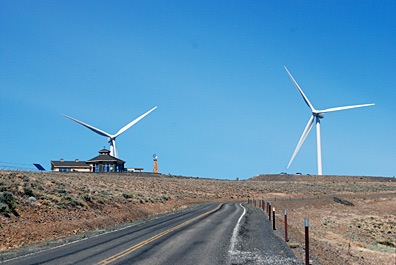 Follow the entrance road about three miles as it winds up a hill. You’ll pass a bunch of windmills along the way — the road actually passes quite close to a few of them. Eventually, you’ll see the Visitor Center at the top of the site. Behind it are a few windmills that, when seen with the building in front, look absolutely enormous.
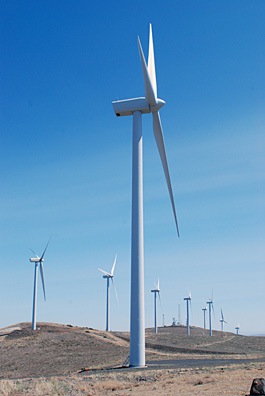 Want some stats? The facility is on a 9,000 acre site overlooking the Columbia River Basin. It was started up in December 2006 with 127 wind turbines. Each turbine is capable of producing up to 1.8 megawatts of power in 31 mph winds, for a total of 229 megawatts. The turbines start generating power at 9 mph of wind and are programmed to feather their blades and basically shut down when winds exceed 56 mph to avoid damage. Since the site is usually pretty windy, the facility does a pretty good job generating power.
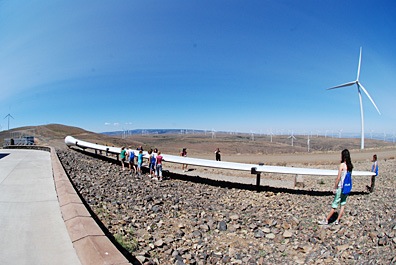 The blades are also huge. There was one on display outside the visitor center and I snapped a photo with my fisheye lens (which explains the distortion) of the girls gathered around it. Each of a windmill’s three blades is 129 feet long, 11.6 wide near the hub, and 1.6 feed wide at the tip. They’re made of composite materials, are hollow, and weigh 7 tons each. When you figure the length of the rotor blade into the total maximum height of the windmill, you get 351 feet.
 But this sign, which is lighted at night, remains to remind us of the golf course’s past. It’s a great old-style sign that may not be in the best condition, but still calls out to passersby on busy state route 281 as they drive between Quincy, five miles north, and George, five miles south. My favorite part? The silhouetted golfer is wearing knickers. During the day, the sign is rather nondescript and not very interesting.
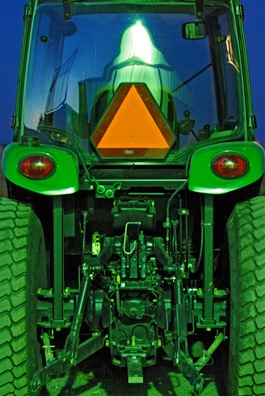 The golf course is in the middle of farmland. All around are fields growing wheat, feed corn, potatoes, alfalfa, and other crops. There are all kinds of farm vehicles all over the place.
 The golf course and its RV park are on the corner of a busy intersection. State route 281 runs north/south between Quincy and George. Road 5, also known as White Trail Road, is a sort of Quincy bypass, that runs east/west and then north/south, west of Quincy. Because it bypasses the traffic light (and minor traffic) in town, its popular with truckers traveling between I-90, five miles south, and Wenatchee, 35 miles northwest.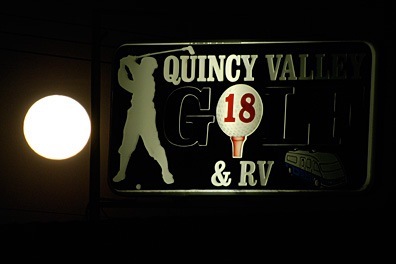
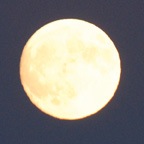
 Last month I tried again. It was my first full moon in Quincy. I was camped out at the Quincy Golf Course, which has an “RV park” connected to it. (The quotes are because there are only 5 full hookup sites, a bunch of partial hookup sites, and no other RV parklike facilities.) I brought my tripod out to take some photos of various things in night lighting. I got a bunch of good photos — check my
  Aperture: f5.6
 Aperture: f5.6
 Aperture: f5.6
 Aperture: f5.6
 Aperture: f5.6
 Aperture: f5.6