The Star-Spangled Banner, In Spanish?

What’s the big deal?

The other day, I got one of those forwarded e-mails that we all get from people who think they’re preaching to the choir. You know the kind. The e-mail expresses a very specific opinion, normally in angry terms, and the person who forwards it to you thinks you’ll agree and keep forwarding it to other people who will agree.

This particular message, like some others I occasionally get, hit a solid brick wall in my in-box. Not only did I disagree, but I feel that the people who do agree are looking at the issue with a typical small-minded, conservative attitude.

The issue was the proposed singing of the National Anthem in Spanish.

The Message

Here’s the entire, unedited text of the message, which was accompanied by idiotic cartoons I won’t bother to reproduce here:

No apology for sending this ! ! ! After hearing they want to sing the National Anthem in Spanish – enough is enough. Nowhere did they sing it in Italian, Polish, Irish (Celtic), Ger man or any other language because of immigration. It was written by Francis Scott Key and should be sung word for word the way it was written The news broadcasts even gave the translation — not even close. NOT sorry if this offends anyone because this is MY COUNTRY – IF IT IS YOUR COUNTRY SPEAK UP — please pass this along .

I am not against immigration — just come through like everyone else. Get a sponsor; have a place to lay your head ; have a job; pay your taxes, live by the rules AND LEARN THE LANGUAGE as all other immigrants have in the past — and GOD BLESS AMERICA!

PART OF THE PROBLEM

Think about this: If you don’t want to forward this for fear of offending someone — YOU’RE PART OF THE PROBLEM!

It is Time for America to Speak up

If you agree — pass this along, if you don’t agree — delete it!

Well, I don’t agree but I didn’t delete it. Instead, I’ll speak up, as the message urges.

Let’s set aside that the language the message was written in wasn’t even in good English. It’s fraught with punctuation errors that make it sound, when read, like the angry rant it is.

But let’s look at this person’s gripe. Spanish-speaking people would like to sing our National Anthem in their language. What’s so bad about that? I think we should be flattered. It’s the ultimate show of respect. By translating The Star-Spangled Banner into Spanish, they’re putting it into a language they can clearly understand. They’ll get the message of the words of the song.

Or does the message just not matter?

Some Truth about Our National Anthem

What’s the song about, anyway? Do these English-only ranters even know? Here’s some history from Wikipedia:

“The Star-Spangled Banner” is the national anthem of the United States of America. The lyrics come from a poem written in 1814 by Francis Scott Key, a then 35-year-old amateur poet who wrote “Defence of Fort McHenry”[1] after seeing the bombardment of Fort McHenry at Baltimore, Maryland, by Royal Navy ships in Chesapeake Bay during the War of 1812.

The poem was set to the tune of a popular British drinking song, written by John Stafford Smith for the Anacreontic Society, a London social club. “The Anacreontic Song” (or “To Anacreon in Heaven”), set to various lyrics, was already popular in the United States. Set to Key’s poem and renamed “The Star-Spangled Banner”, it would soon become a well-known American patriotic song. With a range of one and a half octaves, it is known for being difficult to sing. Although the song has four stanzas, only the first is commonly sung today, with the fourth (“O thus be it ever when free men shall stand …”) added on more formal occasions.

This brings up three interesting points that the ranter probably didn’t know or even think about:

  • The poem by Francis Scott Key was set to the tune of a British drinking song. Key did not write the song. He wrote a poem later set to music.
  • The text written by Key is not usually sung as written. Indeed, only part of the poem is commonly sung. I challenge the writer of the message to sing or recite the missing stanzas or even tell me how many there are. Or sing the stanza added by Oliver Wendell Holmes during the Civil War. (Yes, it’s in Wikipedia.)
  • The poem is not about America. It’s about our flag. A specific flag, in fact, which hangs behind protective shield in the Smithsonian and can be viewed periodically throughout the day. (I’ve seen this huge, tattered flag in person and it puts real meaning to Key’s words.) It’s also about war.

Later, the Wikipedia entry directly contradicts what this small-minded ranter states in his message:

As a result of immigration to the United States, the lyrics of the song were translated into other languages. In 1861, it was translated into German.[12] It has since been translated into Hebrew [13], Yiddish by Jewish immigrants,[14] French by Acadians of Louisiana,[15] Samoan[16] and Irish.[17] The third verse of the anthem has also been translated into Latin.[18]

So there.

The Spanish translations are also discussed, along with the somewhat revealing statement, “It drew a critical response from President George W. Bush, who said that the national anthem should be sung in English.[21]” This clearly reveals the ranter as just another Bushie, echoing the president’s sentiments because he either can’t think for himself or because Rush Limbaugh told him to.

The Wikipedia entry, as usual, makes fascinating reading, with lots of history and links, as well as the complete lyrics to the song. Anyone interested in learning more about our National Anthem should check it out. People who want to rant about it might consider reading it before ranting publicly, so they get most of the facts straight and don’t sound like ignoramuses.

English as a Second Language

But I think what really pisses me off about this whole thing is the continued feeling among a certain group of Americans that immigrants must learn to speak English.

Let’s look at this objectively: every non-Native American in this country — the vast majority of the people here — is an immigrant or can be traced back to immigrant ancestors.

I don’t have to look back very far to find my transplanted roots in this country: my maternal great grandparents immigrated from Italy to New York around the turn of the century and my paternal grandparents immigrated from Germany to New Jersey in the 1930s.

I don’t know much about my great grandparents, but I do know that my grandmother’s mother never learned to speak English. She was a homemaker who lived in an Italian neighborhood, surrounded by people who spoke Italian. Her nine American-born children, including my grandmother, were bilingual. She was deeply religious, a Catholic who likely attended mass conducted in Latin.

My paternal grandparents learned to speak English right away. My grandfather, trained as a pastry chef in Europe, worked in a bakery until he was able to open his own. My grandmother worked up front, dealing with the customers. They had to learn English to succeed in their business. Their two sons were bilingual, although I don’t think my father, the younger of the two, speaks German very well.

There are two points I want to emphasize here:

  • We are the immigrants. Did we come here and learn to speak Navajo or Sioux or Cherokee? No. Instead, we forced the indians to send their children to our schools in an attempt to eradicate their culture. We forced them to speak English and, as a result, many of the native American languages have been lost forever. As a white American, I’m not proud of that.
  • People who come to this country will learn to speak English when they need to. An immigrant living in an immigrant neighborhood or town may not need to learn much English at all. But if he wants to work with English-speaking people and get ahead in this country, he’ll learn to speak the language of the people he deals with. That’s why the English-speaking day laborers are more likely to get work or better pay than the non-English-speaking ones. It’s also why English-speaking employers who hire immigrant laborers learn to speak their language: so they can hire and communicate with the cheapest ones. The language barrier is an economic barrier that works both ways.

And let’s cut to the chase here: how many Americans who move to Mexico or Costa Rica or other places where their dollars enable them to live like kings speak Spanish fluently?

Besides, many “Americans” don’t speak English very well anyway.

Your Turn to Rant

I’m certain that this post will get the hairs up on the backs of certain regular readers here. It’s not my intention to annoy anyone. I just want people to think about it objectively.

What’s the big deal?

Use the comment link or form to state your case. Just remember to keep it civil. If you get abusive toward me or any other commenter, your comment won’t appear here.

Another Reason I Hate Windows

How many updates can a person stand?

I’m off the Internet grid these days. Indeed, every single time I post to my blog, I’m doing so by connecting my MacBook Pro to the Internet through my Treo 700p’s Dial-Up Networking (DUN) feature.

This is not a fast connection. In fact, it can take over an hour to download a 30 MB file. When I need to do a real update, I have to find an Internet cafe with a fast connection. Or sit in my truck in front of a neighborhood home and use its connection.

So imagine my annoyance when Windows Vista on my Dell laptop popped up with this message today:

Windows Updates

Are they kidding?

I just updated three days ago when I was fortunate enough to pick up the neighborhood connection in my trailer. Yet Microsoft has 67.1 MB more of “important” updates for me. That doesn’t count the 43 “optional” updates or the 2 “extras.”

No wonder the Internet connection at the local library is so slow. The five or six Windows PCs at the workstations there are probably spending all day every day downloading updates.

Cherry Drying on Google Earth

Putting the tracks on a satellite image.

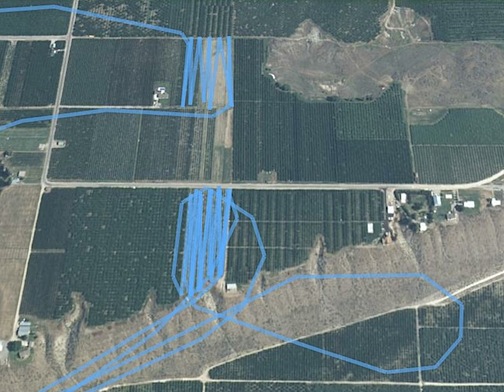
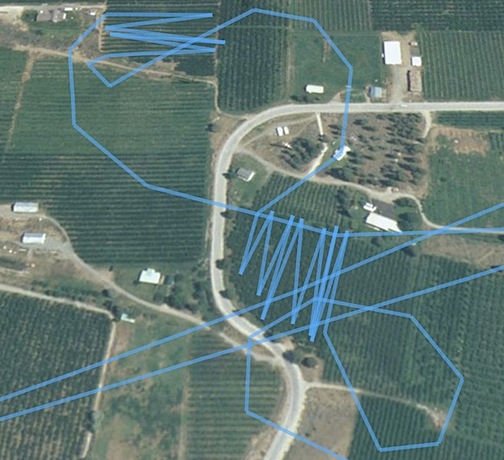
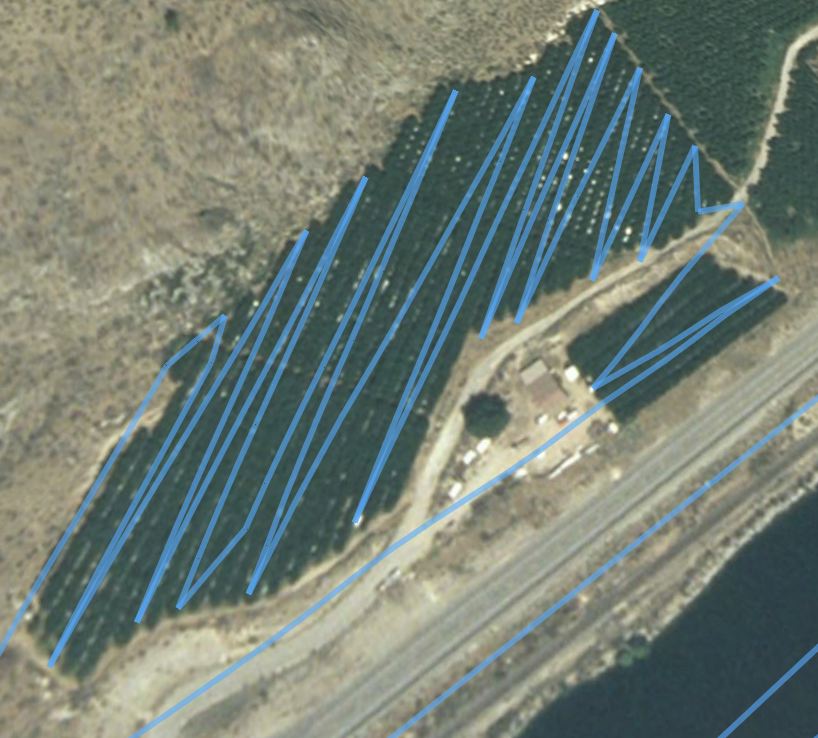
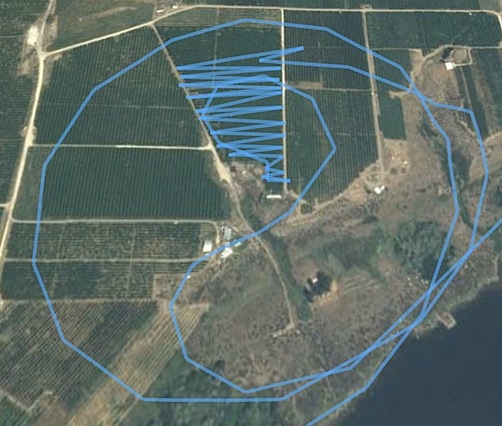
I had my handheld GPS (a Garmin GPSmap 60c) running while I was drying cherries and the GPS tracked my movements. Today, on a whim, I saved the tracklogs and downloaded them to my Mac. Then I brought them into Google Earth and looked at a few of the orchards.

The tracks are not very accurate. They show a zig-zag motion that appears to cross diagonally across the rows. In reality, when I reached the end of each row, I moved to the side and turned to go down another row. So rather than pointed endings and diagonal tracks, an accurate rendering would show squared off endings and parallel tracks.

But I still think it’s interesting to see how I moved over the land. Take a look and see for yourself. These are the tracks from my flights on July 4.

In this first example, I’d flown past the orchard on the south side from west to east, then circled back. I made a wide clockwise circle of the orchard to get my bearings, then came in on the south end, near a white single-wide mobile home. There was a woman there, waving happily when I arrived. She’d left the door of her house open and I blew a bunch of leaves into it. (Oops.) My track took me back and forth up the triangular orchard. Although the track makes it look as if I had a short row near the top, it’s just another inaccuracy in the track. I departed the area with a clockwise circle to the west.

Cherry Drying Tracks

Here are two others representing three dries. I went to the lower one first, passing it by on the south from west to east. I circled back, then came in on the southwest corner. I went back and forth from west to east, then broke off. It started to rain so I repositioned to the airport, which was less than a mile away. I read for a while, then got a call with a new list of orchards. I started back up and took off, returning to re-dry the lower orchard in this image again (hence the double set of track lines) after doing others a bit farther to the west. I did the upper orchard about an hour later, coming in from the northwest and departing from the southeast side back to the west.

Cherry Drying Tracks

Here’s a sloppy looking one that really wasn’t this sloppy. I did the lower orchard first, coming in from the southeast and departing out the northwest. I then went directly to the upper orchard, beginning the dry at the southwest and exiting at the northwest. The pair of diagonal lines going across the bottom of this screenshot represent overflights of the orchard on my way to or from the ones in the previous screenshot.

Cherry Drying Tracks

This is the first orchard I described in some detail in my “I Dry Cherries” post. Again, I really didn’t fly a zig-zag pattern in the main orchard. and I’m certain I flew at least two more rows (one in each direction) in the smaller orchard. But the GPS doesn’t seem to pick up all the points when it makes its tracks. The two other straight lines near the bottom right of the image are overflights to/from other orchards. That’s the Columbia River/Lake Pateros in the bottom right corner of the shot.

Cherry Drying 4.jpg

These are just a few of the orchards. You get the idea. Next time I fly, I’ll use my new geotagger. It can save up to 600,000 waypoints (I think) so I have a feeling the pictures it draws will be a lot more accurate. If they are, I’ll show them off here again.

We all know what a geek I can be.

When It’s Just Not Worth It to Fly

Turning down flying jobs.

I really don’t like cheap clients.

Anyone who operates an aviation business knows exactly what I mean. They’re the folks that expect you to fly for what they see as just above your cost. The way they see it, even though that rate is far below what you normally ask, you’re still making money, so you should be happy.

[What’s even worse than cheap clients who are trying to get flight time for less than cost is the wanna be clients who want you to fly them around for free. I wrote about one of those in my post, “You want WHAT for free?“]

Unfortunately, their idea of your “cost” is the price of fuel times the number of gallons per hour that you burn. As I detailed in my posts, “How do you make a million dollars in aviation?” and “How Much, How Long?,” fuel is just one part of the cost of operating an aircraft. And it doesn’t even account for 1/3 the cost.

I’ve had a number of these clients in the past and I always came up with some kind of compromise, just to get their business. The compromise was normally more than they wanted to pay but less than I usually charge. In many cases, I wound up giving away so much — usually in ferry time — that the job was operated on a break-even basis. I told myself that it was worth it to get a client that would give me business in the future. But in most instances, any future business involved the same kind of compromises. Even though I was getting compensated for the cost of the flight, I wasn’t getting compensated for my time.

And I’ve come to realize that my time is the most valuable thing I have to offer anyone.

So this week, after going back and forth with a past client, trying to come up with a deal that would satisfy both of us, we hit a wall where neither of us would budge. The job was in Nevada, which is a 3 hour flight from my home base in Wickenburg, AZ or my end-of-summer base in Page, AZ. That’s 3 hours each way. I offered to eat half the ferry time — that’s 3 hours — if he paid the other half at a reduced rate ($495/hour) and guaranteed at least 4 hours of photo flight time at my regular photo flight rate (currently $595/hour). The cost to him for 10 hours of flight time (including the 6 hours of ferry time) would have been a measly $3,865, saving him about $1,500. When I ran the numbers after I’d sent him the rates (very dumb), my first thought was, what was I thinking?

I was lucky that he refused to guarantee the 4 hours. I would have spent 6 hours flying through hot desert — the job was in August — just to get there and back. I would have done the job in hot desert, flying heavy because fuel options were limited, beating the hell out of my aircraft and myself to get the videographer in the right places to make his high-action shots. I would have to eat the cost of hotel accommodations for at least one night. And I’d have my aircraft offline for other work for about two days.

All for a net over known costs that was less than what I was saving him with my compromise offer.

I talked to a pilot friend about this yesterday. His business is remarkably like mine, although he does more photo work and I do more tour work. We swapped stories about cheap clients and cheap client wannabes.

Then he told me his take on price compromises. If there wasn’t much money in a job, he considered what he could be doing with his time if he weren’t doing the job. Hanging out with friends — maybe flying with them. Relaxing with his family. Doing things he wanted to do.

And I realized that I’d definitely done the right thing when I stood my ground. The job simply wasn’t worth flying. Maybe I’d have other paying work and maybe I wouldn’t. But I’d be spending my time in a way that I wanted to, rather than giving away my services for next to nothing.

Life’s short. Business is business.

Fighting Twitter Spammers

Fighting a new kind of spammer.

Twitter logoI’m an avid Twitter user with 5,000+ tweets to my name since I joined up over a year ago. I tweet from my computer, usually using Twitterrific, and from my Treo smartphone, usually using text messaging. I don’t follow tweets via text message, but while I’m out and about, I occasionally will use the Treo’s Web browser to see if I’m missing anything interesting among the people I follow in the Twitterverse.

If you know Twitter, you know that you can select whether you should be notified by e-mail when you get a new follower. I have this option turned on. Each time someone follows me, I get an e-mail message with a link to his/her page. In the past, this has enabled me to identify new, interesting people to follow.

Twitter, like all online services, has abusers. In the old days, this was limited to people who tweeted more promotional material and links than real “What are you doing?” content. These people used bots to follow everyone they could. And there were just enough idiots out there to follow them, making them look somewhat legit.

For new followers, I’ve always applied the 10% rule. I wrote about this rule in my post, “Twitter Sluts.” This rule states that if the Twitter member is following more than 10 times the number of people who follow him, he’s following indiscriminately and is probably abusing the system. In reality, he’s not “following” anyone at all. He’s just trying to get suckers to follow him.

Now there’s a new breed of spammers. They set up a Twitter account and post a single tweet with something like “This make money fast plan really works: http://www.somebogusplan.com/.” Then they use bots to follow every person who tweets.

People like me, who want to find new, interesting people to follow, get the notification in e-mail and click the link to check out the user’s Twitter page. What I see is the promotional link and stats that include thousands of people being followed and only a few idiots following in return.

Obvious spammer.

This wouldn’t be so bothersome if it were just one or two of these abusers a week. But I’m getting 2 to 5 of them a day. Following up on these people is becoming annoying.

While I could turn off notifications, I’d also miss out on the real Twitter users who are legitimately following me, people who I might want to follow. So that’s not an option.

Now the folks at Twitter have a technique in place to report spammers. It requires me to go to a feedback page, fill in a form with a number of fields that don’t apply, and put in the spammer’s account name. The entire process takes about 3 minutes to complete — when my currently funky Internet connection cooperates. With 5 spammers a day, that’s 15 minutes of my day pissed away on report spammers.

I don’t know about you, but my time is more valuable than that.

While I could simply ignore them, I’ve taken to using the Block button at the bottom of the user’s Twitter page to block them. This feature is designed to prevent the person from bothering me again or from seeing my tweets. But I think that if enough people do this and if the folks at Twitter occasionally glance at who’s being blocked by more than 5 or 10 people, it could be a quick and effective way to identify spammers. Just two clicks — Block, then a confirmation I want to block — the job’s done.

Of course, if the folks at Twitter installed a “This is a Spammer” link on the user’s page, it would make it clear what we’re all trying to say. I’ve put that in as a suggestion, but am still waiting.

The folks at Twitter have enough on their hands right now, just trying to keep Twitter up and running smoothly 24/7. I hope that when they’re done with that daunting task, they’ll tackle this one.

But they should keep in mind that once they put controls in place to prevent spamming, they’ll have a lot less activity on the site to worry about.