Writing Tips: Soaking Up Creative Energy

What is it and how can I tap into it?

The other day, I posted a blog entry about distractions. In it, I shared an exchange between me and one of my Twitter friends. He’d tweeted that the coffee shop he was trying to write in was distracting. When I asked why he’d try to write there, he said the place had “creative energy.”

On “Creative Energy”

I should start out by saying that I don’t really believe in “energy” as the term is used by New Age folks. I’m a skeptic about most things and the older I get, the more skeptical I get. So if he was referring to some kind of weird, new age “energy” fields — like the vortexes supposedly in Sedona — he completely lost me (and much of my respect).

But I don’t think he meant it that way. (At least I hope not.) I think he meant something I do believe in and understand.

Did you ever go someplace or do something or read something or see something that made you feel almost feverish about writing (or painting or doing something else creative)? It’s as if this place or thing gave you a poke with a creative juice taser. After (or during) the experience, you must create. You’re driven to create.

I really can’t describe it any better than that.

On WritingThis happens to me once in a while. Stephen King’s book, On Writing, made me feel like this. Although I couldn’t put the book down, I also couldn’t wait to get back to my novel in progress the whole time I was reading it. (And no, I’m not a big Stephen King fan.)

I’ve also felt this way other times. It’s a great feeling. It reminds me of why I wanted to be a writer.

It’s frustrating, too, because when it hits, I’m not always prepared to drop everything and get to work. Sometimes, it hits when I’m traveling on vacation or for business and I simply can’t make the workplace I need to get the words out. Or by the time I can, I’m too exhausted by the day’s activities and can only sleep.

I think my Twitter friend was referring to this feeling. I think he feels this way in the coffee shop he tweeted to us about, or in other places like it with “creative energy.”

Soak it Up!

I don’t think that places with creative energy are the best places to write if they’re also filled with distractions. But that certainly doesn’t mean a creative person should avoid them. Instead, why not use them as a place to soak up that energy?

Take my Twitter friend’s coffee shop example. How could you tap into the creative energy you might feel in a place like that?

Sit down with your coffee at a corner table, facing the room. Have your journal open and your pen handy. Take notes about what you see and hear. The woman with blue streaks in her hair is carrying a molecular biology text book. That guy’s accent is weird, like a cross between Australia and New Jersey. Those two women are talking about the guy sitting in the opposite corner, staring into space. There’s a crack in the ceiling that looks as if it might have been dripping last week. The smell of coffee is strong in the air. A song you haven’t heard in years has just come on over the speakers. It reminds you of the road trip you took during college.

Any of these people can be characters in a book or screenplay. The things they talk about can be ideas for articles or nonfiction works. What’s going on around you can trigger ideas that can get your creative juices flowing and help you break the writer’s block that may have sent you to the coffee shop in the first place.

But not if you try to build your workplace among these distractions by keeping your eyes on your laptop or notepad and earphones in your ears — which is what my Twitter friend was apparently trying to do.

Work in your workplace. Soak up the creative energy of other places by actively paying attention to it when you find it.

There’s More than One Work Mode

For a writer, there’s more than one way to work.

Sure, you can go into your distraction-free working place, as I discussed in my earlier post, focus on your writing, and churn out the words. That’s one work mode. The one that actually produces finished (or nearly finished) text.

But you may need to do things that generate the ideas and get you fired up about writing. If going to a coffee shop with “creative energy” does that for you, it’s an important part of your writing routine. I might think of it as the “pre-work” mode. And for folks who write fiction, there’s nothing better than an hour or so of people watching with your journal nearby to get those creative juices flowing.

And people watching isn’t the only pre-work you can do. Take a walk in the park and jot down notes about what you see. What’s the weather like? What does it smell like? What do you hear? Go to the supermarket at a weird off-hour. What’s it like? Hang around outside an office or retail space before it opens or as its closing. What’s going on? Think about the scenes in your work-in-progress and go to places like them to get the real-life scoop of what they’re all about.

Pay attention! You’ll be amazed by what you come away with.

Remember: Characters, dialog, and plot are only three components of fiction. Scene is another. Doing your homework can help you write about realistic scenes.

As for journals…well, I need cover the importance of those in another post.

Landing Zones: Full of Bull

First in a series of photos of unusual landing zones.

One of Flying M Air’s clients owns a ranch in the Wickenburg area. He occasionally hires me to transport people from Wickenburg Airport to the ranch, wait for them to finish their business, and fly them back.

It’s a 45-minute drive on washboarded dirt roads to get to the ranch from town. But it’s only a 6-minute flight. I have a half-hour minimum for flight time (out of Wickenburg), so I usually include a “free” flight around town on the return trip. I don’t charge for waiting time, since they’re seldom onsite more than 30 minutes.

Anyway, the ranch has grazing cattle, which I wrote about in another blog post. On one recent flight out there, a pair of bulls were munching on some hay right near my landing zone. My landing didn’t bother them, and neither did my departure. And they didn’t seem the least bit interested in me as I walked around them to get this photo of them with my helicopter in the background.

I figured I’d start collecting weird LZ shots like this one for my blog. What do you think?

Bulls in the Landing Zone

Posts in this series:

PhotoJeeping: Off Constellation Road

Covering more miles of dirt and desert.

Yesterday, Jack the Dog and I took my Jeep out on Constellation Road. It’s a dirt road that winds into the desert northeast of Wickenburg, past numerous mining sites. It was named for the town of Constellation, which is on many maps. But I’d driven and flown the area extensively and cannot find a trace of the town where it is supposed to be.

Off Constellation RoadPhotoJeeping is like photowalking, but done in a Jeep. Sure, you get out and do some hiking now and then, but most transportation is by Jeep or other 4WD vehicle. I covered 40 miles yesterday, roundtrip, in about five hours. I made stops at a number of mining sites and more than a few “scenic” areas near the road. And, for the first time ever, I drove all the way out to the Williams Family Ranch on the Hassayampa River.

Along the way, I took plenty of photos — more than 150, in fact — and a bit of video.

This is one of the last photos I took on the way back. The light was getting good but I was exhausted. I really didn’t think I’d get back as quick as I did, but wasn’t interesting in hanging around for the light to get even better. This spot is about 8 miles out of Wickenburg, right at the beginning of the hills.

Photo Info:
Camera: Nikon D80
Focal Length: 35mm
Aperture: f/6.3
Shutter Speed: 1/160
Lat/Lon: 43.04841° / -112.6031767°

Writing Tips: Avoiding Distractions

Write where and when you can write.

The other day, one of my Twitter friends tweeted:

At XYZ, writing. Or trying to. This place is insanely distracting on… um… many levels. This place could be trouble for me.

This statement mystified me and I @replied to him to get clarification:

Trying to understand why you’d go to a distracting place to write. What is XYZ?

His reply:

XYZ is a coffee shop. Lots of creative energy, and I have headphones. First time working here; underestimated the place.

But my statement remains: Why would anyone go to a distracting — or even potentially distracting — place to write?

We’re Not J.K. Rowlings

Anyone who is serious about writing knows about J.K. Rowling. She supposedly wrote the first Harry Potter book longhand, in a coffee shop. Apparently, the coffee shop was owned by her brother-in-law — although I’m not sure whether that makes a difference. But the story has given rise to a certain idea that bestselling books can be written in cafes and coffee shops.

Reality check here: What works for one woman doesn’t necessarily work for everyone else. Did Rowling write all the books in a coffee shop? And what was that coffee shop like? Was it a bustling, high-energy place with lots of traffic, music, and noise? Or a quiet cafe off the main drag where people normally gathered to read, write, and drink coffee amidst the soft sounds of classical music?

In other words, was the place conducive to writing?

Distraction reduces productivity.

The above statement should not be necessary. We should all be aware of the fact that the more distraction we have in our workplace, the less real work we’re likely to get done.

I know this from experience. I’ve been writing for a living since 1990. I don’t write in coffee shops or anywhere else I’m likely to be distracted by what’s going on around me. Heck, these days I have enough trouble finding a distraction-free workplace in my own office.

Distractions give me excuses to procrastinate. Sometimes I don’t even realize I’m procrastinating. Let me just answer these few e-mails before i get to work. I’d better catch up on my tweets before I get to work. This link (in an e-mail or a tweet) looks interesting; I’d better follow it now before I forget. I told so-and-so I’d call this week; better do it now to get it over with. The latest episode of House is on Hulu; may as well tune in while I finish these e-mails. It never ends.

I can’t even imagine trying to work in a coffee shop, which likely has WiFi — why visit one that doesn’t these days? — so I have most of the distractions of my home office with me on my laptop, along with the distractions that are part of a coffee shop.

Again, this is me. But I’m willing to bet that, like me, most of us can get a lot more work done without distractions. There’s really no reason to add more to the mix by purposely trying to work in what’s likely to be a distracting place.

Concentrate and Create

I write best and fastest when I can focus on the task at hand. That means eliminating all distractions and putting just my work and related notes in front of me. That means making conscious effort to avoid the things that I know will distract me.

For me, that means doing the following:

  • Clearing off my desk of all non-work material. That means putting away (or at least piling elsewhere) what might be in an “In Box.” Sometimes it even means wiping down the desk surface so it’s free of dust or coffee rings. The only thing on my desk should be my outline or notes.
  • Quitting non-essential software. That includes my e-mail client, my Web browser (usually; sometimes I do need it), and my Twitter client.
  • Loading up all the software I need to get the job done. Opening all applications and documents I need to work with before I start eliminates the need to hunt through the applications and documents folder on my hard disk, where other distractions await me. Depending on what I’m writing, I usually need Microsoft Word or InDesign and Photoshop. (I do layout for some of my books, so I actually write those books in InDesign. I use Photoshop for all image editing needs.) If I’m blogging, I use ecto for offline composition and usually have my browser running to get reference material (like the links to software here). I have tried distraction-free writing tools like Scrivener and StoryMill and I don’t like them. I’ve been using Word since 1989 and have written numerous books about it. I know Word 2004 better than any other program I use; why would I want to waste time learning a new word processing program when Word works just fine for me? (Want to read more of my opinion on special writing software? Read “Software isn’t Always the Answer.”)
  • Turning down (or off) the music. I can often focus with certain types of music on, but when I’m struggling with a topic or having difficulty focusing, the music needs to be turned off. In any case, its volume must be turned down and I absolutely cannot listen to podcasts.
  • Setting the climate control properly. This really only applies in the winter (when my office on the north side of the house seems to get cold) or the summer (when the whole damn house can get hot). There’s nothing I hate more than getting into “the zone” and suddenly realizing that I’m shivering in my chair.
  • Closing my door. Not always necessary, but when Alex the Bird decides to spend 15 minutes imitating the failing battery in a smoke detector, a good door slam can turn him off. If my husband is home, it can also filter out the sound of the movie or football game he’s listening to with surround sound upstairs.
  • Turning off the phone. This is only when I get really desperate to get work done. In general, I don’t get many calls, but a call from a friend or family member can keep me from my work for an hour or more.

Once I get focused, I can churn out finished prose — or even laid-out book pages — at an alarming rate. (I once wrote a 350-page book in 10 days.) My work needs very little editing before it’s published. My editors, for the most part, like me very much because I’m reliable and dependable and make their jobs easier than many other authors.

But that’s because when I’m working, I’m working.

Get Serious!

I believe that a serious approach to writing is what sets professional writers apart from amateur or wannabe writers.

As a professional writer, I must write and I must finish what I write by a predetermined deadline. I don’t have time for bullshit like distractions that might slow me down. I build my best writing environment — like a bird builds a nest — and I climb into it to write. I don’t emerge unless I have to go to the bathroom (which is in the room next to my office) or my stomach is so empty I can’t think over the sound of its growling. (Sometimes, when I really get in the zone, I can go a whole day without eating or drinking.) On tight deadlines, I start at 6 AM and often work until 6 PM. I sometimes work 7-day workweeks. It’s what I do because it’s what I must do.

If I don’t produce publishable prose when I’m contracted to do so, I won’t get paid, I won’t get future work, and I will likely have to join the 9 to 5 grind I’ve managed to avoid for nearly 20 years.

My Two Cents

I didn’t write this post to criticize my Twitter friend or anyone else who tries to write in coffee shops or cafes. I just wrote it to share my own take on the topic of working in a place full of distractions. I say avoid it when you can — if you’re serious about getting work done.

As for “creative energy” — well, that’s a topic for another post.

On Stiff Mixture Control Arms

The saga comes to an end…I hope.

If you follow the helicopter-related posts in this blog, you may know that I’ve been having a problem with my helicopter’s mixture control. My usual interface with this device is the red knob with a button on my instrument panel. Push the knob to get fuel flowing. Pull the knob to shut down the engine. Don’t mess with the knob in flight.

Simple enough, until it got stiff and then broke. I wrote about it here and here.

Mixture Control ArmTurns out, the reason the mixture cable became fractured is because the mixture control arm (lavender in this image) on the fuel control was too stiff. When I pushed or pulled the mixture control in the cockpit it was buckling and fraying. Pushing it in may not have resulted in full rich fuel, which could result in the engine running hot and lead to even more problems.
Good thing we caught it!

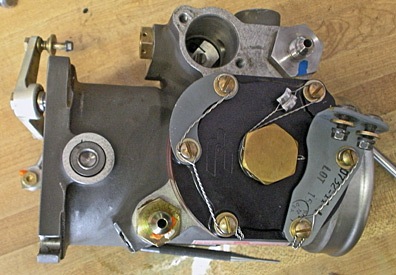
Fuel ControlEd, Wickenburg’s very best airplane mechanic, followed up by pulling the fuel control and fixing it, following instructions of the device’s manufacturer in Wichita, KS. Here’s what it looked like sitting on his workbench with the offending arm removed for repair. This is a lot more of my helicopter’s innards than I usually like to see. But it was interesting to see the piece I’d found an illustration of for this blog (see above) in a place where it was clearly recognizable.

Ed has since put everything back together. I was busy yesterday with the Endurance Ride, so I didn’t fly. And I don’t want to bother Ed on a Sunday. But come tomorrow morning, I’ll be at the airport with the helicopter out on the ramp. I’ll start it up and Ed will likely look at everything from below as its running to make sure the mixture is indeed full rich. I’ll pull the mixture and he’ll watch it work. And then he’ll sign off on it.

And give me a bill. (Ah, the joys of aircraft ownership!)

Of course, if things don’t go as planned, you’ll likely read more about it here.