Natural Food Hypocrites

People who make a show of buying “organic” and “natural” but still eat junk.

My husband Mike and I eat very well. We buy a lot of fresh fruits and vegetables and eat relatively little processed foods. We don’t eat much fast food at all. When we cook, our foods are usually grilled or steamed or pan-sauteed. We don’t fry.

We don’t go out of our way to buy organic. We don’t see the benefit. If the organic apples are on sale and they’re cheaper than the regular apples, we’ll buy organic. And since we do a lot of shopping in Trader Joe’s near our Phoenix place, we wind up buying organic there, since much of what they sell is organic. But it’s also cheap and tasty.

I’m pretty much in agreement with what Brian Dunning has said in his Skeptoid podcast about organic food myths and organic vs. conventional agriculture. (And if you don’t listen to Skeptoid, you should try it; it’s a great weekly dose of reality.)

That said, I still try not to put crap food in my body. But I’m not one of those people who talk the talk about good food and forget to walk the walk.

We have several friends and relatives who are what I call “natural food hypocrites.” They buy “organic” everything — no matter how bad it looks or tastes or how much it costs. When they come to our home, they expect us to buy and serve them organic, too. When we go out to dinner together, they question the source of the chicken or beef and make a big fuss about choosing something that’s free range or farm fed or whatever.

Unless it’s just not convenient for them. Or they feel like having a diet soda. Or want to cut 16 calories off their cup of coffee by using Sweet ‘N Low. Or the guy at the next table in the Mexican restaurant they didn’t want to step foot into just had the Chicken Enchilada and it smells good. Or that chocolate mousse log from the supermarket freezer section looks too damn tasty to pass up.

They’ll put us through hell when they come to visit, making us feel as if we’re not good hosts if we buy regular milk instead of organic while they’re with us, but pop open a Diet Coke to wash down their vitamins with lunch.

Natural food hypocrites.

How Some Bloggers Abuse Commenters

And why this ruins things for the rest of us.

This morning, I got a junk e-mail message from a blogger I’d met on Twitter. And I’m pissed off about it.

How I Was Violated and What I Did about It

I followed this guy on Twitter for a short time and wound up on his blog, where I posted a comment. As anyone who comments on blogs knows, an e-mail address is required to comment, so I entered mine, as I’ve been doing without problems (or spam) for the past five or so years.

This blogger, however, was different. He evidently harvests the e-mail addresses from blog comments and uses it to feed his self-promotional e-mail list. The spam e-mail message from him arrived this morning when I collected my e-mail.

To say I was furious is an understatement. In my opinion, this blogger has violated my trust — and likely the trust of all other commenters on his blog. He’s used my e-mail address without my permission in a way that’s unacceptable. He’s a spammer, pure and simple, and should be subject to the same penalties as any other spammer.

(As if anyone’s actually enforcing the new anti-spam laws.)

Here’s the message he sent; I XXXed out the identifying information so I don’t send any customers his way:

Did you enjoy the free video on the 6 ways to make money on the internet?

How would you like to win the entire XXX System absolutely free?

All you have to do is recommend the system to a friend via a twitter to enter.

We will be giving away 20 full XXX system accounts between now and January 20th.

Click here to enter!

XXX Media Group | XXX | Lincoln, NE 68516 | US
Unsubscribe from future marketing messages from XXX Media Group

Call me an idiot, but I clicked the unsubscribe link. (They say that doing that often just confirms your address and spreads it.) The link sent me to the Bronto Web site, which is evidently the software this jerk uses to send his spam. It supposedly unsubscribed me. But it went a step further — it offered a complaint link. So I clicked that and filled out the form.

I also forwarded the message to spam@uce.gov, which is something I’ll be doing with ALL spam I receive from now on.

Then I went to Twitter and reported the jerk as a spammer there.

Why This Hurts Legitimate Bloggers

I’ve been blogging since October 2003. That’s six years now. My blog has accumulated thousands of comments from readers. All of them entered what looks like legitimate e-mail addresses. Are they? I don’t know. Other than a few notable exceptions when I wanted to network with a specific person — Miraz Jordan, who wound up co-authoring a book with me, comes to mind — I haven’t tried using them.

I don’t spam my commenters. I appreciate their input; they make my blog better. Why would I violate their trust and start spamming them via e-mail? Why would I make them less likely to contribute their comments to my blog?

So you can get an idea of how annoyed I am about this asshole.

Imagine a first-time commenter who happens to comment on this jerk’s blog. He feels good about adding to the conversation and is ready to do it again elsewhere. But then he gets spam from this jerk. He realizes that putting his e-mail address out there on the Internet can get him all kinds of spam. So he doesn’t do it. Maybe he starts putting fake e-mail addresses in his comments — making him impossible to contact if the blogger wants to for a legitimate, non-spam reason. Or maybe he simply stops commenting at all.

All because one jerk is harvesting commenter e-mail for spam purposes.

What You Can Do about It

The best thing anyone can do about spam is to report it to the authorities.

If you receive spam on Twitter, use the Report For Spam link on the user’s profile page. Do it every time you receive Twitter spam.

OnGuard OnlineIf you receive e-mail spam, forward it to spam@uce.gov. You can also visit the FTC’s Spam Site to learn more about how you can reduce the amount of spam you get. And while you’re surfing out on Government sites, visit OnGuard Online for real information about how to protect yourself and your computer from Internet fraud.

But whatever you do, don’t stop commenting on blogs. Most bloggers appreciate your contributions and won’t betray your trust.

Helicopters 101: CG

The other half of the weight equation.

Articles in the Helicopters 101 series:
Flight Planning
CG
Weight
Hover Charts
Ground School

Last week, I wrote a blog post about helicopter weight. It was my response to a blog post by Tim McAdams on the AOPA helicopter blog titled “Gross weight.” The comments to that post indicated to me that some of the commenters were confusing weight with CG — center of gravity — issues. My blog post concentrated on weight, putting CG aside. But CG is the other part of the weight equation. And for most helicopters, CG is vitally important to calculate as part of preflight planning.

CG Defined

Center of gravity is pretty much what the phase indicates: a calculation of the center of gravity on an aircraft. It’s the aircraft’s balance and it’s calculated as part of the “weights and balance” computations.

For helicopters, CG is extremely easy to envision. After all, a helicopter with a single main rotor system (as most have) is supported at one point in flight: the main rotor system or mast. If you held up the helicopter by its rotor system, the distribution of its weight — not just what’s inside it but its engine, battery, tail rotor, etc. — would determine how level it hung.

Take, for example, my R44. Its full passenger load is in front of the mast. Its fuel, engine, and heavy components are slightly aft of the mast. For this reason, if I’m flying solo (just one person up front) with low fuel, the helicopter would be a bit tail heavy. As I set down from a hover to the ground, the back of the skids would touch the ground before the front. In fact, the right back would touch first. That’s the lowest point closest to the center of gravity for that load.

The same applies to R22 helicopters. In fact, it’s often terrifying for student pilots to pick up into a hover after their flight instructor steps out when its time for that first solo flight. (Sure scared the hell out of me.) The helicopter feels as if it’s going to flip over backwards!

But stick a pair of fatties up front in my R44 and the CG will shift forward. In fact, if you have enough of a load up front, the fronts of the skids will touch first on landing. (I remember the first time I flew with my brother-in-law on board. I thought I was landing on a slope!)

Watch any helicopter take off or touch down and you’ll probably be able to tell where its center of gravity is.

Why CG Is Important

CG limitations are important for aircraft operation. For example, if you’re loaded with too much weight up front, the helicopter will tilt forward more in flight. When slowing down, stopping, or hovering, you might not have enough aft cyclic to counteract this forward tilt. Ditto for lateral or aft CG.

Remember, every aircraft control has a “stop.” That’s the limit to the control’s movement. You pull the cyclic back to slow down in flight. If you’re heavy up front, you may have to pull it back to simply hover in place. If you’re so front heavy that you can’t pull the cyclic back enough to stop the helicopter from moving forward, you have a serious problem — a problem with your CG or balance.

Want to see how far your controls will move? You should be checking their movement before starting up by simply moving each of the controls as far as it will go. The idea is to make sure none of them are stuck on anything or binding in any way. You don’t want to learn about a control problem when the engine is running, rotors are spinning, and you’re picking up into a hover.

You Can Be Under Max Gross Weight and Still Out of CG

What was bothering me about the comments on that AOPA blog post was that a few of the early commenters kept referring to CG and “weight and balance.” But the blog post was about gross weight. CG wasn’t discussed at all.

I didn’t address CG in my post because that wasn’t being discussed. In fact, it’s quite possible to load an aircraft out of CG and still be within max gross weight.

CG Calculation

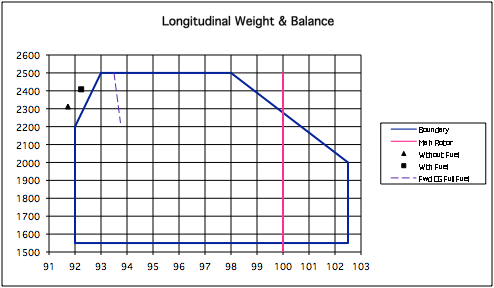
This aircraft is out of CG but still within gross weight limitations.

Want an example? Here are the plotted points for a W&B calculation for an R44 helicopter with 4 good-sized people on board (190 and 250 up front; 190 and 145 in back). It’s a short flight, so only 16 gallons or about an hour’s worth of fuel is loaded on board. The total weight of the aircraft is 2408 — that’s nearly 100 pounds below max gross weight. But as the graph points show, this aircraft is out of CG — too much weight up front.

If you’re having trouble reading this, envision the pink line as the mast. Everything to the left is the front of the helicopter. Everything to the right is the back end of the helicopter. The blue box is the CG envelope for the aircraft, as determined by the manufacturer. In this example, the aircraft with and without fuel is loaded forward of the CG envelope. That’s a no-no.

CG Example 2

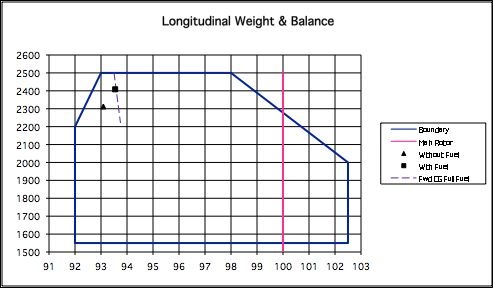
The same passengers as in the previous example, but with heaviest and lightest passengers switched. This load is within CG.

This situation is extremely easy to fix. Simply rearrange the passengers. While you can’t move the 190-lb pilot, you can move the fatty beside him. In this example, the 145-lb passenger in back has switched places with the 250-lb passenger up front.

Adding fuel might help, since fuel is loaded aft of the mast. But you couldn’t add much — you’re already pretty darn close to max gross weight.

Of course, both of these examples show only longitudinal CG — forward to aft. Lateral, or side to side, CG also needs to be calculated. As many of the commenters pointed out, they’ve created spreadsheets to perform these calculations for them. So have I — where do you think these two diagrams came from?

CG Example 3

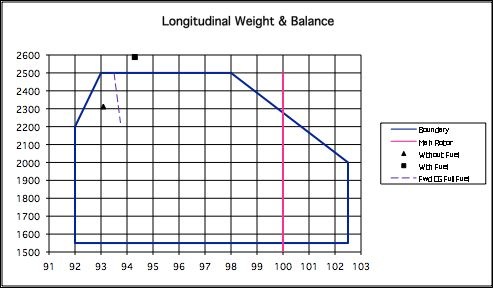
Take the balanced load of the second example and top off the fuel tanks and you’ll get a situation like this.

Can you be over max gross weight and within CG? Technically, no. As these two diagrams indicate, if you’re loaded too heavy, the plot points will be outside the CG envelope. That means you’re out of CG.

But are you really out of balance to the point where you’ll run into control issues? I wouldn’t want to find out for myself.

Which is More Important: Weight or Balance?

I’ll always argue that you need to consider weight before you worry about balance. If you’re too heavy to fly within manufacturers max gross weight allowances, you’re too heavy to fly legally. Who cares about balance at that point?

So if you’re too heavy, it’s time to reduce weight. Leave behind some gear. Take less fuel. Leave behind the passenger who really doesn’t need to come along. Can the mission be flown with the load changes? If so, go the next step with the new load and do the complete CG calculations. Are you in CG? If so, you’re almost ready to go.

Almost? What else is there?

Performance, of course. I’ll discuss that in a future post.

The T3 Helistop at PHX

I show a fellow pilot my favorite LZ at Sky Harbor.

It’s a little-known fact that there’s a helistop atop the Terminal 3 parking structure at Phoenix Sky Harbor Airport. This is where I pick up passengers for Flying M Air‘s multi-day excursions. It’s extremely convenient, not only for my passengers, but for me.

PHX Helistop
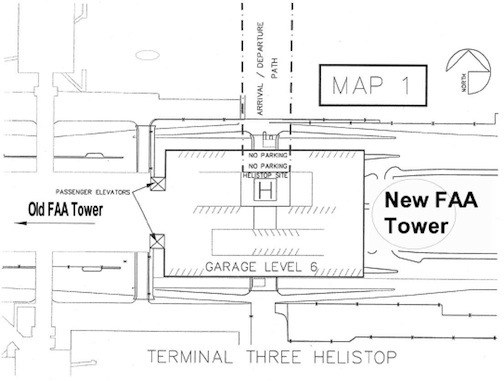
This diagram of the Terminal 3 Helistop refers to the old tower, but it no longer exists. This is part of the Sharp Echo letter of agreement for helicopter pilots operating at Sky Harbor.

I’ve been landing at the helistop since it reopened in 2007. It’s been there for a long time but was closed while they built the new FAA tower beside it. When the new tower opened and they took down the old one, they opened the helistop back up.

I blogged about landing there at night. I also put a video of a daytime landing there on this site and Viddler.

When I say few people know about the helistop, I’m not kidding. The last passengers I picked up there said they’d asked at least six people at Sky Harbor how to get to it and every one of them had told them it didn’t exist. Then they followed my instructions to go to the top of the Terminal 3 parking structure and there it was. Just as I’d told them.

I don’t think too may pilots know about it either — and that’s okay with me. There’s only room for one helicopter up there and if someone’s already there when I need to use it, I’m out of luck until it leaves. It’s not a parking spot — it’s a landing spot. That means that although I can land there, I can’t leave the helicopter there for any extended length of time. I also can’t just walk away. That’s why it’s up to my passengers to find it without my help. I simply can’t leave the helicopter to find them.

My friend, Don, who also flies an R44 Raven II, often needs to pick up his wife and other family members at Sky Harbor. When I mentioned the helistop to him, he wanted to know more. So I explained the intricacies of flying into Phoenix Class Bravo airspace in a helicopter, which is much easier than you might think. I also told him how I make my approach to and departure from the helistop. The conversation ended with me promising to fly with him for a landing there.

Don't Helicopter at PHX
Are we a bunch of tourists or what? Mike jumped out to take this shot of us when we landed on the helistop. Don’s flying; I’m in the front passenger seat.

We made the flight yesterday afternoon. My husband, Mike, came along for the ride, too. I recommended to Don that he not do the trip with a heavy load. The landing is a confined space pinnacle — yes, there are such things — so it needs to be approached with care. As shown in the diagram above, there’s only one way in and out. A heavy load on a hot day — or with a tailwind — could make for a dangerous situation.

Anyway, the flight was uneventful. The airspace was pretty quiet. Just one Southwest Airlines 737 landing as we came in; Don slipped in behind him. He came into the pad a bit lower than I would have, but the landing was smooth. Mike hopped out to take this photo. Then he climbed back in, Don called the tower again, and we took off right behind the next landing 737.

I just hope that Don’s helicopter isn’t sitting on that helistop the next time I need to land there.

The Junk Drawer, Revisited

Not so junky now.

Junk Drawer ReorganizedIf you saw my office, you’d never believe that I truly like to be organized. I hate clutter, I hate piles of junk lying around, I hate not being able to find things.

So it was with great pleasure that I cleaned out my junk drawer the other day and reorganized it with some dividers. The photo here shows the results.

I don’t have time to blog about this in detail right now. And let’s face it — who really wants to read about it? The picture shows all. We made the dividers with a divider kit I bought at The Container Store in Scottsdale the other day.

Now if only I could reorganize my office!