Makes me glad I never had kids.
The title of this post says most of what I want to report, so I won’t stretch this one out longer than it needs to be.
About two weeks ago, I booked a Phoenix Tour with a woman. The flight, which lasts 50 to 60 minutes, circles the Phoenix area and includes incredible views of north Phoenix, Peoria, Lake Pleasant, Glendale, downtown Phoenix, Scottsdale, and Deer Valley. The tour was for her grandson, who was celebrating his eighth birthday. I wasn’t available on the day she wanted to book, so she booked for the following Saturday, a week after the boy’s birthday. Cost of the flight: $495 plus tax for up to 3 people.
I met the family at 11 AM sharp yesterday. It was Grandma (who booked and paid for the flight), Grandpa, Mom, and The Kid. Everyone looked happy and excited. Mom reported that The Kid was so excited that he’d run into the car, still carrying the TV remote.
I walked them all out to the ramp where the helicopter was waiting. I’d just repositioned it there from its hangar. Three small airplanes were parked nearby. They were surrounded by kids. Apparently, some lucky Boy Scouts were getting airplane rides.
We reached the helicopter but The Kid stopped eight feet short. “I don’t think I want to go,” he said softly.
Over the next ten minutes, that small statement ballooned into yelling and screaming tantrum that even included knee shaking (think cartoons, possibly Sponge Bob). I struggled to complete a safety briefing, wondering why I was bothering. Surely this wasn’t going to happen. But Mom and Grandpa climbed in, leaving Grandma to reason with The Kid. A Sheriff Department helicopter landed on the pad next to ours and I hustled them to the other side of my helicopter for added safety. The other helicopter hot-fueled while Mom climbed out and managed to convince The Kid to board.
I did not want the child beside me. Normally, an eight-year-old is fine up front — hell, I had my first helicopter ride at age 8! — but this kid was a complete unknown. What if he grabbed the controls or opened his door? I wanted no part of that. So he sat in back beside his mother. Grandpa sat up front beside me.
I reached back and locked The Kid’s door.
The Sheriff Department helicopter lifted into a hover, then took off. The kid screamed. “DON’T TILT! I DON’T WANT TO TILT!”
I assured him I wouldn’t tilt, wondering how I was going to make turns without banking.
I started the engine. The Kid started yelling again. He didn’t want to go. He wanted to get out. I left Mom to reason with him. I listened to the ATIS and tower as I warmed up. I chatted with Grandpa, trying hard to ignore the monster sitting behind him.
The Kid refused to put on his headset. I was kind of glad about that. I wouldn’t have to hear him.
I called the tower and got a clearance. I picked up into a hover. The Kid started screaming that he wanted to go down.
“Is he okay?” I asked. I repeated that question four times. Mom and Grandpa ignored me. So I took off.
I wanted to depart to the north, across the runways. My instructions had been to depart to the south, turn to the left (The Kid’s side), and cross the runway midfield at 2000 feet. Normally, I’d make the 500 foot climb in a tight climbing turn. Because of The Kid’s tilt restriction, that was not an option. Instead, I swung way wide in a gradual climbing turn. The kid was still screaming, but I had managed to tune him out. I leveled out over the terminal and crossed the runway at exactly 2000 feet MSL, heading north.
We were a half mile north of the airport when The Kid’s tantrum switch apparently turned to the OFF position. Unfortunately, his screaming switch was apparently non-functioning, because he kept yelling at the top of his lungs. “LOOK! A TRUCK! LOOK! WATER!”
At least he wasn’t afraid anymore.
I headed out toward Lake Pleasant. New River and a bunch of streams were flowing. After a few minutes, The Kid put on his headset and I now had his screaming piped directly into my ears, courtesy of the voice-activated intercom. “LOOK! A COW! LOOK! A STREAM!”
I had two options. I could flick the pilot isolation switch and rudely ignore him and my other two passengers or I could turn down the intercom volume. I elected to turn down the volume. Sadly, I could still hear him.
We circled over the New Waddell Dam and headed south toward Glendale Stadium. I chatted with Grandpa. Somewhere along the way The Kid removed his headset again. Whew!
Things had pretty much settled down and it looked as if the tour would finish fine. I actually forgot about my troublesome passenger, who was still pointing out things he saw on the ground to Mom. But then I made a fatal error. I turned to the left.
My normal tour route takes me past Glendale’s University of Arizona Stadium (where the Cardinals play) along the Loop 101 and turns to the left at I-10 south of there. I normally bank at least 15 degrees to make the turn. Since I thought the kid was okay, I did the turn as I usually did.
And he started screaming again.
I changed my route. Instead of making another left turn to go up Central Avenue — normally the highlight of the trip — I told Phoenix Tower I would transition east along McDowell. That removed two 90° turns from the tour without significantly changing the total time in flight. The kid calmed down a bit along this 5-10 minute stretch. But when I turned left at the Loop 101 to head toward Scottsdale, he started screaming all over again.
Fuck this, I thought to myself.
Instead of overflying Scottsdale Airport (as I usually do), I punched Deer Valley’s identifier into my GPS. I adjusted my course, told Scottsdale Tower I’d transition through the southwest edge of their airspace, and cut about 5 minutes out of the tour time.
By this time, the kid was out of control. Any movement whatsoever was enough to get him screaming. We flew right past his house — Mom and Grandpa both saw it — but The Kid was more interested in screaming his brains out than looking.
I came in for a landing at the helipad where we’d started 45 minutes before. Even when we were on the ground cooling down, The Kid was acting up. He insisted we were moving backwards.
I shut down, got the blades stopped, and walked them back to the terminal building. Grandpa handed me some folded up paper money as he shook my hand. “Thanks for your patience,” he said.
While I appreciated the $20 tip, it would take a lot more money — and a gag — for me to take that kid flying ever again.
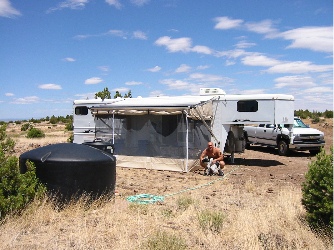 But then we got the horses and decided we wanted to be able to go camping with them. So I bought a 35-foot horse trailer with living quarters. For those of you who aren’t familiar with the concept, the trailer has stalls for the horses in back — mine held three. It also had a sort of closet for storing saddles and other tack. The other half of its length was dedicated to living space for people. It had a queen sized bed, sofa, sink, two-burner stove, good-sized refrigerator, and full (although tiny) bathroom. All this stuff was crammed into a very small space. We added a screened-in room to expand our living space. This photo shows what it looked like parked on our Howard Mesa property with the screen room attached. I lived in this space every other week in the summer of 2004 when I flew at the Grand Canyon. Sadly, we rarely used the camper as it was designed — to take our horses camping with us.
 In 2006, I sold the horse trailer and purchased a Starcraft Antiqua hybrid camper. To me, this was the best of both worlds: a hard-sided camper with the usual amenities (kitchen, bathroom, dining area, sitting area, bedroom) plus the outdoorsy feeling of tent camping. I bought this primarily because I thought we were going to go “on the road” with the helicopter in the summer of 2007. I’d do
  Floor plan. The layout of the RV is likely to determine what amenities it has. If you’ve never shopped for an RV — or haven’t done it lately — you will be amazed at what they can cram into a space. For example, the RV I selected is 36 feet long and 8 feet wide. Yet it has a private bedroom, private bathroom, kitchen, dining area, living area with sofa and recliners, and desk. In many cases, it does this with slide outs. You drive along, park, and push a button to expand your living space.
 Being the picky person I am, certain elements of the floor plan were very important to me. I wanted to be able to access the refrigerator and bathroom without having to expand all the slides. For example, suppose I’m cruising down the road in the middle of nowhere and need/want a cold drink. I can pull over, climb into the RV, and grab one out of the fridge. And even take a leak in a bathroom I know is clean. I also wanted what’s called a “side aisle bath” — a bathroom with all components in the same little room. Other floor plans actually put the bathroom sink in the bedroom. I didn’t want that. And finally, I wanted working space that wasn’t the same place I ate. That means I needed a desk or space for a desk. An RV with a good desk is hard to find and I was perfectly willing to pull out a recliner or even a sofa to put in my own desk. But the model I wound up with actually had a good, usable desk and even had drawers (see photo below). So as far as floor plan is concerned, what I bought is pretty darn close to “perfect” — for me.
 Features and Amenities. Every RV manufacturer and design has its own set of features and amenities. For example, a toy hauler includes a garage-like space in the back. A family model RV might include a separate bedroom — and even an additional half bathroom! — with bunks for the kids. Many luxury RVs have surround sound entertainment systems with wide screen televisions that rise out of a panel or fill an entire wall space. Some units have electric fireplaces. You can find kitchens with two refrigerators and bathrooms with bathtubs. Dining can be in a booth or table and chairs. Sofas can become second beds. Bedrooms can have televisions, closets can be cedar-lined, cabinets can have washer/dryer hookups. The list goes on and on. Just when you think you’ve seen it all, you walk into an RV with yet another feature you didn’t think you’d ever see in an RV.
 For us, less was more — on the inside, anyway. All the RV dealers in the world can assure us that an electric fireplace is a good feature because it gives off heat using the campground’s electricity rather than onboard propane. I can remind them all that we do a lot of off-the-grid camping where there is no campground electricity. A fireplace was a feature we simply didn’t want — yet it appeared in more than half the RVs we looked at! I was extremely pleased, therefore, when we found the unit I’d buy and saw that instead of a fireplace (see photo of typical configuration), there was an empty cabinet.
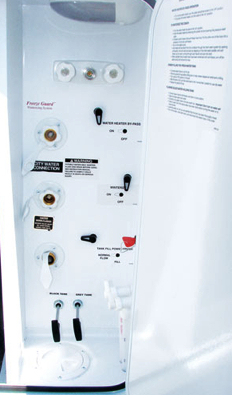 On the outside, however, I wanted some of the newer modern features that were not available in the 2009 model I almost bought. At the top of the list was an electric awning — something I could roll out or back in with the push of a button. (If you’d manually rolled in an awning in your pajamas in the middle of the night when the wind kicked up as many times as I have, you’d understand why.) A remote control to deploy the slide outs was also useful when setting up the RV by myself, as I’m likely to do this summer. Ditto for electric stabilizer jacks and “landing gear.” And it seemed to make a lot more sense to have all hookups (except electricity) and sewer dump/flush controls in one place rather than scattered all over the side of the RV. These features were the primary reason I went with the 2010 model rather than the 2009 (which actually had more cabinet space in the kitchen).
 Quality and Price. Quality and price really do go hand in hand. You get what you pay for. A low-end fifth wheel that you might be able to pick up for $25K is simply not going to be as sturdy or well-built as a top-of-the-line fifth wheel that’ll cost you nearly $100K.
 In my case, I wanted good quality but knew I couldn’t afford — or, more accurately, were not willing to spend enough for — the best. So the very first part of my search was to determine which brands were below my quality needs or above my budget. This should be the first step in anyone’s search for an RV; you can waste a huge amount of time looking at units that simply won’t work for you because of insufficient quality or expensive price. I also cut from the mix any manufacturer what was in bankruptcy or had gone out of the business. 2008/09 killed a lot of them. That limited us to about ten different brands by three different manufacturers. Mountaineer is a mid-range Keystone product. Montana by Keystone is one step above it and I could have made that step if I found one I liked. Heartland’s Big Horn and Big Country were also in the running.
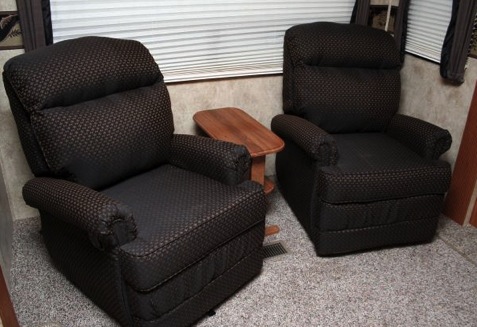 The Mountaineer I bought won on all three factors:
 I started calling some of the RV dealers I’d met with over the past few months — I kept all their cards — to see if they had the same model available. One, in Quartzsite, said he had a 2010. I told him I’d consider driving out to take a look if we could agree to a price over the phone. I told him about the 2009 I were prepared to buy. He asked me to make an offer. I did. He came back with a slightly higher offer that was still below retail. We were there by 2 pm and I had all the papers signed by 4:30 PM.
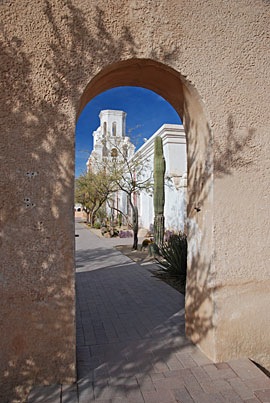
 It was cloudy to the east when we arrived, so sunrise was pretty much a non-event. Although I did take some photos of the front of the building in first sun (or what we had of it), I detoured to a small shrine-like building on the west side of the main church building. My friend, photographer
  When the funeral ended, we paused as the blue coffin was loaded into the back of a Cadillac Escalade hearse — which I didn’t even know existed. As the mourners departed, the photographers swarmed into the church.
 The main altar area, which is shown here, is a crazy ornate masterpiece of southwestern art. Having grown up Catholic, I can’t imagine sitting through a mass amid such decorations. Yet the church is active and has mass daily. (No photography allowed during church services.)
 There are also candles all over the place. The sale of candles is probably the church’s biggest fund-raiser. They’re not expensive — only $3 each — and they’re quite beautiful when lined up in racks near statues. I bought one in memory of my grandmother. I’m not religious, but she was. She would have liked the place, so I bought a candle and put in in front of Saint Anthony (or “S. Antonio,” as the label at the bottom of the statue said). My grandmother used to have a Saint Anthony statue in the guest room — my mother has it now — so Saint Anthony statues remind me of her.
 By the time we were finished inside, the sun was out and the sky was nearly clear. I shot this photo of the front of the mission, after waiting about 10 minutes for various tourists to meander in and out of my composition. This was shot at f/16 with a polarizer to enhance the color of the sky. There’s definitely some distortion in this shot, but I rather like it. It’ll probably end up in
  I also got a little creative, working with various elements inside and outside the main building. These two photos are examples. The first is of the backs of the church pews. They’re simple carved wood with this unusual scalloped edge. It was sad to see that more than a few people had carved words into the backs of them.
  This shot is a closeup of a scroll design in the stucco finish of a wall outside. I like textures and try to experiment with them in my photography. Although not very interesting, this is a good example.