Joy-Flying on a Saturday Afternoon

It’s days like this when I feel very privileged.

I spent most of yesterday morning at my desk, editing videos I recorded the previous afternoon. It was boring, tedious work, made even more unpleasant by a stupid little nagging headache I’d had for more than 24 hours. In general, I was feeling under the weather and I couldn’t understand why. It was a nice day and I had most of the windows in my RV open for fresh air. Even Alex the Bird was behaving.

I worked on a book for a while, then decided I needed a break. I’d head into town and pick up a few groceries, along with an ice cream sundae. That would make me feel better.

The supermarket parking lot was unusually crowded. That’s when I realized it was Memorial Day Weekend. (One of the oddities of being a freelancer is being completely oblivious to things like weekends and holidays.) The parking lot was crowded and so was the store. I realized that many of the people shopping for their holiday weekend groceries were young people who were likely camped out at Crescent Bar.


View Quincy, WA in a larger map

Crescent Bar is a mostly manmade island extending down along the Columbia River just before it enters a gorge. There’s a campground, a few trailer parks, some condos, a golf course, boat ramps, and a cherry orchard (belonging to one of my clients) down there. On weekends, it’s a popular destination for water lovers.

Seeing these people filling their shopping carts with chips and salsa and hamburger buns gave me a brainstorm. Why not take a little flight down to the river and around Quincy Lakes? And maybe even past the Gorge Amphitheater? Hell, I was a helicopter pilot. I had a helicopter parked at an ag strip within sight of my RV. Why the hell wasn’t I flying it?

(For the record, one reason I wasn’t flying it is because it costs a fortune to fly and I’m not made of money — although too many people think I am. Still, occasionally I do need to treat myself to a flight that doesn’t have a “mission” attached to it. Today would be that day.)

So I drove back the RV, stowed my groceries, and hopped back in the truck. A while later, I was standing on the truck’s bed, gently pulling off the blade covers. After a quick preflight, I climbed on board, and started the engine. I did some paperwork while everything was warming up. Then I donned my headset, waved to the ag pilots who were hanging out by the office door, and took off.

Where I live in Quincy is a good 700 feet higher in elevation than the Columbia River. The river flows in a gorge carved out by massive ice age flooding. Quincy sits on a sort of shelf full of irrigated farmland; there’s another, higher shelf to the north covered with wheat fields. The area is fascinating from a geologic perspective. You can really appreciate it when you fly over and through it in a helicopter — which I’d done numerous times in the past two years. I like flying along the towering basalt cliffs and over the various formations formed by those floods.

I hooked up with the road and descended with it through a valley that dropped in steps down to the river. I was cruising at 110 knots. I slipped over the final step and descended down to about 200 feet over the river. There were lots of boats and jet skis speeding around. The campground was full. I circled a small island where some people were camped out, then sped off downriver.

Crescent Bar

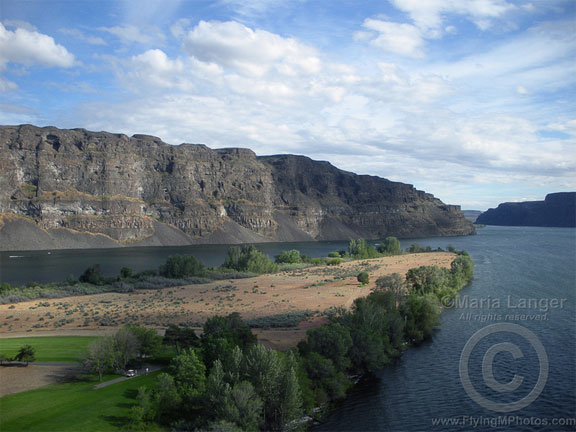
I snapped this photo of the south end of Crescent Bar as I left the area. Quincy’s farmland is spread out on the shelf above the cliffs on the left side of this photo. (View a larger version in my photo gallery.)

Farther downriver, I swung to the east and climbed over the edge of the gorge. I sped over Dusty Lake, where Mike and I had gone hiking with Mike’s cousin Rick and his friend last year. A few fishermen stood on the southwest side of the lake and looked up at me as I zipped past. Then, dodging wires, I climbed back up to Quincy’s level and headed southwest. The Gorge Amphitheater was packed with cars, tents, and people. A show was going on. I kept my distance as I swooped past, then dropped behind the stage and headed back upriver over a rock shelf covered with ancient potholes. Then I was abeam Quincy Lakes again and chose another of the two flood-carved canyons to fly up.

Quincy Lakes

This is Ancient Lake, fed by a waterfall that, in turn, is fed by runoff irrigation water. Quincy’s farmland is spread out on the shelf beyond these cliffs. (View a larger version in my photo gallery.)

I zipped back over the farmland south of Quincy. I noticed that my GPS wasn’t working quite right — a restart was required to fix it — but I knew my way back to the ag strip without it. The ag pilots were just leaving when I touched down. I’d been out for just a half hour. My mood was considerably brightened and my headache was just about gone.

Because of a gusty little wind coming out of the west, flying wasn’t smooth enough to make the flight perfect, but it was good to get out and about. What I really like is flying on those windless mornings or afternoons, when the river is glassy, reflecting the cliffs and clouds. When it’s like that, I can fly low over the water and around the canyons in effortless control of the aircraft. That’s magic.

As you can see, I got two reasonably good photos of the area while I was flying. I used a Nikon Coolpix camera for these shots. Although I really don’t like the camera in general — it doesn’t seem to work as well as the Canon Powershots I had before it — it’s easy enough to use with one hand (my left) as I fly. I can’t really frame a shot — I literally point and shoot and hope for the best. On these shots, the light was low and soft enough to prevent glare through the cockpit bubble. I lucked out.

The Big Detour Map

Annotated map to my most recent flight around the Cascades.

I wrote about my long flight around the Cascades here; this sectional chart shows the actual route with points of interest. You can click the map to get a larger view without the annotation letters.

Big Detour Map

A – Starting point in Auburn, WA, a suburb of Seattle.
B – The first canyon I attempted to fly though. I climbed above the clouds when I turned around to backtrack.
C – My first descent back below the clouds.
D – Where I hooked up with Route 12.
E – My big scare in the clouds. I was less than 5 miles from the pass.
F – The ridge I crossed to descend to the Columbia River Gorge area.
G – The Dalles, where I refueled.
H – Skirting around very low clouds.
I – Skirting around a restricted area.
J – Mattawa, where I had lunch with a friend.
K – Quincy, where the helicopter is based for my first contracts.

In the 3-1/2 hours I flew that day, I could have been 1/3 of the way back to Arizona.

The Big Detour

Or why a one-hour helicopter flight took four hours.

Seattle weather sucks. I can’t say it any other way.

I arrived there last Thursday and experienced rain every single day while I was there. A helicopter flight to Bremerton for breakfast was switched to a much closer destination simply because low clouds made it impossible to get to Bremerton. In a helicopter, for pete’s sake.

By Sunday, I’d had enough. I hooked up the RV and crossed the Cascade mountains to the east side. The Columbia River Valley is [usually] much drier. I set up camp in my usual spot at Colockum Ridge Golf Course and opened all the RV windows to let some fresh, warm, dry air in.

The Mission: Get My Helicopter to the East Side of the Cascades

Of course, my helicopter was still in Seattle. As it ages, parts are starting to fail. This year, it was (so far) the auxiliary fuel pump (again), the muffler (cracked), the upper bearing (worn out), and the engine support do-dad (drooping). Add to that the cost of overhauling the magnetos and I was looking at about $10K of repairs. In the past two months.

So don’t anyone ask me why it costs so much to fly a helicopter.

The repairs were finished on Tuesday afternoon. Although weather was still an issue in Seattle, I needed the helicopter on the east side. My contracts don’t start until June 10 or so — pushed back because of unseasonably cold weather — but there was a slight chance I might be able to pick up a week’s worth of work farther south if the helicopter was available.

So on Wednesday morning, I boarded a Horizon Airlines flight in Wenatchee (EAT) for Seattle (SEA). My friend Don, who’d graciously hosted me and my RV the previous week, picked me up at the airport, let me buy him lunch, and dropped me off at Seattle’s Boeing Field (BFI). After chatting in the office for a while and checking the usual dismal weather, I met with the mechanic, gave the repairs a quick look, preflighted, and took off.

First Attempt

It was about 1 PM and the clouds were low. In the hilly terrain along the I-90 corridor, I managed to keep my altitude at 300-500 feet above the ground with the cloud bottoms a comfortable distance above me.

First Try

The view shortly before I decided to turn back. Unfortunately, my point-and-shoot Nikon insists on focusing on raindrops.

But I didn’t get very far. As I moved eastward over I-90, visibility started to deteriorate. I wasn’t much past Renton’s airspace when I saw a thick rain shower ahead of me over the Interstate. I’d been taught at the Grand Canyon that if you can see through it you can fly through it. I couldn’t see through this one. And I wasn’t anywhere near the pass I’d have to slip through to get over the Cascades. Obviously, this wasn’t the way to go.

I doubled back, calling in to Renton’s tower to get permission to transition along the east side of their airspace. I figured I’d head south — possibly as far at the Columbia River — and go around the mountains. That would turn a 45-minute flight into a 2-1/2 hour flight (at least). But as I traveled south, I could see that the visibility situation was worse than the weather radar indicated. I got past Auburn and knew I couldn’t complete the flight at that time.

I had two choices:

  • I could return to BFI and hang around in the mechanic’s office and wait until the weather got better. I had no transportation there, so I’d be stuck there. If I got stuck there all day, they’d eventually kick me out and I’d have to either fly out or get a cab to a motel and return the next day for departure.
  • Don's Heliport

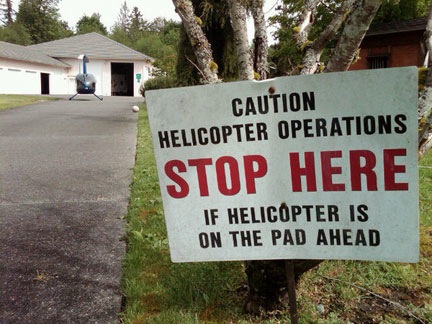
    Don’s Heliport, photographed with his helicopter on the “pad” on a nicer day.

    I could fly to my friend Don’s private helipad in Auburn. He’d already told me I could do that if I needed to. There I’d find a comfortable place to hang out with friends and both a television and wifi to check the weather. I’d also be able to draw on Don’s weather local experience to determine the best time to make another attempt. If an overnight stay was required, they had a nice guest room.

Which would you pick?

The trouble was, Don’s heliport — although logged into the FAA airport database — was not on my GPS. I’d only flown in once with him — as a passenger. I knew some of the landmarks. But I also knew that it was completely surrounded by tall trees and impossible to see until you were literally right on top of it. So I had to go hunting. In the rain. I figured I had about a 50% chance of success.

I did eventually find it. It took about 10 minutes. On the ground, Don heard me and quickly pulled his truck and trailer out of the landing pad. He’d just gotten it out of the way when I spotted it. I circled around to make the steep approach. I came in a bit too slow and steep, but I made it work. Not bad for the first landing.

We checked the weather together and decided I should wait a few hours. I accompanied them on a few errands. It was raining the whole time. We got back and checked the weather again. Radar showed a huge storm system moving northwest from the other side of the Cascades. My buddy, Jim, who had started a cherry drying contract in Mattawa, would probably be flying. We looked at the Washington State Department of Transportation Web site traffic Web cams in the passes. We checked Duats and got information for Stampede Pass, which was not far from the pass on I-90 that I’d be crossing. Conditions changed by the minute.

Second Attempt

Finally, at 6 PM, I decided to try again. I said my goodbyes, started up the helicopter, and climbed up through the trees. The scene from up there was surreal. Wispy patches of thin clouds rose here and there from the tops of the tall pines. To the west and south, the sun had broken through the low clouds, illuminating the ground with rays of light. To the north, I could clearly see the Seattle skyline. To the east, however, things weren’t as rosy. There were scattered rain showers and patches of fog.

My initial plan had been to follow Route 18 to I-90, but Route 18 led right into a thick rain shower. So I punched Bandera (4W0) into my GPS and took a route that was southwest of 18, heading east northeast. I hit I-90 just before it made a sharp turn into a canyon. The clouds were very low there and I’d have to fly about 200 feet over the freeway to enter the gap. While there was a chance that the ceilings could rise right beyond that point, it was impossible to tell from my position a mile or so away. And I was still 7 miles from Bandera, which was still several miles from the pass. The likelihood of getting through there without hitting wires was slim to none.

Afternoon Clouds

Another crappy photo, but it should give you an idea of those wispy clouds coming up through the trees.

I turned around and retraced my route to Don’s place. To the south, there was a lot of bright sunlight. I was pretty sure I could go that way and follow the Columbia River around the mountains. But the flight would take 2-1/2 hours and I’d have to stop for fuel. Sunset was at 8:45 PM. It was already 6:30 — too late to make the attempt.

Of course, I’d forgotten to mark Don’s place as a waypoint on my GPS, so I had to hunt for it again. I found it a bit quicker and made a much better approach and landing. I was there for the night.

I’d been gone 30 minutes.

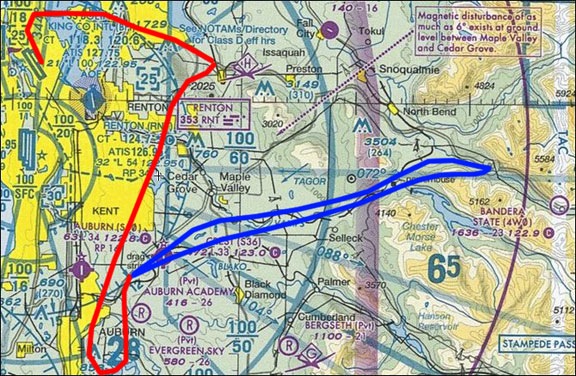
First Two Attempts

My first two attempts on a Seattle sectional chart. Red is my first try, blue is my second.

Third Attempt

I woke to fog. We checked the weather on the Internet and on television. We also called another pilot who lived nearby and had a better view of the sky to get her input. By then, I was so sick of checking the weather that it ceased to have meaning for me. After all, few of our sources gave me the information I really needed: how high were the could bottoms above the ground? What was the visibility in the mountain passes? A direct flight to Quincy from Auburn was less than 100 nautical miles. Although I couldn’t make a direct flight, my goal was to make it as direct as possible.

You need to understand here that this isn’t the first time I’ve had to take the helicopter across the Cascades. It was going to be my seventh. Weather had been an issue on four of those previous flights, but never this bad. I just wasn’t willing to accept it.

So when the fog cleared and our contact a few miles away reported ceilings of about 500 feet, I decided to try again. Don topped off my fuel tanks with another 15 gallons of fuel. I said goodbye again, started up, and climbed back up through the trees.

Nice Weather

This is the nicest bit of weather I came across. This shot was taken about 15 miles south of Auburn at 9:18 AM.

Up top, I was surrounded by poor visibility. I could probably see 3 miles, but not much more. I was certain that I’d be wasting my time if I tried for the I-90 passes again. So I headed south toward Portland, OR. As I flew, the weather improved.

As I flew, I never lost hope of getting across the mountains another way. Although my general direction was south, I kept trying to find passages that would take me more to the east. I followed one particular valley for quite a while, climbing ever so slightly along the way. Then my way was blocked by clouds touching the tops of the tall pines all around me. Discouraged, I turned around to backtrack out of the valley.

View from Above the Clouds

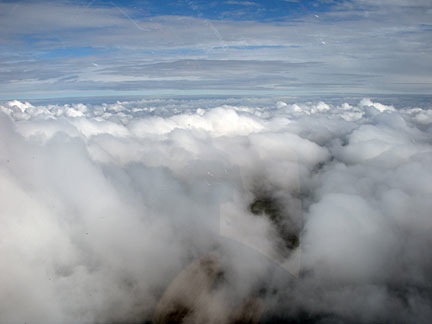
View from above the clouds. I was probably heading westbound when I took this shot after aborting my first canyon passage. 9:30 AM

A big hole in the clouds opened up, revealing blue sky. I pulled pitch, pulled the cyclic back, and climbed out at about 1200 feet per minute. Above the low clouds, the view was disheartening. The cloud tops varied in height and another layer of clouds seemed to meet them on the horizon to the east. The bright, snow-covered top of Mount Rainier seemed to taunt me, shining in the sun less than 30 miles away. On a previous westbound flight, I’d flown above the clouds just north of the peak, dropping down into a valley on the west side to complete my flight. It didn’t look as if I’d be as lucky to find a path back through the clouds on the east side that day so I wasn’t about to attempt it.

I caught sight of a lake to the west of my position through another big hole in the clouds. I dumped the collective and glided down at 1700 feet per minute, banking right and then left to dodge clouds on my way down. Safely under the clouds again, I continued south.

Eventually, I hooked up with Route 12, another of the roads that crosses the Cascades. I followed it eastbound in a pleasant valley dotted with homes, farms, and lumber mills. The clouds overhead were low but mostly broken, so there was plenty of sunshine — enough to turn off the heat and crack the air vent. I tracked my position on the sectional chart. White Pass was at 4500 feet. If I could get through that, I’d be able to follow the road to Yakima.

I passed the last town in the valley and the road began climbing into the mountains. I climbed with it. Then I decided to take a chance above the clouds again. I climbed up through a big hole, reaching 6,000 feet before coming out on top of the lowest layer. The clouds were taller here, some of them starting to show signs of convective activity. Although I was atop many of them, I had to fly around others. My GPS assured me that the road was beneath me, but I couldn’t see it. I also couldn’t see Mount Adams, which I knew was very nearby. The clouds were thick to the east. I knew that to an onlooker, I probably looked like a tiny speck of red among the giant puffy clouds and rocky peaks around me.

And that’s when I scared myself. I flew into a sort of box canyon of clouds. The only way out was back the way I’d come and down. I dumped collective and pulled the cyclic over. Within a moment, I was banking hard to the right at at least a 60° bank angle, descending at 1000 feet per minute. Adrenaline rushed into my system, making my entire body feel the dire emergency situation I was in. In less than 15 seconds, I was clear of all danger, but it would be at least 30 minutes before that adrenaline rush was completely gone.

I won’t do that again.

I flew back to that nice little town with the initial thought of landing there at its airport and waiting for the weather to improve. But I realized what an idiotic idea that was. The weather there would not improve soon enough and the town was too small to have a motel or even fuel at its airport. So I continued on my way, backtracking along Route 12, westbound through the valley.

At Randle, there was a road that cut south through the mountains. It looked like it might be a shortcut to the Columbia River Gorge east of Portland. I still had half tanks of fuel so I figured I’d give it a try. Soon I was flying through a spectacularly beautiful little valley, over a rushing river. Every once in a while, I’d catch sight of the paved road between the tall pine trees. The road climbed and I climbed with it.

Then the inevitable — a wall of clouds right behind a ridge. I circled, looking for the road, wondering which way it went. The neat thing about mountain roads is that they’re usually built on the easiest path to cross mountains. That’s what makes them so good as navigation tools when you need to fly a helicopter over some mountains.

When I spotted the road, I was surprised to see that it was covered with deep snow. It was obviously closed for the winter. I followed it slowly to the top of the ridge to take a peek over. If the land dropped down behind it and the clouds stayed high, I could continue. But if there was another ridge blocked by clouds behind this one, I’d have to go back. Again.

I was lucky. The ridge was the highest point on the road. The land fell away beyond it and the road fell with it. I popped over the top only 50 feet from the treetops and descended into a valley on the other side.

I punched Hood River into my GPS. I’d need fuel somewhere and Hood River seemed as good a place as any to get some. It was still 40 miles out. I flew directly toward it, put off by the amount of cloud cover all around me. I’d been hoping for clear skies in the Columbia River area but I wasn’t going to get them.

Mount St. Helens

A crappy, over-the-shoulder shot of Mount St. Helens. (You try taking decent photos while flying a helicopter.)

At one point, I saw Mount St. Helens over my right shoulder. It was covered with fresh snow.

Eventually, I changed my fueling destination to The Dalles. I hit the Columbia River abeam Hood River and followed the Columbia eastbound. I landed at The Dalles, called Don to assure him I was okay, and went inside to use the bathroom while the FBO guy fueled my helicopter.

I thought the worst of it was over. I even said that to the FBO guy before starting up again. But although the worst of it was over, there was still weather ahead. Unfortunately, I hadn’t taken the time to check the weather again while at The Dalles. So the low clouds and heavy rainstorms I had to fly through for the next hour or so were an unpleasant surprise.

Spot Messenger Track

As this SPOT Messenger track shows, my route from Seattle to Matawa was anything but direct.

It was cloudy but not raining when I landed in Mattawa to visit with my friend Jim. He and his wife drove me to a local restaurant where I could get something to eat and drink. We wound up spending at least 2-1/2 hours there, talking about flying and drying cherries and politics. As I was getting ready to leave, it started drizzling. Jim, who’d flown 2-1/2 hours the day before, smiled and thanked the rain gods. If the rain kept up, he’d fly again later in the day.

From Mattawa, it was only 20 minutes back to my base in Quincy. I overflew what looked like an AStar drying cherries on the north side of Mattawa. (Why he was drying while it was raining was beyond me.) In Quincy, I landed on a concrete pad at the ag strip across from the golf course where I’m camped out. The clouds were thickening in the area. I hitched a ride to the campground, got my truck, and put the padded blade covers on the helicopter.

It was good to get back to my comfy RV and Alex the Bird. I slept very well that night.
Highest Duty

A book review.

Highest DutyLast night, I stayed up late to finish reading Highest Duty by US Airways pilot Chelsey B. “Sully” Sullenberger. Captain Sullenberger was the pilot in command of US Airways Flight 1549, which landed with no loss of life in the Hudson River on January 15, 2009.

I’d been wanting to read the book for a while but I kept putting it off. I wanted it to be my first purchased ebook experience. I was supposed to get a Nook for Christmas, but the idiots at Barnes & Noble were completely clueless about customer service and timely order fulfillment, so I canceled the order. I wound up with an iPad in April. After weighing the benefits and drawbacks of ebook reader software — iBooks, Kindle Reader, and B&N Reader — I decided to go with the Kindle software and ordered the Kindle edition of the book from Amazon.com. From what I hear from Twitter friends, the iPad makes a better “Kindle” than Amazon’s Kindle.

On Heroes

I’ve always been intrigued by Captain Sullenberger’s modesty and apparent reluctance to bask in the limelight of his extraordinary experience. People call him a hero but he [rightly] refuses that title. He quotes from a letter he received after his Hudson River landing: “I see a hero as electing to enter a dangerous situation for a higher purpose, and you were not given a choice.”

I agree with this definition of a hero. Captain Sullenberger did what he had to do and was fortunate enough to have the knowledge, experience, demeanor, and team to carry it off successfully. His love and respect of life — including, of course, his own — is what motivated him to do everything he could to succeed.

In many ways, that’s better than being a hero. When a terrible situation was thrust upon him by circumstances he could not change, he rose to the occasion and emerged victorious, saving the lives of 105 people. Along the way, he gave the rest of us hope — after the terrorist attacks of 9/11, in the midst of a serious economic recession, with wars going on in the Mideast — he showed us what people can accomplish when put to the test. He gave us the happy ending we all needed.

It Wasn’t a “Miracle”

Another thing that intrigued — and, I’ll admit, pleased — me about Captain Sullenberger was his failure to credit his success to the intervention of some supernatural being. I’m talking about God.

I can’t tell you how sick I am of seeing famous athletes and celebrities and just plain people thank God for something good happening to them. Scored a record number of goals in a basketball game? Thank God! Won a Grammy? Praise Jesus! Tornado took out the house next to yours but left yours unscathed? God was watching out for you!

It makes me sick. People don’t want to give themselves credit where credit is due. They work hard, they train, they practice, but they give God credit for getting the ball through the hoop. They learn music, they practice singing, they get a great producer who helps package their material, but they give Jesus credit for winning that Grammy. They don’t want to admit that luck has a place in our lives — good luck preserves one house while bad luck takes the one next door away. What of the people who lost the basketball game or the Grammy or their home? Did God simply not like them as much? And what about when these winners get their own dose of bad luck — injury, illness, scandal, death? Did God change his mind about them?

Captain Sullenberger, however, did not thank God or any other supernatural being for the positive outcome of his Hudson landing. At least I didn’t hear him do so in any article, interview, or elsewhere. I wanted to read the book to be sure that he didn’t thank God within its pages. He didn’t.

And that just makes me respect him even more.

The Story

The book mingles autobiographical material with events from the day of the landing. The autobiographical material was presented in a roughly chronological order, but did bounce around a lot with side stories, including references to the Hudson landing. I’m not sure that was the best approach, but it did keep me reading.

Captain Sullenberger is clearly a true pilot. He entered aviation because of his love of flying. From his start as a teen, he took aviation seriously, learning what he could to be a better, safer pilot. He understands the importance of knowing an aircraft’s systems inside and out. He understands the value of studying past accidents to prevent future ones. He also understands that all the things that happen in our lives define who we are and how we will react in a given situation.

Flight 1549 from Wikipedia

This iconic photo of US Airways Flight 1549 in the Hudson River by GregL originally uploaded to Flickr can be found on Wikipedia under a Creative Commons 2.0 license.

A detailed discussion of the events of January 15, 2009 begin about 60% through the book. The story is riveting. He combines his narrative of what happened with references to his past that he believes influenced him to make certain decisions. For example, his knowledge of research into why military pilots sometimes ejected too late is part of why he decided not to worry about saving the airplane by attempting an airport landing and instead concentrate on saving the people by landing in the river. (There’s a lot more to his decision than that; this is just part of what went into it.)

Throughout this part of the book are bits and pieces of the cockpit transcript, recorded by microphones during the flight — the so-called “black box” data. Even though I knew how it would end — don’t we all? — I found the details fascinating. It was a great example of teamwork between Captain Sullenberger and his first officer, Jeff Skiles. Later in the narrative, it was clear that the flight attendants were also part of the team, helping passengers off the plane in as orderly a manner as possible.

The aftermath of the experience also made interesting reading. Getting an inside look at the mail Captain Sullenberger received from people on the plane — as well as many people who had no direct connection to the flight or its passengers at all — revealed the psychology of people. I’m not the only one who appreciated the happy ending to that seemingly doomed flight.

The Soapbox

One of the complaints people have had about the book is the soapbox aspect. Captain Sullenberger believes that airline pilots are not treated as well as they should be by their employers considering the hours and responsibilities of their work. He believes that pay cuts and pension cuts are making it ever more difficult to attract and retain quality pilots who actually care about their work. He suggests that airline pilots are like bus drivers of the sky.

Although I don’t have intimate knowledge of the airline industry, as a professional pilot who has worked for a large tour operator, I know exactly what he means. Aviation employers don’t care how good a pilot is. As long as the pilot meets insurance requirements and can do the job, all that matters is how much that pilot costs. In my experience, many employers would rather hire a cheap, entry level pilot than a seasoned professional who costs more. They don’t see the benefit of the experience. They’re gambling, of course, on the equipment and circumstances of flight — when something goes wrong, will the entry level pilot have the experience and knowledge to bring the aircraft and passengers back safely?

In the airline industry, pilots are locked into their employers for seniority. If they leave one airline, they lose all seniority and start at the bottom at their new employer. This prevents experienced pilots from looking for better jobs. It stagnates the employee pool. And although Captain Sullenberger didn’t mention this, it prevents good ideas from one airline from migrating to another.

Captain Sullenberger does discuss how many airline employees have simply stopped caring about anything other than what’s in their job description. As budget cuts reduce non-essential staff, customer service suffers. Captain Sullenberger talks about his personal experiences going the “extra mile” to help passengers who can’t get the help they need from other airline employees. He talks about how most airline employees are simply tired of doing other people’s jobs. He doesn’t blame them — he hints that they’re underpaid for what they’re supposed to do — but he does decry the system that results in this poor attitude.

He also believes that budget cuts have the potential to reduce safety. A good example of this is the emergency procedures book that his first officer needed to consult on the loss of both engines. In the past, the book had numbered tabs that made it easier to find content. The airline, in a cost-cutting measure, had stopped including the tabs, making it necessary to thumb through the book and look at individual page headings to find content. In the slightly more than three minutes the cockpit crew had to land the plane without engines, every second was valuable. Yes, this flight had a happy ending — but could other flights be lost due to cost cutting measures like this? It certainly makes you wonder.

My feelings about Captain Sullenberger’s soapbox are mixed. I didn’t like reading his complaints, but, at the same time, I knew they were valid. And I know that his experience and the interviews, articles, and books that come from it are the perfect way to get the message out.

While Captain Sullenberger was careful not to criticize his airline, it’s clear that US Airways is just as bad as the others when it comes to matters of pilot compensation and cost-cutting. Perhaps his insight will help make the situation better?

Sadly, it probably won’t.

Thumbs Up

In all, I give the book two thumbs up. While it’s especially good reading for pilots and others interested in aviation, I also think it makes a good guide for young people who want to make something of their lives. And for the rest of the world, it’s a great look at one of the most amazing emergency landings we’ll likely ever see.

Wickenburg to Seattle by Helicopter: Day 3 AM

Bryce Canyon to Salt Lake City, UT.

I woke to a beautiful day at Bryce Canyon. Of course, I didn’t know it at the time. It was still dark. The weather forecast had called for overcast, so when I looked out into the predawn sky and saw only grayness, I assumed the area was clouded over. But as the day brightened, I realized that it had been just a thin cloud that hid the stars from view. It cleared out to reveal a blue sky.

I grabbed my camera and walked from my cabin to the rim trail. A bunch of folks were there in bunches at viewpoints. Shivering against the cold, I joined a pair of Canadians with the same idea I had: shooting the rock formations in the early morning light. I spent the next hour walking the rim, photographing the view. I’ll share some of those photos in another blog post.

Knowing from the previous day’s experience that I wasn’t likely to get a good meal at the lodge’s restaurant, I went back to my cabin, packed up, and checked out. A while later, I was leaving the park and pulling into the parking lot at Ruby’s Inn.

Ruby’s is a tourist trap. I can’t say it any other way. Every little town outside a National Park is full of them. Ruby’s, like so many of the good ones, has it down to a science. Buffet breakfast designed to satisfy the Americans and awe the Europeans and Asians. Clean comfortable seating. Huge gift shop. WiFi. I settled down in a booth, got tired of waiting for a server, and just served myself from the buffet. The price was far above average so, in true American fashion, I ate a lot more than I should have to get my money’s worth. Sometimes, I’m a real idiot.

After topping off the rental car’s fuel tank, I drove to the airport. By that time, the morning was truly beautiful, with clear skies and light winds. To the north, I could see a hint of some clouds. The weather in Salt Lake City — which I’d checked while at Ruby’s on my iPad — was overcast with showers. I wondered how long I’d be flying before I reached the southern edge of the weather.

I settled my bill with the FBO, left them the car keys, and went out to the helicopter. After a preflight that included checking for ice on the blades (some frost, but it was melting fast in the sun), I climbed aboard and started up. It took a good ten minutes to warm the engine. Then I was lifting off, heading northwest toward Panguitch.

I’d planned this leg of the flight days before and had repeatedly wondered whether It was a good route. Sometimes I do that. I decide on one thing and repeatedly have second thoughts about my decision. Is that a woman thing? I don’t know. But this time, I stuck with it.

Near Bryce Canyon

An example of one of the red rock canyons northwest of Bryce, as seen from the air.

The landscape was immediately amazing. I was coming off the plateau on which Bryce “Canyon” sits. Bryce is not really a canyon at all. It’s more like a mesa with incredible red rock formations around much of its exposed sides. Coming down off the northwest side, I passed over and near dozens of red rock canyons, many of them deep and narrow slot canyons. It would have been interesting to explore, but I was on a schedule and didn’t have time. So I continued on.

I descended at least a thousand feet off the plateau into the valley in which Panguitch and its small airport (U55) sits. The town looked tiny from my perspective. I didn’t overfly it. Instead, I turned north to join up with Highway 89. I’d follow that at least halfway to Salt Lake City.

North of Panguitch

Canyon between Panguitch and Circleville, UT over Highway 89.

The flight took me along the Sevier River, through a narrow canyon and into a wider valley beyond. The towns along here were few and far between: Circleville, Junction, Marysvale. At Marysvale, my chart advised me that there was a Letter M visible from the sky. Sure enough, it was there, bigger than life. I wondered about the pilots who used such landmarks as navigation tools. I also thought it might be cool to display the chart and photo of this landmark side by side in a blog post, so I snapped a photo. (Sorry about the glare. And yes, I really did think about this while I was flying.)

Marysvale on the Chart Letter M

Colorful Canyon Wall

How does this happen?

I went through another canyon. This one had some great color on one rock wall. Really pretty. I’m not sure how color like this happens, but I’m willing to bet that a geologist would really enjoy flying low-level in a helicopter through an area like this. The earth’s geology is laid bare for all to see.

I should mention here that the whole time I was flying, I was in a valley between mountains 10,000 feet and taller. There was plenty of snow atop those mountains. And the clouds were beginning to gather not far above them, thickening with every mile north that I traveled. They were friendly, white, puffy clouds, the kind that get nasty on summer days when convective activity builds them taller and taller.

Reflections in a Lake

Reflections in a glassy calm lake.

I flew by a number of small lakes. The wind was perfectly calm down there — it was easy to see from the quality of the reflections of the mountains and sky. I got a few shots through the bubble. This is the best of the bunch.

Not long afterward, the weather closed in. The clouds thickened and blotted out the sun and sky. They also started to drop, getting ever closer to where I was flying. By the time I got to Provo (KPVU), it was raining and I was flying only a few hundred feet below the clouds. I called the Provo tower and asked to transition along I-15. The controller cleared me for the transition and the radio settled back into unbroken silence until I reported I was clear to the north.

See what I mean about low clouds in this video.

I shot a video in this area using my Flip video camera. It’s crappy — hell, it isn’t easy to take any photos while flying a helicopter so cut me some slack here. It does give you a pretty good idea of what the weather was like. The video sweeps from left to right across the cockpit, ending at my right shoulder. The weather improved somewhat as I closed in on Salt Lake City airport.

I called into Salt Lake City when I was about 11 miles out. The controller told me to call Salt Lake City approach. So I switched frequencies and repeated my call. I was told to proceed along I-15. Three minutes later, they told me to contact the tower on yet another frequency. I dialed in and wound up speaking with the original controller. “Welcome back,” she said.

Salt Lake City Airport DiagramI told her I was unfamiliar but had a good airport diagram. I told her I was going to the Million Air FBO and had a pretty good idea of where it was. She cleared me to land when I was still a few miles out.

Salt Lake City is like two airports in one. There are two big runways for commercial airliners on the west side. And then there are two smaller runways for general aviation on the east side. My destination on the airport was on the southeast corner. I came in right of the taxiway parallel to runway 35. I weaved my way around some parked planes and came in for a landing on the ramp. A line guy came out and guided me to a spot 10 feet away from where I’d touched down. Whatever.

I’d been in the air for a full hour.

I shut down as the pilot I was meeting at Salt Lake stepped out of the FBO into the rain. A while later, we’d be starting a long flight to Seattle together.

But that’s another story.