
Ebook Costs and Pricing, Part II: The Pricing

Publishers and resellers need to give readers value for their money.

Ebook Costs and Pricing
Part I: The Costs
Part II: The Pricing

In the first part of this series, I discussed, in depth, the costs of publishing any book — ebook or traditional printed book. If you haven’t read that, read it now. I think you’ll learn some important things about how the publishing industry works. My hope, however, is that you understand the value of every book that’s published, no matter what format it’s published in.

Amazon’s Macmillan Fiasco

In January 2010, there was a big hullabaloo in the publishing world. Out of the blue, Amazon, the world’s biggest bookseller, dropped titles by the publishing giant, Macmillan, and its imprints. This turned out to be roughly 1/3 of Amazon’s book catalog. The reason for this? Amazon was attempting to strong-arm Macmillan into accepting its ebook pricing model.

You see, Amazon.com wanted all ebooks to have a maximum price of $9.99 with a certain amount of that price going directly to Amazon.com. Macmillan, however, wanted to use the “agency model.” As Mashable reports in “Macmillan CEO Confirms Dispute With Amazon Over eBooks,”

In this model, Macmillan as publisher would sell digital editions of books to customers through retailers, who as the agents of the sale would take the typical 30% commission standard in many digital media industries.

Whereas currently Amazon caps the retail price of e-books at $9.99, Macmillan proposes to set the price for each book individually at price points between $5.99 and $14.99, starting typically on the high end of the spectrum (between $12.99 and $14.99) and dynamically lowering the price over time.

(This is the model currently used by Apple in its iBookstore.)

Flexing its muscles, Amazon chose the “nuclear option” of refusing to sell Macmillan books, thus putting the first battle of the ebook war out into the public eye.

Those of us in the publishing industry sat back and watched the battle of the titans. Amazon attempted to get customers on its side by accusing Macmillan, in a roundabout way, of being greedy. Macmillan, on the other hand, insisted that it had the right to establish its own pricing. Consumers tended to side with Amazon.com. Authors and others in the publishing industry tended to side with Macmillan.

I sided with Macmillan. I believe that the producer of any item for sale should have the right to set its own prices. Amazon was wrong to try to force Macmillan to follow Amazon’s pricing structure. If a publisher has to cut the price, it’ll also have to cut the costs. And where do you think the first cut will be? I can tell you from experience: the author.

So, as you might imagine, I was relieved when Macmillan won the battle. You can read another author’s perspective of this particular battle over ebook pricing in “Amazon, Macmillan: an outsider’s guide to the fight,” by Charlie Stross.

Unfortunately, however, Macmillan’s pricing strategy has serious problems. Not only does it often result in ebooks that are more expensive than their printed editions, but it fails to take into consideration the perceived value of an ebook.

The Psychological Barrier of Ebook Pricing

Although there is a definite cost to publish (as I discussed in Part I of this series; did you read it?), the vast majority of readers feel — and I agree — that an ebook should cost less than a traditionally printed paper book. How much less depends on the consumer, his budget, and the value he sees in the book.

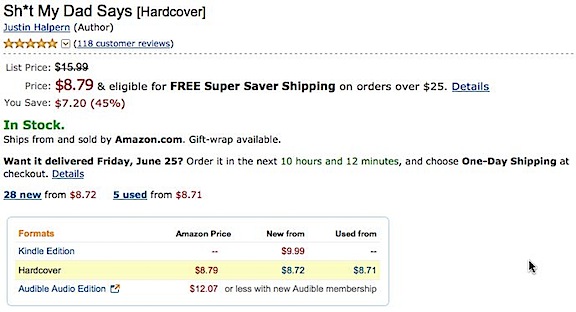
Unfortunately, publishers and resellers don’t feel this way. A visit to Amazon.com tells the story. I pulled up the pages for the hardcover editions of several books currently on the top of the New York Times Bestseller list. In many instances, the hardcover printed book was priced lower than the ebook. Here are two examples:
Sh*t My Dad Says Pricing

Outliers Pricing

While I realize that the difference in pricing is minor — less than $2 in each example — it’s still roughly 10% cheaper to buy the hardcover, printed book than the ebook.

What’s the difference between the two editions of each of these books? The content is certainly the same — the same words by the same author. The less expensive book has substance. I can carry it around, put it on my shelf, thumb through it, write in it, show it to a friend, loan it out, give it away, or resell it on eBay or at a garage sale. This print book is certainly in a flexible format with ongoing future value. The more expensive ebook exists as a digital file that I can only view in one format on one kind of reader. Sure, I can read it on my iPad, my BlackBerry, and my Mac. But I can’t lend it out, give it away, or resell it.

In other words, the more expensive book has more restrictions on how I can use it.

Is that fair? Of course not.

Why would I pay more money for a book with more restrictions on its use?

I wouldn’t. And neither would the majority of ebook readers.

So what happens? Suppose I want to buy one of these books. I don’t want to buy yet another print book for my bookshelf — I’m trying to downsize. I’m not willing to pay a premium for an ebook edition. So I’ll either not read the book or I’ll pick up a copy at my local library. Does Amazon.com benefit from this? No. Does the publisher? No. The only one who benefits is me, because although I have to deal with the inconvenience of two visits to my local library, I’ll save a few bucks on the cost of a book. I’ll also achieve my personal downsizing goal by not adding more books to my library shelves.

The Magic Price

In addition to being less costly than the printed version of the book, to gain wide acceptance, the book needs to be priced to sell. This is where things get tricky. How can the publisher/distributor determine the price of an ebook?

Consider the “magic price” of consumers. What’s the maximum amount a reader is willing to pay for an ebook? For me, that price is $10 for a relatively new book with the price going down depending on the age of the book. I’d expect to pay more for a new book on the New York Times Bestseller list (but not more than its printed counterpart). I’d expect to pay far less for a 5-year-old book by the same author, even if it also once had bestseller list status.

That corresponds with the “agency pricing” model discussed earlier. But what doesn’t correspond is the starting price (as high as $14.99!) and the length of time before the price drops. I think the price should start much lower, perhaps at paperback book pricing levels. If it doesn’t start that low, it should definitely drop more quickly — within three to six months. Or, in the case, of a bestseller, when it falls off the bestseller list.

You might argue that if a reader knows the price of a book will drop, he’ll merely wait until the drop to buy. For a strong title, it shouldn’t matter. Readers will buy at their magic price. Some people won’t want to wait for some titles and will pay the premium. Others who are more price-sensitive will wait and save.

Pure Profit?

Publishers need to understand that the industry is changing. Information is widely available at low-cost or free. People with access to the internet can get plenty of reading material that’s just as good — if not better — than what they can find on bookstore shelves. This is taking a huge toll on the publishing industry.

As all this is going on, however, the publishers are handed a golden opportunity to sell a product with an extremely high profit margin: ebooks.

What the publisher needs to remember is its main goals, which are, in order:

  1. recoup fixed publishing costs
  2. earn a profit on books sold

Once the fixed costs of publishing (again, covered in detail in Part I of this series) are covered, the unit costs (primarily the author’s and retailer’s cuts) are relatively small. The result is a high profit margin product. Publishers should be doing everything they can to sell as many ebooks as the market will consume. Lowering the price is a good first step, as it will make ebooks more attractive to more readers.

As Charlie Stross points out, this is all part of the price elasticity of demand, an economics term that describes the relationship between price and units sold. Generally speaking, as price drops, more units are sold. That means that with proper pricing, the seller can sell more units and, even if the margins are lower, may be able to make as much — or more — money.

With a product like ebooks, which have a low cost to produce once fixed publishing costs are recouped, every ebook unit sold is profit. The more ebooks a publisher sells, the more money they make. So why wouldn’t they want to price ebooks so they sell more?

Who knows?

Short-Sightedness

The main problem I see with publishers is that they’re typically short-sighted. They know print publishing — they’ve been doing it for years. That formula worked for a very long time. But times change and technology marches on.

No one can deny the convenience of having a dozen or a hundred (or more!) books on a handheld device (or computer or cell phone) for instant access at any time. I don’t know about you, but the last time I took a get-away-from-it-all vacation, I lugged four books with me and still ran out of reading material before the end of the week. (I read fast.) I look forward to my next vacation when I can put all those books on my iPad.

Just as computers replaced typewriters, CDs and MP3 files replaced vinyl LPs, and cell phones are replacing land lines, ebooks will replace printed books. It’s inevitable. (Sure, there will still be books out there, far into the future. But they’ll be special books, like the coffee table books with designs and images that don’t translate well into electronic format — yet.)

Why are publishers fighting it? Why don’t they embrace the ebook revolution by hooking us on ebooks with the lure of practicality and cost savings? Get us addicted, make us demand books in this format. Why are they sticking to a pricing model that makes smart consumers feel like idiots for paying more for less?

We finally have three good ebook reader devices — although I believe two will go the way of the dinosaur when more iPad-like devices start appearing — so there’s no hardware excuse. The only thing holding ebooks back is the inflexibility of publishers regarding pricing and format and the limited availability of ebook titles.

Author and Reader

I’m writing this post from two points of view: as an author and as a reader.

As an author, I want to make as much money as I can. It’s my livelihood. You’d think, therefore, that I’d like the idea of high pricing. But I also like to consider what’s fair and I simply don’t believe that it’s fair to charge more for an ebook than a printed book. I also think more books could be sold if the price were lower, thus earning me the same amount of royalties — if not more.

As an author, I’ve had this discussion with one of my long-time publishers. I’ve pushed to create different ebook formats that take advantage of the display capabilities of computers with more attractive pricing. My reward for this: I’m labeled a troublemaker, a whiner, an annoyance. Whatever. It’ll be interesting to see how certain publishers survive the revolution.

As a reader, I want to be able to save money while increasing the convenience of reading. My iPad has given me, by far, the most pleasant book reading experience I’ve ever had. Clear, bright screen, adjustable type size, one-handed operation, the ability to read in low-light conditions. I never thought it would be this good. But I absolutely refuse to pay more for an ebook than its printed counterpart when there are so many limitations on what I can do with an ebook (beyond reading it) once I’ve got it.

What do you think? As author or reader or publisher, I’d love to get your comments.

Reacting to Low Rotor RPM

Yeah, I know RPM = life, but think about it, guys!

I did my monthly perusal of the NTSB helicopter accident reports this morning and this one jumped out at me. It’s another instance of a pilot reacting badly to a low rotor RPM situation. (You can read my favorite example of a poor response to low rotor RPM here.)

The report is short and, for some reason, cut off before the end. (NTSB seems to be having trouble with its database lately.) Here’s the story:

The commercial helicopter pilot reported that he was on a Title 14, CFR Part 91 business flight transporting one passenger and seven dogs to a remote camp. He said as he approached the camp, which was at 3,800 feet msl on a snow-covered glacier, flat light conditions made it difficult to discern topographical features on the glacier, so he elected to land at an alternate landing site at 3,200 feet msl to wait for conditions to improve. During the approach to the alternate site, just before touchdown, the pilot said the low rotor annunciator horn sounded, and he lowered the collective to regain rotor rpm. The pilot said he was unable to initiate a go-around, so he brought the helicopter to a hover, but due to the prevailing flat light he was unable to discern his height above the site, and he unintentionally allowed the helicopter’s left skid to touchdown on the uneven, snow-covered terrain. He said that there was an “instantaneous dynamic rollover” as the helicopter rolled to the left, the main rotor blades struck the snow, and the helicopter came to rest inverted. The helicopter sustained substantial damage to the fuselage, tail boom and main rotor drive system.

Glacier Crash with Dogs

Coast Guard photo of crash site. We’re taught to keep the shiny side up. Note dogs.

The two human occupants were not injured. They don’t say anything about the dogs, but since they were likely crammed into the back seat area, they probably cushioned each other and are okay, too. (Seriously, who puts seven dogs in the back seat area of a 4-seat helicopter?)

About Low Rotor RPM

Helicopter pilots have a saying: RPM = life. It means that if your blades are spinning fast enough, you should be able to fly. But if you lose RPM, there’s a chance that you might drop out of the sky (yes, like a brick) and have a very ugly encounter with the ground. Why? Because the spinning of the rotor blades is what gives a helicopter lift. If they stop spinning, they’re not generating lift. If they’re not spinning fast enough, they’re not generating enough lift to keep the helicopter airborne.

Helicopters have low rotor RPM warning systems. In an R44, it consists of a light on the instrument panel and a “horn.” The sound of the horn is very annoying and impossible to miss. (See for yourself here.) Because RPM is so important, the full system — light and horn — are required for flight.

On a Robinson helicopter, the low rotor RPM warning system kicks in at 97% RPM. Since the helicopter is operating at 102% RPM, that’s just 5 units below normal operation. But as they teach in the Robinson Safety Course, the helicopter should be able to fly with RPM of 80% + 1% per 1,000 feet of density altitude. Using this accident altitude as an example and assuming that it wasn’t above the standard day temperature of 15°C at the “snow-covered glacier” landing zone, the helicopter should have been capable of flight with rotor RPM as low as 84% or 85% (see density altitude chart). I use the word should (and italicize it for emphasis) because this is a rule of thumb. I do not recommend flying a helicopter below normal operating RPM. This rule of thumb just helps pilots understand how critical a low rotor RPM situation might be.

What causes low rotor RPM? Engine malfunction is one cause. A bad magneto or stuck value could rob the engine of horsepower, thus preventing it from keeping the rotor RPM where it needs to be. Performance needs beyond what the engine can produce is another. For example, it takes more power to hover than to fly; attempting to hover with a heavy load at high density altitude could result in a loss of rotor RPM. That may have been the situation here; the pilot was in an R44 Raven I (or possibly an Astro) at more than 3,000 feet density altitude at or near max gross weight*.

Emergency!

During flight training, helicopter pilots are trained to react to low-rotor RPM situations. In fact, Robinson helicopter pilots get extra training every two years (per SFAR 73) because of the unusually high number of low RPM accidents in early Robinson helicopters. Although modern-day Robinsons have correlators and governors to help the pilot maintain proper RPM, this special training and endorsement is still required.

Low rotor RPM is treated as an “emergency.” That means it has an emergency procedure associated with it. Helicopter pilots are drilled on the procedure until it becomes second nature.

Page 3-10 (in the “Emergency Procedures” section of the R44 Raven II Pilot’s Operating Handbook) states:

A horn and an illuminated caution light indicate that rotor RPM may be below safe limits. To restore RPM, immediately roll throttle on, lower collective and, in forward flight, apply aft cyclic.

As a result, when we hear that low rotor RPM warning horn — which is directly related to the deterioration of life-giving RPM — we react quickly to recover lost RPM. That means increasing throttle (to add engine power) and lowering the collective (to reduce drag caused by the rotor blades). Pulling back on the cyclic, when moving forward, can also help recover lost RPM by transferring energy in the forward speed to rotor RPM (which is why RPM increases during a cyclic flare in an autorotation).

Lots of folks argue about which is more important and whether you need to do all three. I think rolling on the throttle is most important but will acknowledge that it doesn’t always resolve the problem. Lowering the collective usually helps.

Hold that Collective

While that is all well and good, I’d like to make this radical suggestion: is lowering the collective to recover RPM a good idea when you’re within 10 feet of the ground?

In this accident, the pilot heard the low rotor RPM horn “just before touchdown.” I’ll be generous and take that to mean anywhere within 10 feet of the ground. So he’s coming in for a landing. He’s already got his descent going and he’s either increasing power to bring it into a hover or he’s past that point and is reducing power gently to touch down. Either way, lowering the collective will cause him to descend faster than he already is. (It doesn’t say anything about rolling on the throttle; did he?) He’s less than 10 feet from the ground. The report goes on to state that he was able to bring it into a hover but was apparently lower than he thought (perhaps because of his collective work?) and touched a skid to the snow, causing dynamic rollover.

Low Rotor RPM Might Not Always be an Emergency

I’d like to argue that low rotor RPM is not an emergency situation when you’re very close to the ground.

After all, what’s the worst that can happen? At less than 10 feet, you don’t need the RPM to keep you alive. Even if the RPM dropped to 0 when you were only a few feet off the ground, you’re not going to die. You’ll drop like a brick — a few feet. Spread the skids a little. I don’t even think the belly would touch the ground. If it did, the seats would collapse as designed and (literally) save your ass. We’re talking less than 10 feet here.

Instead of dealing with low rotor RPM when you’re less than 10 feet from the ground, doesn’t it make sense to ignore the horn and just land?

Remember, in an R22 or R44, the horn sounds at 97% RPM. In this example, he could still remain in flight with the RPM all the way down to 85%.

Let’s review. The pilot is at a critical moment of flight: landing, just before touchdown. The low rotor horn goes off, zapping his concentration. Instead of completing the maneuver he was almost done with, a maneuver that would put him safely on the ground, he switches gears to handle the sudden “emergency.” That reaction just puts him closer to the ground with him focused more on the RPM situation than the ground he could very well make contact with. As a result, he botches the landing, possibly distracted by a non-emergency “emergency.”

A side note here: I have witnessed a low-time pilot literally freezing up when the low rotor RPM horn sounded on landing. I was sitting beside him, horn blaring, in a hover 3 feet off the ground at a very high density altitude airport — 10,000 feet. His brain simply shut off. I repeated the words, “Just set it down,” three times before he snapped out of it. There was no danger, but the damn horn sent him into some kind of mental seizure. If that happens in cruise flight, he’s definitely dead.

The horn is scary. We’re trained to react to it. But is low rotor RPM recovery always the answer? I’ll argue that any time you’re very close to the ground, you need to think about the consequences of all of your actions before making them. Don’t react to an emergency that doesn’t exist.


* Doing the math… I don’t have the details of the accident flight’s weight. But if you figure two grown men weighing at least 180 pounds each and seven 50-pound sled dogs in the back, you have 710 pounds for just the cabin occupants. A Raven I with minimal equipment weighs at least 1440 pounds. So that brings a total of 2150 pounds. Add half tanks of fuel for another 150 pounds; that’s a total of 2300 pounds. The max gross weight of a Raven I is only 2400 pounds. So with my guesstimates, he was pretty close to max gross weight.

Now because I know the mentality of the helicopter forum participants who often lurk here (and then share their opinions about me in the forums they troll), I feel compelled to defend my calculations here instead of in the comments thread. (I don’t waste my time in the forums anymore.)

The dogs were “sled dogs,” which you’d expect since that’s the kind of dog most useful at “remote camps” in Alaska. They were later rescued by the Coast Guard, which airlifted them off Godwin Glacier after the crash. I’m estimating 50 pounds each, but they could easily be larger. Here’s a photo of them. (Frankly, I’m having trouble imagining seven 50-pound dogs crammed into the back seat area of a helicopter like mine. I’m also cringing at the thought of vacuuming all the shedded fur out.)

And yes, both the pilot and the passenger could have been Weight Watchers graduates weighing in at 140 pounds or less each. And they could have been wearing shorts and sandals. Or nothing at all. And there might have been only 10 gallons of fuel on board.

But my guesstimates are based on what I’ve experienced in reality. People are fat and like to bring unclaimed baggage, pilots like to take as much fuel as they can for missions in remote areas. It’s far more likely that the passenger was even bigger and had gear with him and the pilot had his tanks much closer to full than empty. But until the FAA releases more info — which is not likely, since there was no fatality in this accident — guesstimates are the best we can do.

Ebook Costs and Pricing, Part I: The Costs

People need to understand the value of what they’re getting.

Kindle

Nook

iBooks on iPad

Today’s most popular ebook readers, in order of release: Kindle, Nook, iPad (displaying iBooks)

I have been long awaiting the ebook revolution. The idea of being able to store dozens or hundreds or perhaps even thousands of books on a device has always intrigued and excited me. If done properly, I could search book contents to find information quickly and easily. I could view full-color images that are part of the book’s content. I could annotate my copy to highlight or make notations about blocks of text. I could synchronize my digital library to access my books on any of my computers or reading devices. I could loan a book out to a friend — and be sure to get it back.

While people have been talking about and experimenting with ebooks for a long time, it’s only recently, through the introduction of modern ebook reading devices such as the Kindle, Nook, and iPad that the things I want in my ebook experience are becoming reality. That each platform supports a different collection of features is somewhat disturbing — for example, only Nook currently supports the [limited] lending of books, only Kindle currently supports a complete range of devices, and only iPad supports full color. But we’re getting there, slowly but surely. High quality, functional ebooks are no longer over the horizon. They’ve almost arrived. It’ll just take demands from serious ebook consumers to get everyone on the same page (pun intended) as far as features are concerned.

But there’s still a serious barrier to full-blown ebook acceptance by folk like me who want to be serious ebook consumers: pricing.

An Ebook is Not a Physical Product

The reality is that an ebook is not a physical product. It’s digital; it has no substance. Suppose you’re a Kindle user and buy books for your device in the Kindle format. What happens when that format changes and evolves? When the Kindle reader is improved to the point where the old format simply can’t be read on it? Or if the Kindle format dies completely? Think of all your VHS tapes and floppy disks. When was the last time you enjoyed using one of them?

Traditional printed books, however, have been around for over a thousand years, in one form or another. They have substance. They can line shelves or live in stacks on the floor. You can pick one up and hand it to someone else, who can then take it home with them and enjoy it. They can be sold as well as bought. They continue to have value after they have reached the consumer and the consumer has read them.

There’s also an undeniable cost associated with a traditionally printed book that is simply not part of an ebook. Paper is the obvious one — printed books are printed on paper. Paper costs money to buy. Printing costs money to complete — after all, it involves supplies such as ink and machinery such as printing presses, binding machines, cutting machines, etc. Other costs of printed books include the cartons they’re packed into (as well as the labor or machinery to do the packing), the buildings they’re stored or sold in, the transportation to move them from manufacturer to warehouse to retailer to customer.

Costs of Publishing

It’s important to note here that there are publishing costs that are shared by both printed books and ebooks. I need to review these, because in the arguments surrounding ebook pricing, many of these costs are overlooked.

Author
At the top of my list is the author, who needs to get compensated for her work. If the author can’t make a living as an author, she’ll stop writing. If all authors do this, there simply won’t be any new books — or at least none of any quality. Writing is a profession, like being a doctor or a carpenter or a baseball player. Who do you think does better work, the professional doctor, carpenter, or baseball player or the amateur? Professionals need to be paid for their work so they can afford to keep doing it. This makes it possible for them to hone their skills and be even better at what they do.

Editor
Although I may criticize the work of some editors — I am, after all, a writer, and that’s what we do — editors are critical to the production of a quality book. I’m talking here about all kinds of editors, from acquisition editors, who analyze markets and acquire authors and titles, to copyeditors, who make sure that the manuscript text is correct and easy to read. These people are also professionals who need to make a living. They need to be paid.

Designer
The need for design varies depending on the book’s format. At the very least, it needs a cover which must be designed. Ebooks have covers, too. If the book is formatted in such a way that it looks the same in print as it does as an ebook — for example, if it’s distributed as an ebook PDF — then it also needs a designer to determine what it should look like as far as fonts and white space and image layout goes. Then it also needs a production editor and layout staff to create the finished pages. Again, this isn’t always the case of ebooks — especially ones that are primarily text — but some amount of design will always be required. And that costs money.

Marketing
How do you learn about books? That’s what marketing is all about. It helps spread the word about new books. Without marketing, you wouldn’t know anything about the books out there. Now you might say that you heard about a book on television or on the radio or in a magazine in something other than an ad. But how do you think that particular form of communication learned about the book? Through press releases, review copies, release lists. Marketing. And it costs money.

Publisher
Publishers are also in the business of making money. So after a publisher has paid the author, editor, designer, and marketing staff — and handled all the other tasks of publishing, such as getting ISBNs, listing books in published book databases, registering copyright, and learning about publishing trends — there must be money left over to add to that bottom line. In the world of ebook publishing, the publisher is the one that stands the greatest possibility of being eliminated. But think of a publisher as a packager — they’ve got the resources to create the book and get it into the hands of readers, no matter what format they’re reading it in. There’s value there and it would be a shame to see it lost.

Retail Distribution
Transportation costs aside, there’s always a cost of distributing a book. Retailers are in business to make money — they’ll get a cut of every book sold. That’ll likely range from 10% to 60% of the book’s retail price. This compensates them for their “brick and mortar” building (think traditional bookstore) or Web-based shopping service (think Amazon.com’s programmers and servers, and don’t forget their warehouses for print books).

These are just some of the costs of publishing that must apply to both printed and electronic books. So when you look at the price of the book, remember that that’s where the money you pay is going.

Don’t fall into the common trap of thinking that because an ebook isn’t printed on paper it has no cost. That is simply not true.

More to Come

Ebook Costs and Pricing
Part I: The Costs
Part II: The Pricing

In Part II, I’ll continue this discussion with a review of current pricing realities and offer my thoughts on some pricing strategies for publishers that can satisfy consumers and remain profitable.

Until then, I’d really like to get some feedback from readers, especially those in the publishing industry. What costs have I omitted that apply to both printed books and ebooks? How about costs that are ebook only? Enlighten us.

I Love Blog Comments Here

But I hate spammers.

There’s nothing I find more rewarding about this blog than to check the comments held for moderation and find some comments from a reader that really add value to what I’ve written. These reactions are part of why I blog. I want to start a dialog with my readers, I want to learn from them and see their points of view.

Often, I find interesting blogs or Twitter friends among my commenters. I’ve even built relationships with commenters — fellow author Miraz Jordan is a good example — I met her when she commented on my blog years ago. We’ve been friends since then and even co-authored a book together.

I see the comment feature as a way of opening my world to my reader’s worlds. What they say gives me an idea of what they’re thinking, what they’re all about.

Sadly, Comment Moderation is Required

Comments on this site are moderated. There are two main reasons for that:

  • Spam happens. I use automated spam filters, but spam gets through. Spam, in a blog’s comments, are unslightly and unprofessional. They indicate that the blogger isn’t taking care of his or her blog. I take care of my blog. I approve every single comment before it appear on this blog.
  • Some people are abusive jerks. As I wrote a while back in “Why Forums Suck…,” common courtesy appears to be a thing of the past. Online, people say whatever they want to whoever they want, sometimes rudely and abusively. I do not tolerate that behavior here*. Rude personal attacks on me or another commenter will not see the light of day. (And, for the record, I didn’t want to use the word jerk at the beginning of this bullet point. The word I wanted to use was a bit stronger and far less ladylike. I’m trying hard to keep my language more civil these days.)

When I’m in my office or have access to the Internet on my iPad, I check comments throughout the day. I almost always approve or reject a comment within 24 hours and, if I’m sitting at my desk, it could be within minutes. So although moderation doe slow down the dialog, it does not bring it to a screeching halt.

Don’t Think You Can Fool Me

I should elaborate a bit on the spam issue. I also don’t tolerate spam masquerading as a real comment. I’m talking about comments that are obviously hand-written (as opposed to bot-posted) and do add something of value to the original post. But instead of entering his name, the commenter enters his company name. And, of course, there’s a URL in the appropriate field, pointing to the company Web site.

That’s spam.

I handle that kind of comment one of two ways:

  • If it has no real value to the post, I simply mark it as spam and delete it.
  • If it has some value to the post, I remove the company name and URL and approve the comment.

What am I getting at here? Well, if you want to use the comments feature on my blog to get people to visit your site or blog, you need to enter your name (not your company name) in the Name field and compose a real comment that adds value for other readers. Then, when you put your site or blog URL in the URL field, it’s likely to remain and you’ll get the link you want so badly. Consider it a cost of advertising.

I’ve disabled the CommentLuv plugin because it was attracting so many spammers.

June 30, 2014 Update
I’ve finally gotten around to writing up the site comment policy on a regular page (rather than post) on this site. You can find it here: Comment Policy.

You can read my complete comment policy here.

Got something to say? I hope so! Use the Comments link or form for this post to share your thoughts.


Note: In the past, I have tolerated abusive behavior and it quickly got out of hand. Do you want to see how nasty some people can get? Check out this post‘s comments. And those commenters are supposed to be “good Christians” (whatever that means). And please don’t think you can comment on that post here. You can’t.

Hitching a Ride in a Helicopter

Looking back, I realize this was a bit over the top.

I’ve been wanting to blog this story, but a lot of time has gone by and it’s a bit stale in my mind. It is something I want to journalize so I can remember it in years to come. Since that’s mostly what this blog is about, and because a Twitter friend showed some interest in reading it, here it is.

It was April and I was planning to spend a few days down in our Phoenix apartment. I’d already paid for my monthly hangar rental down at Deer Valley Airport (DVT) and figured I’d fly the helicopter down and put it in the hangar in case I got any calls for flights while I was down there.

My faithful Toyota was sitting in the airport parking lot, waiting for me. A true “airport car,” I left it there so I’d have something to drive when I flew in. My to do list for the upcoming month included driving it home and stowing it for the summer, when it wasn’t needed. (No sense in letting the poor thing rot out in the sun.)

I pulled the helicopter out of my Wickenburg hangar with a golf cart I have just for that purpose and parked it on the ramp. I unhooked the tow gear and disconnected the ground handling wheels. I put the golf cart and tow bar away. I parked my Jeep in the hangar, too, and locked it all up. I was good to go.

I did my preflight and climbed on board. A few minutes later, the engine was running and the blades were spinning.

And then my Aux Fuel light came on. The circuit breaker had popped out.

Let me take a moment to explain what this means. A Robinson R44 Raven II is fuel injected. It has two fuel pumps. One is the engine-driven pump which is the primarily means of feeding the engine when the engine is running. The other is the auxiliary fuel pump, an electric pump that’s used to prime the engine and as a back up in the unlikely event that the engine-driven pump fails. It’s a secondary system. If it fails in flight, the helicopter will continue to run.

I have a history with Zero-Mike-Lima’s auxiliary fuel pump dating back to the day after I picked it up at the factory. Back then, I educated myself about the system to troubleshoot a popping circuit breaker problem. My thorough knowledge of the fuel system helped me out on an FAA check ride 2 years later when the circuit breaker popped again. I got the fuel pump replaced right after that incident, when the helicopter was only two years old.

The fuel pump had begun giving me problems a few weeks before — but I didn’t recognize it, at first, as a problem. Circuit breaker had popped during a tour in the Phoenix area. I (incorrectly, it appears) assumed that the front seat passenger had knocked the circuit breaker out with her sandals. Okay, so it was a stupid assumption, but since it didn’t pop again when I pushed it back in, what else could I assume?

On another flight a week or so later, it happened again. That’s when I realized the pump was acting up again and would likely need replacement soon. Fortunately, I still had the old one. I did some checking around and learned that the manufacturer could rebuild it for about 60% of the cost of a new one. Since saving $600 on a like-new part sounded like a good idea to me, I sent it off to be rebuilt and kept my eye on the situation.

Well, the situation came to a head that day on the ramp at Wickenburg. As I sat there, blades spinning, looking at that warning light, a few thoughts went through my mind:

  • If I flew down to Deer Valley, there was no one there to fix the fuel pump. If it completely failed, the helicopter would be stuck there.
  • If I left the helicopter in Wickenburg, my mechanic there could replace the fuel pump when the rebuilt one arrived. After all, he’d replaced the last one.
  • I really didn’t want to drive down to Phoenix. I already had a car there and my husband, Mike, already had two cars down there. Besides, it was a long drive.

I knew what I should do. I cut the throttle, flicked the Clutch switch off, and shut down.

While I was doing this, a helicopter flew in to the airport and landed at the fuel island. It was a MD helicopter that looked like a 500. I didn’t know who it belonged to, so it wasn’t someone local. That meant when the pilot was done fueling, he’d likely leave. It was late in the day. Maybe he’d go home. He was flying a helicopter. There are lots of helicopters based at Scottsdale, which is near Deer Valley. Maybe Deer Valley was on the way home for him. Maybe he could drop me off.

This gives you an idea of the way I think. I have a problem, I immediately consider all kinds of options — including wacky ones — as a solution.

Could I ask a perfect stranger to fly me to Deer Valley Airport in his helicopter?

Nah.

My blades slowed to a stop. I got out and looked at that helicopter by the fuel island.

Why not?

I walked over to the pilot, who was now out, messing with the hose. He was about my age — maybe a bit older — and looked friendly and easy-going in jeans and a casual shirt. He reminded me a bit of the two Hughes 500 pilots who lived in Wickenburg. Regular guys who just happened to own turbine helicopters.

After the usual, “Hi, how are you doing?” greeting, I asked, “Where are you based?”

“Stellar,” he replied. Stellar Air Park was a private residential/commercial airport in Chandler, south of Phoenix. Wickenburg was north of Phoenix. This was looking promising.

“You’re not going home from here, are you?”

“Well, I was just out tooling around the desert. Why? What do you need?”

I explained my situation.

Before I could ask for a lift, he said “Sure, I can drop you off at Deer Valley.”

“That would be great. I just need to put the helicopter away.”

I hurried back to my hangar and fetched my tow gear. Ten minutes later, the helicopter and tow gear was all put away again and the hangar was locked. I left my Jeep parked on the ramp outside my hangar door. I got to the helicopter at the fuel island just as the pilot finished fueling.

We introduced ourselves and he told me to hop in.

I climbed on board. It really was a climb. 500s have long legs. I maneuvered into the passenger seat with the cyclic stick between my knees and stowed my small bag behind me. He climbed in the other side.

The aircraft’s panel looked brand new, with glass cockpit instrumentation. I said something idiotic like, “Great panel. Did you have it redone?”

“No. The helicopter is new.”

That’s when I realized it wasn’t the same model as the Hughes 500s my friends flew. Theirs dated from the 1970s.

“It’s not a 500?” I asked.

MD 500f

This wasn’t the helicopter I flew in, but this is the same model. Photo from the MDHelicopters Web site.

“No. It’s a 530.”

I sat back as he started up. First, the rapid click-click-click of the igniter. Then the woosh as the jet fuel lit. Then the familiar whine as the jet engine spun up and the blades picked up speed over our heads. If there’s one thing I like about turbine helicopters, it’s the sound of the engine startup and the smell of burning JetA.

The flight to Deer Valley was uneventful. We talked about mutual friends — he knew one of my Hughes 500 pilot friends in Wickenburg and had heard of the other. We talked about places to fly. He was also an airplane pilot and had already flown much of the state — and then some. There was no place new I could suggest.

He offered to let me fly but I turned him down.

He was smooth on the controls and had the same low-flying habit the rest of us desert explorers have. (Once we know where the wires are, it’s not uncommon for us to cruise just a couple hundred feet over the empty desert floor.) He told me he’d never flown into Deer Valley, so I filled him in on what I usually do and where I park. He came in from the north, crossed over the top as instructed by the tower, and set down on one of the two helipads in front of the terminal. I grabbed my bag from the back, thanked him several times, and climbed out. He lifted off just as I got to the terminal gate.

It wasn’t until later that I gave the whole thing some serious thought. Did this qualify as hitchhiking? If so, what would my mother say?