I’m sick of people sharing misleading information on social media.
The other day, one of my Facebook friends posted a link to an online petition on a site called Sum of Us. I won’t share the link, but here’s the top of the page:
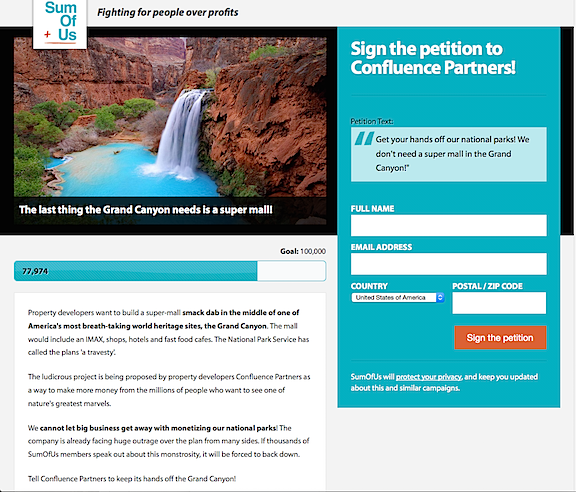
This petition’s page is over the top when it comes to using misleading information to stir emotions.
When I saw the image at the top of the page, my immediate reaction was, “The Havasupai are building a mall?”
You see, the photo shows Havasu Falls, which is just down Havasu Creek from Supai, a tiny village on the Havasupai reservation inside the Grand Canyon. Supai is so remote that you can only get there three ways: on foot, by horse/mule, or by helicopter. There are no roads leading down to Supai. Because of this, it gets relatively few visitors — perhaps a 100 a day during peak summer tourism months. It’s widely known for it beautiful blue waters, waterfalls, and travertine rock formations. I’ve been down there three times and feel very privileged.
The idea of Supai having a “super mall” is absurd, so I clicked through to see what it was all about.
Apparently, I’m the only one seeing this post on Facebook who doubted the veracity of the headline/photo combination. Most of the people who saw it shared comments voicing their outrage that such a beautiful place should be ruined and assured the rest of us that they’d signed the petition.
Of course, the real story didn’t have anything to do with the Havasupai land in the Grand Canyon — which, by the way, is outside park boundaries. It was about the Navajo land on the east side of the Grand Canyon and a proposal to build a tourist attraction near the confluence of the Little Colorado River and Colorado River. These two sites are a full 50 miles apart as the crow flies.
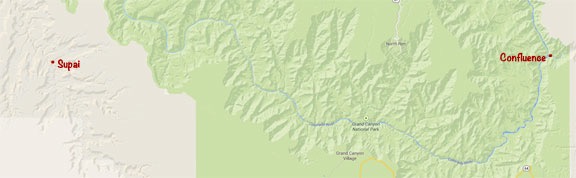
The beautiful waterfall in the photo is 50 miles away from the actual confluence of the two rivers. On this map, green represents actual park land.
The leading paragraph spread more misleading information; they added the emphasis, not me:
Property developers want to build a super-mall smack dab in the middle of one of America’s most breath-taking world heritage sites, the Grand Canyon. The mall would include an IMAX, shops, hotels and fast food cafes. The National Park Service has called the plans ‘a travesty’.
I don’t know about you, but “smack, dab in the middle” should be somewhere near the middle of something — not on the far east end of it. As the map above shows, this development won’t be anywhere near the middle of the Grand Canyon. The Grand Canyon is mind-bogglingly huge: 1.2 million acres or 1,904 square miles — that’s bigger than the entire state of Rhode Island. A development at the Confluence won’t be visible from the South Rim, which hosts at least 90% of the park’s visitors — many of whom spend less than an hour looking at the canyon — or the North Rim.

Here’s the big picture. Grand Canyon National Park is pink; Native American reservations are purple. You can download the whole map as a PDF. Note that there is a dispute over the exact location of the border between park and Navajo lands that would affect the ability of developers to move forward.
The truth about this story is that developers want to build a tourist attraction on the rim of the Grand Canyon inside the Navajo reservation. It would include shops, hotels, and a tram to the bottom of the canyon so people could actually access a part of the canyon that’s currently limited to hearty hikers, river runners, and mule riders — a tiny fraction of the park’s visitors. This isn’t too different from what the Hualapai have done on the west end with their Grand Canyon Skywalk or what the Navajo have done in Monument Valley with The View Hotel.
And maybe I should remind people that National Park Service concessionaires already manage six hotels (El Tovar Hotel, Bright Angel Lodge, Maswick Lodge, Yavapai Lodge, Katchina Lodge, and Grand Canyon Lodge) and well over a dozen gift shops on the rim of the Grand Canyon, inside the park. And a hotel at the bottom of the Grand Canyon (Phantom Ranch).
So what this petition page has done is used a photo of a beautiful waterfall that was shot 50 miles away, coupled it with a headline referring to a super mall, and led with an untrue statement regarding development in the middle of the Grand Canyon. Someone who doesn’t know the facts and relies on the information on this page might think there’s going to be a giant mall ruining the vistas at one of the world’s natural wonders.
So people sign. They provide their names and email addresses. Those addresses are likely harvested for use in other slactivism efforts. They’re likely followed up with pleas for donations to support the cause.
And people share the link to the misleading information, getting their friends to sign up, too.
And people talk about the “problem,” using the misleading information they read — if they bothered to get past the photo and first paragraph.
And this pisses me off to no end.
Now please don’t think that I’m in favor of more development at the Grand Canyon. I’m not. But I am in favor of Native American people being able to develop their land in ways that economically benefit them. I’m very familiar with the Navajo people, having spent quite a bit of time on and over the reservation. There are social problems including poverty, obesity (and related health issues), and alcohol abuse. Young people are leaving the reservation for better opportunities elsewhere. The native language — which was instrumental in our World War II communication efforts — and culture are being lost. If the Navajo people vote in favor of a project like this on their own land, I don’t see any reason why we should stop them. It would give them jobs, bring more tourists and tourism dollars to their part of the canyon, and help their economy.
Again, the Hualapai did this at Grand Canyon West and no one seemed to care. Why care about this now?
Oh, yeah. “Smack dab in the middle.”
My advice to people reading petitions like this: get informed before you let the authors manipulate your emotions to get the response they want. Don’t share misleading information.
We all know how difficult it is to find the truth on the Internet — and the problem is getting worse every day. Don’t be part of the problem. Don’t share information unless you know it’s accurate.