Making Ice Cream

Sinfully good.

Years and years ago, I had an Oster Kitchen Center. This was basically an electric mixer base that I could put a mixer, blender, food processor, and other attachments on. I really liked this thing, but decided to get all new appliances — Kitchenmaid, in fact — when I moved to Arizona in 1997. To say that Kitchenaid has disappointed me is an understatement. I really wish Oster would produce an updated version of that old Kitchen Center; I’d buy one.

One of the attachments I had for the Oster was an ice cream maker. It was the usual device: inner bowl fits into outer container that you fill with ice and salt. The whole thing sat on the base with a paddle inside and a cover on top. You turn on the motor and it turns the paddle while the ice chills down the ice cream mix you’ve put in the inner bowl.
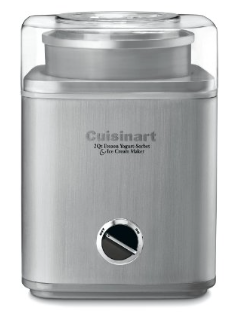
Cuisinart Ice Cream Maker
The Cuisinart Pure Indulgence Ice Cream Maker.

When I switched to Kitchenaid, I never replaced the ice cream maker. Until about a week ago. That’s when I bought a Cuisinart ICE-30BC Pure Indulgence 2-Quart Automatic Frozen Yogurt, Sorbet, and Ice Cream Maker. It’s a small countertop device that I store on a shelf in my garage. Instead of having a double bowl and having to deal with ice and salt, it has a single bowl that I keep in my chest freezer until ready to use. The liquid inside supercools and chills down the ice cream when I set the whole thing up and get it running. It claims to make ice cream in 25-45 minutes and I can confirm that it does.

Of course, it’s not the ice cream maker equipment that makes amazing ice cream. It the recipe for the ice cream that goes inside it. I found that recipe in July, when someone linked to an article titled “The Master Ice Cream Recipe” on the New York Times website. That recipe uses ingredients I can stand behind: real milk and cream, sugar, and egg yolks. A table below the base recipe offers flavoring options with additional instructions.

Kirk and I took the ice cream maker on its inaugural run last week. I made a simple vanilla ice cream, cheating a bit by using vanilla extract for the favor. (I don’t know about you, but I don’t keep vanilla beans around my home.) Along the way, I showed Kirk how to separate eggs without an egg separator. And because the eggs were from my chickens, the resulting ice cream was almost golden in color.

The flavor and texture were great, even though I probably should have kept it in the ice cream maker another 10 minutes or so. (Note to self: use timer.) Kirk liked it with the strawberry rhubarb jam he cooks up on demand with rhubarb from his garden, but although I love that mixture on pancakes, I preferred this ice cream plain.
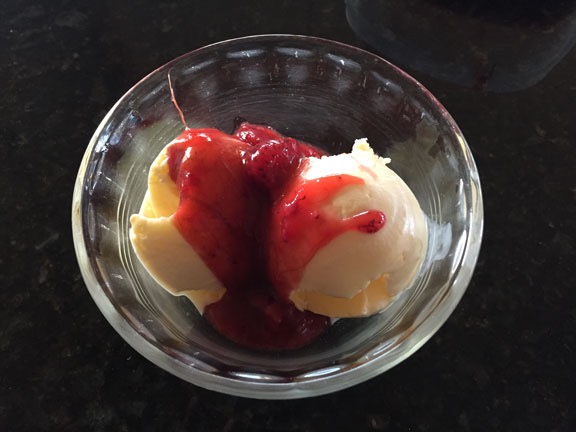
Home made ice cream
Home made vanilla ice cream topped with home made strawberry rhubarb jam.
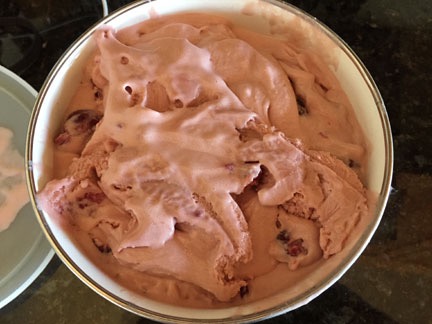
Cherry Ice Cream
Home made cherry ice cream, made with eggs from my chickens and cherries I picked. (Have I mentioned lately how much I love living in orchard country?)

Yesterday, I whipped up a batch of cherry ice cream using the last few pounds of cherries I’d gleaned from client orchards. I followed the instructions in the Times recipe, but I skipped the step that blends the cooked cherries into a puree. I thought whole cherries would be more interesting. This morning, when I put the chilled ice cream mix into the ice cream maker, those cherries got a bit hung up on the mixing paddle. I froze it longer than the vanilla ice cream, scooped it into my dedicated ice cream freezing container, and put it in the freezer.

But not before tasting a big spoonful. Delicious!

Although the Times recipe requires some cooking, the ice cream maker came with recipes that don’t. I will eventually try some of them. I suspect they’ll turn ice cream making into a 1-hour activity instead of one that requires at least 4 hours for the mix to cool down after cooking and another 45 minutes to churn. That means it’s something you could easily do with your kids on a rainy day. Or dinner guests, while you’re munching appetizers before the meal.

The best thing about all this? I control exactly what goes into every batch I make. And although it isn’t that much cheaper to make than the premium ice cream I prefer, there’s a certain amount of self-satisfaction when you get to enjoy something you made from scratch.


The Joy of Journaling

The older I get, the more important it becomes.

Journaling Image
A blank book with lined pages makes an excellent journal.

I’ve been keeping a personal journal off and on for most of my life. In most cases, it was well-intentioned attempts to write daily — or at least regularly — in a blank book. These journals never lasted long and usually were misplaced. I found one of them when I was packing for my 2013 move and was somewhat shocked by entries that foreshadowed the end of my relationship years later.

Blogging as a Form of journaling

I kicked my journaling efforts up a notch when I began blogging in 2003; my blog — which you’re reading now — documents a lot of what was going on in my life as I wrote the entries.

It’s an excellent chronicle, for example, of what was going on during the various stages of my long, drawn out divorce (which is still dragging on but finally close to an end) and will form the basis of my book about it. It’s also a great resource for my evolution as a pilot, my work flying at the Grand Canyon, and the way I’ve tackled new hobbies and interests such as beekeeping and glass work.

Along the way, I wrote lots of opinion pieces about politics, religion, current events, and social issues. My blog’s 2300+ entries are a really good look at my past and what was going on in my mind over the past (so far) 13 years.

Back to Paper

Back in January 2014, I embraced a real paper-based journal again. I was house-sitting for a friend in Malaga, taking a break from the RV I’d been calling my home since I left my house in Arizona in May 2013. My journal, kept in the same kind of blank books I’d used years ago, contained daily entries of what I was doing and thinking. Every entry was limited to just one double-sided page, so I couldn’t go into much detail.

I soon realized that the only way I’d regularly write those journal entries was to make it part of my personal routine. And the only part of my personal routine that’s pretty much the same every single day is that first cup of coffee. So I’d write the entry for the previous day’s activities while I drank my coffee. In most cases, everything was fresh enough in my mind to get down the important information I wanted to document.

Although I didn’t do nearly as much traveling in 2014 as I’d done in 2012 and 2013, the journal book traveled around with me, going to California for frost season, back to Washington for cherry season, and on vacations with me to Lopez Island, Seattle, and Winthrop. I found that while my home was being built from May through July, I didn’t write a single journal entry — my blog has far more details on those days. But I picked it up again later in the season and started a brand new journal book in January 2015.

Then again, in the spring of 2015, when I made the move out of the RV and into my new home, the journal was left behind in the RV down in my cavernous garage. It wasn’t until the other day that I brought it up into my kitchen and set it down on the breakfast bar where I usually have my morning coffee. I made a feeble attempt to bring it up to date, then got back into the routine. I hope to keep journaling regularly.

Journaling as a Memory Tool

I was secretly thrilled to learn that Kirk, my “boyfriend” (pardon the quotes, but it’s such a silly word at our age), also keeps a journal.

It’s important to me that my significant other be literate. Kirk is not only able to read and write well, but he likes to read and write. You can’t imagine what a thrill it is for me to be able to discuss books and articles with the same person I share so much of my life with.

And having a journal means that he’s just as interested as I am in recording his activities to remember in the future. There’s a lot in common between us there and I’m very pleased about it.

As I get older and my memory starts to get iffy, I find journaling a valuable tool for simply remembering things. The entries, after all, form a good reminder of what was going on in my life each day. I can look back and remember things I’d forgotten, including events, emotions, and opinions.

As my life and relationships evolve, I can see how events from the past contributed to that evolution. I can learn from my own mistakes. I can see how what’s important in my life changes from day to day, week to week, and month to month. I can track my recovery from significant emotional events or financial setbacks and learn better about coping with similar issues in the future. I can see how my opinions evolve with input from others. I can see how my relationships with others grow and change.

In a way, when I skip a day of journaling, I feel as if I’ve lost that day. As time goes by, if nothing significant happened on that day, all memory of it is lost. In a way, that makes journaling so much more important.

It’s the little things that make life interesting — when memory of them is lost, part of your life is lost. Why not spend 20 minutes a day jotting down the things you want to remember? I think it’s worth it.

2015 Cherry Drying Season Recap

A short, dry season means less flying time.

The Best Insurance
The tagline on my cherry drying business card is directly from one of my clients “The best insurance is a helicopter in your orchard.” This photo was shot in his orchard in 2009.

My cherry drying season unofficially ended Saturday afternoon. I say “unofficially” because although I’m contracted through month-end, the compressed cherry season had all orchards I was under contract to cover picked out by yesterday.

Timing and Rainfall

The season itself was very early. Although my earliest contract started only a day earlier than the previous year, other contracts started at least a week earlier than usual. My season contractually ended a full two weeks before normal. I typically get about 11 weeks of contract work, which is longer than the average pilot but shorter than the larger helicopter companies that aggregate services. (I have no desire to become like one of those companies.) I start on the river in Quincy and finish on Wenatchee Heights. This year, I got just 67 days — not even 10 weeks!

The season was compressed because of the weather. We had a very warm spring, some cooling, and then some brutally hot weather in late June. This really screwed up the growing season. Too many growers were picking at the same time. This not only dropped the prices they could get for their cherries but it made it difficult or even impossible (in the case of one of my grower friends) to get pickers.

One good thing for growers: there was very little rain. Indeed, I went out to dry on only 5 days during the 67 days I was on contract.

Despite the shorter and dryer than average season, this was my best season in the eight years I’ve been drying cherries in central Washington state. This is due primarily to additional acreage added by existing clients and a new client. More contracted acreage means more standby money and more potential work.

Other Pilots on My Team

The additional acreage under contract made it necessary to contract with additional pilots to ensure that I could promptly cover all acreage under contract. The additional standby money I collected made it possible to bring these pilots on board. I brought three pilots with helicopters in on four-week contracts and one pilot with a helicopter in for a five-week contract. Two were based on Quincy and two in Wenatchee. Their contacts overlapped so I had a total of five pilots with helicopters on my team during the two week period when we had the most acreage to cover.

I say “team” because we work as a team. Or teams. There’s the Quincy team and the Wenatchee team. I’m part of both teams — the person who helps out where needed and eats the extra cost of repositioning the helicopter. The pilots on each team know where all the acreage is. I dispatch them based on availability to get the quickest possible response time for my clients. If there aren’t a lot of orchards to cover, we’ll double up over one of them; my clients love seeing two helicopters over their orchard at the same time.

This year, we flew a total of just 19.1 hours. That’s for five pilots over a period of 27 man weeks. When you do the math, you realize that’s less than an hour a week per helicopter. It was actually worse for the Quincy pilots, who didn’t get to fly at all. All 19.1 hours was flown in the Wenatchee area.

Can you understand now why I insist that cherry drying is not a time-building job?

Come to Washington State Next Summer!

Are you a commercial helicopter pilot with an R44, Hiller, Bell 47, or JetRanger? If you are and want a “paid vacation with possibility of paid flying time,” you need to read this. I’m looking for experienced pilots who are more interested in a return on their asset investment than building time in that asset.

Fortunately, none of my pilots seemed to mind not flying much. I only hire experienced pilots with 500 or more hours PIC and I prefer owner/operators. None of the guys were in Washington to build time.

One of them, who was with me last year, too, already knew that there wouldn’t be much flying. He came to Quincy with an RV and truck, bicycles, and kayaks. On all the cloudless days we had, he kept busy.

The other guys soon learned that they could do the same. I’m not a babysitter — I let the guys do whatever they want, as long as they answer the phone when I call and launch promptly when dispatched. They did so we’re all good. When they weren’t flying or waiting out a possible rain event they were hiking, kayaking, touring Leavenworth or Chelan, visiting the farmers market, or just hanging out together. (I didn’t move here just so I’d be close to work three months out of the year. I moved here because it’s a great place to be.)

In general, they treat their time in Washington the way I did before I moved here: as a paid vacation with a possibility of flying work. All of the pilots who joined me this year have asked to come back next year and I’d be glad to have them back.

Some Stats

I have a master spreadsheet where I track my contract dates, income, pilots, billing, and contract labor expenses. That makes it easy to produce statistics each season. (I love stats.) Here’s a quick comparison of this year and last year.

Stat20152014
First Contract Start Date5/25/155/26/14
Last Contract End Date7/31/158/13/14
Total Contracted Days6780
Maximum Pilots54
Total Man Weeks2723
Days with Rain Events59
Total Dry Time19.138.3
Average Dry Time Per Pilot Per Week0.71.7
Total Acres Under Contract547429
Maximum Acres Under Contract at One Time364336

As I mentioned above, this was my best season ever. I feel very fortunate to have built this niche market for my helicopter services and to have made this beautiful area my home. And I’m very pleased to be able to work with a number of professional, experienced helicopter owner/operators who understand the importance of good service as well as I do.

I’m looking forward to serving my existing client base with a great team again next year, protecting their valuable cherry crops from rain as I have for the past eight years.

Icicle Creek Hiking

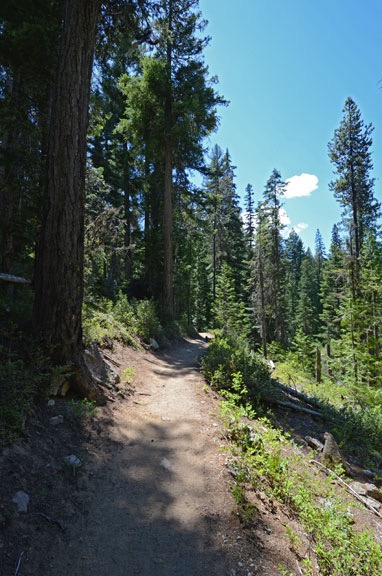
Hiking in the woods in the Icicle Creek drainage.

I really enjoy hiking — but with some limitations. I can hike all day on relatively flat terrain. If the hike has a climb, I prefer that the climb be at the beginning of the hike with the descent at the end. I’m easily winded on uphill climbs — and have been like that all my life, even when I was young and super slim — but have absolutely no trouble going downhill. On hot days, I prefer hiking in areas with at least partial shade. On cold days, put me out in the sun.

Icicle Gorge Trail

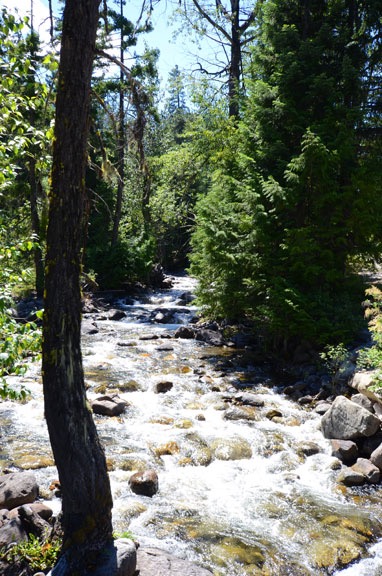
A few weeks ago, Kirk and I did the Icicle Gorge loop trail. That’s up Icicle Creek, not far from Leavenworth. The trail winds through forest and clearing, mostly following Icicle Creek. The water was still running pretty good, the creek fed by meltoff from snowpack and small glaciers up in the east side of the Cascade Mountains. It thunders through several narrow channels along the streambed — the gorge of the trail’s name.

Icicle Gorge Trail
The trail wound along the side of the creek, fringed with tall pines and wildflowers.

This was my second time hiking the trail. It’s just the kind of trail I like for a summer hike, with gentle uphill and downhill climbs, mostly in the shade of tall pine and other trees with a handful of open grassy meadows along the way. I’d done it the year before with my friend Alyse.

We got on the loop heading downstream first, crossing a footbridge at a narrow part of the gorge. From there, we headed back upstream. At first, we were along Icicle Creek, but the trail moves away from the creek, into the forest. At one point, it winds up to the top of a small hill with a monument that overlooks a bend in the creek. Then it descends back down to the creek, crossing Trout Creek not far when it meets Icicle.

Trout Creek
The trail crosses Trout Creek at a small footbridge in the forest.

We stopped along the creek for a snack of nuts and fruit and energy bars. The rocks there were worn by centuries of water flow, with some carved pockets filled with stagnant water. The sound of the rushing creek was oddly calming.

Swimming Hole
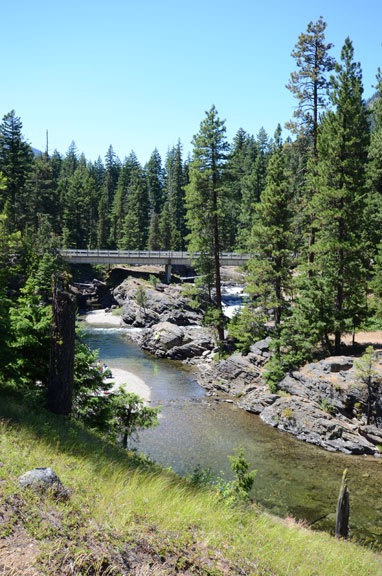
Just downstream from this bridge was a deep swimming hole just perfect for a refreshing dip.

The trail crossed Icicle Creek again at the Chatter Creek campground. There’s an auto bridge there and beneath it, a cascade feeding a deep swimming hole. We climbed down onto the rocks bordering the deepest part. A few people were farther downstream, at a sandbar that helped hold the water back.

I threw Penny in to cool her and pulled her out when she swam ashore; after that, she wouldn’t stay with us. (I had to put her on a leash a while later, just to keep her near.)

Kirk changed into his swimming trucks and wasted no time diving in. I was a little tougher to convince. I hadn’t brought a bathing suit. But after a while, I decided that the water looked too good to pass up. I stripped off my shorts and went in in my panties, tank top, and sport bra. The water was delightful — deep, clean, and refreshing. Probably the best swimming hole I’d ever been to.

Indian Paintbrush
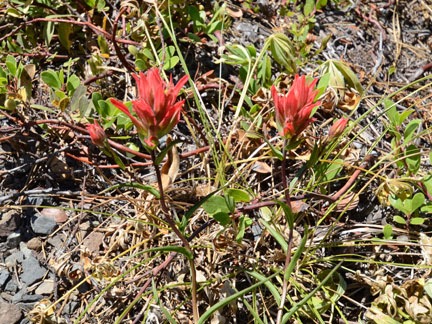
Indian Paintbrush is one of many wildflowers we spotted along the trail.

After our swim, we got back on the trail and continued the loop. We were on the return trip now. The trail wound mostly through dense woods, coming very close a few times to the gravel road that led to the campground. I’d brought along my Nikon with its 10-24mm lens and took some photos of flowers and tiny waterfalls along the way.

We were back in the parking area about three hours after we’d started the hike. We’d walked a leisurely 4 miles or so. A great hike I’d definitely do again — especially on a hot summer day. Next time, I’ll wear a swimsuit under my shorts.

Icicle Creek Trail

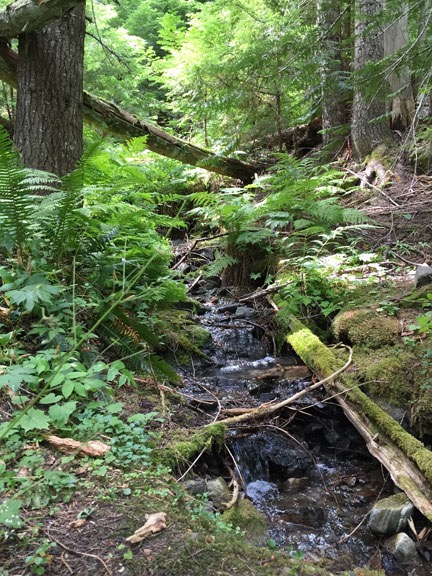
Tiny Creek
We crossed this tiny creek on our hike. The forest was dense and cool.

On Friday, Kirk and I went out to Icicle Creek again. This time, we hiked a trail he’d done before, the Icicle Creek Trail. The trailhead can be found at the very end of the same road we’d taken to get to the Icicle Gorge loop trail.

This is an out-and-back trail that winds through dense forest, gently climbing and descending as it goes. Its name is misleading — it doesn’t actually follow the creek. Instead, it cuts through the woods, crossing a handful of tiny creeks, with the sound of Icicle Creek off in the distance. Eventually, it joins Icicle at its confluence with French Creek.

The walk was pleasant, although I regretted my choice of attire — shorts and tank top — because an overcast made it chilly down in the woods. Not exactly cold, but not warm, either. The kind of day when sunlight would have been welcome. I let the GPS in my phone keep track of our trail, but tucked away in the pocket of my cargo shorts as we hiked in a canyon, it had trouble keeping track of where we were. As a result, the track was jagged with its length likely overstated. At the end of the hike, it said we’d gone nearly five miles, but I don’t think we went much more than four.

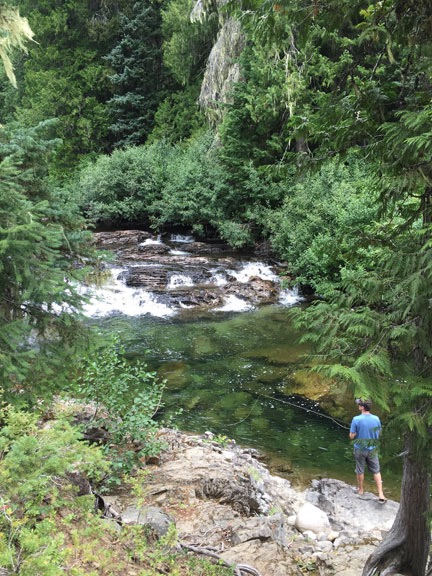
Fishing at Icicle Creek
One of the campers was fly fishing just downstream from the French/Icicle confluence.

We saw signs of horses — there’s a horse camp and a horse trailer parking area not far from the trailhead — but no horses. No wildlife either.

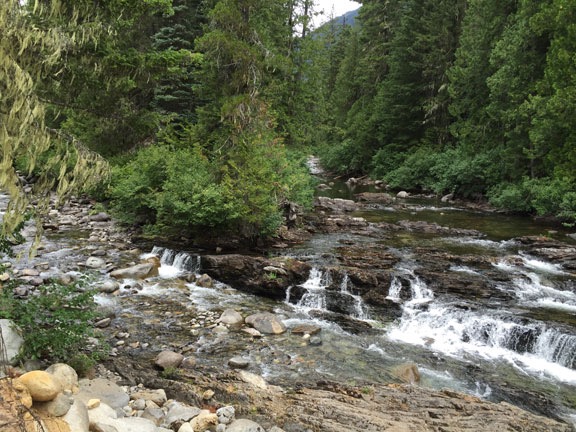
The sound of the creek got louder and louder until we reached it. There are two campsites there, one on either side of the creek, and a family had set up camp in one of them. A man and girl were fishing in the creek while a woman and another child were walking creekside not far away. French Creek met Icicle Creek right there, with water rushing together from both creeks in a jumble of rocks.

French/Icicle Confluence
The confluence of French (left) and Icicle (right) creeks.

We hung out for a short while, then continued on the trail. A “Stock Crossing” sign marked where horseback riders could cross French Creek. There was a good, strong bridge a bit farther down the trail. I found myself telling Kirk about my horses and how Cherokee couldn’t be made to cross that bridge but Jake would have no trouble at all. (I miss my horses, but not enough to have horses again, despite the fact that I have plenty of room to keep them at my home.)

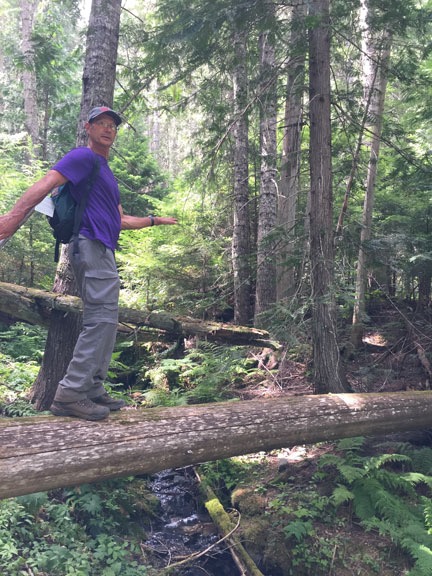
Kirk on a Log
Kirk clowning around on a log across one of the tiny creeks.

We didn’t walk much farther. Not only was I getting cold as the overcast continued to thicken, but I was concerned about the possibility of rainfall over orchard I’m under contract to protect. There was no cell phone service where I was and no clear look at the sky back toward Wenatchee. On top of all that, I had a meeting near home at 5 PM. So after only an hour on the trail, we turned around and headed back.

Kirk dutifully picked up a few pieces of trash — a beer can and a Starbucks cup (if you can believe that) — along the way. I think I’ll be bringing bags for this job on future hikes. I can’t believe how people can be such pigs.

Back at the trailhead, we loaded the Jeep back up and retraced our route back toward Leavenworth. We had just enough time for lunch at Sleeping Lady before I had to hurry home.

Would I do the hike again? Definitely. But next time, I’ll bring a change of clothes and a better lunch. I’d very much like to see what’s farther up that trail.

The Hover Power Posts

Most of my blogging about helicopters is now published on one of AOPA’s blogs.

Just a quick head’s up to let pilot readers know that I am still blogging about flying helicopters. But instead of posting most of them here, they go right to AOPA’s Hover Power blog. The main reason: they pay me to write for them. Girl’s gotta make a living, no?

Here are the most recent posts, in reverse chronological order:

Keep in mind that you can always get an up-to-date list of my work published elsewhere on my Articles page.

If you have any ideas for topics you’d like to see me cover, why not take a moment to comment on this post with your suggestions? I’ll either cover it for Hover Power or here.

And if you’re an editor or publisher looking for a professional writer to create fresh content about flying helicopters for your magazine or blog, I hope you’ll contact me.