Snowbirding 2017: Astrophotography

Practice makes perfect. I’m practicing.

I have more than the average amount of free time in my life and I like to put it to good use doing and learning things. Last September, I took an astrophotography class at the North Cascades Environmental Learning Center. You can read about the class and see some of the photos I took during our field trip in this blog post.

What I learned about shooting the night sky is that it’s very easy to do if you have the right equipment. Fortunately, I do: a DSLR with full manual mode, a very wide angle (10mm) lens, and a sturdy tripod. The hardest thing to do is to find skies dark enough to see enough stars to make the effort worthwhile.

We had dark enough skies in the North Cascades, despite ambient light from the nearby dam and occasional passing car. I don’t have dark enough skies at home, though — the glow from Wenatchee is surprisingly (and disappointingly) bright. And although I camped at more than a few places that should have been dark enough for night sky photography, most weren’t.

Or if I found a place that should have dark enough skies, the sky was overcast while I was there. Or the moon was in the sky, illuminating it so only the brightest stars showed.

Cibola
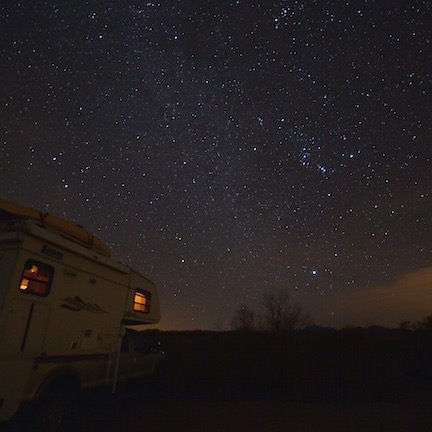
I like this shot of my RV parked on the levee along the Colorado River. I had to crop it square to get rid of the light from the town of Cibola, which is still in the shot.

I did have some success back in January when I camped out along the Colorado River near the Cibola National Wildlife Refuge in southwestern Arizona. I shared one of those photos in a blog post about the campsites I’ve been finding.

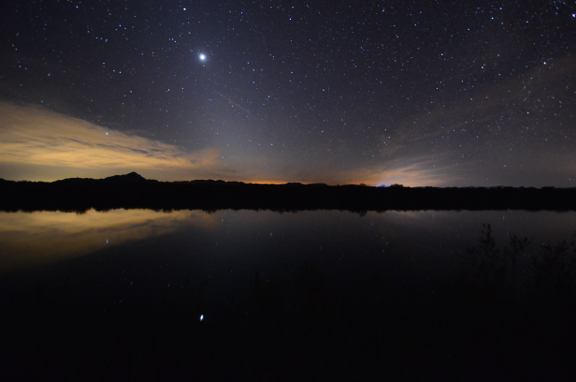
The one I didn’t share was a bit more challenging and I’m not sure if I successfully pulled it off. (Maybe you can tell me?) The bright point of light in the sky is Venus. I wanted to catch its reflection in the Colorado River, which I did. Unfortunately, although it was long past sunset, there was still a bit of a glow to the west. I think it’s from towns and homes off in the distance, but who knows?

Venus Reflected
It’s nearly impossible to include the horizon in a night photography shot without some sort of glow from terrestrial lighting.

I got a chance to practice again in Death Valley National Park, on my third night in the park. The first two nights were too cloudy and the moon was nearly full anyway. But the third night offered a window of opportunity between the end of twilight and before the waning gibbous moon came up. I was parked in Greenwater Valley with some mountains behind the camper. It was very dark outside and the sky was full of stars. I took eight shots. I think these two are the best.

Death Valley Night Sky
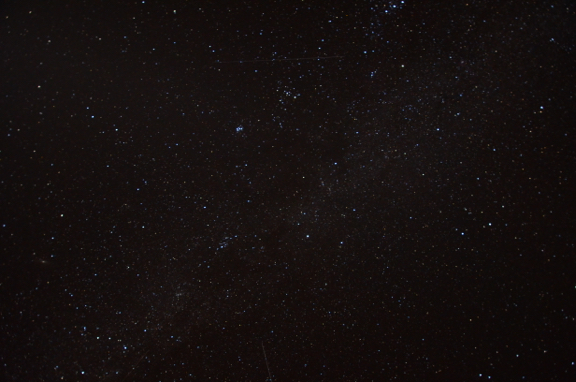
This was my first shot of the evening with the camera pointed pretty much straight up. It features the Milky Way with the Pleiades near the center and Orion’s Belt almost cropped off the top.

Death Valley Night Sky
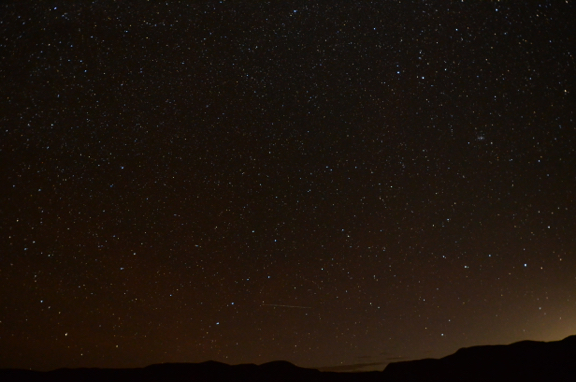
In this shot, I pointed the camera up above the mountains behind the camper. You can see the big dipper just above the horizon. Once again, there’s the glow from something out there; it’s not the sun because I was pointed east.

I think photos are more interesting with something in the foreground. The one with my camper works for me. So does the one with Venus and its reflection. I guess the challenge is going someplace with something interesting to frame in the foreground and possibly “light paint” it with a lantern or something. It wouldn’t take much. The only light in my camper in the above shot was from a single tea light candle burning on the dining table inside. It looks as if I have multiple lights on!

I enjoy doing this, although I admit I’d likely enjoy it more with companions on the same sort of mission. Because my remote shutter release doesn’t work — I think it needs a new battery (again) — I have to use the camera’s self-timer as a shutter release. That adds 10 seconds to a 30 second exposure with about 30 seconds of processing time before an image finally appears. A lot of time standing around by myself in the dark. The field trip I took at the North Cascades class was a bit more of a crowd than I like, but at least it kept things interesting.

I hope to get at least one more chance to experiment with this kind of photography on my trip, but I’m not sure when. Most of my remaining destinations are not well known for their dark skies. I’ll see how I do.

Snowbirding 2017: Two Days at the Dunes

With a note about why loneliness doesn’t exist for people who don’t need the company of others.

On Friday afternoon, I took a right turn off a two-lane road in San Bernardino County, California. A historical marker indicated that I’d found the “Harry Wade Exit Route,” a route a man and his family had taken to escape a particularly deadly desert valley in 1849.

Thus I began a long trek down a series of washboarded single-lane roads into the Mohave Desert. I was on a quest to visit some sand dunes in the farthest reaches of a National Park that gets nearly a million visitors a year but there wasn’t a single vehicle on the road with me. After bumping along on one road and then making a right turn onto another, the only indication I had that I’d entered the park was a weathered sign with the park name followed by a similarly weathered sign warning that off-road travel was prohibited.

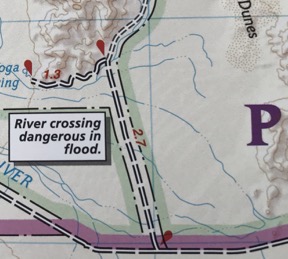
Map
My map of the area was very detailed.

I crossed a few dry washes, recalling quite clearly that my detailed map warned “River crossing dangerous in flood.” I had seen water flowing earlier in the day and suspected the meandering river might enter the valley, but it certainly didn’t seem as if the water had made it this far. Until a healthy stream trickled across the road a few hundred yards ahead. Surely my big pickup with its beefy tires could cross this sandy stream? Even with my big camper on back? I knew that a slow crossing was not advised, so I gave it a bit more gas and surged forward. The tires started to bog down on the far side of the stream, but by then momentum had carried us through. On the way back, I’d use 4WD.

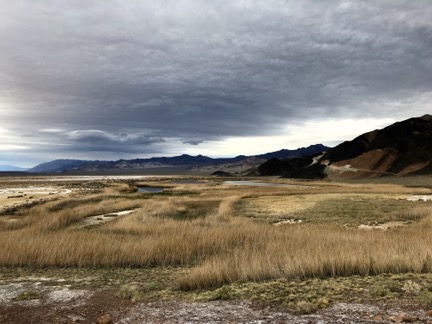
Saratoga Springs
This was supposed to be a photo of the ponds by the springs but it’s a better picture of the dreary weather. Apparently, it was pouring in the main park area.

I followed signs to a spring where another sign that I suspected might be there said “No Camping.” There were no people in the parking area, although there was a weather station that I later found on Weather Underground. I never saw the source of the spring, but I did see the huge reed-fringed ponds that had formed in a desert well-known for its lack of water. I heard water fowl and frogs and, after retrieving my binoculars from the camper, saw a few dark colored birds floating on one of the ponds. I also saw what I think was burro (AKA donkey) dung along the trail.

I was tempted to park there for the night despite the sign, but didn’t want to get in trouble in the unlikely event of a park ranger stopping by this remote spot during the night. My camper is pretty much zero-impact; it’s fully equipped to haul what I need — fresh water, fuel for cooking, food — in and what I don’t need — waste water and garbage — out. A campfire isn’t necessary for cooking. All I need is a relatively level place to park, preferably with a view. But rules are not meant to be broken and if this spot wasn’t protected by the “No Camping” rule, it would likely be overrun with motorhomes and people bathing in the springs as soon as word got out about what a great spot it was.

We are our own worst enemies.

The goal, I reminded myself, was the dunes. It would be better if I could find a place closer to them to park for the night. Although the weather was degrading and rain was in the forecast, a hike to the dunes from my campsite was a possibility, either that evening or in the morning. So I came away from the spring and turned left on the washboard road, continuing north and mindful of the sign that warned about deep sand 4 miles up the road. I didn’t plan on going that far.

I found what I think was a parking area for the dunes about a mile up the road and turned in. There was a sign about it being a wilderness area that allowed foot and horse traffic only. There was space between the sign and the road for my rig, so I pulled out, turned around, and backed in with my camper’s back door facing the dunes. I killed the engine, fetched a few things from the truck, and opened up the camper. After spending about 10 minutes putting out the slide and picking up the things that had fallen during the bumpy ride, I was settled in.

The dunes, over a mile away without a clear trail to them, taunted me under a darkening sky.

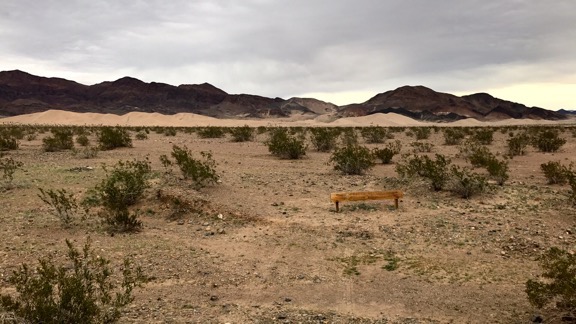
Parking for the Dunes
Parking for the dunes — the view out my camper’s back door.

I fed Penny.

I checked my cell phone, fully expecting to see No Service in the area where there are usually dots representing signal strength. I was shocked to see three dots and LTE. That had to be wrong. I ran SpeedTest and was even more shocked to see that not only did I have Internet service, but it was the fastest service I’d had since leaving home.

I checked in on social media. I admit that part of me wished I didn’t have an Internet connection so that I could fully disconnect. But, at the same time, I’m a realist and know that if anything goes wrong, it’s nice to be able to call for help — even if help would likely take hours to find me. (My dead starter was still fresh in my mind, which also explains why I always back into a campsite now.)

I found a classic rock station on the radio that actually played good music. I listened for about 15 minutes before realizing I preferred silence.

And it was silent. No sound of cars or trucks or planes. I could hear the wind coming through the greasewood (AKA creosote) bushes before it reached me. I occasionally heard a bird.

From my parking spot, I could see for miles in almost every direction; nothing moved.

I looked again with my binoculars. Nothing.

I sat at the table, writing a blog post on my laptop (that I might never publish), finishing the last of the ice tea from my late breakfast in Boulder City. Occasionally, I’d glance outside to see if Mother Nature would surprise me with a ray of sunshine highlighting the dunes or mountains behind them. I heard a few raindrops on the roof. It got dark out without the pleasure of a nice sunset.

Despite the full moon that had risen behind the clouds at around sunset, it got very dark.

I made some dinner and sat up in bed eating it while I did a crossword puzzle. I debated watching a movie but decided against it.

I realized I was exhausted. I’d started the day with a 4-1/2 mile hike on the Historic Railroad Trail near Hoover Dam, which would have been nothing if I was still in shape. But I’d been letting exercise opportunities pass me by and it was starting to really make a difference. Which is why I’d done the hike.

So I went to bed early.

As I slept, I was very aware of the persistent rain on the roof. I thought about that little stream I’d crossed and wondered whether it would be a bigger stream.

Later, I was also aware of the wind loudly snapping the ratchet tie-down strap holding my old rotor blades in place on the roof. There was no way to stop the sound without going outside and climbing a ladder, so I tried to ignore it. Eventually, the wind — and the noise — stopped.

I slept well after that, waking enough just a few times to notice that it wasn’t dark anymore. The clouds had thinned enough to bathe the desert around me in faint moonlight.

I’d slept until after 5:30 AM, which was actually quite late for me.

No surprise that it was dead quiet when I woke up. It was still cloudy. The sky was brightening from the coming sunrise. The dunes taunted me.

I had some coffee and breakfast, fed Penny again, and caught up on social media. The world is going nuts, but you don’t really feel it when you’re disconnected. Sadly, I was not disconnected and can feel it. It makes me sad.

I looked out at the dunes. It wasn’t worth the mile plus walk to get out there with bad light and I definitely didn’t want to spend the day out there waiting for the light to get good.

But I didn’t mind waiting in my camper for the light to get good. There was no place else I had to be. Heck, I had enough food, water, and fuel to last me at least a week and didn’t need to be at my next destination, which was only 536 miles away for six days.

And I really liked the solitude of this roadside campsite in the middle of nowhere.

So I pulled out my portable solar panels and set them up on the south side of the camper. There was enough blue sky that I knew they’d eventually generate some power. I certainly didn’t want to run my generator and break the silence.

And that’s how I spent the day: writing, relaxing, reading, and shooting the occasional photo.

A park ranger stopped by around 10 AM. We chatted for a while and he gave me some advice about road closures and campsites over the next few days of my stay in the park. A while later, two guys in a pickup stopped, wanting to know what the road was like up ahead. I told them I didn’t know, but mentioned the deep sand sign, which they’d also seen. I told them not to get stuck because I didn’t want to pull them out. We laughed.

Much later in the day, two SUVs parked near me and two men and a woman got out. By then the wind was really howling and visibility had dropped due to blowing dust. It was also cloudy and threatened rain. They told me they’d been much farther north in the park and it had poured on them all day. I asked them if they were going to hike to the dunes and they said that they’d come this far so they had to go all the way. I watched them bundle up against the wind — the temperature had dropped to the 60s — and head northeast. It rained while they were gone, but not enough to make anything wet. Around sunset, when they still hadn’t returned, I took out my binoculars and saw them at the base of one of the dunes. I guess they were doing some photography; it was too far away to really tell. I wondered if they’d taken camping gear with them; I hadn’t really paid attention to their departure.

A few other pickups and SUVs drove by but didn’t stop. It was actually a lot more activity than I expected.

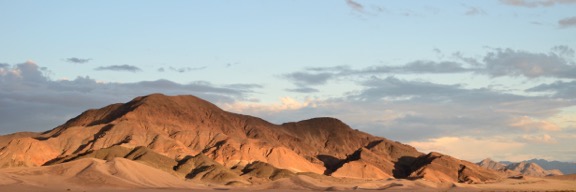
The sun finally made an afternoon appearance about a half hour before sunset, illuminating the dunes and the mountains behind them and making deep shadows. It was too late to walk out there — and besides, the wind was still blowing pretty good — so I satisfied my urge to document the moment using my 70-300mm lens from the roof of the camper. The light was constantly changing and I took quite a few photos. The one below, which I obviously cropped, is one of my favorites.

Sunset at the Dunes
Sunset at the dunes.

When the sunset show was over, I started making dinner: chicken cordon bleu with fresh creamed spinach and chanterelle mushrooms (from the freezer). It got dark quickly. I kept checking out the back windows for the moonrise, which was expected just north of due west at about 6:30. There were clouds out there on the horizon and I wondered it they’d clear out enough for me the see the moon coming over the mountains. Overhead, stars started appearing one-by-one with Venus leading the way.

My dinner was almost ready and it was dark when the sand dune hikers returned. I turned on one of my outside lights for them. Soon their engines were running and I saw taillights down the road. I didn’t envy their drive back to pavement in the dark.

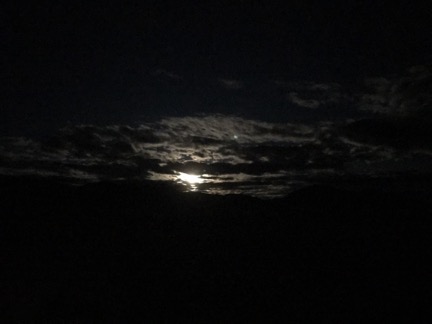
Moon Rise
Moon rise through the clouds.

My friend Bob called and we chatted for a while. It had snowed quite a bit at home and he’d spent the weekend in his shop, working on a Moto Guzzi motorcycle he’d owned for more than 20 years, getting it back into pristine condition. Unfortunately, the work he needed to do on the engine required him to keep the door open to the cold so he wouldn’t be overcome with fumes. While we talked, the moon rose just where I expected it to, making the clouds around it glow. Overhead, the stars faded away, unable to compete with the moon’s brightness.

I went to bed with a book I’d downloaded from the library, Time and Again by Jack Finney. I originally read it not long after it was first published in 1970 and it seemed brand new to me. I recommend it.

I slept great until about midnight, then woke for a while, then slept again until after 6:30. The sound of rain that was nearly forecasted nor on radar got me out of bed. It was overcast (again).

Outside, the dunes taunted me.

The hourly forecast said it would clear up around 10 AM. It would be my last chance to hike to the dunes; I really did need to get on my way if I wanted to see other remote parts of the park. So, after coffee and breakfast, I did the dishes and dressed, getting the camper prepped as much as I could for departure. The sun finally made an appearance as the clouds fled west, faster than the sun could climb into the sky.

Two pickups drove by. I started wondering why vehicles nearly always came by in pairs.

It was just after 9 AM when I started my hike to the dunes. Although satellite images had shown the remnants of a road that went that way, I couldn’t find it. So I just cut as straight as I could through the desert. Halfway there, I stripped off my flannel shirt and faced the sun in a tank top. The shade temperature was below 60°F, but I was not in the shade. The sun felt amazing on my skin and the light breeze kept me cool.

I looked back every once in a while. Although I thought the route was pretty flat, we apparently descended into a dip; I couldn’t see the camper when we were about halfway to the dunes. I later saw it again and made a note of the knob on the mountaintop behind it so I could easily navigate back in the unlikely event that my phone’s GPS tracker failed and I couldn’t see my rig.

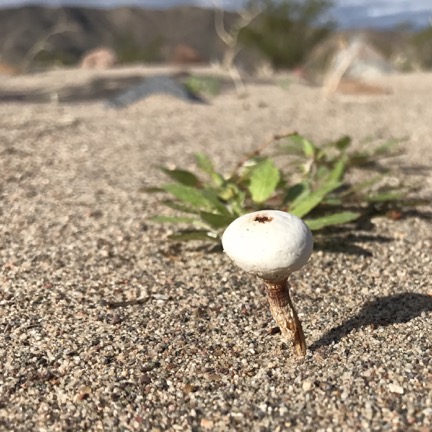
Desert Mushroom
I saw three of these within a half mile radius of each other. They were about an inch and a half tall.

The walk took about a half hour, with stops along the way to look at interesting plants, including mushrooms (!), and rocks.

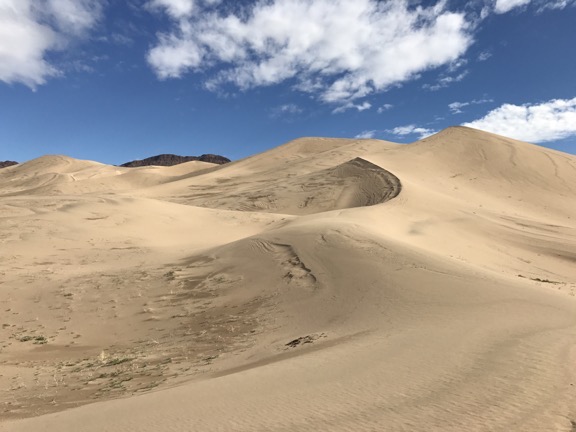
The dunes are large and I felt small beside them. Penny went nuts running up and down the sand. She loves the beach and I suspect that to her, there was nothing better than a beach without water.

Ibex Dunes
A closeup shot of part of the dunes.

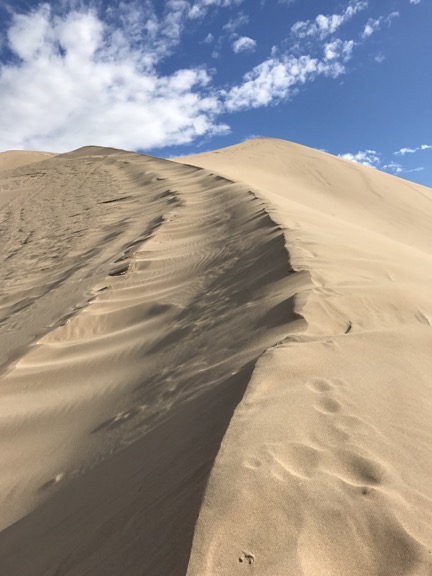
Dune Ridge
I didn’t get very far trying to climb up this ridge.

I took a bunch of photos. Unfortunately, although I might have been in the right place, I was definitely not there at the right time. The dunes were in full sun and the golden hour was long gone. Shadows were relatively small. The light was bright and harsh. A more serious photographer would have arrived at dawn — and gotten rained on along the way.

I tried to climb one of the ridges, but when I got to the point where every step forward slid me a half step back, I quit.

It was windy there — windy enough for my footprints to disappear within seconds of me laying them down.

We stayed about a half hour, then turned around and headed back. By this time, it was almost cloudless. The sun still felt good on my skin and I never really worked up a heavy sweat. Halfway back, my path intersected with the old road and I saw the footprints of the previous day’s visitors. I almost lost the trail when a wide wash ran through it, but I picked it up on the other side and was almost surprised to see that it delivered me almost right back to the door of my camper.

Behind me, the dunes smiled and winked.

After a bathroom break and something cold to drink, I finished up this blog post. I want to get back on the road before noon and I suspect I won’t have as good an Internet connection as I have here for a few days.

I know a lot of people will read this and be amazed that I spent two days alone in such a remote place. Wasn’t I scared? Wasn’t I lonely? How could I stand to be so completely alone for so long?

First of all, no, I wasn’t scared. I come to places like this very prepared. Why would I be scared when help is a phone call away, phone service is excellent, and I have everything I need on hand to survive for at least a week without skipping a meal?

Second, no, I wasn’t lonely. I don’t get lonely. Loneliness is a feeling suffered by people who need to be around other people to be happy. While I wouldn’t call myself anti-social, I’m also not dependent on other people to keep me — well, what? What is it that people need other people for? Conversation? Sex? Companionship while watching television? Am I that unusual in that I can go for more than two days without any of that?

I love my friends, but I don’t need to be with them all of the time.

And third, not only can I stand to be alone, but I rather like it. I’ve always needed a certain amount of alone time. Time to think and reflect without having to keep someone else entertained. Time to read and write and do photography without someone interrupting me, demanding my attention. Time to do whatever I want to do without someone else making judgements about how I spend that time.

When I was in a relationship, every year my future wasband used to ask me what I wanted for my birthday. In the later years, I told him that all I wanted was to have the day to do what I wanted to do. I wanted alone time.

I finally have as much of it as I want.
Snowbirding 2017 Postcards: Colorado River Boat Ride

I’d only intended to spend one night at Willow Beach Campground, in preparation for about a week off the grid in the Turtleback as I make my way to Sacramento for my late winter/early spring work. Recharge batteries, dump wastewater tanks, fill fresh water tank, take a good, long shower. Normal prep stuff.

But when I saw the boat rentals and the smooth surface of the Colorado River at the upper end of Lake Mojave in Black Canyon, I thought it might be good to stick around for another day. And when I realized that the Arizona Hot Springs, which I blog about in another post, might be accessible from the river, I added a day to my campsite reservation. 

(That’s the beauty of traveling without a ball and chain; you can change your plans at any time and not have to listen to anyone whining about it.)

I rented the smallest boat they had for half a day and headed out at around 11 AM with Penny, my camera, a towel, and a packed lunch. I may have been the first power boat up that section of the river that morning — the water was completely smooth and glassy. The canyon started out wide, with lots of water fowl that scattered on my approach. But it soon got narrower and narrower, with canyon walls towering over the water. I had flown over this part of the river several times over the past 15 or so years and it’s beautiful from the air. But it might be even prettier from the water with the canyon walls reflecting on its surface.

Here are a few of the photos I took that morning. I’d hoped to do some exploring on the way back, but I spent too much time at the Hot Springs and had to get the boat back by three. Next year, I hope to bring my own boat on my snowbirding adventures.


Snowbirding 2017 Postcards: Arizona Hot Springs

I need to start off by saying that these hot springs were, by far, the absolute best hot springs I have ever visited in my life.

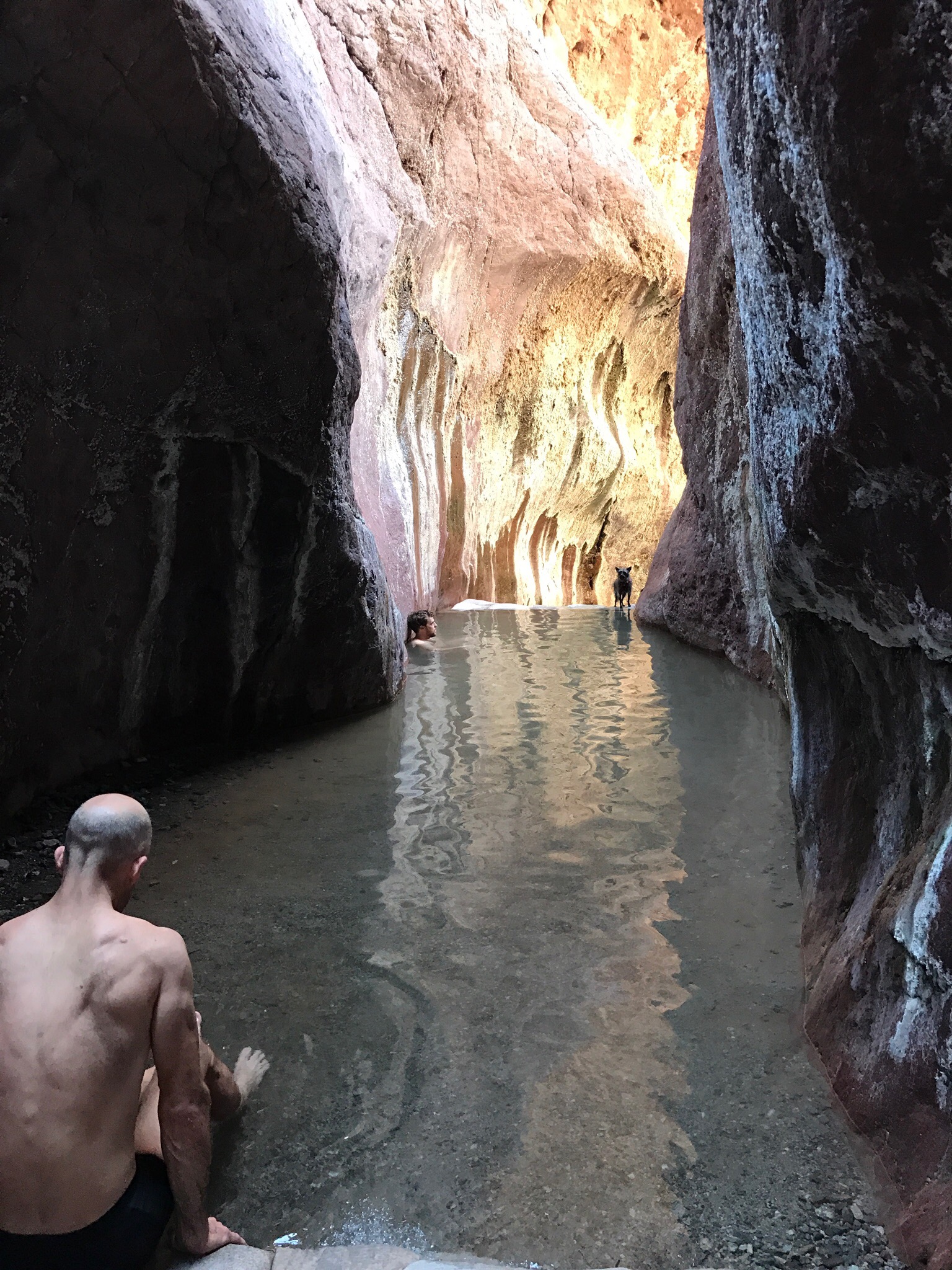
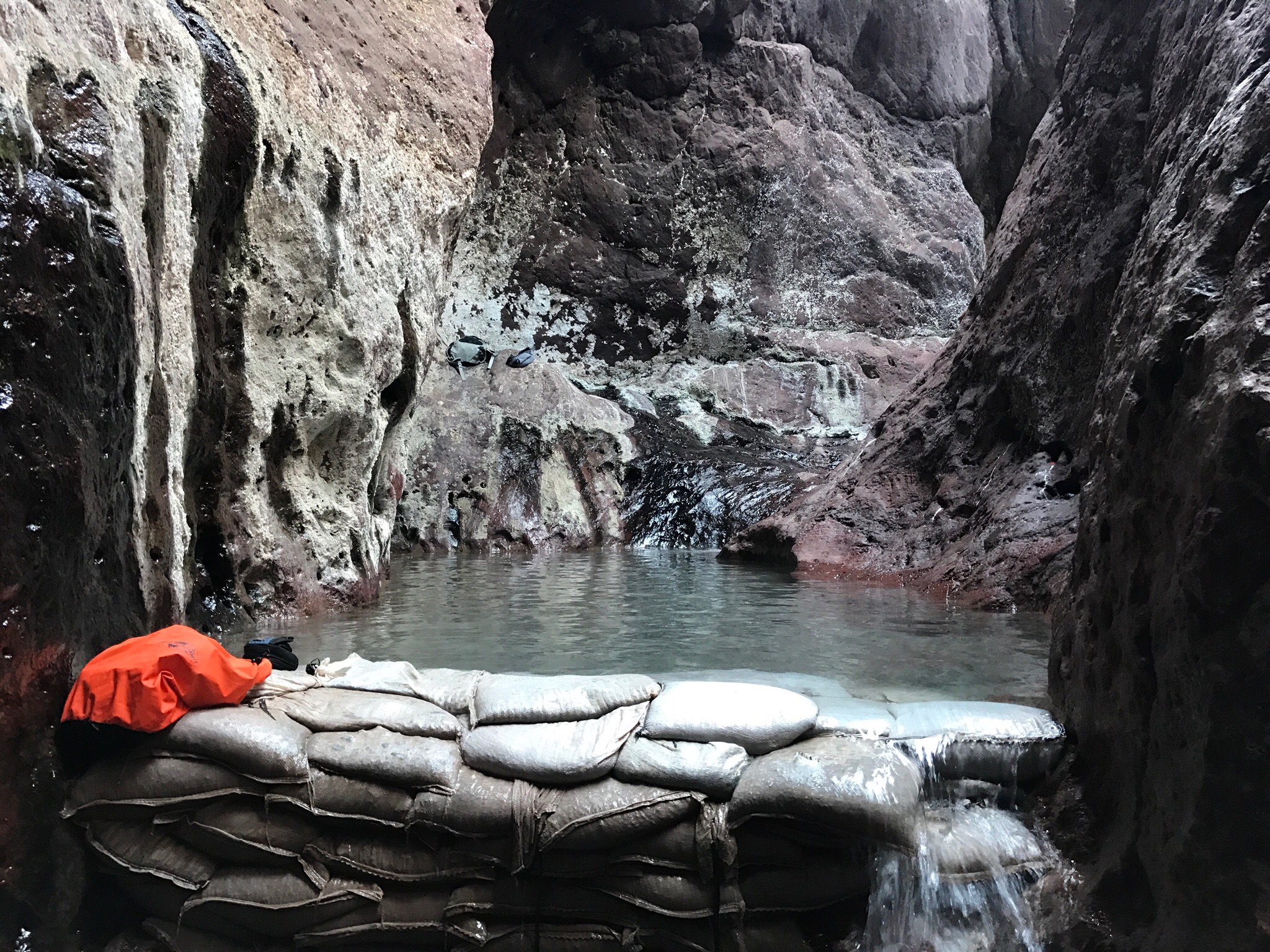
Tucked away in a slot canyon less than a half a mile from the Colorado River, Arizona — or, more properly, Ringbolt — Hot Springs consist of three “tubs” created by using sandbags as dams between the canyon walls. Hot water emerges from cracks in the walls to fill the first tub with very hot water — so hot I couldn’t sit in it. The water cascades over the sandbag dam to the next tub, which is cooler. The same happens to fill the third tub with even cooler water. (According to one regular, water temperatures are 102 to 115 degrees F.) Each tub had a gravelly sand floor and various depths, the deepest part being perfect for submerging up to your neck while sitting on the ground. The water was clean and algae free. There was no slime or nasty sulphuric smell. Although there may have been as many as a dozen people there at a time, it was never what I would call crowded.

This Hot Spring is accessible by a long, 2 mile hike down a trail from route 93 or by a much shorter hike up from the Colorado River. This physical limitation in access is likely what keeps it so pristine; there was absolutely no litter.  I choose the river route and rented a boat to make the 10 mile river trip up from Willow Beach. The boat trip was beautiful with many interesting spots along the way — I’ll save that for another set of postcards.

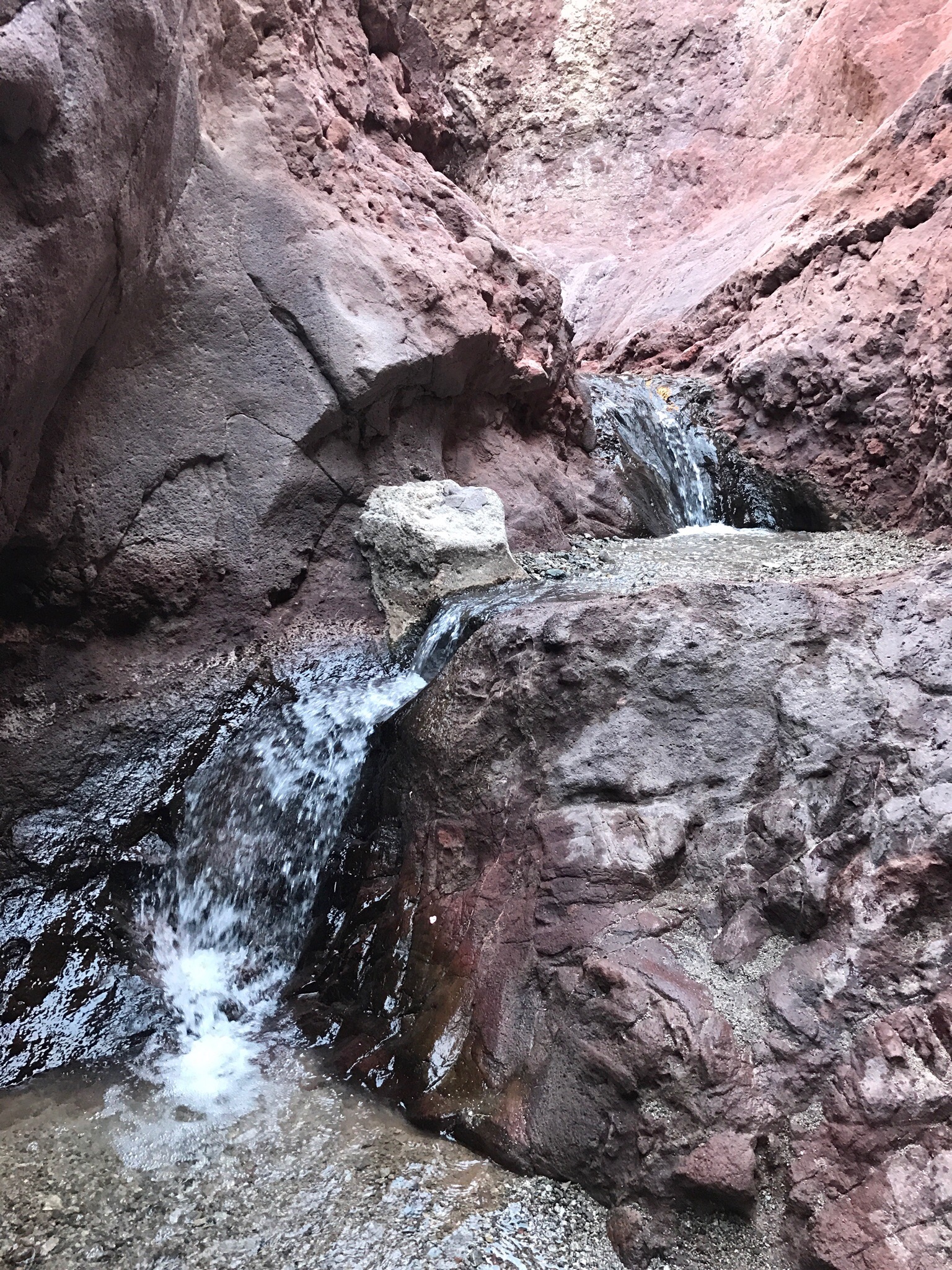
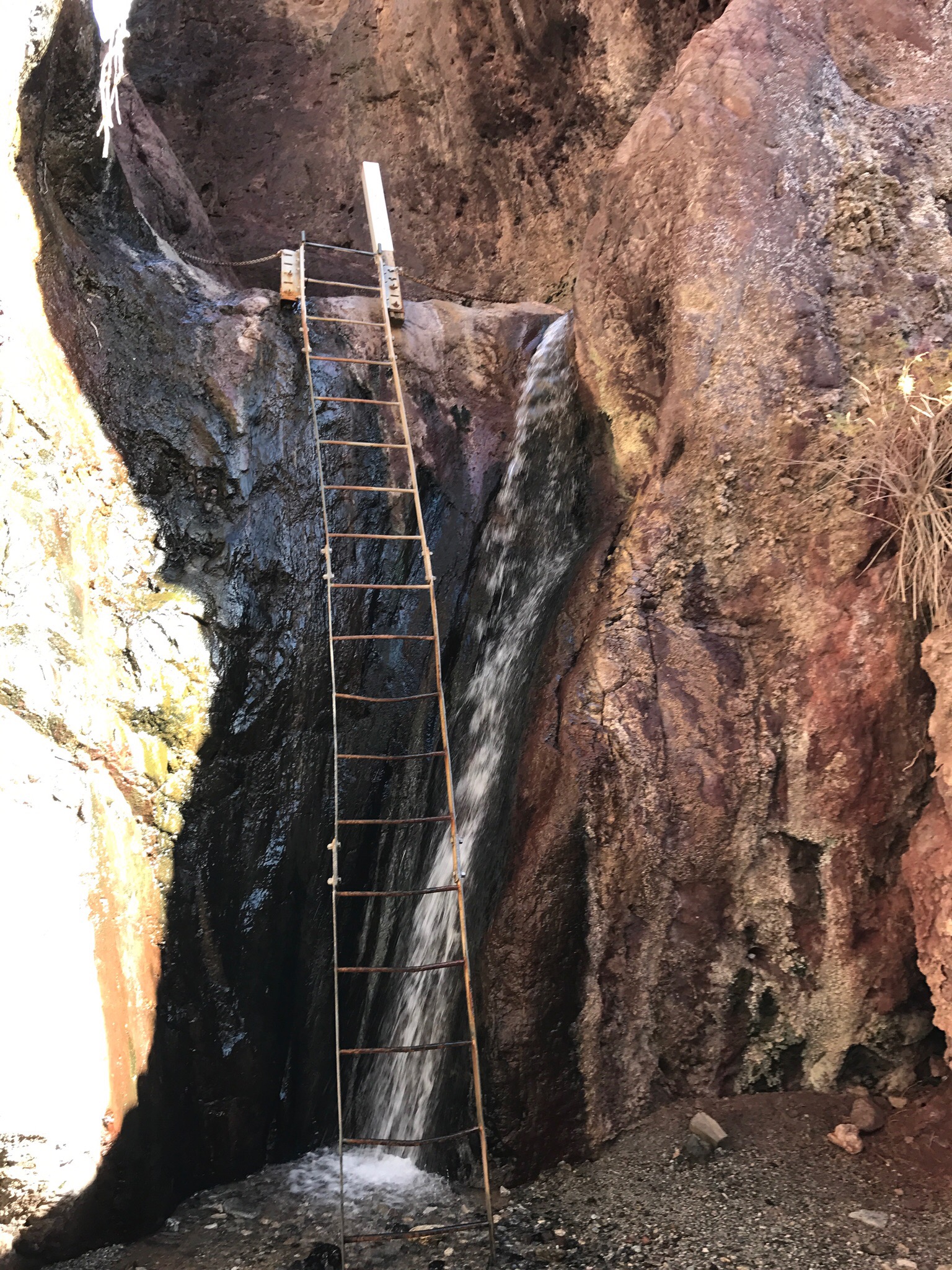
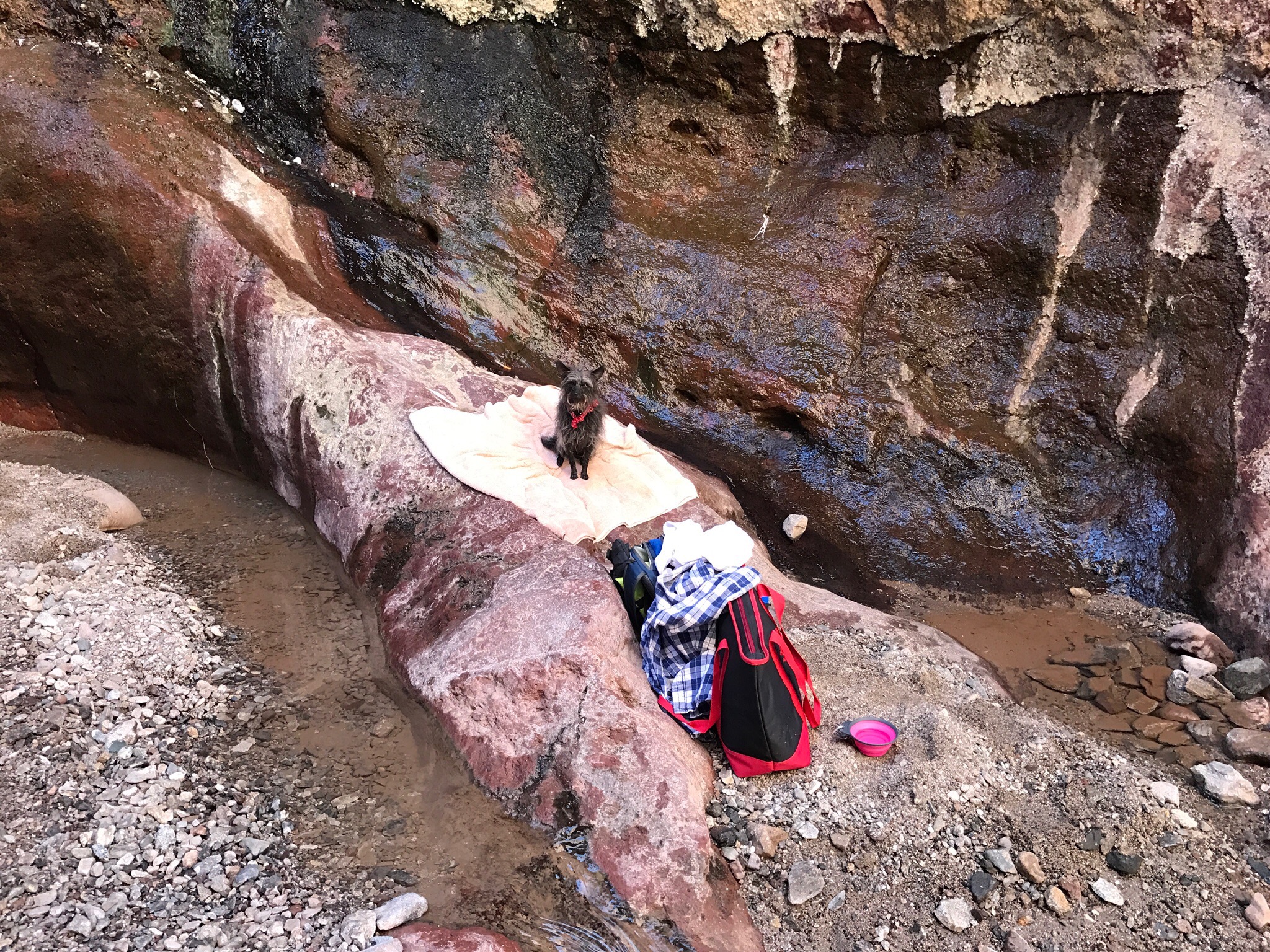
Here are a few pictures that I took along the hike to the hot spring and at the spring itself. The hike started on a dry beach and soon entered a narrow slot canyon with ever-growing trickles of warm water. There was a bit of scrambling up rocky cascades, some of which were slippery. The trickiest part of the whole trip was getting Penny up the 20 foot ladder to where the tubs were.

Along the trail to the hot spring.


There were a few places where we had to scramble up Cascades of warm water.


This 20-foot ladder was securely fastened to the canyon walls.


The third, coolest tub was the first one we reached.


The shallow end of the third tub had very warm water from the second tub.

Penny watches from the dam at the end of the third tub. She did swim twice in that tub, although she didn’t like it.


The first and hottest of the tubs was the last one I reached. I didn’t soak in it at all.


Our lunch spot just downstream from the tubs.


We spent more than two hours at the springs. I soaked mostly in the deep ends of the second and third tubs. The first tub was simply too hot for me and just about everyone else. The people who were there were mostly young and outdoorsy — I might have been the oldest one there! I very much enjoyed the company of three medical students from Syracuse who were making the most of their trip to Vegas for a convention. I also had a great conversation with a local who told me about another hot spring I might pass near in my travels later this week.

Return to Burro Creek

And another [safer] flight under the bridge.

Back in November 2014, I blogged about the time I was in a helicopter that flew under the Burro Creek Bridge on Route 93 at Burro Creek. It was probably on my mind back then as I was reviewing log book entries for a book I’m working on about my flying experiences. I just re-read that post and I do recommend it. It’s short — for me, anyway — and tells an interesting story that gives you some insight into the minds of helicopter owners and pilots.

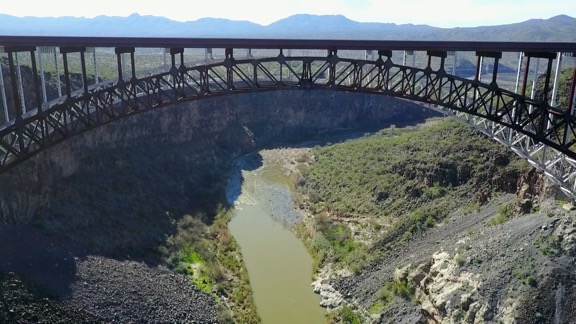
Burro Creek Bridge
Plenty of room to fly under, no?

Anyway, yesterday I drove north on Route 93, starting my annual migration from my snowbirding stay in Arizona to my late winter/early spring work site in the Sacramento area of California. (Yes, my seven-month “vacation” is nearly over.) I gave myself about 10 days to make the trip and planned stops along the Colorado River near the Hoover Dam, Death Valley, and possibly Lake Tahoe. Or the California Coast. I don’t really know yet. One of the things I like most about my life these days is my unfettered ability to make and change plans on the spur of the moment.

I’d been thinking about the drive for a while, wondering what stops I could make along the way. Burro Creek was a no-brainer. There’s a BLM campground down along the creek about a mile or so off Route 93. I’d considered stopping there for an overnight stay on my way south from Vegas in November but had ultimately chosen a different route that kept me on the Colorado River. The campground isn’t much — in fact, the water is turned off there so the bathrooms are closed up and I’m not even sure if you’re allowed to use the dump station — but it does have ramadas (shade structures) at each campsite, along with picnic tables and a nice desert garden. And plenty of hiking opportunities.

Burro Creek Bridge
A view back toward the campground, looking southwest. That’s Route 93 south of the bridge in the distance.

Burro Creek Campground is about an hour north of Wickenburg, which is where I’d spent the previous two nights. Perfect timing for a break on my estimated three hour drive to Willow Beach on the Colorado River near Hoover Dam. I pulled in, drove down the cracked asphalt road to the campground, and parked in the day use area so the campground host wouldn’t try to hit me up for camping fees.

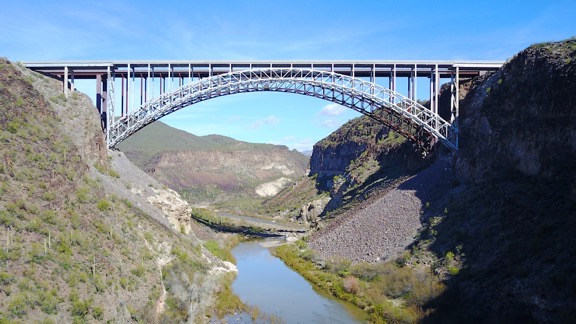
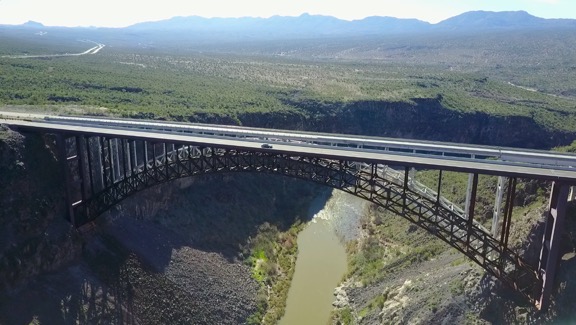
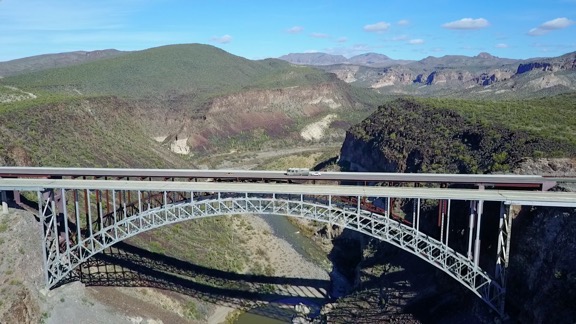
The Burro Creek Bridge — or should I say bridges? — is clearly visible from the campground. It’s a pair of two-lane truss arch bridges that are about 680 feet long about 390 feet over the floor of Burro Creek’s canyon. The first bridge was built back in 1966 and carried all northbound and southbound traffic. In 2005, as part of route 93’s widening project, they built a second almost identical span right beside it. The new bridge now handles northbound traffic while the old bridge handles southbound traffic. I’m glad they built a matching bridge. It really helps preserve the aesthetics.

Burro Creek Bridge
The two bridges are nearly identical, despite being built 40 years apart.

(A side note here: Route 93 between Wickenburg and I-40 near Kingman had the local nickname “Death Highway” because of the number of deadly accidents — often head-on collisions — that occurred there when it was just one lane in each direction. Widening it was long overdue since it handles nearly all auto and truck traffic between Phoenix and Las Vegas. Parts of it are still one lane in each direction. You can learn more about Route 93 in Arizona on Wikipedia.)

I had done a photo shoot of the new bridge back in 2005 with an aerial photography professional. It was a memorable flight, mostly because he did the shoot with a pair of Hassalblad medium format film cameras. These are extremely costly cameras and the reason he had two of them was so that when he finished shooting a roll of film, he could switch to the other camera instead of fumbling at an open aircraft door to reload film. I think each roll only had 12 shots. I distinctly recall hearing the mechanical sound of the shutter and his manual winding of the film though the intercom system since the microphone was so close to the camera. I orbited the bridges several times. I know he was disappointed with our timing; the second span wasn’t quite done but yet it wasn’t open enough to be dramatic. There was just a narrow gap maybe 50 feet wide in the middle of the roadway. We should have arrived about two weeks before for a more dramatic shot or two weeks afterward for a completed span.

I was thinking a lot about that photo shoot as I walked down to the creek with my Mavic Pro flying camera tucked away in my day pack. The construction company — or Arizona Department of Transportation? — had flown the photographer in to Phoenix from somewhere in the midwest for the shoot. He’d rented a car and drove to Wickenburg. I flew him up there with the doors on, then landed in the construction area to pull off his door and stow it in the back seat. We’d done the flight, circling around and and around. It was midday, but there were still shadows because of the angle of the sun in the deep canyon. I’d landed again to put the door back on and then we’d headed back to Wickenburg. The only reason we hadn’t done the whole flight with the door off was because I could get better speed in transit with the door on and it was at least a 30-minute flight. I’m thinking the whole job was about 1.5 hours of billable flight time, but without consulting my logbook, I can’t be sure. Total cost of those photos? Easily a few thousand dollars.

Burro Creek Bridges
Really. Nearly identical.

I walked as far as I could — at least a half mile — getting almost under the power lines that spanned the canyon just southwest of the bridge. I was hoping to be on the other side of them so I wouldn’t have to worry about them interfering with drone operations, but Burro Creek was running full and fast and I’d gone as far as I could without getting too close to the canyon wall. I spread out my collapsable landing pad in one of the few boulder-free areas, and got to work setting up the Mavic and its controller for flight. I have it down to a science at this point and it only takes me about five minutes from the moment I take it out of the bag to the moment everything is powered up and the Mavic is in GPS mode.

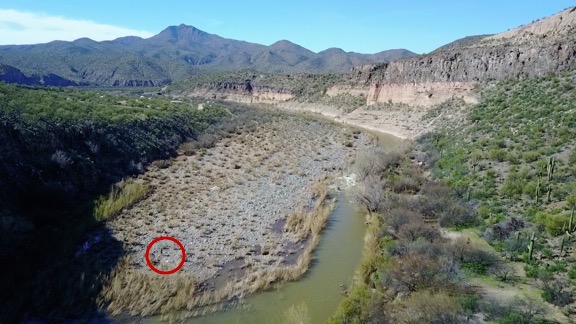
Mavic Operator
I grabbed this image of the video on the Mavic’s return flight. I circled where I’m standing with the landing pad. You can see the campground behind me.

I couldn’t tell how far above the canyon floor the power lines were. I knew they were lower than the bridge, but I also knew that we’d flown under them. They had to be at least 100 feet up. Still, when I launched the Mavic I kept it just 50 feet up until I knew it was on the other side of the wires. (I now estimate they’re at least 150 feet feet from the canyon floor, but likely more than 200.)

I spent the next half hour or so flying around near the bridge. I flew over it once and under it three times. I didn’t want it to distract drivers on the road, so didn’t fly anywhere where the average driver would see it. I had to bump up the maximum altitude for the flight over the bridge, but I figured that was okay because I was still within 400 feet of either the bridge roadway or canyon walls. Certainly nowhere where a manned aircraft should be flying — although I think I’ve already established that it was where a manned aircraft could be flying.

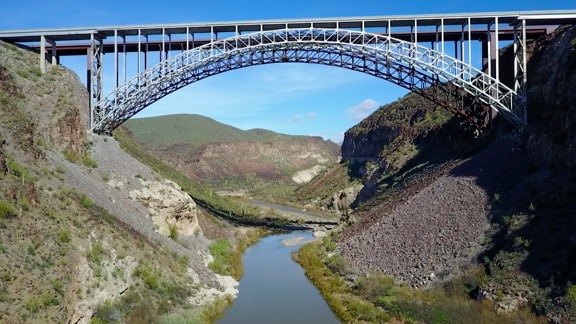
Burro Creek Bridge
This photo was shot from under the power lines.

I switched batteries after two flights and used up 20% of the second battery before finishing up. Penny had very patiently waited nearby. She doesn’t mind the drone or its bee-like buzzing but stays clear of the landing pad when it’s coming or going.

Part 107 Explained
Want to become a commercial drone pilot? Start by learning all about the FAA’s Part 107. This book will help. Buy the ebook edition on Amazon or from Apple. Or buy the paperback edition on Amazon.

When I was finished, I powered everything down, replaced the Mavic’s gyro lock and cover, and folded it up. Within a few minutes, I was ready for the return hike with everything stowed away in my day pack again.

I got a bunch of video shots, as well as some still shots. This blog post shows off mostly screen grabs from the video. Launching from the stream bed inside the canyon limited what I could do, keeping in mind that I had to keep the Mavic within sight during the flight (per FAA rules).

I think that if I’d launched from up alongside the roadway, level with the bridge, I could have gotten the same shots that Hassalblad photographer had captured twelve years before — for a lot less money. But there really wasn’t a good place to launch from that wouldn’t distract drivers. And it isn’t as if this was a real mission. It was just more practice.

I wonder what that Hassalblad photographer is doing these days. I seriously doubt he’s still using those cameras to take aerial photos.