And its fallout.
After a night spent at the Mesquite Springs Campground near the north end of Death Valley, I got an early start on my trip to what’s known as The Racetrack. It’s basically a dry lake bed in a valley on the west side of the park where large rocks “mysteriously” move by themselves across the flats. I put mysteriously in quotes because it’s pretty obvious that the rocks are moved by strong winds when the silty playa is slick from a heavy rainfall. But heck, it gets people out there, right?
The visitor center had warned me that the road was only appropriate for vehicles with good tires. Apparently more than a few tourists have been getting flat tires on some of the more rugged roads, which really aren’t intended for their Priuses or even their city-slicker Jeeps with junky car tires. I assured the ranger that I had all terrain tires on my truck and that they were only a year old. Still, she got me worried about my tires all day and I knew I’d never get AAA out to change a flat, even if I did have a cell signal to call them. I wondered if I could get the spare down from where it was hung under the truck if I needed to.
I left at just after 6 AM, eager to get to the Racetrack in the best light, but not interested in making the estimated 2-1/2 hou drive in the dark. It was still dark in the campground as I pulled out of my spot, leaving the Turtleback behind, but dawn was more than a hint to the east. The bright waning gibbous moon made it possible to pull out with only my parking lights on so I wouldn’t disturb other campers.

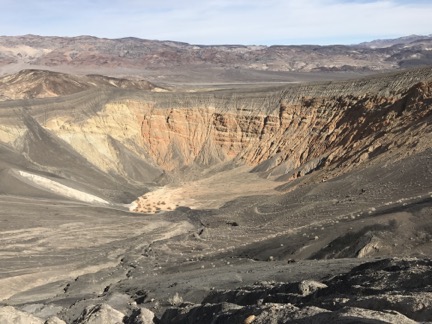
Here’s a tourist photo I shot of Ubehebe Crater the day before.
It was chilly so I turned on the heat for my seat and Penny’s and cranked the heat up a bit. I headed out to the main road, then turned left and followed the pavement all the way to Ubehebe Crater, which I’d visited the day before. Then I made the right turn off pavement, onto the gravel road I’d be following for 24 miles.
Whiplash — For a Reason
The road was completely washboarded and I bounced along it, trying but never quite succeeding to pick a speed that smoothed the ride. I tried 10, 15, and even 20 miles per hour. No joy. I drove with one hand, holding my coffee, in a travel mug up with the other so it wouldn’t spill out of the drinking hole in the cap. That bumpy. Penny alternately stood and sat on the console between the two seats, somehow not falling off.
The road climbed as the sky lightened. It was pretty straight and very narrow — maybe 1-1/2 cars wide? There were few turnouts. I’d considered, the previous day, making camp somewhere along the road instead of back in the campground, but I was glad I had decided not to — there was nowhere to pull off to camp. The grader, which likely worked the road at least once a decade, had left tall dirt curbs on either side of the roadway. There were very few places even wide enough for two cars to pass, let alone for someone to camp.
That didn’t stop someone in an SUV. They were parked nearly half in the road and had likely camped out there overnight. No one stirred in the vehicle as I slowed to inch my way around it.
As the road climbed, the vegetation changed and the outside temperature got colder and colder. Cacti and greasewood bushes gave way to Joshua trees. My outside air temperature gauge got as low as 33°F. I saw frost.
Time passed. It got lighter and lighter. Soon first light touched the tops of the mountains around me. I continued bumping up the road, never quite getting comfortable. Not another soul was in sight.

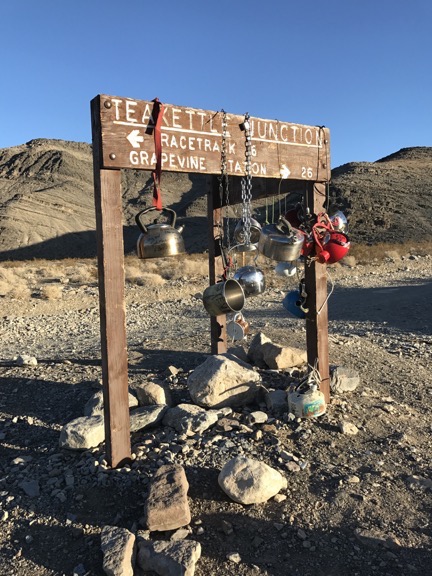
The sign at Teakettle Junction.
After nearly two hours, I’d gone 18 miles and arrived at Teakettle Junction, which is actually a named place on my map. But that’s about all it is. It’s a crossroads with a turn off for someplace called Hidden Valley. A sign decorated with a variety of hanging tea kettles stands at a triangle in the road and points the way. A couple with a big dog in an SUV were camped there, which surprised me because I thought camping wasn’t allowed at the Junction. But, at the same time, it wasn’t as if there was anywhere else to camp.
When I got out to take the photo of the sign, I smelled something I don’t usually smell around my truck. Some kind of hot oil or maybe transmission fluid. I took a quick walk around and looked underneath to see if anything was dripping. Nothing looked wrong and the truck sounded fine. So I got back in and continued on my way.
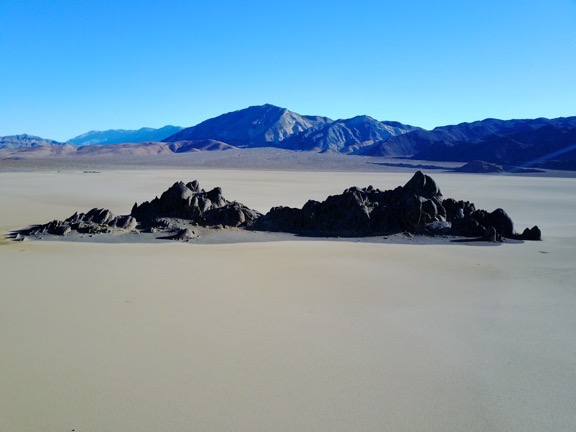
I saw Racetrack Valley minutes later. The main feature, besides the very large dry lake bed, was an island of rocks near the north end. This is what was referred to as The Grandstand. Oddly, I’d never seen any photos of it and it was a heck of a lot more interesting to me than a few moving rocks. It was obviously volcanic in nature — the whole north end of the park shows a lot of evidence of volcanic activity — and wasn’t very large. It reminded me a little of Wizard Island at Crater Lake.

The Grandstand looks like an island in the middle of the dry lake bed.

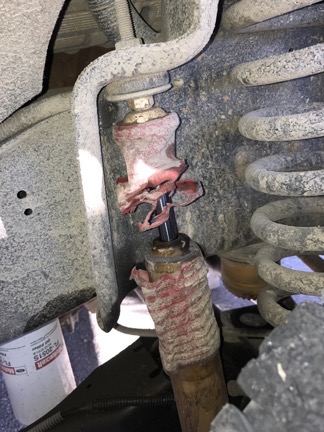
When I break something, I break it for keeps.
We reached a very small parking area with an interpretive sign just abeam the Grandstand. I parked the truck. Again that smell. What was leaking? I walked around the truck, now looking into the wheel wells. That’s when I saw that one of my front shocks was stripped bare of its protective cover and the other was leaking like a sieve.
Great. Well, I guess that would explain why I felt like I had whiplash.
There was nothing I could do about it, so I got a few things together and walked out onto the dry lake bed with my camera. But before I tell you more about my visit, I need to take a break and get something off my chest.
A Word about National Parks and Vandalism
National Parks are among America’s greatest treasures. They set aside special land to showcase some of the most amazing things that can be found in our country: geology, topography, history, wildlife, etc. They are managed by Federal employees who work hard to protect not only the parks and the wonders inside them, but the people who visit those parks. Anyone who tells you otherwise is, quite simply, an uninformed/misinformed idiot.
Every park has rules. Unfortunately, they’re necessary. For some reason, people think it’s okay to litter, or let their dogs shit on trails, or carve their initials into the rock beside petroglyphs 1000 years old. Most of the rules in a park protect the park, although a few also protect the people who visit.
One rule in Death Valley is that off-road travel is prohibited. This is pretty simple stuff: if it isn’t a road, you shouldn’t drive on it. If you’re not sure whether something is a road, it probably isn’t so you shouldn’t drive on it. If something was a road once and isn’t a road anymore, the Park Service has very considerately placed signs letting you know that it is not a road and you shouldn’t drive on it.
This rule protects the fragile desert, its plants, and even its rocks from the affects of a 2000-pound (or more) vehicle’s four tires as they make contact on the ground.
The Racetrack is one of the places where the staff at Death Valley National Park has placed signs making it pretty clear that you shouldn’t be driving anywhere off the road. A dry lake bed is not a road. It doesn’t even look like a road. If you think it’s a road, you probably should not be driving anywhere, let alone in a remote area of a National Park.
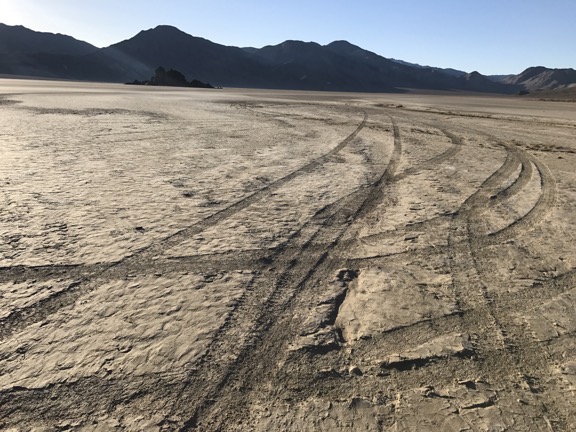
I had been warned by a friend who truly loves Death Valley that the Racetrack had been vandalized by some — pardon my language — fucking inconsiderate moron driving a vehicle on it, likely when it was either wet or damp from a rain. Tire tracks now criss-cross the dry lake bed, in some places deeply embedded into the surface. It rains very seldom in Death Valley, but it had rained earlier in the week. Still, the tire tracks remained in the otherwise pristine surface. It could take decades for them to disappear.
That means that the Racetrack’s otherwise pristine desert playa environment has been destroyed, possibly for generations of visitors.
I took photos to document the tire tracks. I want everyone to see how this area was ruined by a vandal who thought it was fun to drive around where signs clearly told him not to.
Thank you, selfish asshole fuck-head.
A sign where I parked also asked visitors not to walk on the surface of the playa when it was wet. Well, some asshole had done that, too. Fortunately, he was either a lazy son of a bitch who didn’t walk very far or his brain belatedly connected with his feet and he realized he was leaving somewhat permanent footprints. The surface was dry when I visited, but the footprints remained.
Is it that difficult to obey the rules? Will it truly ruin your visit to not vandalize the terrain while you’re there? Are you so important that you don’t have to worry about whether your fun will ruin a National Park’s natural wonder for the thousands of other people who might not want to see it ruined?
If you answered yes to any of those questions, go fuck yourself and stay the hell out of our national parks.
You want to drive around on dry lake beds? Go to Nevada. There are a shit-ton of them there that no one cares about.
Glad I got that off my chest.
My Visit to the Racetrack
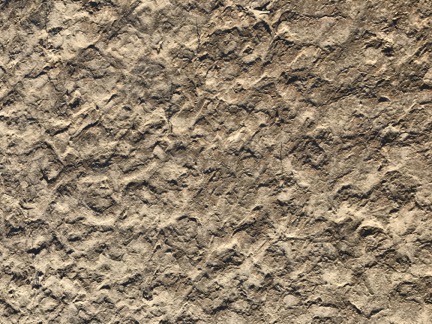
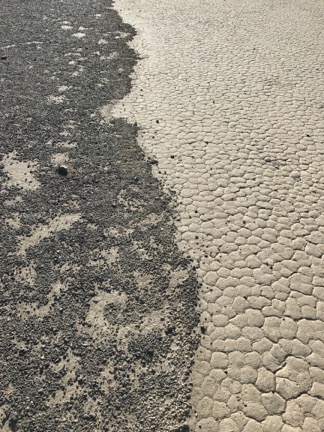
I love closeup views of surfaces textured by nature. This was near the edge of the dry lake bed.
I walked onto the lakebed carefully, making sure I wasn’t leaving any footprints. (I didn’t.) The surface was bone dry with a flat textured or cracked surface that was actually quite interesting — if you’re interested in textured or cracked mud, which I apparently am.
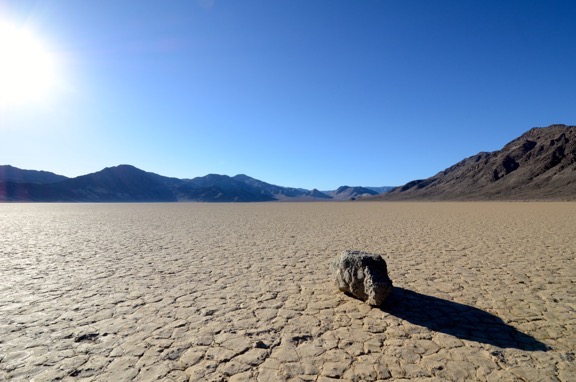
There were a few rocks on the north end where I was walking; the interpretive sign had mentioned that the moving rocks were mostly at the south end but, after 24 miles, I didn’t feel like driving another 3 miles (each way) in my mobile bouncy house to see them. I don’t think the rocks I saw were moving rocks, but who knows?

I don’t know if this was one of the moving rocks. It certainly wasn’t moving when I saw it.
Where the Grandstand’s “island” met the playa reminds me of a beach.
I walked three quarters of the way around the Grandstand, then climbed up one side of it and crossed the rocks in an area where crossing was easy. I liked the way the gravel rock of the Grandstand’s “island” formed a sort of “beach” where it met the dry lake bed around it.

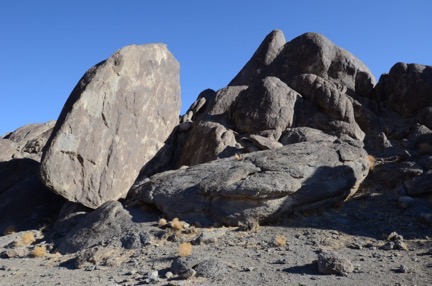
A close-up of the rocks on the Grandstand.
I used my binoculars to look down the lake bed where something shiny was just beyond the surface. Three vehicles, one of which had a very small camper on it. They probably didn’t have broken shocks and were looking at the moving stones.
I headed back to the truck. In need of a bathroom break, I was very disappointed by the lack of cover in the surrounding desert. Still, with the closest people at least two miles away, I crossed the road and walked a bit away from it before taking care of business. I suspect I wasn’t the only one who’d used that particular area for that particular purpose. But why hadn’t the others taken their paper with them? Inconsiderate.
I climbed back into the truck with Penny, started it up, and turned around. We began our long bouncy ride back to camp.
The Aftermath
Two of the vehicles that had been at the south end passed me before I left. I got in behind them. There was some position juggling and I became the middle one. I was glad; if my truck decided it wasn’t going to go any farther, at least I could hitch a ride out with the guy behind me.
We passed about a dozen inbound vehicles on our way out. About half were rental Jeeps. In most cases, I pulled up off the side of the road with my left wheels, leaving enough space for people coming from the other direction to get through. Just once someone moved over for me.
One of the cars was a compact. Maybe a Toyota? It was near the beginning of the road. As they passed, I asked them if they were sure they wanted to make the drive. “Does it get any worse?” the older man at the wheel asked me. “A little,” I said. “It certainly doesn’t get any better.” They kept going.
I was almost surprised I made it without a wheel falling off or something. It took nearly three hours. I don’t think the shocks got any worse.
I was pretty glad to hit pavement. But not when I hit 65 miles per hour. That’s when a front end wobble kicked in. Shit. Had I broken something else?
Up at the Grapevine Ranger Station — which didn’t have any rangers in it — my cell phone worked. I parked and did some research. Within 20 minutes, I’d made an appointment to get the shocks replaced in Pahrump, NV, a two hour drive back towards Las Vegas. It was the biggest town around. The repair shop said the parts would be in at 8 AM and I said I’d be there waiting for them.
Back at the campground, I found a man who had some experience with heavy equipment and had him look at it. My question: could I put my camper back on and take it as far as Stovepipe Wells or Furnace Creek? At first, he said no. But later he came to my campsite and said that if I took it slow I might be able to make it to Furnace Creek. That was only an hour from Pahrump and it would save me a lot of driving the next day. So I loaded it up and made the move. I was fortunate to get one of the last three campsites at Furnace Creek.
I treated myself to a fine meal at the Furnace Creek Inn. I really need to stay there one day.
In the morning, sore as hell from the previous day’s ride, I bounced the 51 miles to Pahrump, using cruise control set at 64 mph. I had a nice breakfast at Mom’s Diner while the folks at Pete’s Auto Clinic replaced all four shocks. The 65 mile per hour wobble was gone when I headed back to pick up my camper and exit out the other side of the park.
Hours later, my truck left Death Valley westbound under its own power for the first time. My camper was on top. My 7-month vacation was officially over.

 For the record, I have never liked Facebook. Search this blog and you’ll find more than a few posts where I’ve bashed Facebook in one way or another. (Here’s an example from January.) While I will admit that it is a great place to reconnect with people from your past and keep in touch with people you know and like who might not live nearby, it has recently become a tool for the spread of misinformation, helping to divide our country — as if it needed any help. Even after unfollowing or unfriending or even blocking the folks with crazy ideas, there seems to be more arguments on update comments than anything else. It’s also depressing when you realize just how crazy some of your friends or even family members can be.