Another Lazy Job Seeker

It’s so easy for them these days, but they still take the lazy way out.

When I was getting ready to graduate college with a BBA in the early 1980s, my school provided some advice about how to look for a job and prepare for an interview. There were basically two different paths:

  • For a posted job opening, research the company to see whether it would be a good “fit.” The write a cover letter to send in with your resume that explained how you not only qualified for the position but could bring additional benefits to the company.
  • For a company you wanted to work for that didn’t have any posted job openings, research the company to learn more about it. Then write a cover letter to send in with your resume explaining what job or department or division interested you and how you could benefit the company.

There’s an underlying theme here: research the company. Learn about it. Understand what it did and how you might fit in. Even if the job you were looking for wasn’t available, the person on the receiving end of your cover letter and resume might realize that you’d done your homework and that might make enough of an impression to forward your resume to someone who was hiring people like you.

In those days, researching a company meant going to the library, tracking down annual reports, and combing through the periodicals Index to find articles about the company. It meant microfilm and microfiche. It mean spending an hour or two or even more to gather enough information to become informed about the company and sound that way if a phone call came. If you got an interview, it was back to the library to learn even more.

These days, we’re lucky — oh, so very lucky — to have the Internet. Researching a company is as easy as visiting its Web site or Googling its company name. All the information you could possibly want — and more! — is there, at your fingertips, in the comfort of your dorm room, living room, or a coffee shop.

Yet people still continue to take the lazy way out, sending generic e-mail messages to anyone they find online that might possibly have a job for them. In many cases, they don’t even bother to research the company and possibly job openings while they’re on that company’s Web site. Instead, they zero in on the Contact Us page or link and paste in their job request.

Here’s the most recent gem to cross my e-mail inbox:

I am seeking an internship position in the helicopter industry and was wondering if your company has any positions available in Phoenix. I am approaching my senior year in my Bachelor’s Degree in Aviation Administration and training for my Instrument and Commercial Rotorcraft Rating. I am very interested in doing an internship with your company so any information would be greatly appreciated.

Contact FormI should note here that this e-mail message was sent using a form on Flying M Air’s Web site, which is reproduced here as an image (reduced to fit). At the very top of the form is the parenthetical statement, “Note to Pilots: We are not hiring.” I added this when I got tired of getting e-mail messages very similar to the one quoted above. I figured I’d just tell them up front that no jobs were available so they wouldn’t waste their time — or mine. Evidently, reading the page the form was on was too much for this soon-to-be-college graduate.

I composed a response:

You’re “very interested in doing an internship” with my company? Really? What do you know about my company?

I’m sure you sent this same message out to every helicopter operator in the Phoenix area who you could contact. Copy and paste makes it pretty easy these days. Are you just as interested in working for all of them?

And tell me: when you used the contact form on our Web site, didn’t you see where it said “Note to Pilots: We are not hiring?” Did you think that somehow did not apply to you? Or did you skip over all the information about my company and that note right above the form so you could quickly fire out yet another generic request for work?

Did you ever think that maybe you should put a little more effort into your job hunt? That some people in the industry aren’t interested in hiring lazy people who can’t be bothered to learn about a company or read available information about job openings — or lack thereof?

Still interested in doing an internship for my company?

We’re not hiring.

I’ve said it before and I’ll say it again: I can be a real bitch. But I didn’t send this. Instead, my husband and I agreed on a better response:

Information about job availability can be found on our Web site.

This is actually a more evil response. It will require him to do some work:

  1. Figure out what our Web site is. I didn’t include a signature line with the URL and my e-mail domain name does not match that of my company.
  2. Search the site to find the one place — which is right above the form he used to contact me — where it says we’re not hiring.

And why shouldn’t he put a little effort into a job hunt? Won’t he be required to work if he gets a job?
On Limited Literacy

Is it wrong to be prejudiced against people who don’t even try to be literate?

I mentioned in my blog that I sometimes allow rated helicopter pilots to fly my aircraft on ferry flights for my flight cost. This is a substantial savings over what they’d pay to rent an aircraft to build time. In addition, they get the chance to fly a long cross-country flight (usually around 10 hours over two days) with an experienced pilot.

I get e-mails from people who are interested in this opportunity. The most recent arrived yesterday:

Yes sir i was intrested in biulding some time i am a commercial rated pilot with 250hr most in a robinson 22 i really need this chance to fly thank you for your time.

Although he managed to capitalize the first letter of the first word and put a period after the last word everything in between is a mess. Spelling? Punctuation? Is this what our schools are churning out?

Keep in mind that he sent me this message using the contact form on my Web site. A Web site that displays my name in the browser’s address bar when viewed. A web site that includes my name, bio, and other information in all kinds of places. Yet he addressed me as “sir.” I figured he’d somehow missed that I was a woman.

Still, the whole message put me in a foul mood. My response got to the point:

Do you have an R44 endorsement?

Maria

Without an R44 endorsement and 10 hours of flight time in R44s, you cannot fly an R44 with a passenger (even me) aboard. No exceptions.

Note that I included my name, just in case he really did miss it the first time.

His reply:

no sir im afraid i do not have it i would be willing to get one if you could let me know what it would take to get one thanks for your time

He didn’t even bother trying to get capitalization or punctuation right this time. Perhaps his shift key broke.

And I wasn’t about to let him get away with “sir” again. I replied:

First of all, I’m not a “sir.” Maria is a woman’s name. You sent an e-mail message to the woman who owns and operates the company and flies the aircraft.

If you don’t have an R44 endorsement, you cannot fly the aircraft. I’m sorry. If you want to get an R44 endorsement, talk to a flight school that operates R44s.

Maria

I’m bugged by this exchange. I’m bugged that someone bordering on illiterate — or too damn lazy to even try to get his spelling, punctuation, or grammar right — has the nerve to ask if he can fly my aircraft. There’s no way in hell I’d let anyone who communicates like that at the controls.

Being a commercial pilot is more than just taking flight lessons and getting the appropriate ratings. If this guy can’t write, how do I know he can read? That he understands the training materials he was given? That he took the time to read the pilot operating manual?

You might argue that he must have because he passed a written and oral test — two of each, in fact — to get as far as he did. But how do I know the quality of his CFI or pilot examiner? Or in the case of sheer laziness, if he’s too lazy to create two short e-mail messages written in proper grammar, why should I do him any favors at all? Frankly, I think even responding to him was going beyond the call of duty here.

Am I wrong to believe that written communication should be created with some semblance to proper grammar? Am I wrong to thumb my nose at people who fail to meet even the lowest tests of their ability to communicate in writing by composing two or three complete sentences?

Is this what our schools are churning out?

Taming My Skeptical Side

And how a podcast helps guide me.

As a skeptic, I’m not likely to believe any outrageous claims without solid proof. Unfortunately, I’m surrounded by people with all kinds of weird beliefs.

I have friends and relatives who believe in things such as ghosts, astrology, psychic power, homeopathy, magnetic therapy, crystal power, and other tested yet unproven concepts. Over the years, as I’ve learned more and more about how unproven these ideas are, I’ve wanted to share my insight to “enlighten” these people in my life. All I’ve faced, however, is frustration. They cannot let go of these beliefs — even enough to see how “proofs” can be faked.

Strained Relationships

One example of this is psychic power. I know people who watch John Edward on television and visit psychics and swear that they’re proof of real psychic power. Yet it’s pretty obvious to me that all these “psychics” are doing is using cold or even hot reading techniques and relying on human nature to remember the “hits” and forget the “misses.” I try to convince these people that what they’re seeing is a scam, but they don’t believe me. In the end, frustrated and disappointed, I feel a great loss. My inability to reconcile my knowledge with their conflicting belief causes me to lose my connection with them. I can’t see them the same way anymore. It puts a huge dent in our relationship.

In the end, I simply begin avoiding the person with the wacky beliefs.

I should clarify here. There are a lot of things people believe in that I don’t. For example, God. I’m an atheist, but I understand why people believe in God and how it helps them in their daily life. If we don’t discuss it, their belief does not affect my relationship with them. The same goes for any other relatively harmless belief that they have but generally keep to themselves.

It’s only when a wacky belief becomes a regular conversation point that I start to back off. Some people want to “convert,” me, to make me a believer, too. But they’re unable to provide the proof I need to believe. I’m unable to convince them to look at things from my point of view. We’re deadlocked. If this becomes an issue each time we’re together, I’d rather just avoid them.

And yes, I realize that “wacky” is a strong and possibly derogatory term. But from my point of view, many of these beliefs are just that: wacky.

Realistic Expectations, Curiosity, and Caution

Actually SpeakingEnter the Actually Speaking podcast. This is a different kind of podcast for skeptics. Instead of preaching to the choir by providing us with the facts and scientific evidence we need to understand the reality of unproven beliefs, Actually Speaking helps us deal with non-skeptics in a way that won’t ruin our relationships. Podcaster Mike Meraz offers advice, not facts. And the advice is, on the whole, very good.

Want an example? Well, the frustration I feel when dealing with the wacky beliefs of my friends and family members is a perfect example of how my skepticism can damage my relationships with these people. My reaction — to just back off — isn’t doing anyone any good. Mike suggests, in Episode 2, to develop realistic expectations for discussing conflicting beliefs. My goal should not be to convince people that I’m right and they’re wrong but to try to guide them to the point of Episode 3, curiosity and caution. After all, does it really matter what they believe? Isn’t it more important that they consider looking at their beliefs from other points of view and not get hurt by decisions made based on faulty beliefs? (For example, using homeopathy to cure a real problem rather than visiting a physician and getting real medicine.)

I realized, after listening to these two episodes back-to-back, that I had actually taken this approach and had a very positive outcome. I thought I’d blog about it to share my experience with other skeptics.

The Dowser

The situation dealt with dowsing. According to Wikipedia, dowsing is:

…a type of divination employed in attempts to locate ground water, buried metals or ores, gemstones, oil, gravesites, and many other objects and materials, as well as so-called currents of earth radiation, without the use of scientific apparatus. Dowsing is also known as divining (especially in reference to interpretation of results), doodlebugging (in the US), or (when searching specifically for water) water finding or water witching.

A Y- or L-shaped twig or rod, called a dowsing rod, divining rod (Latin: virgula divina or baculus divinatorius) or witching rod is sometimes used during dowsing, although some dowsers use other equipment or no equipment at all.

In this situation, an acquaintance — we’ll call him Joe — claimed to be able to dowse gravesites to determine the gender of people buried. He uses this “skill” out in the desert to comb through pioneer cemeteries and other unmarked gravesites and report about people buried there.

A friend of mine — we’ll call him Bill — often writes articles about desert exploration for a Web site I manage, wickenburg-az.com. He went on an outing with Joe and documented Joe’s findings. He then submitted an article about their outing for inclusion on the Web site.

While the general content of the article was interesting and I was sure the site’s readers would enjoy it, Bill included a detailed listing of the gravesites Joe had dowsed, including the number of graves (all unmarked) and the genders of the people buried there. I had a problem with this. I don’t believe that dowsing can provide factual information like this.* Including an account of the dowsing and its results could undermine the otherwise fact-based account of their outing. It could make the site look like a supporter of unscientific beliefs or, to use a term that’s falling out of fashion among skeptics these days, woo.

Worse yet, the article could provide a source of information for serious researchers attempting to find gravesites of specific individuals. Was the female grave at the site the grave of so-and-so’s long-lost aunt Mabel? How could I allow the article to state that there was a female grave there at all if there was no real proof? After all, the only way to be sure there was a grave at all would be to dig it up — which was completely out of the question for so many reasons.

I was in a quandary. I wanted the article, but I didn’t want the dowsing information in it. Bill, I felt, was a reasonable person. I was surprised that he believed in the power of dowsing. So I asked him straight out if he thought the dowsing results were reliable. I told him that I hadn’t heard of any scientific proof of dowsing claims. I told him I was skeptical and didn’t want to report unreliable information.

Bill, to his credit, considered my words. He got on the Internet and started doing some research. He found some documents that seemed to support dowsing. But then he found better documents from better sources — scientific sources — that indicated that dowsing was unproven and likely not possible. He sent me links to everything he found. He seemed embarrassed that he had been taken in by Joe’s confidence in his abilities. He rewrote the article to remove the mention of dowsing. I published it on the site.

By encouraging Bill to be curious about dowsing, I’d helped him come to his own conclusions about dowsing. He made the changes I needed in his article to feel comfortable about publishing it. Our relationship didn’t suffer at all. In fact, Bill seemed genuinely glad that I’d questioned him about it and that he’d had an opportunity to learn more.

Exploring the Human Side of Skepticism

Actually Speaking has helped me see how the way I dealt with Bill’s belief was the right way to deal with it. I didn’t tell him he was wrong. I didn’t belittle or insult him. I treated him like the intelligent human being he is. I made him curious enough to do his own research and come to his own conclusion. This tells me that the advice is Actually Speaking is good, solid advice because it can work.

Are you a skeptic or critical thinker surrounded by people with wacky beliefs? If so, give Actually Speaking a try. I think it might help you with your relationships with these people.

——–

* Curious about dowsing? Check out this article in the James Randi Educational Foundation Library: “The Matter of Dowsing.” You can also read about an actual test in James Randi’s book, Flim-Flam! Psychics, ESP, Unicorns, and Other Delusions.

Oh, Come On Now, Census Bureau!

Enough, already!

March 22, 2010

Robert M. Groves
Director, U.S. Census Bureau
United States Department of Commerce
Washington, DC 20233

Dear Mr. Groves,

After receiving your first correspondence two weeks ago, I waited anxiously for the Census form you promised. Guess what? It arrived right on schedule! I filled it out — it took all of five minutes to complete — and sent it right back to you.

Census PostcardSo imagine my surprise today when I received yet another piece of mail from you. The postcard dated March 22, 2010 not only tells me again about the Census form but urges me to respond. Didn’t you get my response? Should I be as concerned as you obviously are about its status?
Or are you simply testing the capabilities of the U.S. Postal Service? Rest assured that the Post Office can deliver mail just as well as your bureau can create it. Not only did I get all three pieces of mail, but your postcard arrived the same day it was sent!

But seriously, sir: don’t you think this is a big enough waste of taxpayer dollars? Kindly stop spending my money so freely and stop bugging me with what is quickly becoming junk mail.

Sincerely,
Resident

Dear Census Bureau

Does anyone there know how to think?

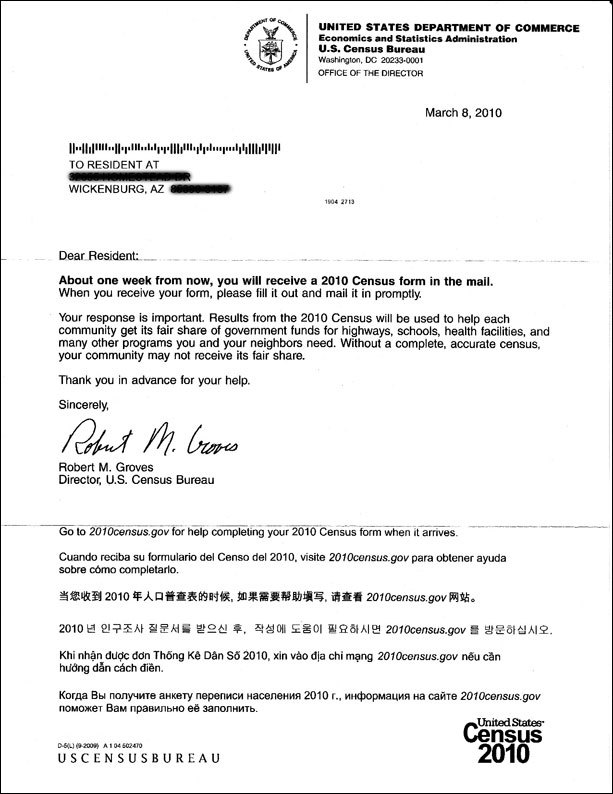
Census LetterMarch 11, 2010

Robert M. Groves
Director, U.S. Census Bureau
United States Department of Commerce
Washington, DC 20233

Dear Mr. Groves,

Thanks so much for your letter of March 8, 2010. It’s interesting to see that the U.S. Government can spend our tax dollars to send mail to millions of people just to let them know that it’s sending them more mail.

While I’m sure this two-punch mass mail campaign will help replenish the ailing U.S. Postal Service’s coffers, have you considered the impact on the ailing U.S. Government’s coffers? Our country currently has a record deficit, yet your office has elected to waste millions of taxpayer dollars on printing, labor, and postage — just to let us know that we’ll receive another costly mailing in a week.

Tell me, will you follow that up with yet a third mailing to make sure we got the second one? Or can we expect a personal visit from a Census Bureau employee to follow up?

Sincerely,
Resident