After the Rain

We go for a helicopter flight after a storm cleans out the air.

We had a storm last night in Wickenburg. It came upon us suddenly, from the west (I think), just as we were going to sleep. Soon the rain was pounding against our newly refinished roof and the bright flashes of lightning were illuminating our bedroom.

It’s monsoon season here in Arizona and storms in the late afternoon and early evening are to be expected. But we haven’t had quite as much rain here in Wickenburg as I’d like to see. The wash that runs past our house has been dry for over a year. And the unpaved roads in town have been just as dusty as they are the rest of the year.

Last night changed all that. It rained like hell. And when I woke up this morning and took a look down into the wash, it was clear that it had become a river during the night. The loose sandy surface was packed hard and wet and the debris that had been left there from the last flow was gone, replaced with fresh debris.

There wasn’t any damage this time around. Just some sand deposited on our driveway. Our neighbor, Danny, was out there with a Bobcat bright and early, working on the steep dirt road we use to get to our homes. He bought it used from a local landscaping contractor and I think he was tickled pink to have a chance to fire it up and use it.

Meanwhile, everything looked really fresh and clean. One of the odd things about living in the desert is that it’s so dry most of the time that dust really gets all over everything — including the trees and rocks. The natural colors of the desert seem washed out when, in fact, they’re just dust-covered. A good hard rain takes all that dust out of the air and off of everything. The desert looks green and alive.

And it feels cool. This morning, the temperature outside was probably in the mid 70s. That’s downright arctic in central Arizona in the summertime. The air was fresh and smelled of the rain and flowers and life.

It was the perfect morning for a helicopter ride.

Mike and I drove over to my friend Jim’s house. Jim lives about three miles due north of Wickenburg Airport. He flies a Hughes 500c helicopter. Years ago, he won a bid to build hangars at the Airport, which was in dire need of more hangars. Jim wanted a hangar so he could park his Hughes 500 in it. He figured he could lease the rest of them and make some money. He spent six months with the Airport Manager and other town powers-that-be to come up with a plan that was satisfactory to all parties. He presented the finalized plan at a Town Council Meeting. The Council members said, “Hey, wait a minute. There was only one bidder on that contract. You couldn’t win it. It has to go back out to bid.”

Jim's HouseJim is like me. He doesn’t take a lot of bullshit. He told them what they could do with their hangars and applied for a permit with Maricopa County to build a hangar and helipad at his house. In less than a year, he had a huge hangar on his 48-acre spread with a nicely marked and perfectly legal helipad out front.

The airport didn’t get new hangars for another three years.

Anyway, the airport is getting ready to close for a month due to construction. Although I’m perfectly confident that I can safely fly in and out of there while construction is going on, they’re closing down the place to helicopters, too. They seem to think that there won’t ever be a safe landing zone anywhere on all that land at any time of the day or night for a whole month. It’s bullshit, but not worth arguing about it. Jim said I could camp out at his place. So it’s not like I’m being inconvenienced.

So after topping off my fuel tanks in Glendale the other day (0.7 hours round trip from Wickenburg), I brought Zero-Mike-Lima over to Jim’s place and touched down right on the helipad.

Jim’s out of town. He and his wife are in the process of moving to San Diego. His house and the 40+ acres still left (he sold off a piece) are for sale. Two houses, a pool, horse setup, shop, garages. And, of course, the hangar and helipad. I’d buy it if I had that kind of money and wanted to invest it in Wickenburg. I don’t and I don’t. If I had that kind of money, I’d be in San Diego. I guess that’s why Jim’s there and other people are living in his house.

Airport ConstructionWe took off to the south, toward the airport. I’d brought along my video camera and Mike was using it to shoot images of the things we flew over. I’ve been wanting to get some good video footage from the helicopter for Flying M Air’s Web site and the wickenburg-az.com Web site I run. But I don’t seem able to get it together. I can’t take video while I fly. Heck, I can barely snap a few photos while I fly.

So today, Mike was in charge of the cameras. Although the video footage was too shaky for use — even online use — he got some great photos of the airport construction and downtown Wickenburg, as well as Jim’s house.

Wickenburg from the AirWe used to do aerial photography together with a Pentax 67 medium format camera. It was a pain in the butt. The camera could only hold 20 shots (I think), it weighed a ton, and although it did have an exposure meter, it didn’t have automatic exposure. That means the photographer had to adjust the shutter speed or aperture for every shot based on the meter reading. Mike didn’t like to do that. He’d set the exposure once or twice during the whole shoot. So half the pictures would be under or over exposed. Of course, the film couldn’t be processed in WIckenburg — we had to send it out. And we had to send out for enlargements, too. It was idiotic.

So now we use a 7 megapixel Canon PowerShot that I carry around with me in my purse. We can take up to 70 images on the card I have in it and even if 80% of them are bad, the remaining 20% are still enough to choose from. So just point and shoot, shoot, shoot.

We were only out for about a half hour. It was still cool when we got back to Jim’s house and put the helicopter away.

Now, later in the afternoon, I see the clouds building to the north. Maybe we’ll have a replay of all that wonderful rain again tonight.

I’ve got my fingers crossed.
Yoga?

Looking for feedback.

I’m thinking about starting a program of yoga for my mental health, physical well-being, and weight loss.

This is a difficult step for me. I keep myself very busy and the program I’ll looking into requires 40 minutes a day. That may not seem like much to you, but to me it’s a lot of time.

I’d love to get feedback from people who are currently using yoga for their health or people who have tried it and have quit for one reason or another. I’d like to learn about successes, failures, and experiences.

Please use the Comment link to share your experiences. I think other people might also be interested in what you have to say.

Thanks.

Water, Anyone?

I haul water for the first time.

“Off-the-grid” is a term that applies to property without access to public utilities like electricity, gas, telephone, cable television, and water.

By this definition, our home in Wickenburg is only partially “on-the-grid.” We have electricity and telephone but live beyond the range of cable television and town water lines. (I don’t think gas is available anywhere in town other than in tanks.) We have Dish Network, so we don’t need cable. (Ironically, Internet is provided wirelessly through the local cable company.) And we get our water from a well we share with the house next door.

Our place on Howard Mesa is utterly and completely off the grid. We get electricity through a small solar system Mike installed on our shed. We get gas delivered to a tank on the property. We use our cell phones for telephone service. We don’t have any kind of television or Internet. And water…well, it has to be hauled up to the property.

While it is possible to dig a well for water, this area of Arizona is notorious for its low water table. A well might have to go down thousands of feet to hit a good water source. It’s just too darn expensive to dig that deep. So most folks have water tanks and either hire a water service to keep them full or haul water themselves.

We have two tanks with a total capacity of 2,100 gallons. Because we don’t live up here full time, we only fill the tanks once every two or so years. Since we bought the property, we’ve had the tanks filled four times by water services (once because a crack in the valve drained a tank over the wintertime and once because I found a dead animal in one of the tanks). But when I called three different water services to fill the tanks sometime this week, none of them would come. (It appears that we’re not the only ones who have had bad experiences with the roads here.)

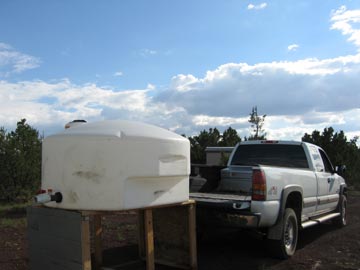
Not a big problem. Our friends Matt and Elizabeth, who live full time on the other side of the mesa, haul their own water. They have one of those water tanks that fit in the back of a pickup truck. It holds 425 gallons. They said we could borrow it, and the transfer pump we’d need to move water from the portable tank to our tanks anytime.

Loading the Water TankI picked up the tank yesterday. Matt had created a platform for it that made it level with the back of the truck. It was just a matter of sliding it off the platform and onto the tailgate, then lifting it slightly to get it over the wheel wells. Close the tailgate and it’s in.
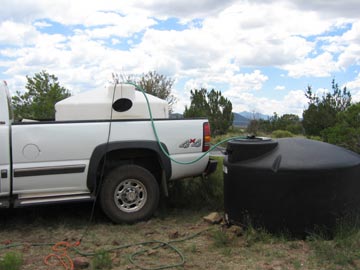
Elizabeth also gave me their pump. It’s a black cylinder that stands upright in the bottom of the tank (on the inside). A power cord and a hose come out of the pump.

I went into Williams today to do some laundry, get on the Internet for a while, hit the Post Office, and pick up a few things at the local hardware store. I stopped at the water “store” — Running Water, which was also one of the water services that wouldn’t deliver to the top of Howard Mesa — on the way back. I pulled in behind a man with a pickup truck towing a trailer with the same 425 gallon tank I had in the back of my truck. I shut the engine, and got out.

“Mind if I watch?” I asked. “I’ve never done this before.”

“Sure.”

He’d parked his tank right under an orange, flexible hose with a 2 or 3 inch diameter. As I watched, he pulled a piece of black plastic pipe with a 4 or 5 inch diameter and stuck it into the top of his tank. He put the orange hose inside that.

“I use an extension,” he told me. “My tank is so low that sometimes the water pressure pushes the hose out while filling. The extension keeps it in.”

He walked to the machine the hose was connected to and inserted a ten dollar bill. The water immediately began gushing through the hose and the extension and into his tank. He put another quarter in.

“I like to fill it all the way,” he said. “This way the water doesn’t slosh around while I’m driving.”

We watched the water fill his tank. It was white and somewhat transparent and the water looked blue. While we waited, we talked about the price of water going up because the price of fuel had gone up. The water at Running Water is hauled to the site, probably from Flagstaff or Belmont. The more water you got, the cheaper it was. But not everyone could haul thousands of gallons of water. 400 gallons for $10 seemed to be the most popular quantity. That made it 2.5 cents per gallon.

The water rose into the neck of his tank and stopped just beneath the 425 gallon mark. The man inserted another quarter. A moment later, the water was overflowing in the tank, splashing all over the trailer. He pulled out the flexible hose, which was still flowing water, and his extension. He put the extension in the back of his truck and came back to fasten the lid on his tank.

“Have a good day,” he said to me. Then he climbed into his truck and rolled away.

I pulled up carefully, aligning the orange hose over the top of my tank’s fill port. Since my tank was high on the bed of the pickup, I wouldn’t need an extension. I got out, checked the position, then moved the truck back about six inches. I killed the engine. I took the lid off the tank and inserted the orange hose in it. Then I slipped a ten dollar bill into the machine. The water started gushing; the hose stayed in place.

While I waited, a woman pulled up in a pickup truck with a smaller tank on the back.

Although I didn’t want the water to slosh around in the tank, I also didn’t want to get water all over the back of the truck. I’d bought three bags of mortar and I didn’t want them to get wet. So when the water stopped flowing short of the 425 gallon mark, I was satisfied. I pulled the orange hose out carefully and let the water in the hose run into the tank. Then I pushed it aside, fastened the lid on the tank, got into the truck, and drove off.

Let’s do the math here. A gallon of water weighs about 8 pounds. I had 400 gallons, which totaled 3,200 pounds. I also had the tank itself, which probably weighed about 50 pounds, 3 80-lb bags of mortar, and a 20-foot length of 1/2 inch re-bar, cut into 4 pieces. So I was hauling at least 3,500 lbs of stuff in the back of that truck.

That’s why we have a truck. Because we haul stuff.

It was 10 miles back up Route 64 to the turnoff for Howard Mesa, then 5 miles up those nasty unpaved roads. The speed limit on Route 64 was 65, but I soon discovered that when I got my speed over 60 MPH, I could feel a certain amount of instability in the truck. I don’t know if I was imagining it or if it was because of the gentle sloshing around of the water, which I could watch in my rearview mirror. So I kept my speed between 50 and 60 MPH and signaled for my turn long before I reached it, letting the truck slow to 40 MPH before I got into the turning lane. I didn’t want to have to jump on the brakes. I also took it very slowly up the roads to our lot, keeping my speed between 10 and 20 MPH the whole way.

Pumping WaterI arrived without incident and backed the truck up to our small, 550 gallon tank, which I’d been using to keep the horses’ water trough filled. After letting Jack the Dog out to supervise and putting my lunch on the stove to reheat, I went out to transfer the water from one tank to the other. I started by lowering the pump into the bottom of the tank and running its hose into my tank. Then I plugged in the pump, using an extension cord from the shed. The pump started pumping, sounding strangely muffled from deep inside the portable tank. The water rushed into the other tank.

Elizabeth had said that it took 20 minutes to transfer a whole tank of water from one tank to the other. That sounded a little too quick for me. So I timed it. I also filled the horses’ water trough to make room for the incoming water. Whatever didn’t fit in the small tank would go in the larger one. But I was trying to use up all the water in the larger one so we could move it closer to the shed. Can’t move a 1,550 gallon water tank when there’s water in it.

I was standing by the tank, monitoring its pumping progress, when the pump sounded like it was trying to suck air. I unplugged it. My tank was nearly full. The portable tank was nearly empty. It had taken 38 minutes to make the transfer.

A lot of people think it’s some kind of crazy ordeal to haul water. I guess it would be if I had to do it every day. But this was the first time I’d ever had to do it — and we’ve owned our place at Howard Mesa for over six years. It wasn’t difficult at all. It wasn’t even inconvenient. I picked it up on my way home, then transferred it from one tank to the other while making and eating lunch.

I figure that between me and the horses, we probably go through 30-40 gallons of water a day. The horses are the big consumers; on a hot day, they’ll drink 15-20 gallons each. I don’t drink this water; I drink bottled water and we have 5 gallon water bottles we fill at home and bring up here for cooking. So this 400 gallons — plus the 300 or so gallons I had to start out with — should last about 20 days. With luck, we’ll have the bigger tank drained and moved before the end of the season. Then we can top off both tanks in three trips and be all set up for the winter (if we come up here) and next summer.

Next summer, I hope to put up a shade structure for the horses. It’ll have a gutter on the lower side of its roof to collect rainwater and dump it right in the horses’ water trough. With monsoon rains the way they are, the trough should stay full from the beginning of July through the end of August.

I will admit one thing about having to haul water: it really makes you conscious about how much water you use. You don’t let the water run in the sink when you know that every drop that goes down the drain is just another drop you’ll have to haul up one day in the future.

[composed on top of a mesa in the middle of nowhere with ecto]

water, tank, Williams, Arizona

Zen and the Art of Ikea Furniture Assembly

I experience a Zen-like calm while assembling Scandinavian-designed shelves and cabinets.

Okay, so I’m exaggerating. But it certainly was pleasant — at least for a while.

Our storage shed at Howard Mesa was in desperate need of some shelves and mouse-proof cabinets.We needed the solution to be cheap.

In a fit of confusion, we’d gone to a Wal-Mart in Prescott and bought some crappy, Chinese-made modular shelves. Of course, we didn’t know they were crappy at the time. Although I hate Wal-Mart and hadn’t stepped foot inside one for more than two years, for some reason we thought we could find what we needed there. After all, Stan raves about the place. Maybe it had changed in two years. It hadn’t. (People say I’m too hard on Wal-Mart but I know I’m not.) And the “furniture” we bought was so poorly made that we brought back all the pieces we hadn’t assembled. We’re still trying to figure out what we’ll do with the three pieces we did put together.

Back to square one.

I was going to try Office Max when Mike suggested Ikea. There’s one down in Tempe, near Phoenix. I didn’t think they’d have what we wanted, but got online to check their catalog. That’s when I found the Träby series of cube-like shelves with optional doors and drawers. We went down to Ikea with the truck to see them in person. They were exactly what we were looking for. And — surprise, surprise — all the pieces we needed were in stock. I loaded up the cart, checked out, and loaded up the truck. Yesterday, at Howard Mesa, I began assembly.

If you’ve never assembled Ikea furniture, you really are missing out on an experience.

First, open the box in which the item’s pieces are packed. You’ll find the box completely filled in with furniture pieces, bag-wrapped hardware, and the minimum number of foam inserts. There’s no wasted space in that box. Since Träby had a natural wood finish, each piece was wrapped in clean, blank newsprint paper.

Now unwrap the hardware and sort it out. There will be pieces you’ve never seen before (unless you’ve assembled Ikea furniture in the past). You might want to sort out the furniture pieces, too. Each one will be slightly different and have tons of holes pre-drilled into it.

Open the instruction booklet. The whole thing is pictures. Line drawings of furniture pieces and hardware with arrows and numbers. In fact, it looks a lot like a coloring book before a kid has gotten to it with crayons. My favorite picture is the one of the man with the pointy nose on the phone; they phone wire is connected to the Ikea store. In words: Call us if you need help.

Next, get your tools ready. You’ll need a philips head screwdriver. That’s it. Okay, sometimes you might need a hammer, but if you do, the hammering job is so light that you can use the heel of your shoe or the handle of the screwdriver.

Now sit on the floor with everything around you. And follow the numbered pictures in the instruction booklet. You’ll screw in weird, tall screws that stick up an inch or more, then stand a panel on top of them and use round do-dads to hold it in place. It’ll be rock solid when you turn the round thing, as if there are ten more screws doing the job. Back panels slide into slots and are held in place with other slots.

What’s amazing about the assembly process is that everything is so incredibly well designed that the pieces can only go together one way. When you’re finished assembling a piece, you feel as if you have performed the final function in a long string of tasks that bring that piece of furniture into existence. You feel as if you’re part of the Ikea team. Like there are a bunch of Europeans nodding their approval at you from across the ocean.

I say Europeans because Ikea is a Scandinavian company and the Träby shelves I bought were made in Poland. The workmanship was quite impressive for such inexpensive furniture. And everything is designed right down to the last screw hole.

The cabinet doors went on just as easily. The only hard part was bending my body in such a way to get the screws into the right pre-drilled holes. The hinges had all kinds of adjustment screws, but I found that if I just used the center setting for each screw, the door hung properly — the first time, every time. Sheesh.

Things changed when it came time to do the drawers. I’d bought two sets of them. Each set had a big drawer and a small drawer. When I opened the box, I got a shock: the drawer insides were lavender. You know. The color. Popular around Easter.

I followed the instructions to assemble the drawers and found that the pieces fit together admirably well. But I hit a snag when I screwed the roller tracks into the cubes I’d already assembled. I kept stripping the screw heads before I could get the screw all the way in.

Now this was weird. I’d been screwing things in all afternoon and hadn’t changed my technique. I hadn’t stripped a single screw up until that point. Now I was stripping the heads on every single screw, unable to get them all the way in. What had changed?

I looked at the box the drawers had come in and saw my answer: Made in China. I guess Poland wasn’t cheap enough for the folks at Ikea headquarters. They’d outsourced to China, like everyone else. The Europeans who’d been nodding their approval were now snickering at me.

I got fed up and stopped only halfway finished with the job. I’ll need Mike to get two of the screws out so I can try again with a fresh set. I’ll go to the hardware store today and buy new screws. Hopefully, they won’t be made in China. Or, if they are, they’ll be made with slightly better quality metal.

Lessons to be learned here? Cheap is cheap for a reason. Even Ikea outsources to China. The best-designed furniture can still be rendered useless by poor-quality hardware.

Today I’ll put together the last shelf cube. With luck, I’ll get that same feeling I had yesterday at the end of all my successful assemblies. But when I feel those Europeans nodding their approval, I’ll ignore them.

As for the Träby shelves and cabinets — they look great and are rock solid.

[posted with ecto]

Ikea, furniture, Poland, China

At Howard Mesa

I begin a short stay at our vacation place.

If you’ve been following these blogs at all, you might know that Mike and I bought 40 acres of “ranch land” north of Williams, AZ (south of the Grand Canyon) about six years ago. The “subdivision” — for lack of a better name — is called Howard Mesa Ranch. We’re on the east side of route 64, at the very top of the mesa. Our land is five miles from pavement, up a maze of partially maintained dirt roads, and is “off the grid,” meaning it has no utilities.

The idea, when we bought the place, was to build a small summer home up there, somewhere we could escape the heat of central Arizona, where daytime temperatures typically exceed 110° F in July and August. The reality was that it was extremely difficult — if not downright impossible — to get contractors to do work at our place. Heck, it took over a year for a contractor to put in our septic system. So although we might be able to get a mobile home hauled up to our lot and installed on jacks (like our next door neighbor did), it would be extremely tough to get a real builder to build us the tiny custom home we designed and had drawn up. To make matters worse, Mike’s work kept him tied to the office throughout the summer and we didn’t spend nearly as much time at Howard Mesa as we’d hoped to. So the building plans are on hold, at least for now.

In the meantime, we used the land to “camp” during the summer months. We have a horse trailer with living quarters (which is for sale, if anyone’s interested) and I lived in that two summers ago when I flew for Papillon at the Grand Canyon. Last summer, we brought the trailer back to Howard Mesa and I stayed there with Alex the Bird, Jack the Dog, and our two horses for over a month. We’d had a pre-constructed, portable shed brought up to the property to hold our camping gear so we wouldn’t have to tow a trailer back and forth. I spent the month making that usable, blogging, and getting little else done.

Now I’m back, at least for a few days, using the shed as my base camp.

I drove up yesterday with Alex, Jack, and the horses. It was a long drive made tolerable — if not interesting — by podcasts from NPR and Slate. I accumulate podcasts on my computer at the office and keep my iPod updated with them. Then, when I’m stuck in the car for a long period of time — like for a drive down to Phoenix — or sometimes when I’m flying alone, I listen to them. It’s a great way to catch up on what I’ve been missing and feed my brain.

The horses were happy to get out of the trailer after the 3-hour drive and immediately began grazing — there’s enough grass right now to sustain them. The first thing we did to the land after buying it was to fence it in so the horses could roam around. Oddly enough, although they have 40 acres to roam, they spend 95% of their time within sight of our camp. In fact, one of their favorite poop spots is about 50 feet from the shed. Never thought I’d have to fence them out.

(A little side note here. Our friends Matt and Elizabeth live full-time on the mesa, on the northwest side. The mesa is open range, meaning that cattle can — and apparently do — roam around, grazing. Recently, a herd of cattle invaded Matt and Elizabeth’s property, destroying their garden, drinking all the water out of their fish pond, and breaking their patio blocks. Unfortunately, the law in Arizona says that if you live on open range land and want the cows off your property, you have to fence them out. Last week, Matt and Elizabeth put in a fence to protect their home from the cows. Now I’m thinking about putting in a little fence to protect our camp from our own horses.)

It took me about an hour to settle in. Then I spent much of the day assembling some storage shelves and cabinets I’d brought up in the back of the truck. I had my iPod settled in the i-Fusion speaker do-dad I bought (and wrote about in this blog) a few months ago so I could listen to music while I worked. Outside was cooler than inside by about 10 degrees — not much air circulation in a shed, even if it does have six windows — so I’d step out periodically to feel the breeze.

The weather was constantly changing. Mostly overcast, I could see thunderstorms moving off in the distance.

One of the things I love about our place at Howard Mesa is the views. We’re on top of the mesa and can see the horizon in almost every direction. (From the second floor of the house we designed, we’ll be able to see the horizon in every direction.) It’s monsoon season now in Arizona and isolated thunderstorms roll through every afternoon. From our camp, I can see them moving through, sweeping across the flat, barren desert to the northwest or west or the mountainous terrain to the south and southeast. I can see storms when they approach and prepare for them before the sudden downpour. But sometimes those storms I see coming pass just to the north or south of me with just a drizzle for all my trouble.

Yesterday was like that: more action elsewhere and very little rain on our camp. Only one storm was fierce enough for me to close the door and lower the windows on the shed. And even then, it was just for ten or fifteen minutes. When the rain let up, I opened everything back up to let in the cool, moist air, heavy with the smell of the rain.

The other thing I love about our place up here is the solitude. Sure, there’s a house across the road, about 1/4 mile away. But that’s the only one I can see. And there’s hardly ever anyone there. It’s a big event when someone drives by. And the fence and gate — with its No Trespassing sign — keep out the occasional real estate investor who wanders up here, sent by a Realtor too lazy to show him the lot in person.

Sunset was a glorious thing, with the sun peeking out from behind thick clouds on the horizon, illuminating in silhouette the mesa I can see miles and miles away to the northwest. The rain was falling hard there and the sheets of rain glowed orange. To the east, the tops of the thunderheads shined puffy white. Then the sun dipped below the horizon, turning the cloud bottoms to the west gold, salmon, and violet.

I called it quits for the day, made my bed, and took a short shower. Water is precious here. We don’t have a well; hardly anyone does. The water table is far below the surface — much farther than most people can afford to drill. So we have water tanks — two of them — and normally pay someone to fill them up. I figure I have about 700 gallons of the 2,100 gallons total capacity. The horses drink 30-50 gallons (total) a day, depending on how hot it is. So we use water like the precious resource it is. That means a three-part shower — wet down, soap up, rinse off — with the water turned off for the middle part.

I made a cup of coffee and sat outside on the picnic table in my pajamas, watching the light show to the west. To the east, another thunderstorm was on the move, flashing white lightning to announce its arrival. Some coyotes howled. I heard an elk call. The horses were milling around in the corral, nibbling on some alfalfa I’d left out for them. I went in for the night.

Believe it or not, I watched an episode of Monk on my iPod. On a whim, I’d downloaded the two-part series pilot a few weeks ago. I set the iPod in the i-Fusion and settled down to watch it. The iPod’s battery made it through the 47-minute first part. And the tiny screen isn’t so bad when it’s just you watching it and it’s twelve inches from your face.

I slept terribly. Part of it must have been the coffee. I used to drink coffee all the time and it never kept me up. But now I usually have just one cup a day and rarely drink coffee before bed. And I’m getting old. I guess I’m going to have to buy some decaf.

The other part of it was the mice. The shed has a mouse problem. Every time we arrive after being away for a while, there are mouse droppings all over the place — that means I spend the first hour or so of every visit vacuuming and washing everything in sight. At night, when it’s really quiet, we could hear them inside the walls. One morning, one ran right past where we were sleeping. We’ve caught four of them in the past and I regularly leave rat poison around when we leave at the end of a weekend.

Last time we came, Mike brought an inverter and three mouse repellant noise makers. (The shed has a pair of solar panels and can generate DC power.) He set them up right before we left. When I got here yesterday, it was pretty much clean. Those silly things really do work. The one in our garage has kept it mouse-free for over two years. But I can’t stand the sound of them so I can’t keep them turned on when I’m around.

Anyway, I was worried that they were still in the walls and would walk over me while I was sleeping. So that kept me up.

And my neighbor’s light woke me up, too. Imagine a dark, moonless night in the middle of the desert, high on a mesa. The only lights are miles away in the distance. Then, suddenly, a bright light flicks on, piercing the night. It shines right into the window where you’re sleeping, right into your face. Of course you’re going to wake up. Especially if you weren’t fully asleep in the first place. I’m not sure why it went on, but it probably has a motion detector. An elk or coyote must have triggered it. It was on for about three minutes, then went off. The darkness closed in around me again.

I was sleeping quite soundly this morning when a noise outside woke me. I knew what it was without even looking. My horse, Cherokee, was trying to get at the bird food in Alex’s lucite travel box, which I’d left outside. I yelled out, “Cherokee!” and heard him walking away. But the damage was done. I was fully awake.

I made some coffee and came outside. It was still overcast, but obviously raining to the west. The sun was just below the horizon and, for the first time ever, I saw a red rainbow — the whole arc, stretching from northwest to southwest. As I watched, she sun rose and the rest of the colors filled in, crowding the red to the outside where it belonged.

Today I’ll finish my shelf assembly project. Then I’ll drive down to Williams for a visit to Java Cycle (my favorite coffee shop), where I’ll have a green tea smoothie (or whatever they call it), send this blog entry, and check my e-mail. I’ll hit the True Value hardware store and Safeway to pick up a few things on a list I’ve been keeping. Then I’ll drive back up to the mesa and spend the rest of the afternoon relaxing.

Hopefully, it’ll be raining by then and I’ll be able to listen to the sound of the falling rain while I read.

[posted with ecto]