Say Goodbye to Land Lines

We decide to drop all of our “regular” telephone lines except one.

This past week, after much nagging from me, we finally agreed to get rid of most of our telephone land lines. There just doesn’t seem to be a need for them.

But it wasn’t always like that.

Our History with Telephone Lines

There was a time when there were six telephone lines coming into our house.

it was right after we moved here. Both Mike and I had offices in the house. He had an office number (1011) and so did I (1233). We shared a fax (3965), which he mostly used for his work. And I needed high-speed, reliable Internet with a fixed IP address. Ten years ago, that meant ISDN, which required two telephone lines (with Phoenix phone numbers to save money).

Are you counting? That’s five so far.

And, of course, we needed a “house” phone number (3537) to make and receive non-work calls.

When we bought our house, it wasn’t wired for six phone lines. (Do you know any house that is?) It was wired for two. And because the phone lines (and electricity, for that matter) run underground in a conduit from a telephone pole at the edge of our property, the phone company couldn’t simply run four more lines with them.

Instead, they sent a crew of Mexican workers with shovels and a ditch digging machine. These guys worked out in the hot sun and dug a trench from the telephone pole across my neighbor’s driveway (on our property; long story), across the wash, and up alongside our driveway. When they got to the top of our driveway, they used a concrete cutter to put a thin slot in the concrete between their trench to the telephone box on the side of our house.

Then they ran the wire — a six-pair — through the trench and connected it at either end. Because running the wires inside the walls to my office on the other side of the house was impossible, they ran the wires over the roof of the garage, down the corner of the house, and through a hole they drilled in my outer wall. If I remember right, they did the same for Mike’s office in the other spare bedroom.

They connected it all up and we had service.

The work crew buried the wires.

The wires didn’t stay buried. The first time they were unearthed and cut was when my neighbor was playing with a backhoe in the wash. He’d rented the thing to do some work around his property — we don’t just use shovels around here — and he was smoothing out an area in the wash for his wife to ride her horses when he cut through the wire. He didn’t even notice. The only way we noticed was when we were trying to use the phone. I distinctly remember going into Mike’s office, which faces the road to our homes, and asking him if his phone was dead. We both looked up to see Danny driving that backhoe up the road to return it to the rental place.

We didn’t call the phone company for that repair. We were worried that either we or Danny would have to pay for it. So we got some wire and some soldering stuff, and some shrink wrap wire stuff and did it ourselves. Twelve wires needing a patch between them equals 24 separate solders.

It took a long time.

The second time, Mike did it with a backhoe. You’d think he would have remembered the first time.

Another time, a flood in the wash took out the wires. That time, we called the phone company to complain that they hadn’t buried them deep enough. They sent another Mexican work crew to replace the wires.

Meanwhile, Mike and I moved our offices out of the house. I own a condo in town and got seriously tired of tenants trashing the place. So I moved us into it. The ISDN and our three office lines (two voice, one fax) went with us.

That left one phone line at home.

It didn’t take long before we realized that we needed a fax line at home. So we added one (2015) — heck, we already had all the wires in place.

Last year, we moved our offices back into the house. By that time, I’d replaced the ISDN with 5-6 Mbps DSL at my office and wireless “cable” at home. No DSL or even regular cable at home, so I’m stuck with 512 Kbps wireless cable. (It could be worse; I could have dial-up.) So that was two less phone lines. Mike was doing less and less work with his office phone — in fact, he’d forwarded that number to his cell phone — and I talked him into dropping that number. We also dropped the home fax number.

So when we moved the offices back to the house, we had only three phone numbers: the house (3537), my office (1233), and the office fax (3965).

And that’s where things stand now.

But Why Have Land Lines at All?

I got my first cell phone in 2001. Back in those days, I never expected my cell phone to take the place of a land line. Cell phones rates were too costly. Roaming charges were outrageous. But over time, I got the right plan to make it a bit more affordable. And with the purchase of my Treo last summer, I realized that a cell phone can be far more than a tool to make phone calls. It connects me to the Internet when I’m off-the-grid. It collects messages, it enables me to send voice or text messages to other cell phone users. And since it’s a “smart phone,” it’s also a mini computer, holding information about my contacts, calendar events, and more.

I find that I’m using it more and more as my primary verbal communication tool. In fact, more often than not, my office phone line is forwarded to my cell phone so I don’t miss any calls while I’m out and about.

Last year, I began putting only my cell phone number on printed advertising materials for Flying M Air. I was starting to think about getting rid of my office line.

Meanwhile, about six months ago, I started noticing that incoming calls from Mike’s family were going to his cell phone. His family simply didn’t call the house very much at all. And my family tended to call my office line. It got to the point where 90% of the phone calls coming to 3537 were telemarketers — despite our inclusion on various no-call lists.

I started thinking about the cost-benefit of having a house phone number. Cost is $30 to $50 per month, depending on how many long distance calls we make. Since our cell phones don’t charge by the minute until we reach our quotas and off peak/weekend calls and calls to other Verizon customers are free, we make most of our long-distance calls from our cell phones.

Benefit was tough to figure out. Sure, it was a “local” number for our friends and local businesses, but most of our local friends used cell phones. Since Verizon works so good around here, they’re all on Verizon, no matter where their number is based. Besides, my cell phone number was local. (Mike’s is a Phoenix number.)

But the number and type of calls we get on that line tells the true story: 90% telemarketers. And the phone can go for days without ringing.

The Decision Finally Made

Unfortunately, all this logic was still a hard sell to Mike. It had been hard to get him to turn off his office number, too.

So I began asking other people what they thought whenever I was with Mike. Friday was the turning point. We were in Macy’s, ordering a chair with the furniture sales lady. She asked for phone numbers and we rattled off a bunch of them for her. Then I said, “We have too many phone numbers. I’m thinking we should get rid of our land lines.”

“I did it a year ago,” she said. “Best thing I ever did. The only calls I got on my land line were from telemarketers.”

This was coming from a woman roughly our age — not some trendy kid bouncing through the early stages of life. Someone who lived in the same place for a long time and grew up with land lines, like we did.

Later, at dinner, the phone rang and Mike got up to answer it. It was a telemarketer.

A while later, as we sat watching a movie on television, the phone rang and Mike got up to answer it. It was a telemarketer.

I told Mike I wasn’t going to answer that phone anymore. It was always telemarketers.

Later, I came up with a plan and talked Mike into it. We’d use a two-step process to get rid of two of our three land lines.

First, we’d remove the house line (3537). We’d wire the fax line (3965) to the phone jacks where the house phone currently is but turn off the phones’ ringers and the kitchen phone’s answering machine. Result: we’d have a handy local phone number throughout the house to make outgoing calls. But the fax machine would still receive faxes, since none of the handsets would ring or answer. The phone company would play a recording on 3537 saying the number has been changed to my cell phone number.

Meanwhile, I’d continue to remove my land line from advertising materials, Web sites, business cards, etc. I’d also start informing people of the upcoming change. Then, in phase two of our land line removal project, I’d turn off my office phone number (1233). This would probably happen in September 2008. We’d wire the fax line to my office handset so I had a handy land line to make outgoing calls. (Actually, it’s already wired to my handset as line 2 and to my computer for outgoing faxes.) The phone company would play a recording on 1233 saying the number has been changed to my cell phone number.

That would bring us down to just one land line, which we’d use for incoming faxes and outgoing voice calls and faxes.

I estimate that this will save us an average of $70 per month. That’s $840 per year. I can use that savings to increase the number of minutes on my cell phone calling plan (if I need to) or spring for faster Internet service. Or just save it.

The Death of Land Line Business?

I heard a story on NPR recently that a big phone company — my brain is telling me it’s AT&T but I can’t confirm that — is getting out of the long distance land line business. They’re losing customers and want to concentrate on wireless services.

So the idea of dropping land lines isn’t anything new. It’s just a bit new to us.

It’s ironic that the overuse of land lines by a phone company’s biggest customers — telemarketers — is a big part of what’s driving other customers away from land lines. While my cell phone isn’t completely free of telemarketing calls — after all, the phone number is listed in so many places, including the Yellow pages — I get far fewer. And since I’m usually wearing the phone, it isn’t a big bother to answer it. And it’s just as easy to hang up.

Although I don’t think land lines will completely disappear any time soon, as a generation of telephone users grows up with cell phones, I’m willing to bet that most of them won’t see any point in getting a telephone line in their dorm rooms, apartments, or homes.

Frankly, if we didn’t need a reliable way to receive faxes, we wouldn’t have any land lines either.

What Do You Think?

Do you still have a land line? Why?

Or have you also gone completely wireless for telephone communications?

Share your thoughts with me and other readers. Use the Comments link or form for this post.

eBay: The Buyer from Hell

When pickiness goes too far.

Macworld Expo ProgramI recently put a bunch of Macworld Expo programs and guides up for auction on eBay. These items, which have been sitting in various boxes and drawers for over 10 years were in very good — or even mint — condition, perfect for a collector.

I got immediate interest from a Twitter user who wanted to buy the lot of them at a fixed price. I’d already listed a few of them on eBay and I thought I might do better at auction.

Apparently, he wasn’t interested in bidding on them. No one was. Except the buyer from hell.

The buyer from hell bought one program for 99¢ and another for $1.99. Although I’d listed each with Priority Mail Flat Rate Envelope shipping at $6.95 (to cover shipping, handling, eBay listing, and PayPal costs), I figured I’d cut him a deal and send the two programs together in the same envelope. So I invoiced him a total of $8.95 for shipping — a savings of $4.95. I figured he’d be happy that I’d just saved him some money without him even asking.

What I got, however, was a long-winded request to package the two programs in a large box with a lot of padding around them. I was to ship this box by parcel post to save him even more money.

So here’s a guy who spent less than $3 on two items that he wants me to treat as if they’re worth thousands.

I tweeted about this on Twitter. I got a few responses that confirmed I wasn’t crazy to be thinking that this guy was asking too much.

I was not prepared to find an appropriately sized box and lightweight padding to ship $3 worth of paper. I reminded him that the auction specified Flat Rate Envelope as the shipping method. (I personally think this is the best way to ship a document like this as it holds it flat and it can’t shift around in the envelope.)

He wrote back with another long-winded, whining message to say that I could use a flat rate box. The post office provides them for free. I can then use newspaper to pad around the programs.

So now he was suggesting an extra trip to the post office — unless he supposed that I’d go to the post office with all my packing material and prepare the package there.

For $3 worth of paper.

Like I didn’t have better things to do with my time.

I ignored his message until after the holiday. He wrote again and copied the message to me. I wrote back to say that I wasn’t going to do any special packaging. That it would be either flat rate envelope as specified in the auction description or we’d cancel the sale. I also reminded him that he had not contacted me before the auction close to ask if I’d do special handling for these items. I told him we could have prevented this misunderstanding if he’d communicated with me in advance.

He wrote back, now indignantly, to say that he didn’t understand why I wouldn’t do this for him, that many other people have, and that he didn’t want the programs damaged in shipping. I didn’t say what I was thinking: that putting two programs in a box with a bunch of dirty newspaper was far more likely to destroy them than shipping them in a nice, tight cardboard envelope. Instead, I wrote what I was beginning to think:

Is this some kind of joke? Did someone put you up to this? I’ve spoken to several experienced eBay sellers and they all think you’re over the top with your shipping concerns. I’ve sold quite a few things on eBay — ALL of them more valuable than this — and NO ONE has ever bothered me about shipping like you have.

I am not completing this sale. I don’t want to deal with you any longer. You are wasting my time.

My advice is to forget this auction and get on with your life. That’s what I plan to do.

He wrote back with some more of the same whining crap, finishing up to say that he’d never bid on any of my auctions again. Well, that’s a relief.

I went online at eBay and reported the auction as unpaid because of a disagreement over terms.

If he gives me negative feedback, I’ll hit him with some of the same, marring his perfect record.

Maybe there are people out there who have nothing better to do than cater to the requests of cheap collectors. I have much better things to do with my time.

As for the programs — they all go back on ice for another 5 to 10 years.

Christmas Off-the-Grid, Part IV

Christmas Day, indoors.

It was cold on Christmas morning. 17°F outside and 53°F inside.

The heater was running at full blast, but it couldn’t keep up with the cold coming in through the cracks and crevices in the building’s joints. The blinds couldn’t keep the cold air from permeating though the single-pane windows. The plywood floor with its foam insulation radiated cold from the space beneath the building.

Up on the loft, it was nice and toasty. But we couldn’t stay up there all day.

I turned on the oven, partially to help out the heater and partially to warm up some apple pie for breakfast. The batteries had 11.7 volts stored, so I used my one-cup electric coffee maker to brew a cup of coffee. I heated Alex’s scrambled eggs on the heater.

It was a typical winter morning at Howard Mesa.

But it was also Christmas.

After breakfast, we started making our calls to family on the right coast. Mike called his mom, but was disconnected three times. His Razr phone doesn’t seem to get as strong a connection as my Treo. So he used the Treo.

I called my mother’s house in Florida where my mom, stepfather, sister, brother, and sister-in-law had gathered for the holiday. I talked to my mom, who thanked me for the Shark steamer I’d sent her. Then I talked to my stepdad, who was extremely excited about the Oregon Scientific weather station I’d sent him. Finally, I talked to my sister, who said she couldn’t wait to try out the iPod I’d sent her. I explained that she needed to copy the songs to her computer so she could put them on the iPod and yes, she would have to plug the iPod into her computer to charge it.

Mike made a few more calls: his brother, his sister, his uncle. He got a few more: his niece, his cousin.

Then we settled down to open the few presents we’d brought with us to Howard Mesa. I got a copy of Microsoft Flight Simulator and a new pair of slippers from my brother and sister-in-law. Both were on wish lists I’d shared with my family. (My sister ordered my presents on Christmas Day.) Mike got an aviation communications training software program from me. I suspect that there might be a few boxes on our doorsteps at home.

Outside, the wind started up. We could hear it whistling around the building. My 13-knot windsock spent most of the day stuck straight out. A thick cloud that had shrouded the San Francisco Peaks right after sunrise finally broke free and drifted off to the east. The sky was perfectly clear, the sun was bright. Although the temperature outside never topped 34°F, it got up to 76° in the cabin.

We stayed inside all day. I read the instrument training materials I’d brought along with me. I’m going for my instrument rating next month and have begun studying. For a while, Mike and I studied the Low Altitude En Route charts, trying to figure out what the heck all those symbols and numbers meant. (I know a lot more about those charts now than I knew last week.) Mike read Smithsonian magazine, which he’d brought along with him.

I made pot pies for lunch — another reason to use the oven. I also got dinner started. I made braised leg of lamb, which would simmer all day. The shed smelled very good.

Near the end of the day, Mike commented that it was the first time he’d spent a whole day relaxing in a very long time.

Dinner was good (if I do say so myself). We ate right after sunset. The temperature outside dropped rapidly once the sun was gone and began to dip inside, too. We played Scrabble before calling it a night. It was 12°F outside when we called it a night.

We stayed inside.

Christmas Off-the-Grid, Part III

It can’t all work right at once.

I woke early Tuesday morning with a bright light in my face. It was the light of the full moon.

A Winter Morning at Howard Mesa

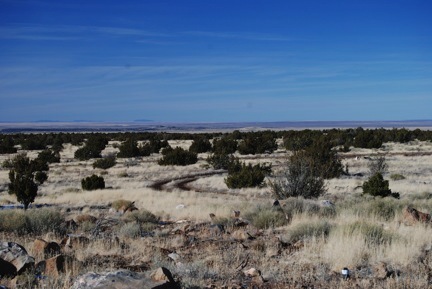
View from ShedWe sleep on a loft in the camping shed. There’s a wall to wall carpet up there with a mattress on top and a pair of very short night tables, one on each side. We make the bed just like we make our bed at home: with sheets and blankets and a cosy comforter. Our heads are right beneath a window that looks out on my favorite view: northwest toward Mount Trumbull.
We usually sleep with the blinds open so we can look out at the night sky if we happen to wake in the middle of the night. On a moonless night, its very dark outside, with just a few pinpoints of light representing far-off ranches. The sky, of course, is full of stars and the glow of the milky way on most moonless nights. If it’s cloudy, we can see the reflection of the lights of Las Vegas, at least 100 miles away, on the cloud bottoms out to the west.

But the moon yesterday morning was so bright that I had to shut the blinds to get another hour of sleep.

It was cold in the shed: in the 50s. The heat was on and set to 70° but the shed, which is insulated, was no match for the 27° cold outside. I changed from my pajamas to a pair of sweatpants and a sweatshirt. Since the power level was a bit low, I made my coffee with a stovetop percolator. I heated up Alex the Bird’s scrambled eggs — which I’d made in the microwave at home before coming to Howard Mesa — in a piece of aluminum foil on top of the heater. I let Jack the Dog out and then back in. With the critters fed and Mike still up in bed, I spent some time working on a blog entry.

Toilet Woes

[Note: The following is a somewhat graphic description of a sanitary problem we’re having at the shed. If you’re easily offended by discussions of toilet operations, please skip this section.]

The toilet was not working properly. The shed has an RV toilet, which we installed because it would use less water.

Now most folks reading this probably know how a standard toilet works. There’s a fixture with a seat and a bowl and a tank on back (or up high). You do your business in the bowl and then use a handle or a pull-cord to flush. The water in the tank rushes into the bowl, flushing the bowl’s contents down the drain and filling the bowl with fresh water. Pretty basic stuff.

An RV toilet works a bit differently. There’s no tank of water. Instead, there’s a foot or hand pedal that lets you put water from your water source into the bowl. You do your business and then use the pedal to open the bottom of the bowl so the contents drop out. Clean water swooshes around the bowl to clean it a bit, but it goes down the drain, too. So the bowl is usually pretty empty between uses. The benefit of this system for an RV — or cabin where you have to haul your own water — is that you can use as much (or as little) water as you like to take care of business.

The problem with the toilet was that the valve to let water into the bowl wasn’t working. You’d push the foot pedal and the bottom would open to drop the bowl contents into the septic system, but no water would rush in to clean the bowl, etc. We used what we called “manual flush” — we kept a bucket of clean water in the bathroom and used that to add and flush water down the drain after using the toilet. Sanitation was not impaired; the bathroom was still clean and the toilet was still flushed.

And the rest of the plumbing worked fine — right down to the water heater.

We figured that the toilet’s valve had water in it that had frozen, thus preventing the flow of water. But the shed had been above freezing for close to a full day, so the chances of it still being frozen were minimal.

After breakfast, Mike worked on the problem. He removed the valve. The plastic pipe had bulged and cracked under stress where water had frozen in it. The valve was broken.

It was the day before Christmas, on a Monday. We worked the phones, using our Flagstaff phone book. The one place that was likely to have the part was closed. No other place that was open had the part.

Mike put the bad valve back on so the pedal would work. (I was not interested in reaching behind the bottom of the toilet to manually twist and untwist the valve control after using the facilities.) And we realized that we’d be on manual flush for the rest of our stay.

It seems to me that every time we come up here, something isn’t working right. Last time was the heater — Mike had to remove a mouse nest from it before it would work. On other visits, it was the water heater not relighting automatically when it should, the water pump cutting out in the middle of a shower, or cracked pipes.

It would be nice to come up here and have everything working right at the same time.

Flagstaff

We spent a good portion of the day in Flagstaff, the nearest city to Howard Mesa.

Flagstaff is a great town, with a wonderful mix of people of different ages and nationalities and backgrounds. It’s a melting pot where young and old get together to steer economic growth. So you’ll find all kinds of businesses there, from hippie gift shops smelling of incense to book shops to sporting goods shops to natural food stores. It also has all the standard big box stores, including Home Depot, Wal-Mart, Target, and Sam’s Club.

Yesterday, we went into Flagstaff for lunch, to walk around the historic downtown area, and to pick up a few odd things we needed. There was quite a bit of snow on the ground, but it had been plowed or shoveled off the roads and sidewalks, leaving scattered ice and some very impressive icicles hanging from rooflines. Traffic was lighter than usual — probably because NAU was between semesters and most of the students had gone home. We still had some trouble finding a parking spot downtown, but soon were parked on Humphrey’s.

There was a Japanese restaurant on Route 66, right around the corner, that I wanted to try. When we got there, it was closed.

We walked around town. There was a Thai restaurant at the Hotel Monte Vista. I like Thai food, but every time we’d looked into the place at lunchtime, it was empty. On that day, there were about a half dozen people inside at noon. We decided to give it a try.

Good choice. The menu was extensive, the service was friendly, and the food was served good and hot. We shared a hot pot of soup, some spring rolls, and an order of short ribs. The ribs were good, but when the guy next to me got his curry, I decided I’d try that next time. I really like curry. Meanwhile, the place filled up. It wasn’t until we left that I realized the place was under new management.

We went into Babbitt’s and a few of the other downtown shops. They were all winding down from the Christmas shopping rush. There were other shoppers, but not many.

Wal-Mart and Beyond

Mike decided that there might be a chance of finding the toilet valve at Wal-Mart, since some Wal-Mart stores stock RV parts and supplies. He talked me into going into Wal-Mart with him. The day before Christmas.

We parked on the side near the garden shop area, which was full of Christmas stuff. One step inside and my stress level rose considerably.

I’ve been in Wal-Marts before, but the one in Flag has to be the worst. It’s an older store, much smaller than the Super Wal-Marts going up all over the country. To fit all that merchandise in the store, they have very tall shelves on rather narrow aisles. The result is claustrophobic. The store was full of last-minute shoppers looking for crap from China to give as gifts or to decorate their homes.

We found the RV Accessories aisle and realized after a moment that they wouldn’t have the part we needed. I immediately went into escape mode, plotting my way out of the store with the least interaction with anyone else. Mike, on the other hand, wanted to get all the items on our little list there: a pencil sharpener, RV antifreeze (to fill drain traps when we leave), distilled water (for our solar setup’s batteries), 9v battery (for our smoke/carbon monoxide detector), hand sanitizer. That would have us running all over the store, which was not a viable option for me. So when he found the antifreeze not far from the RV Accessories, I talked him into buying just that and stopping at a supermarket for the rest.

I endured the recorded sound of dogs barking to the tune of Jingle Bells at the check out area before we emerged back into the sunshine.

We got back into the truck and drove to the nearby Basha’s Supermarket. We got everything on our list there, then headed back to Howard Mesa.

Afternoon and Evening at the Shed

Back at the shed, it was nice and toasty. The outside temperature had risen to the 40s but the sun was very strong, beating on the front of the shed and coming through the front windows. It was in the 70s in the shed. The wind was blowing lightly outside — not enough to find the cracks around the windows and the rest of the structure.

We each took good, hot showers and changed into comfortable lounging clothes. I made up a little cheese platter and opened a bottle of wine. We relaxed and read and studied IFR charts.

We each opened a present. I got a bottle of absinthe from Mike. Mike got a watch-winder cabinet from me. We had three presents left to open: two for me and one for him. I’m pretty certain there’s a small pile of presents on my doorstep at home.

Mike made some pasta for dinner. I was still full from lunch and our snack, so I didn’t eat much.

For our evening entertainment, we tried to play a DVD we’d brought along. My MacBook Pro’s CD/DVD drive is dead — I discovered that just the other day and will be sending it back to Apple for repair next week. So Mike had brought his Dell laptop. Unfortunately, it didn’t seem able to play a DVD either.

So we played dominos and listened to music.

Now this might seem boring to you. I won’t lie and say it’s exciting. What I will say, however, is that it’s restful. Our place is small and far from neighbors and paved roads. No one drives by. The only sound is the wind and an occasional coyote howl.

The only thing that could make this a nicer place to spend Christmas eve is a fireplace with a real yule log burning in it.

And a fully working toilet.

Christmas Off-the-Grid, Part II

Photography, dinner, and more photography at the Grand Canyon.

We closed up the shed and headed out to the Grand Canyon at around 4 PM. We’d wanted to get an earlier start to do some hiking along the rim, but it had taken too long to troubleshoot and fix our water problem.

I should mention here that last year when we came to Howard Mesa for Christmas, the water pipes were broken. Mike spent the entire first day and half of the second day finding and repairing broken pipes. Since then, we’ve replaced the PVC with copper. But it seems like there’s always something to fix up here. It’s part of the place’s charm, I guess. Mike doesn’t seem to mind. And in my mind, nothing could be as bad as the mouse problem we’d had, which forced me to start every visit here with a 2-hour cleaning job.

The Grand Canyon is a 40-minute drive from our place. About 1/3 of that time is spent just driving the five miles from our place to pavement. (Not an easy task, as there was more mud and the pickup did a lot of fishtailing on certain parts of the road.) The rest is on SR 64, a two-lane road that stretches from Williams, AZ to the Grand Canyon. The speed limit on the road is 65 MPH for most of its distance, but because there’s only one lane in each direction for most of the way, it’s pretty common to get caught behind slower vehicles. They added some passing lanes clearly marked with signs that say, “Keep right except to pass,” but since everyone is more important than everyone else, no one moves over to the right. So you basically have to pass on the right.

We were heading toward the canyon at about the same time someone who had left Phoenix earlier in the day for a leisurely drive up there would be arriving, so there was a surprising number of people on the road.

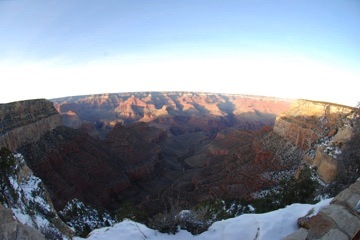
Grand Canyon Wide AngleInside the park, we got a parking spot in the small lot right near El Tovar, where we’d be eating dinner with friends. The hotel is right on the Rim, so we spent some time out on the pathway there, looking into the canyon as the sun was dipping ever lower into the southwestern sky. I played around with my fisheye lens — this was the first time I’d had a chance to use it at the Canyon — and got an interesting shot that includes the snow all around on the Rim.
It was cold. There wasn’t much wind, but the breeze contributed some wind chill to the situation. I don’t own a good winter coat anymore — I’d rather avoid the cold than buy special clothing for it — so I didn’t want to spend much time outdoors.

We went into Hopi House for a short while. This used to be one of the nicer gift shops at the Canyon, a place where everything was high quality. Somewhere along the line, Xanterra (which runs the park concession) had decided to add the kind of tourist crap you can find in most other gift shops there, especially t-shirts, hats, and sweatshirts that say “Grand Canyon” on them and a lot of fake Indian-style dolls, statues, rugs, etc. The good stuff — including a wonderful selection of Native American handmade jewelry — is still in the gallery upstairs, and we made the climb to see it all.

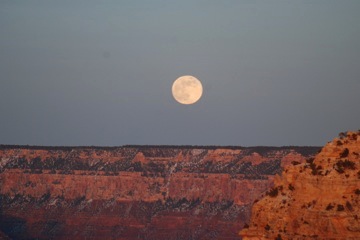
Grand Canyon MoonriseAfterwards, we came out for another peek into the canyon and were rewarded with a view of the newly risen full moon inching into the sky over the north rim. I snapped a few photos of it, but was too cold (or lazy?) to set up my tripod and do it properly, so the shots I took with my 200mm lens aren’t as clear as they could be.
We met our friends inside the hotel. We were booked for the private dining room just to the left of the hostess desk at the restaurant entrance. We’d eaten there the previous year for Christmas Eve. It had been just six of us last year: Mike, me, our two friends, and his parents. A quiet dinner. This year there were ten of us; our friends had invited six of their friends. The rectangular table in the small room was filled to capacity.

Our waiter was excellent. Extremely professional, full of advice, attentive to most details. The food was very good, too — although not as good as I remember from our early days visiting El Tovar 20 or so years ago. (I know: things change.) Conversation was relatively interesting, too. It was a nice meal. The only thing that marred it was when it was time to pay the bill; certain members of the party didn’t chip in their fair share and Mike and I and our friends wound up making up the difference, paying about three times as much as some other members of our party. I know we drank, but we didn’t drink that much.

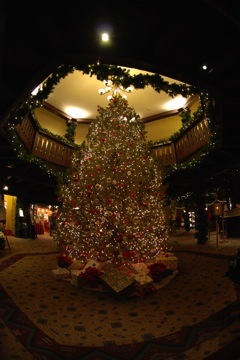
Christmas TreeAfter stopping for some photos inside the hotel lobby where a tall Christmas tree stretched up to the second floor, we stepped outside and walked back to the Rim. The moonlight was shining brightly down into the canyon, casting shadows that defined the rock walls. It was a beautiful scene, but one my camera couldn’t seem to capture properly. (I really need to play around a bit more with the bracketing feature.)
I’ve been at the Grand Canyon many times at night. If there’s no moon, you can look down into the canyon from the Rim and not see a single detail at all. It’s like a black abyss that could be a hundred miles deep. But add some moonlight and you get a completely different picture. This is part of what makes the Canyon such a special place. Different lighting conditions can completely change the experience.

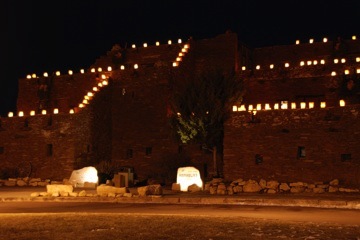
Hopi House at NightSince I was out there with my tripod, I took a few moments to photograph Hopi House and El Tovar. Hopi House was especially festive with its [electric] luminarias.
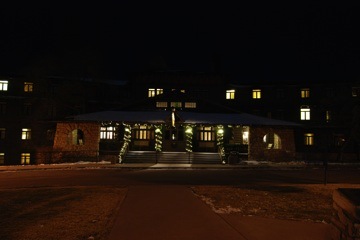
El Tovar at NightIt was after 9:30 PM and it wasn’t very cold at all. The wind had died down and the air was crisp and dry. There wasn’t anyone around except us. That made good conditions for taking these photos. They create the illusion that the historic buildings along the Rim are private, special places. In reality, during the day, these places are mobbed with tourists and it would be nearly impossible to photograph them without including a few people in each shot.

We drove back to Howard Mesa in the full moonlight. There were few cars on the road.

As I opened the gate on our driveway, I noted that all the mud was frozen solid.

It was warm and cosy inside the camping shed and even more so under the covers in bed.