Quincy Tales: Laundry

A report from my summer camp.

One of the drawbacks of living away from a very comfortable, fully equipped home is the laundry problem. I need to find a coin-op laundry to do my wash.

This week, I went to Quincy’s lone laundromat for the second time. While examining the filth around me as I waited for my clothes to dry, I decided it would be my last time.

I can’t understand how a laundromat can get so incredibly filthy. What are these people doing? How can they leave their trash around? How does the floor get so dirty? Doesn’t anyone take a rag over the tops of the washers? Ever?

Do you know how hard it is to fold sheets by yourself when you can’t let them touch the floor?

I spotted a laundromat in Wenatchee on Monday. It’s a long drive to do laundry, but I’ll do other things while I’m there. And it’s only once a week.

Quincy Tales: Fire!

A report from my summer camp.

Smoke Near QuincyThere was a big fire northwest of Quincy on Sunday. I first saw the smoke when I first drove into the Quincy Lakes area and didn’t think much of it. I figured someone was burning brush or trash. But when I next saw the smoke, it looked like a big, white mushroom cloud. Later in the day, the base of the smoke had spread. It was obviously a wildfire.

I was concerned for a while that it might have been orchards burning. Maybe even one of my orchards. So after I finished my trip through Quincy Lakes and my visit to Cave B (where this photo was taken), I drove up as far as the turnoff to Crescent Bar. I could then get a better idea of where the fire was. It seemed to be in the highlands beyond the farmland.

Meanwhile, on Monday, when I drove to/from Wenatchee, I saw a helicopter with a Bambi bucket going between the fire site and the Columbia River. The smoke was greatly reduced, but it was obvious that they were still working on fire control.

Next time I’m out with my helicopter, I’ll check it out.

A Day Off — Kind Of

Good weather sets me free.

If you’ve been following this blog, you know I’m in Quincy, WA, with my helicopter on a cherry drying contract.

The contract requires me to be on “standby” during daylight hours seven days a week. Here in Washington these days, that’s basically from 5 AM to 9 PM. During that time, I can receive a call from one or more of the three growers I’m currently covering. I’m expected to respond quickly, to fly my helicopter over to the orchard(s) and begin drying. The cherries must be dried within 2-3 hours to prevent damage. I have 78 acres to cover, and if you figure 40 acres an hour, I don’t have much time to waste.

Of course, I don’t have to dry the cherries if they don’t get wet. So if it doesn’t rain, I’m not likely to be needed. That’s when I can move a bit farther afield.

And that’s what I did yesterday. It was a beautiful day with no chance of rain, so I took a “day off” and went to Wenatchee.

Now, Wenatchee is only 30 car miles from Quincy. And my orchards are between Wenatchee and Quincy — one of them is actually closer to Wenatchee than Quincy. So if the weather changed over my orchards while I was in Wenatchee, I’d know and be able to hightail it home. So I don’t in any way feel that I was being irresponsible with a day trip to Wenatchee while I was on standby.

Besides, I had work to do in Wenatchee. I’d finally gotten the missing gaskets for my fuel tank setup and had reassembled the tank and pump. For some reason, however, I couldn’t get the pump to work. I figured it might have to do with the tank not being primed. Since I had to fill the tank anyway, I figured I’d get it filled in Wenatchee and troubleshoot the problem there.

So I hit the road and drove to Wenatchee. It’s a pleasant drive, much of which is along the Columbia River. There’s a spot along the way where you turn a bend in the road and the Rock Island Dam is spread out before you. If I could find a place to pull over and take a photo, I would. So far, no luck.

I crossed a bridge and made my way onto Wenatchee Avenue. From there, I went to Wenatchee Petroleum near 6th Street. The folks there were very pleasant. I moved the truck over to their pump and Ken topped off my tank. We couldn’t fill it to the very top because fuel kept spitting out, so I only took 12 gallons. But the price was good and I’m likely to get all my refills there.

I experimented with my pump and it still wouldn’t work. It seemed to be the pump motor. I worked my phone and tracked down the local dealer for the pump, which turned out to be just a block away. After I explained that no, I didn’t have separate suction pipe, the suction pipe was built into the tank itself, we got down to business. We fiddled with the switch and pump. Suddenly, it started working. The problem appeared to be in the switch. I think it had some moisture in it that was preventing it from working properly. Once it dried out, it worked.

For the first time since installing my $2,000+ fuel transfer system nearly a month ago, it worked. (It was about f*cking time.)

Downtown WenatcheeWith that load off my mind, I could goof off a little. I drove into downtown Wenatchee and parked right on Wenatchee Avenue. I immediately spotted a Mongolian BBQ restaurant. I hadn’t had Mongolian BBQ in 10-15 years and my stomach was grumbling for lunch — it was 12:15 PM, after all — so I went in. I had a great lunch. Then I came back out into the sunshine and walked a few blocks down and then up Wenatchee Avenue, looking into the shops. There’s a great sporting goods shop on the east side of the street and I’ll probably be going back next week to buy a new bicycle seat there. I treated myself to a vanilla ice cream with a shot of espresso on top before heading back to the truck.

Two more stops. First, Home Depot to buy a large plastic planter, potting soil, and some plants for a little garden at my camper. Tomatoes, basil, and some flowers. Then Safeway in East Wenatchee for a few groceries. I was very disappointed that they didn’t sell 8 O’Clock Coffee, which is my favorite brand.

I took the road past Wenatchee Airport on the way back. It might be a little longer than route 28, but it’s a pleasant drive through farmland with occasional views of the Columbia River Valley before joining up with Route 28 near Rock Island.

It was nice having a day off.

And I guess I have a pretty good deal: I only have to work when the weather is bad, so I always have nice weather on my day off!

Trailer Living

Have I become “trailer trash”?

My TrailerI’m writing this from the dining table in my 21-foot pull trailer. I pulled it to Quincy, WA on the back of my 1994 Ford pickup truck from Wickenburg, AZ last week. You can read about each day of that journey here, here, and here. Now I’m camped out in the parking lot of a golf course built on a flat farm field. I have a full hookup — electricity, water, and sewer — and a tiny but lush green lawn between my camper and the big fifth wheel camper parked in the next spot.

The golf course’s “RV Park” is on the corner of two main farm roads. White Trail Road comes south from Route 28 and curves to the east past the golf course. Route 281 runs north-south between Quincy and George, where I-90 cuts through central Washington. These roads get a good amount of traffic that includes everything from farm tractors to 18-wheelers. Because White Trail Road has a stop sign at the corner, the big trucks often rely on engine braking as they coast past the RV park. Fortunately, there aren’t a lot of those. Unfortunately, there is traffic on both roads from about 3:30 AM to 12:30 AM — in other words, most of the day and night. Oddly enough, the sound of the traffic doesn’t seem to keep me awake. (More on that in a moment.)

The golf course is surrounded by farmland. Huge fields with irrigation “circles” grow wheat, potatoes, and other crops. Across the road is a residential area with a row of houses and tall shade trees. There’s a small pasture filled with milking cows and I can often hear the sound of a horse’s whinny and a rooster’s crowing. There are also a lot of rabbits and unfamiliar birds.

The RV Park has five full hookup spots including mine. Four are filled. There are also a few electricity and water (but no sewer) sites, two of which are occupied. There’s room for at least 20 more campers here. But since the golf course doesn’t advertise the availability of the sites, they’re not likely to fill up.

My neighbors keep to themselves. The big fifth wheel’s occupant is normally gone for the day by 5 AM. The other two full-hookup trailers, which look as if they’re about as old as I am, don’t seem to be occupied at all. In the five days I’ve been here, I saw two trucks stop at one of them for the night. Otherwise, they’ve been empty.

I also had an overnight neighbor in the spot on the other side of my camper; they backed in with a big fifth wheel but never bothered to unhook it from their truck. Instead, the man and woman pulled out their golf clubs and hurried over to the pro shop to get in a game of golf. It was afternoon when they arrived, but since the sun doesn’t set here until 8:30 PM, they had plenty of time for their game. They stayed the night, but when I returned from my errands the next day, they were gone.

Front TrailerMy trailer is comfortable. It’s 21 feet long, but none of that floor space is taken up with beds. Instead, the beds drop down in their own little tent-like structures on the front and back of the camper. Each bed is slightly smaller than queen sized. Their mattresses are 6-inch foam. Because I only need one bed, I stacked two mattresses on the back bed and put linens on that. The other bed is open, but I’m using it for storage and for Alex’s cage.
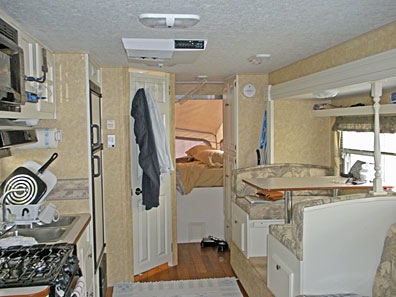
The camper is definitely not designed for cold weather. Cold air comes right through its poorly insulated shell and the tents on each end. It has a forced hot air gas furnace that can does a pretty good job keeping up with the cold, but it’s very loud. It gets down into the 40s (F) here at night. I have a small electric heater that’s quiet and I set that up in the camper’s main area each night, mostly to keep Alex warm.

Trailer BackMy bed has flannel sheets and three blankets on it. Since I added the third blanket, I’ve been sleeping remarkably well. In fact, when I wake at sunrise (around 5 AM) with Alex’s first words, I feel cosy and refreshed. I don’t want to get out of bed. This is extremely unusual for me — at home, I jump out of bed as soon as I wake.

The camper has a three burner stove, oven, microwave, small double sink, and decent sized refrigerator and freezer. There’s also a tiny bathroom with sink, shower, and standard RV toilet. It has a reasonable amount of cabinet space and storage under the dining area’s benches. Both the dining area and sofa can be converted into beds for short people. There’s a special shelf for a television and an antenna on the roof, but I don’t have a television installed. I haven’t missed it yet. There’s a stereo with a CD slot and an MP3 input, so I can listen to NPR and my iPod. There’s also an air conditioner on the roof. We tested it before I left Wickenburg and it worked extremely well in Arizona’s hot sun. I’ve been told I’ll be using it soon, but so far, the weather has been unseasonably cool here.

My morning routine here is similar to at home. I make coffee with my one-cup electric drip coffee maker and cook Alex’s scrambled eggs in the microwave. I’m trying to blog each morning, but I’ve been busy with other settling in tasks, so I’ve neglected my blogging. Lately, I’ve been getting exercise by walking orchards. I brought my bicycle along and expect to get exercise riding it back and forth to the airport (4 miles) and the town of Quincy (5 miles) on mostly flat farm roads. I did walk around the golf course one morning and I expect to do that more often — perhaps when it’s too hot to ride my bike.

I’ve been eating entirely too much, mostly in the afternoon, when I’m done with my errands for the day. I’m working on getting that under control. I was really hoping to lose weight here — not gain it.

Today, I’m going to Seattle to pick up my helicopter and bring it to Quincy Airport. I’ve rented a hangar for two months, so I’ll spend the morning reassembling my helicopter tow bar and swap out my big trailer tow hitch ball for the smaller one that works with the tow bar. At 10 AM, a golf course employee will be picking me up there and taking me to Wenatchee Airport, where I’ll catch a flight to Sea-Tac. Then a cab to Boeing Field. Later today, I’ll fly up the Columbia River, detouring to meet another pilot at Mattawa before continuing up to Quincy. With luck, I’ll have the helicopter put away in its temporary home by 6 PM.

There’s rain in the forecast for tomorrow and Tuesday. Looks like I might finally get to work.

My Neighbor’s Windmill

Things change.

There were a few things that drew us to our house in Wickenburg back in 1997 — beyond the obvious benefits of living in a recently built home. Situated in a hilly and rocky area on the edge of town, our 2-1/2 acres of horse property ensured plenty of privacy. Indeed, to this day we often sleep with the curtains wide open to the night sky. We had few neighbors and the ones nearby were generally very quiet. The dirt road we shared with two neighboring homes was in such bad shape that we didn’t have to worry about strangers bothering us. The Jehovah’s Witnesses have only found us twice in 11 years.

But one of the best things about our house was the view out the back. I’m not talking about the glimpse of nearby Vulture Peak. I’m talking about my neighbor’s home and its windmill.

My Neighbor's HouseThe house was one of the very first built in our area. It’s a one-story structure with just two bedrooms and two baths, perched on a rocky, lichen-covered outcropping. At the base of the rocks was a densely vegetated flood zone, filled with local trees and bushes slightly higher than the level of Cemetery Wash, which also flows through our property. Up at house level were irrigated trees so mature that they blended in perfectly with the home. The house seemed to be part of the landscape. And in the morning, when the first light of day hit it from the east, it glowed red, as shown in this July 2007 photo.

But what I loved most was the windmill. This wasn’t a decorative lawn ornament — it was the real thing. It looked ancient and antique, but it caught the wind faithfully and pumped water from a well. Enough water for my neighbors to have a fish pond. A pond big enough to attract herons — yes herons! — in the desert.

Sometimes on a quiet evening, when the wind blew from the west, I could hear the mechanical clanking sound of the gears and pumps. The rhythm varied with the wind speed. And we could look outside during daylight hours and see just how windy it was.

When we first moved in, I came very close to choosing the back guest room for my office just so I could look out at that windmill while I worked. But late afternoon sun shining in that window convinced me that the front bedroom was a better choice if I wanted to leave my blinds open.

Time went on. And on. My neighbors decided to move. They put the house up on the market and about sixteen months ago, just before the real estate bubble burst, sold it for their asking price. I heard about the new owners through the local grapevine. Wealthy people who had another home. This would be their “guest house,” one person told us. They have horses and kids. They’re going to use it for a vacation home.

Before long, the workers arrived. They enlarged the horse enclosures on the property’s lower level and put in a welded pipe fence to create an arena. I worried when they put up tall poles for lighting and hoped they didn’t plan on keeping them on every night. More workers came with chainsaws and heavy equipment. Over a period of several days, the removed all the natural vegetation below the house, leaving the land barren. They’re putting in an irrigated pasture, one neighbor said. They used earth moving equipment to pile sand in berms that they evidently expected to protect the newly cleared land. They fenced in all of their flood plain property, putting an access gate in the deepest part of the wash.

Then they disappeared.

For a while, there was a red truck in the driveway. A caretaker, someone told me. Lights were on at night. The house looked a bit lived in. But then the red pickup stopped coming. A single light was on all the time, like a blind eye in a forgotten home. Then even that went out.

Flood!Monsoon season came and the first heavy rain brought a massive flash flood. The sand berms were no match for the power of flowing water. The water coming down the wash was no longer held back by the dense vegetation that had grown below the house. The wash changed its course, flooding the undeveloped “pasture” and cutting across the bottom of our access road. The rushing water completely flooded the sandy area in our part of the flood plain and, for the first time ever, our entire fence was washed away.

Washed Out FenceWhen the water subsided, parts of our neighbor’s new fence were tangled across the access road to our neighbor’s house. Cinderblocks from their corral area littered our lower horse corral. Their “pasture” was filled with sand. Lucky they hadn’t set up the irrigation yet; it would have been destroyed.

No one came to fix their fence. My neighbor dragged its remains aside so he could drive through. After a while, tired of chasing trespassers in quads out of the wash, he spent a whole day repairing the damage.

Still no one came.

Throughout this time, the windmill kept turning. But the fish pond was empty and the riparian wildlife was gone. The irrigation must have been turned off because trees close to the house began to die. It made no sense; the water was free. Why not take care of the trees that depended on it?

This winter, I noticed that the windmill was making more noise than usual. It squealed to life in a heavy breeze, then clanked and screeched as it turned. I wondered why, after all these years, it was having these problems. Finally, after a few weeks of listening to it, I tracked down the former owners and asked them. Did the windmill require maintenance?

Oh, yes, I was told. “We had the pump people come in once a year for preventative maintenance.”

I asked if they could get in touch with the new owners and tell them about the problem. They said they had no way of getting in touch with them. We said goodbye and I hung up with a feeling of foreboding.

More time went by. The squealing and clanking got worse. It wasn’t a happy sound; it was the sound of neglect, the sound of the windmill’s pain. Neighbors who lived closer to the house must have taken action. Perhaps they called the owners. But the solution was not the one I wanted to see.

Headless WindmillWhile I was out one day, workers took the head off the windmill and left it on the ground, at the base of one of the dead trees.

That was two months ago.

Today, the windmill’s tower stands topless, like so many deserted windmills throughout the desert. The trees closest to the house are dead. There are no flowers, no cars in the driveway. A single square of light looks out toward our house every night — the burned out lightbulb replaced by someone who checked in one day. The house seems dead and forgotten.

To me, the death of the windmill is a symbol of what’s happening to Wickenburg. With our 50% seasonal population, there are many homes that stand empty and neglected when summer comes. As developers take horse property and turn it into CC&R-controlled subdivisions, the people who moved to Wickenburg years ago for a taste of the old west are moving out. The new people don’t care about horses and natural desert vegetation and wildlife.

And apparently they just don’t understand the powerful emotions generated by watching an old windmill turn in the breeze.