Creating Defensible Space

Fire season is serious business in the west.

Every fire season seems to get a little worse in the west — particularly in the Pacific Northwest where I now live. For the past four summers, we’ve had widespread wildfires, most of which were started by lightning strikes. Fires have been particularly threatening, if not downright damaging, near my new home:

  • In September 2012, lightning strikes started over 100 wildfires from Blewett Pass to Lake Chelan. Visibility dropped down to less than 1/2 mile in smoke and mandatory evacuations affected the Wenatchee Heights area that was my temporary home not long after I left for Arizona.
  • August Fire
    I was at a party at the airport on the evening of August 10 while Jumpoff Ridge was burning.

    In August 2013, lightning strikes started a handful of fires on Jumpoff Ridge, the cliffs that tower behind my current home. Although I’d just purchased the land and didn’t have anything on it, I was as alarmed as my neighbors when my road was put on mandatory evacuation, mostly because firefighters feared that burning debris would tumble down the cliffs and start new fires on our level. (Fortunately, that didn’t happen.)

  • In July 2014, more than 300 homes were destroyed when a fire hit the community of Pateros, about 45 miles upriver from Wenatchee. Other fires up the Methow River near there destroyed forests, orchards, and a few more homes.
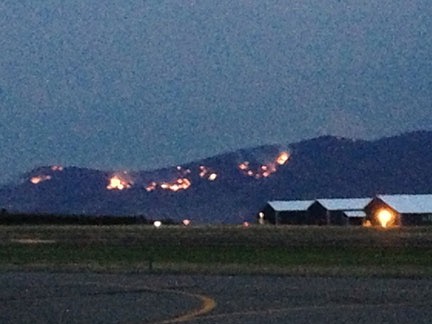
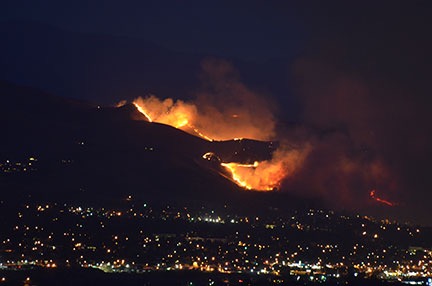
  • Sleepy Hollow Fire at Night
    I shot this photo of the Sleepy Hollow Fire on the night of June 28, 2015 from my deck using a 300 mm lens. It isn’t cropped. Although the fire was more than 8 miles from my home, I found it terrifying and could not sleep that night. A pair of heavy rainstorms the next day put the fire out — and started the Wolverine Fire up near Lake Chelan that’s still burning today.

    In June 2015, the Sleepy Hollow fire destroyed more than 20 homes in a Wenatchee subdivision overlooking the town. Burning embers from the fire traveled on the wind and touched off fires a half mile away, destroying 3 warehouses and fruit packing and storage facilities.
As I write this, there are dozens of fires all over Washington, Idaho, and Oregon. These fires are growing at alarming rates. The Okanogan Complex Fire, for example, started on Saturday, August 15 — that’s just 8 days ago — and has already grown to 227,206 acres. That’s 355 square miles — larger than the entire city of New York (all five boroughs).

Can you imagine all of New York City burning in a week?

And that’s just one of the monster fires. Chelan Complex has burned 87,412 acres in the Chelan area, North Star has burned 132,000 acres on the Colville Indian Reservation, and Grizzly Bear Complex has burned 59,150 acres in the Umatilla National Forest. The Interagency Inciweb website is currently tracking 26 fires in Washington State alone. The President has declared Washington a disaster area. This is some serious shit.

Although the closest fire is at least 20 miles from here, a wind shift has brought smoke into the valley. Visibility is less than 3 miles — I can’t even see the airport from my home. The smell of smoke is in the air. I spent much of yesterday outdoors doing light work and wound up with a sore throat from breathing smoke.
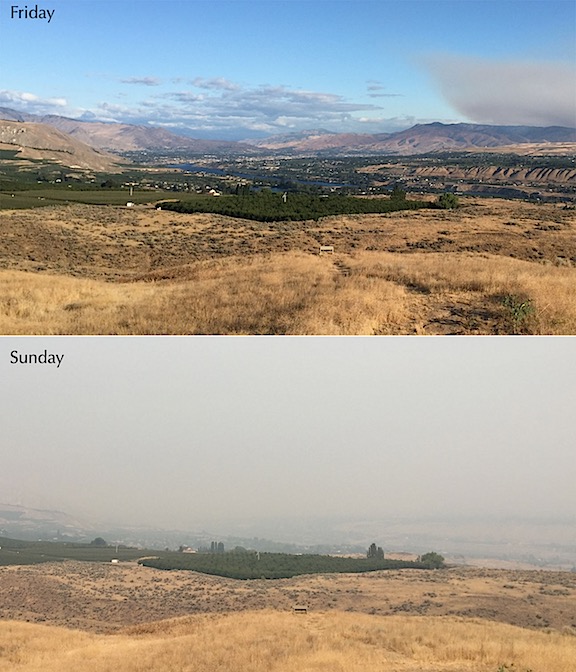
Visibility.jpg
On Friday, the air was very clear, although I could see the smoke cloud coming our way. This morning, the air is thick with smoke. I can barely see the buildings at the airport just 3 miles away.

The scariest part of fire season for those of us who live on the outskirts of town, surrounded by natural vegetation, is the fact that it doesn’t take much to start one of these crazy fires. Lightning is the most common cause, but fires have also been started by cigarette ash, sparks from chainsaws or mowers or ATVs, and even cars with hot engines parking on tall, dry grass. If Mother Nature doesn’t start a fire, some careless idiot might.

As you might imagine, the idea of “defensible space” is on many people’s minds. In theory, it means keeping enough clear area around your home so that firefighters can defend it from wildfire. That usually means cutting down trees and bushes and trimming long grass, surrounding your home with heavily irrigated vegetation such as green lawns or orchard trees, and removing any firewood or scrap wood piles near your home. If your home does not have defensible space, not only is it more likely to burn in a wildfire, but firefighters may not even try to defend it because of the danger it could put them in.

I did much of this over a month ago when I used my string mower to cut back the tall, dry grass on the side and back of my home. I debated cutting a few of the small sagebrush in the area — they burn hot and fast when ignited — but left them. The other two sides of my house have concrete and gravel and a small lawn.

Of course, some of us take it the next step by installing sprinkler systems that can be turned on, when needed, to soak the area. I did that the other day. I drove two 6-foot T-posts into the ground, one at each corner on the road side of my home. Then I fixed 50-foot sprinkler heads to the top of each one. I ran hose from my shed — which has extremely high water pressure — to the first sprinkler and another hose from that one to the second one. When I turned them on, they provided coverage along the entire road-side of the building, as well as about 50 feet down the front and back.
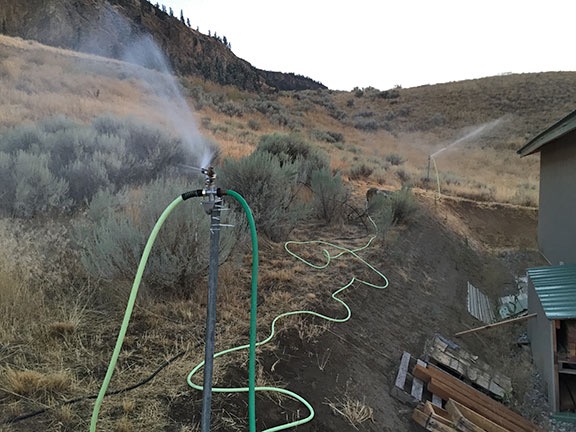
Sprinklers
Here’s my sprinkler setup on the road side of my home. I do need to move some of the scrap wood there, or cover it with some of the metal panels I have.

I want to add a third sprinkler to the roof of my shed, which would protect the shed and chicken coop. A fourth sprinkler head can be mounted on my deck in the other back corner of the building to provide some protection there.

My friends have been asking me whether I have a generator for the water pump. They assume I have a well. I don’t. I have city water which should keep flowing as long as the water company keeps it coming. I guess I should hope that they have generators.

Yes, I know it isn’t perfect, but it’s better than nothing.

The good thing is, my building is made of metal. So flying embers landing on the roof or against a wall should not be able to start a fire. There are some exposed wood beams, however, and I’m not fooling myself into thinking the building is fireproof. As too many folks around here have learned over the past few years, even metal buildings can burn if they’re subjected to enough heat. My goal is to prevent that heat from getting close enough.

I’m not the only one thinking about fire. Kirk has moved his vehicles into his orchard, which is far less likely to catch fire if fires come through the canyon where he lives.

Anyone who lives in an area prone to wildfire damage who doesn’t create defensible space around their home is an idiot, plain and simple. As we’ve seen this year, even homes in subdivisions that are normally safe from wildfire danger can be completely and utterly destroyed. Why would anyone fail to take steps to protect their home before such protection was absolutely necessary?

When the fires come, you often don’t have time to act before evacuation. I feel a bit of comfort knowing that I can get my sprinklers going in a matter of minutes now because they’re already in place. This might mean the difference between keeping my home standing and losing everything I own.


Keeping Cherries Fresh

A few tips from years of experience.

One of the perks of my summer job as a cherry drying pilot is my friendship with more than a few orchard owners. As a result, I often find myself with an opportunity to pick cherries right off the trees for my own personal consumption.

Gleaning

I got an opportunity just yesterday. I was on a charter flight with two good clients who occasionally use a helicopter to visit multiple orchards during the growing season. Our first stop was a cherry orchard about forty miles south of my base in the Wenatchee area. Picking was in full swing, with lots of pickers working on trees just to the south of the clearing where I’d landed. I wandered off into the orchard in the other direction and found large, mature trees. I stepped into the shade and looked around me.

Most of the trees were Bing cherry trees. I could tell because I know that Bings don’t self-pollinate, which would explain the presence of Rainier cherry trees, which are sometimes used as pollinators. There was another type of cherry tree there too — likely another pollinator. The Bings had been picked; the Rainiers and other cherries had not.

I have a lot of respect for my client, which is why I didn’t pick any Rainiers. Instead, I went to the picked Bing cherry trees and began my hunt. I was gleaning.

According to Wikipedia:

Gleaning (formerly ‘leasing’) is the act of collecting leftover crops from farmers’ fields after they have been commercially harvested or on fields where it is not economically profitable to harvest.

(I was not familiar with this term until last year, when I described what I was doing and a friend told me it was called gleaning. I never stop learning and hope you don’t, either.)

I’m pretty good at gleaning, having had lots of experience over the past eight years. As strange as it may seem, when pickers go through an orchard, they often leave a lot of fruit behind. I’ve noticed that some trees have more leftover fruit than others, likely because some pickers are not quite as good as others. I’ll go for good sized, unblemished fruit that I can reach from the ground. (Being tall helps.) It doesn’t matter what I pick or how much — since the trees have already been harvested, if I didn’t pick the fruit it would likely rot there. One of my clients even told me that by gleaning the leftover cherries, I help prevent the spread of a certain pest that thrives on rotting fruit.

Bag of Cherries
Robinson R44 blade tie-downs make pretty decent little canvas bags. I could have put at least five pounds in this one.

I picked about two to three pounds of cherries. I put them in one of my helicopter’s blade tie-downs, which actually makes a good-sized canvas bag. (I can’t take credit for this idea; a pilot friend of mine used one of his tie-downs Thursday as a bag on a kayak trip.) I stowed it under my seat for the trip home, knowing how important it is to keep the cherries cool.

And that’s the trick: keeping the cherries as cool as possible.

Keep the Cherries Cool

Cherries begin to lose their freshness as soon as they are picked. Growers do everything they can to keep the fruit as cool as possible. They only pick early in the day and seldom after the outside air temperature reaches 80°F. If able, they run the bins of freshly picked fruit through a hydrocooler to drop the temperature of the fruit. They get the bins of fruit into refrigerated trucks as quickly as possible. Even at the packing house, the fruit is moved off the trucks and into huge refrigerated warehouses until they can get a place on the packing line.

I have my own hydrocooler of sorts: a kitchen sink or large bowl of cold water. As soon as I got yesterday’s cherries home, I rushed them into the kitchen, dumped them into a bowl, and filled the bowl with cold tap water. I whooshed them around in the water to wash off the orchard chemicals and dumped the water. Then I did it again. And again. Three washes — that’s my routine.

Next, I half-filled the bowl of cherries with water and topped it off with ice from my freezer. (Before I moved out of my RV and into a real home, I actually bought bags of ice that I stored in my RV freezer just for this task.) I whooshed the cherries around in the water, getting the water and the cherries icy cold.

The important thing to remember here is to not leave the cherries in water longer than necessary. Why? Because they will split. After all, that’s why I work as a cherry drying pilot — to get rainwater off cherries so they don’t split.

So my next step was to dump the cherries with the ice into a colander. That would allow the water to drain off while keeping the ice around the cherries to cool them just a little bit more.

Cherries on Ice
I keep the cherries on ice a while to keep cooling them down.

Then I ate some. Quite a few, in fact. Although some people seem to have digestive problems when they eat too many cherries, I don’t. I can eat a lot of cherries.

Cherries in a Bowl
My gleaned cherries, ready for the fridge.

Finally, I pulled the cherries out of the colander and put them in a ceramic bowl, leaving the ice behind. And I put the bowl in the fridge, where I could easily reach in for a handful of cherries any time I liked.

Sealing Out the Air

Every once in a while, I pick a lot of cherries — more than I can eat in a day or two — or one of my clients gives me an 18-pound box. 18 pounds is a lot of cherries.

Besides making cherry turnovers, cherry cobbler, and cherry chutney, eating cherries with yogurt and cereal, and sealing pitted cherries in jars with vodka and a bit of sugar to enjoy six months into the future, I want to store the cherries in a way that’ll keep them fresh for munching as long as possible.

To do this, I follow all the steps above and then add a final step: store them in a zip-lock bag with air sucked out of it. I suck the air out with a straw, just before sealing the bag. Then I put the bags in the coldest part of the fridge. I’ve managed to keep cherries edible for up to two weeks like this.

I Love Washington State Cherries

The only fresh cherries I eat are Washington state cherries, most of which are grown within 50 miles of my home.

Whenever possible, I pick them myself, after the pickers have gone through the orchard block. I’m picking up the crumbs, taking fruit that would just go to waste otherwise. I feel very fortunate to have the opportunity to do this. It’s not just a matter of getting free cherries. It’s also a great way to get closer to my food source, seeing how the fruit grows and fades, getting a better appreciation for what it takes to grow and harvest the food we take for granted.

Washington state cherry season will likely end early this year — possibly before the middle of August. There isn’t much time left to get this great fruit. If you find some in your local supermarket, buy it, bring it home quickly, and chill it back down. Then come back here and use the comments to tell us what you think.

Naked on the Deck

And other benefits of a home with privacy.

Lately, I’ve taken to relaxing on my deck after a shower or soak in the tub. Naked.

Naked on the Deck
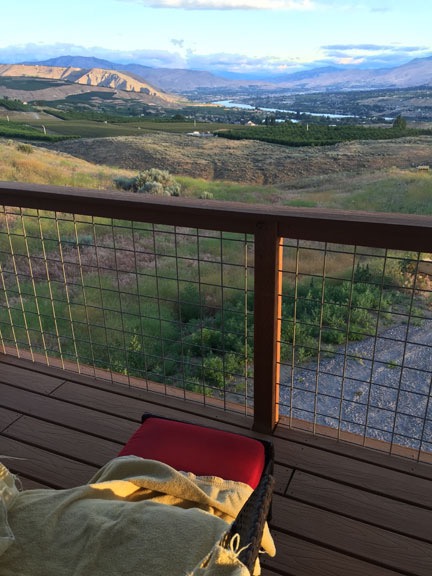
This chair outside my bedroom door to the deck is a perfect place to relax after a shower or soak in the tub.

I can do that where I live. My north-facing deck is covered and blocked from the road by my home. There’s a hill to the west that separates me from my closest neighbor. To the north and east, the land drops away, leaving me with a clear view down to the Columbia River Valley with more than a quarter mile between me and the closest home or orchard.

I have a comfortable chair out there where I can relax, letting a warm summer breeze tickle my skin and dry water droplets my towel missed. I listen to the birds or the crickets or the orchard sprayers while looking out over miles of orchards, scattered homes, a small lake, the winding Columbia River, basalt cliffs, and the city of Wenatchee off in the distance.

It’s one of the perks of living someplace with privacy.

My home in Arizona had nearly as much privacy and I admit I occasionally lounged on my upstairs patio there after a shower or bath — mostly on a warm winter afternoon when the sun flooded the covered area. But I was far more likely to drop my towel at night than during the day; my neighbors were a lot closer and more likely to spot me out there. I’m shy.

My vacation home in northern Arizona was the ultimate in privacy. No one was ever around up there. That place also had a deep silence broken only occasionally by the sound of the flapping of a raven’s wings or a car wandering onto the rumble strip along the closest paved road two air miles away. Or a jet, 30,000 feet up, flying on the jet route over the Grand Canyon.

I value privacy — real privacy. That’s one of the reasons I live on ten acres two miles down a gravel road on the edge of town. Yeah, it’s a long drive — 10 miles to the nearest supermarket — but it’s so worth it.

People complain about loss of privacy from big data collection by social media or portable devices or government agencies like the TSA. Yet these same people live in homes 20 feet from their neighbors’ and rely on association-approved fences to keep those same neighbors from watching their backyard barbecues. Or they share walls with neighbors in apartments or condos and can hear their neighbors sneeze or argue or have sex. Or their windows look out into community spaces, thus requiring them to close the blinds if they don’t want their neighbors to watch them eating dinner or watching television.

I lived like that for a while: in a fishbowl condo that reminded me so much of a movie that I named the network Rear Window. I hated having to use blinds to block out prying eyes — and light. I hated the thought that I had to change the way I lived my life just because I lived so close to other people.

But here in my new home, I don’t have curtains or blinds on any of my windows. I don’t need them. No one is going to look in — no one can. And no one wants to — most of the people out here have their own lives and don’t need to poke their noses into their neighbors’ business. (Sadly, not all of them have learned what living in the country is all about, but I suspect they’ll learn that lesson soon. Seriously: some people who live in metro areas really should stay there. They’re not welcome here.)

So I’ll relax naked on my deck whenever I like, basking in the privacy that my semi-remote home gives me, glad that I made the decision to rebuild my life here, in a place I love, on my terms.

A Ghost in the Machine

Traces of a past best forgotten pop up in the most unexpected places.

This morning, I unpacked and installed my HP color laser printer. I’d been using a cheap Brother laser printer — the one I’d bought years ago for home when I moved my office to a condo in Wickenburg for a few years — since moving to Washington state two years ago. The Brother is very fast and reliable with perfectly fine print quality for the limited amount of printing I do. But I needed a color printer to print some satellite images for the pilots who will be working with me this summer and since the HP was packed in its box in my shop storage area, I figured I’d bring it up.

I honestly can’t remember where the printer was when I packed it. I’d had it in my office in Wickenburg for quite a while but in 2011, in a failed attempt to appease my husband (now wasband), I’d moved my office to the condo he was living in during the week in Phoenix. The idea was to spend more time with him, which he led me to believe he wanted.

But that move also came with a lifestyle that had me shuttling back and forth between Phoenix and Wickenburg every week — weekdays in Phoenix, weekends in Wickenburg. After spending the whole summer living in an RV every year, I wanted to be home. In one home. With my office in Phoenix, whenever I had a book project, I needed to be there. And I work weekends when I have to. So instead of spending most of my time in my comfortable Wickenburg home, I wound up spending most of my time in a dark, depressing, noisy, and privacy-free condo in Phoenix that I never even liked. Meanwhile, he kept going home on weekends, making we wonder, at times, why I’d moved at all.

Anyway, I don’t remember if I moved the printer down to that office. I might have. If I did, it was likely one of the possessions I had to beg him to let me have back when he and his mommy/girlfriend began their reign of harassment in the early days of divorce proceedings. In any case, I still had the original box — I kept all boxes in my hangar — and I packed it in its original foam. I’m pretty sure the Brother was in the condo — it was in the cabinet under the TV — and I can’t remember if I got it the day I came to retrieve my possessions or before that.

Honestly, the whole thing is a blur and that’s probably a good thing.

Today, I moved the Brother off my file cabinet — another possession I had to ask for — dusted the cabinet’s top off, and set the HP in its place. It uses the same cables, so I just hooked it up to power and USB. It immediately came to life with a Paper Jam error message.

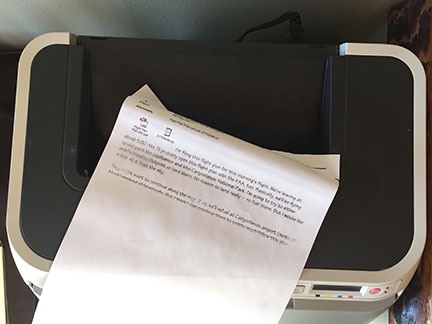
I opened the printer’s big front door. The sheet of paper was clearly visible and easily removed. As I pulled it out, I wondered why I hadn’t removed it when the jam occurred. Then I looked at it and realized that I hadn’t printed it. My wasband had.

Email Jam
The ghost in my machine was a jammed email message printout.

It was an email message I’d written to him back in 2007. It had two attachments, one of which was a PDF of my flight plan. The message told him that I was flying from Page, AZ up Lake Powell and into Canyonlands National Park. I was apparently on a charter flight — probably a photo flight I did with a photographer trying to get images of certain landforms from the air for an advertising poster. I vaguely remember the early morning flight and the photographer holding a camera sitting on a Kenyon gyro. I could probably track down more details in my log book.

I know I’d used the printer after 2007. Heck, I’m not even sure if I owned the printer in 2007. That meant my wasband had printed a long-saved email message while I was gone, probably in the summer of 2012, when he hooked up with his girlfriend/mommy and his delusions went into full swing.

I have an idea why he might have printed this old email. In his deluded mind, he was convinced that he had helped me build my helicopter charter business. That’s how he justified going after half its assets in the divorce. He was unable to prove his case in court — most likely because it wasn’t true — but I assume that he was collecting email messages related to that business as part of his case.

Of course, the reason I sent him an email message with my flight plan that morning at 3:06 AM was because he was my husband and I thought he’d care about my route. At that point, before his delusions began, I think he really did. He might have even still loved me back then.

But mental illness does funny things to people. Once the love was gone and the greed-fed delusions took over, he saw everything even remotely related to my business as evidence of me using him without compensation. I’m sure his lawyer(s) got a stack of email messages from me to him that he thought could help his case in court.

Printed on my printer.

Finding this message jammed in my printer makes me even sadder for him than I already am. His illness, fed by bad advice by manipulative people he trusts, caused him to throw away so much — not the least of which was a friendship and a ton of money. I doubt anything remains of the good, honest man he once was.

I’ll throw this ghost into my recycle bin. Another reminder of a lost life swept away.

The Cricket Wars

Because crickets belong outdoors.

It started the other night at 1:50 AM. The sound of a cricket so loud that it woke me out of a sound sleep.

Like most people, I like the sound of crickets. To me, it’s a country sound, a sound of the natural world. It reminds me of childhood and camping and the great outdoors. It reminds me of star gazing and warm summer nights and forests.

A symphony of hundreds of crickets is a wonderful blanket of white noise to lull a person to sleep.

But not when a cricket is making its noise from the inside of your bedroom closet.

It was loud. Very loud. And because my home has very high ceilings, the sound seemed to echo around the place. Indeed, when I finally got out of bed to try to put a stop to it, it took me a while to zero in on the bug’s location. But I found it in the corner of the closet, hidden under some temporary shelves I’d put in there to stow my clothes until my official move.

This was not a small cricket like the ones you might buy in a pet shop to feed your caged reptile. Its body was at least an inch long.

A shoe made short work of it. I picked up its carcass with a tissue and flushed it.

And then I went back to bed.

I never did get back to sleep. Another cricket started up soon afterwards. This one wasn’t in the closet. I had no idea where it was but I knew it was indoors. Somewhere. Possibly in the living room.

I got out of bed to start by day. At 3:15 AM.

That night, on Facebook, I mentioned my cricket situation:

Found and killed the cricket in my bedroom, but the one in the living room is still at large. For now.

One of my friends commented:

Oh no! I’m sad to hear that, I love me my crickets! All they do is make music for you!

My response:

I suspect you haven’t had them in your bedroom with you. At night. When you want to sleep.

My friend Alix, who is in a doctoral program for entomology, said she could use one for her collection. She’s required to collect, identify, and mount several hundred insects for her degree. I’ve been collecting interesting bugs on and off for her for the past two years. I even bought special zipper snack bags to store them in.

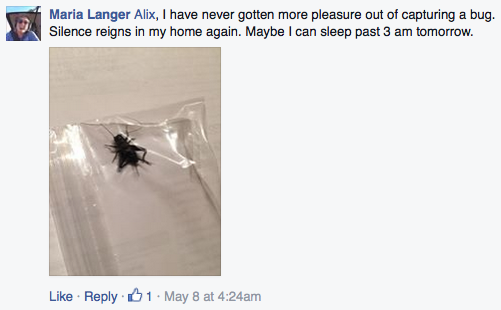
So the next morning, when the cricket somewhere near my hallway started up again before 4 AM, I grabbed a snack bag and went hunting. The trick, I realized, is to be very quiet. If they hear you nearby, they shut up. It took about 10 minutes, but I finally zeroed in on my second victim. It was in my future linen closet — currently shelfless — against one wall. I put the baggie down in front of it and coaxed it in. Then I zipped it shut, took a photo, put it in the freezer, and showed it off on the Facebook thread.

Cricket Post

Alix later identified it as a male Gryllidae. (She is seriously into bugs.)

Later that morning, I heard a third one. I found it in my bedroom closet again. The ShopVac I had sitting in the hallway made short work of it.

That night, it was quiet inside. In fact, it was quiet for the next few nights.

Until 3:30 AM on Monday morning.

I found it in my closet, conveniently close to my household vacuum and closet power outlet. I plugged in the vacuum, positioned the hose nozzle, and turned it on. Whoosh!

After a quick tweet, I went back to sleep.

Since then, I haven’t been bothered by indoor crickets at night.

I did find one by my bedroom door to the deck yesterday afternoon when I went outside with a glass of wine to watch a rainstorm and listen to the rain on my roof. I scooted it outside with my toe.

And I’m pretty sure there’s one stuck inside the wall or possibly between the wall and door jamb downstairs in my entrance vestibule. I can’t find it and it doesn’t make noise at night. As I type this, it’s silent and I’m beginning to think it either found its way outside or has died.

Is the Cricket War over? I doubt it. I am more careful about leaving the doors open downstairs, though. I know I have crickets in my garage and I don’t really mind. But since I suspect they might have come in through one of my two vestibule doors to get upstairs, I now keep those doors closed. And the front door.

But I know who the winner of this war will be — and it isn’t the crickets.