Jumpoff Ridge and Clear Lake

A Jeep drive to an exploratory hike.

Kirk and I spent much of Wednesday morning clearing boxes of items out of my RV (AKA the “Mobile Mansion”) as part of a major cleanup. It was a big job made more manageable by a helper who kept me focused and moving. I suspect that if Kirk and I joined forces for any big job, we’d get it done in record time.

Afterwards, we went inside for a break and lunch. I whipped up some pizza dough and picked eggplant, zucchini, and tomatoes from my garden. By 1 PM, we were each making our own pizza masterpieces, which we later ate out in the shade on the deck.

That took us to 2 PM. Half the day was still ahead of us.

We’d talked about taking out the boat for a short ride, but it was windy down on the Columbia so we put it off for another day. Then Kirk suggested taking the Jeep up onto Jumpoff Ridge, where a road wound along the edge of the cliff. I’m always game for a Jeep ride, so we pulled out the Jeep, loaded Penny and some bottled water on board, and took off.

On Jumpoff Ridge

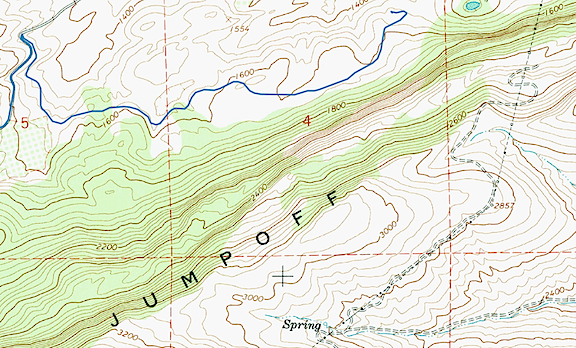
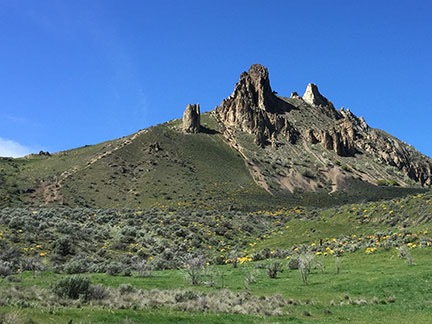
Jumpoff Ridge is the name of the cliff face due south of my home. It rises more than 1,000 feet from the shelf where my home sits. The side facing me is layered basalt columns that are strikingly beautiful, especially with golden first or last light shining on them. Topo maps and satellite images show a road up there that meanders along the top of the cliff. One of the local property owners, in an attempt to avoid contributing to road association fees, claimed he’d use that road to access his land — yes, his 20 acres does include the cliff face and a sliver of land on top. I’d been wanting to check out the road for at least a year and was looking forward to the drive up there.

Jumpoff Ridge Topo
A topo map shows the steep cliff on the north side of Jumpoff Ridge. The road we planned to drive is indicated by the double dashed line atop the cliff. The blue track line to the right of the sharp turn is the road I live on, which was built after USGS topo maps were published.

I knew how to get to the road we sought. Follow Joe Miller Road to Stemilt Loop Road and turn left at the church. Then follow that to Jumpoff Ridge Road. From there, it turns to improved gravel. It’s a moderately steep climb through ponderosa pine with tantalizing glimpses of the orchard-filled land in the Stemilt Hill and Wenatchee Heights areas below. There are about a dozen lots, some of them with homes on them, at the top of the road. One of them belongs to one of my charter clients and I’ve landed and departed with the helicopter from his yard at least a dozen times over the past two or three years.

Top of Jumpoff
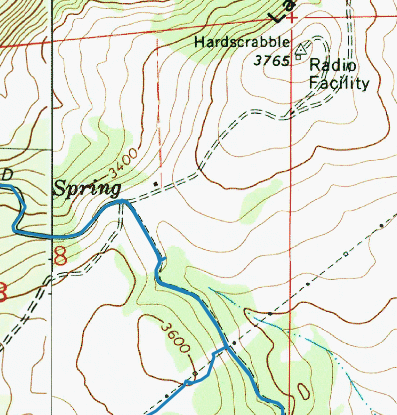
At the top of Jumpoff Ridge, the topo map showed a 4-way intersection. But there was no left turn to the radio facility.

That’s also where the road splits. A left hand turn at my client’s house would take us to the road we sought, but the only left hand turn we saw looked like my client’s driveway. We could see the antennas — marked “Radio Facility” on the topo map — beyond and knew that’s where we needed to be. But there didn’t seem to be a way to drive through. So we went straight, looking for another left hand turn.

We found it a while later, but it was gated and locked. We kept going, passing under the Bonneville power lines and a handful of other homes. (When people say I live “out there,” they should come visit these people. They’re way out there.) Realizing the road was not likely to take us where we wanted to go, we turned back and had a closer look at that gate. It was securely locked with signs warning against trespassing. The road was strictly for communications company and power company use.

I guess my freeloading neighbor had no idea what he was talking about when he claimed he’d use that road to access his property. (Or, more likely, he was just a lying sack of sh*t.)

We stopped to consult the map I’d preloaded onto my phone’s Gaia GPS app. I’d already told Kirk about Clear Lake, where I’d stopped in November with my friend Don. It had been frozen hard that pre-winter day, after an early hard freeze. Don had bowled rocks across its surface just to hear the weird echoing sound as they bounced and slid. I thought it was a good alternative destination. The map showed a road off the southwest-bound powerline road (which was not gated) that would “shortcut” to it. It even had a name: Rock Ridge Road. We headed off to find it.

The road climbed steeply up a rocky slope and joined up with the Bonneville Power lines. It veered off into the forest and rejoined the powerlines. Then there was our right hand turn, right where the map said it would be. But there was also an “Authorized Vehicles Only” sign. Really? Ugh.

Faced with the choice of going back or taking the longer way around, we kept moving forward. The road was a lot longer than I remembered. It joined and left the powerlines several times, mostly climbing. There were tall pines, surprisingly green grass, and large meadows. I could easily imagine elk grazing there.

My 1999 Jeep Wrangler drove like a champ. I’ve owned this vehicle since new and, quite frankly, I don’t take very good care of it. In fact, I think it’s safe to say that I routinely beat the crap out of it. It had been flashing the Check Engine light on rough terrain on and off, coupled with a stuttering engine, for months.. Earlier in July I’d finally had it checked and fixed. Turned out to be a wiring harness damaged by rodents — a much cheaper fix than I’d been prepared for. This was a good practice run for our upcoming camping trip to Glacier National Park and I was glad to see it running so smoothly.

After miles of rough road, we finally found and made the right hand turn that would take us down off the ridge: Schaller Road, according to the map. It was rocky, rough, and full of switchbacks. That dumped us onto Upper Basin Loop Road. We caught a glimpse of a pickup truck turning onto a road up ahead — the first vehicle we’d seen in over an hour — and kept on straight until we reached the turn for Clear Lake.

At Clear Lake

Clear Lake
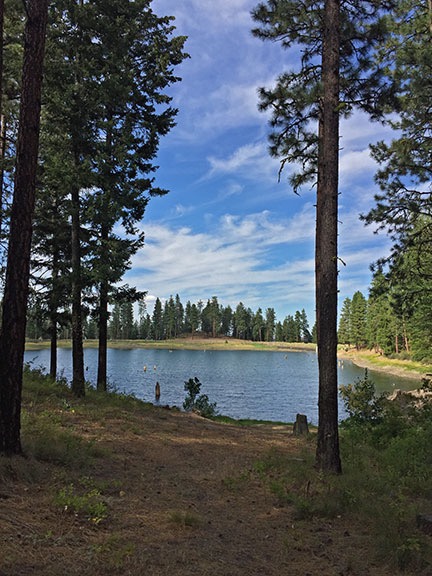
Clear Lake is a small reservoir in the woods.

Clear Lake is a very small reservoir in the Stemilt Basin. It likely collects and stores water for one of the dozens of Stemilt cherry, apple, or pear orchards in the Stemilt Hill area. The road ends at a locked gate close to the lake. We parked and got out for a walk. Penny was very happy to get out of the Jeep, where she’d been riding on Kirk’s lap since our departure from home. There was no one around and it was peaceful.

The topo map showed another larger lake to the west, on the other side of the ridge: Lily Lake. Although our time was somewhat limited — Kirk had a meeting later that evening in Cashmere and the drive had already taken longer than planned — we set off to see if we could catch a glimpse of the other lake. Like me, Kirk has kayaks and we’re always interested in finding new destinations for a leisurely paddle.

Lean To in the Woods
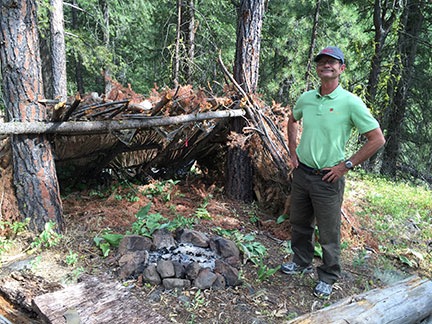
We stumbled upon this old lean-to in the woods up the hill from Clear Lake.

We followed a trail and then a road and then a trail o the west side of the lake and started the climb up the ridge. Near the top, we found an old lean-to made with branches and the remains of a campsite. But not much else.

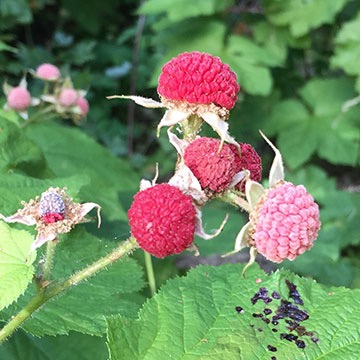
Thimbleberries
Ripening thimbleberries. While not as tasty as raspberries or blackberries, they do make a nice treat.

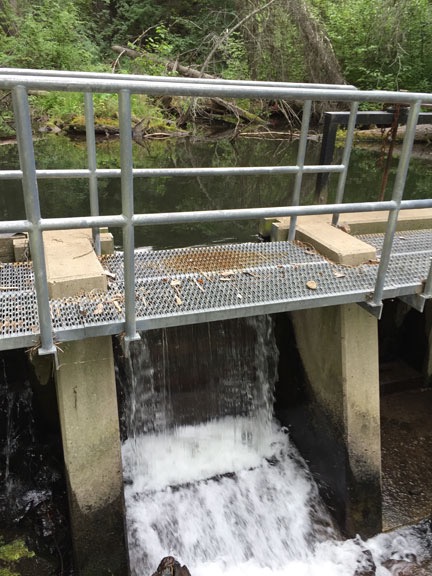
We dropped down and followed the road back to the southeast. There was another locked gate and we walked around it. That took us southwest on a road that small trees were already starting to reclaim. Thimbleberry bushes lined the road and Kirk and I picked and ate the reddest ones. A small creek roared in a steep but narrow canyon beside us. After about a quarter mile, the road dead-ended at a dam with a valve: the control for the underground pipeline that was filling Clear Lake from the creek. There was no road or trail beyond to Lily Lake.

Dam
A concrete dam in the forest formed a small pond where a buried pipeline fed Clear Lake. Water over the spillway fed the creek we heard in the ravine beside the road.

After snapping a few photographs, we headed back to where the Jeep waited. We’d visit Lily Lake another day from a road on the other side of the ridge that I’d already spotted on the map. There were other lakes up that way and it would make a good day trip for us, giving me the Jeep outing I wanted with the hiking Kirk preferred. Win-win.

Heading Home

The trip home was uneventful. It was less than a mile back to pavement from Clear Lake. Then back to the church and Joe Miller Road and, eventually, my road.

Kirk snacked on some cold pizza as we loaded up his car. He headed out for his meeting. I heated the rest of the pizza in the oven and snacked on it while unwinding from the bumpy trip, glad to have found an excellent traveling companion for future adventures.

Curious about our route? Click here to see it and all the photos I took.

My Helicopter’s Annual Migration from California

I take a few days off and fly from California to Washington solo.

Last week, I flew my helicopter home from a frost contract in California. I took the opportunity to treat myself to two nights in a bed and breakfast I’d been wanting to stay in for some time. Then I made the solo trip home, taking a coastal route for part of the way. I thought I’d share some information about why I go to California every winter and the highlights of this particular trip.

My Annual Frost Migration

In 2013, I got my first contract as a frost control pilot in California’s north Central Valley. That year, my helicopter was still living in the winter in Arizona and, as I flew it westward with my dog, I realized with a bit of sadness that it would likely never be back in Arizona. When that contract ended, I flew it north to Washington for cherry season. I left my home in Arizona in May 2013 and bought the land for my new home in Washington before the ink on my divorce papers was dry in July 2013.

The helicopter spent that winter in a hangar in Wenatchee. In February, I flew it south again for my second season on frost. That contract required me to stay in the area, so I migrated down in the mobile mansion and stayed there for two months. I came back in April.

My helicopter moved to its new home on my property in Malaga in May 2014, at the start of cherry drying season. By October, it was tucked away inside my building, which I designed primarily to house it, the mobile mansion, and my collection of vehicles. When I got busy with construction on my place in December and needed to shift the RV into the helicopter’s parking space, I moved it back out and into a hangar at Wenatchee Airport. (Thanks, Tyson!) Then, in February, it was back to California for my third frost season. Like my first frost contract in 2013, I didn’t have to live there with it — I wanted to stay home to continue construction and enjoy the spring blooming season. But in late April, it was time to bring it home again.

A lot of folks ask me why I fly the helicopter to and from these agricultural contracts instead of putting it on a trailer. There are three reasons:

  • I don’t have a trailer that would accommodate the helicopter and I don’t want to buy one. A trailer that can support the helicopter and its blades/tailcone properly would cost about $30,000. I could fly a lot of hours for that amount of money. And I’d still have to cover the cost of the drive, although it wouldn’t be nearly as much.
  • I don’t know about you, but the thought of driving down the highway with a $350K investment towed behind me is pretty scary. All it takes is one asshole cutting me off to turn that shiny red machine into a heap of junk on the side of the road. Simply stated: I think flying is safer for it.
  • I like to fly. ‘Nuff said.

I factor in the cost of transporting the helicopter when I decide whether a contract is worth my while. I don’t take contracts that would put me in the red if I didn’t actually fly on contract. That would be dumb.

But with that said, I do often take either passengers for hire or pilots wanting to build time with me on those long repositioning flights. I’ve been doing this since 2008, when I started migrating between Arizona and Washington for cherry season. I cut various deals with various people, depending on what the market will bear. Sometimes passengers or pilots just pay for gas. Other times, they pay a rate that covers all my costs. Most of the time, I collect something in between. This helps make the contract a tiny bit more profitable, often while giving a new pilot a chance to build some flight time in an R44 and gain some valuable cross-country flight experience.

I know I flew solo from Arizona to California that first season (2013) and I’m pretty sure I flew solo from California back to Washington. But in 2014, I had pilots do the flying with me as a passenger on both flights. And on the way down in 2015, another pilot flew while I just sat in my seat, trying not to be bored.

I decided that for the return flight, I’d be be pilot and I’d treat myself to a flight up the coast.

After all, I really do like to fly.

Potential Passengers

I asked a bunch of people who I like if they’d like to join me on that return flight. I got a bunch of interesting responses.

Four people could not go because of work they simply couldn’t get out of. I’d planned my trip for mid-week, so that really shouldn’t have been much of a surprise.

One person, who is also a helicopter pilot, wanted to go but had to work. I think he would have gotten out of work if I’d let him share the flying duties with me. But I made it clear up front that I would be doing most of the flying. In fact, I didn’t even want the dual controls in because I didn’t want that counterweight. (I would have put them in for him.) Without the bonus of stick time, it wasn’t worth taking time off from work.

One person couldn’t come because his wife’s mom is seriously ill and they expect her to pass away soon. We agreed that it would be better if he didn’t come. (She hasn’t died yet, but she’s close.) And yes, I did tell him he could bring his wife.

One person couldn’t come because he didn’t want to spend $300 on a one-way plane ticket to Sacramento. He had that money earmarked for other things. “Next time,” he said. I’m not sure if he realizes that there probably won’t be a next time.

And there were the usual collection of pilots wanting to build time. When I told the ones who contacted me that I’d be doing the flying, they all passed on the opportunity to come along as a passenger.

So as Penny and I boarded the flight to Sacramento on Tuesday morning, we knew it would be just the two of us in the helicopter on the way home. I’d fly and drink up all the sights along the way. Penny would do what she always does on the helicopter: sleep.

Prepping for the Return Flight

My flight down to Sacramento didn’t go as smoothly as I would have liked. I was supposed to get into Sacramento at 11 AM, but the 6 AM flight out of Wenatchee was cancelled due to a bird strike on the starboard engine the night before. The morning pilot had seen some of the damage during his preflight walk-around and a mechanic confirmed that the bird — likely an owl — had been ingested into the turboprop engine. That plane wasn’t going anywhere soon.

Through some miracle, I managed to get on the next flight out later that morning. Then an afternoon connection to Sacramento. I stepped off the plane there at around 4 PM and was driving away in a rental car by 4:30.

My whole day in the area was shot to hell. I managed to do some errands before heading out to Rumsey where I was booked at a bed and breakfast for the night. I’ll blog about that in another post.

Wednesday’s forecast called for strong winds from the north. That would cause two problems:

  • Strong, gusty winds make turbulence. I really hate long, bouncy flights, especially when I’m trying to take a scenic route.
  • Strong winds from the north when I’m flying north meant longer flight times and more fuel stops. If I cruise at 110 knots and there’s a 40 knot headwind, that means I’m only doing 70 knots. Hell, I could drive faster than that.

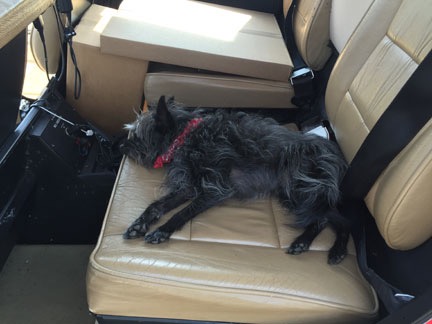
Penny in the Helicopter
Penny lounges in the back seat of the helicopter while I prepped it for the flight home.

So I decided to spend another night in the area and leave early the next morning. In the meantime, I went to the airport, preflighted, wiped down the windows, and prepped it for flight. I’d be taking off as early as possible the next morning.

Locally, the wind was maddeningly calm all day.

The Flight Home

Penny and I were back at the airport at 6:10 AM on Thursday morning. Although the sun hadn’t peeked up over the horizon yet, as far as I was concerned, it was daytime.

I put Penny in the front seat beside me with a cooler full of drinks and snacks in the footwell there, within reach. The back was packed with some luggage and the equipment I’d left with the helicopter over the previous two months: blade tie-downs, cockpit cover, spare fuel pump, and miscellaneous equipment. My GoPro was mounted on the nose with the WiFi turned on. My iPad and iPhone were mounted within reach; I’d use Foreflight on my iPad to navigate and listen to podcasts and music on my iPhone.

The helicopter started right up and I gave it plenty of time to warm up. Then I took off to the west along Cache Creek and opened my flight plan by tapping a button in Foreflight.

Although I didn’t often file a flight plan when flying solo, I’d forgotten to bring along my SPOT Messenger and I wanted some way of being found in the event of a mishap. My flight plan had me heading west along Cache Creek all the way to Clear Lake, then hitting the California Coast at Fort Bragg. But because it was so early and the California Coast is notorious for morning fog and I’d already passed some low clouds near Willits, I took a more northerly route.

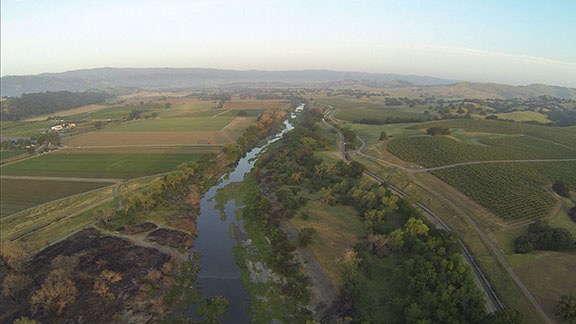
Cache Creek at Dawn
Flying up Cache Creek just after dawn.

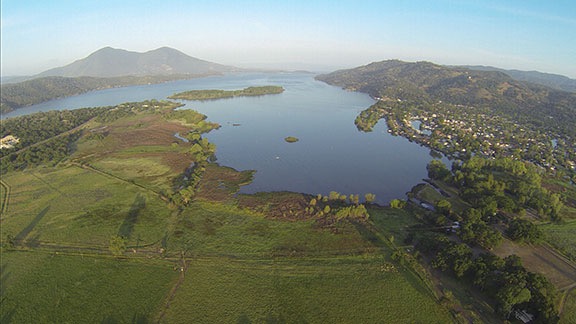
Clear Lake
The lower end of Clear Lake.

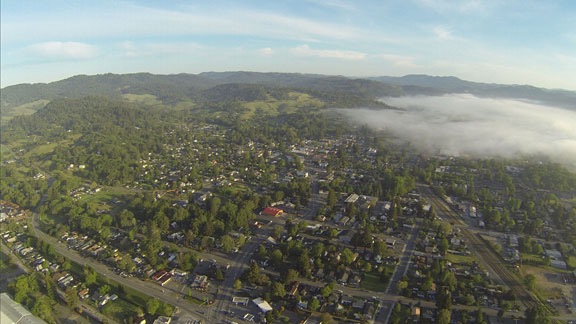
Willits, CA
Low clouds over Willits, CA.

Along the way, I played around with Periscope. This is a Twitter-owned video broadcast service that makes it possible for anyone to broadcast anything to the world in real time. My iPad was mounted in such a way that its camera looked right through the front of the helicopter’s bubble, so the picture wasn’t bad at all. Unfortunately, the rotor sound made it impossible to hear any narration from me, so although I saw viewers’ questions, I couldn’t answer them.

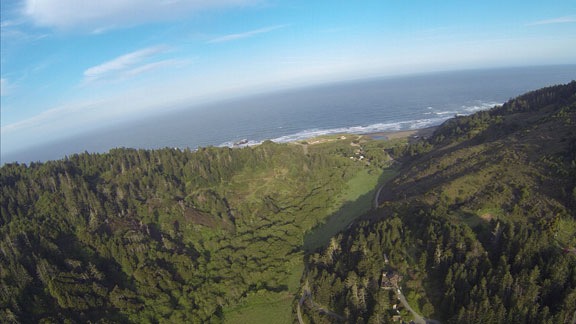
Faced with a choice of following a valley north or striking out across the hills to the coast and following that, I finally headed for the coast. I came down a little green canyon between Westport and DeHaven and banked to the right to start my flight up the coast. (I was broadcasting during this time, so my Periscope followers got to watch it live.)

California Coast
My first sight of the Pacific Ocean from the Helicopter since my trip to Lopez Island last August.

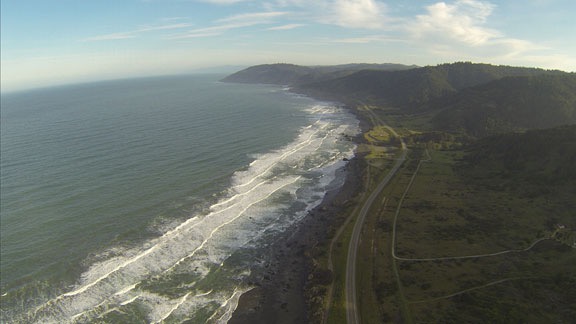
Flying Up the Coast
I flew up the coast at my usual altitude of 500 to 700 feet AGL.

I was surprised, at first, how smooth the flying was. I had been expecting some wind and, with it, turbulence. But just when I started enjoying the smooth air, the turbulence hit. With a vengeance. Within 20 minutes of arriving at the coast, I was bouncing all over my area of the sky.

I headed inland. For another 20 minutes, the bouncing continued. I tried higher elevations to avoid the effect of the wind over the hills — mechanical turbulence. This is the kind of turbulence that most often affects my flights, mostly because I fly so low to the ground. But climbing didn’t help. The only way out of it was going to be to fly somewhere where there was less wind.

Of course, while all this was going on, I was burning fuel at a higher rate than expected. That meant I wasn’t going to make my first fuel stop as far north as Crescent City. I used Foreflight to find a closer alternative. I could make Eureka or Arcata, both of which were on the coast. I checked weather there using the Aeroweather app and saw the wind was much calmer. By that time, the bouncing had stopped anyway and flight was smooth again. So I hooked up with the South Fork of the Eel River at Myers Flat, followed that down to the Eel River, and followed that down to Fortuna.

At the coast, a marine layer had moved in but was burning off quickly. I flew just below the clouds, north from Fortuna to Eureka, where I landed for fuel at Murray (EKA) and closed my flight plan. Their pumps are ancient and attendant-run, which didn’t bother me in the least. When I do long cross-country flights, I don’t mind paying more for someone else to do the pumping. I let Penny out and we went into the FBO for a bathroom break. They had a surprisingly large pilot shop there with lots of goodies. But I wasn’t in the mood to shop so I didn’t linger.

I chatted with the attendant about the weather. I really wanted to fly up the coast but I really didn’t want to do scud-running along the way. He thought it would clear up. I figured I’d head north along the coast as long as I could see, then strike out to the west. I whipped up and filed another flight plan, then added a quart of oil and fired up the helicopter. Minutes later, Penny and I were airborne again, heading north on the east side of Arcata Bay.

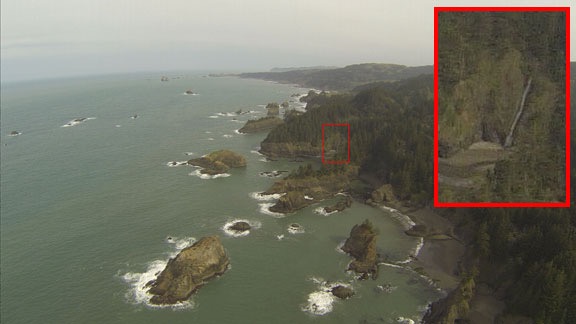
We stayed on the coast for quite a while. I turned on my helicopter’s nosecam as we flew up the coast past the Redwood National Forest and various other places. The views were amazing. There were sandy stretches of beaches, sheer cliffs, and rocky islands. I saw sea lions and sea birds. But I think it was the sheer number of waterfalls tumbling off the cliffs into the Pacific Ocean that really stood out for me. It was just the kind of trip I’d hoped for. It was only after I thought I’d shot at least a half hour of spectacular video that I reached down to shut off nosecam — and realized that it hadn’t been turned on. Duh-oh! I did manage to get some good shots and video later on, but not until after a fine mist started moving in.

Waterfall
There’s nothing quite as awe-inspiring as a waterfall tumbling off rugged cliffs into the ocean.

The mist turned to rain around Gold Beach, OR and I decided to move inland in search of clearer weather. Unfortunately, there was no joy. I took an incoming call from a pilot friend based in California who’d just gotten some bad news about an engine overspeed on his R44. We chatted for a while as I flew between green hills and low clouds while a light rain pelted the cockpit bubble. Then the call dropped and I continued through the muck in silence.

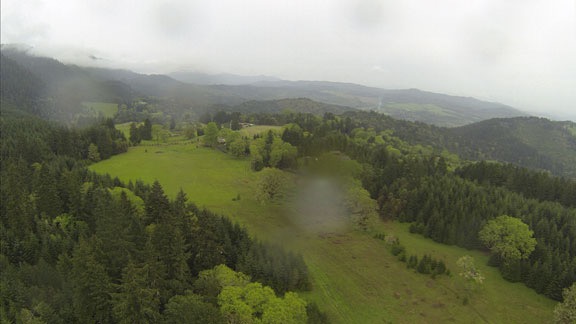
Green Hills Near Umpqua
There was no way to keep the rain off the nosecam’s lens cover. This was the view as we headed northeast near Umpqua, OR.

I hooked up with I-5 near Yoncalla, OR. From that point, it was a bit of IFR — I follow roads — flying. It wasn’t that I had to follow the road — I could see fine. It’s just that there was no reason to fly further east because mountain obscuration made it impossible to cross the mountains anyway.

I stopped for fuel at Creswell. I’d stopped there before. I pumped my own fuel, used the restroom, and checked the oil. It was still raining lightly. One of the interesting things there is a vending machine that sells aviation oil. I didn’t need to use it — I learned long ago to always carry at least two spare quarts and actually had six on board for this flight — and I wish I’d taken a photo of it.

We were there less than 15 minutes. I continued north along I-5, now in Oregon’s “central valley.” I broadcast another Periscope video just past Eugene, then peeled away abeam Harrisburg to the northeast. Although I couldn’t see the mountains at all, I still had high hopes of crossing the Cascades at the foot of Mount Hood’s north side. After all, how big could this weather system be?

Apparently, it could be pretty big. I got within 40 miles of Mount Hood and still couldn’t see it. If anything, the clouds were lower and thicker. I heard some helicopter pilots chatting on one of the frequencies about low ceilings. One was doing training and the other was doing powerline survey work. They shared information about holes in the weather but since I didn’t know any of the places they talked about, none of it helped me.

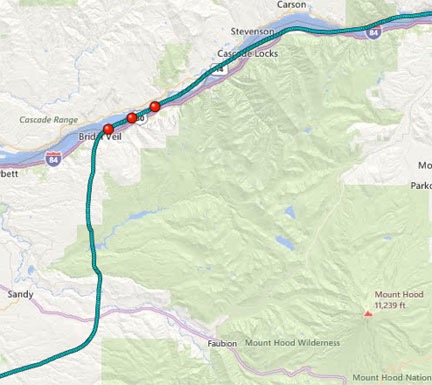
Near Mt. Hood
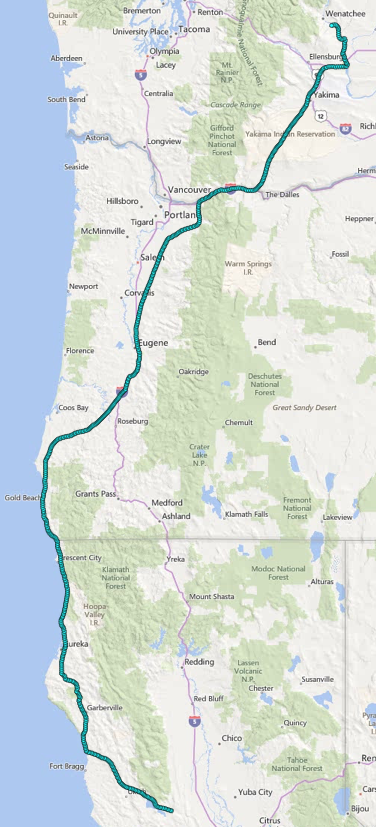
My track took me pretty close to Mount Hood. I never saw it. My track is the teal dots in this map capture; the red dots represent geotagged photos.

So the scud running began. I wasn’t in the mood for it at all, so I didn’t put much effort into it. Instead of following valleys to the northeast that might have got me closer to my destination, I just headed north, hopping over hills and ducking under clouds along the way. I knew that eventually I’d reach the Columbia River, my old standby for crossing the Cascades. And sure enough, just when I thought the ceilings couldn’t get any lower, I found myself at the edge of a drop down to the water. There were clouds below me, but a big enough hole to dive right through. I descended at about 1500 feet per minute and leveled out about 400 feet over the river’s surface.

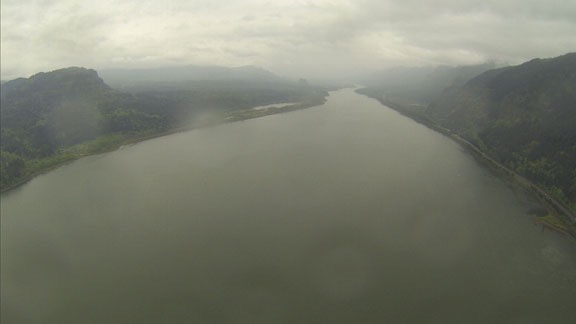
Columbia River
Leveled off over the Columbia River not far from Multnomah Falls.

My reward: an amazing view of Multnomah Falls, off to my right. (Sorry — no photos. My nosecam faces forward, not sideways.)

I followed the river northeast, flying in a sort of tunnel created by the walls of the gorge and the low clouds. I overflew the Bonneville Dam and Cascade Locks and the town of Hood River, which I really liked before it got so upscale. At Lyle, one of my least favorite places on earth, I turned to a more northward direction. That eventually put me over the Yakima Indian Reservation. I don’t know if it’s pretty. By this time — more than 7 hours of travel, including stops — I was tired and just wanted to be home. But the sky gods were going to make me work for it. They threw just enough headwind and turbulence in my way to make me ready for another fuel stop at Yakima.

The FBO’s fuel guy did all the work. I got something to drink and relaxed a while in a comfy chair while Penny looked around for dropped popcorn. We’ve spent entirely too much time at McCormick at Yakima.

Fueled up and feeling refreshed, we headed out again, continuing north. Although I could have gone direct to my home from Yakima, I had a small task to do along the way — I needed to check out a possible landing zone for an anniversary flight in June. The location was off I-90 across the river from Vantage.

That done, and feeling great to be back in very familiar territory, I dropped down and raced up the Columbia River, only 100 or 200 feet from the surface. Wanapum Reservoir was full again — it had been drained for dam repairs all last year — and it was great to do one of my favorite flights. I passed Sunland, where the folks who sold me my property live in the summer months, Cave B and the Gorge Amphitheater, and Crescent Bar. I saw a huge herd of elk down on West Bar before beginning my climb to clear the wires that crossed the river between the mouth of Lower Moses Coulee and Rock Island.

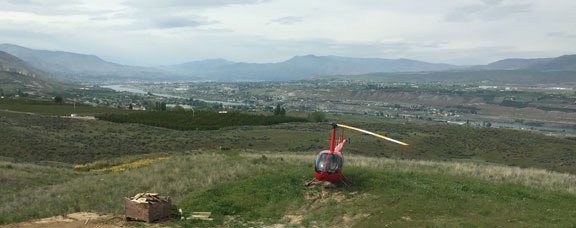
Then I was climbing up toward my home and my old landing zone was in sight. I set the helicopter down on the grass and let Penny out while I cooled down the engine and shut everything down.

Old Landing Zone
I shot this from my deck while having a very late lunch.

It was almost 3 PM.

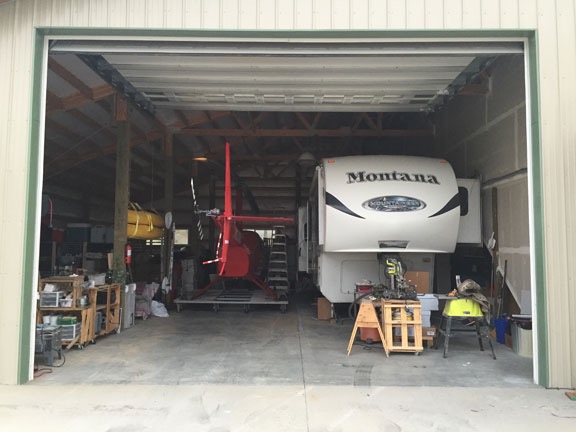
I left the helicopter outside while I went in to make myself a good meal and relax. The wind kicked up and, for a while, I thought it would have to spend the night outside. But the wind died down after 6 and I got my ATV hooked up to the platform and repositioned it on my driveway’s landing zone. Then I started up the helicopter and moved it onto the platform. When the blades stopped spinning, I locked them in place and used the ATV to pull everything into the garage beside my RV.

RVs
Recreational vehicles? Must be. It’s an RV garage, after all.

Track Log
Here’s my track log for the entire flight. I was about 20-30 minutes into the flight when I remembered to turn it on, so it doesn’t accurately show my starting point.

According to my GPS tracklog, I’d traveled about 750 miles in 6-1/2 hours of moving time. It had been a great flight with lots of different flying conditions and things to see to keep it interesting. I’d enjoyed it, despite the moments of turbulence. It’s a shame that I had to do the flight alone. I’m sure every single person I invited would have loved it.

Next time? Maybe — if there is a next time.
A Springtime Hike in the Hills

Five miles is a heck of a way to start hiking season.

One of the benefits of being self-employed with an extremely flexible schedule is the ability to enjoy outdoor activities any day of the week. I abhor crowds so I try to do my hikes and bike rides and other activities when most folks are at work or school: in other words, mid-week.

My friend Susan is the same way. A retired attorney from the Seattle side of the mountains, she also likes to hike mid-week. So when a mutual friend introduced us last autumn, we seemed like a perfect match for hiking.

She got in touch last week when I was in California. I was crazy busy that week and expecting contractors to work on my home Friday and Monday, so we settled on Wednesday for a midday hike. The weather had been unseasonably warm, getting up into the high 60s every day, and the high desert landscape in the Wenatchee area was green and already studded with spring flowers. It would be an early start to the hiking season and, after spending too much time working on my home and traveling over the past few months, I really liked the idea of a day off.

I made a Home Depot/Lowe’s run in the morning with the thought of dropping off my purchases and meeting Sue at her home at 12:30 PM as planned. I didn’t expect to take nearly two hours in Home Depot and then wait 30 minutes in Lowe’s for them to bring my special order out. (Seriously: what is it with Lowe’s? This is the second consecutive time I’ve had to wait an unreasonable amount of time for them to bring an order out.) So when I got to Sue’s at 12:30, my Jeep was too full of lumber for Sue to fit. That meant running home to drop off my purchases. We didn’t get on the road to the trail until nearly 1:30.

Fortunately, the trailhead was close. To stay out of the wind, Sue had suggested Dry Gulch, which goes up a canyon. I wasn’t familiar with the trail names — I normally just hiked wherever there was a trail that looked good — and didn’t realize that I had hiked there once before with another friend back in the summer of 2012. It would be a bit of a climb and, since I suspected I was coming down with a cold, I wasn’t sure I was up to it. I warned Sue that I might not last very long and she said she understood. First hike of the season wasn’t expected to be long anyway.

Saddle Rock
Saddle Rock, from the southern trailhead near the end of Miller Street.

The trail had a surprising number of people on it, including kids. That’s when I realized it was spring break week. Most people prefer the hike up to Saddle Rock, which shares a parking lot. It’s a steep, exposed trail, not suitable for our first hike of the season on a windy day. It has amazing, sweeping views of downtown Wenatchee and beyond, which is one of the reasons it’s so popular. Dry Gulch was good enough for me. I don’t need to hike up a mountain to get views.

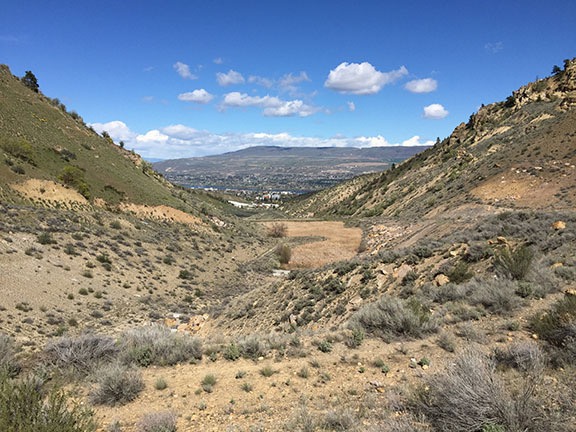
The trail climbs up an old road grade into a canyon crossed by one earthen dam after another. Up canyon from each damn is a dry (right now) pond. After climbing pretty steadily for about a mile, the trail crosses a larger dam. This is the point at which my friend and I had turned around back in 2012, going down a different trail. But Sue and I continued up the north side of Dry Gulch on a very easy, nearly flat trail that wound along the edge of the dry reservoir. (We basically took the green “A” trail on this map.)

Dry Gulch
You can see down into Wenatchee from various points on the Dry Gulch trail.

Penny on the Trail
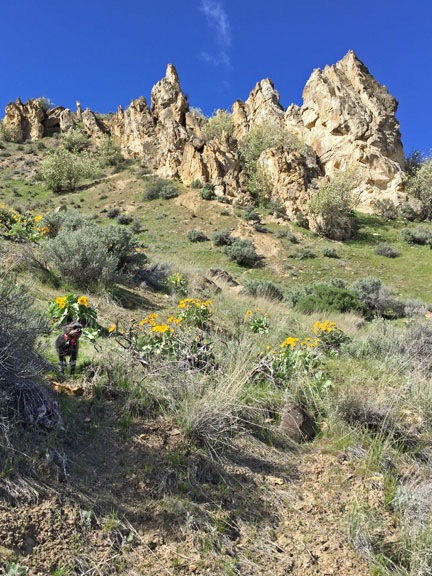
There are various rock formations on either side of the trail. This one was particularly beautiful, surrounded by blooming trees with green grass and balsamroot flowers at its foot. Can you see Penny?

As we hiked, we chatted about all kinds of things. Sue is really into geology and fossils and gave me a little lesson on the area’s rocks. She also pointed out a place where she’d found some good leaf fossils in the past. We took our time climbing the first mile of easy trail, making several rest stops along the way.

Penny spent about half the time leashed; once we got beyond where the other hikers were, I let her loose to run around a bit. There were marmots in the area making a bird-like chirping noise. Every once in a while, we’d catch sight of one running on the slopes. Penny obviously smelled them and even caught sight of a few of them on our return hike. I think her experiences with our barn cats, which are about the same size, taught her to keep her distance.

Lupine
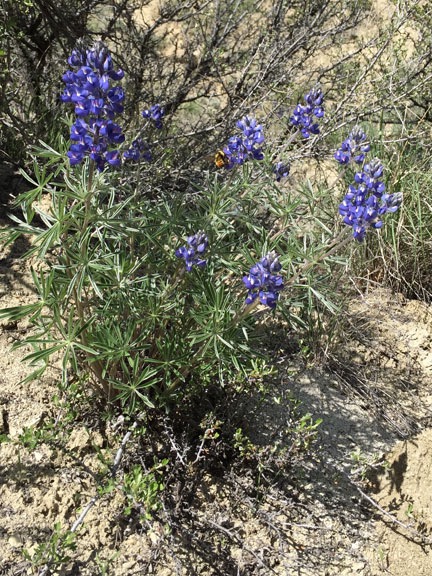
I was quite surprised to see lupine blooming up the trail; it’s just starting to come up at my home. Can you see the bumblebee?

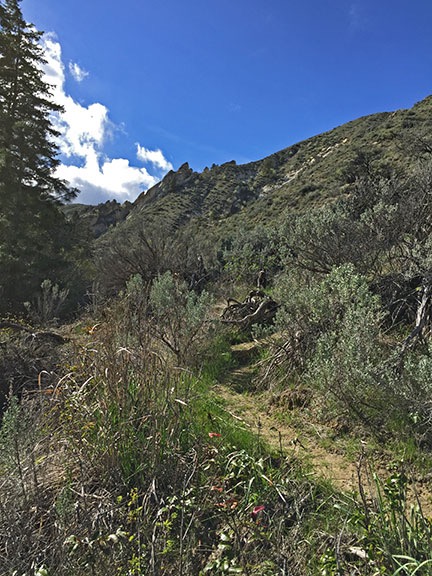
After the dam, we turned left on the trail to continue up the gulch. This was, by far, my favorite part of the hike. The trail followed the edge of the reservoir but was much higher, looking down at it. After passing through a locked gate — we had to slide sideways between the rails — the trail narrowed and wound among balsamroot and lupines. We passed various signs of old mining activity, including low concrete walls at the mouths of side canyons. It was quiet — not another soul was on this part of the trail. We saw evidence of deer and elk — hoofprints and droppings. Cows and horses, too.The canyon narrowed considerably and the trail nearly dead-ended at an old dam. Its gate was gone and a trickle of water from upstream meandered through. It was cool and shady. A nice place for a picnic.

End of TrailThe trail continued as a narrow ribbon up into the canyon past the point where we turned back.
By this time, I’d had enough of the hike. I was surprised I’d come as far as I did — even though I didn’t know at the time how far we’d walked. About a quarter mile into the hike back, I remembered to turn on my GPS tracker. When I turned it off back at the Jeep an hour later, it reported a total of 2.2 miles. That brings the total length of the hike up to about five miles. Whoa. Not bad for a first hike of the season.

It had been a great hike — just the right length for me on that day. It’s unfortunate that my favorite part of the trail required a mile-long uphill hike to reach. I’d like to find more trails like that with trailheads easier to get to. I can hike all day on level ground or even downhill, but uphill has always been a bit of a struggle for me.

After dropping off Sue, I drove home and took a nice, long soak in my tub. An hour later, I was dead asleep in a two-hour nap. Let’s see if that rest is enough to fight off this cold.

On Spur-of-the-Moment Travel

It’s amazing where you can be in just a few hours.

I’m on my third consecutive year as a frost control pilot. I haven’t written much about this, mostly because I haven’t actually had to fly a mission. But for the third year in a row I’m being paid to have my helicopter ready, with relatively short notice, to fly slowly over almond trees on cold California mornings.

The Back Story

My first year’s contract, back in the winter/spring of 2013, had a relatively low standby pay for 60 days, along with compensation to move the helicopter from its base — in Arizona, in those days — to California’s Central Valley. Because I wasn’t sure about my living situation that winter — after all, my future ex-husband could get his head out of his ass and accept the very generous settlement offer I made and I’d have to move — I moved my truck and RV to California as well, thus guaranteeing a cheap and comfortable place to live near my work. (After all, that’s why I bought the RV; as a place to live when I was on the road with the helicopter.) I spent about two months traveling with Penny the Tiny Dog between Phoenix, Sacramento, and Las Vegas, getting called out just once for two days. I happened to be in Vegas at the time, so it wasn’t a big deal to change my plane ticket and spend a few days in California instead of returning to Arizona.

Last year I took a very different contract. It paid a generous standby rate for six weeks but I had to live near the fields. This turned out to be very convenient for me since I was out of my Arizona home for good and didn’t have a home in Washington yet. I brought the RV and helicopter down in mid-February and stayed until the middle of April. I really got to know the area, made new friends, went hiking and kayaking several times, got comped on a balloon ride, and even learned to fly a gyroplane. It was like being on a paid vacation in a pleasant place, with warm days and lots to do and see. If I did have to work, it would likely be between 3 AM and 7 AM, so days were free to do as I pleased.

Although the money was great, the drawback to that contract was the simple fact that I couldn’t get back to Washington until April. I wanted to be back earlier. I wanted to experience the spring: seeing orchards in bloom and leafing out, hiking along streams full of snow-melt runoff, starting a garden. So when December 2014 rolled along, I decided to try to get a frost control contract like the first year.

And I did.

I brought the helicopter down to California on February 22. The RV would stay home — with me — as I finished work on my home and enjoyed the spring.

That’s the back story.

Call Out

Frost control is not like cherry drying. In cherry drying, I’m required to be ready to fly at a moment’s notice. I can monitor the weather closely and vary my daily routine based on the likelihood of rain. When my clients call, they expect me to be airborne in minutes.

In my frost contract, the client monitors the weather closely and, if there’s a possibility of frost, he initiates a callout. My contract requires him to do this by at least 12 hours before he expects me to fly. This gives me the time I need to get to California from Washington. I’m paid for the callout — the fee covers my transportation with a bit to spare. And then I’m paid a generous hourly pilot standby fee from the moment I get to my California base until I’m released the next morning. If I fly, I’m paid a flying rate for that. The next time I’m called out, the process starts all over again

When I brought the helicopter down to California this year, I built in a few extra days to spend some time with friends in the area. When those plans fell through, I kept myself busy by reacquainting myself with the area and visiting other friends. But I couldn’t have timed it better. I was put on standby two of the three nights I was already down here. I was able to earn the callout and standby fees without incurring the related travel expenses. Although it did require a minor flight change for my return home with a $25 fee, that’s still pretty sweet. Really made it worth the trip.

I went home last Wednesday and got back to work on my home. The cabinets were installed on Thursday and Friday and the appliances were delivered on Saturday. Timing was everything and I lucked out.

My client called on Friday to make sure he understood how much lead time I needed to get back to California. Cold temperatures were forecast for Sunday through Wednesday nights. He wasn’t calling me out — yet. But he wanted to make sure he knew how much time would be needed to get me in position. I told him that if he called me by 3 PM, I’d be able to make it to the helicopter by 10 PM and be on standby overnight.

Of course, I watched the temperatures, too. Unfortunately, the forecasts of my various weather sources aren’t nearly as accurate as those available to almond growers, by subscription, from an agricultural weather resource. I had to rely on them to call me and didn’t want to fly down unless I had to.

So each day the forecasted low was 40°F or lower, I’d be a nervous wreck, wondering whether I’d get a call. Once 4 PM rolled along, I’d relax. I did this on Sunday and Monday and got a lot of work done at my place. But I did pack an overnight bag on Monday afternoon, just in case.

On Very Short Notice…

On Tuesday, at 3:22 PM, my phone rang. It was my client. He’d been sitting on the fence about calling me down. Forecasted lows were 32° to 39° in the area. He told me that he knew from experience that if the forecast said 32°, it could go lower. Better safe than sorry. He was calling me out.

Fortunately, I was sitting at my desk answering an email message when he called. When I hung up, I got on the Alaska Air website. There was a flight out of Wenatchee at 5:20 PM — less than two hours from then — and I needed to be on it. I booked the flight from Wenatchee to Seattle to Sacramento. I’d arrive at 9:28 PM.

While I was at the computer, I searched for car rentals in Sacramento. Thrifty had one for $22/day. Rather than book online, I called directly. With my bluetooth earpiece in my ear, I made car reservations as I changed my clothes and put a few more things into that suitcase.

I decided to board Penny. She’d been with me on the last trip and I thought I’d keep things a lot simpler by leaving her behind this time. So I packed an overnight bag for her with enough food for 2 days — just in case I needed to stay over an extra night. Club Pet is on my way to the airport, so dropping her off only took 5 minutes, especially since the paperwork was already waiting for me. As I type this, she’s likely playing out in the yard with the other dogs.

I checked into my flight and chose my seats using the Alaska Air app on my phone while stopped at a traffic light. I only had one bag — a carry-on — so I didn’t need to stop at the counter.

Seattle Sunset
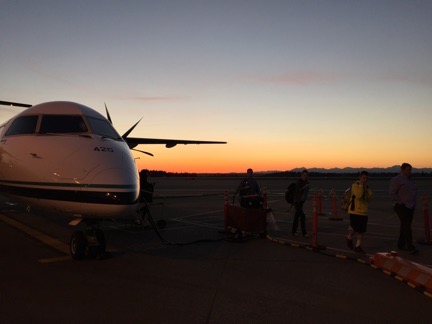
I got off the plane in Seattle just after sunset.

I was at the airport, through security, and sitting in the waiting area by 4:45. That’s less than 90 minutes after getting the call. At 6:07 PM, I stepped off the plane from Wenatchee onto the tarmac at SeaTac. This is one of the best things about living in a small town with airline service: it’s so damn quick and easy to catch a flight out of town when you need to.

I grabbed dinner at SeaTac’s Terminal C before catching my flight to Sacramento.

It was an amazing flight. The moon had risen and was almost full. The land beneath us was illuminated with moonlight. I sat at the window on the A side of the plane and watched as we passed Mt. Rainier and Mt. Hood. Our flight path took us down the Cascade range in Oregon, over the Three Sisters and other mountains there. I could clearly identify the towns I knew on Route 97 from the location of their airport beacons in relation to the town’s lights. The moon’s bright orb reflected back up at me from streams, marshes, and lakes. The flight couldn’t have been any smoother, either.

We touched down in Sacramento fifteen minutes early. I was out of the terminal waiting for the rental car shuttle bus by 9:30 PM. Later, I’d settle down in a Best Western for the night. I slept like a log until 5 AM.

Although a call to fly never came, I don’t mind making the trip. I will be well compensated for my time and the inconvenience of dropping everything to spend a few days in California. My client is satisfied, glad he can count on me to come when called. It’s all good.

I’ll kill some time here today and catch a flight home either tonight or tomorrow morning. I’m flexible and it’s a beautiful day.

Thanksgiving at Friday Harbor

New friends and great food on a busy weekend.

Since I live so far from family, I’ve gotten into the habit of spending Thanksgiving with friends. Although I got four Thanksgiving invitations this year — thanks, everyone! — I accepted the one I got first, well over a month ago: to accompany my friend Bob to Friday Harbor for Thanksgiving at his friends’ home.

The Trip Out

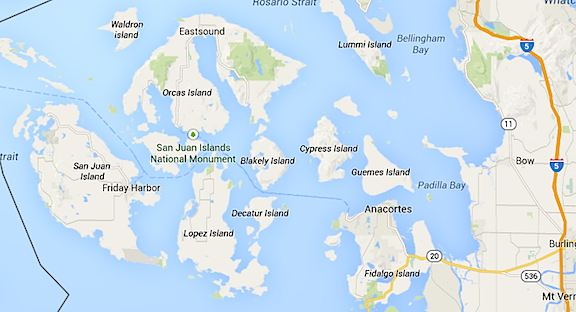
Friday Harbor is on San Juan Island at the very northwest corner of Washington State. It’s so far north, in fact, that it’s north of the lower end of Canada’s Vancouver Island. Getting there requires a 3-hour drive to Anacortes followed by a 1+-hour ferry ride — and that’s if Route 2 through Stevens Pass is clear and open. If Stevens is closed, add another hour to get through Blewett and Snowqualmie passes on Route 97 and I-90. Back in August, when I spent a week with a friend out at Lopez Island, I’d elected to take the helicopter out to avoid the long drive. But in winter, that didn’t seem like a reasonable possibility given the usual low clouds over the Cascades and real possibility of bad weather so I didn’t even suggest it.

San Juan Island on Map
San Juan Island is the farthest west island on this map, which also shows the mainland to the east. The black line you can see in the left top and bottom of this image is the U.S.-Canada Border.

Penny and I packed up on Wednesday and spent the night at Bob’s house. We were making an early start to catch the 8:30 ferry out of Anacortes and Bob wanted to leave at 4 AM. It was my job to keep track of the conditions in the passes so we could pick an appropriate route. WADOT offers a wealth of information about its highways and passes on its Website, including up-to-the-minute pass information and webcams. Fortunately Stevens looked good so we headed out the most direct route in Bob’s pickup. Although I’d offered to take my 4WD pickup on the trip — its tires had less than 5,000 miles on them — Bob had prepped his 2WD pickup with a set up studded snow tires, just in case weather turned bad along the drive.

Penny and Bob’s dog, Skip, settled down in the back seat for the long drive. There was no one on the road. Well, no one going our direction, anyway. We did pass a few cars coming east on Route 2. The road was clear and dry and other than a few foggy areas, easy to drive. Crossing Stevens Pass was a non event and we headed down the west side, still in the dark. The days here are short this time of year and it wasn’t until we got near I-5 that it started getting light.

We stopped for coffee at one of Washington’s ubiquitous drive-up coffee stands — honestly, how do coffee-drinking people live without these? While I chatted with the girl at the window — who was working a 6:10 AM on Thanksgiving Day, mind you — Bob took the dogs for a quick walk. Before leaving, I thanked the girl for being there and gave her a big tip to really show my appreciation. The eggnog latte was good and hot.

We stopped at Safeway in Anacortes before getting on the ferry queue. We’d brought along the fixings for quiche — 15 eggs from my chickens, along with chopped ham and scallions from Bob’s fridge — but needed a pie crust, cheese, and half-and-half. I ran in to get all these things while Bob waited with the dogs. I also bought a small Poinsettia for our hosts. I hate going anywhere empty handed — not that we were going empty-handed. In addition to our quiche ingredients, I’d brought 2 bottles of wine, a bottle of local hard cider, and a jar of honey and Bob had brought 6 bottles of Martinelli’s sparkling cider in two flavors. We had a cooler and a box full of goodies in addition to our luggage.

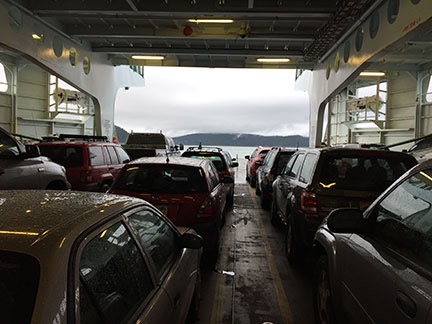
Inside the Ferry
Inside the ferry to Friday Harbor.

The wait for the ferry wasn’t long, but we did have time to get out and stretch our legs with the dogs one more time. Then we loaded up with the rest of the cars, winding up in the middle of the main deck on the Elwha. We hung around in the truck for a while, then went upstairs to take in the view of the islands as we sailed past. By then, it was fully light out, but overcast. The ferry boat moved along at a good clip and I used Google Maps on my phone to identify the islands as we zipped past them.

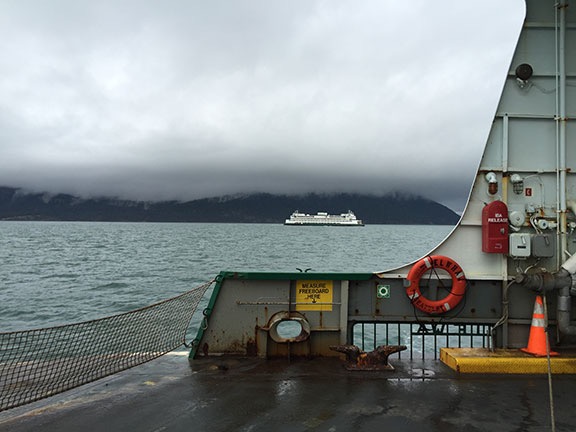
Another Ferry
Our ferry boat wasn’t the only one on the water that gray morning.

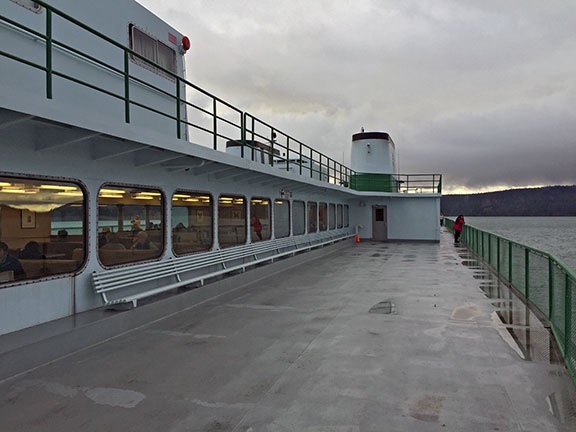
Ferry View
A look back down the deck of the ferry.

Thanksgiving Day with Friends

The ferry was an express that stopped at Friday Harbor and Sidney, B.C. only. We got into Friday Harbor just before 10 AM. From there, it was a short drive to Liz and Brad’s house on 20 acres. I think they were surprised to see us so early. Liz was just putting in the turkey.

The Pond
The pond behind Liz and Brad’s house shortly after Penny chased away all the ducks.

Bob and Skip
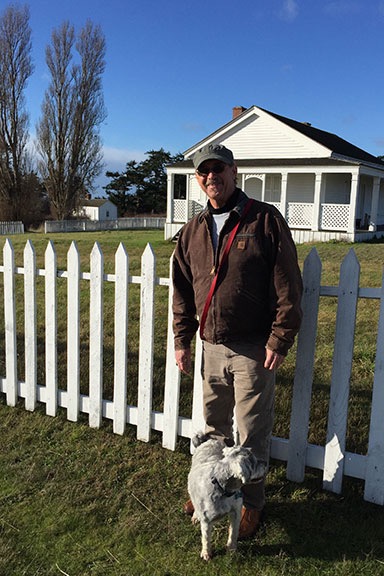
Bob and Skip pose for a photo at American Camp. Skip seems more interested in what Penny is doing than the camera.

After quick introductions, we established that Bob was hungry and Liz and Brad had already eaten. So Bob and I headed back out to find some breakfast in town. We wound up at a bustling local market, which was just the kind of upscale small supermarket I love, and ate breakfast sandwiches on the tailgate of Bob’s truck. Then we drove around the island to kill some time. We wound up taking a walk out at a place called American Camp, the site of an almost-war back in the 1800s. It was a good opportunity for the dogs to run around. By that time, the sky had cleared and it was becoming a beautiful day. We got as far south as the lighthouse I’d flown over back in August before heading back to the house.

The Turkey
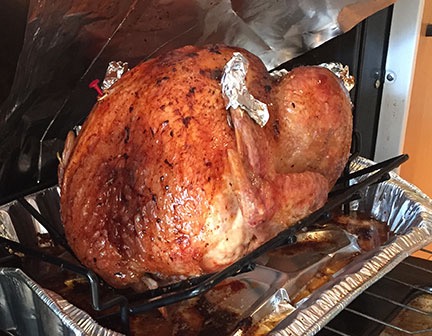
The turkey tasted as yummy as it looked here.

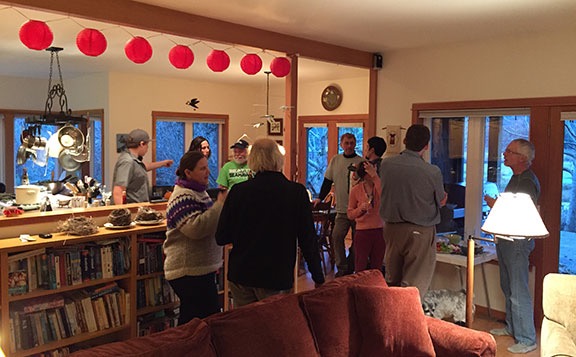
Back at Liz and Brad’s house, we relaxed while the turkey cooked. Liz and I popped open that bottle of hard cider and drank almost all of it before the other guests began arriving. And there were a lot of guests. Soon the house was crowded with adults and young people drinking cider and wine and munching on crab dip, salmon spread, and hummus, chatting and having a good time.

Party Time
I took a break to snap this photo, not realizing that only half the guests had arrived at this point.

Brad carved the turkey and Liz set up a buffet line at her kitchen island. Soon, 15 of us were sitting at a pair of tables put together on an angle to fit in the dining room. The food was great — as you’d expect a Thanksgiving dinner to be — and there was a ton of it. Fortunately, I was boxed into my seat so I couldn’t easily get up for seconds. I made up for that by trying both the homemade cheese cake and apple pie for dessert.

Cleanup went quickly with so many people helping and about half of us went into the living room to watch the football game. The local team, the Seattle Seahawks, were playing the San Francisco 49ers — the perfect game for a Washington crowd. The game had started about a half hour before and Brad had DVRed it so he could fast-forward through all the commercials. I settled down on the floor with Penny on my lap. But since I’d been up since 2:30 AM — thanks to Penny needing to take a pee at Bob’s house — I was exhausted and fell asleep. I missed most of the game but woke up at the end to find the Seahawks victorious again.

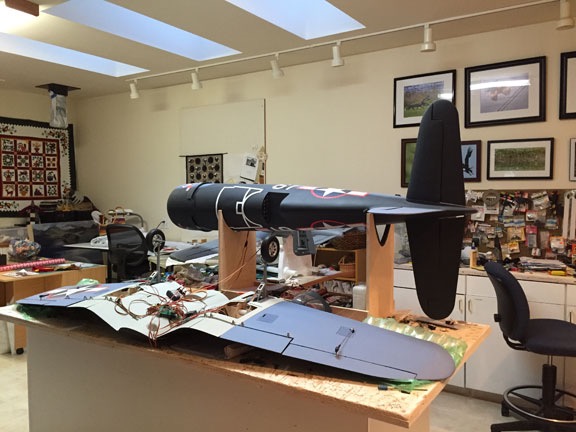
The guests left in small groups after that. Soon it was just Liz, Brad, Bob, and me. We cleaned up a bit more, then retired to sleeping quarters. Penny and I were staying in the “craft room,” which was where Liz does her quilting and Brad builds large scale radio controlled airplanes that he flies on a grass strip in his back yard. The walls of the room were covered with quilts and Brad’s photos of wildlife and airplanes.

Craft Room
One of Brad’s projects in the craft room.

Black Friday — without Shopping

I slept reasonably well, waking up only once to wonder where I was. Hearing noise outside my room, I put on my slippers to join Liz while Penny went looking for and eventually found Skip. Soon Liz and Bob and I were drinking coffee while I was whipping up two quiches — one with cheddar and the other with mozzarella. I was horrified to see that I’d bought fat-free half-and-half — I mean, what’s the point, right? — but that quiche turned out just as good as the one I made with Liz’s regular half-and-half. The three of us polished off a whole quiche. Brad missed out; he had to go to work.

Afterwards, we dressed and went out for a drive in Bob’s car. It was cloudy again and cool. Liz took us to see the lavender farm, which was closed, and a handful of parks. Then we drove up to the top of a ridge where some private developer had tried (and failed) to sell 20-acre parcels that were virtually unbuildable for $210K+ each. The land now belonged to the San Juan County Land Bank, which buys up land in the area to prevent development. In the future, it would be a park with trails. We drove through Roche Harbor, where I’d flown in by helicopter for dinner with my friend Don years ago, and then headed back to Friday Harbor.

Back in town, we met up with Liz’s son Chris, his wife Kelly, and their two kids at a local holiday market. There were about 30 artists and other vendors there, selling their wares. It was refreshing to attend one of these that wasn’t full of the same southwestern stuff I’d seen over and over in Arizona when I lived there. I bought a beeswax lip balm and some locally sun-dried sea salt. I was sorely tempted by some wall sculptures, but held back by my new rule: No buying anything for my home until it’s done.

Afterwards, we went with Chris and Kelly to a house Chris and his partner are refurbishing. (Chris is a carpenter.) Originally built in the 1940s, it’s a small place with a lawn that goes down to the harbor and has the added luxury of its own boat dock. With lots of trees on its end-of-road lot, it was a pleasant location. They’d gutted the house and rebuilt it from the inside out. Although they’d been working on it for about 16 months, they were still at least a few months from completion. I looked around and got some ideas for wood trim around my windows and flooring. The countertop material, PaperStone, was amazing and I will definitely check it out for my own kitchen countertops.

From there we went back to Roche Harbor to look at another house that Brad is overseeing the construction of. This was an upscale home, 3800 square feet, with vaulted ceilings, sweeping staircases, and lots of extras. Pretty amazing for a 2-bedroom home. The two projects — Chris’s and Brad’s — couldn’t be any more different. Here, I took mental notes on the great room’s ceiling, which was tongue-and-groove cedar planks, and bathroom tile work. I also liked the track lighting, which I’d already decided to use in my hallway, which would double as a photo gallery. The home’s owner was there, fiddling around with his computer and the various light switches that made up his smart home system. Although I plan to include some smart home accessories in my place, I don’t expect to do it to the extent that he did.

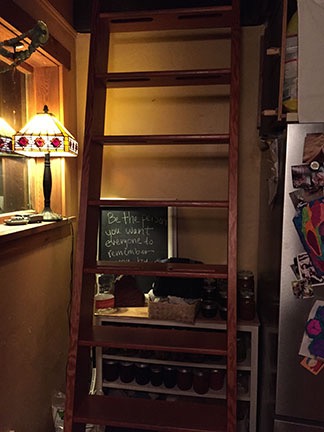
Loft Ladder
I shot this photo of the ladder to the loft in Chris’s house so I could remember some of its details. My home also has a loft — mostly for storage — and I’ve been thinking of how it could be easily reached from below.

We headed back to Liz’s house and took it easy for a while, just chatting in the kitchen over tea. Later, when Brad got home from work, we headed out to Chris’s house for a taco dinner. His family lives in an expanded cabin at the end of a long, steep dirt road. We arrived and departed after nightfall, so I didn’t get a chance to really see it. But it was cosy inside, with an eat-in kitchen, sunken living room, and wood-burning fireplace. After dinner, I got so comfortable on the sofa that I almost fell asleep again.

The Trip Home

We were up at 5 on Saturday, packing up for the trip home. Bob wanted to get on the 8 AM ferry and we’d been advised to get the car on line by 6:45 at the latest. We headed out there and got the first spot in lane 3, then walked up to The Hungry Clam, which was already almost full by then. Apparently, the place exists for ferry traffic meals. Liz and Brad joined us for a big farewell breakfast.

Outside, it was very cold and very windy. There were whitecaps on the harbor. We paid the bill just as the ferry rounded the corner and headed into the dock. We said our goodbyes with a lot of hugs and promises by Liz and Brad to come see us on “the dry side,” then hurried down to the truck. Poor Penny and Skip needed a lot of hugging and rubbing to warm up!

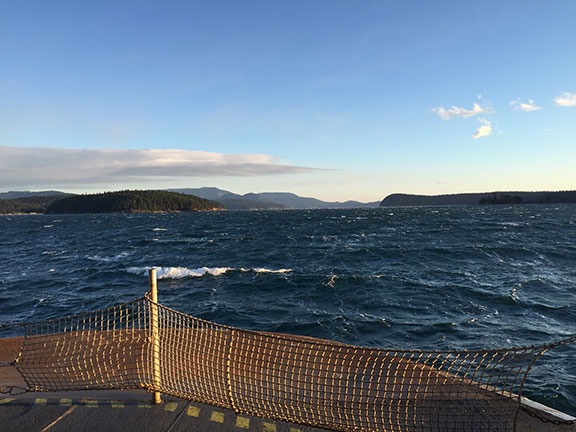
Because the second car in line 1 was empty and there was a truck in line 2, the ferry loaders waved us aboard as the second car on the boat. This positioned us right at the front — although they didn’t load us all the way to the line. (It later became apparent why they didn’t have us drive up closer to the edge.) Ahead of us, the water was more than a little choppy and the wind was mostly blowing right in. I got out to take a photo closer to the edge and thought I was going to get blown away.

Choppy Water
I got got right up to the pedestrian rope to take this shot. It was wicked windy and cold!

We stayed in the car for the whole trip, mostly so we could periodically start it and warm it back up for the dogs. I was glad we did. The water got progressively rougher as we got closer to Anacortes. About 30 minutes out, a loudspeaker warned of the rough ride ahead. The boat rolled in the waves and we could clearly hear waves breaking across its side. Occasionally, the front end would dip down just enough to send a wave of water onto the deck. One wave came so far into the boat that it splashed the hood of the truck. There was water sloshing around all over the deck. Several of the chocks the loaders had placed around the front tires of the cars at the head of the lines got loose and washed back and forth. I think a few might have gone overboard.


This minute-long video gives you an idea of what we experienced. A larger wave than these washed over the hood of our truck, which was at least 50 feet back from the bow. You can see Mount Baker in the distance throughout much of this video.

After hearing about so many ferry accidents overseas, I admit that I was more than a little nervous — especially when the captain kept cutting power to slow us down more and more. But then we got closer to Anacortes and the water calmed a bit. Soon we were pulling into the dock and the crew was moving the ramp into position. I was very glad when Bob steered us off the boat and onto dry land.

Of course, that wasn’t the end of our homeward bound adventure. All morning long, I’d been checking conditions in the passes. Stevens Pass, our preferred route, was reporting 24° with compact snow on the roadway and snow falling. Restrictions were “traction tires advised, oversized vehicles prohibited.” But things were worse at Snowqualmie: falling snow, areas of low visibility, and chains required. It looked as if Stevens would be our route.

All around us was fresh snow that had likely fallen overnight. It was beautiful to see — I don’t think they usually get much snow on the Seattle side of the mountains. There were a lot of cars on the road, too, but not enough to make what I’d consider “traffic.” We got on Route 2 eastbound and stopped at the Sultan Bakery for some baked goods to snack on along the way. One more stop at a park-and-ride nearby for the dogs to take a break. Then back on the road for our climb up into the mountains.

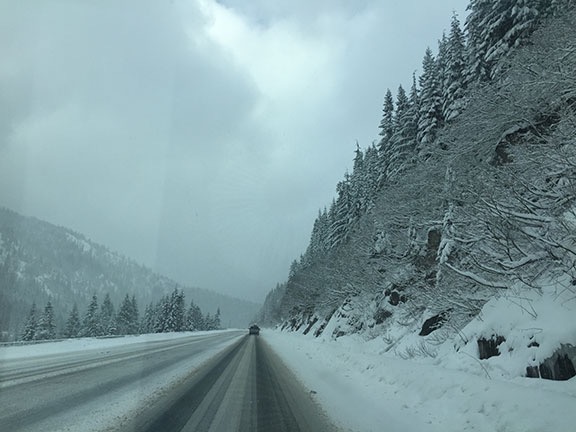
Soon it was snowing on us. The road looked remarkably as it had in the webcam photos I’d studied all morning on my phone: covered with snow with just patches of pavement showing through. Bob’s studded snow tires came in handy as we followed the other cars up the mountain. Snow fell all around us. I was glad Bob was driving. I absolutely detest highway driving in the snow.

Snow on Highway 2
Snow on Highway 2 on our way to Stevens pass and beyond.

We were both very surprised to see most of the cars turn into Stevens Pass ski resort, which I didn’t realize was open. The road was worse on the west side of the pass, but soon cleared up, although snow continued to fall past Coles Corner. By the time we got to Leavenworth, it was mostly sunny — a beautiful day with fresh snow on the ground and in trees. There was less snow in Wenatchee and, when Bob dropped me off at home, I estimated only about an inch of fresh stuff at my place.

I’d had a wonderful weekend away with Bob and his friends. Not only had I met some great new people, but I’d come away with a lot of new ideas for finishing my home. It was well worth the drive — and the adventure that had gone with it.