Summer 2016 Road Trip, Day 4: Baker Lake to Mount Baker

Making it up as I go along.

It was raining when I fell asleep but had stopped by the time I woke up at first light. The trees dripped steadily on the roof of the Turtleback, reminding me just how wet it was outside, even if it wasn’t raining.

Overnight, not a single vehicle had driven by.

I made coffee and finished up the previous day’s blog post by adding photos. Penny woke up and I let her out. When she came back in, she went right back to bed. It was that kind of day.

The Road to Larrabee State Park

Baker Lake
It was starting out to be another dreary day at Baker Lake. This view looks south down the lake.

By 8 AM, we were back on the road, heading south along the lake. It was a dreary day, with low clouds and not a single ray of sunshine. But the big surprise was the number of boats on the north end of the lake: dozens of them. There must be some serious fishing out there to get so many guys out on boats in that weather so early in the morning.

On the road down to Route 20 — Route 11, not the “shortcut” I’d taken the day before — I found the park I should have spent the night in: a tiny county park about 5 miles up the road on a small lake. It was nearly deserted with plenty of lakeside spots for only $5/night. Of course, that’s $5 more than I paid to park where I’d spent the night, but at least I would have been closer to my destination on that cloudy morning. And I think it was worth it.

I had three destinations that day, all in Bellingham: Trader Joe’s, REI, and Larrabee State Park, where I expected to spend the night. Common sense would dictate that I should make the two retail stops before the overnight stop, but I wanted to check out the campground before I committed to it. So I told Google to direct me there and it did, guiding me on Route 20 out of the foothills and into the farmland west of the Cascades. We passed over I-5 and hopped on Chuckanut Road, a narrow, winding road that eventually followed the shoreline north, with views of the San Juan Islands in the misty fog. It would have been a great road on a motorcycle, but in a 1-ton pickup with a full-sized camper on top, not so much.

I eventually reached the campground at Larrabee State park and turned in. The pay station was closed — it wasn’t even 10 AM yet — and instructions said to choose a site. There was a list of available sites and a map. I found a few that might work for me and drove in to check them out.

The campground wasn’t anything like I’d expected. It was densely wooded with narrow winding roads that I sometimes thought I wouldn’t fit through. The sites were relatively close together so there was no privacy. But that was sort of moot because it didn’t look like any of the sites on my list were large enough to get my truck into. The RV parking area was the kind of parking lot style “campsites” I abhor, although I admit they did have trees and shade. There were kids all over the place, mostly on bicycles and all loud. There was no sign of the coast or a beach or the tidal pools I’d hoped to explore — apparently you had to drive or hike down to the water. The train noise warning sound was a bit of a put off, too. When I had to back out of a road because it didn’t look as if I’d make a sharp turn up ahead, I decided the campground wasn’t for me.

I stopped in the parking lot to access the Internet. I uploaded my track log and blog post from the day before. I studied my maps, looking for a place to go. Mount Baker had been tempting me — would I find a place to spend the night up there? Would it be worth the drive? Since I had all day, I figured it was worth a try.

I used Google Maps to find the closest REI and continued on my way.

Shopping

REI was only 5 miles away — and on my way to both Trader Joe’s and the road to Mount Baker. I was looking for a lightweight, streamlined kayak that would be easy to take with me when I went out with the Turtleback. The two Costco kayaks I had were beginner’s kayaks I’d bought cheap because I didn’t know how much I’d like paddling. Turns out, I like it a lot. And with the number of lakes I expected to visit on this trip, it sure would be nice to have one with me.

But the REI in Bellingham doesn’t have a big selection of kayaks. I was referred to their website or their Seattle store — neither of which would help me that day. On my way out, I looked at an “adventure” map of the west side of Canada, decided it wasn’t detailed enough, and left empty handed.

Not so at Trader Joe’s, which was just two miles away. I picked up all the things I had on my list for a Trader Joe’s run — and a few more. The cashier and I got to talking about the weather, which was really getting me down. She said she loved it cloudy like that. I guess it’s a good thing she lives on that side of the mountains. More than 24 hours of clouds and rain had been more than enough for me.

The Road to Mount Baker

Google guided me to route 542, the scenic road to the Mount Baker recreation area. Well, the only road to Mount Baker. It left the semi-urban area of Bellingham quickly and passed into farmland. I learned that blueberries are a big crop in that area.

At Maple Falls, I turned toward Silver Lake, where there was supposed to be a campground with a dump station. That campground was my plan B (or is it C?) if I couldn’t find someplace to spend the night at Mount Baker. It was a huge campground with more narrow, winding, wooded roads and tiny campsites. Lots of availability and I could squeeze my truck into any of them. I stopped at the dump station on the way out and emptied my two holding tanks. Although I could have taken on some fresh water, I still had half a tank and didn’t feel like pulling out the hose.

Back to Route 542. The weather was still dismal, with patches of misty rain. The forecast had claimed it would clear up, but Mother Nature wasn’t listening to the forecast.

Wanting a hot meal, I stopped at a restaurant in Glacier for lunch, Graham’s. It looked pretty trendy from outside, but wasn’t the least bit trendy inside. It was just old and dressed up. The restrooms were weird with a big shared room that had a sink and two tiny toilet rooms. Whatever. When I’m camping, I never knock a flush toilet and hot water to wash my hands. I ordered the BBQ meat loaf sandwich, requesting the BBQ sauce on the side. It was amazingly delicious. Seriously: if I could make meat loaf that good, I’d have it all the time. Bacon, onions, provolone, soft fresh roll. Perfect. Wish I could say the same for the wine; it was a local barbera that was simply undrinkable. I tried and failed several times.

Back at the truck, Penny got my leftover meatloaf and seemed pretty happy about that. She’s a finicky eater, especially when we’re on the road, and I’m starting to think that I might have to start cooking for her.

Nooksack Falls
One of the few possible views of Nooksack Falls, which was crammed into a canyon with sheer rock wall sides.

Wooden Pipe
A wooden section of the diversion pipe at Nooksack Falls. You can’t tell from the photo, but the pipe is six feet in diameter.

We continued on our way, making one more stop before the end of the road: Nooksack Falls. This was an interesting waterfall on the Nooksack River, right where it meets with Wells Creek. There are fences that make it very difficult to get close to the falls and a warning sign that actually lists the names, ages, and dates of the people who were killed there within the past 30 years, including the unborn child of one of the victims who happened to be pregnant. (Talk about a downer!) But the fences were low enough to get photos and a good look. The site had been developed for a hydroelectric project downstream and some of the diversion pipe — which still has water running through it — runs through the site. It was kind of interesting in a weird sort of way — especially since a portion of the original wooden pipe was still there. It would have been a nice picnic stop if I needed one. The power plant was destroyed some years ago in a fire, so there was nothing of that to see.

We continued along Route 542, into the forest. Soon the road climbed steeply upward, with numerous tight curves and, later, switchbacks. If there were viewpoints, I didn’t notice them — all I could see where tree-covered hillsides climbing up into the clouds. The rain had stopped, but it showed no sign of clearing up.

I passed signs for the ski area and saw numerous buildings and ski lifts, all of which were closed. The road split into two one-way roads and wound around a small lake called Picture Lake. I got out to take some pictures (apparently, with my Nikon because I can’t find them on my phone) and wound up walking around the whole lake with Penny. Some signs along the way informed me that the lake was popular with photographers for the reflections of Mount Suksan to the southeast. I looked but could only see a mountain with snow climbing into the clouds.

Road to Artist Point
The road to Artist Point, shot from the Artist Point Trail on a less than perfect day.

I drove past the parking area for Heather Meadows, figuring that I might as well take the road to the end, which was just a few miles farther. It got very steep on this last part, with tight switchbacks. It ended abruptly at the parking area for Artist Point, which had about 30 cars in it. From this point, hikers could get on several different trailheads. The one that interested me was the one to Artist Point, mostly because it was short. I grabbed my camera, cracked the windows in the truck, and set out on a hike, leaving Penny behind.

Not Mount Baker
Mountain? There’s no mountain here.

I thought I’d be gone for just a short while, but it was at least an hour. Based on several signs along the way, I assumed I’d be able to see Mount Baker to the southwest if it was clear enough to see. It wasn’t. I could see the base of the mountain and some snow but the top half was completely obscured. I hiked the trail anyway, optimistically believing the weather forecast that said it would clear. It didn’t. I had a nice walk that included some photography and a thoughtful moment alongside a snowmelt creek. I reached several view points where I should have seen the mountain, but I didn’t. Instead, visibility got worse. I headed back, stopping to chat with a man who pointed out a grouse and two chicks. By the time I got back to the truck, visibility was down to less than 300 feet in the parking lot, which was now mostly empty.

We headed back down the road, this time stopping at Heather Meadows. The Fire and Ice Trail there was another easy one — a loop of about a mile. Although I didn’t plan on doing the whole thing, I did. Again, I left Penny behind. Again, the clouds obscured any mountain vistas. But I did get down to a large snowmelt creek that cut through a rocky, hilly meadow. It was the sound of this creek that filled the valley and could be heard all the way back up in the parking area.

Fire and Ice Trail
Along the Fire and Ice Trail. This photo makes it look as if it were cold out. It wasn’t — it was probably in the 60s. Just low overcast and dreary.

Looking for a Campsite

By this time, it was after 6 PM and I needed to find a place to spend the night. Part of me wanted to stay nearby just in case the weather cleared. If views of the mountains were possible in the morning, I could come back. But I didn’t want to drive all the way back from one of the campgrounds far below.

I remembered a turn onto a gravel road that I’d passed just below the ski resort. I found it on my map: White Salmon Road, FR 3075. It looked like it descended on steep terrain with three switchbacks before dead-ending. It couldn’t be more than two or three miles long. Maybe there would be a spot along the road where I could spend the night?

Nothing ventured, nothing gained. Ten minutes later, I made the turn and was heading down a narrow road through the forest.

Bee Yard Near Mount Baker
Why yes, there is a bee yard alongside the road near the Mount Baker Ski Resort.

I was very surprised to see a bee yard set up alongside the road. There were about 30 beehives there surrounded by an electric fence wire with a solar panel to keep it charged. (The fence was to keep out wildlife, especially bears, not people.)

I kept going. About a half mile down was a spot wide enough for me to pull over, but I really didn’t like the looks of it — too close to the road. I had no idea how much the road was used and didn’t want vehicles driving right past me.

I kept going. I started thinking about how remote it was. How unlikely it would be to get help if I needed it when I was so far from the main road. How long a walk it would be if something happened to the truck.

Just when I was ready to turn around, I found a campsite on the right side of the road. Slightly raised off the road, it was a clearing with three routes in/out. There was even a sad little fire pit in it.

Cell Tower
I had a 5-bar LTE cell connection when I shot this photo through the windshield of my truck. I wound up camping within 2 miles of here.

But do you want to know what sold me on it as a place to spend the night? I had a 2-bar LTE signal on my cell phone, probably from the cell phone facility I’d passed back up near the ski resort.

I turned the truck around so I was facing back down the road and my slide would be open away from the road. I maneuvered the truck into position in the site so it was relatively level. And then I killed the engine. We’d landed for the night.

Penny had no interest in walking around outside; she looked decidedly spooked. I suspect that she smelled some of the wildlife — maybe even a bear. So I locked the truck for the night and we went into the Turtleback. I had the door open for a while, but it was downright chilly so I closed it.

Believe it or not, I was still full from that meatloaf sandwich at lunch. I fed Penny some dog food, which she turned her nose up at. So I put her up on the bed while I read for a while, catching up on the antics of a certain presidential candidate who has turned election season into a surreal farce of epic proportions. I also checked in on Twitter and Facebook and peeked at my email. Part of me was glad to be on the grid while another part kind of wished I wasn’t. I liked not wasting time on social networks.

By 8:30, I was up on my bed, doing a crossword puzzle. By 9:30, I was asleep.
Summer 2016 Road Trip, Day 3: Colonial Creek to Baker Lake

A tale of two parks.

It began raining very early in the morning, maybe around 3:30. I was wakened by the first drops — my years as a cherry drying pilot have fine-tuned my senses to react to the sound of rain overnight. At first, I thought the sound was caused by tiny pine cones hitting the top of the Turtleback. Click, click, click. I could count the impacts if I wanted to. It was only when they were falling too frequently to count that I realized it might be rain. At first, I couldn’t believe it — after all, the day before had been perfectly cloudless day nearly all day. I looked up through the clear plastic sunroof over the bed, trying to see stars. When I couldn’t, I knew it was rain.

It might be my years of living in Arizona followed immediately by years of living on the desert side of the Cascade Mountains in Washington that make me forget that it sometimes rains when you don’t want it to. Yes, we had a rainy cherry season at home this summer: more than a dozen days with rain in the 10 weeks I was on call. But the weather for the week before my departure had been drier than dry — normal, in fact. The grass that had managed to stay green since spring was finally turning to gold, the wildflowers were withering, the blackcap raspberries I’d planted in the spring needed watering almost every day. Surely it wouldn’t be raining anytime soon. Especially not on my vacation.

But there it was: a heavy shower in the campground. The sound of the rain on my roof and in the trees almost drowned out the sound of the rushing water in nearby Colonial Creek. Almost.

Even after the rain stopped about fifteen minutes later, I couldn’t get back to sleep. I read for a while and did a crossword puzzle. Then I slipped out of bed, made a cup of coffee, and finished up the blog post I’d started the afternoon before. When it got light, I made myself a bowl of cereal with some of the blueberries I’d picked on Saturday morning and kept working. I pulled photos off my phone with a USB cable, not realizing that the cable was keeping the phone charged at the expense of my laptop’s battery. When I was done, my laptop’s battery was down to 24% power. That meant using the inverter to charge it so I could publish the post later when I was back in cell phone coverage later. The inverter has a noisy built-in fan and I only use it when I’m not around to listen to it.

Back on the bed, Penny got up out of her bed and stretched. I lifted her off the bed — it’s too high for her to jump down safely — and put her on the floor. It had drizzled a few times since I got up and it was raining then. She didn’t seem to mind too much when I let her out. She did her business under the truck — one of the benefits of being a tiny dog is that she can just walk under it. She came in when she was done and I gave her some breakfast while I got dressed.

It was a lazy morning, to be sure. None of my neighbors seemed to be awake. No noise from the RVers on either side of me. I could imagine the tent campers snug inside their nylon shelters, dreading breakfast on a wet picnic table. We’d had heavy rain one day on my last tent camping trip which, coincidentally, had been at the same campground the previous year. I’d been prepared with a tarp and ropes and we’d rigged up a good shelter over our table. So good, in fact, that we invited a family of four tent campers to join us under our shelter for dinner since they didn’t have a similar shelter at their site. But RV camping makes tarps and temporary shelters from the rain unnecessary. It makes the whole camping experience easier. Is it still camping, though? I guess that depends on how much of a purist you are.

I grabbed a nylon rain jacket and put it on over my long-sleeved shirt, just in case it started raining again. Then Penny and I took a walk to the garbage dumpster. I visited the very clean restroom I hadn’t noticed the day before and enjoyed the luxury of a real flush toilet. On the way back to our site, I noticed the family of tent campers at the creekside spot two spots down from us sitting dejectedly in folding chairs around a cold, wet fire pit. I hoped their day would get better.

After washing the dishes and stowing my loose belongings, I closed up the Turtleback and got into the truck with Penny. It was about 9 AM when we rolled out of the campground. We hadn’t used the picnic table or fire pit once.

On the Road Again

My plan had been to explore the area on the west side of Baker Lake, which was in the Baker-Snoqualmie National Forest. I was hoping for a lakeside campsite, possibly in one of the campgrounds I saw on my North Cascades area map. I wanted to get in a hike before the end of the day and thought I might find a good one along the way. Or possibly a good walk from my campsite once we’d parked. In any case, I was in no hurry to get there.

I did want to make at least one stop: the park Visitor Center in Newhalem, which was along the way. I knew from experience that my cell phone would work there. I wanted to check messages and texts, update my house-sitter and a friend with my current location, publish my blog post, and post my two hiking track logs with photos. And maybe check in on Facebook and Twitter. In other words, check in with the rest of the world.

I have to say this about being off the grid: On one hand, it’s wonderful to not have communication and social media distracting me and taking up so much of my time. But on the other hand, it sucks to not have access to basic information such as weather forecasts and maps. The weather had completely taken me by surprise, which would not have been the case if I’d had access to the Internet.

Along the way to Newhalem, I saw some of the damage wrought by the fires that had swept through the area after my camping trip last year. Thousands of tall fir trees standing dead, their needles burned off, skeletons of what they once were. There were dozens of patches like this along the mountainsides, climbing high into the low-hanging clouds. I wondered why I hadn’t noticed the extent of the damage the previous autumn when I was in the area for a mushroom course at the North Cascades Environmental Learning Center. Had I been too distracted by the autumn colors? Or had the weather that weekend been so much worse that I just couldn’t see the burned up trees? It had certainly rained very hard on our mushroom hunting day.

My phone pinged to life about a mile short of Newhalem. Text messages, social media notifications, missed call notifications. The usual. (My house-sitter texted to say that she couldn’t believe how many tomatoes and eggplants were in my garden.) Nothing pressing. But it did mean that I was back on the grid.

I parked in a regular spot near the Visitor’s Center in Newhalem. It was pretty much deserted at about 9:30 AM. I fiddled around with my devices, posting my track logs with photos from my phone first and then using my iPad as a hotspot for my laptop to publish my blog post. It sounds a lot more complex than it is. While the blog post and its photos were being uploaded, I used my phone to check Twitter and Facebook and reply to some comments there. Then I posted links to my track logs and new blog post. The whole chore took less than 15 minutes. When I was done, I closed up all my devices, put away my laptop and iPad, put my phone in my pocket, and went to see if I could find a decent map of British Columbia at the Visitor Center.

I was chatting with the ranger when my phone rang. Seriously: I would only be on the grid for about an hour but someone managed to catch me. It was a woman who wanted me to do helicopter rides at Quincy’s Farmer Appreciation Day in September. She needed details for an article in the newspaper. I answered her questions while I looked at the books offered for sale. When I hung up, I chose a small book about easy hikes in the North Cascades. (I later discovered that I had already done all or part of six of those hikes, including the two hikes I’d done the previous day.) I also bought a “2016 National Park Service Centennial” refrigerator magnet. And I got a free map of Washington State’s Scenic Byways. The ranger and I chatted briefly about the road to Baker Lake before I left.

I made a quick stop in the store across the street, looking for velcro, which they didn’t have. Then I was back in the truck with Penny, heading out of town.

Although Newhalem is still inside the park, it feels as if it’s outside. The road winds mostly down to the west from there, out of the mountains. I stopped briefly at the convenience store in Marblemount, still looking for velcro, and emerged with a small tube of Gorilla Glue, a pint of milk, and some Hostess Cupcakes. Then more winding, descending road. I was now farther west than I’d ever been on Route 20. But I hadn’t really missed much. Once I’d left the park, it was typical foothills driving on the west side of the Cascades: cloudy with rain showers through rural land with the occasional town. Seriously: does it ever not rain on that side of the mountains?

I took a detour off route 20 through the historic area of Concrete. This is a cute little town that might be (but probably isn’t) popular with tourists on weekends. I did find what I was looking for, though: a True Value hardware store. These small town hardware stores are really gems. They’re loaded to the gills with everything you might need to build, repair, or decorate your home. This one occupied two storefronts with an open area between them. Because my truck was protruding into the main road, I wasted no time getting someone to help me find what I needed: adhesive velcro and a outdoor folding chair. If I’d had more time, I would have wasted an hour in there and probably bought a lot more than I needed. There’s something about a good hardware store that I really like.

Back on the road, I almost missed the turn for Baker Lake. The narrow, winding road climbed up a steep hill with lots of 10 mph switchbacks. I had to take it slow and started wondering how long it would take to get to the lake. I hadn’t expected the road to be quite like that. But then it ended abruptly at the road I should have turned on: Baker Lake Road (Route 11). I’d unwittingly taken a “shortcut” that wasn’t very short.

On Baker Lake Road

Baker Lake Road was wider, better maintained, and straighter than the one I’d been on. It headed north, paralleling Lake Shannon and then Baker Lake. I passed the turnoff for Route 12, which led westward to the Mount Baker Recreation Area. Soon — very soon, it seemed to me — I was at the turnoff for the Upper Baker Dam, which created Baker Lake. I turned in to check it out.

About two miles down the road was a mostly vacant campground with parking lot like sites. Beyond that, a fork in the road with the right leading to the road over the dam and the left leading to the boat ramps. For reasons I still can’t determine, I went left. I wound up in a parking area full of boat trailers and fishermen taking their boats out of the water. It was busy; I guess Baker Lake is a real hit with fishermen. I noticed I had a cell signal there and consulted the map on my phone. I was exactly where thought I was. And I didn’t need to be there. So I turned around and retraced my route back to the main road.

Shadow of the Sentinals
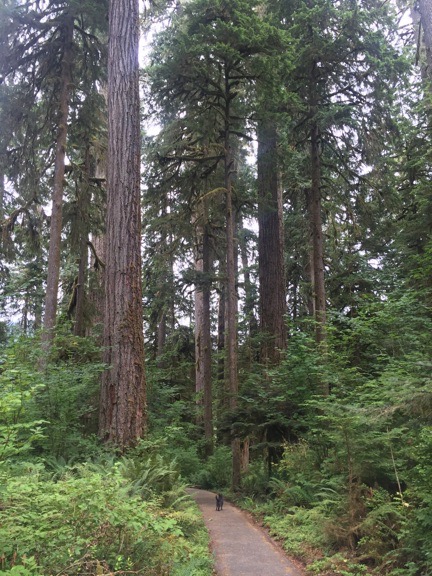
The main features of the Shadow of the Sentinels Nature Trail were the old growth trees towering well over 100 feet into the sky.

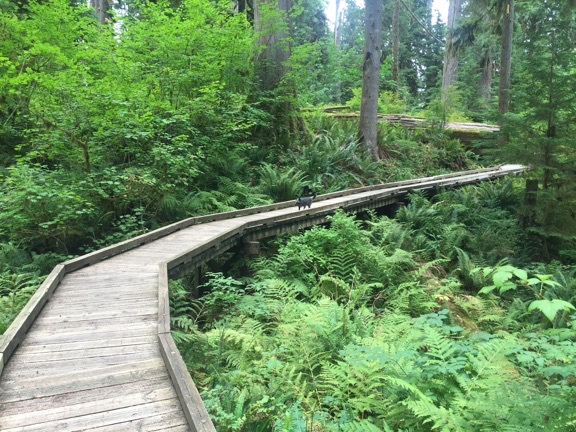
Shadow of the Sentinels Nature Trail was my next stop — and not a moment too soon. Penny was eager to get out and run around. This is one of those stops built to help the casual tourist get in touch with nature — without much effort. It doesn’t matter if you’re young or old, fit or a couch potato, tuned in with the world or out of touch with reality. Who can’t take 20 minutes to walk on a boardwalk among old growth trees in a densely vegetated grove? The half-mile loop trail wound into the forest with plenty of interpretive signs along the way. The forest floor was absolutely carpeted with moss, fern, lichen, and countless kinds of shrubs. The trees grew straight up into the cloudy sky, draped with what looked like Spanish moss. If it weren’t for the boardwalk, the trail would likely get grown over weekly. And yes, a 680-year-old tree is very big. Think redwoods big.

There weren’t many people there, although one group was a family with two small, loud boys whose shouts seemed to echo throughout the forest, audible no matter how far away I was. Penny and I walked the trail quickly, more for the exercise and experience than to learn anything new from the interpretive signs. I would have stayed longer on a nicer day, especially if the loud kids weren’t around. As it was, I think I was more fascinated by that winding boardwalk than anything else.

Boardwalk Trail
To me, raised boardwalks like this one, forming a nearly a half mile long trail through the forest, are the real attractions of nature trails like Shadow of the Sentinels.

Back on the road, I skipped the turnoff for campgrounds at Horseshoe Cove and Bayview, preferring to go farther uptake. It wasn’t much of a drive. The map made everything look farther away than it was. I drove through Boulder Creek and Panorama Point campgrounds. They were similar: very small campsites nearly right on the road, some adjacent to the ones beside them. Very little privacy. Most had Reserved signs on them; it was a while before I realized that the dates were in the future and most of the empty sites were not reserved for that night.

It was around this time that I started getting a bad vibe about the area. I can’t really describe it. It kind of reminded me of old, off-season resorts in the Catskills: busy and popular at one time, but now neglected and decaying. This feeling would nag at me as I continued up the road, visiting one campground after another. It got especially strong when I drove through what my map referred to as Baker Lake Resort but the sign identified as Swift Creek Campground. It may have been a resort at one time, but now it was just a collection of campsites, a closed down store, and a boat ramp. In many of the campgrounds, there appeared to be squatters — people who had been living there for a long time with lots of junk spread out in their site. It was unclear whether these sites had a nightly fee or if a Northwest Forest Pass was sufficient. At one campground, a very nice site overlooking the water was being used as overflow parking with three cars in it — but no sign of camping. I felt almost as if I were intruding just by driving through.

I continued up the road. Past a certain point, people were camping alongside the road. They’d park in narrow turnouts and set up their tents between the road and the lake. Some of these sites were quite spacious — but they were still right next to the road.

Free Camping

Camping is pretty much legal anywhere in National Forest or BLM land where it isn’t prohibited. In other words, if you find a nice parking spot down a side road in a National Forest and there isn’t a No Camping sign around, you can camp there. Campfires may or may not be allowed depending on local burn bans. Firewood collection might not be allowed; again, it depends on local rules. There likely won’t be any facilities and you’ll have to pack out your trash. Although there’s often a 14-day limit, it’s usually free.

That’s how I camped for free on my first night of this trip. I also did it in for weeks on BLM land along the Colorado River in Arizona with some friends this past winter. There’s nothing nicer than free, private waterfront living.

I kept going past the Pavement Ends sign and continued on gravel. No big deal for me and my big 4WD high clearance truck, but I assumed it would weed out a lot of city dwellers who liked to keep their cars clean. (Although I suspect it’s hard to keep a car clean in a place where it seems to rain all the time.) There were still people camped along the road. In one place, there were two empty boat trailers parallel parked alongside the road; I still can’t figure out how they got their boats off, through the narrow stretch of woods, and into the water.

As I neared the top end of the lake and passed the Road Narrows sign, I realized that I was probably not going to find a campground site I liked. I started looking at options along the road. Near the end, I found a nice turnout that had obviously been used for camping. Although large rocks prevented me from driving all the way in, there was plenty of room to back in far enough off the road. Beyond the rocks was a trail leading down to the water. But it wasn’t the lake anymore; it was the rocky delta of Baker River. I got back into the truck and kept driving. A half mile farther, the road ended at a trailhead parking lot for the Baker River Trail — coincidentally one of the trails in the book I’d bought that morning. People were parked along the edge of the parking area and tents were set up in the woods nearby. A makeshift campground.

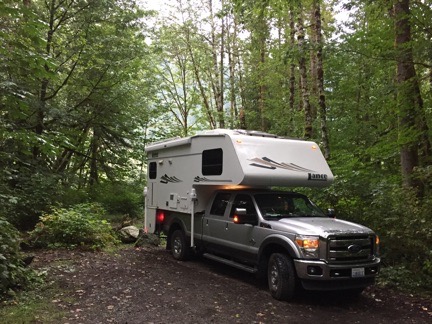
Night 3 Parking
Here’s where I parked for the third night of our trip. It was far enough off the road, surrounded by drippy trees with the river a few hundred feet away out back.

I backed the Turtleback in beside another truck camper, thinking I might spend the night right there. But when I got out to take a look around, I got those bad vibes again. This is not where I wanted to spend the night. Who knows what these people might be like? Would they be crazy drunks who get loud after dark? Would their dogs be barking on and off all night, triggering Penny to do the same? Did I really want to be parked right next to another RVer and have to lower my blinds for privacy? Suddenly, that spot back up the road looked really good. So I got into the truck, drove back to it, and backed the truck in as far as I could go.

Not what I’d envisioned for the night, but it would do.

Lunch and a Hike

By this time, it was after noon and I was hungry. I heated up some leftover steak and ate it with a salad that included the last of the tiny tomatoes from my garden. I drizzled the steak juices over some kibbles for Penny.

Then we headed out for our afternoon hike. I figured we’d follow the short of the river back up to the trailhead and then follow the trail for a mile or two. My goal was to make sure I got my 10,000 steps a day on this trip and I wasn’t even halfway there. Three or four miles would be enough.

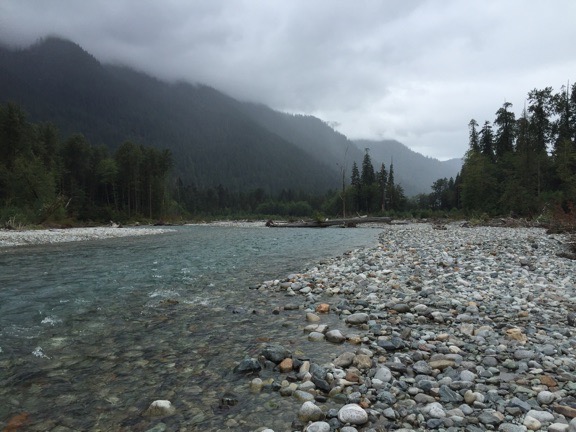
The shore of the river was rocky, with smooth river stones carved by glaciers far upstream and carried down by spring floods. Huge, old growth trees, torn out by wind and water, lay scattered like so many matchsticks on the rocks. The river’s channels wound through the delta, its water rich with glacial flour that gave it a milky color. The sound of the rushing water competed with the sound of the drizzle on the hood of my nylon rain jacket.

Baker River
Looking down Baker River, from the shore right behind my campsite. Every once in a while, the sky would brighten, leading me to believe that it might clear up, but it never did.

It wasn’t an easy walk. The rocks were large and required carefully footing to navigate without mishap. The logs often blocked the most direct route, requiring me to go around or over them. Penny accompanied me, sometimes in front of me, sometimes lagging behind to sniff at a stump or clump of weeds.

We reached the trailhead parking lot/camp area a while later. I was surprised to see that we’d already walked almost three quarters of a mile.

We passed a few of the people there. None of them acknowledged us. One guy walked right past us without so much as a nod. Unfriendly. That vibe again. I was glad we weren’t camping among them.

We got on the trail and headed north. It was a very wide, very smooth, very level trail. Easy. I set a brisk pace. My goal was to walk a total of two miles — as measured by the Gaia GPS app on my phone — and then turn around and walk back, taking the road from the trailhead to our camp. A brisk pace would make it a good workout and hopefully get us back before the rain soaked us.

It was a nice walk through old grove forest. Every once in a while, I’d notice a particularly huge tree or interesting bit of vegetation. There were few wildflowers, but I think that’s mostly because the forest floor probably got very little sunlight.

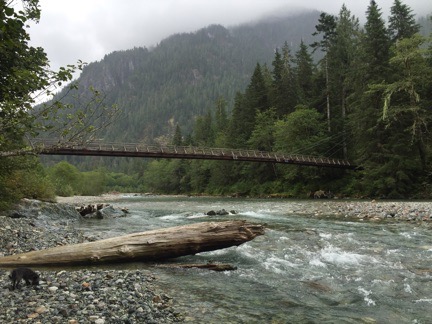
Bridge Across Baker River
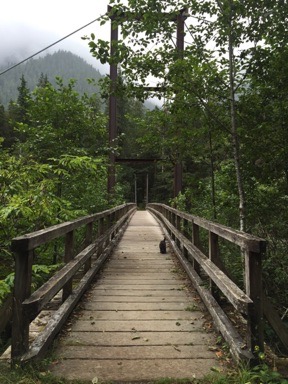
This sturdy wood and steel suspension bridge spans Baker River for hikers and horseback riders. This is our tax dollars and park fees at work, folks.

After a while, I caught sight of a bridge across the river. It was a wood and steel suspension bridge, designed for foot and horse traffic. The trail spilt here. The Baker River Trail continued north as a narrow path for hikers only. The Baker Lake Trail turned right over the bridge and continued south down the other side of the river back to the lake. I chose the wider trail, mostly because I wanted to be able to keep an eye on Penny, who is easily hidden by tall brush alongside narrow trails, and to keep my jeans dry.

The Bridge over Baker Lake
I really admire the structures like this, especially when they’re so well-built and out in the middle of nowhere.

As we walked over the bridge, I took a moment to look at the solar panels attached to it, wondering what they could be powering. The answer was on the other side: a USGS flood gauging system that likely broadcast information to a base somewhere.

Blum Creek
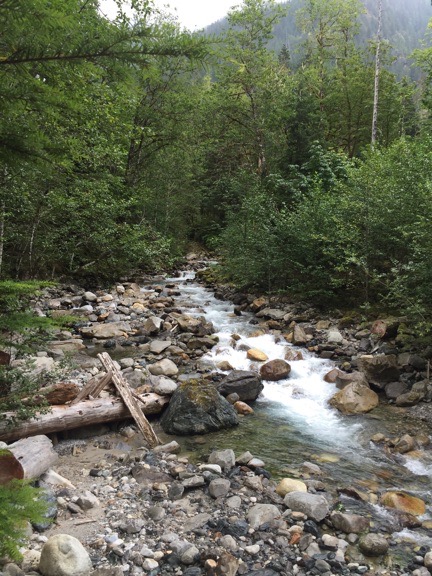
Blum Creek, near where it enters Baker River. You might think that all this flowing water is from the rain. It isn’t. This is glacial runoff.

We crossed another small footbridge, this one over Blum Creek, and continued through the woods. The rain started to pick up, but, at the same time, my quick pace was causing me to work up a sweat under my layers of clothing: long sleeved shirt, fleece hoodie, nylon rain jacket. I stopped to pull off the hoodie and leave the rain jacket draped over my shoulders. We’d walked just short of two miles when I’d had enough. We turned around and went back the way we came.

It was a good thing we did. The rain started coming down harder. Back on our side of the river, we passed a family hiking north; I figured they had to be from Seattle and used to the rain.

I put the leash back on Penny as we finished the hike along the road from the trailhead parking lot to our camp. Although she’s usually pretty good around cars, I didn’t know how people would be driving.

It was good to be back in the Turtleback.

Repairs

After stripping off my wet clothes and putting on some dry ones, I did a few repair chores.

The first was the velcro. Apparently one of the three pilots who had stayed in the Turtleback during cherry season had snapped off the plastic latch that holds the medicine cabinet door closed. The result: the door swings open and closed during travel, spilling medicine cabinet contents all over the bathroom. Not acceptable. I’d found a temporary remedy with a bungee cord, but it was a royal pain in the butt to deal with.

I decided to try velcro: one small piece in the top corner of the door. I prepped the areas by cleaning and drying them thoroughly and then sticking the stuff on. The instructions say maximum adhesive strength is in 24 hours, so I left the door open for now and will close it before moving on.

The second was the latch to the cabinet under the sink. All of the cabinets have push-latches that keep the doors closed until the button on the latch is pushed. But the one under the sink doesn’t catch properly. The result: the door swings open and closed during travel. Although nothing falls out, it bugged me that the door wouldn’t stay closed. Surely there was something I could do.

I compared the door latch on that door with another cabinet door and discovered that its position wasn’t quite right. I used a screwdriver to loosen the latch, shifted it back a bit, and tightened it back up. Voila! The door works perfectly.

The Turtleback needs one more repair that’ll require parts from Lance: the latches that hold sunroof over the bed in the full down position broke off. I think this is because they’re plastic and have spent a lot of time in the sun. I’ll have to order and install new latches. Until then, I’ve discovered that I can keep the sunroof in the slightly open position while driving; not locking it in that position causes it to swing wide open, which isn’t a good idea in rainy weather or at high speeds. When I’m parked, it’ll stay full down, even without the latches.

I’d like to make a few improvements, too. For example, there are key hooks over the door; the previous owner likely put them there. Trouble is, you need to be in the camper to reach them. In the Mobile Mansion, I’d mounted the key hooks near the floor at the door. This made them easy to reach from inside or outside with the door open. Instead of key hooks up there, I’d like to put a shelf. I already had a charging station for my phone installed on the side of the cabinet there, which is close to the stereo so I can plug in my phone for music while charging it. It would be nice to lay the phone and other things, like my sunglasses and wallet, on a shelf up there, out of the way.

And hooks. I need hooks in the bathroom to hang items I want to dry.

I’m still debating whether to remove the stove lid and use my big cutting board there as a lid and additional counter space. The stove lid in the Mobile Mansion broke off within a few months of buying it and I never missed it. The cutting board has feet that fit solidly over the stove grating. I can stand it up behind the stove when not in motion. I think it all depends on whether I can remove the stove lid neatly, without breaking it. I’ve already removed a cabinet door in the sleeping area because the mattress I added makes the bed too tall to get the door open.

These are all things that get hashed out when an RV is in use. I like to customize my space, especially when I know I might spend months traveling with it, as I hope to this winter.

R and R

When I was done with the repairs, I relaxed at the table with a crossword puzzle. I’m just starting to figure out how to get comfortable in the Turtleback and I admit that I sorely miss the Mobile Mansion’s La-Z-Boys. It it hadn’t been so nasty out, I probably would have tried out my new chair, possibly set up along the river bank.

Inside the Turtleback
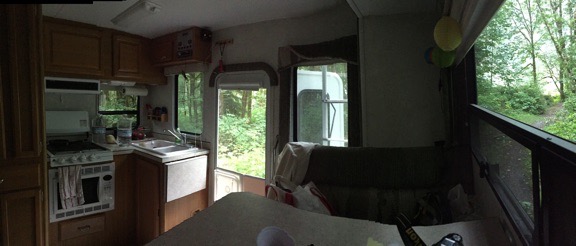
A panoramic view of the back end of the Turtleback from my seat at the table. We were surrounded by lush, green forest, dripping from the rain. You can see the trail down to the river on the right side of this photo.

Penny wanted to nap, so I lifted her up onto the bed and she got into her bed. I thought she had the right idea and climbed up beside her. Soon, I was drifting off to sleep. When it got chilly, I went down to fetch a blanket. Then I was out like a light.

Until 8:30 PM.

Sheesh. I couldn’t even use a long hike as an excuse for such a long nap.

Miraculously, I wasn’t hungry when I woke up. That didn’t stop me from eating the pudding I’d made that morning and left in the fridge for dessert.

It was nearly dark when I let Penny out to do her business for the last time that evening. I gave her some dog food, which she turned her nose up at. Then I put her back on the bed and she went back to sleep.

I stayed up at the table for three hours writing this blog post. Outside, it rained hard for a while. I cracked one of the windows open so I could hear the sound of the river not far away.

I decided I wanted an early start in the morning. I’d be heading back into civilization, staying at a State Park campground on the coast after making stops at Trader Joe’s and a supermarket. I might even have a full hookup Wednesday night.

I just hope it stops raining.

It was nearly midnight when I went to bed. When I turned off the light, it was pitch black dark — darker than I’ve been in for a long time. And other than the faint sound of the river out back and the dripping of the trees, it was dead quiet.

Summer 2016 Road Trip, Day 2: Mazama to Colonial Creek

Day 2 is full of hiking, amazing mountain vistas, and the sound of running water.

I woke as the sky was getting lighter — just like I usually do at home. The difference is, because I was in deep valley, that didn’t happen until after 5 AM. By 5:30, I was done sleeping.

It was pleasantly cool. Cool enough to close the few windows I’d left open overnight.

I made a pancake and coffee for breakfast and settled down to write yesterday’s blog post. I didn’t really feel like writing — I’ve been like that a lot lately and it has me bothered. I’m working on a book — or trying to — and can’t seem to get and stay motivated. I was hoping that blogging each day of this trip would get me back in the mood, but yesterday morning, as I drank my coffee and our campsite brightened around me, I just couldn’t. It got worse when the first rays of the sun touched the tops of the hills nearby. It gave me a sense of urgency to start my day. Still, I forced myself to finish the task and then posted the result.

Penny and I took a short walk to that most excellent pit toilet building. Yes, the Turtleback does have a toilet in its microscopic bathroom. (Seriously: bathrooms are bigger on airliners.) But I didn’t see any reason to fill my blackwater tank. Besides, I was “practicing” for long term living in the Turtleback this coming winter. I hoped to park it out on the Colorado River again with friends and dumping wasn’t an option. The goal, then, was to use public facilities when needed if they were available. This was, as I mentioned yesterday, a very clean facility.

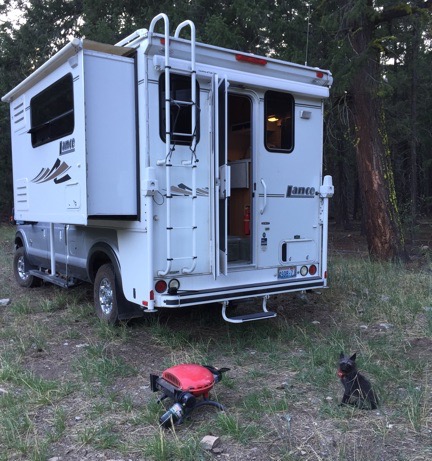
Then I broke camp. That was as easy as packing my portable grill back into its carrying case, stowing it in the truck, and turning the key that closed the Turtleback’s single slide. We were back on the road within 10 minutes.

On the Road

I stopped at the Mazama Store, which was on the way back to Route 20. I wanted to pick up a bottle of wine, some onions (I’d forgotten to pack the ones in my fridge at home), some seasonings, and some bug repellant (which I didn’t need yet but who knew when I would?). While I was in there, I looked at the selection of extremely overpriced, high quality clothing and household items they had for sale. No, I wasn’t going to spend $40 on an 600+ piece jigsaw puzzle or $60 on a sweatshirt that had Mazama written across its front. They do have the largest selection of Lodge cast iron cookware, including dutch ovens, that I’ve ever seen in one place. But I don’t even use the pieces I have. (I plan on changing that next time I head south for the winter.)

I also topped off the truck with diesel. I had a half tank, but I didn’t want to have to worry about it as I traveled.

As I drove out of town, I looked around at the big open field where I skied every winter. It looked completely different without the snow and snow banks. And, surprisingly, it was a lot less busy on that beautiful summer day than it is every Christmas Day. Go figure.

I hadn’t gone more than 5 miles when I started seeing National Forest campgrounds that I could have stayed in. I pulled into two of them to check them out. They were nice, with some level of privacy and enough space to be comfortable. But as I drove around mentally critiquing the sites, I began to realize that I didn’t really like camping in campgrounds anymore. It was like living in a subdivision. Why would I want to live somewhere with less peace and privacy than my own home? Sure, the first night’s site wasn’t anything special, but I was the only one there. It was dead quiet all night and completely private. The only thing that could have made it better was a stunning view or a lake or river out my door. Like the first campsite I’d taken the Turtleback to back in May.

But I do have this to say about National Forest campgrounds: they’re clean, they have good basic facilities, and they’re cheap. I’d rather pay $8 to $16 for a fire ring, picnic table, and nearby restroom facilities in the woods with some trees between me and my neighbors than pay a KOA $35-$55 for the basics plus a full hookup in something similar to a parking lot. When did “camping” turn into a parking lot activity?

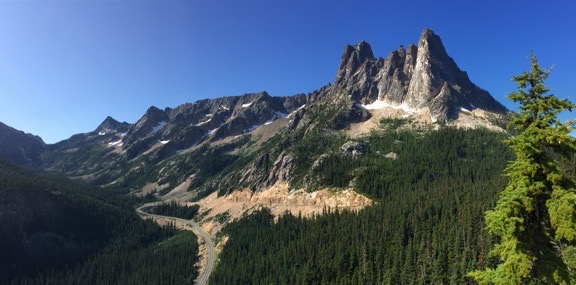
I stopped at the Washington Pass Overlook, parked in the RV parking area, locked up, and walked with Penny up the path to the overlook area. There were only a few people there. The air was clear, the sky was cloudless, the low sun was illuminating the granite peaks around us. The view was spectacular — almost surreal — of forest crowned with pointy, snow-studded rocky outcroppings. The only sound was that of cars and trucks and motorcycles rushing by on the road far below.

The View from Washington Pass
The view from Washington Pass overlook, looking southwest.

First Hike: Maple Pass Trail

Back in the truck, I consulted my Methow Valley trail map. We were already almost off it. I wanted to do a morning hike. Rainy Lake was up ahead — it was an easy one-mile hike to a lake that no one other than me ever seemed interested in. The same trailhead had the much more popular Maple Pass loop trail with its side trail to Ann Lake. The Ann Lake hike looked doable — maybe a mile and a half each way. Worth a try.

I was pulling into the trailhead parking lot — which is almost exactly halfway between Winthrop and Newhalem — a short while later. It was already nearly full. On a Monday morning. Apparently I wasn’t the only person who thought a vacation in the North Cascades was a good idea for the first week in August.

Again, I parked in the RV parking area. I should mention that although my truck with the Turtleback on it will fit (snugly) in a standard parking space, it’s a bit wide and a bit long. Backing up out of a space in a crowded parking lot is often a problem. (Heck, it’s often a problem even without the Turtleback on; my truck is big.) It’s a lot easier to pull through a spot, so I park with the motorhomes when I can. I hung my Forest Pass from the rear view mirror, put Penny on her leash, and stepped down into the parking lot with her. After a bit of organizing to get my waist pack filled with water bottles, jerky, binoculars, and other necessities, I grabbed my camera bag and camera, locked everything up, and headed to the start of the trail.

Maple Pass Trail
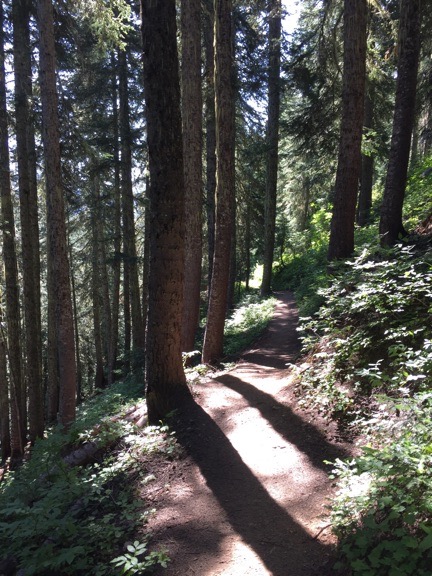
Along the trail to Maple Pass and Ann Lake.

The Maple Pass trail starts climbing immediately. It isn’t a steep climb, but it does begin with some switchbacks. I took my time — as I always do when climbing hills. I can hike all day at a good pace on level terrain or downhill, but put me at the bottom of a hill and you’ll need to be patient while I climb it.

Penny was freed from her leash when we reached the first fallen tree. She wanted to go under it and I couldn’t. So the leash came off and she hurried off up the trail, coming back when I called her and generally entertaining everyone who passed us. (That “he looks like Toto” thing is really getting old.) And lots of people did pass us, which was okay with me. I was in hill climb mode and not in a hurry.

I stopped to take a lot of photos, mostly of wildflowers. The light and shadows made lots of opportunities for me to capture a bloom in the sun against a darker, out-of-focus background. This was a lot easier with my Nikon than with the camera on my iPhone, so I have few photos to share here. (I can’t get my Nikon photos onto my laptop without an SD card reader, which I neglected to bring along; maybe I’ll pick one up on the west side of the mountains, later this week.) The trail was mostly very shaded, but every once in a while it would open up to a hillside with spectacular mountain views. That’s also when it would get very hot — at least 20° hotter in the sun than the shade — and I regretted bringing along my sweatshirt.

The heat combined with the relentless hill climb was starting to get to me after an hour or so of hiking. At 10:30, I decided I’d hike until 11 AM and then turn back. But a short while later, when we emerged from the woods again, I saw a crowd of at least 50 hikers up on the trail ahead of me. I immediately assumed they were part of a tour group — they were dressed in brightly colored clothes with small day packs on their backs and seemed to be split into large groups led by a person with what looked, from a distance, like a map. I imagined some sort of nature outing of city folk from Seattle closely examining the plants and rocks as they walked. They hadn’t passed me, which meant they were hiking slower than I was. Which meant I’d be passing them. And, at my current rate of speed, I’d likely be among them for at least 20 minutes. Clearly, it was time to turn back.

Open Trail
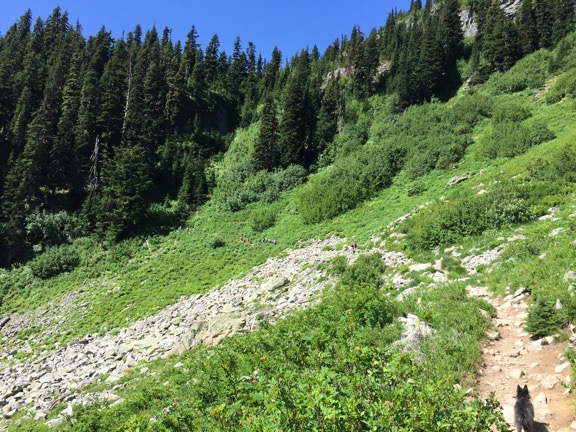
Here’s where I spotted that group of hikers. Can you see them? Only about 1/3 of them are in this shot; the rest had already entered the woods beyond them.

For the return hike, I activated the Gaia GPS app on my phone, mostly to get track stats. It already had the detailed maps loaded up; I’d done that last year. (Must remember to load maps for the rest of my trip when I’m back on the grid.) I snapped a few photos to include with the track and, with luck, will remember to upload it to the GaiaGPS site when I publish this later today. When I got back to the trailhead, I saw that I’d hiked just under a mile one way. That was just two miles total. Pitiful, even by my standards.

Colonial Creek Campground

After a pit stop in the Turtleback’s tiny bathroom — the toilets at the trailhead were too stinky — Penny and I continued in the truck on our way west. My plan was to camp one or two nights at the Colonial Creek Campground, where I’d stayed last year.

The road winds through the forest at a good clip and I did the best I could to stick to the speed limit so as not to slow up people behind me. The Turtleback raises the truck’s center of gravity considerably and, although it’s not in the least bit unstable, it feels very different when it’s so top-heavy. The drive was very pleasant, with views of at least a dozen small waterfalls along the way. I decided that, weather permitting, I’d take my motorcycle for the ride when I returned later that month for the photography class I’d booked at the North Cascades Environmental Learning Center on Diablo Lake. The road seemed made for motorcycling.

Diablo Lake from the Overlook
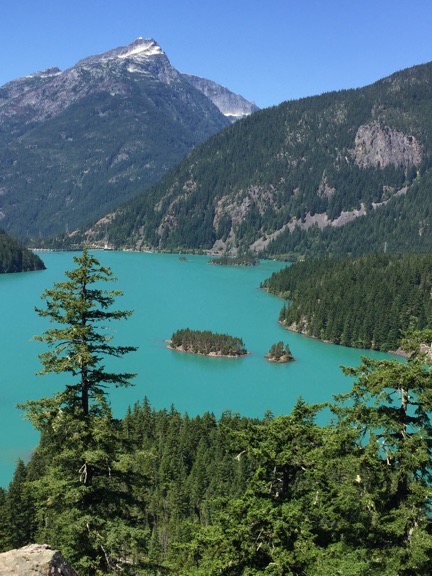
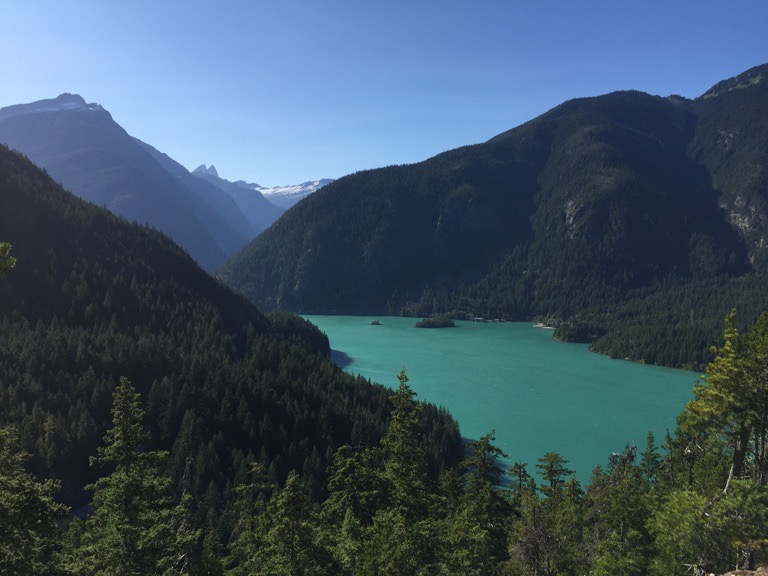
Diablo Lake, from the overlook on Route 20.

We passed the Ross Lake overlook without stopping, but stopped at the overlook for Diablo Lake. The incredible blue-green color of this lake’s water never ceases to amaze me. We took a nice walk along the rail on the edge of the drop-off and I shot photos with my phone’s camera along the way. Then it was back in the truck to finish the drive to Colonial Creek Campground.

I knew from last year that there were some sites right along Diablo Lake and I was hoping I could find one for the Turtleback. But as I drove through the campground, I also remembered that most of those sites — one of which we’d gotten the year before — were tent sites that you had to walk in to. A vehicle would be parked along the road, nowhere near the water. Great for tent campers but not great for RVers. I finished the loop, seeing one or two suitable sites on the west side that weren’t anywhere near the water but did have the privacy I prefer in campsites. Then I remembered the other part of the campground on the north side of Route 20. Colonial Creek ran along one edge. Maybe I could find a site along the creek?

Colonial Creek Campsite
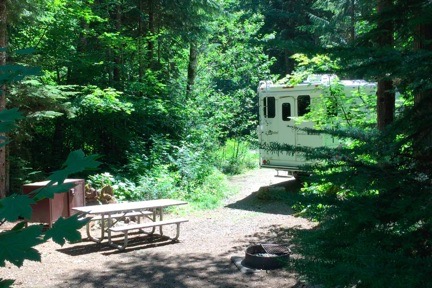
My campsite at Colonial Creek Campground was right on the creek.

I drove in and found what I was looking for almost immediately: a creekside site I could back the truck into. Although the front end of the truck was within 5 feet of the road, the back end — with the Turtleback’s door — faced the campsite and creek. I maneuvered the truck so that a large flat stone set like a curb to prevent vehicles from driving any farther into the site was right beneath the Turtleback’s step, making it easy to climb up and down. Although I couldn’t see the creek from the Turtleback, I could certainly hear it rushing by beyond some fallen logs. And a trail led right from the site to the creek. With trees on both sides, I had plenty of privacy from the occupied sites on either side of me.

By this time, it was well after noon and I was starving. I had a fridge full of vegetables and ground beef I had to cook. I sautéed the beef with onion, peppers, eggplant, green beans, and tomatoes. I would have added zucchini and yellow squash, but the pan was already too full. A touch of Spike seasoning and some pepper and I had a nice hot lunch. Even Penny had some.

While I ate, I studied the North Cascades National Park Map I had. Although I’d tentatively planned my trip for two days at Colonial Creek, without my kayak along I wasn’t sure what I’d do the next day. Maybe I could move along and explore another location? Maybe the Mount Baker area? There were some campgrounds that seemed accessible from what might be paved roads — not that lack of pavement ever stopped me. If I wasn’t going to do any paddling on this trip, I’d do more hiking and photography. So far, I’d been in places I’d been before; it was time to strike out and explore something new.

So when I walked with Penny and my checkbook to the pay station to pay for the site, I filled out the form and wrote the check for just one night: $16. I also chatted with a uniformed volunteer about fire regulations. Campfires were still allowed in the fiercest provided for that purpose. I had a bunch of cedar trimmings from a windowsill project at home as well as some fruit wood I could burn. Maybe we’d have a campfire later that evening.

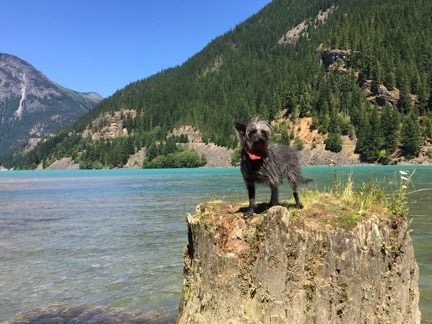
Dog on a Log
I took a picture of Penny on a stump in the lake. Why not?

We walked along the lake on the way back. I let Penny off her leash again. I stopped to chat with a man coming off the lake in a kayak. It looked sleek and light and a lot smaller than mine. He said it weighed 30 pounds but was 12 feet long. 12 feet! Mine was just under 10 and had to weigh at least 50 pounds. He’d bought it at REI. I figured I’d check them out if there was an REI near where I emerged from the Cascades on the west side later that week.

Back at the campsite, I spent a while starting this blog post. I had my phone plugged into the stereo system and was listening to old time vocals: Frank Sinatra, Tony Bennett, Dean Martin, Nat King Cole. Later, I climbed into bed for a nap with Penny stretched out napping nearby. It was a nice, relaxing afternoon, with no Internet distractions or phone calls or pressing tasks.

Vacation. Gotta love it.

Thunder Knob

I woke at about 4 PM. The campsite was in the shadows; although sunset was still more than 4 hours off, the campground is in a valley and the sun had already dipped behind the trees around us.

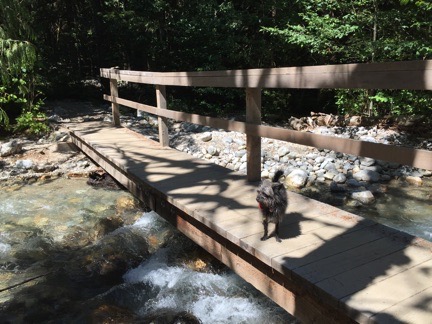
Bridge over Colonial Creek
Here’s Penny on one of the bridges over Colonial Creek.

I put on my hiking shoes, grabbed my waist pack with a bottle of water and ice and my camera, and headed out with Penny. The Thunder Knob trailhead was just down the road two campsites away. It was a 1.7 mile hike that I’d done the previous year with my camping companion. I remembered it being a bit of a climb on the way out but all downhill on the way back. After my dismal performance that morning on the aborted hike to Ann Lake, I felt a real need to redeem myself with a good hike.

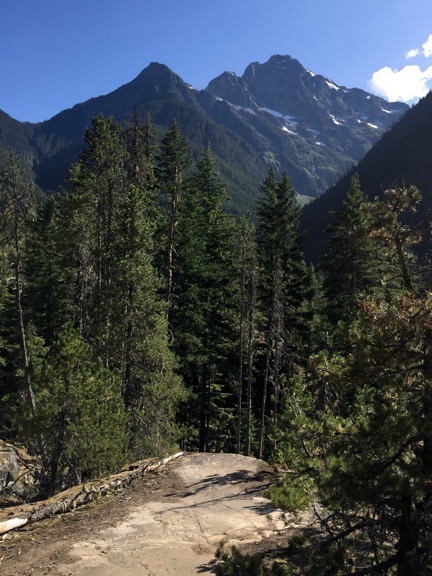
Mountain View
I’m not sure, but I think this is Colonial Peak.

It was pretty much as I remembered it: cross Colonial Creek on some wooden bridges, walk through the cool woods, and then start a climb, mostly on switchbacks, up a hillside laid bare in places by high winds or past fires. Once the climb began, it was remarkably dry and even got hot in places. There were no wildflowers — just scattered fir trees and lower vegetation. Occasionally, there would be a view of Colonial Peak or Diablo Lake or some other snow-studded mountain or glacier off in the distance.

As I hiked, I kept pace with a couple around my age that were stopping for rests almost as much as I was. They offered to let me pass and I declined, the first time, telling them they’d just pass me on a steep portion of the hill. But the second time they offered, I did pass. I felt amazingly energized after my lunch and nap — much better than I had that morning on the first hike. They kept pace with me for a while, but when I announced (after consulting Gaia GPS) that we were half way there, one of them said, “Half way? Have fun!” They stopped for a break and I kept going. I never saw them again.

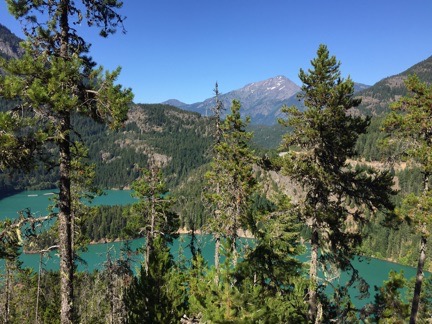
View from Thunder Knob
The view northeast from Thunder Knob.

The hike was worth it, though. The views of the lake from the top of Thunder Knob are nothing short of spectacular. It was cool and breezy up there and I could hear the wind in the trees and see the small whitecaps on the lake far below us. There were also very few people up there: just two couples. I think it was because it was the kind of hike that’s too long or strenuous for a casual hiker (like the folks I’d passed) and too short for a serious hiker. I’m apparently casually serious about hiking. When they left, Penny and I had the place to ourselves.

View from Thunder Knob
The view northwest from Thunder Knob.

It had taken us a little over an hour to get up there, but only forty five minutes to get back. I’m a gravity-assist hiker and get good speed when gravity is pulling me the same direction I want to go. The walk was, for the most part, in the shade or shadows and relatively cool. But humidity — especially near the bottom — got me working up a sweat anyway. By the time we got back to camp, I was hot and exhausted.

But I’d also broken my previous record for steps taken in a day: 18,095.

And yes, I have a trackless with photos from Gaia GPS. With luck, I’ll remember to upload it and link to it here.

Ending the Day

I opened the bottle of wine I’d bought in Mazama and poured a glass. Even though it was probably the worst Malbec to come out of Argentina, it still tasted good enough for a camping trip.

Although I felt as if I lacked the energy to take a shower, it definitely had to be done. It was my first shower in the Turtleback’s microscopic bathroom and it went surprisingly well. The water gets very hot and there was enough pressure to get the job done efficiently. Afterwards, I let the shower curtain hang open and draped the towel over the bathroom door to dry. It felt great to get into clean clothes, even though they were a night shirt and lounge pants.

I made a salad and gave Penny some leftovers from lunch. I did the dishes and briefly considered a campfire. But smelling smoke from the campfire next door reminded me that a campfire would just leave me smelling like smoke — a smell I didn’t want to take to bed. So I settled down at the dining table to read for a while, leaving the door open to let in the glorious sound of the rushing creek just 50 feet away.

When it started getting chilly, I closed up the door and whatever windows were still open and climbed up into bed. I managed to stay awake for about 30 minutes. I was dead asleep by 9.

Summer 2016 Road Trip, Day 1: The Road to Mazama

A late start, a free overnight stay.

I’m on vacation. After a 10-week cherry drying season that had the five pilots on my team flying more than 160 total hours (!), my last contract ended on Sunday, a beautiful cloudless day. Because I’m required to stay in the area for the entire season, I get a little stir crazy by week 7 or 8. I started planning a trip with my new camper, the Turtleback. I had some minor repairs and improvements made earlier this month and brought it home on Thursday. I began packing the next day. By Sunday morning, I was ready to go.

Kayak Blues

Or at least I thought I was. I still had one thing to get on board: my kayak. My trip would have me visiting lakes throughout the North Cascades, both in Washington and British Columbia (Canada). Clearly it would be nice to have my kayak along for early morning or late afternoon paddles.

The idea was the hang my kayak on the ladder on the back of the camper. My kayak isn’t anything special. It’s straight out of Costco and several years old. Plastic with a molded seat and storage space and a cup holder. Room for Penny to ride on the bow or between my legs. It’s the kind of thing that if it broke along the way, I wouldn’t lose sleep over it. Besides, I have two of them that are identical, mostly so visitors can come paddling with me. For this trip, I only wanted to bring one.

But no matter what I did, I couldn’t easily hoist it onto the ladder rack. I’d wanted to leave town by 10 AM and by 9 AM I was sweaty, still needing a shower, and had a handful of other more important tasks to complete. And the kayak was still lying on the ground in front of the garage.

I showered, dressed, and headed down into town in my Jeep. I’d rig something up with pulleys and my electric winch. I’d already confirmed that the camper’s onboard generator could power the winch.

Then I got home, had lunch, and did those other things. I was waiting for shade in my driveway. By 12:30, there was some shade, but not quite as much as I hoped. Still, I climbed the ladder, rigged the pulleys, and built a sling for the kayak. I attached the winch and hoisted the kayak into place. It was a struggle. The ropes and knots and hooks kept getting hung up on the ladder. I tried to imagine doing it in a campground or lakeside up in the mountains, possibly with a handful of people watching. I couldn’t paint the picture. I imagined bringing along the kayak and never using it.

I winched it back down and pushed it into the garage. I removed the rigging and put away the winch. I finished packing and loaded Penny on board the truck. It was 3:00 PM when I pulled out of the driveway.

On my way out of town, I bought an inflatable raft and an electric air pump. That would have to do.

The Generator

I had one stop to make on my way north: a gas station in Pateros, WA.

I owned two generators. One was a 1KW Troy-Bilt that had been bought way back in around 2000 for backup power at the vacation home I owned with my wasband. The generator had been in my Wickenburg hangar when I moved to Washington, so I’d taken it with me. The other was a 2KW Honda I’d bought in 2010 for use with my old Mobile Mansion. I only needed one generator. (Heck, you can argue that I don’t need any generators because my new camper has one built in.) So I decided to sell the smaller one.

I had no idea what it was worth, but I knew you could buy a Chinese-made one at Harbor Freight for about $100. Surely this one was worth more. I figured I’d list it on Craig’s list for $175 and see whether I got any calls.

The calls started coming pretty quickly. One guy who seemed very interested was living in an off-the-grid cabin about 17 miles from Tonasket. Tonasket near the border of Washington and Canada — not exactly close by. He was willing to drive down to get it, or to see if he could talk a friend into picking it up. I told him I’d be heading his way on Sunday and offered to meet him. (Why not, right?) So after several phone calls, including one to say I’d been delayed and another to say I was finally on my way, I headed for the Chevron station in Pateros, which was about a half mile past where I’d turn up the Method River.

I got there around 5. I went in, bought a heavily caffeinated beverage and some chocolate covered espresso beans. Then I went back into the truck to wait.

And wait.

I was just getting ready to roll out of there at 5:30 when he pulled up in a pickup truck with a water hauling tank in back. He was around my age with really nice long hair covered on top with a sort of trail guide hat. He greeted me with a friendly handshake and I brought him over to the truck, where the generator was sitting on a blanked on the back seat. He pulled it out — it’s very heavy — and laid it on the tailgate of his truck. I pointed out the power switch, fuel valve, and choke lever. He set everything up and pulled the cord. It roared to life.

He asked me if I’d accept less. I guess that’s something you’re supposed to do. I told him not after I’d hauled it up here and waited a half hour. He understood, although I think he doubted I’d been there a half hour. He counted out $175 and I put it away. We chatted for a while about what I do in the Wenatchee area and what he does up in Tonasket. (He’s a “Jack of all trades, master of a few.”) He was an interesting guy and it would have been nice to talk to him a while longer. But I had a vacation to get on and I wanted to be parked for the night before it got dark. We shook hands again and I went back to my truck. He was gone before I even pulled out.

The Campsite

I had no idea where I would be spending the night. The original plan had been Pearrygin Lake State Park north of Winthrop, but I couldn’t see spending $30+ for a campsite I’d only occupy for one night, especially if I didn’t have time to take advantage of any of the facilities. So I drove north through Twisp and Winthrop towards Mazama with the idea of finding a quiet spot in the National Forest.

Twisp was relatively quiet — although I didn’t drive through the business part of town — but Winthrop was hopping. The town was full of parked cars with plenty of people out and about. I was pretty surprised — after all, it was after 6 PM on a Sunday night. I assumed the tourists would have gone home by then. But then again, it is still summer. I rarely vacation in the summer months because I want to avoid crowds, so I really have no idea how a typical summer week plays out.

I have to say that it was interesting to visit the area in the summer. I come up to the Winthrop area annually for Christmas — at least I have for the past three years — to do some cross-country skiing. The area is always covered with snow. Last year I drove through in the summer on a camping trip with the guy I was dating at the time and again in the autumn when I went for a weekend mushroom seminar at the North Cascades Environmental Learning center. (I’ll be back in late August for a nighttime photo class.) The hillsides were the same golden color they are around my home, but the valley was lush and green. There was one field with tall grass that had gone to seed; the wind whipped it around and the seed heads seemed to flow like water.

There was a recreation side at Mazama that indicated camping was available, so I turned in and headed north up Lost River Road. I didn’t remember any campgrounds up that way, but I did remember a parking area for a Sno Park. When I got there, it was big and flat and empty, surrounded by fir trees. The pit toilet was unlocked and was probably the cleanest one I’d ever been in.

By this time, it was after 7 PM. Sunset was in over an hour, but the valley was already in deep shadows. I could drive back to Mazama and continue up route 20. But I didn’t know how far I’d have to drive before I found a suitable place to park for the night. Do I leave a known in search of a suitable unknown? The answer was no. I’d had enough adventure for the day. It was time to kick back and relax.

First Campsite
Our first night’s campsite, just north of Mazama, WA.

So I parked the truck, opened the Turtleback’s slide and set about organizing my hastily packed belongings.

A while later, I had my portable grill out with a hamburger sizzling and two small eggplant from my garden grilling beside it. A sliced tomato from my garden completed the meal.

My only regret: I’d forgotten to pack a bottle of wine.

Cross Country Flight: Sacramento to Seattle and Wenatchee

A look back at a memorable flight.

Since the winter/spring of 2013, my helicopter has spent two months each year in the Sacramento area of California on a frost control contract. I fly the helicopter down in late February and fly back in late April. I usually take along a fellow pilot who does most of the flying to build R44 time and shares the cost of the flight. Most of these people are relative strangers and although they’re usually nice guys or gals that I stay friends with after the flight, I admit that I prefer flying with people I already know pretty well. So this spring, when it came time to start thinking about that return flight, I started thinking about who I could invite to join me.

The answer hit me like a lightning bolt: of course I should invite my friend Don.

Don’s been a pilot for much of his life and has flown airplanes and helicopters. I don’t know how much time he’s logged, but I’m certain it’s more than my 3,300 hours. I also know he has tons of cross-country experience, including helicopter flights between the Seattle area and Alaska.

Why Don?

You might be wondering why I’d invite such an experienced pilot when there were so many low-time pilots who’d likely jump at the chance to fly with me on a six to eight hour cross-country flight. There are three reasons.

First, Don is a good friend I’ve known for years. He and his wife were very supportive during my crazy divorce, and you know what they say about a friend in need. He’s easy going and has a good sense of humor. I knew I’d enjoy spending time with him.

Don't Helicopter at PHX
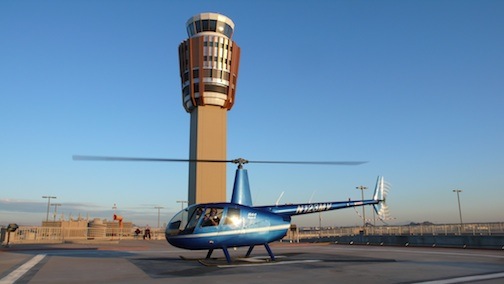
Don’s helicopter on the T3 Helistop at Sky Harbor Airport in Phoenix in 2009. After I shared my experience approaching and landing at the helistop, he often picked up and dropped off visitors there. Later, in October 2012, he dropped me off there when I was off on one of my many trips.

Second, Don had owned a helicopter very much like mine — in fact, it was only six months newer — which he’d kept in his garage at his Seattle area home. About two years ago, he sold it. I knew he hadn’t flown much since and probably missed it. He would appreciate the flight; surprisingly, not everyone I’ve invited to fly with me on a long flight has.

Third, because Don already had so much flight time, he’d actually share the flight with me. After all, I like to fly. When I fly with other pilots, they’re paying for the privilege of every minute of stick time they can get. They don’t want to share the stick with me and I don’t feel comfortable asking them to.

So I texted Don to see if he was interested. The response came almost immediately. Hell, yes!

Getting to the Helicopter

Don has two homes, one in the Phoenix area and one in the Seattle area. He made arrangements to be in the Seattle area on the day we’d go south to fetch the helicopter.

I booked my flight from Wenatchee to Sacramento, which included a plane change in Seattle. Don booked his flight from Seattle to Sacramento on the same flight. Since Don always flies First Class, I bought a First Class ticket, too. When he booked his flight, he got the seat right next to mine.

We met at the gate for the Seattle to Sacramento flight. I’d been at the airport for two hours and had treated myself to a breakfast of trout and eggs at Anthony’s. Don had also been at the airport for a while and had breakfast.

I had Penny with me, of course. She’s always excited when she sees me take out her airline travel bag. She’d gotten back into the bag at the gate before Don arrived and he didn’t even realize I had her with me until we boarded.

There wasn’t supposed to be breakfast on our flight, but there was; a nice yogurt and granola bowl with fresh fruit that would have gone nicely with the Bloody Mary I couldn’t have. (First Class on Alaska Air really is worth the extra cost. Can’t say the same for all airlines.)

On the flight, we chatted, ate, read. Time passed quickly. We were on the ground by 10:45 AM. With no bags checked and a quick exit from the plane, we were at the curb waiting for our Uber driver by 11 AM. Penny seemed happy enough to be out of the bag, sniffing around someplace she was pretty familiar with. After all, we’d flown to Sacramento quite a few times over the past four years.

It was about a 30 minute ride to the airport where my helicopter had been parked on the grass for two months. I settled up my bill for parking and said goodbye to the staff there. Don preflighted and installed the dual controls while I folded up the cockpit cover and tie downs and went to work setting up my GoPro. That’s when I realized that I’d left the Mini SD card for the camera at home. Duh-oh! There would be no video from the flight.

California to Washington

We’d discussed our route briefly on the flight down. Neither of us was in a hurry and both of us leaned toward a flight up the coast, which would add about an hour to the flight time.

Marine Layer
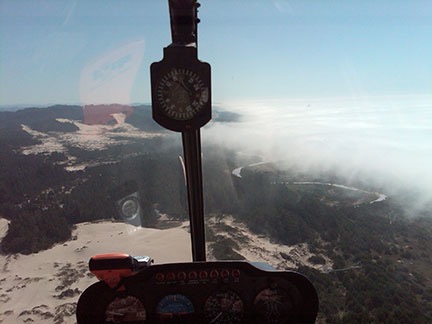
Here’s a shot of the marine layer on the coast of Oregon that forced us inland during a flight from Seattle to Wickenburg with my wasband in 2009.

My experience with flying the coast was varied. What I’d learned was that if I could get to the coast, I probably wouldn’t be able to follow it all the way up. The California and Oregon coasts are well known for their “marine layer” clouds. Although I’d flown the coast many times in the past, from Los Angeles to the Columbia River between Oregon and Washington, those damn clouds always made an appearance, forcing me inland so I’d never covered more than one or two hundred miles at a stretch. Last year, when I’d flown north by myself, planning on a coastal route, clouds with rain moved in not long after I hit the coast, forcing me inland for a dreary flight with more scud running than I like to do.

But nothing ventured, nothing gained, eh?

We followed Cache Creek west into the hills. I did the flying. I’d been wanting to fly Cache Creek all winter, but truck troubles had messed up my March plans and I wound up spending most of the month home instead of with the helicopter. I hadn’t flown nearly as much as I wanted to. This was my chance to get flying out of my system, flying a familiar and loved route. Somewhere in the hills, I turned the controls over to Don and he steered us over Clear Lake. Although the weather was clear where we were, there were clouds to the west (of course) and neither of us were sure whether they came into the coast or were off over the Pacific.

After flying up Highway 101 for a while, we decided to try heading west to see if we could make the coast. So we followed one of the canyons — I’m not sure, but I suspect it was the one the Noyo River flows in — concentrating on the path ahead of us. As expected, we were moving right in toward the clouds, which forced us lower and lower. But ahead of us, to the northwest, the sky was bright. Maybe it was clearing up?

We were flying about 300 feet over the road, stretching our necks to peer ahead of us and ready to turn around as the road went around a bend at a high point in the hills. We followed the bend and the road dropped away. We kept going.

Low clouds kept us flying low in the hillsides near Fort Bragg. We turned north, heading for our first fuel stop at Eureka. The coast was to our left and we occasionally caught glimpses of it as we flew over tree-covered hills with the clouds only a few hundred feet above us. I don’t think either of us wanted a trip up the coast in such conditions — I know I didn’t. But I also didn’t want to fly the I-5 corridor, which is painfully boring, especially once you get north of Eugene. We’d make a decision at Eureka.

The ceilings were much higher when we stopped for fuel at Eureka. We gassed up; Don bought the first tank. Then we went inside for a potty break. There wasn’t much else to do there — although the airport has a nice little pilot shop, there was no restaurant and nothing was within walking distance. So we climbed back on board and continued on our way, this time following the coast.

Cloudy Coast
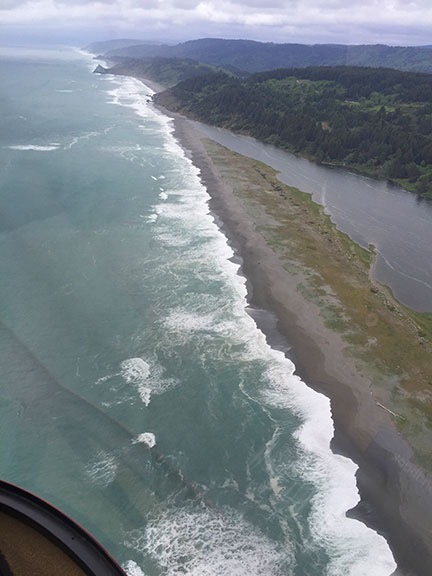
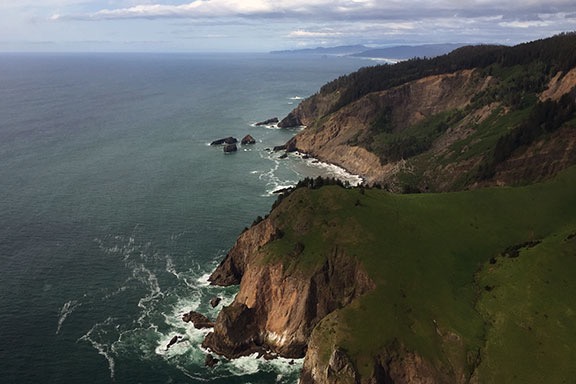
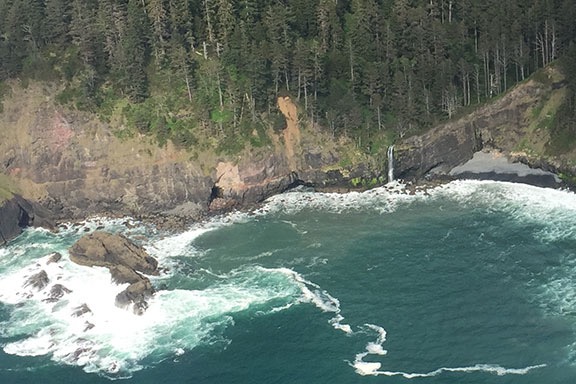
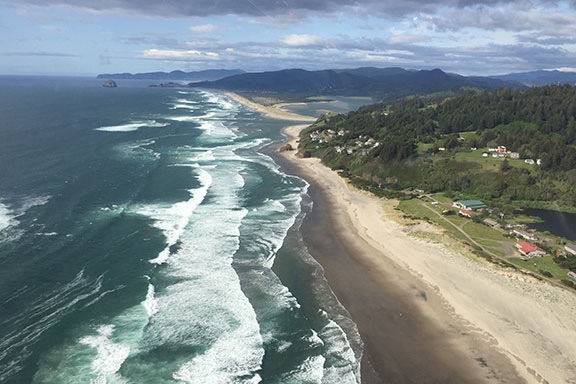
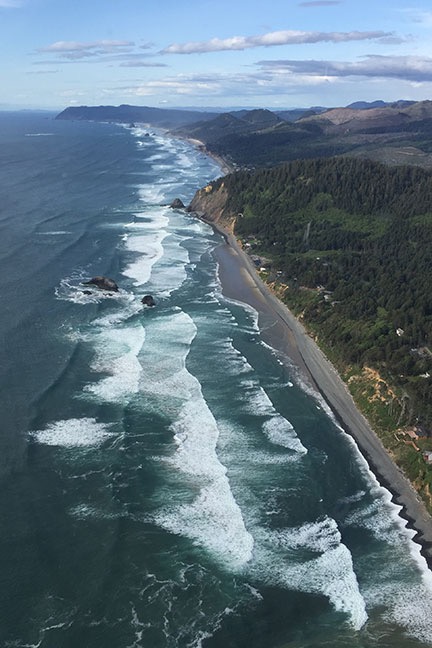
Despite the clouds, it was beautiful on the coast.

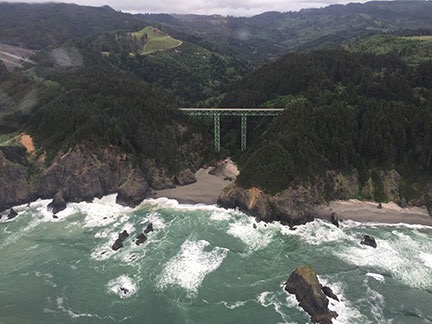
Brookings Bridge
If you’ve driven on the Pacific Coast Highway — Route 101 — through Brookings, CA, you’ve driven over this bridge.

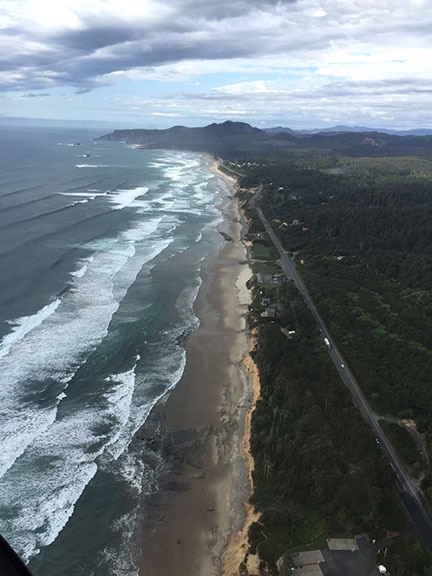
Near Newport
The coast near Newport, OR. I love the way the breakers line up when you see them at just the right angle.

Lincoln City, OR
A look down into Lincoln City, OR.

By this time, the scenery around us was interesting enough to take some pictures while Don flew. The doors were on, of course, so most of my photos have reflections and glare and even window dirt. But they give you a feel for what the weather was like and show a little of how beautiful the California and Oregon coasts can be from about 500 to 1000 feet up.

The coast was very rugged at the beginning, where the Redwoods National and State Parks come right up to the rocky shoreline. There were no roads in many places — just trees right up to the cliffs with lots of small waterfalls dropping down into the ocean. This is a view few people see, a view that can only be seen from the air off the coast. Don steered us along its left, over the ocean, just within gliding distance of land.

In some places, we saw sea lions stretched out on rocky beaches. I took pictures, but they didn’t come out good enough to share.

The Pacific Coast Highway hit the coast and then went inland several times. Finally, just before we hit the Oregon state line, it came out to the coast and stayed there for quite a while.

The weather got a little worse at first, with light rain pelting the cockpit bubble in more than a few places, then started to get better. By the time we got into Oregon, we saw patches of blue sky. The sun was shifting ever lower toward the horizon to the west and the light started getting kind of good.

Good Light on the Coast
Light is 90% of photography.

Waterfall
Waterfall near Otis, OR. Yes, I cropped this image; we weren’t that close.

Cloverdale
Cloverdale, OR looks like a pleasant place to live, eh?

Tillamook, OR
Don fueling up at Tillamook. The huge hangar behind him was used for airships years ago. I think there’s a chance it might be an air museum now.

We made our second fuel stop at Tillamook, OR. Don pumped while I paid. It was just after 5 PM and the airport office (and restrooms) were closed. It was also chilly. I let Penny loose to do her business, then called her back to get back on board. We didn’t hang around.

Oregon Coast at Seaside
The Oregon Coast near Seaside.

By now, we were hungry. Two breakfasts had filled us before noon, but skipping lunch hadn’t gone unnoticed. Don had been texting back and forth with his wife who would have a hot dinner waiting when we arrived at their Seattle area home.

We continued up the coast a bit more before heading inland not far from Astoria, where the Columbia River meets the Pacific Ocean. This was, by far, the longest stretch of the Pacific Coast I’d flown in one day: more than 400 miles.

Don navigated northeast toward his house. It was all familiar territory to him — I didn’t fly much west of the Cascades. We flew east of Olympia and right over the top of the airport at Puyallup. From there, it was only a few minutes to Don’s place.

My iPad, with Periscope running, broadcast the approach in typical low-def quality.

Don let me take the controls and guided me in. I’d flown to his house before a few times but honestly couldn’t remember much about the approach. He had to keep pointing out landmarks and reminding me to slow down. It is tight — that’s for sure — with a steep approach between tall trees into a clearing beside his garage. I had Periscope running on my iPad in its cradle and recorded the whole thing.

And then we were on the ground, the long part of my journey over.

Resting Up

We went in and had something to drink while Don’s wife, Johnie, finished making dinner. Penny played with their new dog and ran around their grassy yard occasionally taking a detour to terrorize their chickens through the fence.

After dinner and a nice dessert, I went out to the barn with Don to see the two cows they’d “rescued.” They were huge. I really wish I’d had the presence of mind to take a photo, but I was so shocked by what I was looking at that I simply didn’t think of it.

I hit the sack in the guest room pretty early. I was still fighting a cold I’d had for at least three weeks and was exhausted. I slept well with Penny at the foot of the bed.

Seattle Area to Wenatchee

In the morning, after letting Penny out and then taking a quick shower, I dressed and met my hosts for breakfast. It was overcast and questionable (as usual) as to whether I’d make it across Snoqualmie or Stampede Pass. The automated weather station at Stampede was reporting half-mile visibility, which was enough to get through legally. But what about the rest of the flight? There was no accurate weather reporting in other places in the mountains. The only way to find out whether I’d make it was to give it a try. If I couldn’t get through, it was a long flight around the Washington Cascades to the Columbia River Gorge. I was hoping I wouldn’t have to go that way.

Don's Heliport
Another cloudy morning at Don’s place.

After thanking my guests and saying goodbye, I did a quick preflight, added some oil, and climbed on board with Penny. Then I started up and warmed the engine, setting up my iPad and iPhone with weather resources and Firelight maps to guide me while I waited. When the helicopter was ready to go, I picked up into a hover, turned 180 degrees over the driveway, and climbed out through the trees the way I’d come.

I had ForeFlight’s track log feature enabled during the flight, so I know exactly how I went. Originally, I thought I’d hook up with I-90 and follow that through the mountains at Snoqualmie Pass, which is at 3004 feet. But that would require me to head north quite a bit before heading southeast. It didn’t make sense to go out of my way. So instead, I followed the course of the Green River up into the mountains, aiming for Stampede Pass, which is higher at 3800 feet, but had that handy ASOS weather station. The weather there was reported at 1/4 mile visibility with mist, but I knew that could change at any time.

My Route
An overview of my route from the Seattle area to Wenatchee. Not exactly a straight line.

In the meantime, the flight was pleasant, even under the clouds, taking me over the Howard A Hanson Reservoir and a few communities that were no more than named points on the map. The area below me was thick forest, for the most part, with a road following the river for part of the way. I wish I could have taken pictures, but I’m a terrible photographer when I’m flying. I really missed my GoPro on that flight.

I steered up another canyon to the left just past Lester, heading for Stampede. The only roads were forest roads now as I climbed with the hills, getting ever closer to the cloud bottoms. Soon, I could see Stampede Pass ahead of me. I’d forgotten all about the wires that crossed through the lowest (and clearest) spot. I’d have to cross at a higher point a bit east where the clouds seemed to touch the ridge line. I could tune into the ASOS by that point; it was still reporting 1/4 mile visibility with mist.

My route over the pass
Here’s a closeup of my route (the blue line) through the Stampede Pass area on a Sectional Chart. I crossed the mountains just southeast of the pass, not at all interested in crossing over all those wires.

I slowed to 40 knots and creeped up to the ridge. I knew the rules I’d set for myself, rules that had never failed me when dealing with weather flying: if I could peek over the ridge and see the ground and my path ahead, I’d cross the ridge. Otherwise, I’d have to backtrack or find another place to cross.

I peeked, I saw. The ground dropped away ahead of me as I crossed the ridge near the pass and descended down into the valley beyond. Soon I was flying over I-90, past the lakes near Roslyn and Cle Elum. I steered east northeast, then due east, then northeast, direct toward home.

I crossed the mountains south of Wenatchee at Mission Ridge and made a slight detour to check out the slide damage areas at Whispering Ridge and Joe Miller Road. Then I made a beeline for the airport to get some fuel and take care of some paperwork with my mechanic.

A short while later, I was landing on my platform, which I’d left outside before heading down to Sacramento the previous day. It was good to get the helicopter put away.