Snowbirding 2017: About the Campsites

And how I find them.
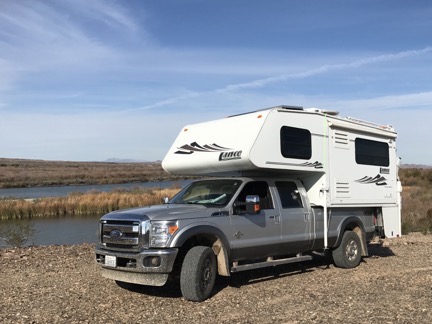
Adventure Truck
Adventure Truck and the Turtleback off road near Cibola Lake on the Colorado River.

I’ve been on the road since the day before Thanksgiving — an early start to my annual snowbird migration to points south. Other than a little over a month spent at a friend’s guest house in Wickenburg, AZ and three days spent in another friend’s guest house in Phoenix, I’m been camping out in my truck camper, the Turtleback. It’s a fully-contained RV with a queen size bed, refrigerator, stove, convection microwave, sink, and bathroom. It can carry 14 gallons of propane, 40 gallons of fresh water, and a total of 60 gallons of wastewater (in two tanks, black and gray). There’s a propane furnace for cold nights and an AC air conditioner for hot days. The two batteries have plenty of juice for overnight stays, are charged by a solar panel during the day, and can be supplemented by an onboard propane generator with the flick of a switch. With its dinette and refrigerator on a slide out, it has plenty of room for one (or two who like each other a whole lot). Best of all, it can go just about anywhere my truck can go and since my truck is a 1-ton 4WD diesel with high clearance, it can go pretty much anywhere it wants to go.

This ain’t no KOA parking lot rig.

Now that I’m back on the road again after my Wickenburg stay, I’ve been sharing photos of my campsites with friends on Twitter and Facebook. The other day one of them asked how I find my campsites. I thought that might make a good blog post.

What I look for

First let me start by explaining what I look for in a campsite.

I want something quiet, private, and safe. I don’t like to listen to generators and I don’t like to close my blinds.

I like a view, but don’t need one. I love camping near moving water or a body of water that’s smooth and reflects the sky.

I must have relatively level ground, although I do have leveling blocks to make minor adjustments if a site has a slope to it. (The camper does not need to be perfectly level.)

I also want something free or cheap or at least worth what I’m paying for it. So far, of the 23 days I’ve spent camping, I’ve only paid for 5 nights. Prices for those campsites — one state park campground, two BLM campgrounds, and two nights at a Las Vegas campground (yes, they have them) — ranged from $5 to $23 per night.
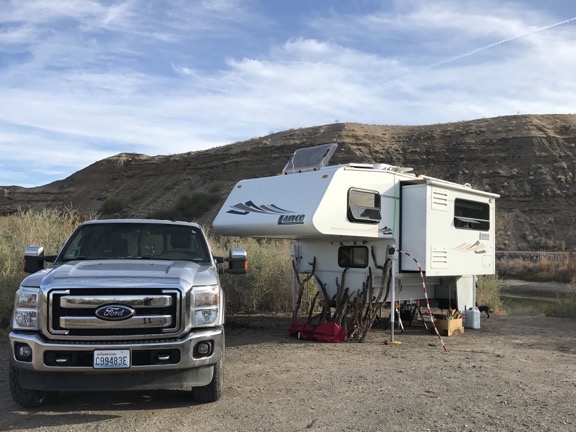
Colorado River
I spent about 10 nights at this free BLM campsite along the Colorado River south of Ehrenberg with some friends. We were on a peninsula and surrounded by water, so I got some fishing and paddling in while I was there.

Because I’m self-contained, I don’t need any hookups or even access to water or a dump station. (This, by the way, is often called “dry camping.”) Picnic tables are nice to have, but I don’t need a fire pit because I don’t usually have a campfire when I’m traveling alone and I have a portable BBQ grill if I want to grill something up. Although these things are nice for long-term stays, they usually come with neighbors so I lose any possibility of quiet or privacy. Those are actually more important to me than the convenience of being hooked up to utilities.
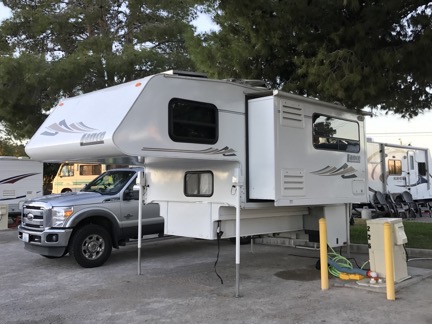
Las Vegas Camping
I spent two nights at a Las Vegas campground so I could take in two shows. At $23/night, it was the most expensive overnight stay, but it had clean, hot, private showers.

I’m not opposed to staying in a regular campground with a full hookup once in a while. It’s a good opportunity to dump my tanks, take a long hot shower, top off the charge on my batteries (if needed), and refill my fresh water tank. But as I recently learned after 10 days of dry camping south of Ehrenberg, my black water tank can hold at least 10 days of waste and I don’t use much fresh water. (It probably would have been a perfect stay if it weren’t for battery issues that were resolved when I left by simply replacing two bad batteries.) But the parking lot atmosphere of most RV parks is a real turn off to me and it irks the hell out of me to pay $30, $40, or even $50 to spend a night there.

Where I look

First, I’ve learned over time where the kind of campsites I want can be found.

When Free isn’t Free
Keep in mind that some areas — including the Icicle Creek area I discuss here — require an access pass for parking. I buy my passes annually and keep them in my truck for hiking and camping, which I do three seasons out of the year. It’s worth it to me and I like supporting the park system.

Public land, including National Forest (NF) and Bureau of Land Management (BLM) and sometimes even State Forest (SF) land almost always has some free “distributed” camping. Distributed camping is camping allowed off forest or desert roads in established campsites that are not necessarily in campgrounds. For example, a drive up Icicle Creek in the Leavenworth, WA, area will take you into National Forest with several established campgrounds. Those campgrounds have level parking space, picnic tables, fire rings, and access to toilets and sometimes even water and you’ll pay a fee to use them. But off the main road are side roads with campsites scattered here and there. Those campsites are usually free.

Did you know that you can camp in the NF just outside Grand Canyon National Park for free? And if you know where to look, you can even find back roads into the park that can help you avoid entrance lines? It’s like camping near your own private entrance to the park.
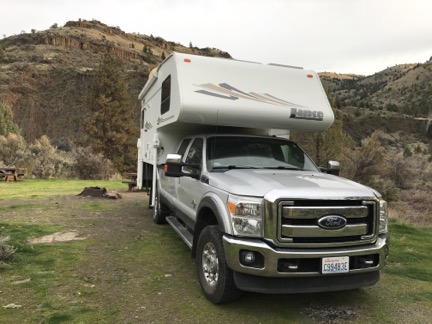
Near John Day
My Thanksgiving dinner campsite on a tributary creek to the John Day River in Oregon.

Even the campgrounds in NF, BLM, and SF areas can be quite a bargain. On Thanksgiving night, for example, I had an entire campground on a creek in Oregon to myself. My back door looked out over the creek, it was dead quiet and completely private, and I had a picnic table and fire ring if I wanted to use them. There was even a very clean pit toilet a 250 feet from my site. All for $5. I can’t complain, can I?

State and county park campgrounds can also be nice, although they can be spendy and are usually crowded on weekends. Washington state campgrounds can be outrageously priced so I generally avoid them unless they have features I can’t get elsewhere.

How I find them

This is where experience is a good teacher. The more I look for and find sites, the better I become at doing it. And getting a feel for an area is also extremely helpful.

I use a few online tools to get started. I start with Google Maps to get a general feel for the area I want to spend the night. What’s there? Towns? Parks? Points of interest? NFs appear on Google Maps; when I get the name of a NF, I can Google it and get details, including detailed maps that show parking areas and forest roads.

I can also go to the BLM website and search its maps for nearby BLM land. Then I can get details about possible camping areas or campgrounds.
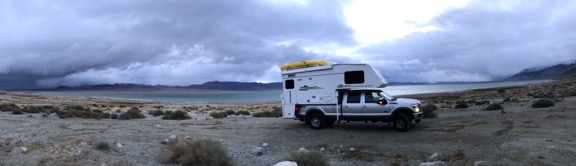
At Walker Lake
I needed a place to stay near Hawthorne, NV, where I planned to meet up with a friend of a friend. No problem: free camping on the lake on BLM land. Too bad the weather was so stormy!

Once I know for sure that camping is allowed in an area, I can use Google’s satellite view to get a look at potential sites. Keep in mind that map view isn’t always accurate — for example, Google maps shows a through road along the levee where we camped in early January; in reality, there’s an inlet cut through the road that clearly shows in satellite view. Satellite view will also show clearings in forested areas, side roads, and even fire pits that indicate an established campsite.
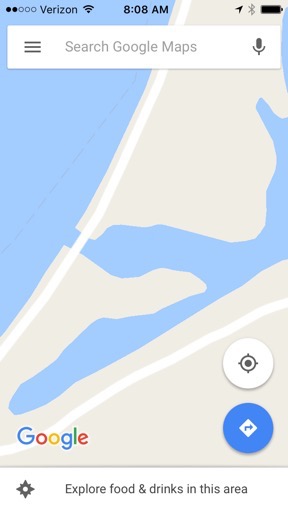
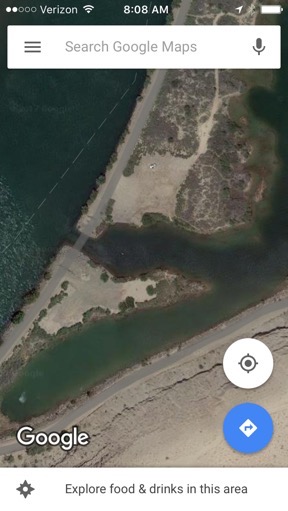
Map View Satellite View
In map view, it looks like the road crosses right over inlet (left) but satellite view tells the real story (right). We camped in the clearing just to the east of where the north side road ends.
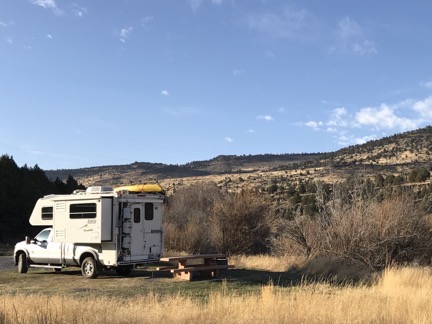
Oregon Camping
I had a streamside campsite in central Oregon. There were about two dozen deer roaming the campground when I arrived late in the afternoon. Only five of the 30 or so sites were occupied.

Another somewhat obvious trick is to simply ask around. For example, when I was near Burns in Oregon looking for a place to stay on my way south, I saw some BLM land that showed a campground. It was pretty remote and it was late in the day; I worried that it might not be suitable for me and then I’d be stuck driving at night, which I hate to do. I Googled BLM and found a BLM field office. (The same one that was in the news a lot last year.) I was close enough to drop by and chat with a ranger. He assured me that the campground was open and would accommodate my rig. I made the hour-long drive south and found what might have been the nicest campground so far. I picked a site along the creek and paid only $8/night.
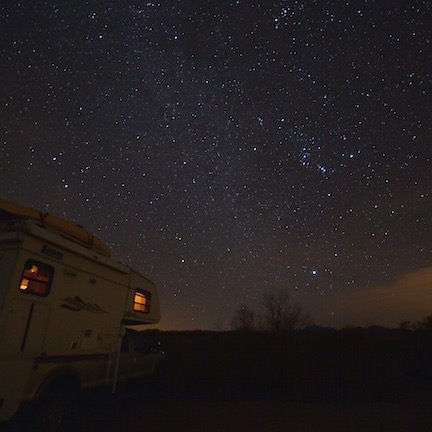
Cibola
A bonus to this campsite along the Colorado River just outside of the Cibola Wildlife Refuge was the incredibly dark night sky. I got to practice my astrophotography skills not long after sunset.

I also ask friends. The campsites I stayed in last year and this year south of Ehrenberg on the Colorado River were sites my friends knew well, having camped there for many years. My friend Janet showed me other sites. I found still more just wandering around on my own, like a campsite father down the river near a wildlife refuge.
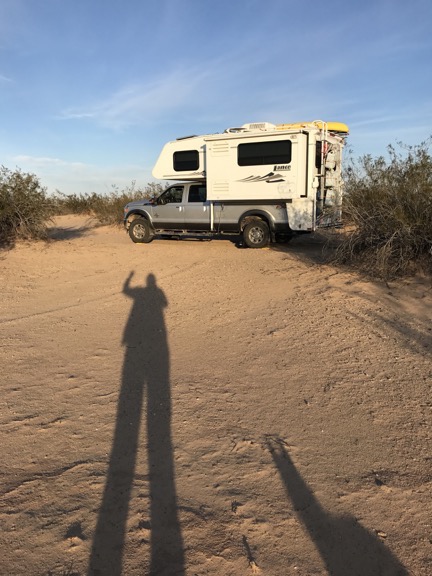
Near the Hot Spring
Greetings from somewhere south of Holtville, CA!

I found the site I was in the last night before my side trip to San Diego (where I am now) by a combination of methods. A friend told me about the hot springs along I-8, although he was pretty sketchy about the name and location. Google maps found the place and directed me to it. A review on Google told me it was BLM with camping available and the reviews were pretty good. The campground host at the long-term (i.e., fee) camping area directed me to free 14-day limit camping about 2 miles south of the hot spring. I drove in, found a level spot, and parked for the night. Only two cars drove past during the 16 or so hours I was there so it was plenty quiet. I got a great night’s sleep — with the bonus of a good hot tub soak in the morning before I hit the road.

I’ll leave San Diego later today and head back east toward Arizona. I’ll spend a night or two in Borrego Springs, following up leads for free campsites with good hiking on BLM and NF land. Then the plan is a side trip to the Salton Sea where I should be able to find a site in the state park there. Then back to Quartzsite for a few days; there’s plenty of free camping out in the desert. After that, who knows? I’m making it up as I go along and only tentatively plan things out a week or so in advance.

I love the flexibility I have on this trip with my smaller rig. I also really love the freedom to make things up as I go along, without having to get approval from (or listen to complaints from) a travel companion. So far, most of my sites have been better than I expected and, as you can imagine, I’m very pleased about that.

I do admit that things can get a bit stressful late in the day when I still don’t know where I’m going to park for the night. But there’s aways plan B: a truck stop or Walmart parking lot. (Fortunately, I haven’t had to resort to either one so far on this trip.) Or a KOA.

Do you have any campsite tips you’d like to share with readers? Please do use the comments link or form to let us know. I’d certainly love to get some new ideas. You can never know too much.

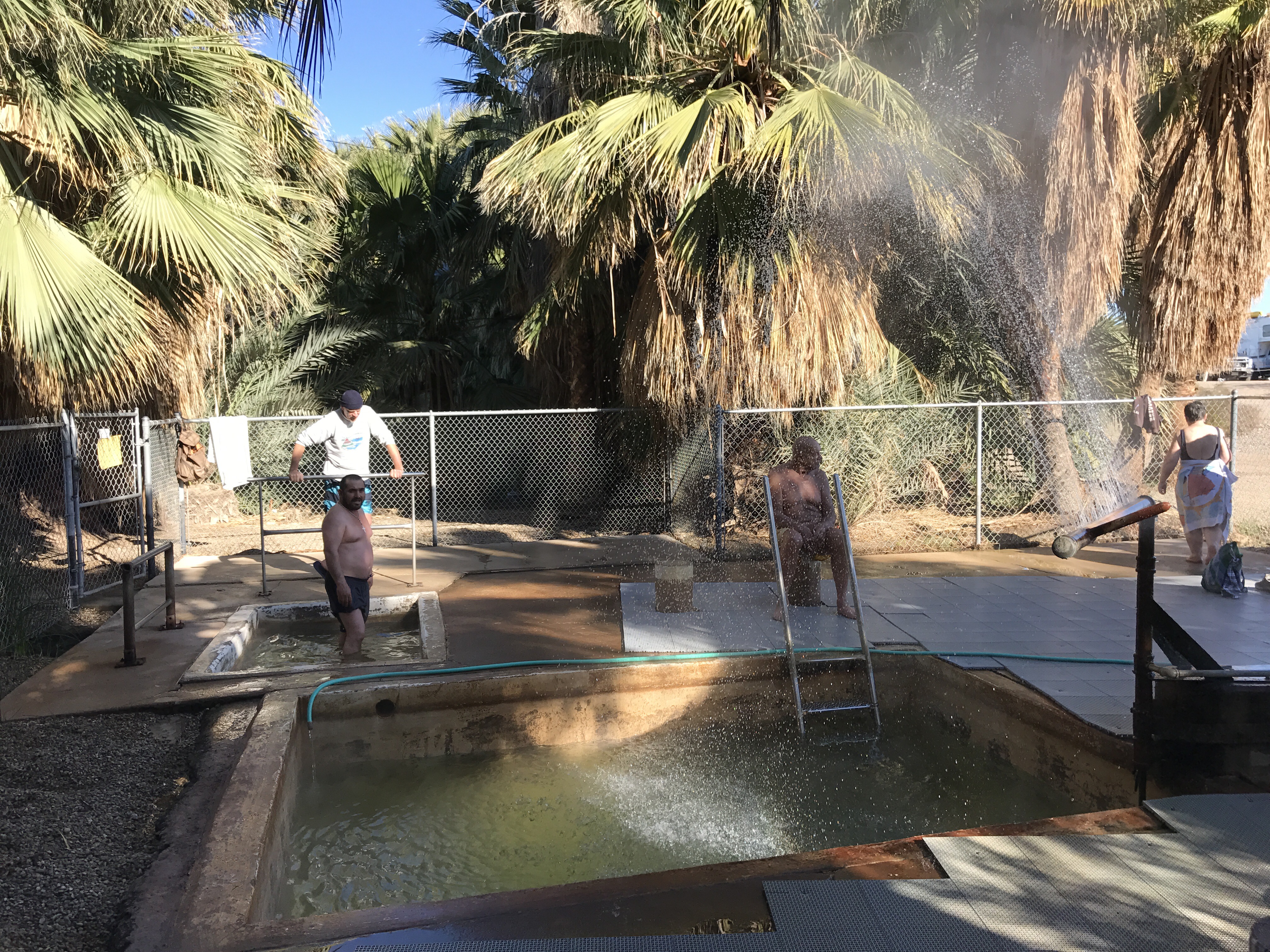
Snowbirding 2017 Postcards: The Hot Springs

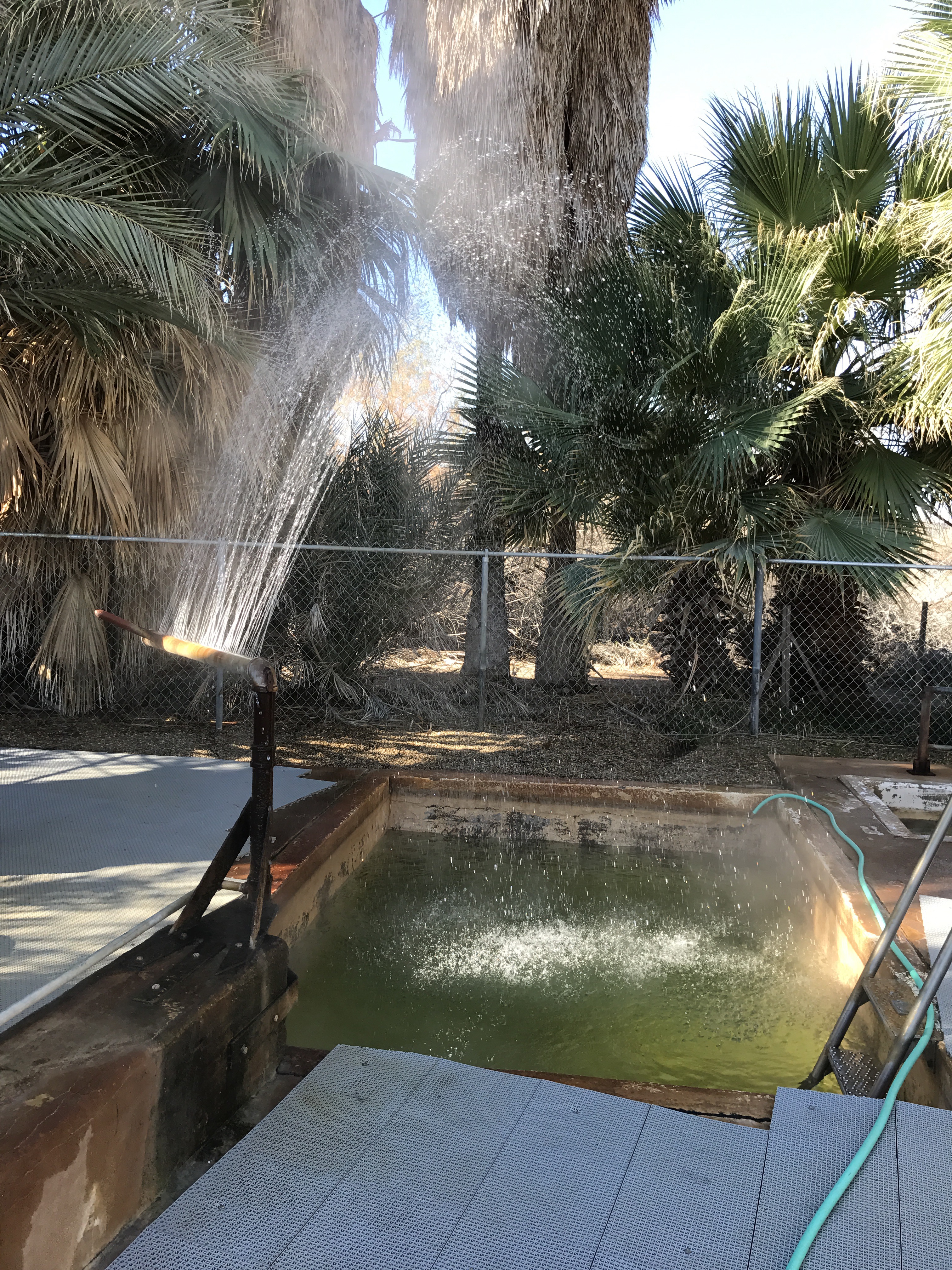
Just a quick bunch of photos. These hot springs are right off I-8 near Holtville. Managed by the Bureau of Land Management (the original BLM), they are clean and spacious. Two tubs: a large, deep one that’s about 105-110 degrees and a small, shallower one that’s a bit cooler. Then there’s a small, palm-lined pond that the water drains into; it’s much cooler and quite beautiful. Mostly snowbirds, so I’m the youngster here. Very few people using the springs at 10 AM. 

Snowbirding 2017: Life at the Colorado River Backwaters

Back at the backwaters.

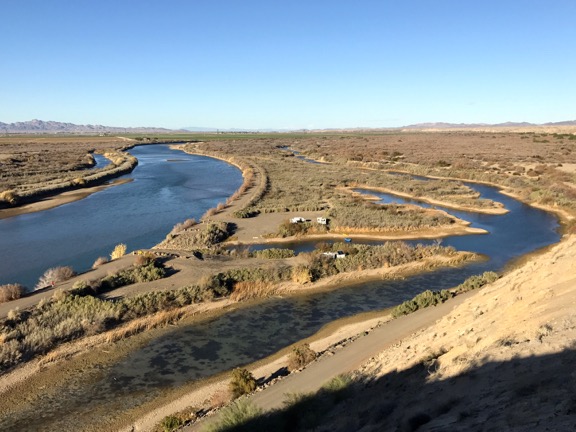
For the second year in a row, I’m camped with some friends in some BLM land south of Ehrenberg, AZ, right along the Colorado River. This year’s site is on the north side of an inlet into some channels that parallel the river on the otherwise dry side of a levee. We’re on a peninsula across the inlet from where we camped for a while last winter. My friends preferred this spot because it gets sunlight earlier in the morning; the other spot is in the shadow of some 200-foot high cliffs to the southeast for too much of the morning. Sunlight is everything in the winter, especially when you’re getting most of your power from solar panels.

The Backwaters
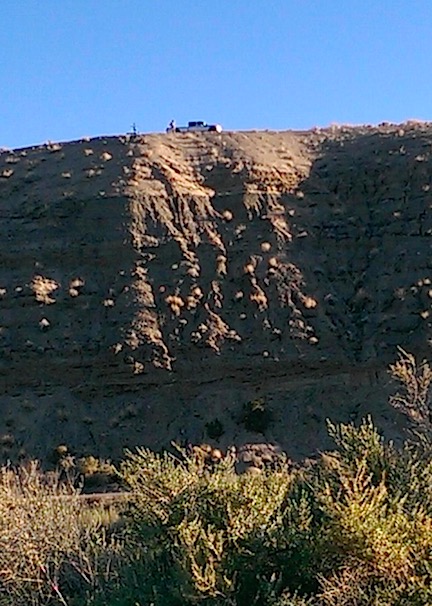
A look down at this year’s campsite from the top of the cliffs to the southeast. Our site, which is just about dead center in this shot, consists of my truck camper, Janet’s little pull trailer, Janet’s workshop tent, and our two vehicles. (My truck was with me at the top of the cliffs when I shot this photo.) The “backwaters” is the forked channel on the right side of this image.

The site is somewhat remote: seven miles from pavement. Other than the folks camped out across the inlet and the occasional camper driving in to see if this site is occupied, we’ve got a lot of privacy and solitude. Across the river is an RV park that’s remarkably quiet, although they do have a bunch more lights than I wish they had. The sky is not nearly as dark as I’d like it to be; this is not the place I’ll be doing any astrophotography.

We’ve had guests. My friend Rebecca joined us for two nights at the beginning of my stay and Janet’s husband Steve just joined us today for the rest of our stay. We’ve also had a few visitors: another snowbird named Mike who’s staying with his wife in the first campsite we had last year has come by for brief visits and Janet’s artist friends Karen and Steve who camped with us in our second campsite across the inlet last year came by today to help troubleshoot an electrical issue I was having with my camper. (Turns out I have a bad battery and will get it replaced on Sunday.)

Life is very laid back around here. There is no schedule.

I wake up, usually before dawn, and if I’m lucky — which I usually am — I’ll get a 2-bar LTE signal on my iPad so I can catch up on the latest political craziness on Twitter and check in with friends on Facebook. I very rarely check email.

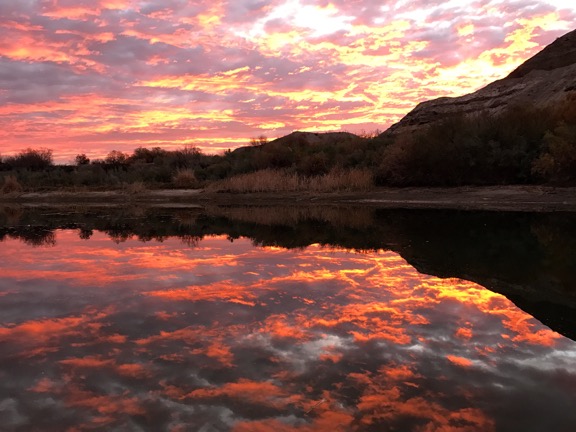
I’ll roll out of bed around dawn and might be more motivated to do so if we’re having one of our spectacular sunrises. That’s when I’ll go down to the beach in my pajama shirt, sweat pants, and slippers with my phone to try to capture a shot that beats the last best one I took. Janet sometimes gets down there before me and sometimes doesn’t.

Sunrise
I don’t think a sunrise photo will get much better than this. And yeah; I shot this with my iPhone 7.

Then back to my camper to make coffee with the immersion coffee maker someone talked me into buying. (They’re right; it does make the best coffee without electricity.) I’ve got a technique where I boil water in a glass kettle on the stove with my empty coffee cup as a sort of lid. That speeds up the boil while thoroughly heating my cup so my coffee stays hot extra long.

I’ll keep busy by writing up the previous day’s journal entry or a blog post or reading something interesting in the New York Times or Washington Post. Janet usually has her coffee out by the fire pit and if there are still embers from the previous night’s campfire, will get another fire going. Usually there isn’t.

Fishing
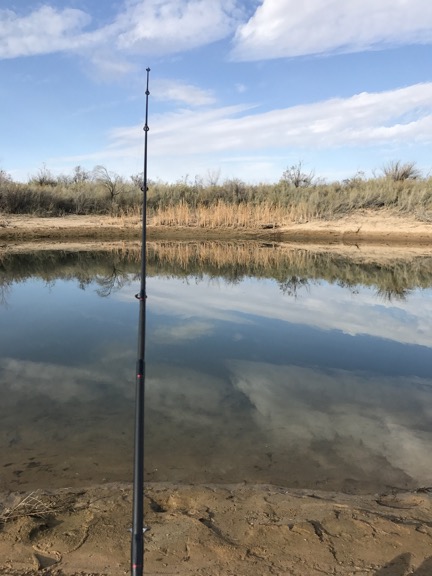
We went fishing this morning. It was supposed to rain, but it turned out to be a beautiful day.

What follows varies from day to day. Janet usually either goes fishing or paints — she’s an artist — and sometimes does both. I usually putter around the RV, neatening it up from the previous day, then try to get some serious writing done — I’m working on a memoir about my first ten years as a helicopter pilot and I’m really procrastinating a bit more than I should be. Sometimes I go fishing with Janet. (Today I actually caught a small bass; although it was large enough to keep, we tossed it back. The fish were literally jumping out of the water.)

Truck on the Hill
Janet shot this photo from our campsite of me and my truck atop the cliff.

The other day I drove to the top of the cliff southeast of our campsite. I wanted some photos for this blog post (see the photo at the top) and I also wanted to see if my truck could make it. (It could.) Last year, I chickened out near the top and walked the rest of the way; this year, I took it all the way to the top. The drive is no easy task in a truck the size of mine; there’s a very steep, narrow gravel “road” to climb followed by a winding pathway that sometimes goes through some very deep sand. It’s all about four-wheel-drive, good tires, momentum, and knowing when it’s safe to stop.

Blue Heron
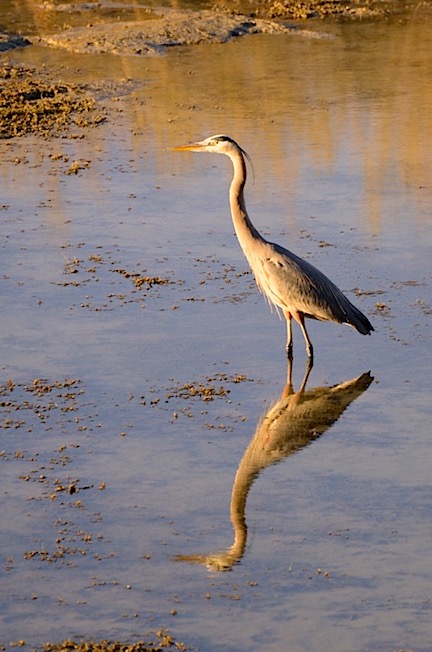
I must have shot 20 images of this blue heron from the driver’s side window of my truck with a 300 mm lens. This one is the best, although I think it might benefit from a touchup in Photoshop.

I’ve done some photography. This is a desert riparian area so there are some water birds. Mostly duck-like birds — I really don’t know exactly what they are — and at least one blue heron and one white heron. The other day I got a bunch of really nice pictures of the heron, no small task because he seems to spook very easily. When he does, he makes one hell of a racket as he takes off into the air, usually landing within a quarter mile for a new hunting spot.

We also go boating. Janet brought a river raft rowboat that can seat both of us comfortably for fishing. I also brought my kayak and have gone paddling with Penny. We do all this in the backwater channel. Sadly, the water level is very low this year — “they” are supposedly working on either canals or docks or possibly both so they’re limiting what comes through the Parker Dam far up river. Last night, for some reason, the water level was very high. But this morning it was low again.

Once in a while we’ll go into town. There are actually three towns:

  • Ehrenberg, AZ is Exit 1 on I-10. There’s a truck stop on the south side of the road and a “resort store” on the north side. The resort store is where we buy fishing licenses, refill water bottles, throw away our garbage, and dump RV tanks on the way in or out of our campsites. They also sell Mexican ice cream pops, which are a cheap and amazing treat. And worms for fishing. We go there two or three times a week, usually on our way in or out from somewhere else. It’s about 8 miles from our camp. The post office is also there; that’s where we get our mail forwarded via General Delivery.
  • Blythe, CA is a few miles west of the Colorado River off I-10. That’s where we do grocery shopping, usually at Smart and Final, although there is an Albertson’s. There’s also an excellent Ace hardware store, an O’Reilly’s auto supply, a K-Mart, and a Walgreens. Other than that, Blythe is a sad little town and I can’t see any other reason to visit it. (Sorry, Blythe, but I do tend to tell it like it is.) I do know its airport, on the west side of town, very well since that’s where I nearly always stop for fuel for my helicopter when flying along the I-10 corridor between California and Arizona. Smart and Final is about 12 miles from our camp.
  • Quartzsite, AZ is Exit 17 on I-10. That’s a hopping place in January, full of rock shows and art shows and RV shows and all kinds of booths to buy all kinds of useful and junky stuff. It’s what brings Janet to this area of Arizona; she displays and sells her artwork at the Tyson Wells show that runs concurrently with the big RV show at the second half of January. (There’s another show going on there now, so Janet has to wait; she waits out on BLM land where camping is free and life is mellow.) I like Quartzsite because it’s weird and I can always find something neat to buy for my truck or my RV or my home. Last week I bought some fossils. This week I bought a little DC water pump I can use to transfer water from my 6-1/2 gallon water jugs to my camper’s water tanks. Next week, I’ll buy new batteries for my camper and possibly an additional solar panel. (Yes, Quartzsite does see a lot of my money; I bought a cool neon sign there last year and my old 5th wheel trailer back in 2010.)

Between Quartzsite and Ehrenberg is the Chevron station with cheap diesel and gas; that’s where Janet and I fuel up if we need to. (We don’t usually because we really don’t go far.)

In the late afternoon, we regroup for dinner. We share cooking duties. Our main goal these days is to empty our refrigerators and freezers. I brought a ton of frozen food from home and we’ve been eating some of that. We had nice little filet mignons the other day. Janet makes various dishes — she made an excellent chicken with quinoa dish the other night and we had pan-fried panko-crusted bass (that she caught, of course) one night last week. I always seem to have ingredients for a salad. I think we’re having pad thai chicken for dinner tonight; Janet has the noodles and chicken and I have the pad thai sauce and other ingredients.

Sunset
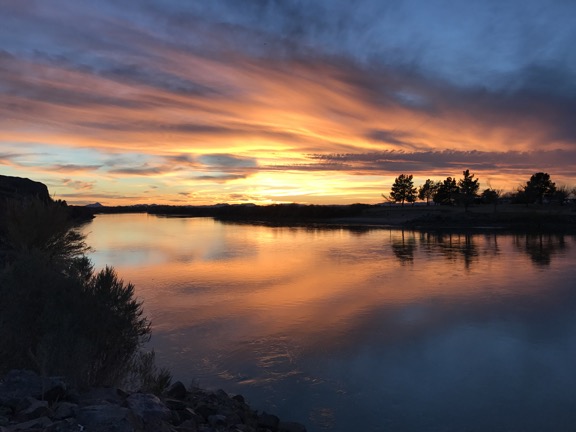
At sunset, if there’s a show I’ll go out and take photos from the levee. I shot this on my second night here. That’s the Colorado River with California on the other side.

Campfire
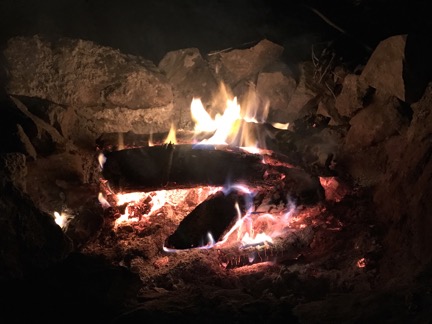
We have a campfire every night.

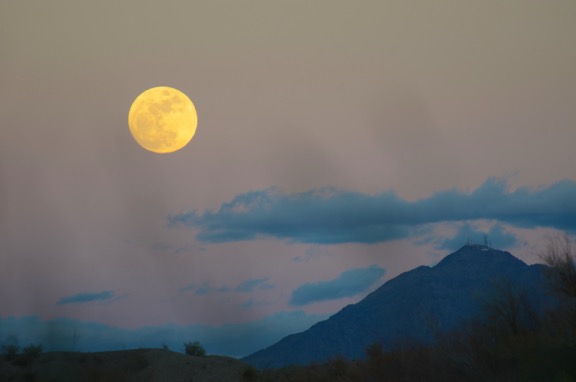
By the time dinner is ready, the sun has gone down. Janet usually has a fire going before it gets dark. We sit in front of the fire and eat, drink wine, and chat. Very relaxing. After dinner, we’ll spend a while longer in front of the fire with our dogs in our laps. Sometimes the sky is full of stars. The nearly full moon rising the other evening was a real show-stopper.

Moonrise
Moonrise from our campsite.

We’ll each turn in to our campers between 8 and 9 PM. Sometimes I’ll write up my journal entry for the day. Other times I’ll just relax in bed with Twitter or a book or a crossword puzzle. Then it’s lights out. If it’s a clear night, I can see the stars through the big sunroof over my bed.

It’s a very simple, very quiet, very mellow existence here. This year, I’ll be at the backwaters for a total of nearly two weeks. It’s quite a change after my month-long stay in a friend’s guest house in Wickenburg.

From here, I go to San Diego with friends. I might spend a night at Glammis Dunes near Yuma, hoping to get some good photo opportunities if the sand isn’t too disturbed by tire tracks after a holiday weekend. On the way back, I’ll visit various hiking spots near Borrego Springs and possibly Joshua Tree National Park. Then I’ll be back at Quartzsite for the RV show. I’ll camp out in the desert near town and make daily trips in to visit the shows and check out the RVs. I’m in the market for a tiny toy hauler; who knows what I might come home with?

And who knows where I’ll go from there? I have another month to kill before my seven-month vacation is officially over — and even then I have the ability to do some travel before I need to be back home with my helicopter in May.

But the Colorado River Backwaters is one of my favorite destinations for off-the-grid camping. I look forward to coming back every year I travel south for the winter.

Snowbirding 2017: Fossil Shopping at Desert Gardens

Too beautiful to pass up.

I’m camped out in the desert south of Ehrenberg, AZ these days with friends. On Friday, I went into nearby Quartzsite with my friend Rebecca. She wanted to meet up with her friend John, a jewelry maker who sells raw rocks, gems, cabs, and jewelry at the Desert Gardens rock show in the southwest corner of town.

I’d only been to Desert Gardens a few times and every time there had been just a handful of scattered vendors on the dusty flat show grounds. Nothing to impress me. But Friday was different. The official show had begun and all vendors were present and accounted for. It was a rockhound’s paradise, with all kinds of rocks, gems, and minerals on display and for sale.

John’s booth had a nice mixture of things. His jewelry is exquisite. He has a real eye for design and there were more than a few pieces I would have bought if I had the money — they were not cheap — and someplace to wear them.

While he and Rebecca chatted, I wandered through the show with Penny, stopping here and there to look at things that interested me. While I do think a lot of the raw, unprocessed rocks are interesting, they don’t interest me nearly as much as pieces that have been cut and polished. There was plenty of that to see, too.

But what really interested me were the fossils. My wasband had collected two that we displayed in our old living room. I’d left them behind — after all, he’d bought them, not me — and I can’t say I really missed them. They were interesting, but not worth lugging up to Washington. One was a flat rock with the skeletal remains of a fossilized fish. Someone had “enhanced” the fossil, making it easier to see. The other was a large ammonite — a nautilus-shaped creature — that stood upright like a carved rock paperweight. I always worried that it would fall over and break the glass-topped coffee table.

I need to stress here that although I think fossils are interesting, I’d don’t have any overwhelming desires to own them. At least I didn’t. Until Friday.

That’s when I saw fossils presented in a new way in a shed turned into a fossil shop at Desert Gardens.

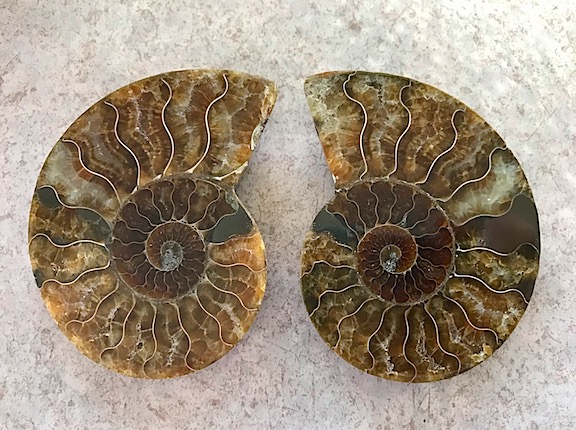
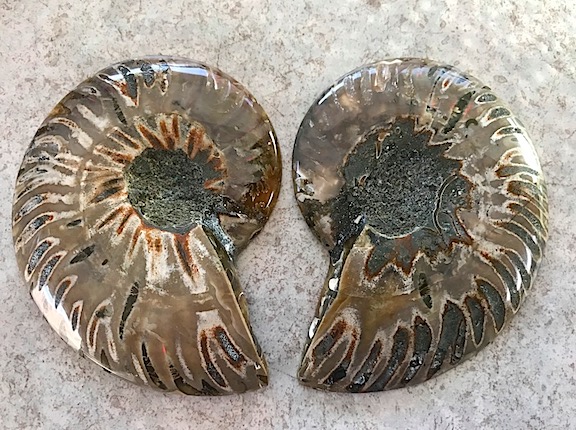
First was the ammonite. Each one had been cleanly cut in half vertically to show the inside, which had been polished. The colors and textures and patterns were amazing. And I found it incredibly appealing to have both halves of the fossil — not just one. There were dozens of them at the shop in a wide range of sizes and prices, ranging from $5 all the way up to more than $100. I wanted one that would fit inside my little curio cabinet at home. Here’s the one I wound up buying later in the day.

Ammonite-Inside
Here’s the inside of the ammonite fossil I bought.

Ammonite-Outside
And here’s the outside of the same fossil, which was also polished.

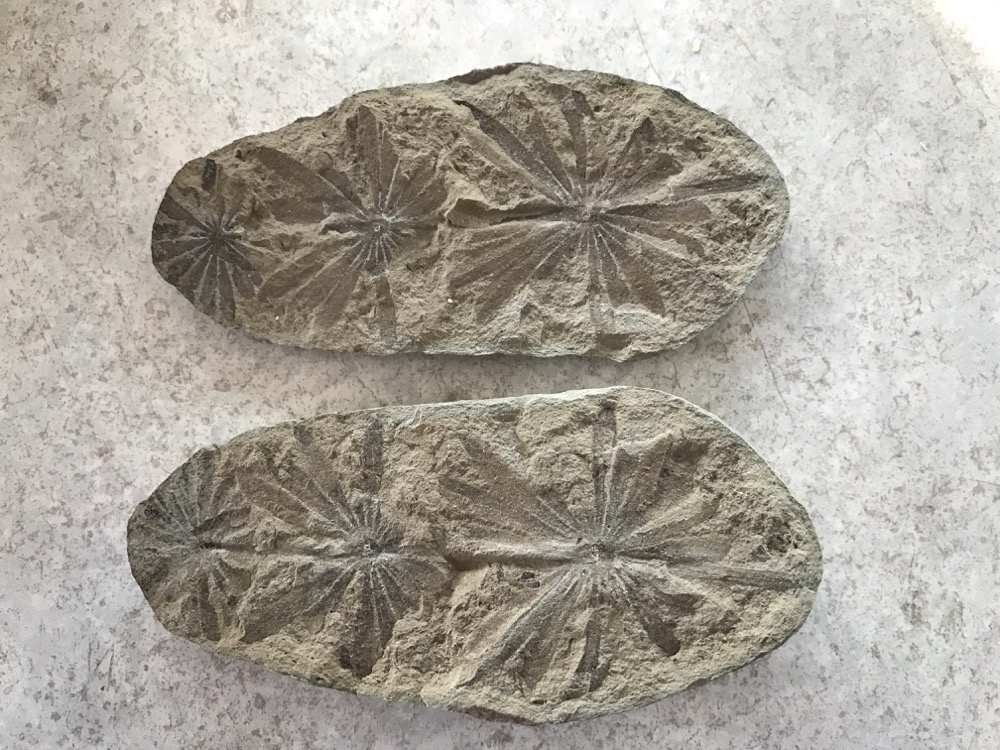
Next were the fossilized leaves. There were a handful that caught my eye and were within my price range for what was, effectively, a rock. As the guy who owned the booth told me, the rocks are nodules that they heat and then thrown in a freezer. The sudden change of temperature causes them to split, revealing any fossils inside. He saw the ones I was looking at and then said, “Did you see these over here?” I hadn’t. They were magnificent, but also a bit more money than I wanted to spend on a rock. Still one of them, an annularia, was just too beautiful to pass up. I asked him for his best price and he knocked $10 off. I bought it.

Annularia Fossil
The annularia fossil I bought. It’s about seven hinches long.

They wrapped everything up in paper and even put the annularia in a box. I took them out when I got back to my camper just to photograph them. Then I stowed them away in the wine box I’ve been using to store acquisitions during my travels. I’m looking forward to unpacking that box and putting my finds on display at home.

If you’re in Arizona or southern California, I highly recommend Desert Gardens from now until about mid-January as a place to find rocks, minerals, and fossils. Later in the month, half the vendors go south to Tucson, leaving the show in Quartzsite a bit sparse. They return in February for a while, but I really think the best time to shop for rocks in Quartzsite is now. Get on over there and see what treasures you can find.

Photography: The Right Place at the Right Time

It’s kind of like the stars needing to align just the right way to get the best shot.

Practice Makes Perfect
This reminds me of a podcast I was listening to in the car just yesterday on my way back to Wickenburg from Winslow. It’s an episode of Freakonomics radio which discusses practice as a way of becoming an expert at anything. If you’re interested in learning or getting better at a skill and like to understand the science behind how things work, I recommend “How to become Great at Just About Anything.”

A few weeks ago, a friend of mine — we’ll call her Jane — shared a photo on Facebook. She’s an amateur photographer turning pro and has begun to sell some of her work. Other work has appeared in various publications. I’ve known Jane since she first took a serious interest in photography and it’s no exaggeration to say that her work has come a very long way since those early days. Many of the photos she shares now are absolutely stunning. Practice makes perfect — or at least helps you get closer to perfect.

Anyway, the photo Jane shared that day was one of those where she caught the light on her subject just right. It was one of her best shots — in my opinion, anyway — and I complemented her. I also added the comment, “It’s all about being in the right place at the right time.”

I don’t remember her exact response, but it was something like, “It’s a little more than that.” I suspect that I’d offended her and I certain didn’t mean to. But I’ll stand by what I said and make an attempt to prove it with an example. I’ll also share some of my philosophy about photography.

What Makes a Photo Great

The way I see it, a photo can’t be truly great unless the photographer nails three components: subject, composition, and light.

Subject
The subject of the photo is what the photo shows. It should be something beautiful or notable or interesting in some way. Beautiful is pretty straightforward, although I agree that beauty is in the eye of the beholder. Notable is what I think about when using photography to document something, for example, the way a bridge cable attaches to a support or the design of a water fountain. (Yeah, I’m sometimes fascinated by silly things like that.) Interesting covers a lot of ground. The pattern of sand after a wave has come by is interesting. Paint peeling off a wall can be interesting, too. It’s part of the photographer’s job to make the subject something that speaks to us in some way, something that makes us stop and look and think. A good photographer can do that with just about any subject using the other two components.

Composition
Composition refers to the way the photographer arranges the subject and its surroundings in the camera’s frame. You may have heard of the Rule of Thirds and it’s a great thing to keep in mind when composing a photograph. But that doesn’t mean a photo can’t be great without following that rule. One of the differences between a good photographer and someone who haphazardly snaps dozens of photos in hopes that one will be good is that a good photograph can figure out where to stand and which lens to use (or how to set a zoom lens) and how to hold the camera to get the best composition more often than not. I should add here that a good photographer does not need to rely on cropping to get the right composition; she should be able to compose right in the camera. (One obvious exception to this rule is when a photo’s desired aspect ratio is unsupported by the camera; for example, a square photo would require cropping.)

Light
Of course, photography absolutely depends on light. Without light, there would be no photography — after all, that’s what the camera’s sensor (or film in the old days) records. What so many amateur photographers don’t understand is that there is good light and bad light. Natural light changes with the weather and time of day. Blue hour or twilight light is, as the name suggests, bluer and dimmer than daylight. Golden hour light tends to be redder and softer, casting longer shadows. Midday light is often harsh and bright, flattening out the scenery. Beyond that, light can be direct or reflected or shadowed — sometimes all in the same composition. A good photographer using natural light — for example a landscape photographer like Jane (and me) — understands the importance of light and makes a special effort to photograph the subject at the best time.

Get all three of these right and the photo will be great. Get two of these right — for example, subject and composition or subject and light — and the photo might be good, but it won’t be great. Get just one right and the photo won’t be very good at all. (We’ve all seen these — think vacation photos uploaded en masse on Facebook.)

Being a Serious Amateur
I call myself a “serious amateur” photographer and I don’t use that phrase lightly. I see it this way: An amateur is someone who snaps photos without bothering to try to make the photo great. Good is good enough. A serious amateur is someone who understands what makes a photo great and puts a conscious effort into trying to make great photos. Each shot, objectively reviewed, is a step (hopefully up) on the learning ladder. Good is never good enough.

The trick is to objectively assess how good you’ve covered each of these components. And that’s a Catch-22 in itself: if you’re not a good photographer, you likely won’t be able to objectively critique your own work. That’s part of how practice makes perfect. Keep trying, keep comparing, keep objectively trying to figure out what could be better in each photograph you make. If you’ve got a good eye and you’re honest with yourself, you’ll get better all the time.

Right Place, Wrong Time

This past weekend, I was up in the Navajo and Hopi Reservations in Northern Arizona. This is an amazing place for landscape photography, with the broad desert scrubland of the Painted Desert punctuated by deep canyons, flat-topped mesas, and towering buttes. The west end of the Navajo Reservation is where red sandstone formations laid down when oceans covered the Four Corners region meet and merge with dark brown lava flows emerging from the multitude of volcanic cones north and east of Flagstaff. That’s where an explorer with a vehicle capable of tackling rugged roads can find the Grand Falls of the Little Colorado River.

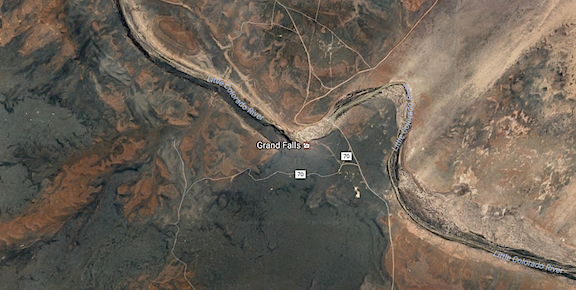
Grand Falls Terrain
Nothing better illustrates the way the two landforms come together at Grand Falls than a satellite image like this one. You can clearly see the reddish rock of the painted desert butt up against the lava flows. One flow forced a bend in the river around it; the falls come right after that bend and then cut into the rock joint, forming the Little Colorado River Gorge. (The Colorado River flows east to west here.) Want to study this for yourself? Use Google Maps to Search for Grand Falls, Leupp, AZ.)

As a subject for photography, the Grand Falls is a crap shoot. I’ve seen the falls completely dry without a single drop of water flowing over the long shelves of rock. While that might be interesting to some folks — geologists come to mind — I personally lack the skills to make it interesting enough to qualify as a great photo. I’ve also seen the falls with water thundering over its entire breadth and mist rising up into the sky. When the water is flowing it’s always reddish brown from sandstone silt it picks up along the way, thus giving it the nickname “chocolate falls” or “chocolate milk falls.”

So timing is vital when visiting the falls. It nearly always runs with spring runoff from the mountains far to the Southeast, so spring time is the best time to visit if you want to see water. It also may run from monsoon rain in July and August — depending on weather, of course. But it was January — too cold for runoff and no monsoon rains. We did, however, have a good rainstorm on Friday night. And my trip to the Hopi Reservation put me just over an hour away. It was worth a try.

I was lucky. The falls were at about half flow: certainly interesting enough for some photos. So I had a good subject.

I spent about an hour shooting from various points along its south shore. I would have crossed the river to shoot from the other side, but there’s no bridge and the crossing looked a lot muddier than I was willing to try, even in my big four-wheel-drive truck. My ability to compose my shots was limited by where I could stand to shoot and the lenses I had with me. Although the photos here are from my phone’s camera, I did have my Nikon and three lenses with me. To fit the entire falls into the shot, I wound up using my 10-24mm zoom lens. This gave me a huge amount of flexibility as far as framing was concerned. I did the best I could and believe I got some interesting compositions that showed off the geology with manmade objects to indicate the scale — after all, Grand Falls is actually taller than Niagara Falls. So I was relatively satisfied with my compositions.

Light was another story. I arrived at midday, which would have been horrible on one of those perfectly clear, blue sky days Arizona gets so often. But it wasn’t a perfect day. It wasn’t even a nice day. I’d driven through fog to get to the falls and the low clouds had lifted only a few thousand feet above me. The light was soft but colorless. The sky was gray. The air felt wet.

Now I know that lots of photographers like the kind of soft light that was all around me that day and I know it’s hard to make a bad landscape photo on a day like that, but it just doesn’t appeal to me. Still, you can’t adjust natural light; you have to take what Mother Nature delivers. So I did what I could. I got a bit excited when, about 30 minutes into my visit, the sun began shining down the canyon past the falls. I watched the soft sunlight creep up towards the falls, hoping it would give me the kind of spotlighting I’d seen downriver. I waited. I was at the right place — or as close to it as I could be — and I was willing to wait a while for the right time.

It didn’t come. The gap in the clouds closed up. Everything returned to the even flat light. I took a few more shots, got back into the truck, and left. The rain started immediately.

Grand FallsHere’s my favorite unedited cell phone shot from the visit. Note the sunlight on the canyon wall at the top left of the photo. I was waiting for that light to get to the falls, but it never did. The Nikon version of this shot shows a wider field of view and the composition is a bit better.
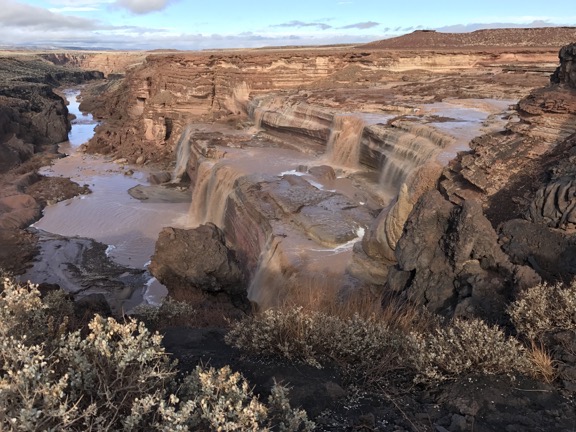
So did I get a great shot of the falls? I don’t think so. I did get a good shot, though. And, for a while, I was satisfied with that.

Right Place, Right Time

Until the next day. It rained (and snowed) again overnight and I figured there might be more water going over the falls. I was leaving La Posada in Winslow (where I was staying) and another trip to Grand Falls would only take me an hour or so out of my way. I knew that if I didn’t at least try it, I’d regret it forever. After all, how often do I get up to that area of Arizona with a sturdy vehicle and time on my hands?

There was some fog along the way, but not much. The sky was clearing and blue sky was poking out. There was definitely sunlight but it was filtered through lighter clouds. Soft yet bright light. It was still early in the day — not long after 9 AM — but long past golden hour. (I’m not sure whether golden hour would have been golden anyway; the clouds were still thick around sunrise.) As I drove the last 10 muddy, bumpy roads, plowing through puddles that would swallow a Smart Car, I wondered whether the angle of the sun would cast deep shadows across the falls.

Of course, that’s a whole other aspect of light. The angle of the sun determines where the shadows will be at various times of the day at various times of the year. It was winter, not long after solstice, so the sun was nearly as low in the southern sky as it would be. And it was morning, so it would be low in the southeastern sky. The falls faced southwest, with a canyon wall to the south. Would that canyon wall cast deep shadows at that time of the day? How long was I willing to wait there for the right light?

Turns out, I didn’t have to wait at all. The light was damn near perfect when I arrived. (Perfect as far as I was concerned, anyway.) The sky was an interesting mix of patches of blue with clearing clouds. The falls had about the same amount of water flowing over, which was okay.

Grand Falls
This is nearly the same composition, although for this shot I got down into a crouch to include some sunlight-illuminated plants in the foreground. (The crouch also allowed me to block the floating garbage patch at the base of the falls (ick!) with a rock formation.) The light was nice and soft and really added color to the shot. And because it was a soft light, the shadows cast by the wall of the canyon weren’t deep enough to screw up the exposure. This shot is also unedited, from my iPhone.

Is this a great photo? Some people might think so. I’m certainly pleased with it. But I can always do better. I just have to try.

But what it really illustrates is that it’s not enough to be in the right place for a good photo. You also have to be there at the right time. While I might not have been here at the “perfect” time to shoot a “perfect” photo, the timing of my second visit was much better than the timing of the first.


Related Posts:
I’ve written a bit about this before. Check out the following posts: