
Near the Vermilion Cliffs.
In 2004, in the autumn, I took a road trip in Arizona with my Jeep. The idea was to duplicate a trip I’d taken the year before in my little helcopter. On that trip, I’d flown around the Grand Canyon airspace (which is highly regulated) with stops at Page and Bar 10 Ranch. Mike was supposed to go with me, but there were some difficulties with the dog, who he insisted on bringing, so the two of them flew back to the Grand Canyon where he’d left his truck, leaving me to finish the trip alone.
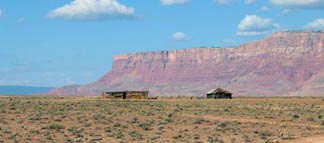 On the second day of the trip, I left Page and headed out toward Marble Canyon on the Colorado River, just downstream from the Glen Canyon Dam. It was early morning and the sun was casting a golden light over the landscape. I saw this abandoned Navajo homestead on the west side of the road with the Vermilion Cliffs in the background. It was a really beautiful sight, one certainly worth a photograph.
But I didn’t stop to take the picture.
The rest of the trip, I thought about this scene and wished I’d taken the picture. Days later, after filling my Jeep with dust on the 60-mile dirt road between Fredonia and Toroweap and the 85-mile dirt road from Bar 10 Ranch to St. George, UT, I made my way back to Page where I spent the night again. This time, when I left early in the morning, I made a detour back to this spot and took the photo I wished I’d taken on day 2. It was worth it.
The Vermilion Cliffs, which were obviously named for their color, are on the far eastern end of the Grand Canyon. When you drive to the North Rim from Page, you drive along a road that runs near their base. When I flew at the Grand Canyon and did the eastern end tour, I’d often point out the cliffs to my passengers.
If you’re a pilot and want to explore the southwest with your airplane or helicopter, you can land at one of two airports not far from the road. My favorite is Marble Canyon because it’s right across the street from a motel and restaurant, making it an ideal place to stop for a meal or the night. In fact, when I made my helicopter trip in 2003, that’s where I spent the night after filling up with fuel at Page.
Arizona, Navajo, photo
 Anyway, Havasu is famous for its waterfalls. The most famous is Havasu Falls, but there’s also Navajo Falls (upstream) and Mooney Falls (downstream, named for a guy who died trying to descend them). I don’t have pictures of any of the falls in the header of this site because falls are vertical and this header needs horizontal shots. So I have this shot, taken near our campsite on Havasu Creek.
 A few years later, in February, I took my brother to the Canyon. We spent two nights in rooms on the rim and each morning, we went out to watch the sun rise. Each morning, the canyon was full of clouds. I don’t think my brother saw the inside of the canyon at all on that trip. But he did tell my mother that it was the coldest place on earth.
 This photo is available for sale as cards, laminated prints, mounted prints, or framed prints from
  Although it’s not a difficult trip, it is a long one. Although Mike and I have horses and ride once in a while (not as often as we used to, I’m afraid), this is 4 to 5 hours in the saddle — enough to make anyone sore. But it’s worth it. Only a tiny percentage of the millions of people who visit the Grand Canyon each year actually descend into the canyon. This is one of the “easy” ways to do it. And you get a whole different view of the canyon once you get below the rim.
 I’m sitting on a plastic chair on the front patio of a ground-floor apartment in Vancouver, British Columbia, Canada, watching four men wash the apartment building across the street. It looks to be a 24-story building and, like most of the buildings in this area, it’s got a steel and glass facade. The four men are sitting on separate wooden seats — kind of like the seats you’d find on a swing set — hanging from ropes on top of the building, about four stories down. Two of them have long hoses and the other two have brushes on long poles and plastic pails. They’re all wearing shorts and sneakers and are doing a lot of bouncing off the walls as they move back and forth and down.
 In the meantime, I’m enjoying my non-working hours in a clean, safe, and rather beautiful Canadian city. The weather is beautiful, in the mid 70s and mostly sunny, although a marine layer of clouds seems to be drifting in as I type this. My hotel and the office/apartment I’m working at are right on the water near Stanley Park. The view from my hotel room at the Westin is full of boats and seaplanes and healthy people strolling the waterfront.