Why I’m Leaving Etsy — and Maybe You Should, Too?

For years, I had an online shop on Etsy to sell my jewelry. Not anymore.

I’ve made some changes in my online shop and I thought I’d take a moment to explain why and what I changed. But let me start with an explanation of how I sell my handmade jewelry.

How I Sell My Work

Most of my sales are either directly to buyers at art shows, via consignment sales at two Washington State galleries, or wholesale to a variety of gift shop owners. Each method has its own pros and cons:

  • Art shows take a lot of time and effort. I’ve got to get to the show, set up my booth, and then sit in it for the duration of the show. At the end, I have to pack it all up and get it home. Those are the cons. On the plus side, however, is that I have complete control over my inventory and sell at retail price. So I have the potential to make more money per item sold.
  • Consignment is a different ball game. I drop off inventory that the consignment place may or may not put on display immediately. When I drop it off, I lose control of it and can’t sell it. But I also have to keep track of it. If and when it sells, I get a check for 60% to 65% of the retail price. Ouch. If it doesn’t sell, I get it back, usually in serious need of cleaning before it can go back into my inventory. Those are the cons. On the plus side, it doesn’t take much effort to sell and my work eventually appears in a shop with other gallery quality items. I generally get checks every single month, year-round. Still, I’d rather not do any more consignment selling, especially for high ticket items.
  • Wholesale is pretty much the same as retail with the main benefit being that I get paid up front, don’t have to keep track of what’s sitting out there, and I never see it again. It’s the same as selling to a retail buyer, but at a deep discount. Once it’s gone, it’s gone for good.

I’d like to do a lot more wholesale selling and a lot less art show selling. Part of that is that art show success is so dependent on the venue and the weather. I usually turn a decent profit at each art show I attend, but I did lose money at a Christmas Show in Spokane last year and that hurt.

When I sell wholesale, I know my cost of sales right up front: the amount of the discount I have to offer and the cost of getting the merchandise to the buyer. When I sell at art shows, I have a lot of costs to cover before I can start seeing profits: jury fees, entrance fees, transportation costs, lodging costs, etc. — and that doesn’t even include the cost of my booth tent, tables, table coverings, displays, etc. It’s possible to pay $400 for a booth at an outdoor show 50 miles away and have weather so miserable that no one comes out to the show. Or pay $500 for an indoor show 150 miles away and be stuck in a back room none of the shoppers walk back to. This has happened to me and it sucks.

Selling Online

Of course, selling online is probably the best of all worlds. I keep control of my inventory and sell it at retail price (or maybe a slight discount with a coupon or sale). The online shop calculates and collects the money and sends my share — more on that in a moment — right to my bank account. I package the merchandise — which is easy because I’m selling small items — and ship it out. I don’t have to set up, sit in, or tear down a show booth. I don’t have to sell at deep discounts or wait until an item out of my control is sold. When an item is sold online, it’s gone and I never have to think about it again.

Lots of folks think this is the only way to sell. They think it’s as easy as setting up an online shop and ringing in the sales. But what they don’t understand is that people not only have to want what you sell, but they have to be able to find it.

And that’s where Etsy comes in.

Etsy — Then and Now

Etsy started as a marketplace for handmade goods — items created by crafters and artists. It built a reputation as a place where you could buy unique things while supporting makers. And, for some people who don’t know any better, it probably still has that reputation.
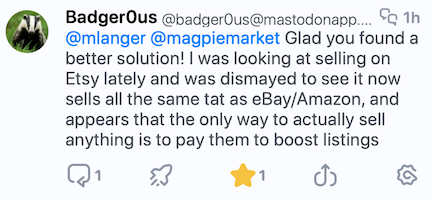
Mastodon Toot
A response to my toot this morning about my switch from Etsy to Square for online selling. I giggle at the word “tat,” which is apparently UK English for “junk.”

But it’s a farce. Etsy is now full of manufactured junk, much of it made overseas and passed off as “handmade” by people trying to cash in on Etsy’s reputation. As a web designer on Mastodon commented to me today, “I was looking at selling on Etsy lately and was dismayed to see it now sells all the same tat as eBay/Amazon, and appears that the only way to actually sell anything is to pay them to boost listings.”

And that brings up another one of Etsy’s ploys. If you search Etsy for an item — say “silver jewelry” — it will bring up search results with Etsy sellers who paid to have their posts boosted before any other sellers. Sometimes, the search results don’t even match the search phrase. In so many cases, the results that come up are cheap crap that you know isn’t handmade.
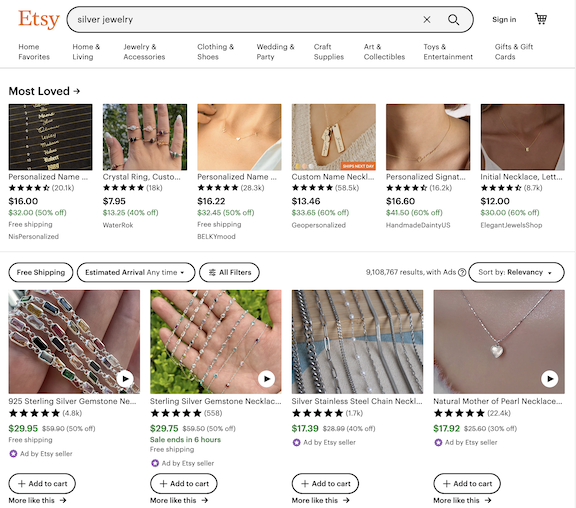
Etsy Search Results
My search for “Silver Jewelry” brought up this collection of garbage. Are we expected to believe that someone will make you a personalized name necklace for only $16? And how much of this stuff looks like silver to you? The whole second row is paid advertising. Scrolling down (beyond this screenshot) displays more of the same. As a seller, do you think anyone will find what you make in this mess?
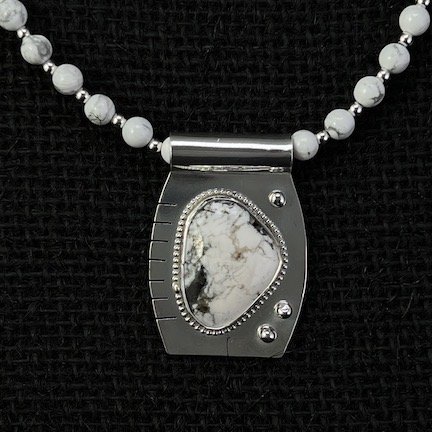
White Buffalo Pendant
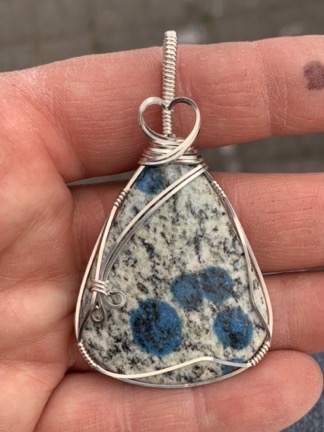
While this might not be your taste in jewelry, it’s solid sterling silver, hand formed from sheet, strip, and wire with a genuine White Buffalo Turquoise cabochon in it that was hand polished by a lapidary friend just for me. Even the beaded necklace has sterling silver beads, although the white beads are howlite.

So I’m making quality sterling and fine silver jewelry with gemstones using a wide variety of silversmithing tools and techniques and I’m competing on Etsy with this crap?

But wait, there’s more!

Recently, Etsy decided, out of the blue, that it was going to hold back 70% of my payment as a “reserve.” No real explanation of why. It just had to wait an extra week or two to get my money.

Add that to Etsy’s fees:

  • 20¢ for each listing, including automatic re-listing of an item that didn’t sell in 60 days and automatic listing of multiple quantity items when one sells. So, in other words, you’re going to pay 20¢ per item just to be able to show it on Etsy.
  • 6.5% of the order total, including shipping and gift wrapping fees, if charged.
  • 3% + 25¢ for payment processing fees.
  • 15% of the order total for sales made through the use of Etsy’s offsite advertising. Yes, if Etsy puts an ad on Google and someone clicks that ad and it takes them to your shop and they buy something, you pay Etsy an extra 15%. This is an opt-in feature and I’m pretty sure the fee used to be 20%. I opted out when I realized what it was costing me; somehow all of my sales were being hit with this fee.

And this doesn’t even begin to cover the optional monthly fees you can pay for shop customization options or the optional marketing fees you can pay to boost listings and get them at the top of search results.

So, in all, we’re looking at roughly 10% to 25% of the listing price to sell it. And that’s if it sells the first time it lists. You’ll pay an extra 20¢ every time it’s relisted.

Yes, I know this is less than the cost of selling by consignment or wholesale and even less than the cost of selling directly to buyers at art shows given the cost of doing art shows. But I think it’s a bit outrageous when you consider that I’m not getting my money immediately and my work is pooled in with so much other crap.

Sellers Revolt

Etsy sellers are not taking this sitting down. Or at least some of them aren’t. The withholding of money has gotten Etsy sellers up in arms enough that they’re threatening to strike. And that has resulted in Etsy backpedaling to reduce the amount it withholds. I got an email telling me that they were only going to withhold 30% of my sales.

Too little, too late. For the reasons listed above, I’m outta there.

I set up my shop to be “on vacation” with a vacation notice that says my shop is permanently closed and they can find my new shop on Square. Of course I included a link. I also turned off all automatic listing renewals for everything still listed in my shop. One by one they’ll disappear. When they’re all gone, I’ll delete the shop. Unless Etsy deletes it first.

The Square Solution

I use Square for credit card processing. I have been using it since it first appeared as a credit card acceptance option, back when its target market was garage sale runners and babysitters.

Back then, I set it up for my flying business. I was tired of using a credit card acceptance system that charged me a minimum monthly fee, statement fees, and a relatively high credit card processing fee. It was costing me more than $50 a month, even when I didn’t accept any credit cards.

Square was different. It used a smartphone app, charged a reasonable processing fee, and that was it. No monthly fees, no minimum fees. The only catch (back then) was that they wouldn’t pay out more than $1,000 per week. They weren’t expecting folks like me who sold service that often started at $1,000. But I was able to get around that with them by providing documentation that proved I was legit and had other credit card processing service in the past. The upped my weekly limit to $5,000, which was fine. (There isn’t any limit anymore.)

So when I started doing art shows, it made sense to set up a Square account for my jewelry business. While people might whine and complain that the rate is too high — seriously? — or they have some other imagined gripe about it, I have no complaints about Square, at least not yet.

One of the things Square now offers is the ability to sell online. While they didn’t implement this in a user friendly way, I have enough tech knowledge that I was able to figure it out. I started building my online store more than a month ago and now have most of my inventory in it. You can find it at MLJewelryDesigns.square.site.

It’s simple, but that’s okay. I think it looks professional — certainly a lot better than Etsy ever looked. It works.

Best of all, it’s free. No listing fees, no selling fees. All I pay is the cost of credit card processing, which I would if I were selling at an art show. It even has a built in shipping calculator that lets me buy discounted postage to ship items out. Just like Etsy.

Yes, there are upgrades available for a monthly fee. One of them would let me use a custom domain name, which I’m considering. Others offer better marketing options or shop analytics — most of which I don’t need and certainly don’t want to pay for. I’m not fooling myself here: I don’t sell much online and don’t think I ever will. But I want the option. I want to be able to send folks to a place where they can buy what I make 24/7.

And that brings me to marketing.

Promoting My Online Shop

I remember the early days of the worldwide web — you do know that’s what the WWW stands for, right? Back in the day, everyone wanted an online shop. They thought that all you had to do was set up a website and people would just buy, buy, buy whatever you were selling. No one seemed to realize that people had to want what you sell and find your shop before you could maybe sell to them.

And that’s where marketing comes in.

Yes, I have an online shop. Yes, there are features built into Square’s online shops to be found by Google in searches. But I’m not dumb enough to think that I can just sit back and let those two things bring me sales.

If Facebook is your business’s website, you’re doing it wrong.

Serious business owners have real websites for their businesses, not Facebook pages.

You might think it’s enough to just put your business on Facebook and steer folks to your page, but it isn’t. First of all, it’s alienating people like me who wouldn’t open a Facebook page to follow a friend, let alone get more information about a business. Second, as discussed in this blog post by UK web designer Nick (who also authored the Mastodon toot above), you’re at the mercy of Facebook’s algorithms to determine whether what you post on Facebook will even appear for the folks who follow you.

You can do better than that without breaking the bank. Heck, even my WordPress-based sites have the ability to forward all of my posts to the folks who want to see them. No algorithm will block that.

No. I have to send people to my shop. And I do that several ways:

  • Maintain a website. I use the ML Jewelry Designs website as way to share news with visitors, including folks who actually subscribe to get that news. And yes, I get a bump in website hits and even a few online sales after every art show I attend. Also note that I used the word “maintain.” That means adding fresh content regularly. No one wants to visit an out-of-date website more than once.
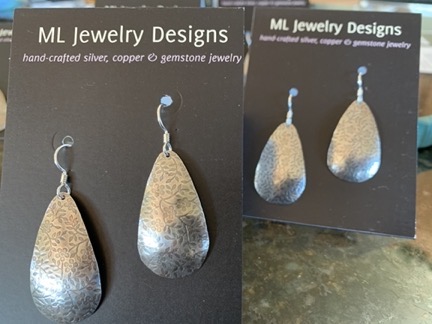
  • Distribute business cards at art shows. My cards have a photo of one of my pieces of jewelry and a link to the ML Jewelry Designs website. The website is not my shop, but it does have links to my shop and links to specific pieces of jewelry. Those cards are not only available in multiple places in my booth, but I also slip them into the packaging for every single item I sell.
  • Post about new work on social media. The website does this for me. I use WordPress which posts to Mastodon for me. I’m not on Facebook or Twitter (or X, the dead bird site) anymore. I do have an Instagram account and I try (but mostly fail) to post there. Any social media post I make has a link to either my website or the actual listing in my online shop for the jewelry I’m showing off.
  • Link where appropriate. I link to the ML Jewelry Designs website wherever appropriate, including this blog and from the organizations that sponsor the shows I do.

No More Etsy for Me

While I know that several of my artist friends have had some success with Etsy and haven’t seemed too bothered with the reserve or fees, I can’t say the same. If you’re like them and Etsy is working for you, stick with it. But if, like me, you’re tired of your work being hidden away among so much manufactured crap, maybe it’s time to find another solution.

I’m done.
Doing the Math on Art Shows

I compare art show venues to see which ones really do give me the best bang for the buck.

I’ve got a sort of running debate with a friend of mine about art show fees and which methodologies are best for artists.

Fee Considerations

Clearly, in a beautiful, perfect, artist-friendly world, show fees would be low and shows would be full of art lovers with deep pockets and plenty of empty wall space or jewelry/pottery/other craft needs.

But that’s not the way it is. Show runners want to make money far beyond the cost of running their venue and the artists are the draw. They set their fees based on what they think artists can afford to pay, with the goal of filling every available spot.


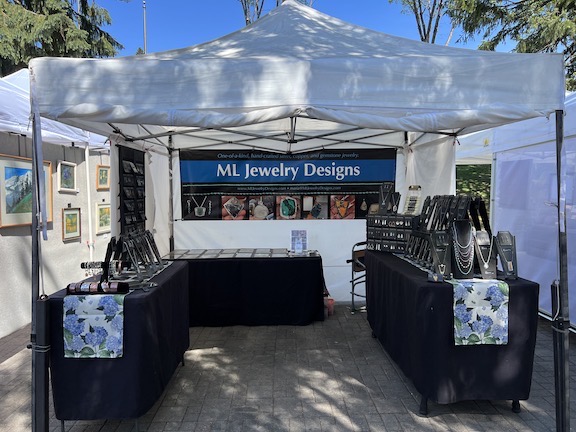
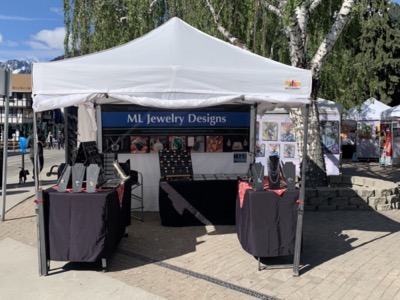
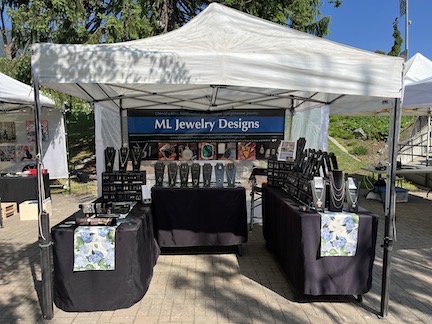
Here’s my jewelry sales booth as it appeared at Leavenworth Village Art in the Park on May 19. I’m trying to display my work as serious and elegant; most folks seem to think I’ve done it.

Artists, on the other side of the transaction, have to consider fees when they decide which shows to apply for. The higher the fees, the more work needs to be sold. Is it possible to sell enough work at the artist’s price points to cover show fees? And what about other expenses, such as the cost of getting to and from a show, lodging, parking, and who knows what else?

In general, better shows — ones with good track records for attracting lots of shoppers and scoring high on artist satisfaction — command higher fees. That can also be said for shows that can attract shoppers with deeper pockets or ones where the quality level of the artist work meets a higher than average standard. In both cases, the potential to sell work at higher prices might make it easier to cover fees.

But in nearly all cases, it’s a gamble. And in the short time I’ve been doing art shows, I’ve seen that firsthand.

Two Fee Methodologies

There are several fees involved with doing art shows and it’s worthwhile to take a look at each one.

  • Application Fee. This is usually a small amount of money — under $50 but usually closer to $10 or $20 — that must accompany an artist’s application to participate in a show. It is non-refundable and is apparently used to cover administrative costs.
  • Jury Fee. This is also usually a small amount of money — again, under $50 — that’s paid to judge an artist’s work before acceptance. Artists are normally required to submit photos of their work and their booth and may also sometimes be required to submit one or more photos showing them actually making the work to prove that they make it themselves. This is also non-refundable. Some shows will charge just a jury fee, if the show is juried, and not an additional application fee.
  • Booth Fee. The booth fee is usually the expensive part of doing a show. Fees can range from $20 for a Farmer’s Market table to well over $1000 for a spot in an indoor venue showcasing fine art in a major city. Just about every show is going to charge a fee for your space, based in part on the size of the booth and its position. A 10×20 foot space that’s open on two or more sides — like in a corner — would usually cost significantly more than a 10×10 space in line with other artists.
  • Commission Percentage. In addition to the booth fee, some venues charge a commission based on artist sales. They could process the sales of all artists centrally or provide special sales slips for artists to fill out to record each sale or use the honor system for artists to report sales. Commission percentages vary and are usually higher at venues with lower booth fees.
  • Other Fees. In addition to all this, some venues charge extra for power, draperies, tables, lighting, local business licenses, and insurance.

I’ll give you two examples.

Wenatchee Apple Blossom Festival Arts and Crafts Show, a three-day show where I’ve sold my work twice in the past four years, has the following fees:

  • Application/Jury Fee: $30
  • Local Temporary Business License: $25
  • Insurance Fee*: $85
  • Booth Fee: $299

Leavenworth Village Art in the Park, a three- to four-day show where I sell my work on about five weekends per year in the spring and late summer, has the following fees:

  • One-time application/jury fee for season: $15
  • Per weekend Security Fee: $30
  • Booth Fee: $0
  • Commission Percentage: 21%

—
* You can usually skip the insurance fee charged at an event by carrying your own insurance, which I do. It costs $375/year and covers all of my events.

The Debate

So the main part of the debate is this: which fee structure is best for artists? Flat fees or commission based fees?

First I need to mention one other thing: I’ve seen shows that have a relatively high booth fee — maybe $500 — plus a commission percentage of 20% or more. (I’m looking at you, Sacramento.) I avoid shows like that because I honestly don’t see how I can make any money. I also think those show runners are being unreasonably greedy and I don’t want to support them in any way.


Oh, this Seattle show! Although I paid the same as the artists in the main room with 10×10 booths, I was given a 10×7 space in a side room with six other unfortunate artists. The window behind my booth was old and drafty; on those November days, it was about 50°F in my chair. I didn’t lose money on this show, but sales were disappointing. I think I would have kicked butt in the other room, but who knows?

That said, the answer to the question of which is better really depends on the show. If it’s a great show and you have lots of sales, it’s better to avoid paying a commission on sales. After all, the more you sell, the more you pay.

But, at the same time, if the show is crappy and sales are low, commission based fees are better because you’ll pay less.

Let’s look at some hypothetical numbers, comparing the Apple Blossom show to the Leavenworth show. For the sake of argument, we’ll say the artist does Leavenworth just once so that one-time application fee doesn’t need to be split among multiple shows.

ItemApple BlossomLeavenworth
Gross Sales$3,000$3,000
Fees:  
  Application Fee$30$15
  Business License Fee250
  Insurance Fee850
  Security Fee030
  Booth Fee2990
  Commission0630
Total Fees$439$675
Net Sales*$2,561$2,325
Sales Cost Percent (Net÷Gross)14.6%22.5%

So in this case, the fixed fee event would be a better deal for the artist, allowing her to take home more money.

But what if the outdoor event was on a really crappy weather weekend? Cold and rainy and folks just didn’t want to come out? Say the artist sales that weekend were a disappointing $1,000. The story changes quite dramatically:

ItemApple BlossomLeavenworth
Gross Sales$1,000$1,000
Fees:  
  Application Fee$30$15
  Business License Fee250
  Insurance Fee850
  Security Fee030
  Booth Fee2990
  Commission0210
Total Fees$439$255
Net Sales*$561$745
Sales Cost Percent (Net÷Gross)43.9%25.5%

Totally different picture, no? Basically, the worse the show is for you, the less you pay in fees if your main fee is based on a commission.

This really comes into play when you have a totally crappy show, like the one I did in Spokane last November. Billed as a Holiday Arts and Crafts show where the show runners actually charged shoppers a fee to get in, most shoppers seemed more interested in buying $13 caramel apples than any sort of quality artist work. Between the show fees of $340 and the cost of making the 3-hour trip (each way) to Spokane, I wound up losing money on the show. (It would have been worse if I’d had to stay in a hotel, but I stayed in my truck camper on the fairgrounds and no one ever collected a fee.) Needless to say, I won’t be doing that show again.

But then again, if you have a great show that charges a commission percentage, it really costs you.

And that’s where the debate stands.

—
*Net Sales does not include other expenses of attending a show, such as transportation, lodging, parking, credit card fees, etc. All those do need to be calculated by the artist to come up with a total cost for the show when evaluating it.

What’s the answer?


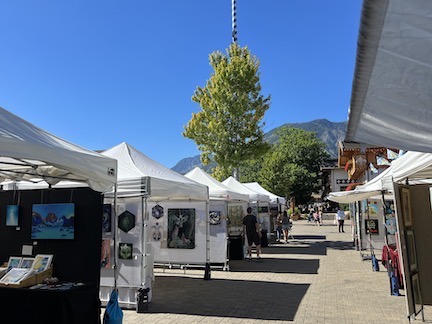
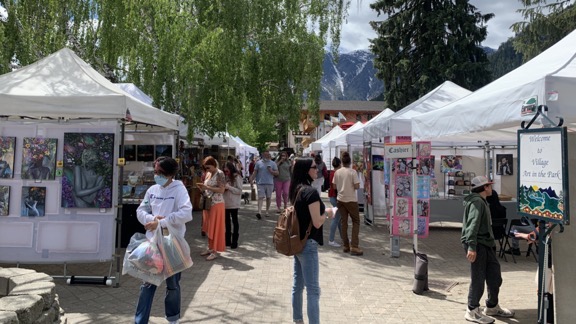
Sunday mornings are always slow in Leavenworth, no matter how beautiful the weather is.

We don’t know how a show is going to be before we attend so it’s impossible to determine which will work out better in advance. Of course, prior attendance at a show can give you an idea of how it might work out. But even that isn’t guaranteed. I did well in Spokane in 2021 so I assumed I’d do just as well in 2022. I didn’t. Not even close. And the weather is always a factor, especially at outdoor shows.

I’ve done three shows in Leavenworth this spring and the first two were disappointing while the last one was really good. I paid relatively low fees for the first two but was hammered at the third. Still, my cost percentage remained between 22% and 26%. The percentage I take home is pretty solid. There’s some reassurance in that. It’s pretty much impossible to lose money at a percentage-based show. Low sales, low fees.

So there is no answer. It all depends.

And that’s part of what artists deal with when they try to sell their work at shows.

The other part? Setting up and tearing down a booth. Buying and maintaining display equipment. Getting to and from shows. Parking. Sitting in a booth all day, possibly leaving work unattended during trips to the restroom. Dealing with often thoughtless shoppers who make audible comments to friends about how easy it is to make this or how overpriced that is. Seeing your work handled by people who then drop it back down to bang against the metal display. Watching kids with ice cream on their hands touching everything. Keeping an eye out for dogs lifting their legs on table draperies and tent sides.

But let’s not forget the good stuff, too. Being told your work is beautiful. Being complemented on your unique designs. Having a customer buy an expensive piece that took you hours to make and telling you how much they love it.

All that should figure into the costs and benefits of being an artist at an art show, too, no?

End of May Already?

Time flies when you’re busy, whether you’re having fun or not.

My last two posts were more than a month ago, in April. I haven’t written a single word — in any of my blogs — since then. I’ve just been too damn busy.

Or tired. Or unmotivated.

The Trip Home

I’m home now from my winter travels. Unlike previous years when I took my RV — most recently, a Lance truck camper — down into Arizona and California for December through March — this year I was on my boat traveling along the Great Loop. I’ve done a total of just over 3000 miles in the boat since I launched it in Chicago in October 2022. Most of that has been solo — just me and my pups. Turns out that my guest accommodations are not satisfactory for friends who have joined me. (Who knew?) Also, I don’t think they got the trip they were expecting. So solo is probably better, at least for now, until I can find a companion who has the right expectations and doesn’t mind sleeping in a cozy cubbyhole.

I’ve been trying to detail my trip in my Great Loop blog, My Great Loop Adventure. Unfortunately, I got behind in my posts and then I got really behind in my posts. As I type this, my most recent post covers my stay in Clearwater Beach, FL in January. It’s now the end of May. I have to hope I can reconstruct the following three months from my notes, travel logs, and photos. That’s one of my main tasks for June. You can help motivate me by reading and commenting on the posts there. That blog will eventually become a book — if I can ever catch up and finish it.

I had the boat hauled out of the water in late April and put “on the hard” at a marina in Chester, MD. The boat’s bottom looked great — no damage at all and very clean after a quick power-washing. It won’t need painting before I launch it again, so that’ll save some money. On the other hand, it appears that a shallow water incident on my first Loop day did indeed do some minor damage to the prop. (That is the only shallow water incident I had where the prop was involved, so it must have been that.) Obviously not enough to affect operation — after all, I did drive it 3000 nautical miles after that — but enough to have the prop pulled and the two tiny blade bends fixed. That might reduce the vibration I feel at certain speeds and, according to the yard owner, it might even help me get an extra knot of speed. I was also very pleased to see that I didn’t have any crap trap line wrapped around my prop; I know I cut one line with the prop on Florida’s west coast but never had any symptoms of a problem.

After cleaning the inside of the boat and packing up, my pups and I headed for Dulles Airport early in the morning of April 27. At 2:30 local time, we were back in Wenatchee, where my friend Bob picked me up and took me home. My house-sitters had vacated just a few days before, leaving the place neat and clean, with clean sheets on the bed. (Thank you John and Allie!) I’m not sure if the cats were glad to see me, but I know the chickens weren’t. I’d been gone so long, they surely had no memory of me.

Good to Be Home?

For the next few weeks, I felt conflicted about being home.

First of all, it was nice to sleep in my big, comfy bed that, amazingly, didn’t rock at all at night, no matter how windy it was outside. It was nice to be able to use a toilet without worrying about how many times I’d flushed, what color the tank light was, and where/when I’d have to dump waste. It was also nice to take a shower with as much hot water and space as I needed without having to walk to a separate building on shore. And I really do appreciate my dishwasher, washer, dryer, and giant refrigerator.

I was home with all the comforts of home. My boat is comfortable, but its space is limited and, like living in an RV, there are special concerns that you just don’t have at home.


Here’s the view from my deck one day not long after my return. How can a person not love looking at this every day?


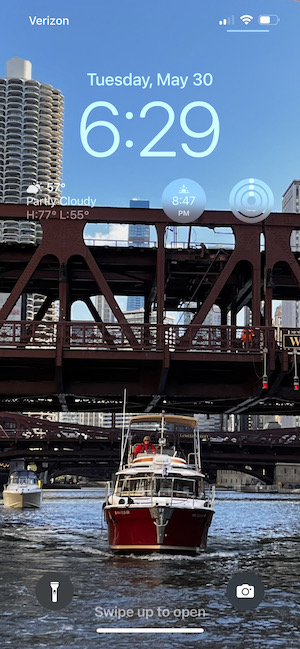
I changed the Lock Screen on my phone to a shot taken by my Looper friend Kim on her boat Pony as we headed down the Chicago River in October 2022. Now I’m reminded every day where I want to be.

But I did miss being on the boat. Traveling from place to place, meeting new people every day, seeing new things every day. Facing and overcoming challenges. Enjoying the simple joy of a sunrise from up on the command bridge, with a gentle breeze in my hair and waking birds flying about. Motoring to a new destination with very little idea of what I’d find along the way or when I arrived. I’m a traveler — like my grandfather was — I’m happiest when I’m on the road — or water — exploring new places or revisiting favorite old ones.

So the first few weeks home were a bit of a mental challenge, with an internal argument telling me I should be happy to enjoy the comforts of home while also telling me that home was boring and predictable and I needed to get back out on the boat as soon as I could.

The Art Shows

Of course, I had to hit the ground running when I got home. (Or I thought I did.) I had four weekends in a row with art shows and I seriously doubted I’d have enough inventory to do them.

It started a week after my return, with my second appearance at Wenatchee’s annual Apple Blossom Festival. There’s an Arts and Crafts show the second weekend of that event with strict setup rules. That had me setting up my booth on the Thursday before the event. That day, I also (finally) got a haircut and made myself presentable to the world. I spent the next three days in my booth, suffering through the dust or pollen or whatever that stuff was that got on everything. The event was extremely disappointing; I suspect my work was too high-end for the audience. I tried not to be insulted when two different people — guys, of course — came into the booth to ask if I had anything around $10. I don’t.

What followed that were three consecutive weekends at Leavenworth Village Art in the Park. This is a juried show that I’ve been part of for the past three years. It’s held every weekend from May into October and artists are able to choose the weekends they want. Management then picks the artists and tells them which dates they can have. I picked five weekends in May, August, and September, and got four. I always want Mother’s Day weekend — I’m selling jewelry, right? — but this year I didn’t get it. Until about two weeks before I got home. Another jeweler had backed out on that weekend and I was asked if I wanted to take her place. Hell yes. So that’s how I wound up with three weekends in May.


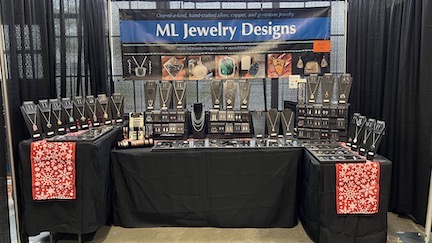
Here’s the current incarnation of my art show booth, set up for Mother’s Day weekend in Leavenworth, WA.

(I should mention here that I don’t do weekends during the summer because that’s cherry season and I’m on standby. I can’t answer calls promptly if I’m sitting in a tent a hour’s drive away. More on that in a moment.)

So I set up for Mother’s Day weekend — three days. Unfortunately since I thought I wasn’t going to do Mother’s Day weekend, I booked a class in Ellensburg — two hours from home — to teach silversmithing on Saturday. I thought that class might get cancelled; it was a relatively expensive four-hour class. But it wasn’t so I had to get a friend to sit in my booth on Saturday while I went to Ellensburg to do that.

Mother’s Day weekend sales were very disappointing.

So was the next weekend. That made three weekends in the row with disappointing sales.

I was beginning to think that it was either the economy or the venue that was bringing my sales numbers down. People are definitely not spending like they were back in 2021. And, at the same time, some of my work was becoming more refined and, yes, more expensive. Was I making a product that wasn’t a good match for the “tourist shows” I was showing at? My friend Janet, who has been doing art shows for about 40 years now, thinks so. I think I’m on a sort of knife’s edge where I could go either way. I can make the lower-end items people seem to be ready to buy but I want to make the higher end items that are more creative and challenging and help develop my skills as a silversmith.

The good part of all this is that although I thought I’d have to spend the month making jewelry to keep my inventory up for shows, I didn’t. I made a handful of new items and then, after that third bad show, took the week off to tend to other things.

I went into the four-day Memorial Day weekend with very low expectations.


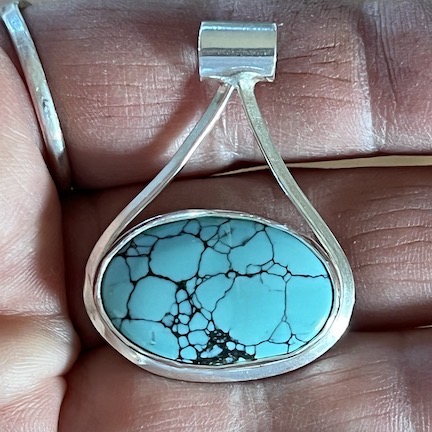
This was the first of two “next level” pieces I made during the month of May. Hubei Turquoise in sterling silver.

And I kicked butt. Seriously: I had my second best ever show. (The best was Mother’s Day weekend in Leavenworth back in 2021.) Although I’d told myself I’d stop making the wire-framed pendants that had gotten me started back in 2018, I had to make them while I was at my booth just to keep my displays filled. And beaded earrings and bracelets and necklaces. And I sold them. But best of all, I also sold one of the high-end pieces I’d made earlier in the month — a piece I considered “next level” for me. While I was sad to see it go — sometimes I get a real attachment for my work — I was also thrilled that someone was willing to pay that much money for something I’d made.

So now I’m done with shows for a while, coming down off a high from this past weekend. My next show is at Lake Chelan — yes, another tourist show — but I suspect I’ll do well if the weather is good and folks come out. I have three weeks to stock up and I have some ideas for the kind of next level pieces I want to make.

The Diet

Well, it took about 10 years, but I managed to gain back all of the weight I lost back in 2012, the year I also shed a husband and gained full control of my life. If you’re a regular reader, you may recall that I’d gone on a Medifast diet along with a friend and we both lost about 45 pounds in four months. (I basically followed him down the scale; he was a week ahead of me and we’d started at the same weight. He’s shorter than I am.) I kept most of the weight off for a few years, but little by little my overeating habit returned and the weight came back. For the most part, I eat very well — very little junk food and hardly any fast food — but I tend to like what I eat and eat more than I should. That’s what got me back to where I started in early 2012.

I’d tried cutting back on my eating but was unsuccessful. I needed a program that was easy to stick to, one I knew would work. So I went back on the new version of Medifast, which is called Optavia. Mostly the same food — although definitely sweeter sweets and saltier savories (what’s up with that?) — and the same plan. I started on May 1 and 30 days later, I’m weighing in at about 16 pounds less than I started. I’ll stick with it throughout the summer and have no doubt that I’ll reach my goal weight (again) before I go back to the boat in September.

And this time I’ll keep it off. It’s mostly for my health, but I can’t deny the emotional kick I feel when I look in the mirror and see someone who looks as good as I should.

Cherry Drying

I start my last season drying cherries on June 10. This is a mellower than usual season with less acreage and fewer pilots. It’s also not clear how much flying I’ll do — if you recall, I sold the helicopter to buy my boat last year. Last year, I leased a helicopter for the season, but that ended with problems I didn’t want to blog about — and won’t unless they rear their ugly head again. (Contrary to popular opinion, I don’t blog about everything in my life.) This year, I might be flying one of the helicopters my pilots are bringing up from Texas. Or I might not. It depends on whether it rains. (If my pilots have everything under control and can dispatch themselves, I’ll tell the Leavenworth Village Art in the Park folks to put me on their wait list for other summer weekends.)

This will be my fifteenth season drying cherries. Since I started way back in 2008, I’ve built my business up to the point where, at its peak, I had six guys on my team every summer and was bringing in more revenue than I did during the heydays of my writing career. Things are slowing down now and that’s fine with me. The stress of worrying about a crew of mostly unknown pilots and literally hundreds of acres of client orchards has really taken a toll on me. This is the last season I’ll be involved and I’ve already let most of my clients know.

When I look back at my freelance career, I’ve come to realize that I’ve been working every single summer since 1998. If it wasn’t a Quicken book, it was cherry drying. I’m really looking forward to having a whole summer off for the first time in 25 years and I’ve already made plans for it.

As for the business, I’m hoping this season’s pilots will consider taking over my contracts and giving my current client base the good service they deserve.

Will I miss flying? I already do, a little. But honestly, I’m enjoying the boat so much that I think I can get over it.

Remember: you can’t move forward if you’re looking behind you. Being a helicopter owner/operator is in my rear view mirror and I’m not turning around.

Other Stuff to Keep Me Busy This Summer

My list of Things to Do gets bigger every day.

Gardening
I didn’t properly put my garden to bed last autumn so that meant more work this spring. I finally have most of my 12 beds planted. I still need to weed around them and get things neatened up.

Selling Stuff
My biggest problem at home? I have too much stuff. I’m in the process of selling off a bunch of it. I’ve already sold my helicopter landing platform and tow bar; one of my summer pilots might be buying other helicopter gear I still have. I also need to sell my truck camper and my little boat — yes, I still have that! Future items for sale: my telescope, my cheesemaking gear, a bunch of circa 2000 Apple swag from Macworld Expo shows, my beekeeping equipment, and so much more. Craig’s List has been an absolute gem at moving this stuff out without costing me an arm and a leg.

Garage Bathroom
I still need to finish the bathroom in the garage. That’ll require some assistance on the plumbing from a builder neighbor who I hope to get in here soon. The goal is to have it done — or at least the toilet functioning — by the end of June.

Garage Reorganization
What a mess my garage is! I’m reorganizing it to move all my woodworking and tools out of my jewelry shop area and into the adjacent space. My workbench will become a miter saw bench. Then I’ll expand the jewelry shop to include space for two students, as well as my futon and some other furniture to make it a more comfortable, useful space.

Spring Cleaning in the House
I’ve already done the cleaning part of this. Now I just need to offload a lot of clothes and other household items I simply don’t need in the house. Yes, I’m downsizing! There are a lot of reasons for this, but the main one is that less stuff means less clutter.

Blogging
I really do need to catch up on my Great Loop blog. And not neglect this blog so much.

Working the Jewelry Biz
I need to keep making new jewelry, selling it at shows, and bringing it to established consignment and wholesale accounts. Others are selling my jewelry for me and although they take a hefty fee — as much as 40% — it’s a lot more efficient to let them sell it than to go to shows, especially since I can’t do shows when I’m on the boat. I also want to start teaching small classes out of my shop, using days when I need to make a specific product to teach others to make the same thing. That’s something I need to set up soon since my time home is so limited.

Those are the main things that will keep me busy this summer. I guess I’d better get to it.

First Art Show of the Season

Surprisingly successful.

This past weekend was my first art show of the season. It’s at a venue which is usually good for me, but this time, it was surprisingly good. I thought I’d blog a bit about it.

But before I go into a report of this past weekend’s art show, let me begin by explaining how I sell my work. (You know me; there’s always a back story.)

My sales channels

I sell most of the jewelry I make in three different channels:

  • My Art Show Booth
    My art show booth as it appeared this past weekend in Leavenworth. I was fortunate to have an end spot and be open on three sides.

    Art Shows. This accounts for far more than half of my sales, but it’s the hardest work I do. I (normally) pay a free up front for booth space and then, on the day of the show, arrive early with a 10×10 foot tent, tables, table covers, signage, and merchandise displays. I set everything up — it takes roughly 90 minutes — placing my work as artistically and practically as I can. Then I sit in the booth all day — sometimes for as many as five days in a row — to sell what I’ve brought, make more inventory (when possible), and take/make orders for custom items. Then, at the end of the show, I pack everything back up. The benefit: I (normally) get to keep 100% of the selling price for each item.

  • Wholesale and Consignment Sales. This accounts for maybe 15% of my sales and involves a lot less work — but at a cost. My wholesale price is 50% off the retail price; consignment fees are typically 35% to 40%. Even though it costs more, I prefer wholesale sales — once an item is sold, I can pretty much cross it off my inventory and forget about it. (The exception is the trade-in policy I offer for my wholesale clients; if something doesn’t sell in their shop in 6 to 18 months, I allow them to trade it in for another item.) Consignment is a royal pain in the ass. Not only am I letting a consignment shop hold onto my inventory (so I can’t sell it myself), but I need to keep track of all that stuff. And if an item is lost through theft at their shop, I’m pretty much screwed. Or if they go out of business while they have my stock, I have to worry about getting it back. Needless to say, I really don’t do much on consignment. What’s nice about these channels, however, is that they do often lead to a regular stream of sales with monthly income. So there’s that.
  • My Online Store. This accounts for another 10% of my sales. Right now, I’m using Etsy, but I hope to switch to a more professional solution soon. Etsy takes a small cut of each sale — it’s less than 10% (unless the sale is related to a special ad they’ve placed) — so it isn’t the cost that bothers me. It’s being in an online retail space with people selling cheap, imported junk that they’re trying to pass off as their own work. The only thing that keeps me with Etsy is their integrated shipping feature, which not only makes it easy to ship to addresses all over the world, but gives me a discount on USPS postage costs.

The rest of my sales are face-to-face to friends and acquaintances. That’s a tiny percentage of the total.

This Weekend’s Show

This past weekend I was at Leavenworth Art in the Park. This is a weekly art show in the center of town that has been fine-tuned over the past year for COVID. Right now, it’s operating with only 15 artist vendors in widely spaced outdoor booths; when restrictions ease a bit more, I suspect it’ll go back to its previous capacity which was about 20.

Art in the Park
With spacing for COVID, booths are able to be open on all sides.

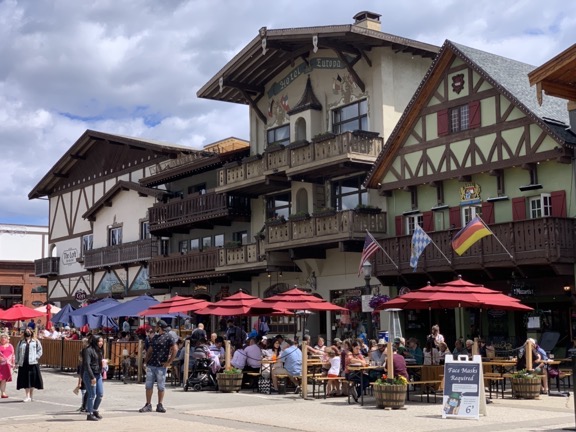
Leavenworth, Washington, is a small town in the foothills to the Cascade Mountains. It’s a gorgeous location, nestled near mountains that remain snow-capped for much of the year. Its Bavarian Theme is what brings tourists in all summer long. The town also has (or had before COVID) lots of festivals, including a three week long Oktoberfest and big Christmas celebrations. The area has tons of hiking, white water rafting, camping, and other outdoor activities. It’s a nice place to visit, although admittedly a bit too touristy in town for my taste.

Leavenworth, WA
Downtown Leavenworth, WA was completely redone years ago to require Bavarian style architecture. One of the nice things about COVID — there are silver linings if you look for them — is that it got the town to close down the main street to vehicle traffic to make room for outdoor dining.

Elk horns
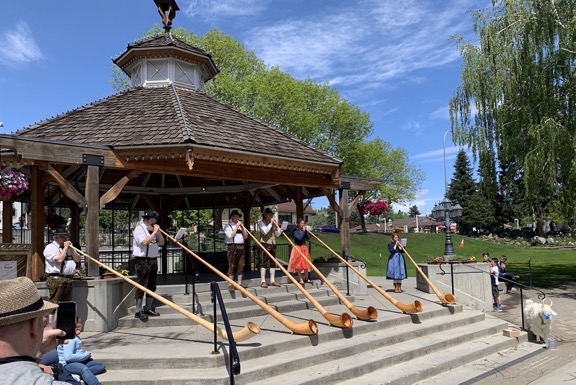
One of the draws to Leavenworth is entertainment, like this elk horn group. I shot this photo from my booth; it was very close to where the entertainment was.

I started showing/selling my work at Art in the Park in 2019. I attend on a limited basis because my primary work, which is cherry drying with my helicopter, requires me to be close to the helicopter in the Wenatchee area from roughly June 1 to August 15 every summer.

In a way, my limited time there is a good thing. Leavenworth is 50 miles from my home and the days there are long: 9 AM to 6 PM. Add that to my one hour (each way) commute and I’m looking at 11 hours. Spring and early autumn can be cold, summer can be hot. Parking is a pain in the ass. There are long lines at restaurants and, often, for the restrooms.

The reward of being there, however, is great sales. Folks who come to Leavenworth come to be entertained and to spend money. They shop in town and at the Art Show. They eat and drink in countless restaurants and bars. They stay in local hotels. They are in money-spending mode. And because most of them come from the Seattle side of the mountains, they have a bit more disposable income than the local folks I used to sell to at smaller venues in downtown Wenatchee. A pendant priced $59 isn’t a big expenditure for these folks, so I can actually sell and make money on my work.

This weekend was a great example. Although it was the second weekend of the show, it was my first weekend attending. I set up on Friday morning and began selling almost immediately. By 6 PM, I’d sold more than I had in an entire weekend on my last show. I did even better on Saturday and almost as well on Sunday.

Overall, it was the best weekend I’d ever had at any show anywhere.

Pendant
Here’s one of the pendants I made while I was sitting in my booth on Sunday morning. I made a total of six pendants that day.

It was so good that I spent most of Saturday and Sunday making more inventory. My wire work pendants continue to sell well in Leavenworth and I made five custom pendants for customers while I was there. I also made a bracelet and three beaded necklaces. This week I’ll be making a lot of earrings in my shop.

Now although the booth fee at Art at the Park is remarkably low, the non-profit organization that runs it does take a cut of sales: 21%. So I don’t get all of the money I brought in. But 21% is a lot less than the 35% or 40% I’m paying two galleries to show and sell my work. And I sold a lot more this past weekend than I’ve sold in my three year relationship with both galleries combined. So I’m definitely not complaining.

I’m doing two more weekends at Leavenworth this month. Then I’m stuck in Wenatchee for most of the summer. I applied to a show in Wenatchee in June and another show in Chelan in July. (I had to find a booth sitter for the July show in case rain is possible and I need to stay home.) I’m scheduled to go back to Leavenworth in August and September, but I may need to cancel that because of a conflict with another opportunity that I’m not quite ready to discuss here yet.

And if you’re a Leavenworth tourist reading this, I sure hope you’ll stop by Art in the Park while you’re in town. It’s open on Fridays, Saturdays, and Sundays from about 9 AM to 6 PM (or 5 PM on Sundays). I believe it’s also open on Thursdays between Memorial Day and Labor Day. Support local artists and makers!

Handmade Items: It’s NOT Just Materials Cost

I explain why I charge $39 for a pair of earrings with less than $10 worth of materials.

Yesterday, I went down into my jewelry shop and made 6 pairs of earrings out of roughly $55 worth of sterling silver sheet metal and pre-made ear wires. I’ll sell each pair for $39. Sounds like a great deal for me, right? Well, if you read on, you’ll learn more about the actual cost of these earrings.

I tweeted my progress while creating these earrings, using a Twitter thread with photos. I skipped tweeting the first step, which was getting the pattern onto the silver — I don’t buy sheet silver with a pattern already on it (although I do sell it that way) — but got most of the other steps. They make up good documentation for this blog post’s purpose, which is to talk about what actually goes into making something from scratch: materials, tools, skills, and time.

Materials

The materials for this project were pretty basic:

  • 26 gauge sterling silver sheet. I buy the metal I plan to apply a pattern to in 6″ x 2.5″ pieces because that’s the size of most of my texture plates. I learned (the hard way) that you can ruin a texture plate by using it to texture a smaller piece of metal than the plate. Because of a 75% or so increase in the price of silver last year, this small piece of metal cost just over $42.
  • Sterling silver ear wires. I buy these in bulk, but they still cost nearly $1 each. I can save money by making them myself out of 20 gauge half-hard sterling silver wire, but I like the look of the ones I buy and they’re less likely to bend out of shape than the ones I make. I’ve even had one of the galleries I provide inventory to tell me that they prefer manufactured ear wires for the very same reason.
  • Rubber ear nuts. These are tiny pieces of rubber that go onto the end of the ear wire, making them less likely to fall out of your ear (or off the jewerly display card I use when selling). I buy them by the gross and they cost a fraction of a cent each. (I don’t understand why all jewelry makers don’t include them with ear wire earrings. Such a tiny, inexpensive little thing can prevent the loss of earrings.)

In addition to these materials. I also have the printed cards I use to display and sell the earrings. These cost just pennies apiece and are part of my marketing/selling expenses, but they shouldn’t be overlooked. Ditto for the specially sized, clear plastic zipper bags I put the earrings and cards into when I sell.

Tools and Equipment

It’s the tools and equipment that really add to the cost of the jewelry I make. As an accountant might tell you, these are fixed costs that need to be considered as part of anything you make with them. The more you use a tool or piece of equipment, the less the per-piece cost of that equipment is. An analogy from my day job as a pilot would be something like insurance: if it costs you $15K/year and you fly 100 hours a year, that’s $150/hour; but if you fly only 10 hours, that’s $1500/hour. Ouch.

Going through the steps to create these earrings, I used the following tools and equipment:

  • Rolling mill. This is the device I used to impress the pattern onto the silver. Rolling mills vary in cost. I have a Durston, which is made in the U.K. and isn’t cheap. But mine is small, so it wasn’t too costly. I think I paid around $750 for it.
  • Texture plate. This is a piece of brass with a texture on it. The brass is harder than the silver so when the two pieces of metal are run through the rolling mill together, the texture from the brass is imprinted onto the silver. The texture plates range in price from about $5 for a single-use paper version up to $100 or more for steel versions. My brass plate cost about $10 and will give me about 50 impressions before it’s too flat to make more impressions.
  • Metal shear. Although I didn’t really need it for this project, I used my metal shear to cut off a 1/4″ by 2 1/2″ piece of the textured metal to use as a ring blank. You see, when the metal goes through the rolling mill, it stretches. So even though I cut 1/4″ off one end, I still had 6″ x 2 1/2″ of textured metal to work with. My metal shear, which I use a lot, cost about $250.
  • Shape template. I use shape templates to create earrings and other items in consistent sizes and shapes. The template I used for this project has about 30 shapes/sizes on it and cost $8. It’s made of heavy duty plastic so it’ll last a long time.
  • Fine point Sharpie pen. That’s a tool, too. I used it to trace the shapes onto the metal as close as I could without overlapping. What do they cost? About $3 each?
  • IMG 0028
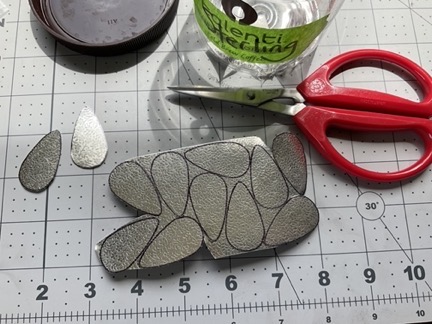
    Here’s the cutting job in progress.

    Joyce Chen kitchen shears. I have a variety of ways to cut metal sheet — my jeweler’s saw, a pair of French shears — but I used these shears for this project. They’ll cut through any reasonably thin soft metal — and 26 gauge silver is pretty thin and relatively soft. The cost? $21.

  • Flex shaft. After cutting out all those pieces, I needed to smooth their edges. Being the machine person I am, I used my flex shaft, which is basically a Dremel-style tool with the motor at the end of a long shaft and a foot pedal to control the speed. Mine is a EuroTool and cost about $120. But don’t forget to add the motor hangar for it, which cost another $32.
  • Mounted sandpaper cartridge roll. I used a sandpaper roll to do the actual sanding. They cost about $1 each.
  • IMG 0032
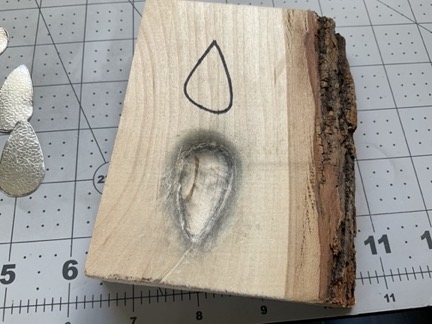
    Here’s my custom dapping block. The other drawn-on shape is for one I no longer use and never actually carved into the wood.

    Custom dapping block. A dapping block makes it possible to put a dome into pieces of metal. But because these earrings aren’t round, they needed a custom dapping block. I made mine from a piece of bass wood that only cost about $2, but I used a variety of Dremel bits to carve it out and I fine-tune it every time I use it. Still, we’ll say $2 for this homemade tool.

  • Nylon hammer. Although my photos on Twitter show me using a dapping punch with the block to put a dome on the metal, I actually used a domed nylon hammer that has always worked a little better for me. Cost: $14.
  • Hole punch. While I could have drilled holes for the ear wires into each piece before doming it using a center punch, flex shaft, and drill bit, I took the easy way with a 1.25mm metal hole punch. Cost: $14.
  • Scrap wire. I used a piece of thin copper wire to attach the earring pieces together for oxidizing them. The cost of this scrap is pennies and not even worth adding into the equation.
  • Using Liver of Sulfur
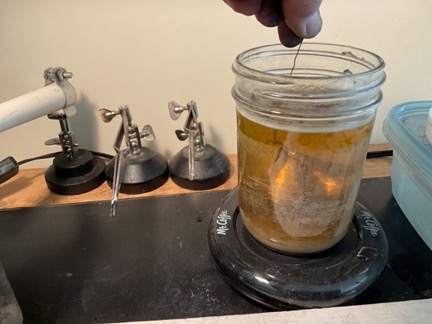
    In this shot, I’m dipping all 12 pieces of the earrings, on a copper wire, into the liver of sulfur. You can see the jar and mug warmer, as well as the side of the container next to it that I use for the baking soda rinse.

    Liver of Sulfur. Liver of sulfur is a chemical that, when dissolved in warm water, can darken copper or silver (but not gold). It’s widely used by jewelers who want an oxidized look on textured metal. The stuff I use costs $18/jar and that’ll last about a year.

  • Mason jar. I use a 1-pint wide mouth mason jar to mix, heat, and store the liver of sulfur. Because I do canning, I always have a bunch of spare jars — although once I use them for chemicals, I can’t wash and reuse them for food. Figure about $2 for this jar with the plastic lid.
  • Cup warmer. I use a coffee mug warmer to keep the liver of sulfur warm while working. The one I use costs $11, but you can sometimes find them cheaper in thift shops.
  • Baking soda. I mix baking soda and water in a glass bowl and use that to neutralize the chemical reaction of the liver of sulfur so the metal stops darkening. It’s the stuff you buy in the supermarket. How much? I don’t know. $3 for a box that’ll last a very long time?
  • Container. Of course, I need a container to put that baking soda and water solution in. I use reusable disposable plastic containers with lids. When I’m done, I cover it up so it doesn’t evaporate. Figure $2 for a container with a lid.
  • Tumbler. There are all kinds of tumblers you can use for jewelry, but I use a basic Lortone 3A 3-lb capacity rock tumbler. I paid about $110.
  • Ceramic tumbling media. This is my secret sauce and I’m not very motivated to provide details, mostly because it saves me a ton of work and provides consistent results every time I use it — which is vital when you need to make multiples that are the same. Let’s just say that it’s ceramic tumbling media that rubs the darkening off the raised part of the pattern. The stuff I use costs $45/bag and that bag will last at least a year. If you want to try it, find one that works for you. (Good luck.)
  • Dawn detergent. I add a drop or two of Dawn to the tumbler with the ceramic media and water. I always use dawn because everyone recommends Dawn. I buy small bottles that last a long time. What does that cost? Let’s say $2.
  • Extra tumbler barrel. Because it’s best to keep stainless steel shot separate from any other tumbling media, I had to buy an extra barrel. Add $36.
  • Stainless steel shot. Steel shot burnishes the finished jewelry. Don’t buy the cheap stuff; it’ll rust. I buy it by the pound for $26; because it doesn’t rust, it should last forever.
  • Burnishing compound. A few drops of burnishing compound in the tumbler with water and the steel shot helps achieve a nice polish. It’s $10 for an 8 oz. bottle that lasts at least a year.
  • Earrings
    I finished the earrings in my home at my breakfast bar while waiting for dinner to cook.

    Chain nose pliers. I use pliers to open the ear wire loops and close them once the earring piece is attached. My preferred brand: Wubbers. They’re not cheap but they’re heavy duty. $26.

  • Paper hole punch. I use a small punch to put holes in the cards that I mount earrings on. Figure about $9.

That’s everything I used directly during the course of this project. It doesn’t include rags or paper towels or the wipes I use to keep my workspace clean after sanding. It doesn’t include any of the furniture in my shop — my homemade jeweler’s bench, the tables where I keep my rolling mill and soldering station (where the liver of sulfur lives), or my adjustable height stool. It doesn’t include lighting and utilities for my shop space. Heck, it doesn’t even include the cost of constructing my shop space, which is an entire 12 x 24 foot room in my garage.

Let’s add these costs up:

ItemAcquisition Cost
Rolling Mill$750
Texture Plate$10
Shape Template$8
Fine Point Sharpie$3
Joyce Chen Shears$21
Flex Shaft$120
Flex Shaft Motor Hangar$32
Sandpaper Roll$1
Dapping Block$2
Nylon Hammer$14
Hole Punch$14
Liver of Sulfur$18
Mason Jar$2
Cup Warmer$11
Baking Soda$3
Container$2
Tumbler$110
Ceramic Media$45
Dawn Detergent$2
Extra Tumbler Barrel$36
Stainless Steel Shot$26
Burnishing Compound$10
Chain Nose Pliers$26
Paper Hole Punch$9
Total$1,275

Add that to the $55 in materials and you come up with $1,330. So if the only thing I ever made was those six pairs of earrings, their cost would be $222/pair.

Yes, that’s absurd. Of course I make more than six pairs of earrings with all this stuff. But how many pairs of earrings do I need to make and sell at $39/pair to cover my investment in tools and equipment?

Think about it.

Skills

And then there are skills, which come with training and experience.

I am not exaggerating when I say that I’ve spent thousands of dollars on jewelry making courses — in-person and online — as well as books and magazines. YouTube videos can only take you so far — what works best is one-on-one time with someone who has actually been doing this for a while.

And practice. How many times did I screw up a piece of metal in my rolling mill? Or cutting it apart? Or oxidizing it? (I’m still smarting from a bad oxidation job on 3 pairs of Keum-boo earrings where I used a new (to me) solution and darkened the gold as well as the silver. Ouch.) Or any of the other steps that went into this project? Practice really does make perfect — or as close to it as a person can get. Practice takes time and burns through materials and supplies. It’s no coincidence that we practice with copper instead of silver or — heaven forbid — gold.

Time

Time is easily quantified for this job since I know when I started and when I finished: 3 hours. That comes out to 30 minutes per pair of earrings. This is why I made stuff like this in batches; it’s a much more efficient use of time.

But how long did it take last time when I didn’t necessarily have everything as well organized? And how long will it take next time, when practice makes me a bit faster?

And shouldn’t I be compensated for my time? Clearly, I wasn’t compensated directly for the time I spent in training or reading up on new techniques or ruining materials because of inexperience or dumb errors. I should, at least, be compensated for the time I spent actually creating salable pieces of jewelry, no?

The Bottom Line

Finished Earrings
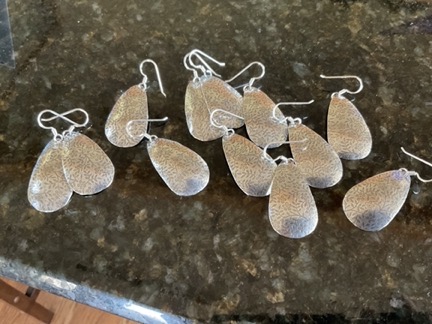
Some of the finished products.

Here’s the bottom line: I took 3 hours of my time and used thousands of dollars worth of training, hundreds of hours worth of practice time, and $1,330 worth of materials, tools, and equipment to make 6 pairs of earrings that I’ll sell for $39/pair.

I think buyers are getting quite a deal, don’t you?