Nothing like airport security!
I took this photo last year after arriving at this airport gate. I wanted to remember how secure my aircraft would be, sitting out on the ramp beyond this lock.
Can you see why I took a photo of it?
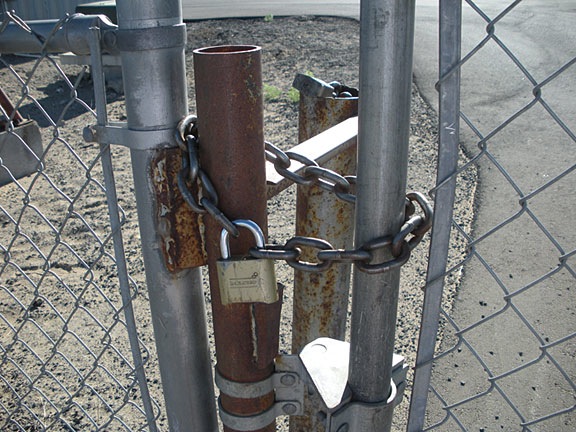

Nothing like airport security!
I took this photo last year after arriving at this airport gate. I wanted to remember how secure my aircraft would be, sitting out on the ramp beyond this lock.
Can you see why I took a photo of it?
And a check ride report.
I realized this morning that I never did report on my check ride. When I mentioned that I was prepping for it, I promised a report the next day. That was a week ago.
In my defense, I’ve been unreasonably busy. Here’s a rundown of how I spent the past seven days.:
On Friday morning, I took my Part 135 check ride with an FAA examiner. It was a non-event. I didn’t fly as well as I wanted to — I guess having an FAA inspector sitting next to you while you’re flying and wondering what he was going to do to play with your head (think pulling circuit breakers, chopping the throttle, etc.) is enough to make me a nervous wreck. But I flew good enough. And once I realized the test part was over, I actually flew very well. I want to write more about this, but don’t have the time right now.
When it was over and I put the helicopter away, I had to start prepping for another round of house guests. I ran around like a nut, taking care of errands and prepping my office for use as a second guest room. I was still at it when my husband arrived with the house guests: his mother and her friend.
Saturday was our big annual Buckeye gig. This was our fifth year at the Buckeye Air Fair and I hope I can do it for 15 years. I enjoy it so much. I do cheap helicopter rides priced low enough that folks can (and do) bring their kids. I think I flew just as many kids under 15 as I did adults. One flight was just three kids aged maybe 4 to 7. It was nonstop flying from 9:30 AM, when the first takers climbed on board to 3:15 PM, a full hour and a quarter after the end of the event. I had to shut down once for fuel and a bathroom break, but I didn’t even get much to eat.
I wanted to write about that, too — especially about the flight down from Wickenburg — but I just haven’t had time. Now the memories aren’t quite as fresh and I don’t think I could write something interesting about it.
On Sunday, I was on the road at 7:15 AM, heading west in my little Honda S2000. Road trip. I had to go to Ventura for a week for work, but I wanted to stop at Anaheim on the way to check out Heli Expo.
 The show was at least three times the size of the last one I’d gone to, which was back in 2004 in Las Vegas. It was like a candy store for rotor-heads like me, with millions of dollars in hardware sitting out on plush carpeting for us to caress and drool over. And climb on board to sit in cockpits. I didn’t take many pictures — it was just to damn crowded.
One of the highlights was meeting a Twitter friend, Keith Gill. Keith flies the big iron — including Air Cranes — all over the world. He’d just come in from a firefighting gig in Australia and was prepping for another gig somewhere else. Keith writes a blog called “Helicopter Pilot, Will Travel” with lots of great, real-life stories about his flying and travel experiences. I highly recommend it for anyone interested in what being a helicopter pilot is all about.
Another highlight was meeting Dennis Raubenheimer of HeliNews. I’d written an article for them at it appeared in the current issue. He had two copies for me and I eagerly opened one as soon as I had it in my hot little hands. I was thrilled to see that they’d used all of the photos I sent, many of which featured my helicopter. My only regret is that the magazine is based in Australia and few U.S. pilots (or helicopter operators interested in hiring pilots) would see it. Can’t wait to hand off a copy to Ed, my local mechanic, who is featured in a bunch of the photos.
After leaving the show at 5 PM, I took a roundabout route up to Burbank, successfully avoiding any Oscars traffic in the Hollywood area. I was meeting another Twitter friend, SaxDiva (Leanne), for the first time. She’s a college professor who teaches business by day and plays saxophone and other woodwind instruments in the evening. She was doing a big band gig at a Burbank restaurant called Victorio’s. I’d been wanting to meet her for a while and we finally connected. Another friend of mine, Deb Shadovitz, joined me for dinner. Leanne sat with us between sets and we got to meet a bunch of the other band members, including a singer who sounded an awful lot like Tony Bennett. There’s nothing quite like good food and good music at the end of the day. If you live in the Burbank, CA area, I highly recommend Victorio’s on a Sunday evening for a casual night out with live music and dancing.
From there, it was a nightime drive to Ventura. I only made one wrong turn getting on the freeway. I was in my room, 400+ road miles from home, ready to pass out, by 10:15 PM.
Talk about a long day.
I spent much of the first three days of the week in a soundproofed booth, recording a new video for Lynda.com. The rooms are like isolation chambers that completely shut out the sound from outside them. The work is pretty basic, but often frustrating as I trip over my own tongue to get the words out. I’m not really at liberty to say what the course is about yet — I’d rather keep it a surprise to the folks who don’t already know. (No spoilers in the comments, please!)
We did the live action footage yesterday. That’s when I get dolled up with makeup, etc. and talk to a camera. I was fumbling through the takes and was starting to think I’d never get it right when I absolutely nailed the last one. What a relief!
The week has two more days left in it and I’ll be working in Ventura both days. I think I’ll need both of them to get the material recorded. If I finish before noon on Friday, I’ll drive home. If I finish after 3 on Friday, I’ll spend the night here again. If I finish sometime between noon and 3, I’ll make a decision then.
At home, Mike is entertaining our house guests. They leave on Monday. I have nothing scheduled next week, but I know I’ll be doing at least one flight, probably to Sedona. I already have a flight booked for the week after that, too.
Too much to do. Too little time. It seems to be the story of my life.
I need a vacation!
I get ready for my sixth Part 135 check ride.
Some of you may know that I hold what’s called a “Single Pilot Part 135” certificate. This is an FAA certificate that allows me to perform operations that a regular Part 91 pilot can’t perform. For example, I can pick you up at Airport A and drop you off at Airport B. I can also take you for a sightseeing tour more than 25 miles from our starting point. This might not seem like a big deal, but it’s very difficult — if not downright impossible — to build a business in aviation without the capabilities offered by Part 135.
There are three kinds of Part 135 certificate: Single Pilot, Single PIC (I think that’s what it’s called), and Basic. Single Pilot means there’s just one pilot doing all the Part 135 work. I can have two pilots in my company, but only one of them — me — would be able to do Part 135 flying. The other would have Part 91 limitations. A Single PIC is for companies with aircraft that require two pilots; one is always the pilot in command, but the second officer could be any qualified pilot. A Basic Part 135 certificate is not very basic at all. It allows multiple pilots in a company to operate under Part 135. It also requires all kinds of paperwork, training programs, and personnel.
I was a Part 135 pilot when I worked at the Grand Canyon. The company I worked for did all operations under Part 135 and had a basic certificate. I took my first Part 135 check ride with their check pilot. It wasn’t a huge deal.
When I ordered my R44, I applied for a Single Pilot Part 135 certificate. In February 2005, I took my first check ride for that certificate. Since then, I’ve taken a check ride with an FAA inspector every February. My 2009 check ride is tomorrow.
The check ride is like any other commercial check ride. There’s an oral part that lasts 1-2 hours. Then there’s a flight part that lasts about an hour. I’m expected to get all the important questions right and to fly safely, to commercial helicopter pilot standards.
Every year, the flights get easier. I don’t think it’s because they’re going easy on me. I think it’s because I’m getting to be a better, more confident pilot.
 I now have over 800 hours on my R44 and I’ve flown just about every one of them. There’s something magical about flying the same aircraft all the time. You get to know its little quirks. And you can fly it without thinking — it’s as if it’s an extension of my hands and feet. I climb in, strap myself in, start the engine, and fly. It does what I tell it to do without me laboring over it. That’s a really great feeling.
Anyway, one of the reasons I haven’t been blogging as regularly as I usually do lately is because I’m prepping for my check ride. Cramming. I can never remember weather minimums — we don’t have much weather here in AZ — and I have to try again to remember them for tomorrow. Not that it matters much. The rules for airplanes don’t apply the same way for helicopters. But I’ll try to remember and hopefully get it right when I’m asked.
The rest should be pretty easy.
I’ll let you know how I did tomorrow afternoon.
2009 Edition.
I did another flying gig out at Parker AZ again this year. It was wicked windy on the ground when we took off — so windy, in fact, that a Bell Jet Ranger pilot refused to fly. (I didn’t think it was that bad, but then again, I’m not flying a Bell.)
About 100-200 feet up, however, it was dead calm and I was able to do just about any maneuver the camera guy needed. I had an excellent observer on board who kept an eye out for wires and other helicopters without freaking out when I intentionally got close to either one.
For the first flight, we chased the truck featured in the video below, as well as a dune buggy like car. I don’t know the technical terms for any of these things — I’m a pilot, not a dirt racer.
For the second flight, it was windy. We were videoing the guys coming into their pits and a lot of hovering was required. I could only hover when pointing into the wind, which was gusting to 28 knots. When we flew around the trucks in the “Python” area of the course, I couldn’t fly slowly enough with a wind up my tail so I did a lot of circling, keeping the target where the camera guy could keep his camera on it.
In case you’re wondering, our usual setup is to have the camera guy behind me with his door off. (If it were warmer, I probably would have had my door off, too.) This makes it easy for me to see what he sees and keep the car in sight. The observer sits up front next to me. Although I keep a good eye on what’s around me, he’s a second pair to make sure I don’t miss something important.
After the second flight, I could see that bad weather was literally minutes away. After putting the doors back on and estimating that I had enough fuel to get home, I took off. I called the airport later to pay my fuel bill and was told that the downpour started 10 minutes after I left.
I flew a total of 3.9 hours, including ferry time. Judging from the video, I think the guys got just what they wanted.
And that can safe your life.
After guesstimating for a while that I had about 2,000 hours of flight time, I finally got around to adding up all those columns of numbers in my log book. Although I make entries pretty regularly, the chore of adding them up is only done a few times a year. I’m prepping for a Part 135 check ride this week and figured it was about time. I discovered that I passed the 2,000 hour mark back in October — about ten years to the day after my first flight lesson.
Flight time is one of the few real gauges of experience that pilots have. While many passengers ask me how long I’ve been flying, very few ever ask the real question: how many hours have you flown? I know plenty of pilots who have been flying far longer than I have, but don’t have as many hours logged. Who is more experienced? I think hours is a better indication than years.
The more you fly, the more you really experience as a pilot. Let’s face it: shit happens. But it won’t happen to you if you’re not out there in a situation where it can happen. How can you learn how to deal with the kinds of weird things that happen to pilots if you’re not flying enough for them to happen?
You might wonder what kinds of things I’m talking about. Here are a few of them:
These are just a few things a pilot learns with experience. If you’re a pilot, you can probably think of others. Please share them in the comments for this post.
My point is this: don’t whine and complain when a job you want to do requires 1,000 hours of experience to get your foot in the door. The folks hiring you know the simple equation: flight time = experience. And you can never have too much experience when you’re a pilot.