Leaving Red Creek

Another helicopter video.

I’m finding a bunch of gems on my hard disk. Figured I’d share them online.

We’d stopped at the Red Creek landing strip on our way down the Verde River when we saw another helicopter parked there. We were working on a video project and wanted to interview the pilots. They must have been down by the river because they weren’t anywhere near the helicopter. So after screwing around on the ground for a while, we took off back down the strip and turned downriver to complete our flight. This video was taken with a nose-mounted POV.1 camera.

Night Flight into Wickenburg

It’s dark at the edge of nowhere.

I was going through a bunch of old video I had stored on my computer and came across some clips from a night flight from Falcon Field (FFZ) in Mesa, AZ to Wickenburg Airport (E25), in Wickenburg AZ. This particular clip was kind of cool. In it, I’ve just flown over town at night and the sky is pitch black. I turn on the runway lights by clicking my mic button, line up for landing on the taxiway, and set down on the ramp.

If you’ve ever wondered how dark it gets at the edge of nowhere, this video will give you an idea, from a helicopter pilot’s perspective.

Enjoy.

On Aerial Photography

A comment turned into a blog post.

I just read “The Shot” on Helicopter Pilot, Will Travel. (If you’re a helicopter pilot and you don’t read this blog, you’re really missing out on something valuable.) The post was about aerial photography and the difficulties in getting good shots.

Combine from Air
I was a passenger in a friend’s R44 when I snapped this photo.
It was the best image of about two dozen attempts.

I started to write a comment on the post, but soon had more words than a polite commenter should be leaving on someone else’s blog. So I figured I’d just turn my blather into my own blog post on the subject.

I do a lot of flying with photographers and video folks on board. A lot of it is “fine art” photography in places like Lake Powell and Canyonlands National Park. There’s also some commercial photography — bridges, highways, buildings, etc. And lots of “action” photography and video of racing boats and off-road trucks.

I absolutely love this kind of work — especially the high-speed chase stuff. It gives me an opportunity to get “in the zone” with the aircraft. I usually sit the photographer in the seat behind me so we get the same view. This makes it easy to stay on the target.

It gets challenging when slow flight is required — especially if it’s windy or if we’re in high density altitude. I’ve gotten to the point where I know when to expect a settling with power situation and can recover from it quickly, with the minimum loss of altitude. I’m also smart enough to avoid it any time I’m flying low-level.

The quality of the photographer’s work varies greatly. There’s a video guy I work with on off-road races that’s incredible. The four of us — me, my helicopter, the video guy, and an up-front observer — make an excellent team. I’m not sure if it’s my ability to fly close to the racing vehicles or his ability to manipulate the camera — probably a combination of both — but his footage is mind-boggling.

The fine art photographers’ work depends on lighting and where we’re taking the photos. The southwest U.S. landscape is amazing, but early in the morning, just after dawn, or late in the afternoon, just before sunset, I really think it’s impossible to take a bad photo.

You can tell the experienced aerial photographers from the newbies by the equipment they bring — mostly lenses. I’ve had people show up with zoom lenses that not only forced me to fly far from the subject matter to get it to “fit” in the lens, but let in so little light that shutter speed was an issue.

On the other side of the coin is a photographer that always mounts his camera on a hand-held gyro stabilizer to minimize the vibrations coming in from the helicopter. I’m actually thinking of investing in one of these devices, so I can rent it to the photographers that fly with me. Being more flexible with shutter speed would give them more flexibility in terms of composition.

Gunsight

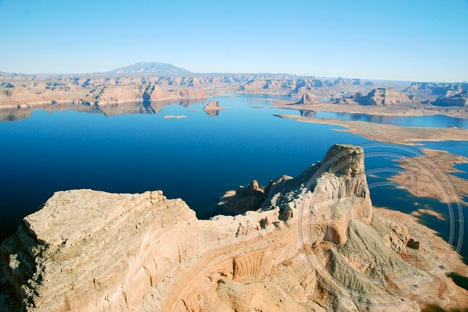
Gunsight Butte on Lake Powell.

My husband was at the controls while I snapped photos.

Unfortunately, I seldom get to try my own hand at aerial photography. You see, both hands are usually busy with the controls in my single-pilot R44. I did get an opportunity to fly with a fellow pilot in his R44 in Washington State last summer (see combine photo above), but more recently, I’ve begun doing some doors-off flying with my husband, who is also a helicopter pilot. We take turns playing with the camera. The shot accompanying this post is one of mine from a recent flight to Lake Powell.

One thing Keith is certainly right about in his post — it can take an awful lot of tries to get just the right photo.

Finding a Legal Landing Zone

It’s not as easy as it seems sometimes.

At Lake Pateros
My R44, parked on the side lawn at the Lake Pateros Inn in Washington State. Sadly, heat from my engine browned the grass.

One of the benefits of operating a helicopter is that you can land it almost anywhere. One of the drawbacks of this, however, is that not all landing zones are legal.

The other day, I was asked by a client to find a pickup location for him that was closer to where he was staying than Scottsdale Airport. He suggested two possibilities that I knew I couldn’t use:

  • A private helipad at the resort where he’s staying. That helipad is owned by another helicopter operator who gets three times what I do per hour of flight time. They do not allow others to use their helipad.
  • A private, residential airport near the resort where he’s staying. They have a strict “no helicopter” policy.

I went through the motions and called the managers of both facilities. I was told what I expected to be told: that I could not use them.

What Do the FARs Say?

Around this time, I commented on Twitter that I was conducting a search. Another pilot, who flies airplanes, wanted to know how I was searching and where legal landing zones were covered in the FARs (Federal Aviation Regulations).

The truth is, they’re not. There’s no FAR that clearly states where you’re allowed to land a helicopter.

Instead, the Aeronautical Information Manual (AIM) offers some clear guidance on where you’re not allowed to land any aircraft. 7-4-6 Flights Over Charted U.S. Wildlife Refuges, Parks, and Forest Service Areas states, in part:

The landing of aircraft is prohibited on lands or waters administered by the National Park Service, U.S. Fish and Wildlife Service, or U.S. Forest Service without authorization from the respective agency. Exceptions include:

1. When forced to land due to an emergency beyond the control of the operator;
2. At officially designated landing sites; or
3. An approved official business of the Federal Government.

I assume this is in the FARs somewhere — the AIM is generally a plain English translation of most FARs, better organized and easier to read — but I can’t track it down.

So Where Can You Land?

A Heli Outing
This heli-outing brought three helicopters, including my old R22, out in the desert near the Swansea Townsite.

When I first started flying helicopters, knowing where you were allowed to land in a non-emergency situation was a big deal. Everyone dreams of landing on their best friend’s driveway or backyard. Was it legal? How about showing up at your kid’s soccer game? Dropping off a friend at work in an office park? Stopping in at Krispy Creme for a donut and coffee? Landing along the lakeshore for a quick afternoon swim?

Is any of this legal?

My answer: it depends.

Before you read any farther, understand that I am not a lawyer. I cannot advise you on these matters. If you get in trouble for landing somewhere and use what you read here as a legal defense, you are an idiot and deserve to lose your license. I’m just sharing what I’ve learned through experience. I don’t know all the answers and certainly cannot advise you in your specific situations.

Landing in the Middle of Nowhere

R22 in Riverbed
A blast from the past: My old R22 sitting in a wash south of Alamo Lake about a day after it flowed. Hard sand makes a good landing surface.

Keep in mind that I live on the edge of nowhere. Wickenburg is on the northwest end of Maricopa County. There’s not much other than empty desert in most directions. Go southeast and you’ll get to the Phoenix metro area within 30 minutes, but go in almost any other direction and you’ll be driving (or flying) for a while before you get anywhere else.

That said, friends and I have landed our helicopters at many remote patches of desert, both privately owned and owned by the Bureau of Land Management (BLM).

I discovered through telephone calls, an exchange of mail, and a $270 fine that I’m allowed to land on BLM land that’s not Wilderness area as long as I don’t do it with paying passengers on board. Commercial flights must have permits for landing on BLM land. And trust me: BLM will drag its collective butt in getting you a permit once you apply for one. It took 18 months for me to get permission to land at the Swansea Townsite and costs $90/year to maintain that permit. (I’ve landed there once with paying passengers in the past three years; do you think I should renew?)

But land on private land just footsteps away from government-owned land and you’re okay — as long as other factors don’t come into play.

Permissions and Local Ordinances

At the Big Sandy Shoot
Parked at the semi-annual Big Sandy Shoot. The event is held on a mile-square parcel of privately-owned land northwest of Phoenix.

What are the other factors?

Well, you need to have permission of the property owner. After all, it is his property. It doesn’t have to be written permission, but if you don’t have permission, you could be prosecuted for trespassing.

You also need to be aware of any local ordinances against landing. Wickenburg has one of these ordinances, although they only seem interested in enforcing it when it’s convenient to them. (This is the case with many of Wickenburg’s rules, especially those regarding zoning.) Scottsdale also has an ordinance.

Moab, UT didn’t have an ordinance until after I landed at a friend’s 2-1/2 acre property there. The cops rolled by and I thought I’d get in trouble, but they just wanted to see the helicopter. A week later, the ordinance came out and was on the front page of the local newspaper. Oh, well.

There are two ways to find out if a locality has an ordinance against helicopters landing within town limits:

  • Land there and see if you get in trouble. I don’t recommend this approach, but it can be effective, especially in remote areas where you might not even be seen by anyone on the ground.
  • Call ahead and ask. In most cases, they won’t know. You can make a lot of calls and get nowhere. Then you can try the above approach and see where it gets you. Hopefully, not in jail.
Helicopter at HouseParked in the desert north of Phoenix. Photo by Jon Davison.

Of course, this refers to towns and cities. Within those are subdivisions that may be controlled by written rules (such as that private airport that won’t allow helicopters). And everything is inside a county, which may have its own rules.

Sounds like a pain in the butt? It is. But if you don’t do your homework before you land off-airport, you’re liable to get in deep trouble with the local authorities and FAA. You could have your pilot certificate suspended or even revoked. I don’t know about you, but I have enough time and money invested in my helicopter pilot certificate, aircraft, and business to act wisely. If I can’t find a legal landing zone where I think I need one, I won’t land there.

Please Read This

Tristan's R44
Before buying my own R44 in 2005, I leased a friend’s. This shot was taken in Congress, AZ, where I attempted to sell helicopter rides a few times.

If you’re landing off-airport, whether you have permission to land at an official helicopter landing zone or you’re just taking a risk landing where you might or might not be allowed to, please, for the sake of all of the helicopter pilots out there, keep these things in mind:

  • Only land where its safe. This applies to the terrain of the landing zone itself, as well as your approach and departure routes. Wouldn’t you be embarrassed if you had a dynamic rollover in your buddy’s backyard?
  • Land at the edge of activity — or farther away, if possible. I used to do rides at the Mohave County Fair. My landing zone was at the far end of the event, beyond the carnival rides. There were many people at the event who didn’t even know there was a helicopter around. I’ve also landed at remote restaurants far enough away that no one even heard me approach.
  • Only land where you can secure the landing zone while the helicopter is running. I’ll land places where there may be people on the ground if I have a second person on board with me to get out and keep the landing zone clear of curious bystanders. But if I’m alone, I wouldn’t even think of landing where someone might approach the helicopter while it’s running. Do you really think it would be a good idea to land at your kid’s soccer game? What if a bunch of those kids ran toward you from behind and ducked under the tailcone? Do I have to paint a bloody picture for you?
  • Do not overfly people, vehicles, animals, or buildings at low-level. This is for courtesy and safety. Engine failure on approach or departure means a possibly messy crash into whatever’s below you. Crashing into an empty parking lot is very different from crashing into a crowded soccer field or county fair arcade. (By the same token, anyone who buys a home within a mile of the approach/departure end of any airport runway should have his/her head examined.)
  • Be courteous to people on the ground. Don’t spend more time than necessary circling the landing zone at low level. Once you know your approach and departure routes, get it on the ground. Don’t give bystanders a reason to complain. That’s why localities make these ordinances. Because some jackass pilot annoyed just the right number of people to get the ordinance voted in.
  • Do not draw attention to yourself. Sure, it’s cool to land off-airport and yeah, everyone will be jealous. But aren’t you above all that? If you can land and depart in such a way that no one even knows how you arrived, that’s even cooler.
  • Do not walk away from the aircraft with the engine running and blades spinning. I can’t believe I have to include this no-brainer on a list, but here it is, for the folks who have no brain and actually leave a running helicopter unattended.
  • If asked to leave, do so quickly and without argument. Be apologetic. Be nice. Don’t be an asshole.

The rest of us are depending on you to act wisely so the FAA doesn’t add a rule that prevents us from landing off airport.

My Advice

Mansion Landing
Parked at the house of some friends just outside Wickenburg town limits. They cleared a small helipad up there for me to use. Photo by Jon Davison.

My advice is that you don’t land anywhere where safety or legality may be an issue. Do your homework and get the information you need to establish whether your landing zone is legal.

Or simply land at the nearest airport. That’s what I’ll be doing for my upcoming charter flight.

Weight & Balance Woes

Or why I had to turn down a potentially lucrative charter flight.

One of the things I’ve said again and again is that it’s nearly impossible to load a Robinson R44 helicopter out of CG. Nearly, but not completely.

What is CG?

For those of you unfamiliar with the term CG, it stands for center of gravity. All aircraft have a specific center of gravity or point at which they could (theoretically) be lifted and hung level. While an aircraft doesn’t need to be in exact balance to fly, there are limitations to which it can be loaded out of balance. These limitations form an envelope of acceptable loading and if you’re loaded within this envelope, you’re said to be within CG or simply in balance. The aircraft controls are rigged with this in mind.

If you load an aircraft out of CG, you’re asking for trouble. For example, if I load my helicopter too heavy on one side, I could run into trouble in a turn by not being able to move the cyclic enough in the opposite direction to come out of the turn. After all, all controls have limits, normally defined by a physical stop. Running out of right cyclic while trying to come out of a left turn would be very scary indeed. Of course, I probably wouldn’t get to that point because I’d feel the problem as soon as I pulled up into a hover — I simply wouldn’t be able to keep the aircraft from drifting left.

[Note to all you flight instructors out there; if I completely mangled this description — since I’m not a CFI — feel free to step in to clarify in the Comments. This is my understanding after 10 years and 2,000+ flying hours, but I never had to teach it to anyone.]

Pilots are required to have an aircraft Weight and Balance (W&B) calculation on board for every flight. This is part of the Federal Aviation Regulations (FARs) in the U.S. In non-commercial flight, it’s usually enough to have the W&B for the empty aircraft. But in commercial flight, there are usually requirements for an individual W&B to be calculated for each flight with the given load.

So yes, when you fly on a commercial airliner, there’s a computer program somewhere that’s spitting out a W&B calculation for your flight. Your pilot has it in his possession in the cockpit.

Now you might say, “Hey, wait a minute. How do they know what I weigh?” They don’t. They’re allowed to use estimates. It all depends on the airline’s Operating Specifications (Ops Specs), which are established with the FAA.

I have Ops Specs, too, but I’m not allowed to estimate for my Part 135 Charter work. That’s why I ask for the name and weight of each passenger when I book a flight.

Four Fatties is Too Many

When I asked for names and weights yesterday while booking what was supposed to be a 2-hour aerial survey charter, I got three weights that I knew would be trouble:

A: 240 lbs
B: 220 lbs
C: 195 lbs

That’s 655 pounds of passengers alone.

Add the pilot (who is trying hard not to reveal her weight; don’t do the math, guys!) and you could only put on about an hour and 20 minutes worth of fuel to stay below the 2500 lbs max gross weight — the absolute maximum weight of the aircraft at takeoff time — limitation of my Robinson R44 Raven II.

Of course, the situation gets worse when you factor in the simple fact that all passengers lie about their weight. Every single one of them. If I put a scale out and made them stand on it, I guarantee anyone over 200 lbs. has shaved at least 10 pounds off their weight when reporting it. They either don’t figure the weight of their clothes or they’re in denial about their weight or they’re afraid that I’ll say they weigh too much. Even folks under 200 lbs are guilty of this. So I routinely add 10 pounds for each passenger. That 30 pounds corresponds to 5 gallons of 100LL fuel or 15-20 minutes of cruise flight.

Since I’m really supposed to have 20 minutes more fuel on board than I expect to need — per FAA reserve requirements — I was really sunk. Apparently, I’d be able to load up my passengers and just enough fuel to take us on a brief flight around the departure airport.

This is just the weight portion of the equation, which is easy enough to do. Add empty aircraft weight to passenger, baggage, and pilot weight. Then add the weight of required fuel. If the number exceeds 2500 lbs, something’s got to come off the aircraft. It can’t be the pilot and it can’t be the fuel required to complete the mission. Simple as that.

How the CG Stacks Up

While I could have done the math in my head, I did it as part of a complete CG calculation. It’s a pain in the butt do to one of those manually, but I have a spreadsheet solution that I worked up to do it for me. I punch in the weights and amounts of fuel and it draws the CG envelope with points for takeoff weight and empty fuel weight. So while manually doing this task would likely take 15-20 minutes of calculator punching, I can do it in about 30 seconds. I can also easily play “what if” by changing fuel quantities and moving the passengers into different seats.

Here’s what I got for the proposed flight and 2 hours of fuel on board:

Weight and Balance Example

Note that both points (square and triangle) are outside the boundaries of the CG envelope. The red line indicates the rotor mast. The points clearly indicate that the CG is way forward. In other words, I’m front-heavy. If I pick up to a hover, I’m likely to start drifting forward immediately. I may hit the back stop of the cyclic when I try to stop that forward motion. In other words, I won’t be able to stop.

Of course, the aircraft is also 100 lbs over weight.

Just for grins, I moved the passengers around in a what-if scenario. I’d put the biggest guy up front, since that’s where the leg room is. After all, maybe he’s not fat. Maybe he’s a former professional basketball player. It doesn’t matter for my calculation how tall a person is — all I care about is weight. But if he’s got long legs, he’s likely to be miserable in the back seat.

So I put the light guy up front and got something like this:

Weight and Balance Sample

A little better, but not safe or legal. But I kept playing. I really wanted to do this flight. The only thing left to fiddle with was the fuel, so I started off-loading fuel on my worksheet until I got within weight limitations. I needed to drop 99 pounds to get down to 2500 takeoff weight. That’s 16.5 gallons or about an hour’s worth of fuel. This what-if scenario would produce be for a short flight, with only 56 minutes of fuel on board:

Weight and Balance Example

And this is where the sad truth of the matter emerged. It didn’t matter how little fuel I had on board — we would always be out of CG for this flight. Too many fatties on board. Both points remain outside the envelope.

I called the client back and told him the problem. I said that together, we weighed too much. I gave him two options: leave one of the passengers behind or fly with a company that had larger aircraft. I suggested a company based in Scottsdale. He wasn’t happy, but he understood.

I’ll be interesting to see if the big fatty (A in my list above) gets left behind. If he does, we’ll be good to go — with full tanks, as you can see here:

Weight and Balance Example