Back in the Saddle

I spend a morning flying and it feels good.

Yesterday morning, I went flying. And boy, did it feel good to be back in the air, just tooling around, again.

I needed to go out to Robson’s. I’m doing helicopter rides at their big anniversary celebration on Saturday. I wanted to check out my landing zone and drop off a few signs and flyers for Rebecca, who is organizing the whole thing.

Jim Wurth wanted to get some stick time in an R44. I owe it to him. He’s taken me out a few time in his Hughes 500c. Since the dual controls are always installed in his ship, I always get at least a little stick time. I’m not too crazy about the feel of his ship. It doesn’t have hydraulics, so the cyclic and collective are very stiff. I feel uncomfortable pushing it around because you have to push so much harder than in a Robinson to get it to do anything. I worry I’ll push too hard and I’ll do something sloppy which will make me look like a bad pilot. So when I fly his ship, I fly it very conservatively, almost to the point of being boring. Of course, he notices that and just thinks I’m a boring pilot.

Which brings up the old aviation saying, “There are old pilots and bold pilots, but no old, bold pilots.”

So yesterday morning, I put the dual controls in Zero-Mike-Lima, did a thorough preflight with the assistance of a new ladder (that mast is tall!), towed it out to the fuel island, filled it up, and positioned it in a parking space for departure. After disconnecting all the bothersome tow stuff, I did a final walk-around (a good habit I picked up at Papillon) and climbed on board.

It took a long time for the engine to warm up in the early morning cold. It was about 10:00 AM and the winter sun was shining but hadn’t gone to work yet. I think it was still having its morning coffee. I picked up and felt the odd sensation of having all that full helicopter behind me with no one in front with me to balance the weight. I was still in CG, of course — it’s damn near impossible to load an R44 out of CG — but the front end of the helicopter came off the ground about ten minutes before the rear end (okay, so it just seemed like ten minutes). I wondered if I would scratch the bottom of the back of the skids on the pavement. Like that matters much.

Jim’s house is exactly 2 nautical miles away from Wickenburg Airport. It took about a minute and a half to get there. And once again, the R44 showed me how well it floats. I had to dump all my power to get it to descend to Jim’s helipad.

Why not just fly lower for that two miles? Well, there’s some idiot who keeps coming to Airport Commission meetings to complain about helicopter noise. I know he isn’t complaining about me because I haven’t flown in over two months. It’s LifeNet, which is now based at the hospital, and probably Ray, who flew low to do some aerial survey work on a housing project near town one day. And the flight schools that come up from Scottsdale and Glendale. But I don’t want him complaining about me so I’m not going to give him anything to complain about.

When I got to Jim’s he was taking pictures of my arrival. I set Zero-Mike-Lima down gently in the middle of his pad. He gave me the shut down signal and I complied. A few moments later, I was out on the pad, showing off Zero-Mike-Lima to Jim and his wife Judith.

Jim and I both climbed aboard a few minutes later. I narrated the startup sequence for him. In the few minutes the ship had been shut down, it had cooled considerably. It took a few minutes to warm back up. Then I took off on Jim’s usual departure path, heading northwest.

We followed the train tracks, then took a detour over Moreton Field. Doug Moreton had just sold the remaining lots in his partially-developed air park to a developer. Jim pointed out the homes and hangars of a few people we knew. Jim told me he was thinking of buying a lot there. I couldn’t understand why. He lives on 40 acres just outside of Wickenburg and has his own hangar and helipad. Why move?From there, we buzzed straight toward Robson’s. I let Jim fly. He immediately commented on how sensitive the controls were. He kept drifting to the right. After a few minutes, he got the hang of it, though, and we zipped over the desert at about 110 knots. Jim said he never cruises that fast. But, like me, I think he was having trouble getting it to go slow. The Raven II just wants to go.

He gave back the controls for the landing at Robson’s. I landed in a space between several saguaros, a long, skinny (at the bottom) landing zone that gave me plenty of room for my tail. I think I was roughly in the same place I’d landed the year before. We shut down, got the signs out of the back, and went into Robson’s. We dropped it all off in the restaurant. I had to walk back to the helicopter to get the flyers, which I’d forgotten under my seat. While I was taking care of that, Jim used my Pilot Operating Handbook to research a problem I’d been having with the Aux Fuel Pump.

We took off a while later. Jim wanted me to fly up a canyon behind Robson’s where there are some Indian ruins and petroglyphs. He said I should fly through there on Saturday with passengers. I told him I didn’t want to because there would be people hiking in there and I didn’t want to ruin their hiking experience.
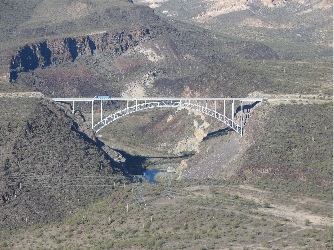
Burro Creek BridgeFrom there, we buzzed out over the desert toward the Santa Maria River. We followed the river east to 93, then headed up 93 to the bridge at Burro Creek (shown here in a photo I took several years ago). ADOT is doing construction in that area, building another two lanes on the bridge. We made a right turn and flew up Burro Creek, dropping into the canyon to get a better look at the things we flew over. Jim wanted to show me a few mining sites he and Ray had spotted on another trip. He thinks I can do tours to these places and let passengers off to explore. I know I need to track down ownership and get permissions. (I’m in the process of doing that with BLM for Swansea Townsite and it’s a lengthy process.) I’m always interested in seeing new places.

It turns out that the first place he wanted to show me was one I’d already seen and considered before. It was a definite possibility. I marked it on my GPS while he took the controls and flew. We got to an intersection of three canyons and he flew up the middle one looking for the second mine site. We flew about five miles before he gave up. He pulled up over the left wall of the canyon and dropped into the next canyon over. We continued flying up canyon. Water was flowing down there and it was beautiful. I saw more than a few waterfalls — some of them spectacular. I also saw two abandoned ranch homes that looked to be in good condition. I’d return to explore on foot one day and, if they’d make good sites for heli-camping, I’d track down the owners and get permission.

We flew up the canyon, climbing at a stead rate of about 200 feet per minute as the canyon floor climbed. We must have flown about 10 miles up that canyon. It was a really beautiful flight. I’d never seen the desert so green. It looked almost lush. Almost.

Jim finally gave up and climbed out of the canyon, this time to the right. The first canyon we’d been in had ended. We were up at about 6000 feet now and there was ice on the mesa tops beneath us. The outside air temperature was 50°F. In the distance, we could see the mountains with snow on them.

We flew southwest for a while, then dropped into another canyon. This canyon quickly dumped us out in the canyon where I’d spotted the ranch houses. After a while, we spotted the Bagdad Mine’s tailings piles ahead of us. And there was the mine site Jim had been looking for, almost in Bagdad Mine’s backyard.

We flew over the Bagdad Mine, which was very active that day. Lot’s of huge dump trucks driving up and down the ramps. The only way you could see how big they were was to see the men or normal sized vehicles bedside them. The bottom of the mine was filled with water and water was gushing into it from a hole in one side of the hill. I assumed they were pumping the water out as quickly as it was gushing in. If not, they’d have a problem in a few days.

Next, Jim wanted to show me some Indian ruins on a hilltop near Skull Valley. We headed toward Kirkland, buzzing along at about 100 knots. There was so much water down in the desert. I saw a ranch that had lost its access road in a flood that was still flowing.

The ruins were interesting, but not the kind of thing I like to explore. I guess you can say that I like “white man’s ruins.” Although the ruins he showed me were probably 1,000 years old, I’d rather walk around in 100-year-old ghost towns. I think it’s because I can identify with what I’m seeing. Indian ruins tend to be nothing more than rock piles. It’s hard to imagine them as buildings when they’re seldom taller than two feet.

I took the controls and brought Jim over to one of my favorite sites in the Weaver Mountains. There are some cabins there and if you approach it just right, you can see them from the air. I didn’t approach just right because even I couldn’t see them — and I know where to look.

We came over the Weaver Mountains and dropped into the valley where Stanton is. I flew relatively low over this ghost town turned trailer park. If I had gotten my helicopter two weeks earlier, I could have had a very lucrative gig among the amateur miners there.

We were only about 400 feet off the ground, near the ghost town of Octave, heading toward the Hassayampa River, when I pointed out some cows running through the desert. I wondered, for a moment, what had spooked them — I was too high to be the culprit. Then I saw the R22 down below me, about 15 feet off the ground, herding the cattle. I swung around to get a better look, trying to raise the pilot on the radio. No answer. I wondered if he’d seen me. He headed back toward Congress and I continued on my way to the Hassayampa.

The river is flowing big right now and it’s a neat thing to see from the air. The slot canyon, where I’ve driven my Jeep numerous times, is wall-to-wall brown water. The water spreads out past Box Canyon and heads into town. The river has been running for more than a week now. I remember the first year we lived in Arizona. It had been an El Niño winter and the river flowed for three months straight. Cool.

I made a nicer approach into Jim’s helipad, although I may have been a little close to one of his neighbor’s houses. I let him off and took off right away. I buzzed past Vulture Peak before I landed. There were two hikers up top and they waved enthusiastically as I went past.

I landed, feeling invigorated. We’d logged 1.8 hobbs hours. I fueled up for Saturday and put the helicopter away. It was 2 PM.
On Popping Circuit Breakers

I learn about a Raven II’s Fuel System While Troubleshooting a Pesky Circuit Breaker

Starting a Raven II is a weird process. You turn on the master battery switch, push the mixture full rich, then turn the key to prime and count 5. Behind you, you can hear the sound of the auxiliary fuel pump priming the engine. Then you position the key to Both, pull the mixture knob out to engine cutoff (full lean), and push a starter button. When you hear the engine catch, you push the mixture knob back in to full rich and put the guard over it. Throttle up to 50%-60% RPM, engage the clutch, the strobe, and the alternator. The blades start spinning within five seconds, usually with the sound of new drive belts slipping (at first) on the sheave. Then, as the belts tighten, the sounds all sound good and it’s a matter of waiting until the clutch light goes out before finishing the startup procedure.

The very first time I started Zero-Mike-Lima, at the Robinson factory last Thursday, the engine caught right away. That was easy, I remember thinking to myself. Since then, I’ve had mixed results. I just have to get the hang of it, I guess. First time was luck.

Zero-Mike-Lima has already shown me a potential problem. Nothing major, thankfully. When it’s cold out on start — like it was on the morning of day two of my ferry flight and again yesterday morning — the auxiliary fuel pump circuit breaker pops right after startup. Fortunately, I was still on the ground, so the first time, so I didn’t worry much about it. I just pulled out the Pilot’s Operating Handbook and consulted Section 4 for information about what to do if the Aux Fuel light comes on. It said that if the engine continued to operate normally, I should land as soon as practicable (as opposed to land as soon as possible). I was already landed, so that wasn’t a big deal. I pushed the circuit breaker in, the light went out, and I continued my startup process. It didn’t pop again and the light didn’t go on. A fluke, I decided the first time. The new helicopter is just shaking out a few little bugs.

On Friday evening, I pulled out my Maintenance Manual and looked up the fuel system. I soon became an expert (of sorts) in how the Raven II’s fuel system is designed. There are two fuel pumps: an engine-driven pump and an electric (aux) pump. Either pump provides more fuel to the engine than it will ever need. So the system is designed for redundancy. If the engine-driven pump dies, the aux pump, which is running whenever the engine is running, will take up the slack. The excess fuel that these pumps provide is pumped into the auxiliary fuel tank (the smaller of the two fuel tanks) which helps with fuel cooling.

I flew it on Saturday several times — starting it at least four times in the process — and the Aux Fuel problem never happened again. This further confirmed that the problem was a fluke. But yesterday, when I started it at about 10:00 AM, when it was only about 40°F outside, it did it again.

Time to call Robinson.

When I called the factory, I spoke to a guy named Ray who took the information about the problem and said he’d call back. He did — much later in the day — and left a voicemail message on my cell phone. He told me to look for pinched or shorted wires in the vicinity of the Aux Fuel Pump. He also told me to check the anemometer (gee, I hope I spelled that right) while starting up to see if there’s a power fluctuation before the breaker pops. So today I’ll have Ed look things over back there. Hopefully, it’s just a bad wire. But it could be a bad fuel pump, one that needs too much power to go to work on a cold day. I’ll keep an eye on the situation to see. I certainly won’t fly with that light on.

Of course, I did start it three times yesterday and the problem only occurred on the first start. So it definitely has to do with things being cold. That’s what I think, anyway.

But then again, what do I know? I’m just a pilot.

Time to Get to Work

Now that I have Zero-Mike-Lima, it’s time to put it to work.

The thing that bothered me most about the last three weeks I waited for my new helicopter, N630ML (or Zero-Mike-Lima, for short), to be ready for delivery is the number of requests for rides I had to turn down. For a while, I was getting them every day. There was the man who wanted to take his grandkids for a ride and the other man who wanted to take his son for a ride. There was the man who’d lost his dune buggy out in the desert near Aguila and the other man who’d lost his dog. There was the man from England who wanted to take photographs of his newly acquired property at Grantham Ranch and the paving company that wanted to take photos of a number of jobs throughout town and the woman who wanted a photo of her house off Scenic Loop. Saying “I can’t do it right now because my helicopter hasn’t been delivered yet” was killing me, one syllable at a time.

It all came to a head on the week of delivery. They said it would be ready sometime during the first week in January, but when I requested a Thursday delivery, they told me to come on Friday. Friday was the same day that a 5-day storm was expected to descend on LA. And I’d scheduled a little event at Wickenburg Airport for Saturday. I lost my patience, in true New Yorker style, and put my foot down. (I also did a lot of begging.) I arrived at the factory on Thursday just 20 minutes after my money did (a long story) and waited while they pulled all the paperwork together. It was about 4 PM local time when we high-tailed it out of the LA area. We got as far as Bermuda Dunes (east of Palm Springs) that night, then flew the rest of the way home early the next morning. By 11 AM on Friday, Zero-Mike-Lima was in its new home in my hangar.

Of course, LA wasn’t the only place out west to get bad weather. Saturday, the day of my event, was overcast and a bit chilly. But when I got to the airport, people were already waiting for rides. I took about a dozen people up that morning and Zero-Mike-Lima began earning its keep.

I have a big event lined up for this coming Saturday. Robson’s Mining World is having their anniversary celebration. Robson’s is a neat place out in the desert near Aguila, that has an incredible collection of old mining and farming equipment among its other turn-of-the-last-century displays. I wrote about it in an article for wickenburg-az.com. I flew for Robson’s last year with Tristan’s R44, but because I came relatively late (around noon, if I recall) and it wasn’t very well publicized (I was a last-minute add-on), I only took about 20 people up for rides. This time around, I’ll arrive around 8:30 and be all ready to go by 9 AM. My ground crew will consist of Mike, John, and Lorna — the same crew that helped out at Robson’s and an event at Stanton last year. We also have T-shirts for sale to help generate a bit more revenue.

Today, I’m going to pick up Jim Wurth at his house and buzz over to Robson’s to check my landing zone and drop off a few signs and flyers. I’m hoping to use the same LZ I used last year, or perhaps one a bit closer to the road. I’m also hoping all this rain hasn’t softened up the ground too much. I haven’t done any off-airport landings with Zero-Mike-Lima yet (heck, there’s less than 10 hours on the hobbs!), so this should be good practice.

After Robson’s Jim is taking me up to the Burro Creek area, where he says there are a few interesting mine sites I might want to visit for one of my Part 135 tours. For those of you who aren’t familiar with the Federal Aviation Regulations (FARs), I need to have an FAA Part 135 certificate to land and discharge passengers for hire. I’m working on getting that valuable piece of paper. In fact, yesterday my FAA contact called to tell me that we were getting close to wrapping the whole thing up. So I should be ready for longer tours and charters by month-end.

Today I may also be doing that flight for the paving company. They called yesterday and set up a tentative time for 2 PM. That would be extremely convenient for me, since that’s when I need to drop Jim off.

I’ve also placed an ad in a movie-industry directory, offering Flying M Air’s services to movie/video makers. I did some research and learned that I could put something called a “Tyler mount” on my helicopter so a camera could be gyro-stablized on the helicopter for smooth filming. The mount is available for rent in California and I may have to fly out there to have it installed. The client, of course, would pay all costs for that, plus a per-hour fee for flight time. One good job would pay for the ad, so I have my fingers crossed. My R44 is a lot less costly to operate than turbine helicopters, so I should attract budget-conscious movie/video makers who want to work in the Phoenix area.

I also spent much of money working on getting out-of-town gigs for the spring. I put out a lot of feelers. Next Monday, I’ll follow up. The one I’m most interested in right now is Quartzsite. With the help of the local police chief, I tracked down a property owner who might let me use his land for operations. Next week is the big RV show week in Quartzsite, the week when its population peaks. According to Ivan, who did a whole season there with a Hiller years ago, Quartzsite can be a very lucrative gig. We’ll see.

One thing is for sure: Zero-Mike-Lima has to work for a living. And it’s my job to make sure it does.

Hangar Cleanup Time

I prepare my hangar for inspection by the FAA.

Cleaning a hangar is a lot like cleaning a garage. But instead of cars among the miscellaneous non-automotive junk, there are aircraft among the miscellaneous non-aviation junk.

I really shouldn’t say junk. Our hangar has far less junk than our garage has. That might be because we’ve only occupied it for two and a half years. We’ve lived in our house for about eight years now, so we’ve had far more time to stuff junk into the garage.

Hangar ClutterI’m applying for an FAA Part 135 certificate. As part of the approval process, the FAA has to come take a look at my operations base AKA my hangar. I want to make the right impression. So this weekend, while it drizzled outside, I did a cleanup. I share the hangar with a Grumman Tiger, a stagecoach, four motorcycles, a Porsche, a Go-Ped, a short row of theater seats, and various pieces of furniture. The Grumman Tiger belongs to my significant other, Mike, and his partner, Ray. They bought the plane about two years ago but they don’t fly it very much. In fact, I was thinking of selling partnerships to it. I figure I could get another two or three partners on the plane and neither Mike nor Ray would notice. It’s a nice plane — 1974, I think — and in very good condition. Every airplane person who sees it is impressed. To me, it’s just a nice, shiny plane. I can’t fly it and I don’t really enjoy riding in it as a passenger. The thought of doing 60 or 70 knots when the wheels touch the ground on landing scares me. I’m doing zero when I touch down and that suits me fine.

The stagecoach belongs to the Desert Caballeros Western Museum, located in downtown Wickenburg. If you ever drive by this place, don’t let the dinky exterior fool you. It’s an incredible little museum, with exhibits on two floors (there’s a basement, so it looks like a one-floor place from the street). My favorite exhibit is the semi-permanent collection of antique horse gear, including bits, bridles, spurs, saddles, and chaps. Anyway, the stagecoach in my hangar was donated to the museum by Vi Wellik of Flying E Ranch. The stagecoach is authentic, originally used in the 1880s. It was meticulously refurbished some years ago and was used on the ranch and in the town’s local Gold Rush Days parade every year. I even met one of the wranglers who used to drive it. Now it’s sitting in my hangar, waiting for the museum to build something to house it in.

Why is it in my hangar, you might ask? (I ask myself the same thing quite often these days, as my hangar fills with other stuff.) The previous hangar tenant agreed to house it for the museum. When he died and I moved in, I was told it would be there for another three months or so. That was 28 months ago. I don’t mind too much. The helicopter fits snugly in the place between it and the hangar door and it does tend to impress visitors.

The motorcycles belong to me and Ray. I own a 1993 Yamaha Seca II and a 1996 Ducati 900 SS CR. Ray owns two cruisers, one of which belongs to his wife. Frankly, I don’t know what they are, but I know they’re not Harleys. He came by and ran one for a while in the hangar and it didn’t make enough noise to be a Harley. They don’t drip any oil, either. Ray and I ride our motorcycles even less often than Ray and Mike fly that plane. I’m always on the verge of selling mine. I should, really. They cost about $100 per year to insure and that again every two years to buy them new batteries. I’d ride mine more if I could get them out of the hangar. But that darn airplane’s wings take up so much space and, with the helicopter in there, I just can’t wheel either one of them out. That’s my story and I’ll stick to it.

The Porsche belongs to Ray. He stored it in the hangar when he moved to Montana. But he never fully moved. He’s back now, looking for a new place in Wickenburg. It seems that winter temperatures of -5°F don’t really appeal to him. His wife is still up there with her horses, but she might come down. In the meantime, the Porsche is tucked in the corner, behind one of the airplane’s wings, covered with a car cover. I can’t even remember what color or model it is.

The Go-Ped is mine. The idea was that I’d use it as ground transportation when I flew my helicopter someplace that I needed ground transportation. But the darn thing is a menace. I had a bit of a scare on it and don’t like to ride it. One of my New Year’s Resolutions is to practice riding it so it doesn’t scare me anymore. Or sell it.

The theater seats are something I bought on impulse when the local theater was replacing its old used seats with new used seats. They were selling the seats for $5 each to raise money for a local charity. I bought six of them, along with the hardware to put them together. Now they’re in a row in the back of the hangar, covered with cobwebs and looking a heck of a lot worse than they did in the theater.

The furniture includes our old bedroom set, which we’re saving in case we ever do build something on our Howard Mesa property, and some kind of cabinet that Ray moved in with the Porsche. Our furniture is up on palettes, shrink-wrapped, and covered with an old sheet. We’re trying hard to keep it nice. My grandmother gave it to us as a wedding present back in 1986. It’s Scandinavian stuff, teak and very nice. But it didn’t go with our southwest decor. So about six months after she passed away, we ordered a new bedroom set. We’ll use this one again someday.

Yesterday, I cleaned around all this stuff. I started out with a broom, but quickly switched to a Shop-Vac. There was some dried mud along one wall (we get some water in the hangar when it rains really hard.) There were also lots of cobwebs, which I really can’t tolerate.

I also assembled a brand new Black and Decker storage closet. It cost me $69 and it was probably worth about $64. No tools required. Everything snaps into place. Give me furniture that requires tools any day. But once assembled and with 18 quarts of oil on its bottom shelf for ballast, it was fine. I’m using it to store all of my stuff, in an effort to 1) segregate it from the Tiger stuff and 2) to keep the dust and cobwebs off of it.

I also threw out a bunch of junk. We have a big trash can in the hangar with an even bigger heavy-duty trash bag in it. It had never been emptied. I emptied it yesterday and was pleased to find extra bags at the bottom of the can.

While I was cleaning, my hangar landlord, Rusty, came by to look at the new helicopter. It’s always good to have a landlord stop by while you’re cleaning. Especially when that cleaning includes using cat litter to soak up oil drips and installing a drip pan under your aircraft.

I had to take a break in the middle of the hangar cleaning process to have lunch and take care of other chores. Those chores included buying new filters and bags for the Shop-Vac, which was spitting out as much dust as it was sucking in.

I finished late in the afternoon. The hangar looks good and ready for inspection.

I Got It!

I finally pick up my new helicopter and fly it home.

It started to come together on Wednesday. And that’s a good thing, because there wasn’t a day to spare. A huge storm was moving into the LA area from the west and forecasters were promising heavy rains and high winds from Friday through Tuesday. If I didn’t get Zero-Mike-Lima out of Torrance before Thursday night, it would be stuck there for another week. And I’d miss yet another potentially lucrative flying gig.

Justin called my cell phone late Wednesday night to tell me Robinson had sent the bill of sale via FedEx to MBNA, the finance company. MBNA would not fund the loan without the original copy of this piece of paper. Unfortunately, my cell phone was turned off and I didn’t get his call until Thursday morning. By that time, I thought we’d missed the window of opportunity. Although Mike and I had planned to hitch a ride to Phoenix Sky Harbor Airport with a friend early Thursday morning, there seemed no reason to bother. When I got Justin’s message, I began to get a glimmer of hope.

I called MBNA and told my lending guy that the bill of sale was on its way. He told me he didn’t get his mail until about 1 PM. He didn’t seem interested in hunting down the package earlier. It was obvious that he didn’t care much about the weather situation. But he said he’d be able to fund within two hours of receiving the package.

Time ticked by. Mike had gone to work. I checked Southwest Airline’s schedules. Since tickets are refundable, I bought two tickets for the 11 AM flight to LAX.

No word from anyone on the situation. I knew we had to leave LA no later than 4 PM to get out of the area before nightfall. Before long, it was too late to catch the 11 AM flight. The next flight was 12:30. I decided to make sure I was on it.

I called Robinson and left a message for Milly to tell her I was coming and to ask for transportation from LAX to the factory.

Mike’s car was already down in the Phoenix area. It would have been stupid for me to drive mine down, too. So I tried to get a taxi. Fat chance here in Wickenburg. The demand is so low that neither taxi company has enough drivers to handle last minute requests for an airport shuttle. So I called John and Lorna. They were in Wickenburg, but on their way to help a friend take down Christmas decorations. But John agreed to drive me down. I told him to meet me at Wickenburg Airport, where I’d leave my car.

At the airport, I talked to Chris, who keeps one of his planes in the hangar across from mine. I was looking for someone to drive Mike’s car back from Sky Harbor. Chris had business in Deer Valley and agreed to do it for us. He’d stop in Deer Valley on his way back. It was all falling into place nicely.

Veronica from Robinson called. She told me they’d send a helicopter to pick us up at LAX when we arrived. All I had to do was call when we got in and meet the helicopter at the Heliport at Terminal 4. She gave me the code to go up to the roof there and I wrote it down.

John showed up with his friend Jerry, right on time. The four of us went down to Sky Harbor. John left Chris and I at the curb in the departures area. It took a while, but we finally met up with Mike. Chris took the car and went.

We only had one small piece of luggage — an overnight bag — so getting to the gate should be quick, right? Well, because we had bought one-way tickets, we had to go through an extra security screening process. They went through our coats and overnight bag and my purse. They wanded us very thoroughly. Heck, the woman who wanded me even patted me down a bit where the rivets in my jeans had set off her wand.

A side note here. I have a few problems with the way security was handled that day. First of all, if terrorists know that people with one-way tickets get extra screening, they’ll just buy round trip tickets. They don’t care. They can charge it. If they’re planning a suicide terrorist thing, they’ll be dead when the bill comes anyway. Second, someone with a little skill can easily make a sharp, dangerous “knife”or other weapon out of plastic or some other material that doesn’t set off a metal detector and conceal it in their clothing where it would never be found. Third, the screening couldn’t be too good because there was a small Swiss Army Knife in my toiletries bag and they didn’t take it away from me or even find it. Sure, it only has a two-inch blade, but they take knitting needles away from people and a knife is far more dangerous. (And no, I didn’t know it was in there until that night, when I opened the bag. I thought I’d taken it out.)So we literally ran from security to the gate, arriving at 12:20, just ten minutes before the plane was supposed to depart. Unfortunately, the plane hadn’t arrived yet. (Hurry, hurry, wait. It seemed the theme for this helicopter delivery.) We had lunch at Pizza Hut Express. At 1 PM, we boarded the plane and it took off. It was a nice flight that followed I-10 most of the way. I saw the Salt and Gila Rivers flowing and I’m pretty sure I saw where the Hassayampa (which is also flowing right now) meets the Gila. I saw the truck stop we flew Three-Niner-Lima to for breakfast once and Quartzsite, with its seasonal urban sprawl. I saw the Salton Sea and, looking straight down, saw the roads in Joshua Tree National Park. I saw the runways at Palm Springs, San Bernadino, and El Monte. The sky was partly cloudy, with most clouds high up. Good weather for flying.

At the airport, I called Veronica and left her a voicemail message that we’d arrived. Then we made our way from Terminal One to Terminal Four. It was a long walk, but it was nice to stretch. At the Heliport, I called and left another voicemail message. We watched a Pasadena Police Helicopter land and depart. Then Veronica called back and told us it would be about twenty minutes.

A white R44 with pop-out floats approached from the south, crossed the two south runways, and made a nice approach to the Heliport. When its skids were firmly on the ground, Mike and I walked over and hopped in. We buckled up, put on headsets, and sat back for the ride to Torrance, which included a flight along the beach at about 150 feet above the waves and a 180 degree autorotation to the Robinson ramp.

Zero-Mike-Lima was parked on the other end of the ramp. It looked beautiful. But we couldn’t take a closer look. Paperwork.

We were led through the factory and into the lobby. Then it was a bit more waiting time. I checked my voicemail and got a message from Justin, telling me that MBNA had sent the money. Then my cellphone’s battery died.

It turned out that although MBNA had sent the money, a wire transfer isn’t a quick as a fax. The money goes into the ether for a while before it ends up in the recipient’s bank account. Robinson had just gotten the money. Normally, they need at least 24 hours from the time they get the money to the time the have all the paperwork ready. They were doing all the paperwork while we waited.

We waited at least 30 minutes. I read the Wall Street Journal and looked at Mike’s watch. Mike reminded me that every minute we were delayed was 2 miles of distance we couldn’t cover.

Finally, Veronica appeared. She led us out to the delivery room where she loaded up my R44 bag with all the accessories that came with it: blade tie-downs, cabin cover, short-pilot cushion (not something I’ll need), and all the warranties and manuals. And the wheels. I signed a bunch of papers. Then she let us loose on the ramp. By this time, it was almost 4 PM local time.

N630ML at TorranceThe helicopter was beautiful. Incredibly clean and perfect. Really nice. Mike laughed and said, “It’ll never be this clean again.”A guy came out of the factory to check us out on the route. I got some frequency information from him and assured him that I knew the route and had flown it before. Then I did as much of a preflight as I could without a ladder. I checked the oil; it was so clean, I couldn’t see it on the dipstick. Mike took this photo of me. Then we climbed on board, and I started it up. A few minutes later, I was hovering away from the factory and talking to Torrance ATC.

The first leg of the flight — from Torrance through Fullerton — was crazed. I talked to Torrance, Long Beach, and Fullerton towers — all within fifteen minutes. The R44 is fast (we were cruising at about 110 knots) so those places came up quickly, one after another, bam-bam-bam. Then a bit of a break until we got to Riverside and March Air Force Base. Then a longer break until we got to Palm Springs. By that time, it was getting dark. The sun had gone down and it was time to think of a place to stop for the night. I wanted to stop at Bermuda Dunes (east of Palm Springs) because it was relatively close to a motel I’d stayed at once before. So that’s where we landed for the night.

I was on final and a plane was on base when a third aircraft called in. The second aircraft knew the third one and chatted a bit over the Unicom frequency. It turns out, the second plane was brand new, too, and the pilot was taking his first flight in it.

We got a rental car and a cheesy tourist map and made our way to the Fantasy Casino off of I-10. This is one of those Indian Casinos that have been popping up all over California and pissing off the Californians. It was a nice place, with a brand new high-rise hotel that sure beat the Holiday Inn Express I’d stayed at the previous time I’d overnighted in the area. We got a room on the 4th floor and Mike took me to dinner, complete with champagne, in the casino restaurant. Afterward, we fed singles into a few slot machines, got locked out of our room, got a new key, and went up to bed.

I slept badly. I think it was because the sheets were so new they were still rough. We may have been the first people to sleep in that room.

By 4 AM local time, we were both awake. The Weather Channel showed us that the storm would be on our heels and the sooner we departed, the better off we’d be. But it was still very dark out and the sun wasn’t scheduled to rise until 6:51 AM. We couldn’t wait. We checked out of the hotel and were back at the airport at 5:50 AM. It was already starting to rain.

I did the best preflight I could in the dark — the oil was the main thing that concerned me — and we climbed on board. Mike wiped down the windows on the inside while I started up and warmed up the engine. There was some confusion with the Aux Fuel Pump warning light and circuit breaker that I think may have had to do with us using so much power right after startup. The problem went away and we took off.

It was still dark. And raining. I wasn’t happy about this, especially when I realized that once past the Bermuda Dunes area, I would not be able to see the horizon. Was I about to perform my final stupid pilot trick? I almost turned back. But the lights of I-10 below us were easy to follow and showed good visibility far into the distance. And as we flew into the dark and our eyes adjusted to it, the faint outline of the horizon appeared. No problem.

It got lighter and lighter as I flew. Unfortunately, the rain kept falling. In fact, it rained on us all the way to Blythe, which we reached about an hour after departing Bermuda Dunes. The sun was up and after blinding us for a while, retreated into the clouds above the horizon. There was some ground fog at Blythe, probably because of the river. Then the rain stopped and we had nice weather the rest of the way to Wickenburg.

We got into Wickenburg about 9 AM local time. John and Lorna were there to meet us. They’d fed the horses and the dog the night before and that morning. Mike got out and fetched two more headsets out of the hangar. I gave John and Lorna a nice ride as far as Yarnell and back. Then I gave Chris a quick ride around town. Finally, I shut down.

Some of the airport bums came around to check out the helicopter while we assembled my new tow bar. Unfortunately, the tow bar wasn’t as sturdy as I’d like it to be. Although I used to to take the helicopter from the ramp to the hangar door, I didn’t trust it to back the helicopter in over the lip of the hangar door’s runner. I had a feeling it would snap. So I put my old tow bar on it and we used that. I think I may have to have a dolly built.

With the helicopter all tucked away in its hangar, I locked things up and came home. The rain should start here later this afternoon.