Sunrise Flight

I re-experience the magic of getting out to fly at dawn.

The alarm went off at 4:40 AM. Normally, I don’t set an alarm. I’m usually awake by 5 AM without one. In fact, that morning, I was awake at 3:30. But I fell back to sleep and was very surprised when the alarm brought me back to consciousness.

I had enough time to jump in the shower, dress, and make coffee in a to-go cup. Alex the bird and the horses would have to wait. My flight was at 6 AM and I still needed to do a preflight and pull the helicopter out to the ramp.

It was cold and dark as I drove away from the house. I’d taken the doors and windows off my Jeep about two months ago and still haven’t put them back on. The temperature was in the 50s, and I really felt it as I sped down West Wickenburg Way (the old California Highway) to the airport.

The moon was full, casting a blue-white light over the desert landscape. I love to fly in the light of a full moon. The ground is so dark out here in the desert that the moonlight really illuminates things. Sometimes, as I fly back to Wickenburg from moonlight dinner tour in the Phoenix area, I can see the helicopter’s shadow moving along 700 feet below us — a tiny gray dot darting across the washes and along the rolling hills.

I rolled up to my hangar, pointed the Jeep’s headlights at the door, and turned off the Jeep, leaving the headlights on. I fiddled with the combination padlock on the door to get it open, then turned off the headlights. I rolled the right side door open and flicked on the overhead lights. I seldom come to the hangar at night, so I use the lights rarely. They’re bright and fully illuminate the contents of my hangar: Mike’s airplane, my motorcycles, some furniture in storage, my airport “office,” and my helicopter, sitting on its ground handling equipment, always ready to roll out to the ramp.

I did a preflight, checking under panels for fluid levels, tele-temp colors, and unusual signs of wear or tear. I climbed my 10-foot ladder to examine the rotor hub. I checked the tail rotor and the oil level. One of the good things about flying the same aircraft all the time — and being the only person to fly that aircraft — is that you really get to know it. When there’s something wrong, it jumps out at you. Like the tiny crack I found in the plastic part of my clutch activator’s down-limit switch the year before. The crack was only about 1/4 inch long, but I saw it on a preflight. (That turned out to be another case of $1000 in labor to replace a $12 part.)

By then, it was 5:30 AM. Time to get out on the ramp. I hopped in the golf cart that was attached to the helicopter’s tow bar, and began backing out. It’s a tricky maneuver; I have to back straight out about 3/4 of the way to the hangar across from mine to make sure the tail rotor clears Mike’s airplane and the hangar door. Then a sharp turn toward the ramp, which swings the tail out. When the helicopter and cart are parallel to the row of hangars, I’m ready to roll.

But not yet. I had to get out of the cart, switch off the lights, and roll the door closed. I left my Jeep parked as is. It wasn’t blocking anything except my left hangar door and I’d be back before 7 AM.

The sky to the east was beginning to lighten. According to my computer, dawn in Wickenburg would be at 6:17 AM. The goal was to be in flight, flying east when the sun broke over the horizon. I could see now that there was a cloud out there, not far above the horizon. The sun would make its appearance, then slip behind that cloud. The cloud didn’t seem too dense, so I was pretty sure much of the light would penetrate, keeping the sky bright as the sun continued to climb. That was my prediction, anyway.

Zero Mike Lima before DawnI rolled up to the fuel island, set the parking break on the cart, and got out to disconnect the ground handling equipment. That means unfastening the four ratchet straps on the front of the skids, moving the tow bar away, and taking the ground handling wheels off the back of the skids. (You can see a photo of what the ground handling equipment looks like on my helicopter in this article.) It’s a bothersome routine — it would be so much nicer to just land on a rolling platform like Ray and Dave do — but I have it down to a science and can do it quite quickly.

I added 15 gallons of fuel to the main tank. I was expecting three passengers — a dad and his two young sons — and could actually top off the tanks if I wanted to. But I don’t like putting on more fuel than I need (including reserves, of course). With the added fuel, we’d have enough to fly 2 hours. Our flight would take 30 minutes.

Done with all my preflight stuff, I waited. It was 5:45 AM.

The airport at Wickenburg is kind of magical at that time of the morning. The ramp, lighted by a handful of overhead lights, illuminates the few planes parked outside. Every once in a while, one of the lights goes out, leaving the space beneath it in shadows until it recovers from its temporary ills and comes back to life. The rotating beacon — now a cell tower — sweeps its white and green light over the vicinity. If you listen hard, you can hear its motor. You can also hear the sounds of life in the industrial park across the runway: distant banging and clanking one of the small manufacturing facilities, the steady beeep-beeep-beeep of a truck backing up, some voices carried on the breeze. In the past, I’ve heard the mournful mooing of a free-range cow on the ranch (soon to be a housing development) across the road or the call of a coyote.

Zero Mike Lima at DawnIt was the light that fascinated me that morning. The light from the fuel island cast on my helicopter combined with the light of the coming dawn behind it. I pulled out my digital camera — which I keep in my purse — and took a few photos with the flash turned off, using the fuel island equipment and camera self-timer as substitutes for a tripod and cable release. The resulting photos weren’t bad, as you can see for yourself.

As 6 AM approached, I waited over by the terminal building. Before long, a car pulled in and my passengers got out. The sons were somewhere between 8 and 12 years old. The younger one didn’t look very enthusiastic. I gave them the safety briefing as we walked out to the helicopter. The older son sat in front — an arrangement that seemed to make the younger son very happy as he climbed in back next to his dad. I showed them how to work the doors, then closed them in. A few moments, later, I had the engine going and we were talking over the headsets while the engine warmed up.

To the east, the sky had brightened considerably. The cloud hanging out there would make the sunrise interesting. Our normal cloudless skies are wonderful if you like sun — and you’d better, if you come to Arizona — but they make for boring sunrises and sunsets. Today they’d have a bit of a treat. The sun was already illuminating the bottom of the cloud, although there wasn’t much color to its light.

We took off and headed east. I climbed more than I normally would to give them the best view I could muster. It was already too bright for the lights of Phoenix to be very noticeable, which was kind of unfortunate for them. One of the things I like to do at night is launch from Wickenburg Airport, which is in a pretty dark area of the desert, and climb up to reveal the lights of Phoenix stretching from 30 to 60 miles away in a perfect example of urban sprawl light pollution. Terrible for people wanting to look at the stars, but quite beautiful from the air, especially when climbing from the darkness on the edge of nowhere.

My goal was to get as far as Lake Pleasant before sunrise. I made the goal. The lake was in sight with the brightening sky reflecting off its smooth surface when the sun peeked over the horizon.

Of course, that’s also when you could see the streaks on the Plexiglas of my cockpit bubble. That low-lying sun will show how badly I cleaned the bubble, even if I did a good job. At least there wasn’t any dust to make it worse.

I made a gentle turn to the left, leaving the sun behind us. Now we were facing Wickenburg again and could see it in the distance. We also saw Vulture Peak and the full moon as it was descending toward the horizon. The sun cast long shadows in the desert between the hills and mountains. Details of the terrain emerged: a gravel pit, some trailers parked on BLM land, a windmill and tank. I steered us toward Vulture Peak, which my companions planned to climb later in the day. We flew past the east side of the peak, then past the guest ranch where they were staying. A while later, we were touching down gently on one of the heli-spots at the airport. We’d been in the air about 30 minutes.

As I cooled down the engine, my passengers told me how much they’d enjoyed the flight. Even the little guy in the back, who wasn’t scared anymore. I escorted them all back to the terminal and we said goodbye.

It was still early — about 6:45 AM — but the airport’s nighttime magic was gone. Although I was the only one left on the ramp, it didn’t have the same deserted feeling it had had less than an hour before.

I rolled my cart over to the helicopter to put it away. At home, Alex the Bird and the horses were waiting for breakfast.

The Big Sandy Shoot, Take 2

I return for a weekend-long rides gig.

Last year, I wrote extensively about the Big Sandy Shoot, an event held north of Wikieup, AZ by MG Shooters, Inc. I’d gone to the event at the urging of my friend Ryan, and although I did some helicopter rides, it wasn’t a terribly good gig for me. But it certainly was a fascinating experience.

A few months ago, the MG Shooters folks contacted me, asking me to come to this spring’s shoot. The rich guy with the helicopter who’d shown up last year and had given free rides had sold his helicopter. I wouldn’t have to compete with him. I checked my calendar, saw that Mike and I had the weekend free, and decided we’d try again. I didn’t expect to do many rides, but I thought it would be a nice opportunity to test out our camper in a real off-the-grid situation. We’d leave Jack the Dog and Alex the Bird at home with a house-sitter and just get away for a weekend. If I did rides, great. If not, I’d brought along a book to read and Mike could study for his helicopter check ride, which is later this week.

Getting There

The weather was bad on Thursday and Friday, with heavy rain throughout most of the day. This was good and bad. Good because the shooters would be able to use tracer rounds during the night shoots without worrying much about starting fires out in the otherwise dry desert. Bad because the shoot location is about 5 miles from pavement on the other side of the Big Sandy River. The Big Sandy River does not have a bridge at the crossing, so you have to drive across the river in whatever water is flowing. And the dirt roads often get a top layer the consistency of snot when they get wet.

Of course, I didn’t have to deal with this. I was flying in. What I had to deal with was the weather itself: clouds, rain, wind, etc. We waited until [too] late in the day to make our go decision. Mike pulled out with the camper in tow at about 5 PM and I went to the airport.

In Wickenburg, the sky was partly cloudy and the winds were no more than breezes. I’d checked the weather along the route 93 corridor where I’d be flying, all the way up to Wikieup and Kingman. It didn’t seem bad, but it certainly didn’t seem good. As any pilot who flies in remote areas can tell you, weather forecasting isn’t exactly perfect for areas where there aren’t any airports or cities. So although my destination was 60 miles from Wickenburg, I couldn’t get any solid weather information for it. I had to extrapolate based on what I was experiencing in Wickenburg and what was going on in Kingman, another 30 miles northwest of Wikieup. The radar images helped. And just looking out the window in the direction I had to fly helped.

The plan was for me to fly up there and scout out the river situation from the air. If the river was flowing too swiftly to drive across, I’d call Mike on the aviation radio he had with him and tell him. We’d set up camp at the Burro Creek campground about 30 miles south on route 93 for the night. I wasn’t sure how they’d feel about a helicopter landing down there, but was willing to find out if I had to. (Obviously, I wouldn’t land in the campground itself.)

Because a straight-line route would have put me in the mountains east of route 93, I decided to follow route 93 itself. (IFR: I follow roads.) There were two benefits for that. First, if weather closed in, I could land near a paved road where I could meet up with Mike or get a ride with someone else if I had to. Second, I could check out Burro Creek campground from the air to make sure there were potential landing zones and open camping spaces.

It was an uneventful flight. The winds were not much more than light breezes. Although there were a significant number of clouds at my altitude, none of them were near my flight path. Instead, they obscured the mountain tops on either side of the valleys I flew up. I never got within a mile or two of any of them.

I passed Burro Creek and saw that the campground was about 80% full. I also noted that they’d never painted the second bridge over the canyon there. (I’d taken a photographer from Utah to shoot the bridges from the air as the second one was being completed at least a year before.) I climbed over the mountains there and dropped down into the valley where the Big Sandy River flowed. It wasn’t flowing much at all. In some places, the riverbed was dry, in other places, there was about a foot of water flowing. It was a lot like the Hassayampa River, which flows mostly underground through Wickenburg. I overflew Wikieup, then concentrated on my GPS to locate the shoot site.

It was a good thing I had the waypoint programmed into my GPS. The shoot was quite a bit farther north and east than I remembered. It was in the foothills of the Aquarius Mountains. A line of clouds at my altitude hid the mountaintops from view. The shoot site was about 1/2 mile from the clouds. A bunch of people were set up on the flattened out ridge top with campers and shade structures.

Now, I’d been told that they’d put in two helipads since the previous year. And try as I might, I just couldn’t find them. I circled once, coming quite close to that cloud bank, then decided to land, shut down, and get directions from the ground. I used my cell phone to call Mike and leave him a message about the river conditions — I knew he was too far out for the radio — then landed on the southwest edge of the ridge.

Zero Mike Lima on its helipadTurns out that the helipads were nothing more than just flattened out areas on the north side of the ridge. Someone had decided that the closer helipad would make a great campsite and had set up a ton of camping gear on it. Ed, the guy who runs the place, suggested that he move, but the guy camped out there wasn’t interested in that. He tried to say that it was muddier there than anywhere else. That simply wasn’t true, although the mud leading up to that spot was terrible. So Ed and I found another place on the east side of the ridge. It was higher and dryer and although it hadn’t been cleared for helicopter use, I had no trouble landing there. Best of all, it was closer to where the shooters and spectators would be hanging out, so I was more likely to get people coming over to me.
With the helicopter settled in and the light fading quickly, my thoughts turned to Mike. Last year, he’d gotten lost on his way in from route 93. I didn’t want him getting lost in the dark. So I found someone with a truck who was willing to take me down to the main road and guide him in. That’s when I saw how muddy the road was. It was almost frightening — especially one steep hill covered in reddish brown snotty mud.

We literally almost ran into Mike. He didn’t know I was in the truck, so he didn’t stop. My driver, Ron (I think), made a U-turn and tried to catch up with him. We were more than halfway back when Mike finally stopped and I switched vehicles. We followed Ron the rest of the way up, checked in at the registration area, then climbed to the ridge and parked the camper near the helicopter.

Night Shoot

We were just finishing the camper setup — which included parking its right wheels on five leveling blocks and using large stones to prevent it from rolling away — when the night shoot began.

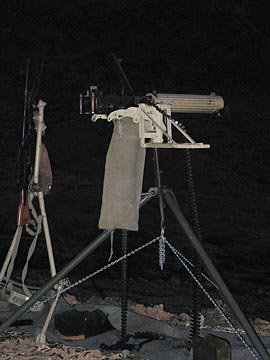
A big gun. At night.If you’ve never been to a machine gun shoot, you’re missing a really outrageous event. These guys have the same kinds of guns the military has/had for warfare and I think they have more ammo than the military issues to its soldiers. And they’re not afraid to shoot it. At night they use tracer rounds that clearly show the path of the bullets as streaks of red or green light. The sound of fire is deafening and every once in a while, it would be punctuated by the loud boom of a reactive target (i.e., stick of dynamite) going off.
At 10 PM, the shooting stopped. By that time, Mike and I were already in the camper, getting ready for bed. It started raining lightly outside. It got quiet and we slept pretty well.

The Big Day

In the morning, the low clouds were back, but never really drifted into our area. The big camp slowly came to life as shooters woke. The local 4H club was serving breakfast and the bacon smelled excellent. After breakfast in the camper, I went out with some rags to dry the dew off my helicopter. We hung a sign that said, “Helicopter Rides $35” on the back of the camper, which faced the rest of the camp. At 8 AM, I had my first passengers.

I flew much of the day. It wasn’t nonstop, but it wasn’t stop-and-go, either. Generally, I’d get three or four flights in between shutdowns. Then I’d get out and grab something to drink or take a pee or do something in the camper before the next few passengers showed up. Most flights had just two people on board — most of these guys were pretty “healthy” — and I made the flights a bit longer than I needed to. The later flights were a bit shorter — after all, I wanted to make money on this event — and included a view of the little waterfall in the foothills about a mile east of the camp.

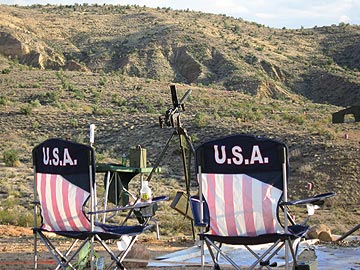
U.S. Firepower in WikieupMeanwhile, the shooters were shooting. They started up at about 9:30 AM and stopped at noon for lunch. Then 1:00 PM to 5:00 PM when they stopped for dinner. They kicked off the 1 PM shoot with the detonation of a pig statue packed with explosives. I was in the air when they did it, but my passengers and I saw the smoke out in the target area. Mike said that the car alarms for all the cars and trucks had gone off.

We used our new fuel transfer tank to refuel the helicopter. It didn’t work quite as expected. Mike got tired of cranking after about 2/3 of the fuel had been pumped and made the fatal error of stopping. The fuel drained out of the hose and we couldn’t get the damn pump primed again. So the remaining 1/3 tank (about 8 gallons) remained in the transfer tank. Later, I made a fuel run to Kingman which took about 5 minutes longer than it needed to when I parked the helicopter about 3 feet farther away from the pumps than the hose would reach and had to start up to move it. (I hate when that happens.)

The weather threatened rain to the east and west of the site most of the day. On a few flights into the mountains on the east, I got drizzled on. We saw rainbows, too. But the clouds broke up around sunset. I stopped flying at 6 PM after taking at least 40 people for rides.

We made dinner in the camper and opened a bottle of wine. Outside, everyone was preparing for the night shoot. It got dark and people started shooting off flares. They’d shoot into the air like a fireworks rocket, then explode. A red light would glide to earth at the end of a small parachute, lighting up the range. Occasionally, one would land before it went out, setting a small bush on fire. But the earth was so wet that the fire soon went out.

The night shoot began loudly. Mike and I walked down the back of the firing line, past the shooters, taking photos and videos as we went. Thank heaven for ear plugs.

The Last Day

By morning, the folks who hadn’t left the night before were packing up to leave. There was another shoot scheduled, but only the hard-core shooters seemed interested. I flew another 10 or so passengers. The waterfall was drier and harder to spot in the canyon. Between flights, Mike and I packed up the camper.

I was on the ground when one of the shooters, a man who had made a canon out of a fire extinguisher, shot a red bowling ball over the range. That thing climbed at least 300 feet, with the wind whistling through its finger holes, before crashing to earth. He’d been shooting the bowling balls all weekend, but I always seemed to miss them. Seeing it was a treat.

Mike and I had lunch, hooked up the camper, and prepared to leave. I took Mike on a quick flight up in the mountains before dropping him off at the landing zone. I flew home the direct route, detouring only to peek into Bagdad Mine on my way back. Total flight time for the weekend: 6.2 hours. When I later tallied up the money, I discovered that I did a little better than breaking even. (Should have made the rides a little shorter.) But it was enough to come back.

The Helicopter Job Market

It’s pretty shameful.

Knowing how to fly a helicopter isn’t exactly a common skill.

It takes at least 40 hours of flight time to get a private license, although most people need at least 60 to pass the check ride. At at least $200/hour, the cost alone is enough to scare most people away from learning.

Then, to get a commercial license so you can do it for hire, you need 100 hours of pilot in command time (at about $200/hour if you rent) and to pass yet another, more stringent check ride.

So then you can get a job, right? Not quite. No one is going to hire a 150-hour pilot to fly their helicopter with paying passengers aboard. In fact, you probably won’t be able to find a job flying for someone else until you have at least 1,000 hours of pilot in command time.

How do you build that time? Most people do it by becoming a flight instructor or CFI. That’s more training, more requirements, and another check ride. Then shamefully low pay rates — maybe $15 to $25/hour? That might sound good, but we’re not talking about a 40-hour work week. You get paid based on when you teach. That might be 10 or 20 hours a week. I don’t know too many people who can live on that.

(I did it the more expensive way. I bought a helicopter and flew the paint off it. Figuratively, of course.)

Captain MariaSo now you’ve got 1,000 hours of PIC time, accumulated over a period of about 2 to 3 years. You’re ready for a “real” job. Fly tours at the Grand Canyon (like I did). It’s great experience, but the pay is only slightly better than what a CFI gets. Fly in the Gulf of Mexico, bringing oil rig workers and VIPs to and from platforms on a featureless, watery landscape, miles from land, in good and bad weather. More good experience, slightly better pay. Pretty crappy living conditions, from what I hear. And I don’t think many women work out there. (Would love to hear from a woman who does; use the Comments link.)
Want a high paying job? One of those $80,000/year job you hear about on radio commercials and in seminars? You’ll need several thousand hours of turbine helicopter experience (which you usually can’t get as a CFI), long line experience, and a “OAS/USFS card.” You’ll have to work your way up through the ranks on other kinds of helicopters to get to this stage.

And, oh yes, you have to be willing to be away from home at least 14 days out of every month.

My friend, Rod, is among the handful of people who qualify for the good paying jobs. He does all kinds of long line work — logging, fire fighting — you name it. But the long hours, questionable living conditions, and time away from home burns him out so badly, he can only work half a year. He actually spent a winter delivering propane (from a truck) just to get away from flying.

Think I’m lying about job requirements? Check out these links for helicopter jobs:

Even police helicopter pilot jobs start at less than $50K. And they require police training, too.

And I think that’s amazing. Helicopter pilots have an incredible skill that few other people have. They have thousands of dollars and hours invested in their training and experience. They’ve worked their way up from the bottom, with low pay and unfavorable working conditions most of the way. And only a handful will ever achieve the high pay you’d think would come at the end of the dues-paying process.

I’m fortunate enough to have two jobs, so I never have to depend entirely on helicopter pilot pay to cover my living expenses. Still, that tour pilot job in Hawaii remains beyond my reach — until I get another 650 hours of turbine time…

You want WHAT for free?

The amazing nerve of some people.

This morning, I got a lengthy e-mail from a photographer that started out like this:

Hi Maria. I’m [name omitted], an award winning VR photographer famous for my interactive, fullscreen 360° aerial panoramas. I’m the only photographer in the country that does this from a helicopter.

I can’t seem to catch the attention of the larger helicopter charter companies, evidently they have all the business they want, so I’m hoping a smaller company like yours will have a little more vision.

In April I want to shoot a series of aerial panoramas for an “aerial virtual tour” of Las Vegas and the Grand Canyon, and I’d like to make a trade with you: Give me a free flight, and I’ll give you some of the 360° aerials for your website.

He then went on to explain how valuable his photos were and exactly why I should fly him around — for free.

Gee, I wonder why he “can’t catch the attention” of other helicopter companies. Could it be that, like me, they’re in business to make money, not to collect photographs? That, like me, they can’t pay their mechanics and insurance companies and fuel providers and pilots with pretty pictures? That flights like those he suggests can cost thousands of dollars and tie up the helicopter, preventing it from doing revenue flights at the same time?

But the kicker is this: he claims he’s “the only photographer in the country” that does panoramic 36° interactive VR photos from a helicopter. And that simply is not true.

Just the other day, I got a copy of a photo taken by one of my clients this past fall that is exactly what he describes. It’s an incredible piece of work that shows the confluence of the San Juan and Colorado Rivers on Lake Powell. You can drag your mouse to look up and down and circle around. You can see the sky and the water. You can zoom in or out. I’m waiting for the photographer to give me a watermarked version so I can put it on my Web site and share it with everyone else.

So I guess he’s not “the only” one, huh?

I followed a link and found that he introduced himself in a forum using the same exact first paragraph he used with me. Guess he has a macro key that inserts it everywhere he needs to introduce himself. Talk about tooting his own horn.

This really gets me. These guys are so full of themselves that they think everyone else should be giving them their services for free. But if he was so good, he’d have the money to pay for these services — like the rest of the professional photographers I’ve worked with over the years.

I forwarded the message to one of my photographer clients — you know, one who pays me to fly him around. He looked the guy up online and wrote back, outraged. A quote: “What bullshit!” So even photographers think this guy is a jerk.

Will some hungry helicopter pilot take this guy around for free? Maybe someone with a few hundred hours and an R22. Let’s just hope he knows how to recover from settling with power, which is a real danger when flying for this kind of work.

But I hope members of the professional helicopter pilot community take the same stand I have. Maybe it’ll take this guy down a rung and get him to put his money where his swelled head is.

Blogging the FARs: ELTs

What’s required…and what’s smart.

I recently got into a disagreement with another helicopter operator about the requirement for emergency locator transmitters (ELTs).

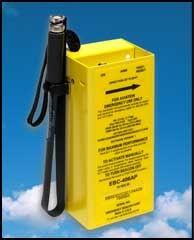
An ELT is a device that sends out a signal in the event of an unplanned landing or crash. Rescuers can use the signal to find the aircraft. Most ELTs are activated by impact, but they can also be manually turned on, either by a switch on the unit itself or a switch wired into the cockpit of the aircraft. My helicopter’s ELT has impact activation, a switch on the unit, and a switch inside the cockpit.

ELTAn ELT is a piece of equipment you hope you never need, but one you pray is working right when you do need it.

Who Needs It?

FAR Part 91.207 covers the requirement of an ELT. It starts out like this:

(a) Except as provided in paragraphs (e) and (f) of this section, no person may operate a U.S.-registered civil airplane unless–

(1) There is attached to the airplane an approved automatic type emergency locator transmitter that is in operable condition for the following operations, except that after June 21, 1995, an emergency locator transmitter that meets the requirements of TSO-C91 may not be used for new installations:

(i) Those operations governed by the supplemental air carrier and commercial operator rules of parts 121 and 125;

(ii) Charter flights governed by the domestic and flag air carrier rules of part 121 of this chapter; and

(iii) Operations governed by part 135 of this chapter; or

(2) For operations other than those specified in paragraph (a)(1) of this section, there must be attached to the airplane an approved personal type or an approved automatic type emergency locator transmitter that is in operable condition, except that after June 21, 1995, an emergency locator transmitter that meets the requirements of TSO-C91 may not be used for new installations.

This is the FAA’s way of saying that you can’t operate an airplane without an ELT attached unless the flight meets the requirements of paragraphs (e) and (f):

(e) Notwithstanding paragraph (a) of this section, a person may–

(1) Ferry a newly acquired airplane from the place where possession of it was taken to a place where the emergency locator transmitter is to be installed; and

(2) Ferry an airplane with an inoperative emergency locator transmitter from a place where repairs or replacements cannot be made to a place where they can be made.

No person other than required crewmembers may be carried aboard an airplane being ferried under paragraph (e) of this section.

(f) Paragraph (a) of this section does not apply to–

(1) Before January 1, 2004, turbojet-powered aircraft;

(2) Aircraft while engaged in scheduled flights by scheduled air carriers;

(3) Aircraft while engaged in training operations conducted entirely within a 50-nautical mile radius of the airport from which such local flight operations began;

(4) Aircraft while engaged in flight operations incident to design and testing;

(5) New aircraft while engaged in flight operations incident to their manufacture, preparation, and delivery;

(6) Aircraft while engaged in flight operations incident to the aerial application of chemicals and other substances for agricultural purposes;

(7) Aircraft certificated by the Administrator for research and development purposes;

(8) Aircraft while used for showing compliance with regulations, crew training, exhibition, air racing, or market surveys;

(9) Aircraft equipped to carry not more than one person.

(10) An aircraft during any period for which the transmitter has been temporarily removed for inspection, repair, modification, or replacement, subject to the following:

(i) No person may operate the aircraft unless the aircraft records contain an entry which includes the date of initial removal, the make, model, serial number, and reason for removing the transmitter, and a placard located in view of the pilot to show “ELT not installed.”

(ii) No person may operate the aircraft more than 90 days after the ELT is initially removed from the aircraft; and

(11) On and after January 1, 2004, aircraft with a maximum payload capacity of more than 18,000 pounds when used in air transportation.

Our argument centered around the point that this operator uses his helicopter for training, including cross-country flights in excess of 50 miles ((f)(3) above). So under the above rules, it seemed to me that he should be required to have an ELT on board. He argued that the rules applied to airplanes, not helicopters. And although the wording of the rule certainly supported his claim, I couldn’t believe that the FAA would exempt helicopters from the requirement.

So a few days later, while taking my Part 135 check ride, I asked my examiner. Actually, he asked me. And I told him about the disagreement I was having with my unnamed friend — I didn’t want to get him in trouble — and that I thought an ELT was required.

I was wrong. Helicopters are not required to have an ELT on board unless they’re doing Part 135 operations. [Note: The previous edit was made after a reader, Mark from Teterboro, confirmed that helicopters are not required to have ELTs, even for Part 135 operations. Read our discussion in the comments for this post to get the details. Thanks very much to Mark for taking the time to correct this.]

Personally, I think this is nutty. I wouldn’t dream of flying a helicopter some of the places I fly without that piece of potentially life-saving equipment on board. I don’t spend most of my flying time buzzing around a city or the suburbs where someone would notice a helicopter on the ground in their backyard or local park. I fly places where there aren’t paved roads for miles and miles. For example, on a straight-line flight from Wickenburg to Laughlin, NV, I fly over only two paved roads in a distance of 80 miles. And there ain’t many unpaved roads, houses, or even cows under me, either.

But the regs are the regs, so if my ELT broke or simply stopped functioning, I could continue to fly legally under part 91 as long as I wanted to. Would I do that? No.

The Rest of the Reg

Part 91.207 also covers requirements for mounting the ELT, testing it, and replacing its batteries. All of this maintenance stuff should be clearly logged in your Aircraft Log book, just in case someone comes along to take a peek at it — perhaps as part of a ramp check.

It’s another interesting example of how helicopter regulations differ from airplane regulations.