Chasing Race Cars Isn’t for Every Pilot

Analysis of an accident report.

The other day, I got a call from an off-road racing team manager. He was interested in hiring me to chase his truck at an upcoming race. But rather than ask me the usual bunch of questions about rates and ferry times, he grilled me about my flight experience.

How long have you been flying? Do you own the helicopter? How many times have you done this?

I answered all of his questions honestly — I have nothing to hide. I’ve been actively flying for about 8 years, since I bought my first helicopter. I have about 1800 hours of flight time. I own the helicopter I fly and I’ve put all of its 610 hours on it. I’ve followed cars and trucks and boats during races about ten times now.

Then he asked, “Did you hear about the helicopter crash at Lucerne Valley last year?”

I told him I hadn’t.

“One of our guys was on board. The pilot didn’t have very much experience, so we’re careful about who we hire now.”

The Accident Report

Later, after discussing rates and finishing up the call, I looked up the info on the accident he referred to in the NTSB database. I found it under NTSB Accident number LAX05FA189. He’d been wrong about the accident date — nearly three years had passed since the May 28, 2005 accident in Lucerne Valley, CA. The helicopter had been a Robinson R44. Although no one had died, three people had been seriously injured in the crash.

I read accident reports to find out how accidents occur. This helps me stay aware of potential problems with my aircraft or flight situations. Here’s the short text of this particular accident’s description:

The helicopter impacted level terrain and rolled onto its left side while maneuvering during a low-level photo flight. The pilot was flying southbound along a racecourse on a photo flight when he made a hard 180-degree turn, and lost control of the helicopter. As the helicopter began a spin to the right, the pilot noted a loss of rpm and altitude. He asked the certified flight instructor (CFI)/safety pilot to take the flight controls. As the CFI took control of the helicopter, he realized that the rpm’s were decaying and that the helicopter was too low to recover the rpm. He attempted to cushion the impact with the collective. Both pilots reported that there were no preimpact mechanical anomalies with the airframe or engine. No evidence of any preimpact mechanical malfunction was found during the post accident investigation that would have precluded normal operation. During the accident flight, the helicopter was running approximately 131 pounds over the maximum gross weight for an Out of Ground Effect hover for the existing atmospheric conditions. The helicopter was being operated in a high density altitude environment, which was computed to be 7,350 feet mean sea level. The pilot received his rotorcraft helicopter rating 7 days prior to the accident. He had approximately 77 hours of total rotorcraft flight time at the time of the accident. The helicopter manufacturer indicated that photo flights were a high risk phase of flight and issued a safety notice SN-34. Safety Notice SN-34 recommended at least 500 hours and extensive training in both low rpm and settling-with-power recovery techniques prior to flying photo shoot type flights.

The National Transportation Safety Board determines the probable cause(s) of this accident as follows:
the pilot’s failure to maintain adequate main rotor rpm and directional control while maneuvering at low altitude. Contributing factors in the accident were the helicopter’s gross weight in excess of the maximum hover out of ground effect limit, a high density altitude, and the pilot’s lack of overall experience with regard to low rpm and settling-with-power recovery techniques.

Full narrative available

There’s a lot of information here. I’ll review it and explain the parts that might not make sense to folks who aren’t pilots, aren’t helicopter pilots, or are new helicopter pilots.

Out of Ground Effect Hover

Let me start out by explaining that helicopters need more power to hover than to perform just about any other maneuver. That might seem counter intuitive, since when you’re hovering, you’re really not going anywhere. But the reason for this is that when a helicopter is in motion, there’s an increase in lift from the relative wind against the rotor blades.

Effective Translational LiftFrom the FAA’s Rotorcraft Flying Handbook:

Translational lift is present with any horizontal flow of air across the rotor. This increased flow is most noticeable when the airspeed reaches approximately 16 to 24 knots. As the helicopter accelerates through this speed, the rotor moves out of its vortices and is in relatively undisturbed air. The airflow is also now more horizontal, which reduces induced flow and drag with a corresponding increase in angle of attack and lift. The additional lift available at this speed is referred to as “effective translational lift” (ETL).

So you use less power to fly than to hover. And any speed lower than ETL will require more power than speeds above ETL. Helicopter pilots often use 30 knots airspeed as a rule of thumb.

You can break down hovering into two types: in ground effect (IGE) and out of ground effect (OGE). From the Rotorcraft Flying Handbook:

When hovering near the ground, a phenomenon known as ground effect takes place. [Figure 3-7] This effect usually occurs less than one rotor diameter above the surface. As the induced airflow through the rotor disc is reduced by the surface friction, the lift vector increases. This allows a lower rotor blade angle for the same amount of lift, which reduces induced drag. Ground effect also restricts the generation of blade tip vortices due to the downward and outward airflow making a larger portion of the blade produce lift. When the helicopter gains altitude vertically, with no forward airspeed, induced airflow is no longer restricted, and the blade tip vortices increase with the decrease in outward airflow. As a result, drag increases which means a higher pitch angle, and more power is needed to move the air down through the rotor.

Here’s the diagram that goes with this information:

Hovering

Out of Ground Effect Hover R44Operating Handbooks for helicopters provide charts that help pilots determine the expected performance of the aircraft in a variety of conditions. The accident report indirectly refers to the OGE Hover Ceiling chart. This chart tells a pilot the maximum altitude you can expect to maintain an out-of-ground effect hover given the aircraft weight, altitude, and outside air temperature. The one shown here is for a Robinson Raven I helicopter (I can’t seem to find my office copy of my Raven II manual). Here’s how it works. Start by following the weight line up to where it hits the temperature line. Then follow that intersection across to the altitude.

For example, if the aircraft was 2300 pounds and the outside temperature was 20°C, the maximum OGE hover would be 3,000 feet pressure altitude. In this accident, the aircraft was roughly 2,220 pounds at the time of the accident and the temperature was about 31°C. Following those lines on the chart indicates that the maximum OGE hover would be 3,100 feet pressure altitude.

The accident location was at 4,266 feet MSL. So the pilot was operating in an area and at a weight that made out of ground effect hover impossible in his aircraft.

Now I don’t want people reading this to think that you can’t (or shouldn’t) fly a helicopter in a place where you can’t hover out of ground effect. That’s not true. But the OGE hover situation does weigh heavily into this accident because of the maneuvers required for the mission.

Lower Rotor RPM

Having just flown with a photographer for an off-road race, the kinds of maneuvers needed are very fresh in my mind. More than once, we were required to slow down to wait for a vehicle. We also hovered OGE several times, with and without slight tailwinds or crosswinds. And, of course, we often had to make sudden course changes that required sharp 180° turns. These are not simple maneuvers, especially when power is an issue.

I can also say from experience that when flying an R44, if you pull more power than what is available, the first indication of a problem will be a low rotor RPM horn. I’ve had this happen twice on takeoffs at high altitude locations (over 6500 feet) with four people on board. If you can increase airspeed to reduce the amount of power needed to fly, you can get out of the situation, but that normally means a descent. (In one case, I did a running take-off from an airport and was fine once airborne; in the other case, my takeoff was from the edge of a cliff, so a descent wasn’t a problem.)

Here’s how I see this accident setting up. The pilot is going very slowly, below ETL, almost in a hover, and makes a hard turn. The aircraft starts to settle, so he pulls more pitch. This increases the drag on the main rotor blades, but there isn’t enough power to overcome it. The blades slow down. The low rotor RPM warning system sounds its horn. He’s too close to the ground to push the cyclic forward and get the airspeed he needs to get out of the bad situation.

How could this have been prevented? One way is to lighten the load. The maximum gross weight for a Robinson Raven I is 2,400 pounds. The pilot and passengers weighed 230, 180, and 175 respectively. If the pilot had checked the OGE charts, he would have seen that the aircraft was too heavy to fly at speeds less than 30 or so knots. He could have taken on less fuel or, better yet, flown without the 180-pound man beside him.

Another way to prevent the problem is to keep the aircraft speed up, above a minimum of 30 knots. This will prevent the pilot from getting into a situation where OGE hover power is required.

I should note here that I considered buying a friend of mine’s R44 Raven I — until I looked at the OGE hover chart. The performance was simply not acceptable to me. I often fly to the Grand Canyon (6300 feet), our vacation property (6700 feet), and Sedona (5200 feet) on hot days. Based on the chart, it was uncertain whether I’d be able to land and take off from these destinations when the aircraft was near maximum gross weight. I needed the additional power and performance of the Raven II for flexibility and safe operation in these areas.

Pilot Experience

Like my potential client, I think a main contributing factor to this accident was the pilot’s inexperience. He had only 70 hours in helicopters, and this was the first time he’d flown this kind of helicopter at a race event. He simply was not prepared for the kind of maneuvers he’d have to perform to get the job done. Add that to the OGE hover problem and it’s easy to see how this could have happened.

Robinson Helicopter Company knows that inexperienced pilots should not be flying photo missions. It issued Safety Notice SN-34 in March 1999 which states:

There is a misconception that photo flights can be flown safely by low time pilots. Not true. There have been numerous fatal accidents during photo flights, including several involving R22 helicopters.

Often, to please the photographer, an inexperienced pilot will slow the helicopter to less than 30 KIAS [knots indicated airspeed] and then attempt to maneuver for the best picture angle. While maneuvering, the pilot may lose track of airspeed and wind conditions. The helicopter can rapidly lose translational lift and begin to settle. An inexperienced pilot may raise the collective to stop the descent. This can reduce RPM thereby reducing power available and causing an even greater descent rate and further loss of RPM….

The Safety Notice goes on to recommend that the pilot have at least 500 hours pilot-in-command time in helicopters and over 100 hours in the model flown before conducting photo flights.

Conclusion

I’m glad my potential client mentioned this accident and I’m very glad I looked it up. I learned a lot from reading it, analyzing it, and summarizing my thoughts here.

It’s also made me more aware of weight and performance at events like these.

When you do a lot of point-to-point flying, you become somewhat complacent about the aircraft and don’t consider the additional demands of multi-maneuver flying. Although I’m always concerned with the weight of my aircraft on takeoff, I tend to look at it more in terms of whether I’m too heavy to fly legally — over maximum gross weight. With only 3 people on board, unless we’re all fatties, that’s not usually a concern.

Parker was at less than 500 MSL and it was a cool day, so I admit I didn’t check the hover charts. (When you check them over and over, you get a “feel” for them and can “guesstimate” what they’ll say.) But after reading this and thinking about it, I’ll review the charts before each photo flight, even if I’m already pretty sure that OGE operations won’t be a problem.

Any thoughts, comments, experiences you want to share? Use the Comments link or form for this post.
Chasing Desert Racers

At the Best in the Desert/BlueWater Parker 425.

I spent this past Saturday doing one of the things I really love to do: chasing racecars with a helicopter.

The venue was the Best in the Desert Racing Association’s BlueWater Resort & Casino Parker 425, which featured highly modified trucks, cars, and buggies racing on a 140+ mile dirt track through the desert. My client was a television producer who videos these events from multiple cameras and turns them in TV shows. For this event, they had a total of 15 cameras, includibut thingsng one in my helicopter and several in the trucks out on the course.

I flew the helicopter with the cameraman and my husband, Mike, working as a spotter, on board. The cameraman sat behind me with his door off. Mike sat beside me.

We started before dawn at the Parker Airport. I started up at 7 sharp and was warmed up and ready to fly by 7:15. The police escort was leading the 300+ participant vehicles to the starting line on Route 95 in downtown Parker when we began circling about 500 feet overhead. The cameraman had a list of 15 targets he needed to video. The first one was the 15th truck in line at the start. Racers were released 30 seconds apart. When our first target was released, the fun began.

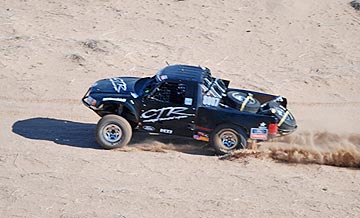
Desert Racing TruckI chased the car down the paved road and onto the dirt track, descending as I left the downtown area. Soon, we were racing beside it just 70 feet up on the long straightaway that heads due east. Mike kept an eye out for wires, calling them out as he saw them. My attention was split between the truck, the wires, and the track in front of me. I worked the cyclic and collective hard, climbing, descending, slowing, speeding up. Both arms and legs worked automatically to make the helicopter do what I needed it to do. Spectators below me went by in a blur. The track made a 90 degree turn to the left and I paused at the inside of the curve just long enough to pivot so the cameraman could keep the camera on the target. Then down the short straightaway to the edge of a steep drop with high wires on one side. The truck descended the hill while I climbed over the wires. I met the truck on the other side and we raced together through a tree-filled dry wash.

“Okay, peel off,” the cameraman instructed.

I turned away from the target and followed the road back. Now we had to find the next target. All we had were numbers — we didn’t know much about how the vehicle looked, other than what class it was in. I had to fly low enough to see them. The first one of us to see a number, called it out. We got the next target halfway back to town. I lowered the collective to slow down and made a sharp 180 degree turn. Then I was on that truck, following it to the wires and into the wash.

We repeated this process about seven or eight times, each time picking up our target a little farther away on the track and ending a little farther down the track. I got to know exactly where all the wires were. Sometimes, I’d look down in time to see a spectator wave up at us or snap a photo. I think there were more photos taken of us that day than of any one racer.

This went on for over an hour.

Then, suddenly we could no longer find any of the targets we needed to video. That started a search up and down the track, flying low enough to read the numbers. Every once in a while, the cameraman would pick out a “trophy truck” or a vehicle driven by someone well-known, and ask me to follow it. I’d follow as closely as I dared, putting the cameraman close to the action. Inside the helicopter, through our noise-reduced headsets, we could sometimes hear the engines of the racers below us or the sirens of the vehicles preparing to pass. We watched one driver slip off the track and race along beside it, scattering spectators who had been standing too close. We shot some video of a modified Hummer flying through the air after a particularly bad bump.

I suppose I should mention here that I wasn’t the only helicopter at the event. There were at least five others: 2 R44s, an Astar, a Eurocopter, and a Bell Jet Ranger. In most cases, they’d been hired to follow a specific race vehicle or team. Once they left the area, they didn’t come back for a while. So keeping an eye out for aircraft wasn’t a serious issue.

After two hours, we headed back to the airport. I shut down and placed a fuel order. Then we drove over to the BlueWater Casino for breakfast. The cameraman the cameraman met with some of the folks he works with to see how many vehicles on his list were still in the race. Each vehicle had a transponder and satellite communications device so it could be tracked from headquarters at the Casino. According to the cameraman, fewer than 50% of the vehicles finish the race. Most of them break. And if you saw the track, you’d understand why.

With an updated list, we headed out again just before noon. We were expecting one of the target vehicles in the pit area, so we stayed nearby. There was a “serpentine” area just east of the airport, with winding, bumpy tracks in a big field surrounded by spectators. I think there was about 5 miles of road there, and it was so twisty that even from the air, I had trouble figuring out the route. We spent about 15 minutes there, filming the action of vehicles skidding around the sandy curves, throwing dust high up into the air. At some point, I realized that I was probably putting on a better show for the spectators than the cars and trucks were.

We spotted a target vehicle as he was leaving the pits and took off after him. More chasing at low level, avoiding wires, slowing when the truck slowed, speeding up when it speeded up. We peeled off and continued down the track, looking for more targets. That’s when we started seeing the breakdowns. Trucks and cars and buggies on the side of the road with parts peeled off of them and drivers bent over their innards. One team was changing a tire. Another was taking the hood off the car. We saw a fender alongside the track. Later, we saw a prone driver with his companion performing CPR. (The rumor I heard was the driver suffered a heart attack or stroke while driving and died on the race course. I have not been able to confirm this yet.)

Desperate to find one last vehicle on the cameraman’s list and looking for exciting footage, we followed the entire 140-mile course. It stretched from Parker through the empty desert as far east as Cunningham Pass (north of Wenden) and around Planet Peak (near the Bill Williams River) to the northwest. This much-reduced map gives you an idea of the distance — I’ve highlighted the track in light red so it’s easier to see.

Parker 425 Map

Much of the course was pretty boring from my point of view — lots of long, straight stretches. In one area, the road ran alongside a set of high tension power lines, making it tough to get low enough to see car numbers. But things got interesting on the last 4 or so miles, when the track headed into the mountains south of the Bill Williams River. The cameraman got some excellent footage of a car winding its way down a narrow canyon. I had to stay high — there wasn’t enough room for me to fly alongside it. But when the canyon opened, I dropped down so he could get some close-up shots.

After trying a few more times to find the missing buggy — we were in touch by radio with the satellite tracking people — we headed back to the airport and I shut down.

We’d flown a total of 5.0 hours. The sky had clouded up and lighting wasn’t as good as it had been earlier in the day. Although we’d planned a third flight for the finishers, the cameraman. The cameraman decided to skip it.

It had been a great day. Not only did I do a lot of flying, but it was the kind of flying I really love to do — challenging, exciting, and with a goal other than going from point A to point B.

Why can’t all my gigs be like this one?

Note: If you were at the 2008 Parker 425 in February and have photos or video footage of a plain red helicopter (no stripe) flying with the cars, please let me know. I’d love to show them off with this post or elsewhere on this site.

February 7, 2008 Update: I added a photo Mike took during the flight to give a better idea of what was going on at Parker.

The Super Bowl is Coming!

Developments around the University of Phoenix Stadium in Glendale.

I’ve been doing flight training down at Glendale Airport for the past few weeks, working on my Instrument Rating at Silver State Helicopters. Two or three times a week, I drive or fly down there in the afternoon, spend a few hours sitting in a simulator trailer with a flight instructor, and fly or drive home.

The drive is long and boring. I found the best route though, thanks to my friends Ray and Robbie: Grand Avenue to Litchfield Road to Glendale Avenue to the airport. I can do it in just over an hour sometimes. It’s about 50 miles each way.

University of Phoenix StadiumGlendale Airport is just 3 miles or so from the University of Phoenix Stadium, where Super Bowl XLII will be held this Sunday. The other day, while waiting for the Glendale Tower controller to clear me across the runway, I overflew the stadium area. The grass was outside, looking rich and green. The top of the stadium was closed. A ferris wheel was under construction in the parking lot on the west side of the stadium and there were lots of party tents and other things going up.

The Super Bowl is apparently Glendale‘s chance at the “big time” and they’re doing everything they can to make it a big party.

At the airport, things are also changing. Glendale Aviation, which had been the FBO there for years, expanded its building and added a corporate hangar large enough to accommodate three small jets. (At least that’s how it looks to me.) It’s now called LuxAir — I guess you need a foo-foo name to attract football fans arriving by jet. Of course, since it’s the only real FBO there, there’s no competition at the airport. It’ll probably make enough money this weekend to cover the cost of the building addition and more. But it couldn’t have been timed any better; crews are probably putting on the finishing touches inside as I type this.

Last week, the ramp was completely full of small airplanes, like Cessnas and Pipers. Apparently, the guy who owns the hangars and shades evicted everyone while doing some upgrades, then raised the rents beyond what local pilots were willing to pay. Few planes went back. I guess their owners would rather roast their wings in the hot Arizona sun. But yesterday, the ramp was almost empty. They’d moved all the little planes under the shades or to the more remote parts of the ramp, leaving plenty of room for incoming jets. Even the DC3 that had been sitting there for months (if not years) had been towed to the far reaches of the airport ramp, tucked into a spot between the hangars and perimeter fence like a broken down truck in someone’s yard.

Inside the terminal, the lobby area’s furniture — a mixture of chairs and tables normally used by one of the flight schools for training and briefing — have been removed. In their place are leather chairs and tables, arranged in little chat groups. I can’t tell you how comfortable they are because I don’t know. They’ve roped the whole thing off with yellow caution tape so no one sits on them until the big money starts arriving. I’m willing to bet that next week, when I return, all that nice furniture is gone.

It’s almost as if Glendale Airport is putting on airs, like Scottsdale Airport.

Glendale Airport’s restaurant, which had been closed for months, reopened last week. It’s the same old place, but with new owners. I haven’t eaten there, so I can’t rate it. I’m sure they expect to do a good business over the weekend. Rumor has it that they’re going to do a buffet. Rumor also leads me to believe that they’re doing a buffet because they can’t deal with table service and they’re taking the easy way out.

Yesterday was my last afternoon at Glendale Airport until after the big event. I canceled Friday’s lesson so I could get an early start out to my weekend gig in Parker, AZ, chasing race vehicles around a desert racetrack with a film crew on board. Wickenburg is one of two area airports outside the 30-mile TFR (Temporary Flight Restriction) that’ll kick in around Glendale on Sunday afternoon, before the game, so even if I get back late on Sunday afternoon, I don’t have to worry about landing at my home base.

But I doubt whether Wickenburg will see the big jets. There’s plenty of room at Glendale and, thanks to the inability of Wickenburg’s Airport Consultants and Manager to plan for the future, only two jet parking spaces at Wickenburg Airport.

The above image of University of Phoenix Stadium is from Wikipedia and is licensed under Creative Commons Attribution ShareAlike 2.0 License (cc-by-sa-2.0). In short: you are free to share and make derivative works of the file under the conditions that you appropriately attribute it, and that you distribute it under this or a similar cc-by-sa license.

A Flight Down Burro Creek

Following a flooded desert stream.

Note To Readers:
This post was removed for three years because readers bothered my client. Since then, my client has left the area, returning its site to the way it was before they arrived to work there. Because the client is long gone and because this blog post remains one of my more interesting flying accounts, I’ve returned it to the blog’s timeline in its original position.

Yesterday, around midday, I took two passengers down the length of Burro Creek from its confluence with at Kaiser/Warm Spring Canyon to Alamo Lake. My passengers were part of a drilling operation that had lost some materials downstream during a flood the night before. They wanted to inspect the damage to their camp from the air and try to find the missing materials.

I met them at what they told me was a helicopter landing zone. It was actually a well-maintained dirt road just west of highway 93, north of the Kaiser Canyon Bridges. They’d provided the GPS coordinates and I punched them into my helicopter’s GPS while it was warming up on the ramp at Wickenburg. It would be a 50-mile flight each way, just to get them, and then a flight until we either found the materials, gave up, or got to fuel situation where I’d have to land.

I filled up with fuel at Wickenburg before departing. Although Lake Havasu City was the closest fuel to their location, it was pretty far out of my way. I’d prefer refueling at Wickenburg and they’d prefer it, too, since it would save them at least $500.

The Flight Up

I listened to podcasts on my iPod on the way up. My iPod can connect to the helicopter’s audio system, so when my aviation radio is active with calls, the iPod goes quiet. But I was tuned into 122.9 most of the way and since it’s mostly used as a UNICOM frequency for very small and private airports, it was pretty much dead. Nothing to disturb my listening pleasure.

Although it was a beautiful day, it was windy. The wind had been gusting to 15 mph at Wickenburg before I departed and the farther northwest I got, the windier it got. I had a good tailwind for most of the way, so while I was indicating 110 knots airspeed, my GPS told me I was really getting about 125 knots groundspeed. The sky was full of huge puffy clouds like the ones I used to see quite often back east. But these were much lower — perhaps 1500 to 2000 feet off the ground. As I climbed with the terrain, they got lower. So, in the back of my mind, I was thinking about the return trip and routes I could take if the clouds started obscuring the mountains around my usual route.

My route was pretty simple; I followed the GPS’s guidance to the Santa Maria River, then followed Route 93 up into the mountains. There are some high tension power lines that run along Route 93 in the area, sometimes on the southwest side, sometimes on the northeast side. You have to pay attention to where they are as you fly up that way — keep tabs on them. I was much higher than the towers, but in the event of a problem, I didn’t want to land anywhere near them.

I was approaching the bridges over Burro Creek, where I’d landed before, when the new LZ’s waypoint came into view. It was only a few miles farther up the road. Soon I caught sight of a white pickup truck parked on a dirt road on a ridge. I descended down and around the to spot, made sure the power lines were far behind me, and made my approach. Although no particular place was marked as a landing zone, the spot I picked was quite firm and level. There wasn’t even much dust because of the heavy rain the night before. I landed facing the truck, about 50 feet away.

I signaled my passengers to approach and opened up the door in front of me and the door behind me. When doing a search from the air, it’s best to have the searcher’s eyes spread out with at least one pair on either side of the aircraft. They were two youngish guys, probably in their late twenties or early thirties. As they got in and buckled up, I gave them a passenger briefing. I made sure their doors were secured. Then, as two big trucks came up the road and waited for us to depart, I took off.

Burro Creek

Burro Creek AreaBurro Creek (red on the map here) is a typical desert mountain water course. Nestled in rocky canyons, it drains the area north of Bagdad, AZ. Its multiple tributaries come together a few miles upstream from where it crosses Route 93.

At the crossing, there’s a beautiful steel arch bridge. The original bridge was built in 1966, but a duplicate bridge was built beside it just a few years ago when the road was widened and extra lanes were added (see photo below). The canyon there is deep on both sides, then drops off on the south side where BLM has put in a campground.

Burro Creek Bridge

After the campground, the canyon walls climb on both sides as the creek winds through some mountains. That’s where Kaiser/Warm Spring Canyon (blue on the map) joins it. They continue the course as Burro Creek about 8 to 10 miles where Burro Creek joins the Big Sandy River (green on the map). From there, the Big Sandy River continues through flat land and then more mountains.

The Santa Maria River (orange on the map) joins them just before they all spill into Alamo Lake, which sits at the bottom of a broad, relatively flat valley, with mountains on its north side. What comes out of Alamo Lake, past the dam, is called the Bill Williams River, which eventually spills into the Colorado River.

Burro Creek usually has some water in it. Pools form under the bridge and then in the canyon just before the Kaiser Canyon confluence. In most cases, the water is a trickle between these pools that dries up before Kaiser Canyon.

Kaiser Canyon, which is also known as Warm Spring Canyon because of a hot spring at the bottom of the canyon, is normally dry, except for where the spring is. Upstream, it’s an interesting hike though a narrow slot canyon. I would not want to be there during a heavy rain.

The Big Sandy River is a lot like the Hassayampa, which flows through Wickenburg. It’s mostly sandy riverbed with water flowing underneath, but when there’s heavy rain, it flows. The Santa Maria is more likely to flow than the Big Sandy, but most of its course is through canyon areas just south of the Arrastra Wilderness, passing between the Poachie Range and the Black Mountains.

Yesterday, of course, Burro Creek, the Big Sandy River, and the Santa Maria River were all running at low flood stage. It had rained all day the day before and most of the night before. The heavy rain, winds, and flood waters had destroyed my client’s drilling camp and washed away the materials we were looking for.

So I started my flight for them with a few circuits around their camp at the bottom of the Burro Creek Canyon. I couldn’t get beneath the canyon walls because it was very windy, very turbulent, and very narrow. But I showed them enough for them to get a sense of the damage done and possibly find some other equipment that may or may not have been lost. They took pictures, of course, so they could share what they’d seen with their crew.

From there, we headed down Burro Creek. The water flowed beneath us in a silt-filled torrent, tumbling over boulders in the stream bed and crashing into canyon walls at sharp turns. I could imagine a kayaker down there, paddling to find the best course, getting covered with cold, fine sand. Ick. I could also imagine the lost equipment floating along in the current, racing downstream.

When the canyon ended, I was able to drop down closer to the water. The Big Sandy added its water to the flow and the river spread wide. We were flying into the sun and fighting against its glare to see. We didn’t see the lost items, although there were plenty of places on either side of the river where it could have been caught in trees, weeds, etc.

We reached the place where Signal Road meets Seventeen Mile Road. There are a few houses there and three places where wires cross the river. I wasn’t low enough for them to be a problem, but I liked being able to see them.

The river forked to two paths near there and my client told me to take the larger path. We continued downriver, searching. Then the river entered another canyon area and I had to climb a bit. One spot was turbulent enough to knock us sideways, but I straightened us out and continued. No sign of the equipment we were looking for.

At this point, I began to feel bad for my clients. They were paying me $495/hour to help them find this equipment and we weren’t having much luck. They were already into it for at least an hour to cover my time to get to them and back to Wickenburg. Before we were done, I’d have cost them over $1,000. I really wanted to help them find something.

But as we continued downstream, it looked less and less likely that we’d succeed.

Finally, we emerged from the last canyon where the Santa Maria River joined the flow. Alamo Lake was ahead of us. Normally a clear blue body of water, it was stained brown with silt and floating debris where the rivers joined it. A fishing boat was picking its way through the debris with two men on board. There was no sign of the missing equipment floating on the lake.

I turned around and we headed back upstream. Now the sun was at our back and it was a lot easier to see what we were flying over. We could clearly see wet and dry spots on the wide river bed. Wet spots are where the equipment could be; dry spots were not. Since I knew exactly where all the wires were, I was able to drop down closer to the water surface. We followed the course of the river upstream winding through the canyons and back into the wide, flat area just downstream from the Big Sandy’s confluence.

When we reached the spot that the river had split, I suggested that we try the other fork. They agreed. So I followed that upstream.

We were just downstream from the split when I spotted it: a black barrel with a white label on it. I pointed it out. “Is that one of them?”

They looked. “Yeah, it is. Good eyes.”

We came down for a closer look. It was a 55-gallon metal drum beached on the island between the two river courses. My clients wanted me to land, but there was no truly safe place to do so — the island was a mix of fine sand and large, round river rocks, with no level spots nearby. So I hovered right up to it. We looked at it together and my client took photos. The barrel looked as if it had been over Niagara Falls. Fortunately, there was a road and those homes not far from where we’d found it. When the water receded a bit, it would be easy to recover.

We continued upstream, looking for another barrel just like it. We circled around a few times, but didn’t have much luck. A few minutes later, we were back at the canyon. The wind was howling and I had to climb. We had a close call with a bird that all three of us saw fly past under the helicopter’s bubble. We circled around the ruined camp again and they took more photos. They wanted me to descend into the canyon, but it would not have been safe and I told them so. Instead, we climbed out, back to the LZ. We had a bit of help from a powerful updraft.

“Feel that?” I said as the vertical speed indicator hit 800 feet per minute.

They both did.

“I’m not doing it,” I told them. And I think they got an idea of what it might have been like fighting the wind in that narrow canyon.

I set down at the Landing Zone and they gathered their things together. I told them I’d send them a copy of their receipt; I already had a credit card to charge for the flight. They got out and walked back to their truck. I checked their doors, then plugged my iPod back in and started it up. Then I took off in a climbing right turn back toward Wickenburg.

The Flight Back

I had a headwind all the way back and couldn’t get a groundspeed above 100 knots. I went the most direct route I could, but did make sure I overflew the Barnes Ranch on the Santa Maria River. Eric Barnes has a landing strip there with a taildragger he uses to come to Wickenburg, where he keeps a car. But the river had cut off the ranch from the road. I made a few calls down to them on 122.9 — that’s the frequency they monitor at home — offering to take them into town. But I got no answer, so I continued without stopping.

The turbulence I was flying in faded when I got out of the mountainous area. But by the time I got to Wickenburg, the FBO guy was telling landing traffic that the wind was 20 miles per hour from 140 degrees. That’s a direct crosswind at Wickenburg. Three planes were in the area — all student pilots with instructors — and I made appropriate calls so they’d know where I was. I landed from the northwest, directly into the wind, across the runway to the ramp. It’s nice to be a helicopter.

Total time for the flight: 2.3 hours.

Over Quartzsite

An interesting photo gig.

I got the call about a month ago. From France. A photographer with a name I couldn’t easily pronounce wanted to photograph Quartzsite, AZ from the air during its busiest time of year. This year, that’s January 19 through 27.

About Quartzsite

Quartzsite, in case you’re not familiar with the place, is a small desert community about 20 miles east of the Colorado River, right on Interstate-10. During the summer, it’s a glorified truck stop, with gas stations, a handful of fast food joints, and a few of the necessities of everyday life for the 1,000 or so people who live there year-round. But in the winter, it’s home to numerous events, including gem and mineral shows, a huge RV show, and flea markets. That’s when the snowbirds flock to the place, filling in the otherwise empty campgrounds and spilling over to the millions of acres of BLM land around the town. The population swells to an estimated 100,000 people, most of whom are living in extravagant RVs and motorhomes.

From the air, this is simply amazing. Quartzsite is nestled in a valley between two small mountain ranges. I-10 cuts through it east/west while route 95 between Parker and Yuma cuts through it north/south. The town is a concentrated sea of white rooftops. Scattered all around, in every direction, grouped in the BLM-approved camping areas, are more white rooftops, sometimes arranged in circles or rows.

Sadly, I don’t have a single photo of the place that shows it off.

Back to France

I gave the Frenchman a quote. He’d have to pay for me to fly to Quartzsite, fly around there for his photos, and fly back. We estimated that at about 3 hours: 1 hour ferry, 1 hour photo shoot, and then 1 hour ferry. At $495/hour, which is my current going rate, it wasn’t going to be cheap. He didn’t book, but that didn’t surprise me. About 90% of the calls I get are from folks who are “fishing.”

Two weeks went by. I got CCed on a message to a Frenchman from Robinson Helicopter, Inc. They told him that the closest Robinson helicopter operator to Quartzsite was Flying M Air. In other words, me.

Another week went by. I got an e-mail message from the Frenchman. He wanted to know about dates and weather. I told him that the weather in Arizona this time of year is usually perfect. He tentatively scheduled a flight for January 25. But since he wouldn’t provide a credit card number, I wouldn’t guarantee it. If someone else put up a card for the same date and time, he’d be out of luck.

The Gig Happens — Suddenly

On Saturday morning, I got a call from Etienne. He was in Arizona. He wanted to do the flight that afternoon because the weather forecast for midweek wasn’t very good. Was I available?

Oddly enough, Mike and I had planned to go camping in Quartzsite that weekend but had decided, just the night before, to skip the overnight trip and just drive out there for the day on Sunday. So I was available after another flight booked for 10 AM.

Etienne picked up an RV from a rental place in Mesa, AZ and drove it up to Wickenburg. He parked it in the airport parking lot. We had a pow-wow to go over details on timing. Then he went into town to book a hotel room — don’t ask me why; I don’t understand either. At 3:15 PM, he was back.

We took off to the west with coats on and his door off.

Fuel Concerns

I’d filled the helicopter’s fuel tanks to capacity. That’s close to 50 gallons of fuel. At my normal rate of consumption, that would last close to three hours. Unfortunately, we were expecting to be out for a full three hours. There’s no fuel between Wickenburg and Quartzsite. The closest fuel is Blythe, which is 20 minutes farther west. If we went there for fuel, it would add 40 minutes to his flight time. It would also have us crossing through very dark desert — and over several mountain ranges — long after sunset.

So I filled an approved fuel container with another 5+ gallons of fuel and tucked it into the back passenger area. There were two paved runways between Wickenburg and Quartzsite, as well as numerous other landing zones. If fuel got low on the way back, we could land, shut down, add 5 gallons, start up, and get back. Of course, if we spent a lot more time in Quartzsite than we expected to, we’d have to detour to Blythe anyway. Five gallons was only about 15-20 minutes of fuel.

The Gig

The flight out to Quartzsite was as boring as I remembered it. Etienne had asked me to show him Arizona. I warned him that the ferry flight didn’t have much of interest, but he assured me it would be interesting to him. I think that by the time we were on our way back, he agreed with me. The landscape is mostly flat, empty desert, with the exception of a few small communities, some of which have farms. We cruised over all of this about 700 feet off the ground, doing exactly 100 knots. Why 100? Because with a door off, that’s my maximum airspeed.

We crossed over two tiny mountain ranges: one just west of Salome and the other just west of the intersection of Route 60 (which we’d followed) and I-10. After the second one, Quartzsite came into view. We’d been in the air less than 50 minutes.

Etienne had envisioned a shot that included mountains in the foreground, Quartzsite in the middle, and the low-lying sun in the background. Problem: the mountains to the east that he was thinking of for his foreground were simply too far away to make the shot work. So we headed into town to see what he could do.

Thus began at least 90 minutes of aerial photography over Quartzsite.

At Etienne’s request, I started by climbing up to about 3,000 feet over the town. I circled the town several times while he shot down at it with two different cameras, each sporting a monster zoom lens. I spiraled down to get closer to the town while he snapped away. Then we flew up and down along the freeway and the BLM camping areas. Then out to the west, to get a shot of the town behind a sunlit mountain. Then lower over the camping areas, with me flying sideways at about 10-20 knots groundspeed so he could shoot right down at the campers.

By this time, most folks had returned from their day at the markets and were gathered around within their “circled wagon” compounds. It was impossible for them not to see and hear us, so there were a lot of people waving up at us. I think each group was competing to be included in the photos.

We broke off from that and started following campers on the Interstate or side roads as they moved to their campsites. We must have followed five different rigs, following above and behind them. I’m sure none of them realized they were being followed. (It reminded me of that scene in Goodfellas where Ray Liotta’s character is followed by a helicopter as he drives around the city.) Etienne was especially interested in rigs that included motorhomes pulling cars. We hit the jackpot when we found a motorhome pulling a pickup that had an ATV in the back of it. There must have been $400,000 worth of equipment down there, driving out into the dusty desert to dry camp.

We did some more shots all over town as the sun started sinking to the west. Etienne got some really interesting shots at the dry camping campground southeast of the I-10/95 intersection.

The sun finally disappeared, but Etienne still snapped photos.

My fuel situation was interesting: I was showing 1/3 tanks of fuel. If we broke off soon, we might still make it to Wickenburg without stopping.

I think Etienne read my mind. He announced that we were finished. I swung out to my right, added power, and headed back. I’d already programmed the GPS for Wickenburg and I made a beeline for it.

Flying Back

The flight back was almost as boring as the flight out had been. The only difference was the moon and the fuel situation.

The moon was nearly full, out in front of us to the east. Each time I passed over a body of water — the Central Arizona Project canal, a cattle tank, etc. — I’d see a quick flash of light as it caught the moon’s reflection. Beautiful.

The fuel situation kept me on edge, wondering if we’d make it all the way back. We were still excellent shape as we flew over the first paved strip at Salome. About 20 minutes later, we were still in reasonably good shape as we passed over the second paved strip at Aguila. And when we landed at Wickenburg in the darkness, we still had fuel and no low fuel light.

When I finally shut down, I was amazed to note that we’d flown 3.3 hours on the full tanks of fuel. Based on what we had left in the tanks — at least 5 gallons because of what the gauges said and there was no low fuel indicator — I figure we burned only about 13-14 gallons per hour. My normal burn rate is closer to 17 gallons per hour. But one look in the Pilot Operating Manual confirmed what I vaguely remembered: maximum range speed is 100 knots. So the fact that my speed was limited by the door being off helped us save fuel.

Since the airport was dark and the FBO office was closed, Etienne and I finished up the paperwork in his rented camper. He was shivering; sitting beside that open door all the way back had chilled him to the bone. I went back to the helicopter, put the door back on, and closed it up for the night.