POV.1 Progress

I’ll get the hang of it — one of these days.

I’ve now had my new POV.1 video camera for just over a week. And I’m not too pleased with my ability to operate it yet.

Tests Runs Okay

POV.1 CameraI made a few test runs with the camera.

The first consisted of me walking around the downstairs of my house, holding the camera in my hand and narrating what I saw. This was mainly a test of the controls and sound capabilities. It produced some predictably boring yet perfectly fine quality video. So far, so good.

Next, I attached the camera to a hat and had it running when I went down to feed the horses one evening. More narration, but I was limited to where the camera pointed because it was attached to my hat and the monitor was in my pocket. I couldn’t see what the camera was really pointing at. It turned out, it wasn’t pointing at what it should have been for about 90% of the video. So while the sound test worked fine — you could certainly hear my heavy breathing as I walked back up the hill — the video was not a keeper.

Next, I decided to test the setup in the helicopter. Because running the helicopter is not what a budget-conscious individual would do unnecessarily, I wanted my test to test all systems: the camera mount, video quality, and sound. Sound was the tricky part. I couldn’t just let the mic pick up cockpit sound because that was mostly helicopter engine and rotor noise. Instead, I had to figure out a way to get just the sound I wanted — intercom and radio sounds — directly into the POV.1’s recorder.

Lapel MicThe solution was to use a tiny powered lapel mic (similar to the one shown here) that I happened to have for a cassette recorder. The mic’s pickup was small enough to fit inside my headset ear cup, dangling right over my ear. I secured it in there with a clip. Any sound that got to my ear would get to the recorder. And the Bose Generation X headset’s active noise cancellation would filter out much of the sound of the helicopter running.

[A side note here: a more permanent solution would be to get an avionics guy to install an audio out jack. I already have an audio in jack, which is standard on Robinson helicopters, and allows me to listen to my iPod while I fly. An audio out would make it possible for me (or a passenger) to connect a video camera to the helicopter’s intercom system.]

I mounted the camera on the bar between the two front seats, using a mount I’d bought a year or two ago for a regular digital video camera. (That experiment had not gone well; the camera couldn’t compensate for the helicopter’s vibrations.) Then I went flying with Ed, my mechanic. We took a 14-minute flight around Vulture Peak, down to Vulture Mine, and back to the airport. Ed held the recorder unit while I flew. I used Viddler to post an edited-down version of the video. It wasn’t bad at all.

In fact, I thought I was ready for “prime time.”

Real Life Trials

My next for-hire flight was the next day. I was taking a dad, his birthday-boy son, and his son’s friend on a 50-minute flight to see the ghost towns and mines in the Wickenburg area. I figured I’d video the flight, then put the video on a DVD for the dad and his son.

[Another note here: That day, as I waited for my passengers, I met a pilot from Oregon who typically flies with three cameras on his plane. He had his laptop with him and showed me some of the video, which he’d set to music. It wasn’t very exciting stuff — not for a fellow pilot, anyway — but he said that his non-pilot friends love it. That wouldn’t surprise me at all.]

I was all set up as I had been the day before. As the helicopter warmed up, I started the recorder and placed it back on the space between the two back seats so it would be out of the way. I then did the flight. When we returned and shut down, I was surprised to see that the recorder was turned off. I figured it had run out of space on the SD card. But when I brought it inside, I was embarrassed to see that it had only recorded 41 seconds of video. The power button must have been hit after I put it down.

Dang! No video for my clients.

Anxious to get some real video to send them, Mike and I went out again with Mike’s mom. This time, I turned the camera on and locked its controls to prevent an accidentally pushed button from shutting it off.

I managed to capture 80+ minutes of video and sound. The only problem was, Mike’s mom’s profile or hands or shoulders are in every shot. In attempting to capture what was out the window in front of her, I managed to capture a bit too much of her. And 80+ minutes of partially blocked views, much of which are of boring open desert, really isn’t very interesting to anyone. Here’s a tiny bit I extracted and set to music.

On Wednesday, I took another client “heli shopping” down in Scottsdale. She’s a much smaller woman and I adjusted the camera a bit to take in more of the panel and less of her. But I also made the fatal error of using the camera’s “loop” mode to avoid capturing lots of boring stuff. Unfortunately, I didn’t understand how loop mode really worked, so when I thought I was turning it on and tagging the video, I was really turning it off. I didn’t capture any video at all.

Sheesh. Am I a loser or what?

Today’s Plan
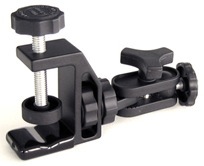
Clamp1For today’s flight to Sky Harbor, I made some changes to the mounting setup. I’d ordered a special mounting clamp from the V.I.O. people and it arrived on Wednesday afternoon. It would give me more flexibility in where I could mount the camera.

There are two places I had in mind. The first was inside the cockpit bubble, at the front passenger’s feet. There’s a ridge there at the very bottom of the bubble and I’m pretty sure I can use the clamp and the 12-in. flexible mount I also bought to mount the camera inside, pointing out. The drawback of that location, of course, is glare. An additional drawback is the position of the recorder box and the difficulties I’d have attaching audio to it. (I can’t have any wires hanging loose around the critical areas near my flight controls.)

POV Camera on VentThe second place I had in mind was where I actually attached it: on the vent opening for the pilot’s door. This mount, which is shown here in the photos I took with my Treo yesterday, has the camera head outside, pointing slightly to the right and slightly down. The rest of the unit is inside, fastened to the helicopter’s airframe. I have all wires securely attached to various things that’ll keep them away from my controls. And I wrapped the camera and mount with red electrical tape, which is somewhat elastic and easier to remove than duct tape. I showed the setup to Ed and he agreed that the camera was not likely to come loose during flight.

Today will be an important test. If I can get the camera to work well from this position and not screw up using the controls, I’ll have some really interesting video. And if the mount and tape hold properly, it might be a good location for future installations.

To Las Vegas on Sunday

We’ll be flying to Las Vegas on Sunday. My planned route will take us over some very boring desert to Lake Havasu City. From there, we’ll fly up the Colorado River, past Topock, Bullhead City and Laughlin, Lake Mohave, Black Canyon, the Boulder Dam, and Lake Mead before turning west and flying right down Tropicana Boulevard to McCarran Airport. It’s one of my favorite flights and I’m eager to get the “good parts” on video.

So cross your fingers for me. I need to get some good shots soon.

And I Thought the Grand Canyon Was Windy!

The weather in Anchorage.

I’m preparing to take a trip to Anchorage, Alaska next week for a job interview. If all goes well, I’ll be moving up there for the summer, flying tourists around glaciers and delivering 50-gallon drums of dog food to sled dog camps via long line.

In trying to get a handle on what to pack for my 3-day trip, I’ve been monitoring the weather in Anchorage, using the National Weather Service Web site. Here’s what I read this morning at 6 AM my time (4 AM Anchorage time):

Remainder Of Tonight…Mostly cloudy with a few sprinkles. Lows in the 30s. Southeast wind 40 to 55 mph along turnagain arm and the higher elevations with occasional gusts up to 70 mph. Elsewhere southeast wind 10 to 25 mph with localized gusts to 40 mph.

Okay, I added the emphasis. The NWS evidently doesn’t think 70 mph gusts of wind is unusual, since the forecast didn’t include a weather advisory. I know there would have been one in the Wickenburg forecast page if the winds were expected to reach 70.

My Experience with Wind

I flew tours at the Grand Canyon in 2004. In the spring, the wind was howling, occasionally reaching 50 mph or more at the airport. Because we flew Bell 206L (Long Rangers), which had a two-bladed rotor system that didn’t do well in high turbulence, we’d shut down if the wind got that bad. But the experience of flying at the Grand Canyon in spring and having to deal with all of that wind made me a lot more comfortable with high winds than the pilots who haven’t had to deal with it. That’s why I always recommend flying at the Grand Canyon as a first “real” job after flight school and duty as a CFI. Lots of good experience there.

Still, I don’t expect to fly in Alaska with 70 mph gusts. (I hope my potential employer doesn’t expect me to, either.)

Yesterday, I did a flight to Scottsdale with a client. Although the winds were relatively calm when we flew down there — variable at 4 mph according to the Scottsdale ATIS recording — they were forecast with gusts to 30 mph for that afternoon. Sure enough, when we left the area at about 5:15 PM, the wind was 16 mph gusting to 23. That’s certainly not bad enough to keep me on the ground, put I did have to give the pedals a workout as I lifted off the ramp. I also had to put in a lot of directional correction against the wind when I took off, just to prevent it from blowing us over the runway (which would have gotten me in hot water with the Tower there).

What’s Wrong with Wind?

There are two things that can make high wind especially bothersome for helicopter pilots:

  • When flying in mountainous (or even hilly) terrain, the wind coming over those mountains (or hills) makes the air turbulent. Here’s how I describe it to passengers. Imagine a stream with rocks in it. As the water flows downstream, it sets up eddies and weird water flows around the rocks. The water has to go up or around the rocks in its path. It then goes down or rushes in from the sides on the downstream sides of the rocks. Can you imagine it? Now imagine the mountains or the hills as those rocks and the wind as the water. The helicopter is like a little boat bobbing around in that water. That’s the turbulence you feel when you’re flying relatively close to the ground on a windy day near rough terrain.
  • A gust spread — that’s the difference in airspeed between the steady wind and the gusting wind — sets up what probably meets the definition of wind shear. Most pilots know that a wind shear is created where the wind suddenly shifts direction or speed. A gust changes the speed, right? The result, therefore, is the same kind of turbulence you’d feel in a wind shear. The bigger the gust spread, the bigger the shear, the greater the turbulence.

Not all helicopters handle turbulence the same way. Generally speaking, a fully articulated rotor system is better for handing turbulence than a semi-articulated system. But no matter what you’re flying, you’re going to feel those bumps. So will your passengers. Fortunately, they’re likely to get sick before the pilot does.

When I flew at the Grand Canyon, the wind was so bad a few times that I started feeling sick. Some of my passengers, as you can imagine, were making full use of the plentiful barf bags we had on board.

Will Alaska Be Worse?

Right now, I’m left to wonder whether Alaska will be more of a challenge due to wind than the Grand Canyon was. Although I’d prefer calm winds — who wouldn’t? — I’m up for the wind challenge, if I have to face it.

I just hope it’s not 70 mph.

Helicopter Training and Broken Promises

A look back at the warning signs of the Silver State debacle.

I don’t know all the details about the rise of Silver State Helicopters (SSH) because I wasn’t looking for training when it began its phenomenal growth. Once I caught notice of it and learned more about how its training program worked, I began to suspect that it was what I refer to as a pyramid scheme. Not wanting to get myself in trouble with SSH’s legal department — and frankly, not sure if I was right — I kept my opinions to myself. I did, however, try to warn people to take a close look at what a helicopter training program would give them before signing up for one.

The purpose of this article is not to say “I told you so” to the folks who are now suffering from the demise of SSH. The purpose is to shed some light on what may have been going on and the realities of the helicopter industry.

A Look at SSH

If you’re unfamiliar with SSH — not likely but possible if you’re considering a career as a helicopter pilot — here’s a bit of background information.

SSH was a helicopter training organization that used a “program” approach to training. For a set fee of $70-$80K (I’ve heard several dollar amounts in that range), SSH would provide training that would take you through the following helicopter pilot ratings: Private, Instrument, Commercial, and Certified Flight Instructor (CFI). I’m not sure if it included a CFII rating (that’s for CFIs to do instrument training); perhaps someone reading this can clarify.

SSH attracted potential students by holding seminars in large auditoriums. It would come to a city and hold a seminar. Advertisements on the radio and elsewhere promised to explain to seminar attendees how they could become helicopter pilots earning $80,000 a year. This was enough to attract quite a few potential students. After all, what could be a cooler job than a helicopter pilot? And $80K/year is a great paycheck.

SSH arranged for financing at the seminars. So if you came and liked what you heard, you could apply for a loan on the spot and sign up. This immediately put you in debt. I believe money was drawn out to SSH in 1/3 increments, but I’m not certain how that worked. Again, I’m hoping someone intimate with the situation will clarify in the Comments here.

SSH grew incredibly fast. Founded in 1999, it reported revenues of $40.7 million in 2005 and was ranked number 12 on the Inc magazine 500 list of the nation’s fastest growing small businesses(1). They had training centers in 17 states and over 2,000 students enrolled. I heard a rumor that they tried to buy a fully year’s production of Robinson helicopters one year. (Can anyone substantiate that rumor with a reference?) Helicopter pilots were talking about SSH online and in person. And, unfortunately, many flight schools saw a formula that worked and began limiting their training to a “program” as well.

The Program

Many knowledgeable helicopter pilots had a problem with “the program” and the promises made by SSH. My biggest concern was the salary promise: telling people in their seminars that they could get an $80K job as a pilot. I never heard the promises firsthand, and I worried that they were leading people to believe that they could get that salary immediately after the 18-month training program ended. As I explained in “The Helicopter Job Market,” this is simply not the case. The comments on that post — many of which were written by experienced pilots — support my claims.

Then there was the quality issue. I received this comment on my August 2004 post, “Thoughts About My Summer Job“:

I have a question for you. I am looking at begining training, I already have my PPL fixed wing, and I have been looking at a few schools. But have you heard of helicopter academy? Look them up Helicopteracademy.com
0-300hrs. for 50k and a job offer after that. Your opinion would be great or if you have heard anythin about them. Thanks and thatr offer still stands for me to jump in your new bird. lol

(Oddly enough, the flight school he was referring to is the same one my friend Dave works for as the Chief Flight Instructor. And the post he was commenting on was a direct response to a question Dave had asked me. Small world.)

I responded to his comment with a lengthy comment of my own. In it, I listed a bunch of things a potential helicopter flight student needs to consider when evaluating a “too good to be true” deal on training.

At SSH, there were some problems with how quickly students could get through the program. They were supposed to finish in 18 months, but not all of them could do it so quickly because of other job responsibilities or shortages of aircrafts at SSH locations. There were also some problems with check rides — some students simply were unable to pass a check ride on the first try because of their lack of knowledge or skills. Although the FAA says you only need 35 hours of dual time to get a helicopter rating, not everyone can do it so quickly. (It took me 70+ hours; I like to think it was because I did it part time over 18 months and took a summer off.)

I also worried about the affect of releasing so many new pilots into the helicopter job market. If SSH was graduating 1,000 students a year, where were they all going to work? There simply weren’t enough helicopter jobs out there for all of them. As someone who likes to fly for someone else in the summer time, I saw a lot of potential competition for the usual entry level jobs.

In addition, having too many pilots to fill open positions could negatively impact pay rates. Why pay $700/week when you can easily find someone willing to take $500/week? I also saw a decline in helicopter pilot salaries because of a glut of pilots.

SSH Closes Its Doors

On February 4, 2008, SSH declared Chapter 7 bankruptcy. For those of you who don’t know the individual chapters of the bankruptcy code, Chapter 7 is the bad one. It means you’re definitely out of business for good and are liquidating assets. This action put over 700 employees out of work and left 2,000+ students in various stages of completion of their program, some of them owing $70K or more to a lender.

If you’re interested in more facts about the rise and fall of SSH, here are some excellent references on news sites:

The “Pyramid” — Or Borrowing from Peter to Pay Paul

My background is in accounting — indeed, I have a BBA in Accounting from Hofstra University. I was an auditor and financial analyst for eight years. So I think about numbers and I know how people can manipulate them.

When I first heard of SSH, my immediate thought was pyramid scheme. This is probably the term I used when discussing it with fellow pilots. In fact, however, it’s more of a case of Robbing Peter to Pay Paul.

What I saw going on was this: SSH was collecting money up front from students, supposedly to cover their training costs. But it was probably using this money to pay the bills on previously purchased goods and services. So it was always a step behind with payments and it always relied on new student revenue to keep the business afloat.

This would be fine if (1) the inflow of new students remained constant or increased or (2) SSH finally caught up with its debt and began paying current expenses with current revenues.

Unfortunately, neither of these scenarios developed.

The rise in interest rates soon discouraged the smart students from signing up. I was shocked in November 2007, when I read a comment from a reader on my “The Helicopter Job Market” post from earlier that year. In it, he queried:

I’m curious, has anyone ever heard of Silver State Helicopters? Are they reputable?

Also, how is someone to payback an $80K loan at 19% on an entry level salary of 30K/year? That’s a freakin’ house payment each month without having a house! My “off-the-cuff” figuring say’s that equates to about $800 a month for 20-30 years!

I pushed his numbers through Excel and came up with $1,271 per month over 30 years — which I find difficult to believe they’d offer. The total payments over that time would exceed $450K. Hell, he could buy a helicopter for that!

While I still find it difficult to believe that financing terms were that bad, it does tend to explain why SSH’s sign up rate declined to a slow trickle. It also explains why they closed their doors two days after their last seminar, which was held in Florida.

So SSH got to the point where there wasn’t enough new revenue in to cover their debts.

I got an inkling of their serious financial problems in the fall of 2007 when SSH did a major reorganization that eliminated several middle management positions. Later, in January 2008, I was told by a SSH employee that SSH was unable to pay overhaul centers to get their helicopters back from overhaul. As a result, they were running out of helicopters to do training in. Indeed, the Glendale, AZ location had a timed-out R22 sitting in the hangar because they worried that if they sent it to the overhaul center, they’d never get it back.

How I Know So Much About It

Even though I saw the writing on the wall, I had a relationship with SSH that began in 2006. Needing a qualified R44 mechanic for my helicopter, I made arrangements for SSH’s Mesa, AZ location to do my maintenance. The folks there were friendly and helpful and the mechanic did a fine job at a reasonable price. (He’s now looking for work; let me know if you need a full-time R22/R44 mechanic and I’ll put you in touch.)

When I decided to get my instrument rating, I spoke to the folks at Mesa and they set me up with their chief flight instructor in Glendale, which is much closer to where I live. After several false starts, I began my training in January 2008. I accumulated about 12 hours of instrument flight time — 10 of which was in a simulator — before they abruptly shut their doors.

I was surprised, although not shocked. I knew the end was coming, but didn’t realize it was so close. I was lucky, though. I’d been on a pay-as-you go program because of my unusual relationship with them and was paying by credit card in $2K installments. I’d used up my first $2K and had just paid my second $2K for the next month’s training. When I got the call that SSH had closed, I got on the phone with my credit card company and initiated a chargeback. It took three weeks for them to process it, but the money was recovered.

So I managed to emerge unscathed. I wish I could say the same for the rest of the SSH students.

[A side note here: I was notified of SSH’s shutdown by the FAA. My contact there knew I used SSH for maintenance and was worried that my helicopter was locked up in their hangar. His first question to me when he called was, “Do you have possession of your helicopter?” That’s a weird question coming from the FAA.]

Let This Be a Lesson

I hope this post teaches its readers a thing or two about the situation. If we learn from this experience, it’ll help protect us from being victims of similar situations in the future.

In short: if something sounds too good to be true, it might just be. Think things through, do your homework, be aware that not all promises are kept. Don’t sign on the dotted line with your eyes closed or seeing only half the picture.

One last word: I’ve tried hard not to bash or blame any specific person for what has happened and I will not tolerate any bashing or finger-pointing in the comments to this post. If you have something to say about your particular situation or experience, do use the comments feature to share your thoughts. But if you use them to personally attack anyone, your comment will be deleted. This isn’t a helicopter forum and I don’t tolerate the high school mentality that’s so common there.

Forms for Funding Airports

Thoughts on FAA Form 1800-31.

On Saturday, I received FAA form 1800-31 in the mail. Titled “Airport Activity Survey (by Selected Air Carriers),” it’s headed up with the following description as part of its Paperwork Reduction Act notice:

Submission of this form is voluntary. The purpose of this collection is to capture passenger enplanement data to be used to allocate Federal funds to eligble airports. The public reporting burden for this collection of information is estimated to average 1 hour and 30 minutes per response.

The form requests me to enter the names, states, airports, and airport identifiers for all airports where I picked up passengers for on demand commercial operations. For each airport listed, I need to provide a count of the passengers I picked up.

To gather this information, I’ll need to go through my aircraft logs for 2007 and look at each flight conducted. If it was a revenue flight, I need to note where I picked up the passengers and how many passengers I picked up. I then need to tally these for each airport and summarize it on the form. Ninety minutes sounds about right for this chore.

Although this task is voluntary — frankly, I don’t think I bothered last year — I’m looking forward to doing it this year. It might be the bean counter in me — once an accountant, always an accountant. But there are two good reasons why it interests me more this year:

  • A line-by-line review of my log books helps me to remember individual flights. I’m in the process of drawing together material for a book about my flight experiences and I’m sure I’ll be reminded of a few flights that are interesting enough to write about.
  • I’m curious to learn which airports I did the most business at last year. I’m pretty damn sure it wasn’t Wickenburg. Hell, I picked up more passengers in Buckeye in one day than I did during a whole year at Wickenburg.

Not Wickenburg? you may ask. How can that be? Aren’t you based there?

Yes, I’m based at Wickenburg. But sadly, very little of my business originates here. The vast majority of my revenue comes from flights out of Deer Valley, Scottsdale, and Sky Harbor, with the big revenue charters originating in places like Page and Yuma. Try as I might to market my services here in Wickenburg, the population simply isn’t interested. I’m probably too costly for most of the fixed income folks who live here, while the folks who don’t worry about money would prefer a pickup from a turbine helicopter based in Scottsdale. (How’s that for ironic?)

I’ve actually gotten to the point where I don’t bother marketing much in Wickenburg anymore. Sure, my original tri-fold brochure is still out there. Why not? I have about 10,000 copies of it left. It emphasized my Wickenburg tours and, when I realized that my market was in the Phoenix area, I had it redesigned to emphasize tours from there. The leftover copies of the original are in my hangar, slowly making their way out into brochure racks around town.

And this year, I pulled the plug on my local Yellow Pages ad.

I’m even in the process of turning off my local phone number, preferring my cell phone for all communications with current and future clients.

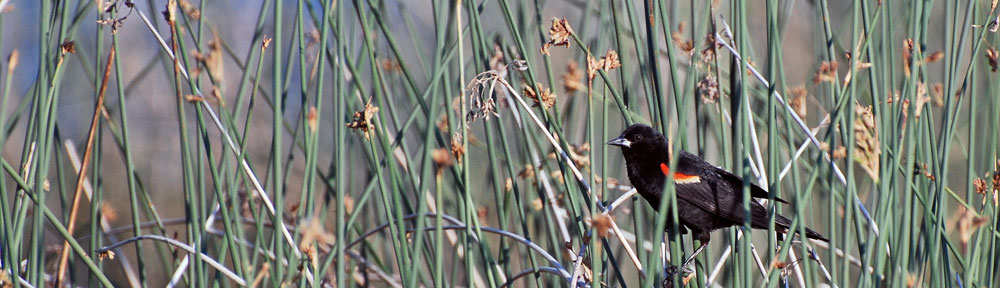
Hermosa RanchIt’s odd, in a way. I’m the only aircraft charter operator based in Wickenburg. The town has a very nice little airport that recently got a bunch of funding from the Federal Government that added 1000 feet to its runway. But when finally given the opportunity to set up an office on airport property, I turned it down. I, like many other business owners (or potential business owners) here, have learned that dealing with the Town can be a nightmare of bullshit politics conducted by men who get their kicks controlling this insignificant corner of the world. They have no regard for the future of the airport — a fact they’ve made clear by allowing housing on three of the airport’s four sides, including less than 4000 feet from the approach end of Runway 23. Why would anyone in their right mind put up a building or hangar or anything else at an airport that’s likely to be closed in 10 or 15 years due to residential encroachment and the accompanying complaints? Or, for that matter, sign a land lease agreement that can be cancelled at any time on the whim of the Mayor or a Council member?
So my business languishing, as far as Wickenburg is concerned, but doing quite well everywhere else. And that’s unfortunate for Wickenburg. Not only is the Town losing out on sales tax revenue generated by my scenic tours, but FAA Form 1800-31 will not indicate Wickenburg as one of my major operating airports.

And if the only charter operator based in Wickenburg has more passenger operations at other airports, then how many passenger operations will be recorded for Wickenburg’s final tally? And how will that affect future airport funding?

I’m learning not to care.

Flight to Sky Harbor…at Night

A pickup at the Terminal 3 helipad.

Last week, I had my first passenger pickup at Sky Harbor’s Terminal 3 helipad. This was an unusual gig for several reasons:

  • I’d only flown into the Terminal 3 helipad once before, and that was with a flight instructor. I’d asked for the flight so I could learn the approach in case I ever had to do it. A full year went by before I had a call for a pickup there.
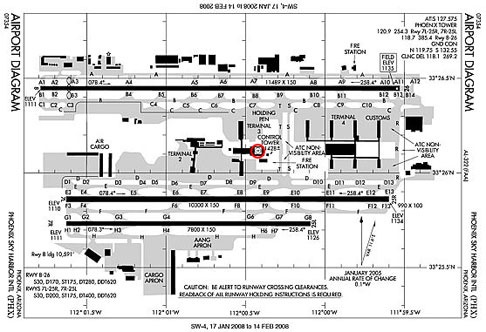
  • The Terminal 3 helipad is on top of Terminal 3 (hence the name), in an area that’s in the middle of the top level of a parking structure. To reach it, you have to cross one runway (from the north) or two runways (from the south) where commercial airliners are landing and taking off. (The airport diagram below shows its location beside the Control tower in the middle of this busy Class Bravo airport.)
  • This particular pickup was at 8 PM. Since it was February, that means it was night.

Sky Harbor Airport Diagram

So I was going to land at a helipad I’d landed on only once before, at the top of a 6-story building, in the middle of busy airport, at night.

The terminal 3 helipad is far more convenient for my passengers than where I usually land on the southwest corner of the airport at one of the FBOs. (I usually use Cutter, but Swift is there, too.) Landing at an FBO requires my passengers to get a free shuttle from their terminal to the FBO. You can’t beat the cost, but the amount of time you wait for the shuttle and then ride it takes away from the convenience of being picked up at Sky Harbor and whisked to your destination. My passengers were arriving via U.S. Airways (formerly America West), which had gates at Terminal 4. They’d still need to take a shuttle to meet me, but at least they didn’t have to go around the airport to do it.

The Flight

My passengers were supposed to land at 8:07 PM. I figured that by the time they got to the gate and retrieved their luggage, it would be at least 8:30. Then at least 15 minutes to get to me. Still, I don’t like to make people wait for me, so I decided to get there by 8:15 PM. That means I needed to start up at Wickenburg Airport by 7:30 or so.

Mike dropped me off. I’d pulled the helicopter out and fueled it up earlier in the day so it was sitting on a helipad, ready to go when we arrived. There was still a little glow to the west where the sun had set. Mike waited until I took off. Our friend Dave pulled up in his Jeep and chatted with him while I warmed up the helicopter. Then I took off, turning on the runway lights as I lifted off. I climbed to 3,000 feet and turned to the southeast where I could see the glow of Phoenix.

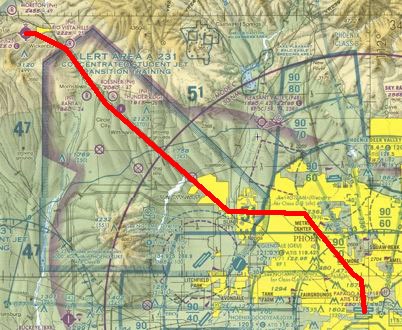
Route to PHXMy flight path would take me from the darkness of Wickenburg along Route 60 (Grand Avenue) to Bell Road. By then, I’d be in the brightness of the Phoenix area, flying at about 2,000 feet in over its lower elevations. I planned to turn east along Bell Road and follow that to I-17. I’d call Phoenix Tower from the Metro Center Mall at I-17 and Dunlap.
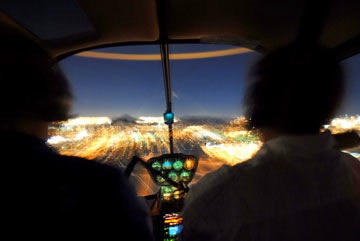
Yes, I follow roads.

The flight worked just as I intended, although I did have to head southeast toward the mall sooner than I expected to avoid Deer Valley’s airspace. It wasn’t worth calling them for the 3 minutes I’d be in their space, so I just avoided it. My GPS made it easy to see where the space was so I didn’t slip in by mistake.

I’d been listening to Phoenix Tower talking to the incoming airliners since I was 20 miles out. I had nothing else to listen to. I’d purposely left my iPod behind so I wouldn’t be distracted by it. I don’t fly at night that often — maybe once or twice a month — and I was nervous about flying into the helipad at night.

Don’t think you can recite what I’ve written here to land at the T-3 Helispot. In March 2012, the tower management at PHX realized that a lot of pilots were claiming they were signatories to the Sharp Echo letter of agreement when they, in fact, were not. As a result, they instituted a new letter of agreement and required all signatories to attend a meeting at the tower. If you plan on operating a helicopter in the Phoenix Class Bravo airspace, you need to meet with Phoenix tower management and get signed up with the new letter of agreement to take advantage of the options it offers pilots.

I tuned my transponder to 0400. “Phoenix Tower, helicopter Six-Three-Zero-Mike-Lima is over Metro Center Mall, Sharp Echo with November for landing at the Terminal Three helipad.” This call to the tower identified me and my position, indicated that I was a signatory to the Sharp Echo letter of agreement for helicopter pilots, verified that I’d listened to the airport’s ATIS recording so I knew conditions, and state what I wanted.

The female controller’s voice came back in a moment. “Helicopter Zero-Mike-Lima, squawk zero-four-zero-zero and ident.”

She was telling me to tune my transponder as I already had and press the Ident button. That button makes my radar blip brighter than the others for a short time so she can see which blip I am.

“Zero-Mike-Lima is identing,” I said, pressing the button.

I was still quite a distance from her space, so I continued, now heading southeast. Hopefully, she’d see me and clear me to enter the class bravo airspace. But she didn’t. Instead, she gave some instructions to incoming airliners. I waited about two long minutes, then pressed the Ident button again, convinced that I was flying too low for her to see me.

“Helicopter Zero-Mike-Lima, say position again.”

“Zero-Mike-Lima is about three miles southeast of Metro Center.”

“Helicopter Zero-Mike-Lima, radar contact. Cleared into Class Bravo airspace. Proceed via Sharp Echo to midfield for crossing to Terminal Three helipad. Remain north of Runway Two-Six.” This call verified that the Tower could see me on radar and gave me the all-important clearance into the surface airspace. It also told me how I should proceed inbound: toward the airport, north of midfield.

I confirmed that I’d received the instructions by reading back the most important ones: “Zero-Mike-Lima proceeding. Will remain north of Runway Two-Six.”

I continued on my way, now looking for the airport. I was still at least ten miles out and all I could see were lights. After a while, I could see airplanes coming in for a landing and airplanes departing. I figured the airport had to be between them. My GPS confirmed that, but I really wanted to see where I’d be going.

I also wanted to see the tower. The Terminal Three helipad is less than 100 yards west of the tower. If I could see the tower, I could find the helipad. I wanted to make my approach directly to the helipad to minimize my time over the runway.

I heard the incoming jets talking with the tower as I continued in. One of them was being told to wait in the holding area. The pilot came on the radio and said, “Tower, we have a medical emergency and need to get to the gate immediately.” She cleared him to the gate.

I was three miles out and down to about 1500 feet when I saw the tower quite clearly. I adjusted my course. A moment later, the controller came on the radio again.

“Helicopter Zero-Mike-Lima, do you have that Airbus on short final in sight?”

“Zero-Mike-Lima has the traffic in sight.” How could I not? Two bright headlights were about a quarter mile from the runway end, closing on it quickly.”

“Helicopter Zero-Mike-Lima, cross behind that traffic and cleared to land at the Terminal Three Helipad.”

“Zero-Mike-Lima crossing the runway behind the traffic.”

I adjusted my speed to reach the runway just as the airbus passed by me and began my descent. I was already pretty low, so my descent wasn’t very steep. I crossed the runway with the quickest glance at the landing lights of about five more jets on their way in. I felt my cell phone vibrate and ignored it.

At first, I couldn’t see the helipad. I saw the rooftop parking structure and headed toward it. I was about 50 yards away when I saw the lighted helipad. I glided over to it and set down diagonally in the square, unsure of where my passengers would be coming from. I don’t like to park with the helicopter’s tail rotor facing where people might be walking or waiting.

It wasn’t until later that I saw the tri-colored rotating beacon in the southwest corner of the area that identified a civil aviation helipad. It was the first time I’d ever seen one.

On the Helipad

I cooled down the engine and shut down. A message on my cell phone was from my passengers. They’d landed but couldn’t get to the gate. It turned out that their gate had been handed over to a plane with a medical emergency. (I can’t make this stuff up.)

The terminal 3 helipad is a big, square landing area on top of the building. There’s enough room for one helicopter. If a helicopter is sitting on it, no one else can land on it. For that reason, a helicopter pilot who is parked there cannot leave the area.

Of course, I had my engine shut down and my radio off. If they needed me to move, they’d probably have to get someone out there to tell me. There was a security guy watching me for the first fifteen minutes or so of my wait. But then he got as bored as I did and, able to relocate, did.

I was aware of a few things up there. First, the smell of burning rubber. At first, it was so strong, I thought it was my helicopter. But then I realized it was the smell of the tires of the big planes heating up as they hit the tarmac on landing. The wind was blowing the smell from the south runways right to me. Not long afterward, I started smelling their brakes, too.

I was also aware of how nice the view is from up there. Great view of most runways. Phoenix skyline off to the northwest. The lights of Phoenix’s urban sprawl spread out in every direction around me, punctuated by blackness where rocky mountains rose too steeply to build upon. The antennas atop South Mountain looking like so many floating red lights. A nice breeze blowing kept the air feeling fresh and clean (despite the tire/brake smell).

The helipad is an excellent place to hang out and watch traffic come and go. It was quite entertaining — at least for the first fifteen or twenty minutes. Then it got just plain boring. I spent some time tweeting updates on Twitter and reading what others were writing. The Oscars were on television and most folks seemed tuned into that.

After about 45 minutes, I called my passengers again. They’d retrieved their luggage and were now waiting for the van from the guest ranch they were staying at to come pick it up. I guess I should explain. There’s enough room in my helicopter for them and some small pieces of luggage, but not enough room for them and enough luggage for two people for two weeks. It turned out to be cheaper and easier to have the ranch send a van down for their bags than to book them on another charter carrier. This was also a good idea in case the weather turned bad and I couldn’t come get them at all. They could always take the van to the ranch. Why not just take the van? My client wanted to fly and he didn’t even care that he’d arrive at the ranch before his luggage. (Why can’t I have about 20 clients like that every season?)

I told them to have the van drop them off at Terminal 3 as it was leaving the airport. This would save them the hassle of catching the Inter-terminal shuttle bus. Then we hung up and I went back to waiting.

The Flight Back

My passengers arrived suddenly about 15 minutes later. I greeted them and bundled them on board, seating them both on the left side. I planned fly fly past downtown Phoenix on the way to Wickenburg, to give them a little night tour of the area. I started up and warmed up the engine, listening to the ATIS recording before switching to the tower frequency. I must have timed it just right because when I requested a departure to the northwest past downtown Phoenix, she immediately cleared me across the runway. I saw the landing lights of at least another five jets bearing down on us as I scooted across, climbing.

Phoenix at Night by Jon DavisonAfter clearing the runway area, I turned to the west. The roof on Chase Field was open and there were some lights on in there. Maybe they were doing some kind of maintenance. I didn’t fly close enough to see. I turned north to follow 7th Street past the tall buildings, then headed northwest. I wanted to hook up with Grand Avenue again before we left the brightness of the city. This photo by Jon Davison gives you an idea of what it might have looked like from the back seat.

The flight back was uneventful. As we reached Sun City and left the lights behind us, a sort of haze seemed to fill the cockpit. The first time I’d experienced this phenomena, it had scared me. Now I knew what caused it: my eyes adjusting to the lower light levels. I dimmed the cockpit’s instrument lights even more to prevent reflection on the inside of the bubble. My passengers were awed by the darkness we had to fly through.

Then we could clearly see the line of white that marked route 93: cars returning from Las Vegas on that Sunday night. They’d pass right through Wickenburg. We followed route 60 at an altitude of about 3,000 feet into town. Then I turned along the dark corridor of Sols Wash, keyed the mike button, and brought the airport lights to life. A while later, we were on the ground on one of the two helipads and Mike was driving up to give them a lift to the ranch and bring me home.

It was just after 10:00 PM.

This particular flight will be one of those that stays with me for a long time. Not because it was frightening or dangerous or beyond my skill level. It was none of those things. But it was a new experience that offered new and unique challenges. Any time I take on a reasonable challenge and succeed, I learn and become a better person.

And when it’s a flying challenge, I become a better pilot.