The first of a four-part series about flying at Lake Powell.
Part I: Lake Powell and the Airports
Part II: Avoiding the Tour Planes
Part III: Points of Interest
Part IV: Going Way Uplake
I’ve been at Page, AZ on the dam end of Lake Powell for about a month now. Although I already knew quite a bit about flying at the lake from numerous photo jobs here, I’ve picked up quite a bit in the past month, mostly from my pilot neighbors at the campground. Since I have enough material to blog about it, I figured I’d write about it, mostly to get my mind off politics and the tech book I’m working on.
Anyway, this will be a four-part series and this is the first part. I have notes for the other three parts, so I’m sure I’ll get them done — probably within the next week or so.
About Page and Lake Powell
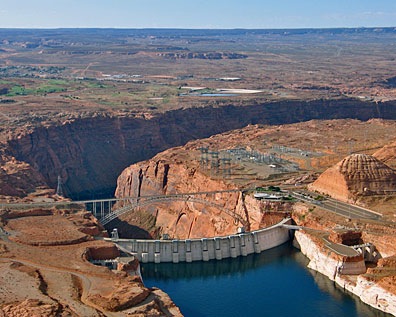 Page is the town built in the late 1950s to house the workers on the Glen Canyon Dam, which was under construction at the time. It sits atop a mesa to the east of the Colorado River. The current population of the town is about 7,000, but it attracts approximately 3 million visitors a year.
The dam was completed in 1963 and water began collecting behind it in what would become Lake Powell. It took 17 years for the lake to reach its high water mark at 3,700 feet elevation. Since then, the water level has fluctuated considerably over the years. As I type this, the water level is at 3,629 feet, a full 71 feet below full pool. Around the water line is a tall white line: the so-called “bathtub ring” that marks the high water line.
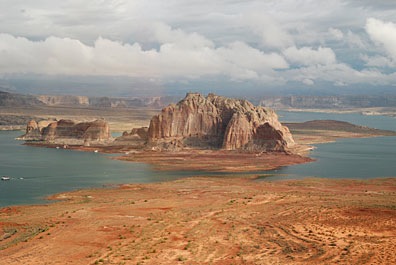 Lake Powell is outrageously beautiful. Its clear, blue water reflects the clear Arizona/Utah sky. Its red rock canyons, buttes, and other formations change throughout the day with the light. Deep, narrow canyons cut into the desert, making mysterious pathways for boaters to explore. When the wind and water is calm, the buttes and canyon walls cast their reflections down on the water. In the rare instances when weather moves in, low clouds add yet another dimension to the scenery.
I love the lake.
Flying at Lake Powell
The best way to see Lake Powell is from the air.
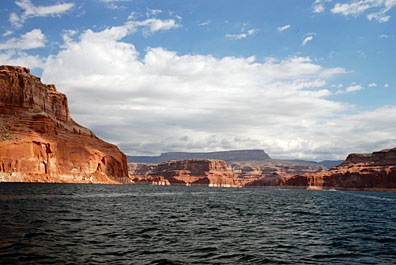 Sure, it’s wonderful by boat — especially by houseboat over 5 to 7 days with a bunch of good friends or family members — but views are limited from the ground and distances take a long time to cover. Let’s face it: the lake’s surface area is 266 square miles (at full pool) and it stretches 186 miles up the Colorado and San Juan Rivers. You could explore the lake by boat for a year and not get a chance to visit each of its 90 water-filled side canyons.
So if you have a plane (or helicopter) or feel like splurging on an airplane tour, you’ll get a special look at the lake that few people see. I highly recommend it.
[Air]Ports of Entry
There are technically four airports along Lake Powell. You can see them all on this pieced-together sectional. (The lake straddles the Las Vegas and Denver charts.)

- Page Municipal (PGA) is the main airport. It’s on east side of the mesa where the City of Page sits, and has two runways. Runway 15/33 is the more commonly used runway; it’s longer. But for strong crosswinds, there’s also 7/25, which does not have a parallel taxiway. There are two FBOs competing for the fuel business (AVFuel and BP). There are tie-downs and a mechanic on the field.
- Bullfrog Basin (U07) is at the Bullfrog Crossing marina. I haven’t landed there (yet), but I’m pretty sure it doesn’t have any facilities. It does, however, have transportation to the marina, where you might be able to get lunch.
- Cal Black Memorial (U96) is 10 miles from Halls Crossing. It’s a nice airport with a good, lighted runway and 24-hour fuel pumped by Maury, who lives there. (Maury’s getting over some surgery as I write this, but I hope he’ll be there if you stop in an visit. Tell him Maria with the red helicopter says hello.) There’s a shuttle to Halls Crossing, where there’s a lodge and boat rentals, during regular business hours.
- Hite (UT03) is near Hite Landing. This is a very scary runway — narrow and perhaps slightly crooked — and it’s marked “hazardous” on charts. The last time I drove through the area in 2005, the Hite marina was high and dry and the area was deserted. It might be a bit more active now that the water level is up a bit.
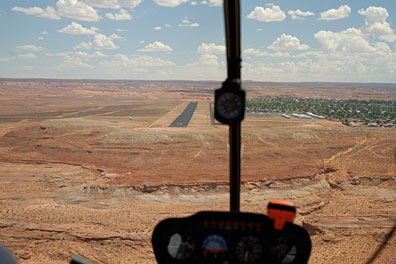 Most people fly into Page, since it’s the only airport near a town. If you come in from the northwest and land on Runway 15, as we are in this photo — well, we’re actually lined up for landing on the taxiway — you’ll make your descent right over the lake, west of Antelope Marina. (The town is all that green stuff to the right.) Taking off on Runway 33 has you shooting out over the edge of the mesa and lake. Pretty dramatic stuff. I have a lot of fun with it since I don’t really “climb out” after takeoff. The airport is at 4316 feet and the lake is currently at 3629 feet, so there’s no reason to gain altitude if I’m just cruising the lake.
Cal Black has the distinction of being the closest fuel to Monument Valley — about 25 miles away, I think. I made quite a few fuel stops there on a 3-day photo job at Monument Valley and even flew in before sunrise one morning. (Scary stuff; there’s nothing else out there.) I don’t know enough about Bullfrog to provide any tips, but I’d recommend staying clear of Hite.
If you’re a helicopter pilot and think you can set down anywhere near the lake or on one of its islands or buttes, think again. Lake Powell is in the Glen Canyon National Recreation Area and off-airport landing is prohibited. If you’re caught doing it, you will get in serious trouble with the National Park Service and the FAA. I don’t think it’s worth it, do you?
Coming Up
In the next three parts of the series, I’ll cover the air tour operations, which all pilots flying in the area should be aware of. Then I’ll tell you about some points of interest on the lake. Finally, I’ll tell you what to expect if you fly uplake, beyond the Confluence of the San Juan.
Meanwhile, your comments are welcome here. I’m especially interested in hearing from pilots who have landed at one of the four airports along the lake. Save your tips about points of interest for Part III or IV.

 So I took the controls, bought everything back up to 102% RPM, and started raising the collective. I’ve done a lot of flying in high density altitude situations, so I know from experience that it takes a certain “touch” to avoid low rotor situations. I pulled the collective up slowly, felt the helicopter get light on its skids, and kept pulling. We were off the ground at 22 inches of manifold pressure, in a nice, steady hover. The engine sounded good, the low rotor RPM horn kept quiet. Keeping in mind that it takes more power to hover than to fly, I was satisfied that I’d be able to take off at our current weight and density altitude situation. I set it back down and we shut down.
 I’d wanted to depart into the wind, using the 6 to 8 mph breeze to help me get through effective translational lift (ETL), which occurs around 24 knot airspeed in an R44. The trouble was, the wind was blowing across the ramp area and a small jet was parked at the edge of the ramp, making a low-level obstruction there. If I hover-taxied over to the taxiway, I could takeoff downhill, but with a quartering tailwind that would not help the situation. Of course, a running takeoff — that’s where you get the helicopter light on its skids and run on the skid shoes until you’re through ETL — would be possible on the taxiway, which was smooth. In the end, I decided to pick it up into a hover and take off with a quartering headwind toward the runway and big empty space beyond its approach end. I’d have pavement under me for at least 200 feet, so I could always slide along it or abort the takeoff with a running landing if I couldn’t get enough lift to clear the fence and the road beyond it. You can see all this in the diagram; we were the red X.
 Mike took this photo from the back seat when we were nearly out of it. It was pretty bright at this point and easy to see that the cloud tops weren’t far above us. It was tempting to punch out through a hole to the top. But I don’t like flying when I can’t see the ground. If the engine quits I want to see my spot right after entering an autorotation — not seconds before we hit the ground.
 All this groping around added an hour to our flight for the day and shifted our flight path to the south. The weather was still iffy with low clouds in the Columbia River Gorge between the Cascade Locks and Hood River. You can get an idea of the situation in this photo of the Bonneville Dam that Mike took when we flew by.