
I spend a day in Quartzsite, AZ with friends.
I know I’ve mentioned Quartzsite more than a few times on these pages. I can’t remember if I explained what Quartzsite is. So I’ll explain here.
Quartzsite, you see, is more of a what than a where. Where is easy: it’s on I-10 about 20 miles east of the Colorado River/California Border. What is more difficult. It’s a town with a population that swells from a summertime low of about 1,000 people to a wintertime high of over 100,000 people. Most of those people show up in January. They show up in RVs and motor homes, they fill the campgrounds and the overflow vehicles park on the BLM land out in the desert.
Why do they come? For the swap meets, rock and art shows, and RV show. The whole town fills with vendors selling everything from dental picks to RV toilet systems. There are tools, clothes, RV equipment, blankets, custom license plate frames, hand trucks, scooters, dried fruit — you name it. All spread out in “shows” throughout the town on what are normally dirt lots. By mid-February much of this is gone. By March, most of it is gone. Any by April, Quartzsite has a ghost town appearance. Things don’t start picking up again until November or December. Talk about seasonal economies!
I’d wanted to spend a week out at Quartzsite, giving helicopter rides. But I was too late to arrange for a landing zone. Besides, when I was out there last week, flying over with Nancy and Bill, I wasn’t very impressed by the size of the crowd. It didn’t seem worth the bother.
But yesterday, when I rode into town in the back seat of John and Lorna’s pickup, I got a different picture. What a difference a week makes! Last year I’d guessed that the biggest week in Quartzsite was the week of the RV show. Yesterday confirmed it. There were at least three times as many RVs parked out in the desert as there had been the week before. I have no idea of where all these people came from, but there’s no denying they were there. In numbers.
After inching our way through traffic in town, we found a good parking space on Kuehn Street, which runs parallel to I-10 on the south side of the highway. That became our base for exploring two of the shows: The RV show, which John and Lorna were anxious to explore, and Tyson Wells, a rock and art show across the street.
Before we hit the shows, however, I scoped out a piece of land I was interested in leasing for the following year. I’d seen it from the air and it seemed like a perfect location for basing helicopter rides. It was 20 acres, but I’d only need an acre or two. There was a For Sale or Lease sign on it with a phone number. I called the number and spoke to what I assume must have been a Realtor. He promised to e-mail me information about the property.
The RV show was packed. Walking inside the huge tent, in fact, often reminded me of the old days, when I shuffled with thousands of other commuters through the Port Authority Bus Terminal to the subway escalator in New York. (Days I don’t miss one bit.) Everyone had something to sell, some line to try on you. I especially admired the cookware sales people, with their tiny stages and ten or so audience seats, repeating, over and over, the well-rehearsed lines that expounded the benefits of their products. Imagine doing that hour after hour, day after day, for ten days? I couldn’t.
It soon became apparent that, at 43 years old, I was the youngest person in the crowd. RVers in January in Quartzsite tend to be retired folks who are escaping from some cold climate. Some of these people will show up in Wickenburg for Gold Rush Days, the town’s annual attempt to capture revenue from seasonal tourists. Later, when we went to Tyson Wells and the Main Event, the average age dropped a bit and I didn’t feel like a young whippersnapper anymore.
One thing John, Lorna, and I agreed on: the prices of some of the RV equipment seemed very high. We talked about the average cost of the rigs people were towing or driving. A fifth wheel rig averaged about $75K while a Class A motor home (the kind you drive) probably averaged around $150K. These people obviously had no qualms about spending money to make themselves more comfortable. That’s probably why there were at least eight satellite television receiver booths, ten generator booths, and countless booths for electric massage devices and drug-free pain relief products.
We picked up a smoked turkey leg to bring home for Mike, then went back to the truck to drop off our purchases. I’d bought a five-pack of micro-fiber towels ($20 inside the tent; $5 outside the tent — I bought outside). John and Lorna had bags of product literature that Lorna said they’d probably never look at. Near the truck, John bought a battery-operated, bug-zapping fly swatter and threw that in the truck, too. Then it was on to Tyson Wells for lunch.
There were a bunch of food vendors at Tyson Wells. We looked around and found Smokin’ Willie’s BBQ. The Smokin’ Willies people had spent about a week at Wickenburg Airport, at my invitation, the year before. It was my lame attempt to find some kind of “restaurant” at the airport. They did well while they were there, but they had other gigs (like Quartzsite) where they could do better, so they left. They remembered me well. John, Lorna, and I ate at their booth.
We walked around Tyson Wells for a while. I bought two 16′ telescoping poles that I could use to hang flags at helicopter ride events. (I still had four red, white, and blue flags I’d bought for the airport but had not included in my asset sale.) John and Lorna bought some ocarinas to give as gifts. I inquired at a booth about an engraved key tag. I’d bought one at Quartzsite years ago for Three-Niner-Lima: a classy leather tag with an engraved metal insert. I wanted the same thing for Zero-Mike-Lima. We were directed to the Main Event, which is where I’d gotten the other one made. So we walked back to the truck, pulled out, and got back into the inching traffic to cross the highway and hit the Main Event.
The Main Event is probably the longest-running show in Quartzsite. By that, I mean it seems to be the first to start and the last to end. We got a good parking space on the east end (the parking gods must have been watching over us that day) and got out to walk. We found the engraving booth right away. The guy remembered me. He no longer made the leather/metal key tags, but he had some other designs. I picked one and requested that he engrave N630ML on it. Then I designed a license plate frame for my Honda that said “My Helicopter is Red, Too!” and paid for my purchases. While I was there, the booth guy and his wife told me that the Main Event was now owned by two different people. The show was Main Event East and Main Event West. Interesting.
We walked around the show and it soon became apparent that the split was quite serious. A big piece of land between the east and west sides had been fenced off and was vacant. This is the same land that had been crammed with vendors the year before. A fence with a gate let people into the west side. There were fewer vendors than I remember and the overall quality of what was offered was a bit lower than the usual low I’d come to expect. Many of the vendors were what I call “garage sale” booths — booths that seem to be selling junk from someone’s garage. But the cactus people were there, along with a few better quality vendors. Among these was the pelt and feather guy (as I call him) from Sedona. I took a moment to call Janet in Colorado and see if she needed any feathers. (Janet is an artist who paints on feathers.) I wound up buying two different kinds of pheasant skins for her. So I got to carry around two dead birds with me for the rest of the day.
We crossed back to the east side and walked around those vendors for a while. We bought some dried fruit and some other odds and ends. Then we went back to the engraving guy and picked up my key tag and license plate frame. Both were perfectly done. I told the engraver that he was an artist and I think that pleased him quite a bit.
We met with John and Lorna’s friends, Steve and Sandy, soon after that. They were camping in BLM land off Dome Rock Road. We chatted at the McDonald’s, eating $1 ice cream sundaes. By the time we went our separate ways, it was about 3:30 PM.
I was beat. I spend too much time sitting on my butt, so when I do a lot of walking, it really wipes me out. But we had one more thing to try to find. Ruben, at Screamers, had asked me to pick up a machete for him. He said you could find them “everywhere” in Quartzsite. I’d been looking all day and hadn’t seen a single one. So on our way out of town, we went to the show he said he’d seen them. I don’t know the name of the show, but it’s on the north side of the highway, at the east intersection with SR 95. The machete was in the first booth we walked into. $4. I bought it. Mission accomplished.
The ride home was long — Quartzsite is about 100 miles west of Wickenburg — but pleasant. For much of the ride, there was a rainbow off to our left, where heavy rain was falling over the Harcuvar Mountains. Centennial Wash would be flowing later in the day. We got back to West Park, where John and Lorna are staying, just after sunset.
It had been a good day and I’d gotten plenty of exercise. I’d need some Ibuprofen to help work out the aches and pains today.
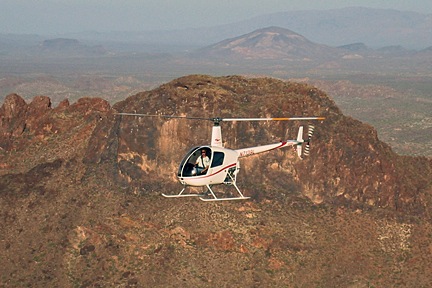 I’ve done this before. Years ago, when I needed photos of my R22 for marketing material, a friend took Mike and a camera up in a Piper Cub. We flew in formation around Vulture Peak. Mike snapped off 50 or so digital photos. I loaded them into my computer, discarded the really bad ones, and cropped the good ones to get what I needed.
 Two years ago, we did the same thing with Tristan’s R44. This time, I flew Mike in my R22. We flew in formation around Vulture Peak until Mike had about 30 pictures. For some reason, the focus wasn’t good on all of them — I think the camera’s autofocus feature was just starting to die at that point — but we had enough good photos for what we needed.
 But Mike did get a few decent photos of my helicopter. One of them was almost perfect. A few of them were pretty funny; Mike managed to cut off various parts of the helicopter in others. Two of the photos didn’t show the helicopter at all. (That might have been when I spotted Jim over my left shoulder and veered away from him.) None of the photos, however, were as good as that first Vulture Peak shoot. In those photos, I’d been looking right at the camera. (That’s because I’d been following the lead, looking at the lead like I was supposed to. On this shoot, I’d been the lead but Jim had lost sight of me and passed me. Seeing him beside me, just after this photo was taken, scared the shit out of me.)
 The photos of Jim’s helicopter weren’t very good at all. Jim had this idea of background firmly entrenched in his mind. So rather than form up with us and let Mike shoot photos with him relatively close, he followed the contours of a cliff face. He must have been a few hundred feet away from the cliff for the entire run. I couldn’t see him because I was ahead of him so I didn’t know how far away he was. He should have been watching me, forming up on me, adjusting his distance accordingly. I don’t know what kind of camera lens he thought we had. Mike claimed that Jim’s helicopter filled “one third to two thirds of the frame,” but Mike was seriously mistaken. In most shots, Jim’s ship is a red, white, and blue speck against the desert. I cropped the hell out of this shot here; it would not be suitable for printing.
 I was a nervous wreck when we finished up and very glad to be done. (My hands were shaking for some time afterward.) We landed and parked side by side on the ramp. Then we wandered over to the terminal to the shade to look at the photos in the camera’s tiny screen. We were both disappointed. I knew I had a few usable shots, but Jim’s were just too small to be of any use.