Another Scammer Looking for Free Content

Business opportunity? Is that what you call it?

A few weeks ago, I received the following e-mail message from someone I didn’t know, with the subject line: “I like your work- Business Opportunity”:

Hi Maria,

My name is [redacted] and I got your contact info from Lynda.com and really like your work especially your blogging content.

I am involved in a start up company that is wanting to change the way entrepreneurs use and get content. We are composing information/articles in a platform for marketing, legal and financing and we are looking for great business content to provide our entrepreneurs. We are looking at several options to pay authors for their content.

One of the reasons I emailed you was because I really like your work and I wanted to engage you in your level of expertise and wondered if you would be willing to answer some brief questions about your work. If you are interested in learning more about this opportunity please email me at [redacted]@gmail.com or call me at [redacted].

Looking forward to hearing from you,

[redacted]

http://www.linkedin.com/in/[redacted]

A few things struck me about this:

  • Apparently the folks at Lynda.com had given this person my contact info. That meant this initial contact had an element of networking to it instead of being just a “cold call” e-mail. (More on this in a moment.)
  • This could be a lead on another good publishing opportunity. As print publishing declines and the beginner-to-intermediate user base I write for shrivels, I’m always looking for new opportunities to write or create content for paying markets.
  • There was no mention of a company name or a Web site name. The person contacted me from a Gmail account. That raised a red flag.

But heck, it was worth a shot. I e-mailed back:

What do you need to know?

Maria

The Questionnaire

The response came quickly:

Maria,

Thanks for the quick reply!

I have prepared these questions for you. If you would rather I called please let me know when you are available or if you would rather feel free to respond to these questions via email.

I know your time is very important so please feel free to be as vague or detailed as you want on the questions. I really appreciate your feedback and I hope when we launch, you will be apart of our expert authors. Any feedback you have regarding these topic would be great. We hope to be able to provide additional revenue streams for authors by breaking down content.

1. Would you be willing to resubmit your articles/book content in a 5 step format or less? And would this be doable for you?

2. What kind of opportunities are out there for you in regards to getting your work out?

3. Who are you currently partnered with right now?

4. How do you typically get your content published?

5. Is this your full time job?

6. What outlets do you seek to get your work published or do they come to you?

7. What products do you have? Do you have any content in any other format? Audio? Video?

8. How do you typically get paid?Is it a flat fee? Would you be interested in getting paid pay per click?

9. Would you be interested in getting an identity in our community and would it be useful for to you have a website on our site that allowed you to sell your work, that could connect to your Facebook and additional products? It would also have a fan reading for you too.

Thank you for your help in advance Maria!

[redacted]

By this time, the red flag was flying high. The questions proved that she knew little or nothing about me or what she was doing. After all, questions 3, 4, 5, and 7 could be answered by a visit to my Bio page. Question 1 clearly indicated that she had no knowledge of copyright and non-compete clauses that appear in standard book and other publishing contracts. Questions 2 and 6 certainly shouldn’t matter to her if she’s really offering me an opportunity. Question 8 told me she was going to try to pay me per click — which is something I’m not interested in, especially from a “startup.” And Question 9 told me (1) she had no idea that I already had two very well-trafficked Web sites, (2) that my publishers sold my work, leaving me to actually create content, (3) that she would attempt to tie me to a Web site her organization operated, and (4) that she’d likely try to sell me products.

But I played along to see where I could take it and whether I could get her to dig herself in any deeper:

I’m a freelance writer and have been since 1990. I’ve written 70+ books and hundreds of articles for dozens of legitimate print publishers (think McGraw-Hill, Macmillan, Random House, and Peachpit Press). My Mac OS X books for Peachpit have been bestsellers since 1999. I also produce audio and video — you’ve seen the video on Lynda.com; I’m working on another title for another publisher now.

You can get all this information and more about me on my Bio page: https://aneclecticmind.com/bio/
You can see a list of all my published work using links on my site, https://aneclecticmind.com/

I don’t have a “full time job.” That’s one of the benefits of being freelance.

I’m definitely NOT interested in getting an “identity” in any “community.” I have an identity and certainly don’t need another one. I’m not the least bit interested in being tied to another Web site. My publishers are doing a pretty good job of selling my work, so I don’t see the need to use another Web site to sell it, too.

If you’re looking for a low-cost content creator, don’t look at me. I get paid very well for my work.

That said, let’s cut to the chase. What did you have in mind?

And maybe you can tell me who YOU are and why you are contacting me through a Gmail account. Doesn’t your company have e-mail?

Maria

As you might imagine, I didn’t get a response.

I contacted the folks at Lynda.com to see if they knew anything about this person. I forwarded them the initial e-mail. They all confirmed what I had begun to suspect: they hadn’t given this person my contact information at all.

So I sent [redacted] a final e-mail message:

It turns out that no one at Lynda.com gave you my contact info. I’ve warned them about you and what appears to me to be some sort of scam. Don’t contact me again.

What Writers Should Take Away from This

There’s a lesson here for writers, including bloggers and other content creators.

There are many “startups” out there in desperate need of fresh content. They’ll make all kinds of promises to get you to submit content to them. They’ll promise ad revenue from the pages on which your content appears, they’ll promise you payment per click on your content, they’ll promise to give you an “identity” and make it easy for your “fans” to find you. They’ll flatter you and tell you they love your work — without even knowing what your work is. Meanwhile, you’ll be required to upload and format your content on their site. You’ll be required to moderate or respond to comments on your content — perhaps even give technical support or answer other questions. Your “business partner” will also likely keep all rights to your work and republish it elsewhere without paying you a dime.

But you think it’s a good idea — they’ve hinted at thousands of hits a day! — so you give it a try. Your work appears on a slick-looking Web site that’s just jam-packed with advertising. But you soon discover that the majority of people visiting the site are the suckers like you — and their clicks don’t count. Your work appears among the drivel spewed out by other writers trying to cash in on a “business opportunity.” You’ve lost the rights to republish your work elsewhere and you’re not making enough to buy lunch once a month.

You think I’m making this up? I’m not. I was suckered in by one of these about five years ago. Sadly, I didn’t blog about it so I can’t remember the name of the company. But I did blog about eZineArticles.com, which is probably the biggest ripoff out there for serious writers. (Publish with them and you never know where your work will end up; mine appeared on porn sites.)

What do they get? Advertising revenue. Or maybe they repackage and sell your content to someone else.

My advice is to avoid any operation like this — even if you’re just starting out. It’s rare that any relationship like this can benefit your career.

A legitimate publisher will pay you for the content you create. Up front, before or at publication. They will accept First Rights or reprint rights or negotiate with you for rights — they won’t take all rights unless they’re paying big bucks for them. Although they might offer bonuses based on content popularity (hits), the revenue will not be completely tied into that. And, for Pete’s sake, they won’t compensate you based solely on clicks or ad revenue.
Dear Census Bureau

Does anyone there know how to think?

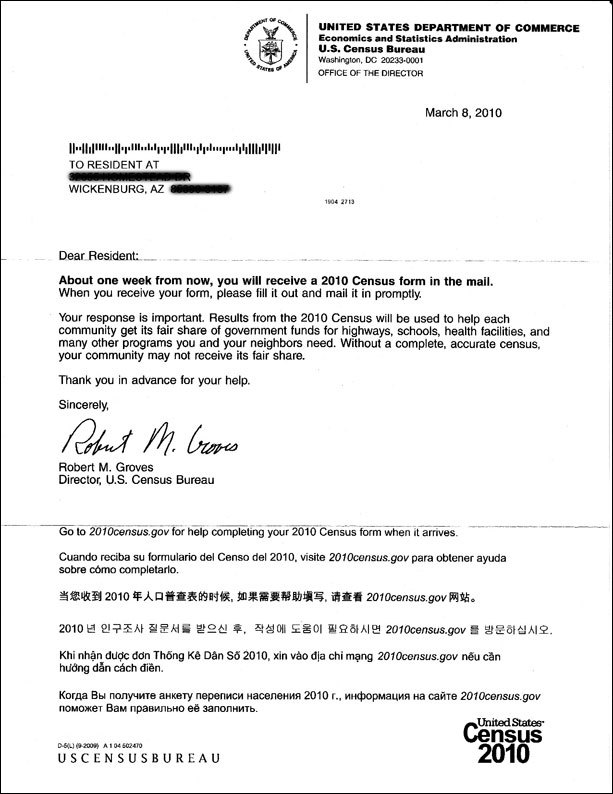
Census LetterMarch 11, 2010

Robert M. Groves
Director, U.S. Census Bureau
United States Department of Commerce
Washington, DC 20233

Dear Mr. Groves,

Thanks so much for your letter of March 8, 2010. It’s interesting to see that the U.S. Government can spend our tax dollars to send mail to millions of people just to let them know that it’s sending them more mail.

While I’m sure this two-punch mass mail campaign will help replenish the ailing U.S. Postal Service’s coffers, have you considered the impact on the ailing U.S. Government’s coffers? Our country currently has a record deficit, yet your office has elected to waste millions of taxpayer dollars on printing, labor, and postage — just to let us know that we’ll receive another costly mailing in a week.

Tell me, will you follow that up with yet a third mailing to make sure we got the second one? Or can we expect a personal visit from a Census Bureau employee to follow up?

Sincerely,
Resident

Some Concerns about Home-Schooling

Is it an excuse to teach religion instead of science?

I’ve always been concerned about the quality of education kids get these days. Underpaid teachers, peer pressure that rewards bad behavior, high drop-out rates. As I reported back in November 2008, kids are graduating the local high school without knowing how to tell time on an analog clock. It’s impossible to have an intelligent conversation with most teens; they seem absolutely clueless about anything that isn’t on television or the Internet — and I’m not talking about PBS or Wikipedia here. They can’t spell because they have spelling checkers that do that for them. They can’t do math without a calculator. While I’m obviously not talking about all young people here — there would be absolutely no hope for America’s future if the problem affected every kid — it’s certainly more than half of the ones I come in contact with.

And “No Child Left Behind” just made the situation worse. It forced teachers and schools to teach just so kids would pass exams. Teaching by rote rather than ensuring that kids understand what they’re being taught is not doing the next generation any good.

These days, concerned parents are taking an active role in their kids’ education. While I personally believe that working together at the end of the day on homework and even just discussing what was learned in school each day is enough, many parents are going the extra step: they’re home-schooling their kids.

I’ll admit that I don’t know much about home-schooling. I don’t have kids; I decided early in life not to take that path. I don’t regret it. I sometimes wonder how my kids would have turned out — whether they’d be smart or lazy or interesting or dull. I’d like to think that they’d know how to tell time by the age of 18 and aspire to something more substantial than stocking shelves at the local supermarket.

I do know that if my kids weren’t getting the education they needed at school and I couldn’t help them by being part of their nightly homework routine, I’d likely consider home-schooling. After all, if you want something done right, sometimes you have to do it yourself.

My neighbor home-schools her kids. She has four of them ranging in age from about 5 to 12. She and her husband are either Evangelical or Born-Again Christians. I don’t know which and I don’t care. The last thing I want to do is have a discussion about religion with people who scratched religious slogans into the wet concrete of their driveway.

And this brings up my concerns about home-schooling. While browsing the news with the Associated Press (AP) mobile application on my BlackBerry (while waiting for a notary public at the bank), I stumbled upon an article titled, “Top home-school texts dismiss Darwin, evolution.” It reported:

“The majority of home-schoolers self-identify as evangelical Christians,” said Ian Slatter, a spokesman for the Home School Legal Defense Association. “Most home-schoolers will definitely have a sort of creationist component to their home-school program.”

It went on to say that, “Two of the best-selling biology textbooks stack the deck against evolution,” according to educators who reviewed the books.

And this is the root of my concerns. I believe that science textbooks and science lessons should be about science. Evolution is a widely accepted component of the science of biology. The alternative — creationism or its disguised alter-ego, “intelligent design” — is not. There is a wealth of scientific evidence to back up evolution; there is no evidence to back up creationism.

Clearly, the failure to teach accepted science as that — accepted science — is a serious shortcoming in the home-schooling textbooks that shoot down evolution. The children being taught that evolution is “only a theory” are being given an inadequate education — one that could put them at a serious disadvantage if they go on to college or attempt to pursue careers in science or medicine.

One of the books doesn’t hide its intent:

“Those who do not believe that the Bible is the inspired, inerrant Word of God will find many points in this book puzzling,” says the introduction to “Biology: Third Edition” from Bob Jones University Press. “This book was not written for them.”

The textbook delivers a religious ultimatum to young readers and parents, warning in its “History of Life” chapter that a “Christian worldview … is the only correct view of reality; anyone who rejects it will not only fail to reach heaven but also fail to see the world as it truly is.”

The Christian worldview is the only correct view of reality? In whose world? I don’t think the millions of Jews, Muslims, or Hindus in the world would agree with that statement. I know the atheists wouldn’t. Does that mean that Christian children should be taught a different version of reality than the rest of the world? To what benefit? Certainly not the benefit of the children.

And what of the home-schooling parents that don’t want religion to be part of their children’s curriculum? The AP article discusses their struggle to find appropriate science textbooks.

Evolution Book(Might I suggest starting with Daniel Loxton’s excellent book, Evolution: How We and All Living Things Came to Be? It’s not a textbook, but it’s a great introduction to evolution for kids and parents.)
So here’s my question: if a school board has to approve textbooks that are used in public school classrooms and home-schooled students have to take and pass standardized exams, who is approving the textbooks used in home-school “classrooms”?

And then I recall this, a piece of “Hate Mail” that was sent to Bobby Henderson of the Church of the Flying Spaghetti Monster. You can find it here, but to save effort for the folks too lazy to click, I’ll repeat it here in all its glory, as an example of home-schooling gone terribly wrong:

wow you people are crazy i pray to my LORD jesus christ that you people wake up God created man in his own image and im sorry but if you look like noodles with meatballs growin out your BUTT you need to go back to SPACE or get back in the pan where you’ll be somebodys dinner!

people will believe anything!!

i am verryyy happy i was well homeschooled becuase i would be in jail for punching a teacher in the face when she tried to tell me about this so called spagetti monsterr!

i hate to be the breaker of bad news but when you look around when u die u wont be with your master meatball you’ll be burning in the pits of HELL and i am a REAL christian and that hurts to know that so many people are gonna be in hell! over a random guy that started a joke and has nothing better to do besides make up some god for fun then see how many people are loving this idea.

God bless you wacked out meatball loving freaks!

-christy

(I recommend Bobby’s site if you’re interested in seeing where reason and faith collide.)

Christy is right about one thing: People will believe anything. But is it right to teach it to their kids?

The Window of Opportunity

Sometimes you just get lucky.

This is a follow-up to the post that appeared here on Friday, “The Tour Operator’s Fly or Don’t Fly Decision.” In that post, I explained why I wasn’t going to take a party of three passengers on a 3+ hour scenic flight in northern Arizona in Thursday’s high winds.

It was a very good decision. We flew on Friday instead. What a difference a day makes! The skies were completely clear and winds seldom topped 10 MPH anywhere on our route.

We had a smooth flight up the Verde River before climbing over the Mogollon Rim west of Payson to Meteor Crater. We passed a herd of buffalo just southwest of the crater and I was able to do a low-level circle around them for the benefit of my passengers.

Here’s a quick video of the Meteor Crater overflight, taken from a camera mounted inside my helicopter’s bubble. Narration was added afterward.

It was a bit bumpy from there to the Grand Falls of the Little Colorado River, which were flowing but not exactly “grand” that day. (We need more snow melt to really get them going.)

This video shows the no-so-grand Grand Falls of the Little Colorado River. Look closely and you’ll see a truck parked along the right rim of the canyon; gives you an idea of scale.

Then south of Flagstaff Airport to Oak Creek Canyon and into Sedona. My passengers had lunch at the airport restaurant while I arranged for fuel and chatted with the folks at the terminal. On the way back, we did a quick flyby of Montezuma’s Castle, climbed up the mountains southwest of Camp Verde, and followed the Agua Fria River to Lake Pleasant. I showed them the ruins atop Indian Mesa and one of my passengers spotted some wild burros, so I swung around to give them all a good look. From there, we returned to our starting point at Scottsdale Airport.

I logged 3.4 hours of flight time in the nicest of conditions. My passengers — and I! — really enjoyed the flight. And it was nice to put a little cash in Flying M Air’s coffers.

On Saturday, the wind kicked up again, although not as bad as it was on Thursday. Then storms moved in. It rained almost all day in the Phoenix area (and Wickenburg) and snowed up north. There were low clouds all day Sunday and even now, as I write this around dawn on Monday, I can see low clouds out my window. (Oddly, I got a call from a Phoenix area concierge asking if I could do a nighttime tour of Phoenix last night; what kind of scenic tour did they expect when you can’t see more than a mile or two in mist? Sheesh.)

Of course, all this rain is very unusual for Arizona. We’ve had more rain in the first two months of this year than we did all 12 months of last year.

In general, I consider myself (and my passengers) lucky to have slipped into that narrow window of opportunity for such a long flight. It worked out great for all of us.

The Tour Operator's Fly or Don't Fly Decision

It should be about client experience, shouldn’t it?

Yesterday, like all other days I’m scheduled to fly, I faced a pilot’s usual weather-related fly/don’t fly decision. While the weather in Arizona is usually so good that flying is possible just about every day of the year, yesterday’s weather forecast was different. It required me to make a real decision.

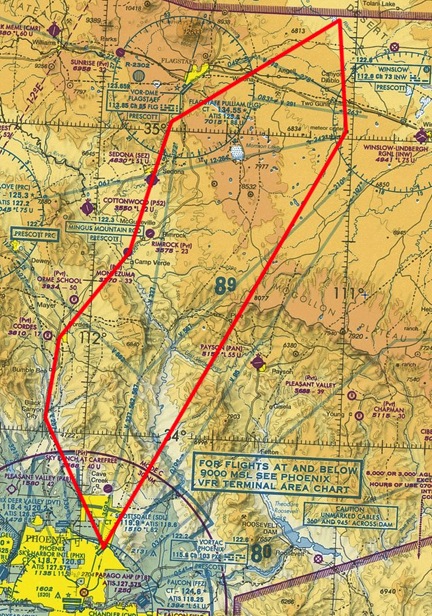
SDL to Meteor Crater

As this marked-up WAC shows, the most direct route I’d take for this flight has us spending extended periods of time at high elevation over mountains.

I was scheduled to do a custom tour of Meteor Crater and the Grand Falls of the Little Colorado River in northern Arizona with a lunch stop on the return trip in Sedona. The total flight time would be about three hours, with much of it conducted over mountainous or high altitude (or both) terrain.

The Weather

I’d been watching the weather forecasts for Winslow (east of the Crater), Flagstaff (between the Grand Falls and Sedona), and Sedona for a few days. Earlier in the week, there had been a 10% chance of snow in the Flagstaff area. That wasn’t worrying me much. What did worry me was the wind forecast: 20 mph plus gusts. That would make for an uncomfortable and possibly very unpleasant flight.

On the morning of the flight, the weather forecast had taken a turn for the worse. According to NOAA what I was looking at for the places we’d fly over:

Phoenix: Sunny, with a high near 64. Breezy, with a south southwest wind between 7 and 17 mph, with gusts as high as 28 mph.

Sedona: A 10 percent chance of showers after 11am. Partly cloudy, with a high near 58. South wind 6 to 9 mph increasing to between 18 and 21 mph. Winds could gust as high as 33 mph.

Flagstaff: A 30 percent chance of snow showers after 11am. Partly cloudy, with a high near 43. Breezy, with a southwest wind 8 to 11 mph increasing to between 20 and 23 mph. Winds could gust as high as 37 mph. Total daytime snow accumulation of less than a half inch possible.

Winslow: Sunny, with a high near 58. Breezy, with a south wind 8 to 11 mph increasing to between 25 and 28 mph. Winds could gust as high as 44 mph.

To be fair, we weren’t actually flying to Winslow. But we’d be about 20 miles to the west, on the same big, flat, windswept plateau.

But if that wasn’t bad enough, there was also a Hazardous Weather Outlook for entire area:

A VIGOROUS PACIFIC LOW WILL BRUSH NORTHERN ARIZONA BRINGING SOUTHWEST WINDS OF 15 TO 25 MPH WITH LOCAL GUST TO NEAR 40 MPH AND COOLER TEMPERATURES. IN ADDITION…PARTLY TO MOSTLY CLOUDY SKIES WILL SPREAD ACROSS THE AREA WITH SCATTERED SHOWERS DEVELOPING FROM ABOUT FLAGSTAFF NORTHWARD TO THE ARIZONA…UTAH BORDER. THE SNOW LEVEL WILL RANGE FROM 4000 TO 5000 FEET BY THIS AFTERNOON

Flagstaff is at 7000 feet.

I know from 2,300 hours experience flying helicopters all over the southwest that when the winds get above 20 mph and you’re flying over mountainous terrain, you’re in for a rough ride. A 15 mph gust spread in the mountains can make you feel as if you’re riding a bull at a rodeo.

And a 10% to 30% chance of rain or show showers didn’t make the situation any better. I’ve been in snow showers in the Sedona area that cut visibility to less than a mile in localized areas. Not very scenic.

The Decision

There are three ways I could make the decision:

  • Do I have to go? The simple truth is that if I had to make the flight — for example, if it were a matter of life and death — I could. I’ve flown in high winds before and although it caused white knuckles and a lot of in-flight stress, it was doable. But this was not a “must go” situation.
  • If paying passengers weren’t involved, would I go? The answer to this one was no, I wouldn’t. If this were a personal pleasure flight, I simply wouldn’t make the trip that day. I don’t take much pleasure in a rodeo ride 500-1000 feet off the ground.
  • Would passengers enjoy the trip? I’d guess the answer would be no. I fact, I’d expect the passengers to actually experience fear at least once during the flight. Turbulence are scary, especially when you seldom experience them — or have never experienced them in a small aircraft.

So the decision was actually quite simple: I would call the client and advise that we not make the trip that day. I could offer a tour of Phoenix (relatively flat, a shorter flight, much lighter winds) or the same trip the next day when the weather was expected to be much better.

I’m Selling an Experience

This is what separates me from the tour operator I worked for at the Grand Canyon back in 2004. In the spring, we routinely flew in winds up to 50 miles per hour, with fights that were so bumpy that even I, as the pilot, was starting to get sick. (Puking passengers was a daily occurrence.) Keeping in mind that we did “scenic” flights, near the end of the season, we occasionally flew in conditions with minimal visibility due to thunderstorm activity and smoke from forest fires (planned and unplanned). After one flight, when the visibility was so bad that I had trouble finding my way back to the airport, I asked the Chief Pilot why we were flying. After all, the passengers couldn’t see any more than I could. His response was, “If they’re willing to pay, we’re willing to fly.”

I don’t have this same attitude. My passengers are paying me for a pleasant, scenic tour. While I can’t control the weather, I can control when we fly. If I suspect that the weather will make the trip significantly unpleasant — or possibly scare the bejesus out of them — how can I, in good conscience, sell them the flight?

I’m not saying that I won’t fly in less than perfect conditions, but if the conditions are downright horrible for flight, why should I subject my passengers — or myself — to those conditions?

I called the passenger and explained the situation. He consulted his wife. They agreed to do the flight the next day. He seemed happy that I’d called and given him the choice.

I’m sure we’ll all have a great time.