Now this is a third-party candidate that makes sense for America.
Thank to Jim Wright of Stonekettle Station for sharing a link to this great video on YouTube. Really gives you some food for thought, eh?

Now this is a third-party candidate that makes sense for America.
Thank to Jim Wright of Stonekettle Station for sharing a link to this great video on YouTube. Really gives you some food for thought, eh?
I summarize how I see the growth of ebook publishing — and what it means to me.
I’ve been writing traditional print books since 1990 — that’s just over 20 years. In that 20 years, I’ve seen massive growth and changes in the publishing industry. But none of the changes I’ve witnessed were as dramatic as those I’ve seen in the past four years.
I got in on the ground floor of the computer how-to book field in 1990. When I started, it soon became obvious that if I wanted to make a living as a writer, I’d have to write a lot of books. (You see, contrary to popular belief, most authors do not make a lot of money writing.) So I buckled down and started churning them out as fast as I got contracts. For years, I wrote or revised an average of two to six books annually. I clearly remember the day I received six book contracts at once; soon after that, I put out ten titles in one year.
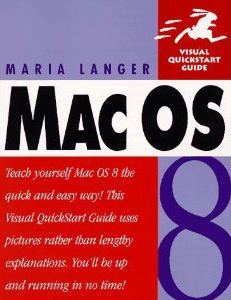
My first bestseller, published in 1997.
It was the advance money that paid the bills. In the beginning, I supplemented that with consulting and classroom training income from hourly or per diem contract work. In 1997, I wrote my first bestseller and, amazingly, in 1998, I wrote another. Revisions on those two books — as well as the new and other revised titles I churned out — earned me a good income and a secure position as a computer how-to book author.
But just as my career took off, so did the Internet. By around 2005, the Internet was offering a lot of free — although often not very complete or well-written — information about how to use computers. Just the the kind of content I was writing — although I like to think I was doing a better job of it. Quality didn’t matter on the Internet; convenience did. If you were working with Excel and needed to perform a task you didn’t know how to do, would you drop everything, run out to a bookstore, and buy a book? Or just do an online search for the information and hope for the best? And why pay for a huge hunk of information when you can get just the information you need for free?
As more and more computer-related content came online, the demand for my books — and I can only assume the books of other authors like me — began to decline. Titles that I’d been revising with every new version of software released were allowed to die, unrevised. The last version of Word I wrote about was 2004; the last version of Excel was 2007. The surviving titles earned out their advance, but often just barely. And with publishers putting out fewer and fewer titles, it was no longer possible to fill in the revenue gap by simply writing more books. There weren’t enough new titles to go around.
Of course, while all this was happening, ebooks began to emerge as a real challenger to traditional print publishing. Although ebook readers had been around for a while, it was the Kindle and iPad that put ebooks on the map. But even before this, people had begun reading books in PDF and even HTML format on their computers.
I saw this trend and wanted to jump on board. Maybe it’s because I was simply enthralled by the technology and the idea of being able to travel so easily with books. Or maybe I’d seen the writing on the wall, a sort of foreshadowing of the death of print publishing.
I think it was in January 2008 that I traveled to Macworld Expo in San Francisco and met with my publisher. It was a lunch meeting with two editors and the person in charge of their ebook distribution method. At the time, their ebook publishing consisted of taking specially formatted PDF versions of books and making them available as heavily DRM (digital rights management) protected PDFs and online-accessible files. Their solution introduced several problems:
Needless to say, the ebook versions of my books — and the books of all the other authors I’d spoken to — were selling very poorly. I felt that a change needed to be made. I felt that my publisher — a company that had been started by a man with a vision — was bogged down by old technology, old ideas, and fear. They were trying to use print concepts to publish electronically and were paranoid about piracy.
So at that lunch meeting, I introduced my solution. It had several components:
To help make my point, I actually prepared a chapter of my existing book as a PDF in the format I imagined. I showed it to my lunch companions on my MacBook Pro. There was no need to scroll; every page was complete and filled the screen. Every word was perfectly legible onscreen. The screenshots looked great. And clickable links led to cross-referenced content. Best of all, I was able to create this version of the book in a few hours of layout work in InDesign, once I’d come up with a good template.
Sounds like I should have sold them on it, right?
Wrong. Although the once small and innovative company had been started by a man with a vision, it was now part of a huge, slow-moving (think plant-eating dinosaur) publishing conglomerate. They weren’t interested in new ideas or new ways of doing things. All they apparently wanted was to cling to the same old print publishing standards and ideas that they’d been using for decades.
In my mind, it was like continuing to rely on monks as scribes after the introduction of moveable type.
Maybe, in the back of management’s minds, they were hoping their failure to make ebooks palatable to readers would cause the whole ebook concept to fail. After all, people had been talking about ebooks for years and there were more than a few failed ebook devices. Maybe this new trend would go the way of the others and they could sink back into the oblivion on their old ways without another thought about this newfangled ebook idea.
They apparently didn’t foresee the Kindle, NOOK, or iPad.
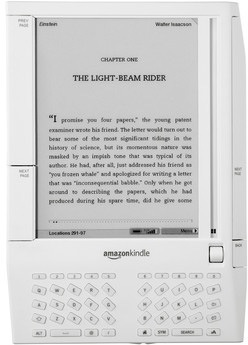 First Generation Kindle
The Amazon Kindle was first released in November 2007. It wasn’t a very impressive device. Small, awkward, and only able to display 16 shades of gray, I found it completely unappealing. Just another entry into the ebook device market.
Fortunately for Amazon, there were plenty of people more impressed than I was and they sold enough of them to keep developing newer, more impressive models. Today’s Kindle Fire is almost a tablet computer, making it a huge leap forward from that original clunky device.
But what Amazon really got right — and what I think supercharged the ebook publishing movement — is that it:
So Amazon set the stage with Kindle books. Kindle owners and ebook enthusiasts — people like me interested in the portability of ebook format — stepped up to purchase Kindle books. When it looked as if ebooks might actually thrive this time around, other organizations took notice. In addition to a new crop of ebook readers by personal electronics makers, Barnes & Noble released the NOOK and Apple developed the iPad’s ebook reader platform, iBooks.
On May 19, 2011, Amazon.com, the biggest bookseller in the world, announced that it was now selling more ebooks than print books.
To the dinosaurs of print publishing, this must have looked a bit like a meteor coming out of the sky.
While the statistics seem pretty solid and do exclude free ebooks (as they should), they likely do include the huge number of extremely cheap ebooks — those selling for 99¢ or even less. This is throwaway money — the kind of money some people spend without thinking about. I think this lessens the impact of the announcement. After all, “real” publishers aren’t going to sell anything for 99¢. Indeed, it’s difficult to get them to release a book at Amazon’s preferred price point of $9.99.
But what does the announcement tell us about ebook publishing? It tells me that ebooks have a large, viable market. And as technology moves forward, that market will grow. (After all, how many books are being hand-copied by scribes these days?)
Sadly it doesn’t seem as if my print publishers are interested in making the most of this development in ebook publishing. They continue to sell my books in a variety of PDF-based formats — including that online format they were using years ago. While some titles are available in the Kindle (Amazon) and iBooks (Apple iTunes) stores, the series I write doesn’t translate well to those formats. The resulting reading experience is disappointing, to say the least. Books are selling better, but certainly not good enough to have much hope for the future with existing author/publisher relationships.
Yet as a writer, I’m embracing the ebook revolution.
Like other writers, I see ebooks as a way to get my original content out to readers quickly and easily — without being at the mercy of decision-makers within huge publishing organizations.
But unlike most other writers, I have the benefit of experience at not only writing and editing, but publishing. For years, I’ve been writing and laying out my own books — books that, for the most part, are very lightly edited or revised by my publishers before they appear in print. I know how to write cover copy, how to assign ISBNs, how to register copyright. I know how to market my work. I can publish professionally produced content because — let’s face it — I’m a professional writer.
 The first book in the new Maria’s Guides series.
So I’ve begun publishing my own series of books computer how-to books, Maria’s Guides, which utilizes ebook publishing formats as well as print on demand for people who still want books in print. The first title, Making Movies: A Guide for Serious Amateurs, was published in October 2011 and the second title (to be announced) will be available shortly.
The design and execution of this series is based, in part, on my proposal to my print publisher years ago:
I see this as a way of supporting existing readers of my work by updating the content found in books my publishers have elected not to revise. I also see it as a way of attracting new readers interested in learning the the things they need to know without spending a lot of time digging through online resources that may or may not address their questions.
You can learn more about Maria’s Guides on the Maria’s Guides website. Right now, this site provides support for all of my books, but I’m likely to move support for my other titles to another website later this year.
I’d love to know what you think about the ebook (r)evolution and the opportunities it presents to writers. Share your comments on this post. Let’s get a discussion going.
Just a quick post after an unusual photo flight.
 I did a “first light” photo flight this morning. The client: me.
I needed a bunch of photographs that could clearly illustrate how a change altitude affects the perspective of an aerial photo scene. So I armed my helicopter with a battery of GoPro cameras, set them up to snap an image every 2 seconds, and went flying at dawn.
For about 90 minutes.
On the way back, I spotted a number of hot air balloons in the sky northeast of Deer Valley Airport. This isn’t anything unusual; the balloons are up every morning for the first hour or two of the day. But what was unusual is my attempt to capture images of the balloons.
Instead of satisfying myself with the usual fly by images, this time, I climbed to about 1,000 feet AGL, pointed the helicopter southwest toward the balloons, and brought it into a hover. And held it there for about a minute.
While I was hovering there, facing the balloons, I got a weird feeling, as if I were a bird trying to join a flock. I could imitate their motion (or apparent lack thereof), but I wasn’t one of them.
Anyway, this is one of the shots I captured, cropped for better presentation. As you can see, there was one balloon at a higher altitude but most of the others were lower. Can you see them all in this shot? I count seven.
I couldn’t do anything about the distance. The GoPro cameras have a wide angle lens, making everything seem farther away than it really is. If I got any closer, the folks in the closest balloon — which was also the one higher than me — may have freaked out. (If you think airplane pilots hate helicopters, you should talk to a balloon pilot one day.)
This isn’t, by far, the best photo shot this morning. But it’s the one I thought of from the moment I lowered the helicopter’s collective to descend back toward Deer Valley until the moment I first viewed it on my computer.
I really do need to spend some time in a balloon soon.
…or why I love my work as an aerial photography pilot.
Regular readers know that one of my jobs is as a helicopter pilot. Sure, my little company offers tours and day trips from Phoenix in the winter and dries cherries in Washington State in the summer, but my favorite kind of flying is for aerial photography.
To me, there’s nothing more rewarding than being a pilot for a talented still or video aerial photographer. These are the people who not only understand basic photographic concepts such as light and composition and exposure, but who also know what a helicopter can do and how they can use it as a tool to get amazing images of the world around us.
In August 2010, I had the privilege of working again with Mike Reyfman, a regular client, over Lake Powell in northern Arizona/southern Utah. He was there for the AirPano Project, capturing images that would become interactive 360° aerial panoramas, as well as still photos around the lake.
He emailed me yesterday to let me know that the Lake Powell Panoramas had finally been put online. There are four of them, including one shot over Reflection Canyon (see screen grab below). Each image is interactive, drag in the image to pan and zoom. You can click on the helicopter icons to switch from one viewpoint to the next. Here’s where you can find them.

Aerial photo work is challenging, especially with a demanding photographer on board who knows exactly what he wants. Mike is one of those photographers. Not only does he know what time of day he wants to shoot, but he provides instructions regarding shooting location, direction, and altitude. For the panoramic shots, I need to get into an out of ground effect hover, sometimes as high as 3,000 feet above the ground, and hold it there for 5 minutes or more. This isn’t easy in my little R44, especially in windy conditions.
But it’s worth it, as Mike’s panoramic images and other shots prove.
I find it especially rewarding work, though. Although I didn’t create the incredible images the photographers on board make, I feel that I was instrumental in making those images possible. After all, my helicopter and I were part of the photographer’s equipment — almost like a tripod. Surely to say that the image would not exist without us isn’t too far from the truth.
And so despite the challenges and the relative dangers, I love flying aerial photographers. And I love seeing the work they create when they fly with me.
How do you want your online history to read?
Today, I unfriended someone on Facebook.
I’d realized, rather belatedly, that about 90% of what this person shared on Facebook consisted of cat photos or videos. I like cats, but not enough to wade through dozens of photos shared in big batches on Facebook every day.
(Maybe other people do like cats that much. Maybe there are people whose sole purpose in using Facebook is to maximize the number of cat pictures they see every day. I am not one of these people.)
She’s not the first of my Facebook friends to share a never-ending stream of content that simply doesn’t interest me. Normally, if I know a Facebook “friend” in real (as opposed to virtual) life, I’ll retain the friendship status but simply stop subscribing to her content. This enables her to keep reading my content (if she wants to), comment on it, and keep in touch via other Facebook features — wall, messaging, etc.
But this person wasn’t really a friend to begin with — just someone I met on Twitter. And with the introduction of Facebook’s Timeline feature, I realized that Facebook is morphing into something new and different where an endless stream of cat photos seems downright idiotic.
The Timeline feature puts every update, photo, event, and detail in your life that you’ve shared on Facebook into a reverse chronologically displayed listing. Here’s what mine looks like today:

At the top of your profile page is a “cover photo” and your profile picture. Beneath that is information about you, your work, and your relationships. After a box containing a few of your friends, you’ll find every single item you’ve ever posted to Facebook.
Let me say that again: every single item you’ve ever posted to Facebook.
Including all the cat photos.
To make it easier for someone to zero in on a particular date, they can drag a slider on the right side of the page. So if you’ve been posting on Facebook for a few years, people can go back in time to see the Halloween party photo when you dressed up like a hooker or your rant about your old boss or the details about the honeymoon cruise with your ex-husband. Intermingled with this stuff is details about your new jobs, vacations, check ins, and other life events you thought (at the time, anyway) were important enough to share with “friends” — or the public at large — on Facebook.
Have you seen the Timeline feature in action yet? If you haven’t, check it out. Be sure to check out yours, too. Even if it isn’t displayed now, it will be in the future.
And that brings me back to the reason I wrote this post. With your Facebook history so easily accessible — possibly to the general public (which is Facebook’s default setting for updates) — people can get a real idea of what you’re all about now and in the past. If you care at all about what people think of you, you probably want to examine your Timeline and make sure it shows only what you want to show — and only to the people you want to see it.
If you think you’re revealing a bit more than you want to in your Facebook Timeline, there are a few things you can do, some of which I discuss in detail in a Maria’s Guides post.
Of course, the best way to limit what people see or know about you is to be more discriminating about what you post. Do you really need to share every intimate detail of your life? Every link to Web content you read? Every photo you take with your smartphone? Every other Facebook update you read that you find mildly interesting or amusing?
Every freaking cat picture?
On Facebook, you are what you post — and Facebook has a very long memory.