I get a job but no experience.
In February, I got my first contract for a frost-control job in the Sacramento Valley of California. It was a 60-day contract and it only recently ended.
Frost control work is similar to cherry drying, but the contract — at least my contract — was very different. And this year, it offered no opportunity to fly and very little profit.
The Goal

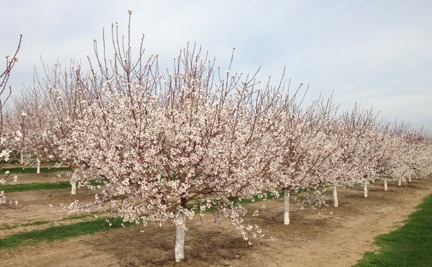
These almond trees in one of my orchards are in full bloom. As you can see, they’re quite beautiful — especially when you see hundreds of acres of them. The contract starts right around this time.
The goal of frost control flying is to grab the warm air above the orchard in thermal inversion situations and suck it down into the trees. My client tells me that you can only do this for about 3 hours before the warm air is depleted.
As the almonds (or walnuts, if you’re doing them) are forming, they’re gelatinous and very susceptible to damage from frost. Each degree below 30° can knock off a significant percentage of the crop. This is serious business — serious enough to have enough helicopters on hand to protect the developing nuts.
My client hired 17 helicopters of various makes and models to protect its orchards this season. I was just one of them, positioned in Woodland, CA.
About the Flying
Like cherry drying, which I’ve done every summer for the past five seasons and hope to do again this summer (if I ever get out of Arizona), frost requires you to fly low-level over trees. But there are a few major differences:
- Frost control flying is usually done at night. This means flying in the dark, although a flight could last until just after dawn. Let’s face it: cold weather comes at night, with the coldest weather just before dawn. (More on that in a moment.)
- Frost control flying is usually done higher than cherry drying. My client told me approximately where he wanted me to fly, but also said that I needed to check my outside air temperature (OAT) gauge to make sure I was in the warmer air above the trees. This means anywhere from 20 to 50 feet off the ground.
- Frost control flying is usually done faster than cherry drying. Again, my client advised me to operate at a speed of about 20 to 30 miles per hour. That’s right at ETL in my ship, which would make for an interesting flight. (I can’t remember any prolonged flying right at ETL.)
And if you’re a helicopter pilot, you probably realize that this altitude and airspeed combination still puts the aircraft right, smack dab in the middle of the deadman’s curve.
Flying in the Dark
But flying in the deadman’s curve doesn’t really bother me. I’m used to it. What does bother me, however, is flying in the dark.
Note that I didn’t say flying at night. I said flying in the dark. There’s a difference.
First of all, you need to understand that these orchards are in farm country. Some of them are huge, stretching across a section (square mile) of land. The only things in the orchard are usually the trees. Trees don’t need lights at night so there aren’t any. So the orchards are naturally dark at night.
When there’s any kind of moon, it really isn’t that dark. In fact, when the trees are in bloom and there’s a moon, you can see the trees from quite a distance up. It’s actually quite beautiful when there’s enough moonlight to see them.
But when there’s no moon — which is basically more than half the month (considering that flight is normally conducted between the hours of 3 AM to 7 AM) — everything is dark. Pitch black dark. And that’s where the real challenge is.
You see, the entire area is criss-crossed with power lines — the big “Bonnevilles” and smaller lines going to homes and shops. If you’re lucky enough to not have wires in your orchards — which I was — you still have to worry about the wires on the way to your orchard. So you’re flying at least 500 feet up to avoid the possibility of hitting wires.
You use a GPS to get to your orchard. When you think you’re right over it, you look down and, if there’s no moon, you don’t see anything except a black hole. You wonder whether the coordinates are for the center of the orchard or one corner. If a corner, which one? And how close are you really to those coordinates? You’re wondering this while you’re flying over the orchard, knowing you have to get way down there, just over the trees that you can’t see, and knowing that if you’re not where you think you might be, you could also be over or near wires you can’t see and you might descend down into them.
Even if you know exactly where you are, you can’t simply descend straight down into the orchard from 500 feet above it. Doing so would put you in serious risk of settling with power. So you have to spiral down into it, making sure that you’re remaining clear of wires that could be in the area. With luck, you’ll see the trees before you hit them.
My Test Runs
Before actually flying a mission, a friend and I went out on a test run with me at the controls. We looked for one of my orchards that I knew had wires along one edge, Bonnevilles nearby, and a huge unlighted windmill less than a mile away. I went to the coordinates and looked down. There was moonlight and I thought I could see a patch of trees. I began my spiraling descent and doubt creeped into my mind. Were those trees? The shape wasn’t right. I realized that I was looking at a small lake near the orchard and couldn’t remember where it was in relation to the orchard. I realized that the windmill was near the lake. Knowing that I wasn’t where I thought I was, I aborted the descent. My friend was with me on that decision.
We tried my other orchard, which had a more regular shape. I got into position over it and began my descent. I could see the flowers on the trees in the moonlight. But when I got within 100 feet of them, my landing light flashed on wires where I didn’t think there were any. Was I over the right orchard? If I wasn’t, I had no idea where wires could be. Again, I aborted the descent.
I was seriously concerned about my ability to get the job done. My friend was even worse, suggesting that it wasn’t possible without lighting from the ground. When I pointed out that other pilots had been doing it for years, he couldn’t argue.

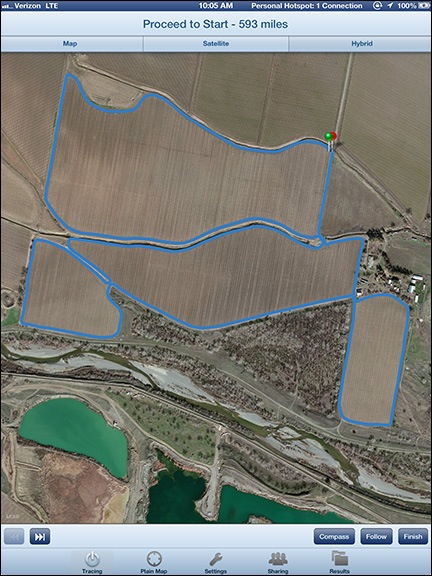
One of my orchards consisted of four separate irregularly shaped fields. There were wires along the northeast side, running to the house. Note the ponds to the south; the windmill is southwest of the orchard, out of the image.
The next day, I downloaded an app called Trail Tracker for my iPad. This app creates a track log as you travel. I drove out to each of the orchards, turned the app on, and drove around the entire orchard. This created a blue track line that surrounded the orchard.
Later that day, I hopped into the helicopter with the iPad mounted in it stand. I then flew out to the orchards, one at a time, with the tracking software displaying the orchard’s outline. A GPS marker indicated my position on the map, although there was a bit of a time lag. I was able to see on the iPad where I was in relation to the orchard.
The next night, we went out again. This time, my friend flew his helicopter and I was a passenger. We flew out to my odd-shaped orchard first and were able to successfully descend down over the trees while knowing exactly where we were in the dark. While we were in flight, I also noted nearby lights that would give me visual references at night — the farmhouse on the east side was a good source of light and there was another at a shop up the road to the orchard (not shown in this image). We also flew all the way up to Williams to check out my friend’s orchards. We were able to find them and descend over the trees. He made a note of lights in the area, too.
So by approaching it with more information, we were able to get a bit more comfortable about the task we’d be called to perform.
But did I like it? Hell no! As I told another friend after I returned home the next day, this would be some of the most dangerous flying I’d ever do. I was not looking forward to it at all.
About My Contract
Unfortunately, my frost control contract was very different from a cherry drying contract. Although the helicopter was required to be onsite for the duration of the contract, I was not. I could go on with the day-to-day living of my life with two exceptions:
- I couldn’t fly my helicopter because it was positioned in California. This made it impossible to accept flying jobs anywhere else. And since I didn’t advertise my availability where the helicopter was based in California, I didn’t book any flying work for the duration of the contract.
- I could be called at any time to get on active standby. Once called, I’d pretty much have to drop everything and head out to California to prep the helicopter and wait until I was launched.
Because I wasn’t required to be with the helicopter, the standby money was considerably less than I’d get with a cherry drying contract. Like 25% of that amount. Ouch. I actually couldn’t afford to stay with the helicopter. My living expenses would be too high.
The contract did, however, provide additional revenue when I was called out and when I was on active standby. I was called out for two consecutive days. The callout and standby fees easily covered the cost of hopping on a Southwest Airlines flight from Phoenix to Sacramento and hanging around for two days.
But the temperatures never got low enough to launch me. I was there with the helicopter, the helicopter was fueled and ready to fly, but I didn’t need to fly.
That was early in the contract. I wasn’t called out again.
Later, my client told me that it was the warmest spring he’d ever been through.

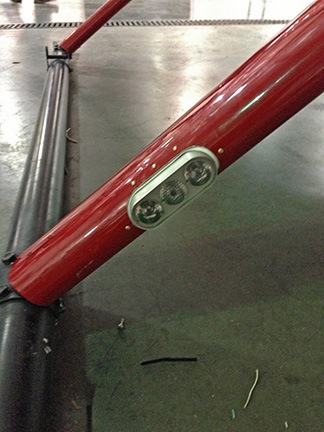
Devore Aviation’s Forward Facing Recognition Floodlight System consists of LED lights mounted on the two front skid legs. The lights and installation were very costly, but I might get some use out of them during cherry season.
In all, it was a break-even gig for me. The standby money covered the cost of getting special lights installed on the helicopter and repositioning the helicopter to California and back to base. The callout and standby fees covered my living expenses for the few days I was in Woodland with the helicopter.
Would I Do It Again?
In all honesty, I’m not sure I’d do this again.
I certainly would not do it again with the same contract in place. I’d much prefer a contract more similar to a cherry drying contract with higher standby fees, even if the contract required me to stay in Woodland for the entire contract term. Woodland is a nice little farm town very close to Sacramento and not far from Sonoma Valley; I think I’d really enjoy spending two months there — especially with the days free to do what I like.
But it really all depends upon the demand for my services in the Wenatchee area, where I’ll be living as soon as I can get out of Arizona. While cherry drying season doesn’t usually start for me until June, I might be able to get other flying work if I were in Washington with the aircraft before then.
It’s a decision I’ll have to make next year.

 To say I’ve been doing a lot of traveling this past year would be to make a huge understatement. I’ve been on more than 20 airline legs since September and expect to be on at least a few more before I finally settle down in my new Washington home.