A Christmas Ski Trip, Day 1: The Road Trip

There’s nothing like a good little road trip.

(This story starts with a Prelude.)

I watched the weather pretty closely during the week leading up to my trip. We had some freezing rain here and I know they had some sort of weather up around Winthrop. But since I couldn’t change my plans, it didn’t really matter. I decided to bring all my gear — skis, snowshoes, winter hiking boots — so I’d be prepared for anything.

Packing Up, Moving Out

I packed the morning of the trip. There was no rush. I figured I’d leave by 10 AM and since I was up by 7 AM, I had plenty of time to pack.

I remember thinking to myself: I’m on vacation!

I tried to keep packing simple. Really. One bag for my clothes and a laptop. One bag for food, including snacks, a bottle of wine, and Penny’s dog food. Then the odds and ends: Penny’s dog bed, my skis, my ski boots, ski poles, my hiking boots, my snowshoes, my emergency road kit (jumper cables, blanket, water, etc.). I had to stop off at my shed to get my ski stuff and I almost forgot the boots. I also retrieved my daypack from my RV; I’d be using that to carry Penny around on the trails if the snow was too deep for her to walk in.

By the time we were ready to go, the Jeep’s back seat was full. I put Penny on her bed in the front passenger seat, locked up the house, and we hit the road.

It was 9 AM.

I wasn’t in a hurry so I made stops along the way. Caffe Mela for breakfast. (Not the best choice unless your idea of breakfast is a pastry. They do make an excellent eggnog latte, though.) Safeway to pick up a package of bakery cookies for a friend and his coworkers. Stemilt’s Bountiful Fruit store, where I bought 3 apples for the trip, including a 1.15-pound Honeycrisp. (Seriously: where else could you find an apple that big?)

I cut up one of the apples in the Jeep in the parking lot and munched on it as I continued north up route 97A. One more stop at Entiat to visit a friend who had to work that day. I brought the cookies into the construction office where he was overseeing a big park remodeling job. The guys were working on a rock retaining wall down by the river and he was there to inspect the work. The cookies were for him and his co-workers. I spent some time chatting with him and looking at the huge batch of blueprints for the park. Then, after a good Christmas hug, Penny and I hit the road, continuing up 97A.

The Photo Stops

The weather in Wenatchee had been clear with temperatures in the high 20s or possibly low 30s. But as I drove up the west side of the river, I saw low clouds up ahead. That’s a weather phenomena that’s pretty common here in the winter: fog. As the road climbed up toward the tunnel that would lead away from the river and toward Chelan, I stopped for a photo.
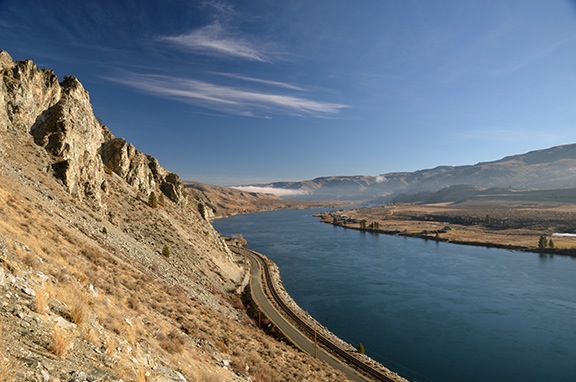
Up River Fog
As I climbed away from the river, I could see a fog bank off in the distance.
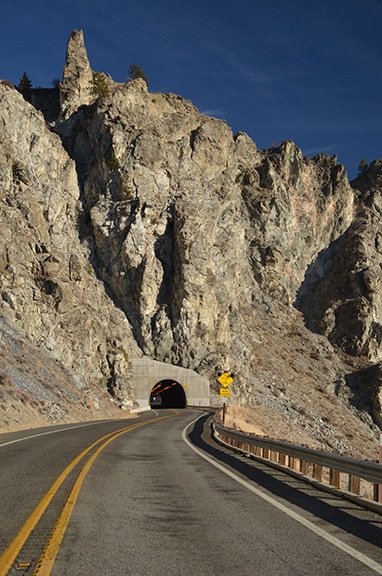
Tunnel to Chelan
Route 97A passes through this tunnel on the way to Lake Chelan.

I passed through the tunnel and into the hanging valley beyond. The area was familiar to me, yet strange. I’ve flown that way dozens of times in my helicopter, taking people to Tsillan Cellars Winery on the lake. But I very seldom drive that way. I kept expecting to see the lake revealed before me. It wasn’t until I began descending down toward the lake that I finally caught a few glimpses of it. The helicopter ride offers much more dramatic scenery.

There was a thin fog layer right over the water. It was probably about 10-20 feet thick and started at maybe 5 feet off the lake’s surface. To the east a thicker bank of fog hung over the town of Chelan. The sky and water were blue; the snow and ice and clouds were bright white. I could see for miles and miles, all the way uplake to the snow-covered mountains off in the distance.

I stopped for a few more photos, pulling down a street that hadn’t been plowed. My Jeep’s fat tires crunched in the icy snow.
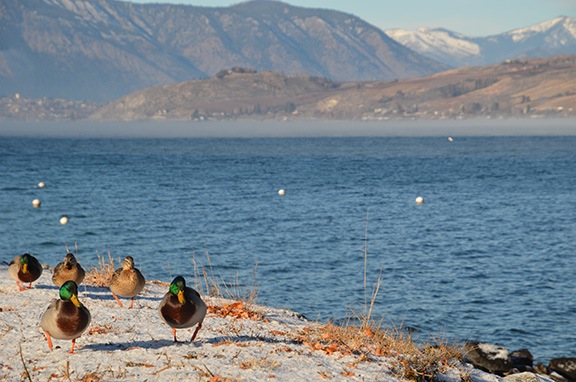
Ducks on a Mission
These ducks were snoozing until I knelt down on the ground to put them in the foreground and the snow-covered mountains in the background. Then they marched toward me; I suspect they thought I was there to feed them.
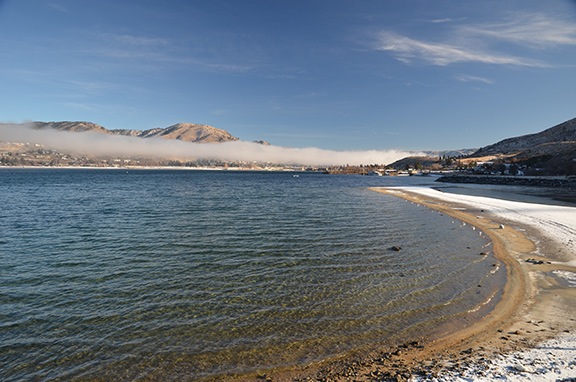
Fog over Chelan
A layer of fog hung over the town of Chelan.

I drove into town. There were few cars on the road, few people around. Winter in a summer resort area. The road had patches of ice and, more than once, my rear tires spun as I moved away from a stop. Slow and easy; I was re-learning my winter driving skills as I went along.

The fog thickened as I followed the road through town and up toward the airport. At one post, visibility was down to less than 300 feet. Along the road I caught glimpses of the Columbia River far below me. Downriver, the sun was shining through the clouds. Up ahead it was cloudy and gray.
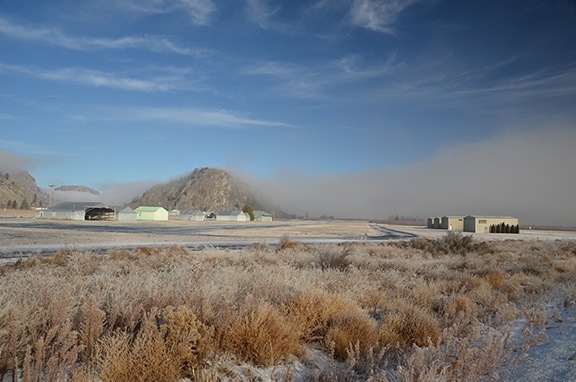
Marginal VFR
It was marginal VFR at the airport but no one was flying. The thick frost you see on the weeds is from freezing fog, another common weather phenomena here in Central Washington State.

Route 97A descended from the airport and joined up with Route 97 to continue up the Columbia River. It was a completely different day, with low clouds and a dismal winter feeling.

Refueling at Pateros

I didn’t stop until I got to Pateros, where I pulled over to top off the Jeep’s fuel tank. I took a short drive through town, getting as far as the Lake Pateros Motor Inn, where we’d stayed in back in 2008. I’d parked my helicopter on the lawn alongside the hotel in a spot that made it very convenient for the few cherry drying flights I did.

I stopped at the Sweet River Bakery, where my wasband and I had come for breakfast each morning during our 10-day stay. Back then, they made the best apple fritters. I ordered an eggnog latte and got an apple-cranberry fritter to go. I’d have it for breakfast in the morning.

We got back on the road, backtracking down to where route 153 turned west along the Methow River. I passed the farm stand with a cherry orchard I’d dried. It was closed.

A Drive Up the Methow
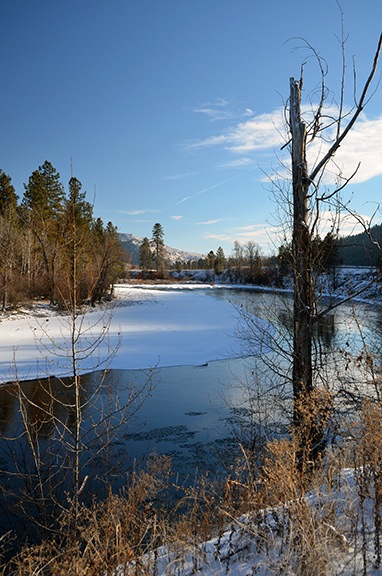
Along the Methow River
Snow, ice, river, sky, trees dormant for winter. I didn’t realize how much I missed winter scenery until I took this trip.

There was ice on the river — so much ice, in fact, that it looked as if I could walk across it. But as I drove upriver, the ice cleared out at the rapids.

The road climbed gently but persistently along the river. The amount of snow along the way increased as we climbed. Soon, we’d climbed away from the fog bank and the sun began to shine again.

It was a really amazingly beautiful day. I stopped for a few more photos. I wanted to remember this trip and the best way to do that would be to document it with photos to act as visual clues. Besides, it was just too darn pretty to pass up.

That’s another benefit of traveling alone; I don’t have to ask permission to stop so I can get out with my camera.
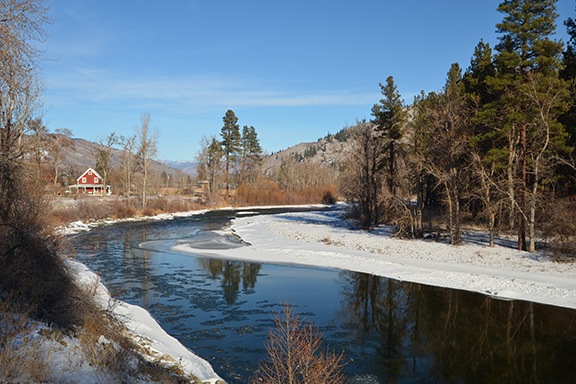
Red House on the Methow
At first glance, the reflection of the red house on the river was much more obvious than I was able to capture with my camera.

I passed through Methow and noticed a restaurant on the side of the road. I have vague memories of having dinner there and there being live music. But it was closed and quiet that Christmas Eve day.

Everything was quiet. I was just about the only car on the road. No traffic! How many other Christmas travelers could say that?

Carlton was a sign and nothing more.

The road twisted and turned along the river, crossing one bridge after another. I reached the junction of Route 20, where route 153 ended. A right turn would eventually take me to Okanogan — which I’d only been to by helicopter in a fly-by years ago. I continued on to Twisp.

The friend I’d visited at work earlier in the day had told me to stop at Twisp’s bakery and the health food store next door. I was hungry for lunch — it was nearly noon — but I didn’t feel like bakery food. The Grover Street Market had a lunch counter, so I went inside to see what healthy choices they offered. I wound up with a bowl of their Curry Stew, which was more like a soup and served so piping hot that I couldn’t eat it at first. It was tasty, with just enough spice to make it interesting. There was enough for two meals so I took half of it to go.

I didn’t visit the Cinnamon Twisp Bakery. I figured I’d visit it on my way back. (That turned out to be a mistake; it was closed on Thursday.)

I took Penny for a short walk through town. Not much was going on, although there were plenty of parked cars. It was sometime around then that I realized that plowing the roads in Washington was optional. All the side streets in town had a reasonably thick layer of icy snow on them. Not really slick — I think they spread gravel or something on them — but certainly not plowed to pavement. They apparently expect people to know how to drive in this kind of snow cover. And people do.

Of course, there were an awful lot of four wheel drive vehicles around.

Winthrop and Beyond

For some reason, I thought I had 20 or more miles to go before I reached Winthrop. I didn’t. It was just about 10 miles down the road.

I pulled out my driving instructions and followed them to Wolf Creek Road and, eventually, to the Chickadee Cabin Loft where Penny and I were staying. It was an upstairs studio apartment in a four-unit building. Next door was vacant but the two downstairs units, which were much bigger, were occupied. The place was at the end of a road in the woods but on the edge of a clearing. The roads weren’t plowed but the Jeep had no trouble getting us where we needed to go.

The “loft cabin” was nice, with a queen-sized bed, futon, TV with VCR and DVD player (and satellite TV), Internet access, kitchenette, and bathroom. There was even a sliding glass door leading out to a small balcony that overlooked a snow-covered meadow. All this was about 6 miles from town.

I unpacked the food and checked the cabinets. There was coffee and coffee filters and even sugar. All I needed was some milk and maybe some yogurt for breakfast. I’d get that in town.

We climbed back into the Jeep and headed into Winthrop. I wanted to find out what trails, if any, were open to cross-country skiing. I figured there would be some kind of ranger station with information in town.

What I found was the local office of the MVSTA. I parked out front and went inside, leaving Penny behind in the Jeep. I spent the next 20 minutes chatting with the two folks inside about which skiing trails were open and where I could get a lesson. It looked like Mazama was the place to be — 15 miles farther up route 20 was where there was more snow and most of the groomed trails. I bought a 3-day pass — in hindsight, two 1-day passes would have saved me a bit of money — and the woman behind the counter called the Methow Valley Ski School up in Mazama to see if they were still open. It was nearly 3:30 PM on Christmas Eve.

A while later, we were in Mazama and I was arranging for a cross-country ski lesson the following day. I brought in my skis and was told that waxless skis need to be waxed — something honestly I didn’t know. I paid for my lesson and a tube of ski wax.

I stopped in next door at the Mazama Store, a new agey market with lots of organic and overpriced food and other merchandise. (I do tend to tell it like it is.) I paid $7 for a quart of organic yogurt and $3 for a quart of organic milk. I also bought a fleece sweater that I wound up returning two days later. I do have to say one thing about the store, though: It has the largest selection of Lodge cast iron cookware I’ve ever seen under one roof. If Lodge makes it, the Mazama Store sells it.

By that time, it was after 4 PM and the sun was setting somewhere behind the mountains all around me. It would be getting dark soon. I loathe driving in the dark these days and had no reason to stick around Mazama so we headed back.

Along the way, I saw plenty of snow-covered fields with a thin layer of fog drifting over them. Advection fog? Radiation fog? I tried to remember what I’d learned in ground school about fog and came up empty. Fog was rarely an issue where I flew in Arizona; it was certainly an issue here in the winter time.

I stopped briefly in Winthrop to take Penny on a quick walk around town. I was curious to see what was open. There was a hotel with a restaurant in town and I walked up the steps to see if it would be open the next day for Christmas dinner. Closed. No big deal. I knew I’d be able to get Christmas dinner at the nearby Sun Mountain Lodge resort if I wanted to.

It was almost dark when Penny and I returned to our loft cabin. I put away the groceries and heated up some leftover smoked ribs for dinner. (I’d made them the day before on my Traeger just so I’d have something to munch while I was away.) We spent the evening relaxing, reading, watching TV.

A nice rest at the end of a long day.

(continued)

A Christmas Ski Trip, Prelude: The Plan

A great way to avoid holiday headaches.

This was the first Christmas holiday in my life that I didn’t have plans to visit family or friends. I’d gotten a number of invitations — all of which required out-of-state travel — and for various reasons, had to turn them down. About two weeks ago is when I realized that I’d likely be alone for Christmas. But rather than be glum about it — as people who need companionship might be — I rejoiced in the freedom it gave me.

Yes, for the first time in my life, I could spend the Christmas holiday the way I wanted to.

Fond Remembrances of Christmas Past

Oddly, my favorite Christmases were the ones I spent alone with my wasband, either at home or at our cabin on Howard Mesa. At home, we’d exchange gifts and do something during the day, like a Jeep ride with cameras out in the desert. In the evening, we’d settle down after a good dinner in front of the fire.

The Howard Mesa trips, like this one, were especially memorable. I remember one Christmas dinner in El Tovar’s private dining room at the Grand Canyon when we were joined by people I thought were friends; one of them looked ever-so-sexy in a kilt.

Simple Christmases were always the best, especially when you could spend them with people you loved.

No responsibilities, no traffic, no pretending to enjoy the company of people I’d simply prefer not to be with. No buying gifts for people I barely know, no receiving gifts from people who feel a need to spend the budgeted amount on me and don’t really care whether the thing they give me is something I might like. (Hint: Save your money; I’ll like/respect you more if you skip the gift than if you give me something stupid that I hate.) No listening to complaints or arguments or political rants, no dealing with kids or grandkids or misbehaved pets. No eating “casseroles” that came out of a bunch of cans; no eating desert that includes Cool Whip or other petroleum products. No guests that complain incessantly about their accommodations — when they refused to stay in your home and expect you to pick up the tab for their hotel.

Don’t get me wrong — I’ve had many pleasant Christmases with family and/or friends in the past. They’re usually relaxing and fun with the emphasis on enjoying each other’s company and taking pleasure out of sharing just the right gifts. Alcohol is often involved.

But I’ve also had some remarkably crappy ones, some of which were with people I’m very glad I’ll never have to see again. And they’re likely just as glad that they won’t have to see me.

Why do we pretend to like the holiday bullshit when we so often don’t? More times than not — at least in my past — it’s been an ordeal better skipped.

And that’s the best thing about being single: not having to “compromise” with a partner so his responsibilities become yours.

But the question remained: what would I do for Christmas?

The Plan

It didn’t take long to come up with a plan. I definitely wanted to go away for the holiday, but I didn’t want to go far. I wanted to go someplace that wouldn’t cost a fortune, someplace with a mix of privacy and small crowds. Someplace I could get out and do something active — I’d been spending far too much time this season sitting on my butt.

The answer came from a friend. She knew I was itching to get out on my new cross-country skis and snowfall had been unseasonably low in our area. “Have you checked out MVSTA?” she asked.

MVSTA LogoA tiny bit of research led me to the website for the Methow Valley Sport Trails Association. The MVSTA is, as it proudly proclaims on its website’s home page, “the Nation’s Largest Cross-Country Ski Area.”
The Methow Valley is a long, beautiful valley that runs up the Methow River. There are a few towns along the way: Methow and Carlton, which really don’t have much to offer, Twisp, Winthrop, and Mazama. Winthrop, which was the big town in the area, was about 50 miles up the road — route 153 and then route 20 — and just 90 miles from where I lived. Driving there would be the equivalent of driving to Sedona from my old house in Arizona. If I continued on route 20, the scenic North Cascades Highway, I’d wind through the Cascade Mountains and end up north of Seattle. It’s not possible in the winter when snow closes down the passes, but I’ve got a friend who’s promised to do the trip with me on motorcycles in September.

I’d been up the Methow once before. Back in 2008 I’d spent 10 days working in Pateros, WA, on a cherry drying contract. Pateros was the little town at the confluence of the Methow and Columbia Rivers. It was summer then and I’d driven with my wasband 65 miles, all the way up to Mazama, with stops at Twisp and Winthrop along the way. My wasband had bought me a little handmade silver ring in a gallery in Twisp. It was the last piece of jewelry he ever bought me.

Revisiting the area would be a good idea. I’d make new memories on my own terms. The fact that it was winter instead of summer and I was going for more than just a day trip would help. Besides: there was plenty of cross-country skiing in the area on groomed trails. I’d never skied on groomed trails before and looked forward to it.

I made a few phone calls and wound up booking a loft cabin about six miles outside of Winthrop. I chose the place because it met my requirements for quiet and privacy and it allowed dogs. And it wouldn’t break the bank. I took it for two nights — Christmas Eve and Christmas — and paid in advance.

Then I called around to see if I could get a cross-country skiing lesson on Christmas Eve. Sure, the first company I called told me. They’d be open Christmas Eve and probably even Christmas Day. But there wasn’t much snow yet; there might not be enough for skiing.

Duh-oh!

But there was no turning back. I could see from the MVSTA website that even if there wasn’t enough snow for skiing or snowshoeing, there were still plenty of trails for hiking. When life gives you lemons…

(continued)

Apprentice Beekeeper Reading LIst

Spending my winter down time learning more about bees.

I started my beekeeping hobby in June 2013 and have been blogging about it periodically. If you’re interested in reading the other posts in this series, follow the Adventures in Beekeeping tag. Keep in mind that the most recent posts always appear first on this blog.

As I get more and more serious about beekeeping, I’ve decided to spend my slow winter months studying up for the Apprentice Beekeeper Certificate. To that end, I’ve tracked down a reading list recommended by the University of Florida for their Apprentice Beekeeping Program. I discovered that I already had may of these books, but I did place an order with Amazon.com to fill in the gaps in my library.

(You might want to consider these as last minute Christmas gifts for the beekeeper in your life.)

Here’s the list with links to Amazon.com; the descriptions are also from Amazon:

honeybeesandbeekeeping.jpgHoney Bees and Beekeeping: A Year in the Life of an Apiary, 3rd Edition
by Keith Delaplane
©2007, Spiral Bound

Beekeeping is enjoyable and satisfying, whether you’re a professional or a novice. With a bit of ingenuity and a little knowledge, anyone can successfully raise honey bees. Learn how to set up and maintain your own honey bee colony from Keith Delaplane, Ph.D., one of the nation’s foremost entomologists as he guides you through each step, from buying tools and selecting healthy bees, to harvesting and selling honey.

Beekeepers HandbookThe Beekeeper’s Handbook, 4th Edition
by Dianna Sammataro and Alphonse Avitabile
©2011, paperback, 272 pages

Since 1973, tens of thousands of first-time and experienced beekeepers alike have relied on The Beekeeper’s Handbook as the best single-volume guide to the hobby and profession of beekeeping. Featuring clear descriptions and authoritative content, this handbook provides step-by-step directions accompanied by more than 100 illustrations for setting up an apiary, handling bees, and working throughout the season to maintain a healthy colony of bees and a generous supply of honey. This book explains the various colony care options and techniques, noting advantages and disadvantages, so that beekeepers can make the best choices for their own hives.

First Lessons in BeekeepingFirst Lessons in Beekeeping
by Keith S. Delaplane
©2007, paperback, 166 pages

First Lessons in Beekeeping introduces the prospective beekeeper to the basics of beekeeping through easy-to-understand text and numerous color photos on honey bee biology, beekeeping equipment, management, honey production and processing, as well as disease diagnosis and treatment. In the preface to this book, author Keith Delaplane says of his first book on beekeeping, “Its pages opened to me a golden world of honey bees and beekeeping and guided my stumbling steps that first spring season. My story is but one of thousands who have passed through the door opened by Dadant’s little book.”

Backyard BeekeeperThe Backyard Beekeeper, Revised and Updated: An Absolute Beginner’s Guide to Keeping Bees in Your Yard and Garden
by Kim Flotsam
©2010, paperback, 208 pages

The Backyard Beekeeper, now revised and expanded, makes the time-honored and complex tradition of beekeeping an enjoyable and accessible backyard pastime that will appeal to gardeners, crafters, and cooks everywhere. This expanded edition gives you even more information on “greening” your beekeeping with sustainable practices, pesticide-resistant bees, and urban and suburban beekeeping. More than a guide to beekeeping, it is a handbook for harvesting the products of a beehive and a honey cookbook–all in one lively, beautifully illustrated reference. This complete honey bee resource contains general information on bees; a how-to guide to the art of bee keeping and how to set up, care for, and harvest honey from your own colonies; as well as tons of bee-related facts and projects. You’ll learn the best place to locate your new bee colonies for their safety and yours, and you’ll study the best organic and nontoxic ways to care for your bees, from providing fresh water and protection from the elements to keeping them healthy, happy, and productive. Recipes of delicious treats, and instructions on how to use honey and beeswax to make candles and beauty treatments are also included.

Honey Bee BiologyHoney Bee Biology and Beekeeping, Revised Edition
by Dewey M. Caron, Lawrence John Connor, and 4 others
©2013, hardcover, 368 pages

The standard beekeeping (apiculture) textbook used to teach college students and beekeepers the science and practice of bees and beekeeping. It concentrates on the ‘why’,’how’ and ‘when’ of beekeeping. It explains bee basics in a manner meaningful to people who lack an intensive background in biology. It does not oversimplify, and provides a meaningful source of beekeeping information for the new and informed beekeeper. Widely considered the most complete beekeeping textbook, covering a vast array of topics of bee biology and colony management. The Revised Edition features the addition of full color throughout the book, extensive revision of photography and artwork and thoroughly updated materials. Comprehensive, assessable and now updated and illustrated with hundreds of color photographs and illustrations.

Deciding on a Career as a Helicopter Pilot

I probably can’t give you the answers you want to hear but I can tell you what you need to consider when making this big decision.

Start Here.

A lot of what I’m saying in this blog post can be found in my series about becoming a helicopter pilot: “So You Want to Be a Helicopter Pilot.” Do yourself a favor and read it. You can find the first part here.

And when you’re done with that — and the posts that those posts link to — try reading some of the posts in the Flying topic. Then search this site for keywords like careers, helicopters, flight training, etc. You’ll find lots more to read and learn from.

I’ve written a lot in this blog, especially over the past five years or so, about building a career as a helicopter pilot. With more than 2,400 posts on this site — including more than a few recipes, day-in-the-life stories, and rants that have nothing to do with flying — there’s a lot to wade through to get the information you want. Some folks think it’s a lot easier to just write me an email with specific questions about helicopter pilot careers. Easier for them, perhaps, but not for me. That’s why my Contact page has this section that appears before the contact form:

Career Advice/Pilot Jobs

I cannot provide career advice of any kind, whether you want to be a writer or a helicopter pilot. The posts in this blog have all the advice I’m willing to give the public. If you want my advice read them. There’s a pretty good chance that I’ve covered your question here in a blog post.

The Email Requests Still Come

Despite that, I still get at least two messages a month — using the form on that very page — asking me helicopter pilot career questions. Here’s a typical example; this one arrived yesterday:

Fascinating blog, lots of good perspectives. My son and I are considering this as a career for him, he is 19. We have made calls, visited a few schools, heard the sales pitches, heard the perspective of the job market from the perspective of the CFI’s and schools.

Your post from 2009 was bleak regarding the career prospectives. We get the need for moves required, the dues needed to put it, the cost, etc.

My question to you is, has your perspective changed at all since 2009?

Although the author did not specifically identify the 2009 post he was referring, I assumed he was referring to the most popular (of all time) post on this blog, “The Helicopter Job Market.” But a quick look showed me that that post dated from 2007. Not knowing what he already read makes it a bit difficult to review what I wrote in 2009 and update it. I do get the impression, however, that he just scratched the tip of the iceberg on career-related content here.

So I thought I’d spend this morning pointing him (and others) in the right direction to learn more, much as I did in “Helicopter Career Advice Sought…and Provided,” which was a reply to someone else’s email back in 2009. (That was apparently back before I instituted the “I can’t give you advice” policy on my contact page and may even have prompted me to adopt that policy.)

Important Points

You need to take all the advice I give on this site with a grain of salt. Why? Here are a few reasons:

  • I am not a career counsellor. I have no training in career counseling and refuse to take responsibility for any actions taken by a reader who might consider my blog posts as career advice.
  • I am not an industry insider. I am the owner/operator of a small, single-pilot helicopter charter business. I only had one flying job for another organization and that was a summer job back in 2004. My fingers are not on the pulse of the industry. I chug along in my own little world, running my business in accordance with applicable regulations with absolutely no intention of building my business beyond what I can handle.
  • I did not get to where I am by following the typical pilot career path. I was fortunate in the early 2000s to have a writing career that paid extremely well. That money subsidized my flying business until it became profitable on its own. That’s why, after 13 years as a pilot and over 3,000 hours in helicopters I still don’t have my CFI certificate. Obviously, I can’t provide detailed advice on following a career path that I didn’t follow. I simply took a different path, one that would probably be very difficult for others to follow.
  • I am not an employer. Although I do occasionally hire helicopter operators like myself to assist me in my summer agricultural work, I have never put any pilot on payroll or provided any career training for another pilot. How can I know what employers want?

All that said, I do know a lot of pilots and we do talk a lot about the industry. I have a very good relationship with the FAA. I also have a generous helping of common sense and have heard enough horror stories to form opinions I’m not afraid to share.

Doing Your Homework

One thing that struck me about this message was that it was written by the dad — not the possible future pilot. While this isn’t the first time a parent wrote to me — last time it was a mom — it does raise flags.

Why isn’t the son writing? Who’s doing the research? Who really wants this job? Is the dad pushing his son into a career he might not be interested in? Doesn’t the son care enough about this as a career to do his own research?

I don’t mean to put the author on the defensive and I certainly don’t want an explanation or answers to any of these questions. It just seems to me that when the parent is doing the homework, the kid is missing out on the learning.

And frankly, at 19 years old, the “kid” is old enough to be doing this for himself.

Maybe father and son need to have a good heart-to-heart chat about this? Look into their motivations? See who really wants this to happen?

Because even if the pair decide to move forward in this career, the son won’t get very far if he lacks the motivation or ability to study and learn for himself. This might not be rocket science, but there’s still a ton to know and learn.

Motivation

Motivation is a huge topic all its own.

Back in the mid 2000s, Silver State Helicopters was a quickly growing helicopter training organization. They’d choose a city and start advertising free seminars where you could learn to be a helicopter pilot and be paid $80,000 a year. On the day of the seminar, they’d pack an auditorium with pilot wannabes. On stage, they’d have shiny helicopters and pilots in cool-looking flight suits.

Silver State was selling two things:

  • A cool, awe-inspiring job. After all, what guy wouldn’t want to be a helicopter pilot?
  • A big annual paycheck. $80K a year is certainly enough money to live on — especially when you’re currently struggling on the weekly take-home pay of a part time job.

Of course, Silver State crashed and burned when the economy tanked and kids couldn’t get $70-$80K loans for their flight training. Because the entire organization was built like a Ponzi scheme with tomorrow’s new students paying today’s expenses, the company ran out of money. They closed their doors very suddenly, leaving hundreds of students only partway through the program with nothing to show for it except a huge loan. There are still young people out there trying to dig themselves out of the mess Silver State left them in. I covered Silver State’s impact on the industry in this blog post.

In the email message quoted above, the dad mentioned that he’d talked to the flight schools and CFIs. He didn’t mention what they’d told him. Were they selling Silver State’s dream, too? The glamor job? The big paycheck?

Is that what’s motivating them to explore this as a career?

I’ve said it before and I’ve said it again: if you want to be true to yourself and ensure happiness for the rest of your life, pursue a career doing something you love.

I love to write. After eight years on a career path I was “guided” into by family pressure, I broke out and became a writer. It took a while, but I found a lot of success and a lot of happiness in my work.

After I learned to fly, I realized that I loved to fly. In an effort to do it more often, I pursued flying as a career. Again, it took a while, but I found enough success and a lot of happiness in my work.

If you’re interested in a career as a helicopter pilot, is it because you love to fly? Or is it because you want to make your friends envious? Or pull in the big paychecks the flight schools claim are possible?

And if you haven’t even flown in a helicopter yet, what the hell are you waiting for? You might hate it. Take a demo lesson where you can manipulate the controls beside a CFI and even log the time. (Why not if you’re paying for it, right?) See if it’s right for you.

(This is yet another reason why you should not buy into a “program” with a flight school You might get 20 hours into your training and decide it’s just not right for you.)

And if you want to know what a career as a helicopter pilot is really like, talk to a helicopter pilot. No, not the owner of the flight school or the chief flight instructor there. And no, not a 400-hour CFI who’s paying his dues so he can start being a helicopter pilot elsewhere. I’m talking about real helicopter pilots — the guys and gals who have been doing this stuff for years. Someone who is serious about learning what it’s really like will talk to as many real pilots as he/she can.

And no, posting messages on helicopter pilot forums does not count. Don’t be lazy. Find real local pilots — EMS, ENG, agricultural services, fire suppression, heavy lift, tour, etc. — and talk to them face to face. They will talk to you. If you visit them at their base and they’re not busy, they’re likely to show off their helicopters, too. (Sure beats getting misled by wannabes who are using the Internet to hide their identities and lie about their experience.)

The Helicopter Job Market Today

As far as I can see, the market hasn’t changed that much. Yes, we no longer have the flood of low-time pilots pushed into the job market by Silver State. But we do have young veteran pilots released from the military. So there are still far more low and mid-time pilots than jobs for low and mid-time pilots.

What is “low time”? Anything less than 1,000 hours is widely considered low time. That’s the amount of pilot in command time that most pilots need to get a job as a real (non-CFI) pilot. You usually get that time as a CFI — that’s the normal career path.

Is it possible to get a pilot job with less time? Yes.

WIll it be a good job, one with real career potential and opportunities to learn and practice new skills? Maybe.

Will it pay well? No. (Hell, if they had a big payroll budget, they’d likely use it to obtain more experienced pilots that would keep their insurance costs down.)

Even when you’ve gotten all your certificates, you still need to compete with other brand new pilots to get the CFI job that’ll make it possible to build your first 1,000 hours. Once you get that job, you need to keep it until you have enough time to compete again with other 1,000-hour pilots for your first entry level pilot job. There are no guarantees. Employers — whether they’re flight schools or tour companies or offshore drilling transportation providers — will only choose the candidates they think are best for their organization. The whole time you’re learning and flying and working you need to set yourself apart from the others to prove that you’re the best.

Like many careers, as you work your way up the ladder, building valuable experience and proving over and over that you’ve got the right attitude to get the job done, opportunities will open themselves to you. The more experience you have, the more opportunities will be available. And yes, some of them will come with very nice paychecks.

I have friends in this industry who are constantly being contacted by employers interested in hiring them. One friend recently turned down an offer five times — even after he was offered a $10K signing bonus — and finally signed when they reached an agreement about the contract length, location, and conditions. Why do you think they were so anxious to have him at the controls of their Huey on that fire contract? He has a great reputation as a responsible, safe pilot who takes excellent care of the equipment and always gets the job done.

It would be nice to be in my friend’s shoes, wouldn’t it? But he didn’t get there by luck. He got there through hard work and the right attitude — for more than 20 years.

Being a successful helicopter pilot is not easy. It requires a lot of hard work. It often requires working in less than optimal conditions, doing things you might not want to do. It requires being willing to learn — and even master — new things. You have to have “the right stuff.”

What do you think?

I’m sure this blog post will be seen by plenty of pilots and maybe even some employers who have been in the industry at least five or ten years. What do you see as the current trends? What information can you add to this? Advice?

Please use the comments for this post to share what you know. My information is limited — you can help me round it out for other readers to get more value from what I’ve already said here.

100 Coffee Filters

Tracking house-sitting time with cups of coffee.

As I blogged a while back, I had every intention of spending the winter in my RV on my property in Malaga. The winterization worked well and I had no trouble with water, electric, or sewer hookups. I had enough heat to keep me warm night and day. And I had all the conveniences of home — the same home I’d been living in full-time since May and every summer since 2010.

The big drawback was the cramped space. Let’s face it, the mobile mansion might be big for a 5th wheel RV, but it’s not big for a full-time living space. And with winter weather outside — often at freezing temperatures — there was no outdoor living space to complement it.

Still, I’m not home very much — I have a pretty active work and social life — and I was prepared to deal with it. After all, the winter wasn’t that long.

I went to Seattle on a Sunday in mid-December. I had some chores to take care of — new battery for my phone, shopping for cross-country skis, hiking with a meetup group — and I’d already decided that I’d make at least one trip into Seattle every month, just to insert a dose of city amenities. When I got home that evening, there was a note on my door. It was from a man I’d never met — we’ll call him Joe to preserve his privacy — who happened to be friends with one of my neighbors. “Don says you’re going to freeze,” the note said, referring to my neighbor. It then ended with an invitation to spend the winter in his house since he was going away to (ironically) Arizona. He’d be gone until February month-end.

I thought about if for three days before calling him. Then I said that I appreciated the offer but thought I’d be okay. Still, maybe we could meet in case I needed a Plan B?

Before meeting, I talked to two people I thought might know him. They both had nice things to say about him. He’d lost his wife in March and was working his way though that. They both told me that he lived in a nice house.

In the meantime, the weather forecast changed. It had been in the 40s every day and I’d been able to get work done outside on the path I was building and in my shed. For some reason, I thought it would stay like that. But no — it was going to get colder and those midday jaunts outside would soon end — at least until the snow came and I could take the skis or snowshoes out with friends.

I met Joe and told him I’d reconsidered. If the offer was still open then yes, I’d love to take advantage of it. He showed me around his wonderful three-bedroom home just two and a half miles from my place. Situated on a shelf — just like my lot two levels up the mountain — it had a wrap-around porch and nearly the same view I had of the Wenatchee Valley. Furnished with antiques, it had a few modern conveniences I missed: a dishwasher, washer, dryer, and satellite television. There was plenty of room and plenty of privacy. There was even a garage and space in a covered carport to park my Jeep and truck.

It was more than I could possibly ask for. And all he wanted in return for letting me use the place was for me to pay the utility bills while I was there, keep the place clean, and keep an eye on things.

Joe, in the meantime, was heading south with his trailer and a friend. They planned to leave on December 2. I was welcome to move in any time, but I honestly felt a little weird moving in before he left. That would make me (and Penny) a house guest instead of a house sitter. So I held off, prepping for the move back in the mobile mansion.

At November month-end, the forecast warned about bad weather on December 1 and 2. Joe’s friend, who was coming down from Canada, came early. They packed up and pulled out on November 30.

I was supposed to do shuttle flights between two wineries — Martin Scott in East Wenatchee and Malaga Springs in Malaga — on November 30, which was a Saturday. But low visibility and some freezing fog made that a dumb idea. With my afternoon suddenly open, I decided to start my move that day.

I made a few trips in my truck, bringing along the bare necessities like clothes and food from my fridge and cabinets. I wasn’t sure what I’d need and, at first, I also brought along linens and towels and my electric blanket. I wound up bringing all these things back to my RV. I wanted to keep things simple so it would be easy to move out at the end of my stay.

I went out that evening with some friends and returned to my new (temporary) home around nine. I’d already picked one of the guest rooms. I put Penny’s bed on my bed, atop the comforter I’d brought along, and and climbed between the covers. I turned off the light and lay on my side, facing out one of the room’s two big windows, looking out at the lights of Malaga, Wenatchee, and East Wenatchee. My new home would have windows just as big. I felt as if I were getting a preview of what was to come.

Coffee
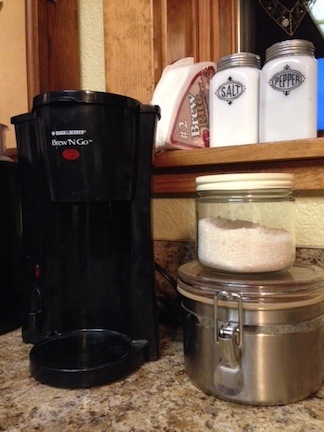
Coffee, coffee brewer, filters. What else do I need?

The next morning, I made coffee, just as I did every morning wherever I lived. I’d brought along my little one cup coffee brewer and a brand new pack of #2 cone coffee filters. I opened the pack of filters and brewed some coffee. I let Penny out and she did her business somewhere out in the yard, which she’d already explored the previous day. When she came back in, I fed her — I’d also brought along her placemat, dishes, and food. It was life as usual for the two of us — just in a different place.

But we’re used to that. For the past 18 months, we’ve been sort of gypsies. We lived in at least 20 different places, including various homes and hotel rooms. Even the RV had been parked in six different places in three different states. Penny and I adapted as necessary, settling into each of our temporary homes with ease. I loved the variety our gypsy lifestyle offered us and Penny didn’t seem to mind one bit. I think she’s come to expect it.

I spent much of Sunday morning prepping the RV for winter vacancy. That meant blowing out the water lines, putting antifreeze down the drains, and disconnecting the power for the heat tape on the water line. And packing up and moving a few more things. The weather was still iffy, with low clouds and mist. I had a gig flying Santa into Pybus Public Market later in the day and, for a while, wasn’t sure if I’d be able to do it. But by 12:30, I decided to give it a try and headed out to take care of it, leaving Penny behind for the first time, alone in Joe’s house.

After the flight, I met up with some friends at a wine tasting room and we wound up going to dinner. I didn’t get home until after 9. Penny was excited to see me. I checked the house out thoroughly to make sure she hadn’t had any “accidents” while I was gone. All was okay.

By Monday morning, life had already settled into a routine. I let Penny out, made coffee, let Penny in, and fed her. I caught up with email and Facebook while having breakfast at the kitchen table, watching the valley light up as the sun rose. (The view really is magnificent.) I showered and dressed. I already felt at home.

I ran out to do some errands that included dropping off my Jeep for service. It had been leaking from the transfer case for about a year and I needed to get it fixed. After all, it would eventually run out of whatever was leaking. But what really prompted me to get it taken care of was that I wanted to park it in Joe’s garage and I didn’t want it leaking in there.

I’d arranged for a neighbor to pick me up on her way home from errands in town and I had time to kill. After dropping off the Jeep, I had another breakfast in town — Sassy’s Dinner makes the best breakfast! — and then walked to Caffé Mela for a latte and to update the software on my iPad. On the way, I noticed that there was fresh snow on the hills north of town. Then I wandered to a used furniture store to browse for a dining table and chairs — the only thing I needed to furnish my new home when it will be built next year. My neighbor and her son picked me up and we drove up to where the mobile mansion and my truck were parked. I was surprised to see fresh snow on the ground — it had snowed during the three hours I was gone.

I decided that I didn’t trust my RV winterization. So I set up a heater in the basement and inside the RV. Power was cheap enough that the two heaters would be cost-effective insurance. I also had the added benefit of having the place kept warmer than freezing if I had to come back and fetch anything I’d left behind. I still had one more trip to make — to get my computer, printer, and camera gear — and then I’d close up the slides. That would make a smaller place for the inside heater to keep warm and minimize the amount of roof space exposed to the snow.

I should mention here that my hangar is large enough for me to park the RV in it, too. But it’s a pain in the ass to move and I did an excellent job parking it right where it is. I’ll admit it — I’m too lazy to move it and then move it back in February. (There’s also the very real possibility that snow on the ground would make it impossible to move in February.) And because of that, the mobile mansion will spend its very first winter outdoors.

Joe Miller Road
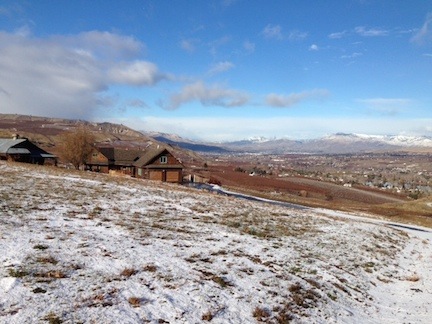
Joe’s place is truly wonderful.

When I got back to Joe’s place, I stopped at the end of the driveway to snap a photo with the dusting of snow all around and the valley off in the distance. It really is a beautiful place and I know I’m very fortunate to be here.

More errands yesterday afternoon, including a quick visit to where my helicopter is parked inside Pybus Market. Then home to Penny and dinner. I set up my Christmas tree for the first time in three years. We even watched a DVD.

This morning, I got right into my routine.

As I pulled a coffee filter out of the package, I consulted the label to see how many were in there. 100 coffee filters. I thought about my stay at Joe’s house. Three months. Pretty darn close to 100 days. I realized that I could see at a glance how much time was left of my stay just by looking at that package of coffee filters.

It’s still very full.