They Call the Wind Maria

A blog post about pollinating corn with a helicopter.

The call came on Monday from someone who works with a very large agricultural manufacturer. Do I do corn pollination with my helicopter?

The only thing I knew about pollination by helicopter was the spreading of purchased pollen using a special piece of equipment installed in a helicopter. It was a two-person job — one to fly, one to measure out the pollen — and I didn’t have the equipment or experience. I’d actually looked into at the request of one of my cherry pilots this past winter, but when he didn’t seem interested in moving forward and I suspected I might need special certification for aerial application, I let it drop.

Besides, I didn’t realize helicopters were used for corn pollination. I thought helicopters just spread pollen over fruit orchards.

But this new potential client didn’t want me to apply pollen from the air. He wanted me to fly over the cornfields in such a way that the pollen would get blown about and do its fertilization thing.

The way he described it, it didn’t sound much different from the kind of flying I do when I dry cherries. Sure, I told him. I could do that.

The Field Guy

After sending the company a copy of my W-9 for billing purposes — big companies always want the paperwork first — I got a call from the field guy. We’ll call him Bill. Bill and I set up a meeting at the White Trail Produce farm stand in Quincy. It was a perfect place to meet, despite the fact it was an hour drive from my place in Malaga. White Trails makes the best peach shakes.

I was drinking a peach shake with Penny on her leash when Bill drove up. Although we’d never met, I easily guessed it was him — he had a plastic chemical tank on the back of his pickup. We sat down in the shade and talked about the work.

Corn Tassel
Wikipedia image “Corntassel 7095” by Spedona Licensed under Creative Commons Attribution-Share Alike 3.0 via Wikimedia Commons; http://commons.wikimedia.org/wiki/File:Corntassel_7095.jpg

The problem was this: as the corn was growing, a heat wave had set in. For the past nearly 2 weeks, the daytime highs had been getting into the high 90s and low 100s. The corn had formed tassels at the top — that’s the male part of the plant that produces pollen — and each day the packets of pollen were opening, ready for the pollen to be dispersed by the wind.
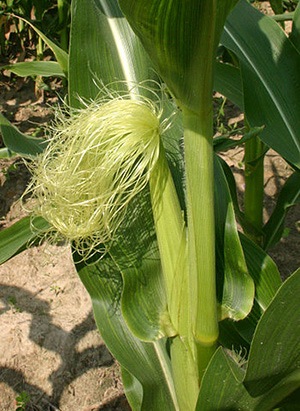
Corn Silk
Wikipedia image “Cornsilk 7091” by Original uploader was Pollinator at en.wikipedia – Transferred from en.wikipedia; transferred to Commons by User:Teratornis using CommonsHelper. Licensed under Creative Commons Attribution-Share Alike 3.0 via Wikimedia Commons – http://commons.wikimedia.org/wiki/File:Cornsilk_7091.jpg

Unfortunately, the extremely hot weather was killing the pollen within a few hours and the lack of wind was making it nearly impossible for the pollen to reach the corn silk — that’s the female part of the plant growing lower on the stalk — while it was still viable.

Bill’s corn fields needed wind — on demand.

That’s where I came in. They’d call me out to fly low over the corn fields at the time when the most pollen was being released by the tassels — likely between 8 AM and 10 AM. I’d fly back and forth, making sure all the plants got a good blowing. Once the pollen was flying around, gravity and mother nature would do the rest.

That was the plan, anyway.

Bill gave me four maps, each of which had at least a dozen or two corn field locations plotted on it. Each had a different number. They were scattered throughout an area that was probably 50 square miles. He said that each field was on its own schedule, so they would never all be done at once. Instead, only a handful would need to be done on a day.

That worked fine for me. I have a one-hour minimum for flights at my charter rate and would be spending at least 30 minutes round trip for travel time, which they would cover. If I could do two or three fields on a flight, it would likely come out to 90 minutes, which looked good for my bottom line and gave them more bang for their buck. Win-win.

I was booked with a photo flight in Seattle at dawn on Wednesday morning, so my first available day was Thursday. Bill said he’d call Wednesday night with a plan.

The Flight

Bill called Wednesday evening. I pulled out the maps. He listed two fields in Quincy and one in George. He asked me to be at the first Quincy field at 9:30 AM. He’d be on the ground, watching what I did. If I needed to make an adjustment in speed, altitude, or distance between passes, he’d call and let me know. Because the second field in Quincy was so close, he’d probably watch that one, too.

We hung up and I looked up the fields on Google Maps, knowing that the plantings in the satellite view might not match what was actually on the ground. I found the cross streets and noted the shape of the fields. I highlighted the fields on my maps.
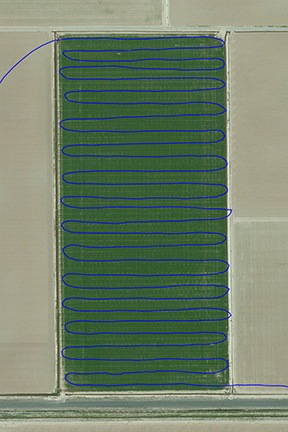
Corn Field 1
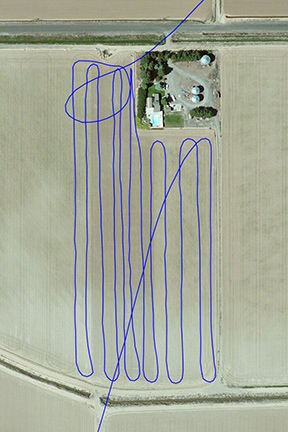
The first field was easy; all corn, no obstacles. I came in from the southeast and went back and forth to the north.

At 9:15 AM Thursday, I took off and headed to Quincy. After following Road 9 instead of Road 8 for about a mile past the field location, I doubled back and zeroed in on the first field. Bill’s truck was in the southwest corner. As I came in to make my first pass about 10 rows in, he got out of his truck to watch.

It took me a few minutes to get the hang of it; my brain wanted to dry cherries. But this was higher: about 15 feet rather than 5. It was also faster: 20-24 miles per hour rather than 5 to 10 miles per hour.

I looked back on my first few passes to see my coverage and realized that every 20 or so rows would be perfect — the corn was really blowing at least 20 feet on either side of the helicopter. (The corn rows were planted 22 inches apart.) I was probably on my third pass before I got the feel for where I should be and how fast I should be moving. I was on my fifth pass when I started making baby ag turns — not much more was needed at the speed I was operating.

Bill watched. I kept expecting my phone to ring, but it didn’t. When I got near the north end of the field, I realized I had an onlooker there, too.
Corn Field 2
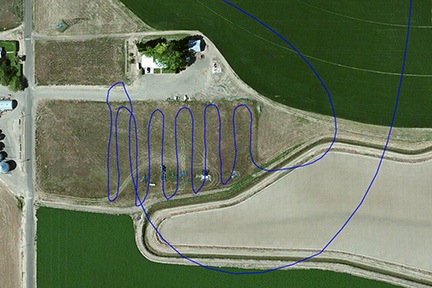
The second field had wires just outside the field. I came in from the north over the wires, circled around, and went up and down the rows. This satellite image doesn’t show the field as it appeared during the flight, of course.

I got through the first field, which was the largest, in about 15 minutes. The second field was right across the road. The were wires on both ends of it, but they weren’t that close to the corn. I made my turns inside the field so there was no need to go anywhere near the wires. Bill repositioned to the north end of that field to watch. When I was nearly done, I realized he was on the phone. Again, I expected my phone to ring, but it remained quiet.
Corn Field 3
This is the last field, which was fully planted with corn. This image doesn’t show the irrigation pivot, but if you look closely enough, you should be able to see the wires on the west side.

I finished up and headed to George. I found the field a lot easier than I expected to, but didn’t like what I saw. Not only did it have an operating irrigation pivot in it, which would force me to fly higher, over the pivot arm when I reached it, but there were what we call “Bonneville” power lines — the tall towers with multiple high-tension power lines between them. The power lines definitely crossed the field. To cover the corn, I’d have to fly under the wires very close to the tops of the plants. Suspecting that I might do more harm than good to the plants — and possibly to the helicopter — if I attempted to fly under the wires, I did only 2/3 of the field before heading out.

There was a house on the north side of the field and about five people had watched me work. I was only there about 5 minutes.

I called Bill and told him I’d finished, what part of the George field I’d missed, and why I hadn’t done it all. He seemed to understand. He also seemed very pleased. I wondered whether he could see the pollen dust on the plant silk. I hoped he’d have some kind of quick confirmation that our “wind on demand” scheme had worked.

I flew back and parked at home. I’d logged just 1.1 hours of flight time.

Repeat Performance?

Learn more.

Want to learn more about how corn pollination works? Read this.

And the title of this post isn’t something I dreamed up. It’s from this song, which was covered by Robert Goulet and others. And maybe — just maybe — it inspired Jim Hendrix to write this song.

Will I do this again? I hope so. It was kind of fun and a welcome break from cherry drying and passenger work.

But it all depends on the age of the corn and the weather. To need me, three things must happen at once:

  • The corn must be ready to pollinate.
  • It must be more than 85°F.
  • There can’t be much wind.

If all three of this conditions apply, my phone might ring with a request to fly in the morning.

I’ll be waiting for it. I need to practice my ag turns.
Repurposing Old Bee Hive Boxes

Reuse, recycle.

A few months back, my beekeeping friend James told me he’d was able to get a bunch of used deep hive boxes for about $5 each. Knowing I used deep boxes — he uses only mediums — he offered them to me. I asked about the condition and he admitted that they were pretty beat up but could probably be usable with just a cleaning and fresh coat of paint. They were heavy-duty commercial boxes — the kind the migratory beekeepers use. I told him I’d take 10.

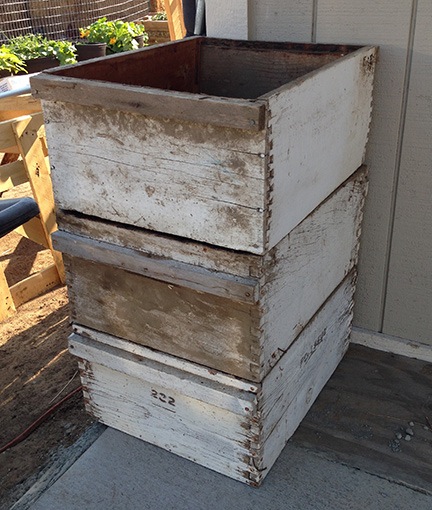
Beat Up Hive Boxes
These hive boxes are a little more beat up than I was expecting them to be.

I picked them up a while later. Although structurally sound, they were very beat up. James showed me one that he’d painted and it didn’t look half bad. Since the price was right and I had plenty of paint, I took them.

I spent one morning scraping the paint off four of them with a wire brush and then repainting them. They did look much better. But when I slipped some frames into one of them, I realized that they weren’t consistently sized; the frames fit too loosely and would require careful placement to prevent them from falling into the box.

Behive
This is my garden hive, so-called because I placed it near my garden. It was built with two of the used boxes and it’s pretty clear that they simply don’t fit the way they need to.

But it wasn’t until I placed the first box of frames onto a hive bottom — for a swarm capture I needed to permanently house — that I realized the problem couldn’t be solved with just a coat of paint. The top and bottom edges of the boxes were rough. This caused gaps between the bottom and the box and between stacked boxes. The gaps were large enough for light and air to pass through. That meant the bees would be busy filling all those gaps with propolis, thus gluing them together.

I used the four I’d painted and found the same problem with all of them. Although I didn’t want to invest more money in beekeeping equipment than I had to, it was clear that these boxes would not be suitable for long-term use. They’d need to be replaced.

I placed an order for five new boxes from Mann Lake, figuring that I’d begin swapping them out on my next inspections.

But what to do with the unneeded boxes?

The answer was in my garden, which was growing wild in the planters I’d bought and made: more movable planters.

Understand that bee hive boxes do not have tops or bottoms. All they have are sides. While I could simply place a box on the ground, fill it with soil, and plant something in it, that wouldn’t make it movable. It also wouldn’t keep the moles (or voles or whatever I have making holes on my property) from digging in from underneath to kill whatever was growing in the box.

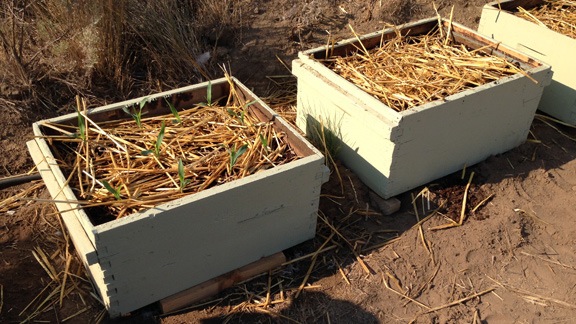
So I did the same thing I did for my large pallet planters — I lined the bottom with wire mesh. I had a large piece I’d been using on the door for my chicken yard that I clipped off, cut to size, and lay inside of each of the three boxes I painted for my trial run. I used a staple gun to fasten the wire to the sides of the boxes. Then I placed the first box in position, put a layer of stray on the bottom, right over the wire, and topped it off with some potting soil. I planted corn in the box, covered the soil with some more straw (to discourage digging by birds), watered it, and left it.

The corn wasn’t supposed to germinate for 8-10 days, but within 6 days, it was pushing its way up between the pieces of straw.

Beehive Planters
A row of the beehive planters. You can see the corn poking up through the straw in the closest box.

I lined up the other two boxes on the ground beside the first. I planted corn in one and onions in the other. When the heat breaks, I’ll prep the remaining three boxes, although I may not plant anything in them until next year.

What I like most about these movable planters is that they’re making it possible for me to have a garden this year, before I’m ready to commit to a location for the garden. And while the bottoms might not be the most sturdy, they do make it possible for plant roots to reach through, into the soil below.

I just hope I didn’t plant the corn too late for a good harvest.

Putting Away My Toys

Well, most of them, anyway.

July 4th was a big day for me. It marked one week after the concrete had been poured for the slab of my new home. That meant it was safe to drive on it.

But what that really meant to me was that I could move most of my vehicles back into covered parking.

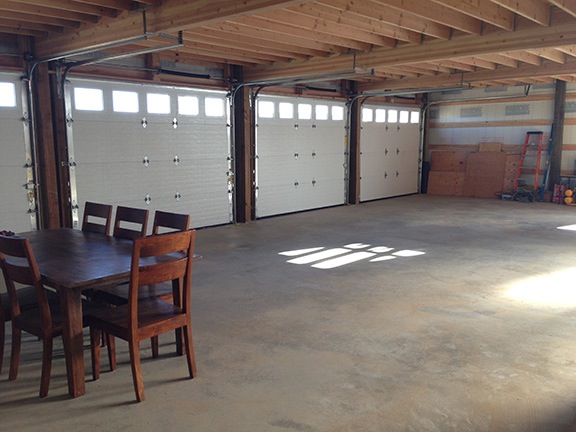
Three of my four garage bays were cleared out and ready to accept vehicles. The fourth was my temporary dining area for entertaining dinner guests. I couldn’t really get a vehicle into that garage anyway because of the pile of scrap lumber out front, effectively blocking the entrance.

My Four-Car Garage
Here’s what the inside of my garage looked like on July 4. It’s a panoramic image; the only way I could shoot the whole thing.

Up for storage: my 1999 Jeep Wrangler, my 2003 Honda S2000, and my 1995 Searay Sea Rayder boat. My 2003 Ford F350 SuperDuty diesel truck would have to wait outdoors.

I backed them all in and took a photo before closing and locking the doors.

Toys Stowed
This might explain why I wanted a 4-car garage.

Later in the week, I parked my 1992 Yamaha Seca II motorcycle between the boat and the table and my 1999 Yamaha Grizzly ATV between the Jeep and the Honda. eventually, they’ll be moved into the RV garage where they’ll be easier to get out when needed.

(None of my vehicles are new, but I like to think they’re in decent shape. And they’re all paid for, which is more than most people can say about the flashy new vehicles that are part of their credit-driven lifestyles.)

After more than 10 years living with my vehicles scattered all over the place or parked out in the hot sun, it’s nice to finally have them all under one roof.

Construction, Day 28: The Stairs are Built

And I get a front door lock.

On May 20, 2014, I began blogging about the construction of my new home in Malaga, WA. You can read all of these posts — and see the time-lapse movies that go with them — by clicking the new home construction tag.

Day 28 wasn’t a terribly busy day, at least from the outside. I wish I’d set up a camera indoors.

The main task was to build my stairs — something I really wanted them to finish as quickly as possible. The stairs would run from a vestibule just inside the front door straight up to the second floor. Without them, the only way up was on a ladder — they’d taken away the man lift on Sunday — and I just wasn’t comfortable climbing a 12-foot ladder.

They got started early enough and I went out to run an errand. While I was out, Corey called to tell me they needed to run up to Leavenworth to deal with an emergency situation on another project.

“Did you finish my stairs?” I asked hopefully.

He admitted they didn’t, then went on to tell me how important it was to handle this other project as soon as possible. I understood. I assumed that my project had gotten priority over someone else’s during the past six weeks. If I’d waited this long for stairs, I could wait a little longer.

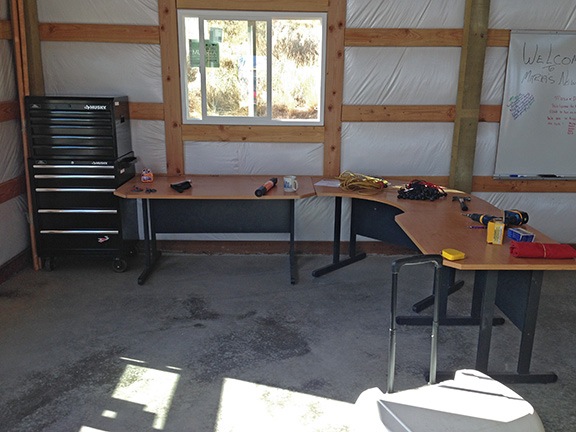
In the meantime, I started setting up my new shop area in the front corner of the big RV garage side of the building. The shop side was 12 feet wide (when looking from the front) and 48 feet deep. I thought of it as having four sections separated by the posts that were spaced 12 feet apart. My boxes of packed items were taking up most of the two back sections. A few days before, some friends had helped me mount my 10 foot long white board — a school surplus equipment sale item I picked up for just $20! — in the second section. They’d also helped me move the three pieces of my old desk into the front corner that would be my shop. I’d toyed with the idea of listing the desk on Craig’s List or giving it to a client who had just set up a new office in town. But I realized that although the work surface — a Formica laminate — wasn’t suitable for working with tools, the tables were a good height and size. I could cover them with a more substantial surface material, like 3/4 inch plywood. It would certainly save the cost of buying or the bother of building a real workbench.

I dragged my rolling toolbox out of the shed and into the building. I placed the new top toolbox on top of it. And then I rearranged the desk components to make an L-shaped workspace. I was pleased with the results.

My Shop
I started to set up my shop on July 3.

As for the desk I’ll use for my computer work, that’ll be much smaller than this old setup. I have a desk and matching file cabinet I bought for the Phoenix condo I lived in part time with my wasband before our divorce. It’ll be perfect in the space I’ve set aside as a home office upstairs. Until then, it’ll wait with the rest of my furniture for the final move.

I should mention here how weird it was — at least at first — to start setting up a permanent workspace. I’ve been living in a number of temporary homes for the past two years: my RV in Washington, my house in Arizona, my RV in California, my house in Arizona, my RV in Washington in three separate locations, a house nearby, my RV in California again, and then back to my RV on my homesite. My worldly possessions have moved from my Wickenburg house and Phoenix condo to my Wickenburg hangar to a Wenatchee hangar and then finally to my building. This has been going on for almost two full years and the temporary nature of my living situation had become almost second nature. But now I had a permanent home, something that belonged to me now and in the future. I’d designed it to have storage space for my things, a shop, and living space. The shop area was ready to move into — why not make the move? This was an entirely novel idea to me, but one I warmed to quickly as I began drilling holes in the girts to hang power tools and cables. It was my space to do with as I pleased.

I think I might have been on Cloud 9 most of the day, despite the stalled stairs.

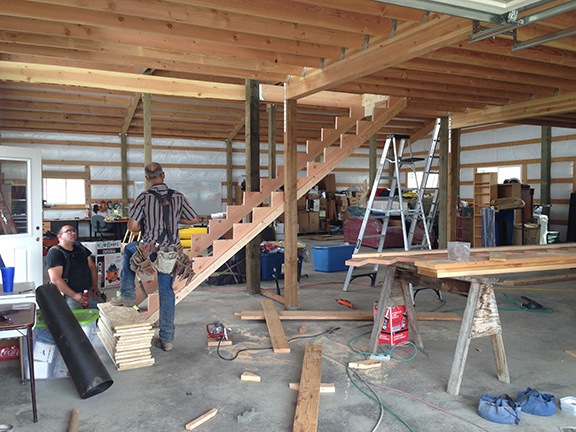
I was working on my shop when the builders came back. I was surprised. I thought they’d have to wait until the next day. But they showed up around 2 PM and got right to work on the stairs.

Stairs in Progress
Corey and one of his guys working on the stairs. The final staircase has four stringers, making them extremely solid.

While they worked on the stairs, I set about my next task: installing doorknobs and locks on my front door. I’d never installed a doorknob or lock before, but I couldn’t imagine it being very difficult, especially since the door and jamb were already cut to accept a doorknob and deadbolt. The project price included doorknobs and locks, but I didn’t want them to waste money on the typical Kwikset locks everyone seems to use. I wanted something more secure, so I bought a Schlage set with a door handle instead of a knob.

Keys
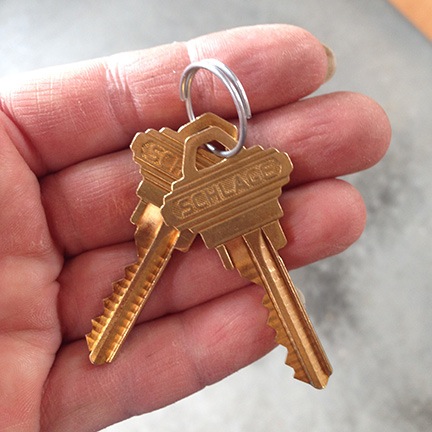
It was an emotional moment for me when I realized I was holding the keys to my new home. And yes, I know someone could theoretically cut a set of keys based in this photo. But I later added a keypad-activated deadbolt, and that’s what I use to lock up.

The set went in smoothly — except for the fact that I put it in the wrong hole and needed to move it (duh-oh!) — and worked well. Later, as I walked back to my shop area to put away my tools, I looked down at the keys in my hand and realized I was holding the keys to my new home.

Corey and his helper worked late. Some friends came for dinner; I had leftover chicken and pork tenderloin from the night before. When the builders left, my friends and I tried out the new stairs. I gave them my standard “tour” of the upstairs, knowing that the walls would be in place soon.

What was really nice was that the garage area was finally cleaned up — the builders had done a great job of picking up their stuff and sweeping before leaving that evening.

Clean Garage
My garage/temporary dining room, all cleaned out.

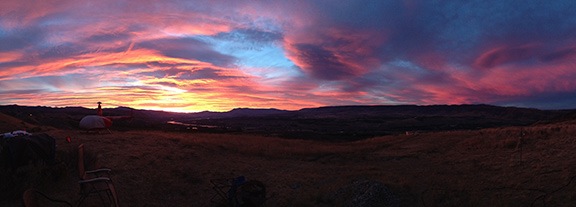
Much later, Mother Nature rewarded me with a sunset so amazing and huge that I needed to use the panoramic feature of my phone’s camera to capture it all. What a great day!

Sunset
An amazing sunset, shot from my front door.

Here’s the time-lapse for the day. Lots of coming and going, but not much in the way of exterior activity. Is it work watching? I don’t know. The movement of the clouds is kind of fun.

Construction, Day 27: Finishing the Front Wall, Framing the Deck

A lot done in one day.

On May 20, 2014, I began blogging about the construction of my new home in Malaga, WA. You can read all of these posts — and see the time-lapse movies that go with them — by clicking the new home construction tag.

I’m way behind on my construction project blogging. Part of reason for that is because construction really slowed down around the time they prepped to put in the concrete. As a result, there isn’t much to report.

But a lot of work was done on July 2.

The workers arrived bright and early and got right to work on the side deck. They’re framing the deck — not finishing it — but it’s still quite a task considering its 58-foot length.

Before lunch, they moved around to the front deck and got started on it. But they couldn’t really get into it until the missing metal pieces arrived. That happened around noon and they spent much of the afternoon removing the temporary pieces and putting in the correct ones.

The last thing they did was to close up the big RV garage doorway. With the help of a bunch of friends, I’d moved all of my worldly possessions into the building on June 28. At that time, the building had no garage doors. The four smaller garage doors were put up on Monday. But the big garage door was still on order and not expected until July 15. That meant I had absolutely no way to secure my home. Someone could drive up with a truck while I was running errands in town or on a cherry drying flight, back right into the big door, load up, and take off.

Yes, the chances of that happening were very slim. But there was still a chance.

The builders remedied the problem by building a solid (although not very attractive) wooden wall across the bottom of the doorway with heavy duty plastic sheeting across the top to keep out rain. That’s what occupied the crew at the end of Day 27. When they left, my building was pretty much secure.

Building Front on July 2
When the builders left on July 2, the metal on the front of my building matched and the big doorway was secured with a temporary wall.

Traegered Chicken
Another day, another meal from my Traeger. This was a locally raised and butchered free-range chicken that turned out very tasty indeed.

Later, when the builders had gone, the guy I hired to do the living space framing showed up with his bid. He made the fatal error of hanging around longer than he needed to — any strong pairs of arms that spend idle time at my place are soon put to work helping me move heavy items. He helped me move my dining table from where my friends had put it in the back of the RV garage into one of the garage bays. When he left, I set up chairs around it, opened the garage door, and hosted a dinner party for four friends on my dining table for the first time: smoked local chicken and grilled pork tenderloin.

Here’s the time-lapse from the day’s work.