A “Personal Note” From a LinkedIn Connection?

More like spam, if you ask me.

LinkedInThe other day, I got an email message from someone I don’t really know, with the subject line “A personal note for Maria Langer, from one of your Linked In connections”

Here’s how it began:

Maria,

You and I are connected on Linked In, and I’m happy about how easy this makes it for us to stay in contact and to get to know each other better. Following key events in your professional life in this way is awesome and inspiring.

I hope you feel the same about the ability to follow me. If not, then you can stop reading, log in to your Linked In account, and “unfriend” me. I won’t be offended, just a bit disappointed that I’ve failed to inspire you and that I have not (yet) made a significant positive impact on your life through my work.

You can go straight to my Linked In profile, here:

I’ll leave out the link and even the name of the person who sent this.

This is a “personal note”? If it was so personal, then the writer would know that I don’t post anything on LinkedIn so there are no “key events” he can follow there. “Awesome and inspiring”? Not on LinkedIn.

That aside, what followed was an extremely lengthy message full of links to this person’s social media accounts, websites, online profiles, Kickstarter campaigns, etc. It goes on to tell me about this person’s professional history, projects, and efforts to write the software he used to send me his spammy message. The message went on and on. 3114 words! (I pasted it into Word for a quick word count.) I didn’t read it all. Why would I? It was spam from a stranger. But the gist of it was that he was trying to get financing for a new venture and was apparently having trouble with the SEC. Or he wanted to change an SEC rule. Or he just expected people with better things to do with their time to drop everything and spend an hour or more of their lives reading his message and following the dozens of links it contained.

To me, this is what LinkedIn is all about: people using social media to achieve their professional goals by tapping into their “connections” — even if those connections are tenuous or with people who likely don’t give a damn.

I know that some of my friends rave about LinkedIn as a valuable resource for getting work. But I haven’t seen anything like that. All I’ve observed about LinkedIn is that it’s a source of spam, usually from LinkedIn itself or strangers.

When I went online at LinkedIn to sever my “connection” to this person, I discovered I had about 30 LinkedIn connection requests waiting for me. I only knew 2 of the people who’d requested a connection. The rest were complete strangers, most of whom had absolutely no connection to my industries (writing, computers, aviation). They’re just building up connections, likely so they can say they have a ton of them and possibly to spam them in the future.

Anyway, I hope I don’t get any more spam from this person. If I do, I’ll be reporting him to LinkedIn.

Not that I expect them to do anything about it.

Upcycling

Turning trash into useful items.

Over the past year or so, I’ve really embraced the idea of upcycling to make useful things around my home.

According to Wikipedia, coined in 1994, the term upcycling means

the process of converting waste materials or useless products into new materials or products of better quality or for better environmental value.

Why Upcycle?

I like the idea of upcycling for several reasons:

  • Upcycling really appeals to my scavenger instincts. For most of my life, I’ve wanted to gather discarded items that I think have some use. Hell, back in my college days, I furnished my dorm room with perfectly good items discarded by departing students, including an area rug, lamp, and table with chairs. You know what they say: One man’s trash is another man’s treasure.
  • Upcycling enables me to have more for less. With my recently limited budget, I have to make do with less money. While that often means doing without, it could also mean building my own solutions.
  • Upcycling reduces waste in landfills and recycling centers. Seriously, don’t we put enough crap in landfills and the ocean? Upcycling is better than recycling because it makes something useful without it first going through a waste stream. That means no transportation costs, no sorting costs, no remanufacturing costs, etc.

First Projects

Coop Construction
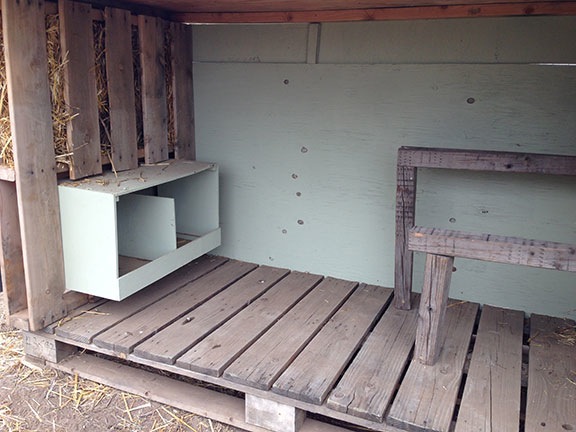
A look at my chicken coop under construction.

Pallet Garden
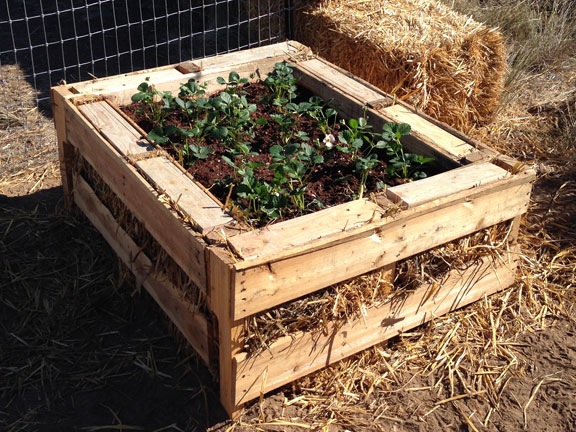
My first pallet planter makes an excellent strawberry patch.

I blogged about my first upcycling project before I even knew the word upcycling existed. In “Chickens Again, Part II: The Coop,” I wrote about the chicken coop I made, in part, from wooden pallets I’d scavenged. Two days later, I wrote “The Pallet Planter,” which showed off one of eventually three raised garden beds I’d built with more scavenged pallets.

Why Now?

All this is pretty new for me. In my old, half-dead life in Arizona, I wasn’t motivated to do much of anything — there just didn’t seem to be a point. And even if I did want to make or build something, I didn’t have tools or a useable workspace.

But here in Washington, things are different. I feel like I have a purpose in life, a reason to get up in the morning and make things happen. I also have a lot of free time on my hands that’s not filled with the need to try (and mostly fail) to make someone else happy.

I began acquiring decent power tools about a year ago — through purchases and hand-me-downs from friends — and have most of what I need to get projects done. And I have plenty of space; with my RV garage still mostly empty and my shop laid out to give me the best access to tools and workspace, I can tackle almost any sized project.

More Projects

As I work on my home to do all the wiring and plumbing — more on that in other blog posts — I take time out to get creative with “waste” materials.

Rolling Workbench
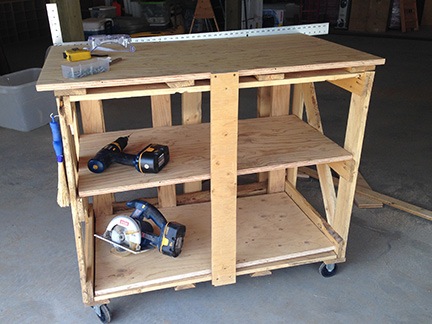
My first rolling workbench is a masterpiece of usefulness, built with a discarded crate and scrap lumber.

My favorite project to date is turning crates into rolling workbenches. There’s a business I pass when I go into town that gets engines and other parts on pallets and in crates. They discard the pallets and crates on a corner of their property near the road, under a sign that says “Free Wood.” If I’m driving by in my truck and there’s something worth taking, I pull over and load it up. (I actually keep work gloves in the truck just for this purpose.)

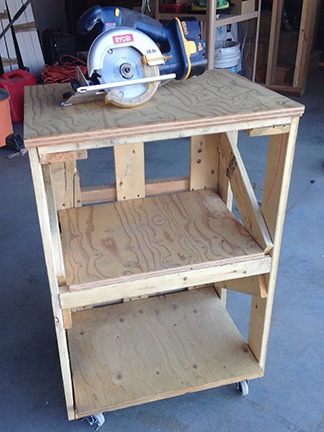
Small Rolling Workbench
I built this smaller rolling worktable yesterday. The only cost was the wheels, which I bought for about $10.

I picked up two large crates a few months back and turned one of them into a stand for my garden beehive. The other just sat in the dirt for a while, occasionally used as a work surface for cutting wood. When my building shell was finished, however, I got a brainstorm. Why not lay it on one side, add plywood shelves, and put wheels on the bottom? I had all the scrap wood and even the wheels that I needed. The resulting mobile workbench is perfect for woodworking projects and storing my power tools in a handy place. I even made a smaller version just yesterday.

Woodshed
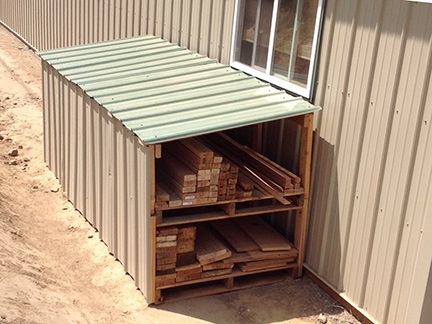
Yes, I did mark the length of each piece on the end and sort them by size. That makes it extremely quick and easy to find just the piece I need.

Because I’m such a scavenger and because I told the builder to leave behind any scrap wood, I needed a place to store the useable pieces. That meant a sort of woodshed. I built one out of pallets (again), scrap lumber, and leftover metal from my building. The result is a 4 x 10 sort of lean-to with shelves that keeps the lumber out of the rain and snow. And yes, I filled it almost immediately — it’s extremely handy to be able to quickly find exactly the piece of lumber I need for other projects. Best of all, it matches my building so it isn’t an eyesore from the road (which it faces).

I’m also working on glass projects, although I don’t have any photos yet. I start with discarded wine bottles which, because of the sheer number of local wineries, I can get in any number I need. I’ll be melting down glass rings in a kiln for use in wind chimes. And I’ve also been cutting the bottles in half and finishing off the cut edges to make drinking glasses and vases. This is time-consuming, tedious work that I’m not exactly excited about doing. But the results are impressive. I expect to make an entire set of drinking glasses for my new home out of wine bottles. I’d also like to melt small glass pieces in a kiln to make jewelry; we’ll see where I go with that.

Creativity Can Be Rewarding

I can’t tell you how proud I am of these silly little projects. Seeing waste turned into something truly useful that makes my life better or easier is extremely rewarding. Knowing that I’m the one who thought up the design and executed it makes it even better.

What have you upcycled lately? Use the comments to brag about it!

Still Alive and Kicking!

Very, very busy!

Just a quick note to let regular readers know that I’m still among the living.

I’ve been incredibly busy since that last post with a trip to AZ for more divorce bullshit, a week-long vacation in the San Juan Islands with a friend, some earth work at my building site, and a lot of electrical and plumbing work in my building and shed. I hope to blog about a bunch of this stuff very soon.

Until then, stay tuned. And remember, you can always use the form in the sidebar to subscribe to new posts as they are published so you don’t miss a thing.

A Visit to the Helibase

Nothing like starting the day with some heavy metal.

When my friend Tristan posted a Facebook update mentioning that he was working fires out of a helibase in Leavenworth, it was all I needed to plan a play day up in the mountains. I told him I’d come at 7:30, before he started work, for a brief visit. Then I picked out a hiking destination nearby, texted a few friends, and made a hiking date.

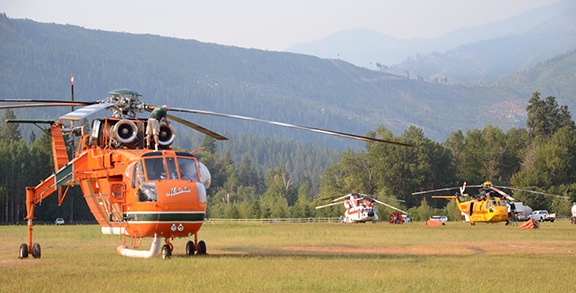
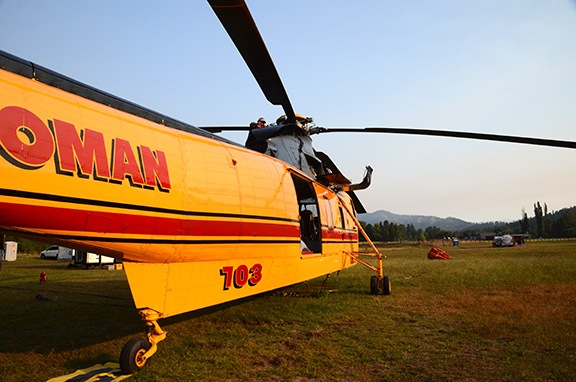
Alyse and I pulled into the field at 7:30 sharp on Sunday morning. I saw Tristan’s helicopter, a bright yellow Croman Sikorsky S-61, parked in the field with some other very heavy metal. There were no cars near it.

Malcolm & Friends
Malcolm and friends at the Leavenworth, WA helibase.

I drove up to the base trailer and got out, leaving the Jeep’s engine running.

“I’m looking for Tristan,” I told a woman there, including his last name in my comment. “He flies the yellow one.”

“Oh, yeah, Tristan. He’s not here yet.”

A man nearby took interest. “You can’t be on my deck,” he said.

I assumed he meant flight deck. He was being kind but firm. “I’m a helicopter pilot,” I said. “I just want to say hello to my friend Tristan. I haven’t seen him in two years.”

“I really can’t have you on my deck when it’s active,” he said, softening a bit. “You can drive over there and wait for him, but you need to be out when we start flying.”

I thanked him and we headed over, down a path in the grass field with a Do Not Enter sign prominently displayed. I parked by a portable toilet and we got out, leaving Penny behind in the Jeep. I texted Tristan. A moment later, he called me to tell me he was one minute out.

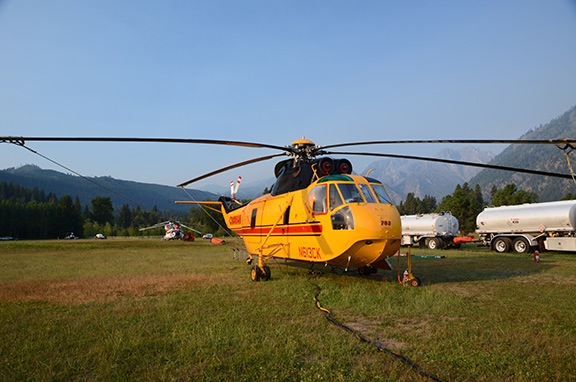
S-61 Outfitted for Firefighting
The Sikorsky S-61 my friend Tristan is flying on a firefighting job in Washington. Note the tandem tanker truck his company uses to haul around jet fuel.

He drove up as I was taking my camera out of my day pack. We shared a big hug, I introduced him to Alyse, and he introduced me to the helicopter’s captain, Sean. We chatted for a few minutes about my old Ducati 900 SS CR, which he’d bought from me in the spring of 2013 at a smoking good price. He’d stripped it down and sold off lots of the parts, in the process of turning it into a real cafe racer.

He gave us a tour of the helicopter that included a walk inside, which had been stripped bare to keep the ship light. It smelled of oil and grease and JetA. The cockpit instrumentation was remarkably simple. There were N-numbers scribbled on a Plexiglas window on Tristan’s side with a dry erase marker.

We climbed down and walked around the side. Tristan told us how it flew — more squirrelly than an R22, he said — and mentioned a few interesting flight and maintenance characteristics. Sean went for the morning briefing and told Tristan he could stay behind. The rest of the crew started working on the preflight, pulling off the blade tie-downs and adding hydraulic fluid to a port near the rotor hub. Tristan showed us the two buckets they use — not at the same time, of course — and described how they dip in a small creek near the fire.

S-61
Here’s another view of Tristan’s ship. Note the Bambi bucket on the ground in front of it.

We talked about his job as the second in command and the things he’s responsible for doing. We talked about what it’s like to fly fires in his position. We talked about the work hours and the challenges and the parts that make it easy and hard. Tristan had lots to say. Like me, he always does.

Note to Non-Pilots:

A fire helibase can be a very dangerous place to visit — which is why nonessential personnel are normally not allowed on “the deck.” The base commander very kindly allowed me a short visit with my friend, but don’t expect him to do the same for you.

Fortunately, this helibase has a nice observer area where you can come visit and watch the helicopters come and go. If you come, obey all signage and the instructions of base personnel and remain within the civilian area.

After about 20 minutes, I figured I’d taken up enough of his time. Besides, the sun was climbing ever higher into the hazy, smoke-filled sky and I was anxious to get down into the Icicle River Gorge where the air would be cleaner and the only sound would be water rushing over rocks. So we said our goodbyes, shared another big hug, and left.

Later, after the hike, we drove past the helibase again. Although the Sky-Crane and Army Chinook were there, Tristan’s ride wasn’t. I didn’t stop.

I’d still like to fly some heavy metal someday. I’d like to see what it’s like to have all that helicopter behind me up in the air. And while I’m not sure I’d be a quick study learning to sling a bucket under a long line, I’m pretty sure I’d catch on and do a decent job. But I doubt that any of that is in my future. Instead, I’ll watch my pilot friends move through utility pilot careers and wonder what it’s really like to be in their shoes.

Or seat.

Good luck, Tristan! Fly safe!

Some Things You Probably Don’t Know about Growing Apples

Getting up close and personal with commercial orchard operations is a good way to learn about real-world agriculture.

Yesterday, I did a charter flight for one of my favorite clients, a company that owns or manages cherry, apple, and pear orchards throughout central Washington state. Throughout the growing season, they often need to visit one or more of their orchards for any number of reasons. Yesterday’s charter flight was to take one of their lead horticulturists around to meet with orchard managers or growers, so I landed in four different orchards.

Helicopter in Apple Orchard
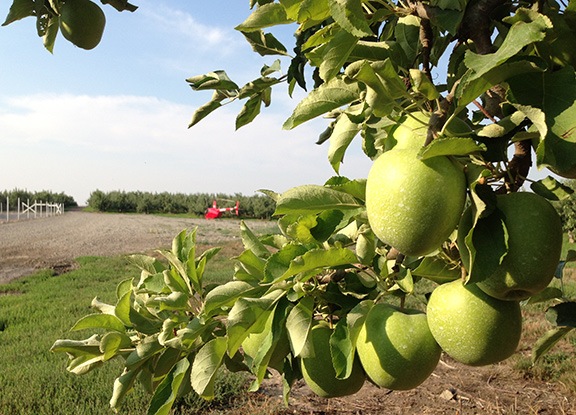
My first landing zone yesterday was a gravel staging area on the north side of an irrigation pond.

I took Penny the Tiny Dog with me yesterday, which I don’t often do. She curled up on a dog bed in the back seat during each leg of our flight and then kept me company while I waited for my passenger to return to the helicopter landing zone from his business elsewhere on the orchard. She also gave me an excuse to go walking while I waited. Together, we walked on the dirt roads around the orchard blocks.

This isn’t something new to me; I’ve been doing this since my first flights for this client two years ago. Along the way, I’ve learned a lot about how various fruit is grown, both by observation and by asking questions when possible during flights. I think some of the things I’ve learned are interesting and, after getting some photos to illustrate what I’ve learned, I thought I’d share them here.

Apple Orchards Need Cooling

Food for thought: Apples bought in the spring or summer are not “fresh”

No matter where apples are grown in the U.S., none of them are picked before August. August through October is apple season. Apples grown in the U.S. and bought any other time of the year have been stored since apple season. There are huge concrete buildings all over apple country called CA (controlled atmospheric) storage in which apples are stored until they’re shipped to stores. There’s nothing wrong with these apples — CA storage is used because it works — but don’t think that the apple you buy in May has been picked off the tree earlier that month. Unless it’s grown south of the equator, it hasn’t.

Apples are among the last fruit to be harvested. Long after the cherries and apricots have been picked, the apples continue to grow and ripen. Some early varieties are ready for harvest in August, but most are harvested in September.

Of course, that means that apples are on trees in the hottest part of the summer. And in this part of Washington — the dry side of the mountains — they’re pretty much baking in the hot sun throughout July and August.

Extreme heat isn’t good for apples. To combat the heat, orchards use evaporative cooling — they have sprinkler heads mounted high above the tree tops and turn them on periodically on hot days. This significantly cools the orchard air.

Where do they get the water for this? Orchardists pull water from sources according to their water right limitations and use it for irrigation. Excess water is stored in ponds on the orchards and used for cooling, as well as for warming during frost season.

I should mention that grower with very deep pockets will sometimes erect shade structures over entire orchards to keep apples out of the hot sun. They sometimes also use crop-dusters to spray chemicals on apples to protect them from sunburn. This isn’t necessary for all apple varieties, however.

Reflected Light Helps Evenly Color Apples

All fruit shipped to market has to meet certain standards. Among these standards is color — red apples need to have a certain percentage of their surface colored red to be salable.

Apples get their red color by exposure to the sun. In a perfect world, apple trees would be widely spaced and pruned so that every apple on the tree got full exposure to the sun. But we don’t live in a perfect world. We live in a world where farmers need to maximize profit on their land to survive. As a result, they plant the trees as close together as they can and prune only as much as necessary to get a good crop.

Gala Apples on the Tree
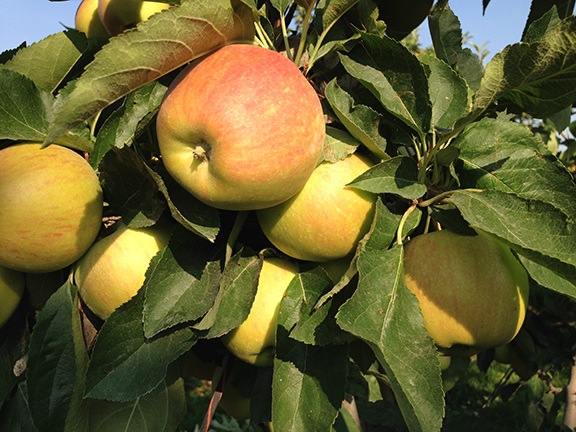
Typical bunch of gala apples growing on a tree in the Ice Harbor area of Washington.

Mylar Sheets between Apple Trees
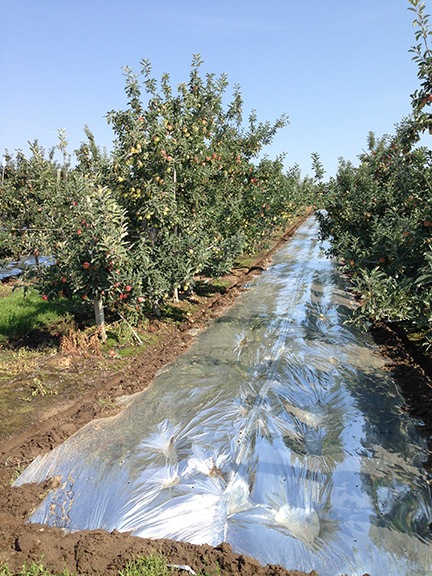
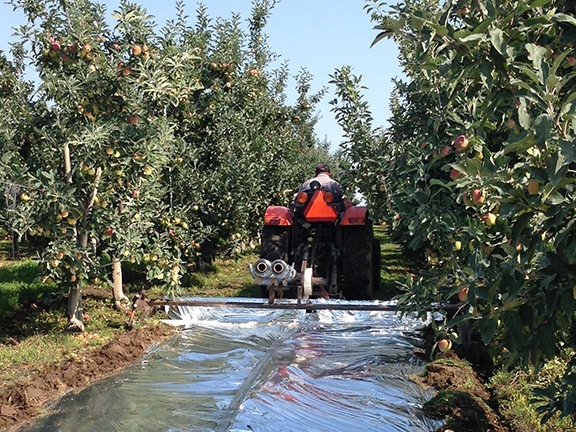
Mylar is commonly used on the ground to reflect sunlight back up to the bottoms of apples.

To maximize the amount of sunlight on each apple, growers occasionally use reflective material such as mylar or white sheeting. The growers refer to this as Extenday, which is actually the trademark of a company that makes this material. They roll these sheets out under the trees between every row or every other row, anchoring them with piles of soil. This is done with a tractor and specialized attachment, which I got to see for the first time yesterday. The sheets are removed and discarded before harvest.

Spreading Extenday
Yesterday, I got to see them spreading mylar sheets in an orchard using a special tractor attachment.

It’s interesting to note that Rainier cherries also require a certain percentage of red color. Reflective sheets are also used to help get that color during growth. In fact, that’s usually how I know I’m flying over Rainier cherries when I dry them — because they have more delicate skins, I need to fly higher to prevent bruising.

Some Apples Require Cross-Pollination with Other Varieties

Not all apple varieties can pollinate themselves. Delicious apples, for example, require cross-pollination to bear fruit.

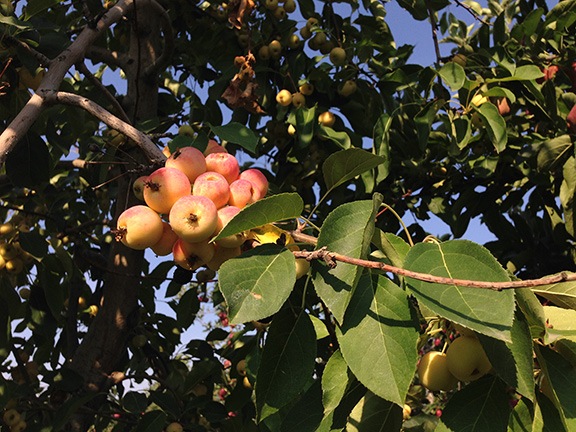
Orchardists commonly use different varieties of crabapples for cross-pollination. These trees are planted within the Delicious apple orchards — perhaps every fifth tree every other row — so that during pollination season bees can spread their pollen around.

Of course, after pollination season, crabapples grow on these trees just as Delicious apples grow on the trees around them. But because there’s no ready market for crabapples, they’re left behind at harvest time to basically rot on and around the trees. This is unfortunate because although they don’t taste very good, they can be used to make other products, including hard cider. Unfortunately, because they’re so tiny and yield such a low financial return, it’s usually not profitable to pick them.

Crabapples
Crabapples growing in a Delicious apple orchard.

Again, some varieties of cherries have the same cross-pollination requirements. Bing, for example, require cross-pollination. Some orchards will plant a less desirable cherry throughout the orchard and leave those cherries behind at harvest time; others will plant another desirable cherry, such as Rainiers or Lapins, and pick them separately.

Bees Can Be a Nuisance to Organic Apple Growers

As a beekeeper, I’m always interested in placing my bees in a location where they get an ample food supply. Earlier this year, when I was touring cherry orchards with a new cherry drying client, I noticed a bunch of beehives in a field. I asked him about it and was very surprised to learn that organic apple growers don’t like bees to be left behind past pollination contracts.

During pollination season, all apple growers rent beehives to ensure pollination of their trees. Non-organic growers don’t care how many successful flower pollinations there are. When the bees are gone and the fruit starts to grow, they spray a chemical that forces a good portion of the fruit to drop off the trees. This ensures that the fruit left behind gets more of the tree’s resources and grows well.

Organic farmers, however, can’t spray that chemical. As a result, they try to limit the number of apples on the trees by limiting the amount of time the bees are present. When a beekeeper removes bees from an orchard but keeps them in the area — perhaps a nearby field — the bees continue to pollinate the trees. As a result, there are too many apples on the organic trees and they need to be culled manually at a great expense to the grower.

So organic growers simply don’t want the bees around any longer than necessary.

Grass and Weeds in Orchards Help Bees Survive

Most orchards have strips of grass and weeds between rows of trees. This is impossible to prevent given that the area is irrigated, fertilized, and cleared of pests. The trees aren’t the only things to benefit from this. The grass and weeds can grow quite luxuriant.

This is good for bees, especially when those weeds produce flowers such as dandelions. In late summer, long after the fruit trees have been pollinated and fruit has begun to grow, other food sources such as wildflowers become scarce. Weeds in orchards sustain the bees.

Flower or Mushroom?
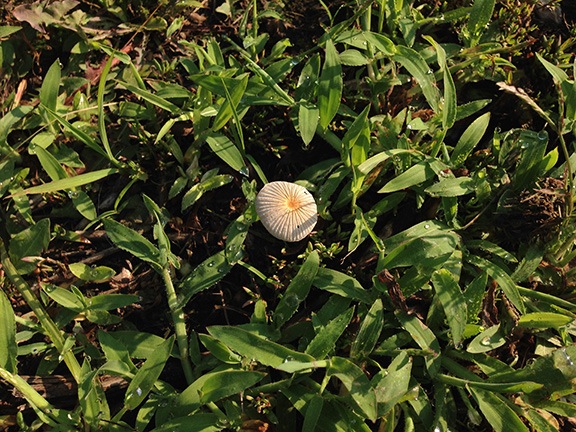
I still don’t know if this weird thing was a flower or a mushroom.

With colony collapse disorder (CCD) killing off bee colonies worldwide, growers are encouraged to leave the grass and weeds in orchards as long as possible to help the bees find a food source. Unfortunately, most orchards are mowed before the pickers come in to make it safer and easier for them to move and position ladders and get around the orchard.

Still, yesterday, I was reminded of this as I wandered into the tall, thick grass and heard bees flying all around.

More to Know

If you’ve gotten this far, I hope you’ve learned at least one thing about commercial fruit growing: that there’s a lot more to it than simply planting and watering trees and picking fruit at the end of the season.

When we go to the supermarket — or even to the farmer’s market — to buy fruits and vegetables, we have no idea what the growers did to make that produce grow and get it to market. The next time you’re at a farmer’s market chatting with a real farmer, take some time to learn more about the food you’re buying. If you’re like me, you’ll find it fascinating and get a lot more respect for them and their efforts.