Summer 2016 Road Trip, Day 1: The Road to Mazama

A late start, a free overnight stay.

I’m on vacation. After a 10-week cherry drying season that had the five pilots on my team flying more than 160 total hours (!), my last contract ended on Sunday, a beautiful cloudless day. Because I’m required to stay in the area for the entire season, I get a little stir crazy by week 7 or 8. I started planning a trip with my new camper, the Turtleback. I had some minor repairs and improvements made earlier this month and brought it home on Thursday. I began packing the next day. By Sunday morning, I was ready to go.

Kayak Blues

Or at least I thought I was. I still had one thing to get on board: my kayak. My trip would have me visiting lakes throughout the North Cascades, both in Washington and British Columbia (Canada). Clearly it would be nice to have my kayak along for early morning or late afternoon paddles.

The idea was the hang my kayak on the ladder on the back of the camper. My kayak isn’t anything special. It’s straight out of Costco and several years old. Plastic with a molded seat and storage space and a cup holder. Room for Penny to ride on the bow or between my legs. It’s the kind of thing that if it broke along the way, I wouldn’t lose sleep over it. Besides, I have two of them that are identical, mostly so visitors can come paddling with me. For this trip, I only wanted to bring one.

But no matter what I did, I couldn’t easily hoist it onto the ladder rack. I’d wanted to leave town by 10 AM and by 9 AM I was sweaty, still needing a shower, and had a handful of other more important tasks to complete. And the kayak was still lying on the ground in front of the garage.

I showered, dressed, and headed down into town in my Jeep. I’d rig something up with pulleys and my electric winch. I’d already confirmed that the camper’s onboard generator could power the winch.

Then I got home, had lunch, and did those other things. I was waiting for shade in my driveway. By 12:30, there was some shade, but not quite as much as I hoped. Still, I climbed the ladder, rigged the pulleys, and built a sling for the kayak. I attached the winch and hoisted the kayak into place. It was a struggle. The ropes and knots and hooks kept getting hung up on the ladder. I tried to imagine doing it in a campground or lakeside up in the mountains, possibly with a handful of people watching. I couldn’t paint the picture. I imagined bringing along the kayak and never using it.

I winched it back down and pushed it into the garage. I removed the rigging and put away the winch. I finished packing and loaded Penny on board the truck. It was 3:00 PM when I pulled out of the driveway.

On my way out of town, I bought an inflatable raft and an electric air pump. That would have to do.

The Generator

I had one stop to make on my way north: a gas station in Pateros, WA.

I owned two generators. One was a 1KW Troy-Bilt that had been bought way back in around 2000 for backup power at the vacation home I owned with my wasband. The generator had been in my Wickenburg hangar when I moved to Washington, so I’d taken it with me. The other was a 2KW Honda I’d bought in 2010 for use with my old Mobile Mansion. I only needed one generator. (Heck, you can argue that I don’t need any generators because my new camper has one built in.) So I decided to sell the smaller one.

I had no idea what it was worth, but I knew you could buy a Chinese-made one at Harbor Freight for about $100. Surely this one was worth more. I figured I’d list it on Craig’s list for $175 and see whether I got any calls.

The calls started coming pretty quickly. One guy who seemed very interested was living in an off-the-grid cabin about 17 miles from Tonasket. Tonasket near the border of Washington and Canada — not exactly close by. He was willing to drive down to get it, or to see if he could talk a friend into picking it up. I told him I’d be heading his way on Sunday and offered to meet him. (Why not, right?) So after several phone calls, including one to say I’d been delayed and another to say I was finally on my way, I headed for the Chevron station in Pateros, which was about a half mile past where I’d turn up the Method River.

I got there around 5. I went in, bought a heavily caffeinated beverage and some chocolate covered espresso beans. Then I went back into the truck to wait.

And wait.

I was just getting ready to roll out of there at 5:30 when he pulled up in a pickup truck with a water hauling tank in back. He was around my age with really nice long hair covered on top with a sort of trail guide hat. He greeted me with a friendly handshake and I brought him over to the truck, where the generator was sitting on a blanked on the back seat. He pulled it out — it’s very heavy — and laid it on the tailgate of his truck. I pointed out the power switch, fuel valve, and choke lever. He set everything up and pulled the cord. It roared to life.

He asked me if I’d accept less. I guess that’s something you’re supposed to do. I told him not after I’d hauled it up here and waited a half hour. He understood, although I think he doubted I’d been there a half hour. He counted out $175 and I put it away. We chatted for a while about what I do in the Wenatchee area and what he does up in Tonasket. (He’s a “Jack of all trades, master of a few.”) He was an interesting guy and it would have been nice to talk to him a while longer. But I had a vacation to get on and I wanted to be parked for the night before it got dark. We shook hands again and I went back to my truck. He was gone before I even pulled out.

The Campsite

I had no idea where I would be spending the night. The original plan had been Pearrygin Lake State Park north of Winthrop, but I couldn’t see spending $30+ for a campsite I’d only occupy for one night, especially if I didn’t have time to take advantage of any of the facilities. So I drove north through Twisp and Winthrop towards Mazama with the idea of finding a quiet spot in the National Forest.

Twisp was relatively quiet — although I didn’t drive through the business part of town — but Winthrop was hopping. The town was full of parked cars with plenty of people out and about. I was pretty surprised — after all, it was after 6 PM on a Sunday night. I assumed the tourists would have gone home by then. But then again, it is still summer. I rarely vacation in the summer months because I want to avoid crowds, so I really have no idea how a typical summer week plays out.

I have to say that it was interesting to visit the area in the summer. I come up to the Winthrop area annually for Christmas — at least I have for the past three years — to do some cross-country skiing. The area is always covered with snow. Last year I drove through in the summer on a camping trip with the guy I was dating at the time and again in the autumn when I went for a weekend mushroom seminar at the North Cascades Environmental Learning center. (I’ll be back in late August for a nighttime photo class.) The hillsides were the same golden color they are around my home, but the valley was lush and green. There was one field with tall grass that had gone to seed; the wind whipped it around and the seed heads seemed to flow like water.

There was a recreation side at Mazama that indicated camping was available, so I turned in and headed north up Lost River Road. I didn’t remember any campgrounds up that way, but I did remember a parking area for a Sno Park. When I got there, it was big and flat and empty, surrounded by fir trees. The pit toilet was unlocked and was probably the cleanest one I’d ever been in.

By this time, it was after 7 PM. Sunset was in over an hour, but the valley was already in deep shadows. I could drive back to Mazama and continue up route 20. But I didn’t know how far I’d have to drive before I found a suitable place to park for the night. Do I leave a known in search of a suitable unknown? The answer was no. I’d had enough adventure for the day. It was time to kick back and relax.
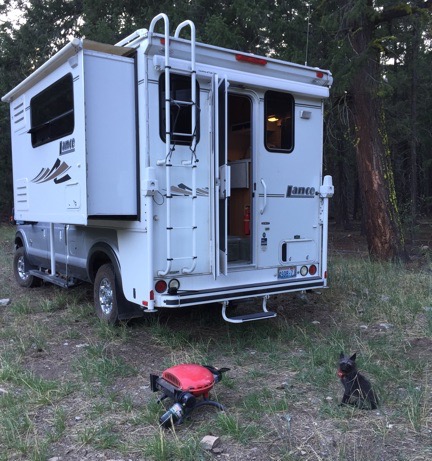
First Campsite
Our first night’s campsite, just north of Mazama, WA.

So I parked the truck, opened the Turtleback’s slide and set about organizing my hastily packed belongings.

A while later, I had my portable grill out with a hamburger sizzling and two small eggplant from my garden grilling beside it. A sliced tomato from my garden completed the meal.

My only regret: I’d forgotten to pack a bottle of wine.
Making It Happen

You can do it if you try hard enough and stop making excuses.

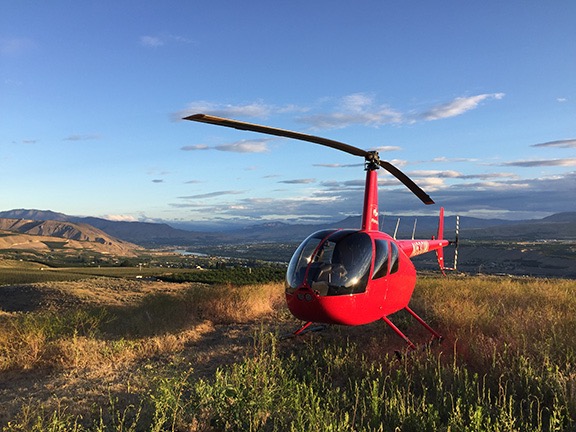
Yesterday evening, when I got home from a charter flight, it was a wee bit too windy to land on the platform I use to roll the helicopter into the garage. The platform sits in a rather confined area and there’s little room for error. A gusty tailwind could make for an ugly landing and I simply didn’t want to deal with it. So I did what I’ve done on a few other occasions: I landed in the side yard.

The wind didn’t die down before nightfall, so I left the helicopter out there overnight. It was supposed to rain today anyway and I figured I’d just put it on the platform after any cherry drying flights I had to do. I do my best to limit the number of times I have to start or shut down the helicopter on my property so as not to bother the few petulant neighbors who, in the past, have complained — to others; not me — about it.

But this morning dawned bright and mostly sunny. I checked the forecast and, sure enough, it had changed. Apparently, the big rain would be on Sunday — unless the forecast changed again.

Of course, the beautiful — and I really do mean beautiful — morning light gave me an excellent opportunity to take a few new pictures of the helicopter. If you’re a regular reader of this blog, you likely know how much I value Golden Hour light. And I never get tired of the view from my property.

N630ML at First Light
Flashy lawn ornament at first light.

My Prized Possession — for a Reason

As you might imagine, my helicopter is one of my prized possessions. (My new home is the other one.) Not only did it cost a huge amount of money to buy — and yes, I do own it outright — but it represents a series of achievements in my life:

  • writing a few best-selling computer books that eventually funded its purchase,
  • building skills to fly it safely as needed for the kinds of flying I do,
  • jumping hurdles set up by the FAA to operate it for Part 135 charter flights,
  • winning the right to keep it and my other business assets in my ugly divorce,
  • building a solid business around agricultural contracts in Washington and California, and
  • continuing to operate it as a primary source of income in my third career as a helicopter pilot.

It’s been a long road that started way back in 1997 when I took my first helicopter lesson and won’t end until I retire from flying and sell it to its next owner.

I often think about an airline pilot I was once friends with. He questioned why I would even bother learning to fly helicopters at my age — I was 36 when I started. “You’ll never make any money as a helicopter pilot,” he told me. Although I didn’t intend to make a living as a pilot back then, he turned out to be dead wrong. And I’m glad that I no longer have negative people like him in my life.

But think about how easy it would have been to accept his “expert opinion” and not try to move forward with any kind of career as a pilot. It was a built-in excuse for failure. Why try if this guy who knows the industry better than me says it’s impossible?

How many people do that? How many people simply don’t try because they think the odds are stacked up too high against them?

Anyway, as I snapped a few photos from every angle in that amazing first light of the day, I was thinking about this, thinking about what the helicopter means to me. Thinking about what it represents. Thinking about the series of actions I took to get from a 36-year-old who had only been in a helicopter twice to a 55-year-old — unlike other women, I don’t lie about my age — who makes a nice living as a pilot and has a helicopter parked in her side yard with that beautiful view behind it.

I’ve written about a lot of it here in my blog, and I don’t want to repeat it here. This blog has over 2,400 posts from the past 13 years. No shortage of things to read if you want to spend the time.

What I do want to touch on briefly here is the fact that just about all of us have it within our power to make things happen for ourselves.

I’m living proof of that. I’m from a lower middle class family where college wasn’t likely to be an option and got my first job — a paper route — when I was 13. I’ve been working pretty much nonstop since then — although my idea of work these days has little resemblance to the 9 to 5 grind most people deal with daily. (Hey, I was there for eight years and I know what you’re going through. The commute, the office politics, the meetings, the feeling that all you’re really doing is pushing paper. Ugh. Hope yours is better than mine was.)

Everyone dreams of doing or learning something special that’s important to them, but how many people do it? Some try but fail because they don’t realize from the get-go that achieving a difficult goal is a lot of hard work with very long hours and no guarantee of success. It takes planning, it takes funding, it takes the ability to work smart and have Plan B (or C or D) ready when things don’t work out as you expected. It’s easier to not try and to simply keep dreaming.

But do you really want to wake up one day when you’re 56 years old and realize that your life is more than half over and you haven’t achieved what you wanted to? (I think that’s what happened to my wasband; it pretty much caused him to lose his mind in a midlife crisis that went horribly wrong.) We only have one life. Why would you let it go by without at least trying to achieve your dreams?

The Psychology of “Success”

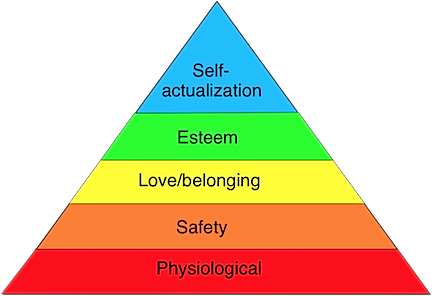
I was in college, in a Marketing class, when I first learned about Maslow’s Hierarchy of Needs. From SimplyPsychology:

Maslow (1943) stated that people are motivated to achieve certain needs. When one need is fulfilled a person seeks to fulfill the next one, and so on.

Maslow's Hierarchy of Needs
Wikipedia image by FireflySixtySevenOwn work using Inkscape, based on Maslow’s paper, A Theory of Human Motivation., CC BY-SA 4.0, https://commons.wikimedia.org/w/index.php?curid=36551248

The earliest and most widespread version of Maslow’s (1943, 1954) hierarchy of needs includes five motivational needs, often depicted as hierarchical levels within a pyramid.

This five stage model can be divided into basic and psychological needs which ensure survival (e.g. physiological, safety, love, and esteem) and growth needs (self-actualization).

The deficiency, or basic needs are said to motivate people when they are unmet. Also, the need to fulfil [sic] such needs will become stronger the longer the duration they are denied. For example, the longer a person goes without food the more hungry they will become.

One must satisfy lower level basic needs before progressing on to meet higher level growth needs. Once these needs have been reasonably satisfied, one may be able to reach the highest level called self-actualization.

The SimplyPsychology page about Maslow goes on at some length, making it difficult to decide when to end the quote. If this interests you, I highly recommend that you read it for yourself. It’s in plain English and a lot easier to decipher than the Wikipedia entry.

Maslow’s Hierarchy stuck with me since I first learned it. It made so much sense. It almost provides a blueprint for a good and fulfilling life. We are motivated for obvious reasons to take care of our basic needs like food, water, shelter, rest, and safety. Once those have been dealt with, we can move on to psychological needs like friends, relationships, prestige, and a feeling of accomplishment. Once we feel secure psychologically, we can move on to the need for self-actualization: achieving our full potential and realizing our dreams.

I admit that I was a bit put out when I learned this — keeping in mind that I was only 17 at the time — by the notion my professor suggested that once we’d found self-actualization, there was nothing left to motivate us. But since then I’ve realized that self-actualization isn’t the achievement of one thing. It’s the achievement of as many things as we like.

Here’s an example from my life. Since I was a kid, I always wanted to write a book (and have it published). When I was 31, I achieved that goal. So what does that mean for me? Game over? Call it quits? No. There was another goal waiting in the wings to step forward when that had been achieved: to make a good living as a writer. And I had other goals throughout my 20s and 30s and beyond: learn to ride a motorcycle, visit all 50 states (still working on it; haven’t been to Minnesota yet), learn to fly helicopters, manage rental properties (what a mistake that was!) — the list goes on and on. As it should.

Some people think of these goals as “bucket lists.” I’m not a fan of that. I don’t believe in check lists of things that we put off until we’re ready to “kick the bucket.” I believe in doing things now, while we can really enjoy them and learn from them and possibly let them change our lives.

Flying is a good example. I wanted to learn how to fly helicopters since my first ride at age 7. I never dreamed I’d be able to do it, but when I had the time and money to learn, I did. Then I got hooked on flying. I bought a helicopter. I dreamed of being a Grand Canyon pilot and built the experience (measured in flight hours) to qualify. I did that for a season. And before I knew it, I had bought a bigger helicopter and was doing what had to be done with the FAA to build a charter business. Now flying is my primary source of income. Yet when I took my first lesson back in 1997, I never thought I’d fly for a living.

Good thing I didn’t wait until I was collecting social security to take that first lesson, huh?

A side note here: 36 is older than usual to start flying, but not too old. Two of the helicopter pilots who flew with me this season also got late starts as pilots. One of them co-owns a helicopter flight school that has two locations and a bunch of helicopters and employees. The other works for him and just this week has built the 1,000 hours of flight time he needs to get his first commercial pilot job. Both men are in their 40s and have been flying for less than 10 years.

Make It Happen

As usual, I’ve wandered away from my original point. I have so much to say that it’s difficult sometimes to stay focused.

My point is this: we all have the power within us to make it happen.

Inspired Pilot

Back in March 2015, I was interviewed for the Inspired Pilot podcast. This is the brainchild of Marvyn Robinson, a UK-based pilot and IT guy, who interviews pilots with the goal of having them provide inspirational thoughts and information for people who want to learn to fly. It was a real pleasure to share my story. If you’re interested in the path other pilots took, I highly recommend it.

Take care of the needs at the bottom of Maslow’s Hierarchy. Don’t piss away your money trying to satisfy higher level needs until the lower-level ones are satisfied. (Do you really need a Mercedes when a used Honda will do? Prestige is better earned through actions than flashy, expensive possessions, despite what advertisers tell us.) Get and stay out of debt so you don’t need to be a slave to a job or lifestyle you hate. Think about what you really want in your life: a skill, a dream job, a business doing something you love? Do your homework — find out what it takes to meet your goals.

And then turn off the television, get your head out of your phone, and stop wasting time whining and complaining and making excuses for why you can’t succeed. Work hard and smart, keep your eyes on the goal and what you need to do to reach it. You can do it.

The Video

I started this post by explaining why my helicopter was parked in my side yard and what I was thinking and feeling about it as I photographed it from various angles. What I didn’t mention is that I made a video, too.

I tried to put into words what I was thinking and feeling. I always feel a bit awkward about showing off the helicopter. It’s one thing to put a picture of it in action or parked at a landing zone online, but it’s another to actively brag about it and what it means to me. I know that owning a helicopter is beyond the wildest dreams of most people. But I also know that it was once beyond my wildest dreams — go figure, huh? Maybe anything is possible.

The video does get a little personal. I mention my wasband and how sorry I feel for him. I wish I could have done a better job motivating him to achieve his goals, but in all honesty, I could never understand why he would need motivation from me. Remember Maslow’s Hierarchy? I’ve come to realize that I’m more driven than the average person to reach the top of his pyramid, but I didn’t know it back then. To me, the man I spent more than half my life with was intelligent and had or could build the skills he needed to succeed in one or more of his many life goals. I could never understand why he didn’t even try — or why he gave up so quickly when he did. Instead, when I prodded him to work toward a goal — for example, flying more often so he could get the hours he needed to achieve his goal of becoming a flight instructor — he countered with excuses. After a while, I gave up with frustration. I now realize that not everyone is as driven as I am. He definitely isn’t.

Hindsight is 20-20.

Yes, I know that this blog post is addressing a first world problem.

Here in the United States, most people don’t have to worry about getting food or shelter or meeting other basic needs. Unfortunately, there is nothing I can do to help those in other nations who are less fortunate than we are. I can only recognize that they are struggling and hope that things get better for them.

That said, please don’t lecture me (or others) here about insensitivity to those less fortunate than we are. Read the Site Comment Policy for more advice about sharing your thoughts here.

The video also assures viewers that we all have it within ourselves to achieve our goals. Maybe I’m being too optimistic? I heard on the radio just yesterday that people in Argentina are starving right now because they can’t get food. And what of the millions of refugees in the Middle East and Africa? Can these unfortunate people ever achieve their dreams? I don’t know. They need to take care of the bottom of the pyramid first. So many people in today’s crazy world do.

But for the rest of us — like the dozens of people who have told me, during flights, that they’ve always wanted to be a pilot but never learned — what are you waiting for? Make it happen!

I did — and I continue to do it every day.

Helicopter Pilot Job Hunting Advice

My response to a job seeker.

Every once in a while I get an email (or phone call) from a helicopter pilot looking for work. Although I usually just ignore email — primarily because the pilots contacting me don’t qualify for the only position Flying M Air ever has listed on its Help Wanted page — and tell the caller we’re not hiring, the other day I got an email message from a U.S. veteran and decided to do more.

I have a soft spot for vets. They risk their lives to keep us safe — or at least follow U.S. military policy which is admittedly misguided at times — and they get a pretty raw deal when they return from service: bad medical care, difficulty finding jobs, etc. The G.I. bill helps these guys get an education that can take them farther in life and it’s always great to see someone taking advantage of it. I fully admit that if I did hire employees and I had two employees with identical qualifications but one was vet, I’d hire the vet. It’s the least I can do to thank them for their service.

The Sad Truth

Pilot Log Book
Until you log at least 1,000 hours of flight time, it’s next to impossible to get a decent job as a commercial helicopter pilot.

The guy who wrote to me was a vet with 10+ years of service. He came home, got an Associates degree at a community college, and got his helicopter ratings through CFI-I (Certified Flight Instructor – Instruments). He told me more in his brief list of qualifications, but to share more here might make him easy to identify and ultimately embarrass him, which is certainly not my intention. The key point is that he has less than 300 hours of flight time, which makes him pretty much unemployable as a commercial helicopter pilot for anything other than flight instruction.

Let me be clear: it’s not impossible to get a job as a pilot with as little as 300 hours of flight time. I know people who have done it. But in almost every single situation, the pilot’s “employer” isn’t paying him/her to fly. Instead, the pilot flies when needed and the “employer” collects and pockets the revenue. In some cases, the employer might provide living space. (I know a pilot who lived on a cot in a hangar until his “employer” went out of business and he found himself homeless.) In a few cases, the “employer” actually expects the pilot to cover part of the cost of flying. In other words, the “employer” is taking advantage of low-time pilots by using their skills without monetary compensation. In many cases, the amount of flying they do is so insignificant that they’re not even building the flight time they need to move forward in their careers. It’s not a job, it’s a form of indentured servitude.

How could anyone recommend a job like that? I certainly couldn’t.

So how does a new pilot build time? As a certified flight instructor. That’s why they get the CFI rating. It’s their ticket to an entry level job as a flight instructor. And with the right flight school, a CFI can build that extra 700 hours they need in a year or maybe just a little more. I call that part of a career “paying dues.”

My Advice

I have to admit that I felt sorry for the vet who emailed me. I knew that his chances of getting a decent job as a commercial pilot were pretty much non-existent. But I felt I owed him something. So replied to his email message. Here’s what I said, with a bit of identifying information edited out:

Thanks for writing. Although we’re not hiring now, I’d like to take this opportunity to give you some advice.

First, the chances of you getting a good job as a commercial pilot with just 277 hours is slim to none. As the folks at your flight school should have told you, most employers look for pilots with at least 1,000 PIC time. Most new helicopter pilots build that first 1,000 hours as flight instructors. If your flight school led you to believe otherwise, they did you a great disservice.

Second, when you visit the website for a potential employer, take a moment to look at job opportunities posted there before contacting them. You used a form on our website to contact me. The page you accessed (http://www.flyingmair.com/info/contact-us/) clearly instructs those looking for a job to visit our Help Wanted page (http://www.flyingmair.com/info/help-wanted/). The first paragraph on that page states that we do not have any full-time or part-time employees. It then lists the openings we do have: usually just cherry drying pilot, which requires both 500 PIC and a helicopter, neither of which you have. Simply sending a summary of your limited flying experience to any helicopter operator you can find an email address for — especially when it’s clear that you haven’t even ascertained whether that operator is hiring — isn’t likely to get you many responses.

Third, as a pilot and blogger, I’ve written extensively about flying helicopters, including a series about pursuing a career as a helicopter pilot. You might find it useful, especially Part 9 (https://aneclecticmind.com/2011/08/25/so-you-want-to-be-a-helicopter-pilot-part-9-pay-your-dues/).

While I admire your optimistic attempt to find employment as a pilot and I greatly appreciate your service in the US Military, I can’t help you beyond the above advice. Get a job as a CFI. Work your way up as most pilots do. Read my series for more tips.

Good luck.

Not the Only One Who Doesn’t Get It

I should mention here that last week I was also contacted by phone by an acquaintance in the helicopter pilot community. She (like another person I know in a similar situation) was attempting to build time through the use of a helicopter bought by a friend or business associate. She called me because the owner wanted to earn some revenue with his helicopter and she wanted to find out if she could get it on a cherry drying contract with me. There were multiple problems with this:

  • She called in July, when my cherry drying season was almost over. I didn’t need any pilots. (I contract with pilots in April.)
  • The helicopter was an Enstrom, which I prefer not to use for cherry drying.
  • Although a cherry drying contract has the potential to make good money for a helicopter owner, there’s no guarantee of flight time. As I’ve said over and over in numerous places, cherry drying is not a time-building job.

When I told her all this, she was disappointed. She asked if I had any ideas for building time. I told her the same thing I told the vet: get a job as a CFI.

There are No Shortcuts

It’s sad that so many people invest so much money in expensive helicopter pilot training and then find that they can’t get the pilot job they want right after earning their certificates. But it’s a fact of life.

And face it: college graduates with bachelors and even masters degrees are unlikely to step right into the kind of job they really want. The problem isn’t just with pilots. It’s with just about any career.

And yes, there are exceptions. But exceptions are for exceptional people.

If you think I’m trying to discourage people from following their dreams to become helicopter pilots, you think wrong. I’m just a realist. I hate to see people working toward a goal with inaccurate information about the path they’ll likely have to take. I’ve written about this over and over throughout this blog; the careers tag should bring up some examples of past posts.

But I can’t recommend my series about becoming a helicopter pilot enough. Really. Read it and the comments for each post. You’ll be glad you did.

Good luck.

China Cheap

How do they do it?

When I was in Quartzsite, AZ this past winter, wandering around the sales, I bought a new pair of reading glasses with yellow-tinted lenses to cut the blue light from mobile devices. I’d heard that the blue light was bad if you used a device at night, which I did. Often. I think the glasses have helped improve my sleep patterns.

Because I need readers with me all the time and I don’t always carry a purse or clothes with suitable pockets, I’d taken to wearing the glasses on a chain around my neck, kind of like a stereotypical librarian from the 1950s. (I’ve been accused of many things, but vanity is not one of them.) When I bought the new readers, they also had beaded chains that were quite pretty and only $2. I bought one.

I wore it just about every single day for six months. Then it broke, dropping microscopic beads on the floor. I was definitely not going to restring them. With heavy heart, I tossed the chain away and got online to find a replacement.

Nice looking beaded chains were available on Amazon.com starting at about $12. Surely I could do better.

I did. On eBay. $3.56 with free shipping. I submitted an order and paid with PayPal.

I knew it was coming from China and I figured it would take a long time. Maybe a month. Whatever. I wasn’t in any hurry. I still had the old chain I’d used before the nice beaded one.

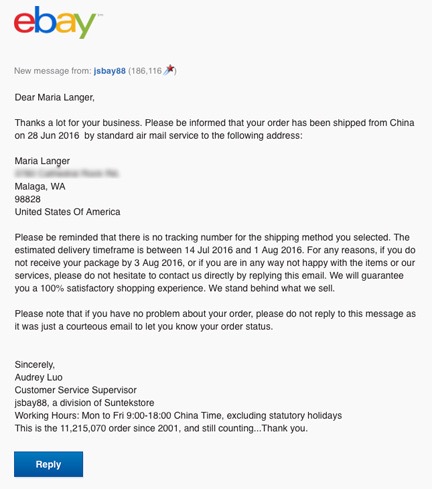
China Letter
A letter informed me my eyeglasses chain was on its way.

China Box
My new eyeglass chain arrived in a very nice satin-lined gift box.

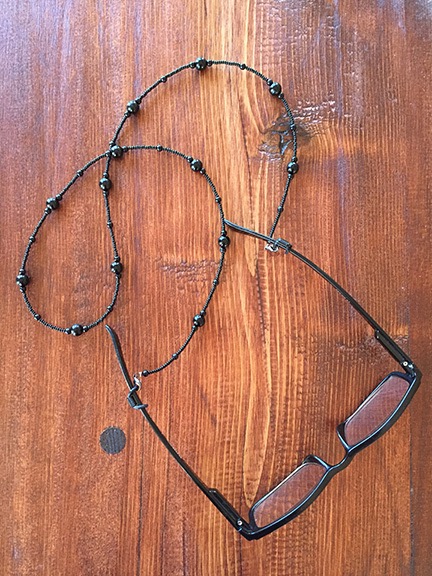
The chain on my glasses
Although not quite as pretty as the one I broke, my new eyeglasses chain certainly does the job.

But within a few days, I got an email message from the Chinese company I’d bought from. It was written in perfect English, easy to understand, and complete in the information I needed. If scammers wrote letters this nice, they’d fool more people.

The package arrived about a week later. It was a padded envelope with Chinese postage on it. It easily fit in my mailbox.

I brought it in and opened it up. I was very surprised to find a nice pink box inside. I’d been expecting the chain in a cheesy plastic bag marked with an inspection number. The box made it suitable for giving as a gift.

When I opened the box, I found the beaded chain inside it on a piece of satin that seemed made just for it. Classy.

And that got me thinking. How do these Chinese companies make money?

First they have to get the materials and labor to create the item they’re selling.

Then they need the fancy box with the satin insert and someone to carefully stow the chain inside it.

Then the box goes into an envelope with a packing slip. A label goes on the outside with postage.

And then someone takes it with countless others to the Chinese equivalent of a post office where it’s shipped thousands of miles. It goes through customs (I assume) and gets sorted into the U.S. postal system. And eventually it makes it to my mailbox.

For $3.56.

Less than the cost of a latte.

How can they possibly make any money on this?

Are Writers this Desperate?

Another rant. I’ll keep it short.

This morning, I went through my email inbox (currently 1795 messages, 10 unread) and found this message from a few days ago:

Email Message
This is the email message I received from a video training company looking for authors.

Maybe I’m being oversensitive here — it certainly wouldn’t be the first time — but I’m trying to figure out why any author in his/her right mind would send a bunch of detailed ideas for potential video courses in response to an obviously boiler-plated email that doesn’t even include the name or title of the person sending it.

Testing for Legitimacy

A side note about Lynda.com

I honestly don’t know why LinkedIn bought Lynda when it’s only a matter of time before there are hundreds of copycat sites out there, all cheaper. And what of the free content already available on YouTube? Video content is already going the way of the print content I used to create. Why buy a book when you can Google it? Why pay for a video when you can find one for free on YouTube? Quality doesn’t seem to be a concern anymore.

With Lynda’s current policy of replacing freelance experts with in house (i.e., non-royalty) authors, they can’t even claim to have better courses anymore. Those out-of-work experts have plenty of places to go — especially if they’re not as picky as I am.

I did some research. I looked at the website for the domain name the email came from. It looked legit — like a Lynda.com copycat site. A link at the bottom of the home page said they were looking for authors. I clicked it. No details at all: just a form to fill out with contact information. Apparently, they’d get in touch.

So at this point, I have no idea what kind of deal they’re offering authors. Do they even pay authors? I don’t know. I do know that I need to be paid — or feel confident that I will be paid — before I do any work, including developing ideas that it would be all too easy to have an “in house author” develop and record without compensating me. I’m not a complete idiot.

And anyone can whip up a real looking website these days. And was the grammar error in the email a typo or a sign that the email was sent by someone who doesn’t speak English regularly? Like someone at a content mill?

My reply was aloof:

I’m interested, but I need to know more about your author program before I make any proposals. I have a great deal of experience creating video courses, having authored and recorded about a dozen for Lynda.com over the years. Here’s a list: https://aneclecticmind.com/videos/ My areas of expertise include Mac OS, Microsoft Word, Microsoft Excel, Twitter, WordPress, and various niche software products. I’ve been writing books and articles about computing since 1990 and have had 85 books published since then.

If you’re interested in working with me, you’ll need to do a bit more than leave an anonymous message for me through a form on my blog. I’ve worked with a lot of publishers since 1990 and have learned that the serious ones are the ones who make personal contact and help me understand why I should want to work with them. I know I can benefit you; what can you do to benefit me?

Looking forward to hearing from you.

Maria

I don’t expect to get a response.

Another Site, another Courting

This reminds me a bit about a personal email I did get from another video training company about two years ago. This guy was in full sale mode, doing his best to tell me why I should be a writer for them, and why they wanted to get a bunch of my courses for their launch. There would be generous payment — 50% of the take on each course sold — but I’m smart enough to know that 50% of nothing is still nothing. Could they sell the courses they put online? I didn’t know.

I decided to wait a while to see how things went. After all, the whole thing could be a web version of vaporware. Six months after launch, I checked in. The site appeared to be up and running and there was content, although the courses weren’t very meaty. I emailed my contact to ask about sales figures. I never got a response. A year later, the site was down.

It would be nice to hitch up to a new wagon, but I need to be careful whose wagon I hitch up to. I don’t want to waste my time writing content for a publisher that I might not be properly compensated for.

How Desperate are Writers?

But again, these contacts and pleas for authors have me wondering: just how desperate are writers that they’d respond to an anonymous message like this with course ideas and outlines?

And how little do content publishers care about authors and content quality that they’d send out messages like this to anyone they think might take the bait?

How bad has the situation in publishing and content creation become?