My Flying M Nightshirt

A bittersweet story.

It’s true: I have a nightshirt with a Flying M logo on it. But there’s a story behind it and I thought I’d take a moment to tell it.

It all started back when I made a visit to my family back in New Jersey. It had to be in the early 2000s, but certainly after I got my first helicopter, an R22. This was back in the days when my mother’s brother’s family was still on good terms with all of us. It may have been when my grandmother was still alive or not long after her death in 2001 or 2002. (I don’t remember death dates; I see no reason to.)

My Uncle Frankie and Aunt Julie lived in Bergenfield, NJ in a typical suburban home on a narrow street. My uncle, who had been in the army during the Korean War, based in Alaska, had worked in a print shop before getting certified as a 100% disabled vet due to a back injury he’d suffered while in the Army. His wife was a typical old-school Italian homemaker. In fact, their household was very Italian in the New York kind of way, despite the fact their families had been in America since at least the 1920s.

They had two kids, Ernest (named after my grandfather) and Madelyn (named after my mother), who were a little younger than me and my sister. Ernest had been in the Marines right out of high school, married someone he’d met when he was in boot camp, had two sons, got divorced, left in the middle of his second tour of duty, and promptly got into serious trouble with the law. Madelyn married and had two daughters.

My Aunt Julie and her daughter Madelyn never really liked me or my sister. Simply said, our grandmother favored us over my aunt’s kids and she did a pretty poor job hiding it. I’m sure everyone has family dynamics like this and they always cause jealousies. My aunt and cousin were jealous of us and there was nothing we could do to head it off. They manifested their jealousies by talking down to us, criticizing us, and ridiculing us whenever they could. We dealt with it. They were family and although we didn’t like it much, we let it slide like water off a duck’s back.

We — I think I can speak for my sister, too — really loved our uncle, who was loud and outrageous and a lot of fun. I remember him staging a mock fight with my cousin Ernest on a visit I made with my first boyfriend back when I was about 18. Ernest had gone down into the basement and my uncle was yelling at him from the door in the kitchen at the top of the stairs. Then he pulled out a gun and fired a round down the stairs. It really freaked out my boyfriend, but the rest of us just laughed and laughed. The gun was filled with blanks.

But because of the friction from my aunt — which got worse and worse as time went on — I didn’t visit often.

We did visit one day in 2001 or 2002 and sat around the kitchen table for a nice Italian meal. My aunt was a good cook, although in later years she was a bit heavy on the spices. (The Italian word agita comes to mind.) She made a great eggplant parmesan, which might be one of the reasons it’s my favorite Italian dish. Making a good Italian eggplant parmesan is a lot of work, but if you want to taste one that’s just like my aunt’s (or mine), try Michael Angelo’s in the supermarket freezer section. I’ve tried a lot of eggplant and this is, by far, the best.)

Flying M LogoThe Flying M logo includes both of my initials. Cool, no?

I was likely wearing one of the Flying M logo shirts I’d had made. The logo was designed by Gary-Paul Prince, based on a idea my wasband had come up with that incorporated my first initial in the design of a helicopter. Gary-Paul had managed to get both initials in. Back in those days, I was near the height of my writing career and had a lot of money to burn so I’d had the logo embroidered on a bunch of henley t-shirts, which I really liked to wear. My uncle liked the shirt and asked me for one.

Now at the time, my uncle probably weighed in at 350 pounds — at least. I obviously didn’t have a shirt at home that would fit him. So I told him I’d have one made and send it to him.

I got back to Arizona (where I lived at the time) and had another batch of shirts made. I made sure the embroidery people included one sized 3XL, which I was pretty sure would fit my uncle. After a week or two, I picked up the shirts, which came in a plastic shopping bag. I likely set it down near the door to my home and it likely sat there for a few weeks — I’m terrible about putting things away.

And then I forgot about them. For years.

You see, back then I had a cleaning lady who came every two weeks. She had apparently seen the bag near the door and decided it was better off about six feet north, on the other side of the door to the garage. She’d moved the bag into the garage where it was quickly hidden under other things that wound up in the garage. Out of sight, out of mind. I completely forgot about the shirts.

Time went on. My uncle died. I went to his funeral. It was the last time I saw my aunt and cousins. My aunt died a year or two later but I didn’t go to her funeral. I don’t think she would have wanted to see me anyway. I think my sister has been in touch with Ernest, but I haven’t communicated with either of my cousins since my aunt died.
Flying M Nightshirt
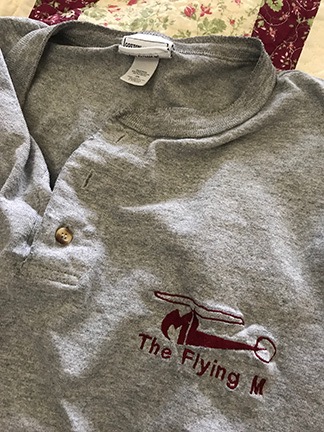
My Flying M nightshirt, now starting to show its age.

One day I was looking through a pile of stuff in the garage and came across a grocery bag with its handles tied tightly around something soft. I opened it up and found the shirts — including the gigantic heather gray one I’d had made for my uncle. I knew immediately what had happened.

I don’t throw away anything that has a use. Since I didn’t know any 3XL sized people, I decided to put the shirt into use as a nightshirt. It was comfortable and soft and very loose fitting.

And it’s still in my nightshirt rotation to this day.

The fabric is thinning and it isn’t quite as soft after so many trips through the laundry. The embroidered logo is puckered and there are tiny holes starting to form here and there in the cotton t-shirt fabric. I suspect that one of these days, I’ll have to throw it away.

But until then, it’s a reminder of my Uncle Frankie and some crazy good old days with family in New Jersey.
Cheese: The Temperature Problem Solved

A creative solution for an annoying problem.

If you’ve ever made cheese — I’m talking about real cheese like brie or butter cheese or cheddar — you know that one of the challenges facing a cheesemaker is raising the milk to an exact temperature and holding it there — sometimes for hours at a time. Unless you have a temperature-controlled cheesemaking vat — which I still haven’t found for home cheesemaking — you’re likely sitting by the stove making minute adjustments to the heat under the pot of water that your pot of cheese is sitting in — just to get the temperature of that to the magic temperature. It’s a nightmare that really makes cheesemaking an unpleasant chore.

A while back, I discovered immersion circulators, which I blogged about here. The circulator heats water to a temperature you specify and is commonly used for sous vide cooking. Trouble is, I didn’t pay close attention to what I was buying and it was only after I got it home that I realized the lowest temperature was higher than I needed to make most cheeses. It wouldn’t solve my problem. (But I did put it to use making sous vide steaks. I like grilled better. I’m pretty good with a grill.)

I experimented with a brewmaker’s mat that I wrapped around the outside of the pot. That was a so-so solution. It worked, but awkwardly. And it only worked on the pot I used for 2 gallon batches of milk; it wouldn’t work for the pot I’d need to buy for 4 gallon batches.

The other day, while surfing Amazon for something else, I decided to look at immersion circulators again. That’s when I found one that went as low as 77°F — the lowest temperature any of my cheese recipes required — the Sous Vide Travellortech Precision Cooker Immersion Circulator. I bought it.

That was only half the problem. I needed a pot big enough to put the cheesemaking pot and the sous vide cooker in. I found one at Fred Meyer: a huge, 33 quart canning pot.

My Cheese Pot Solution
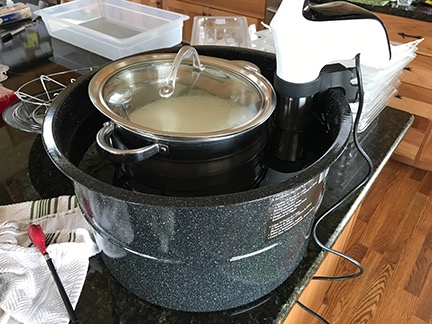
Here’s my cheese pot solution. I don’t even need a stove to use it.

So yesterday I started a batch of brie using 2 gallons of milk. I put the milk in a stainless steel pot and lowered it into the canning pot. I fastened the immersion circulator onto the side of the canning pot. I filled the big pot with warm water to a point slightly higher than the level of the milk in the inner pot. I put a thermometer in the milk pot, programmed the immersion circulator for 88°F, set the timer for 2 hours, and turned it on.

Temperature Setting
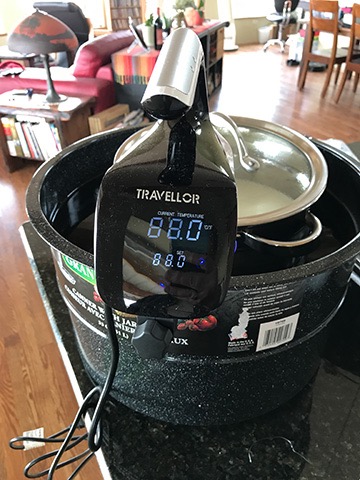
The immersion circulator quickly got the water up to temperature.

Because I’d started with warm water, the temperature quickly got up to 88°F. And held there.

The temperature of the milk read high until I stirred it. It eventually leveled out at 88°F.

I added the molds, calcium chloride, and rennet, stirring after each one. Then I put a cover on the pot and left it to sit for 90 minutes, per the recipe.

Milk Temperature
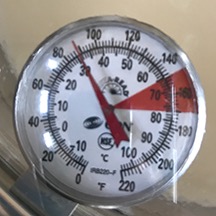
I can monitor the milk temperature through the glass pot lid using a thermometer clipped to the side of the pot.

Every time I checked it, it was exactly 88°F.

No stove babysitting. No wandering temperatures. This is the first time I’ll be able to follow a recipe exactly because I’ll be able to keep the milk the exact temperature I need.

Cheesemaking might actually get fun.

I measured the opening and I’m pretty darn sure I’ll get the pot for 4 gallons of milk into my cheesemaking contraption. Butter cheese in next on my list.

Total cost of this solution: Immersion Circulator: $79. Huge canning pot: $32. I already had the other pots.

Free Bees, Courtesy of Migratory Beekeepers

Catch a swarm without even trying.

The cherry trees are blooming in the Wenatchee area and that means the bees are back.

Every year, thousands of beehives are shipped to the area and placed around orchards to pollinate the flowers. Apricots are first — although there aren’t many apricot orchards in the area. Then comes cherries and then apple and pears. The season has just started and it should go on for at least a month.

My friend Tina and her husband Bill have a cherry orchard in Malaga, not far from where I live. Although they usually keep one or two of their own bee hives, that’s not enough to pollinate their entire orchard. So they rented about 30 hives, which were delivered the other night, likely right from California. (Migratory beekeepers move bees at night when they’re all inside their hives.)

The other day, Tina excitedly texted me that the bees were swarming. Turns out that they’d found her empty bee hives — her bees had not survived the winter — and a swarm had moved into one of them.

If you’re wondering what all this means, you might want to read a post I wrote back in 2013, “Bees: Capturing My First Swarm.” It explains why bees swarm and what’s usually involved in capturing a swarm. But Tina didn’t have to do any of the work. The bees just moved into an empty hive on their own.

I told her she should put other empty hives out to see what else she could catch and she said she did. Then I asked if I could put one or two of mine out. After all, if more than one colony was swarming, it would be great to catch as many of them as we could. Great for the bees, since they’d get a new home easily. Great for us because we’d get free bees. And it didn’t affect the migratory beekeeper since the bees were going to swarm anyway. If we didn’t catch them in our beehives, they’d end up somewhere else.

Keep in mind that buying bees usually costs about $100 to $150 per colony, depending on how many you get and how you buy them. And where you buy them from, of course. Since it’s common to lose 50% of your colonies over the winter here, a lot of folks spend a lot of money buying new bees. I replaced 6 colonies one year and swore it would be the last year bought bees. Now I make new colonies through splits and try to catch a few swarms every summer.

So yesterday I cobbled together two complete hives with ten frames each. Each hive has a mix of frames from a failed colony — three of my eight colonies died or disappeared over the winter — and frames from extracted honey. There’s lots of room for a queen to lay eggs and lots of room for incoming bees to store honey and pollen. And even a little honey to get them all started.

It’s kind of like finding a roomy apartment, fully furnished with just the kind of furniture you like, and a fridge with food in it.

I put one hive near the one Tina had already caught and another right near where half the rented bees were set up. And then I left.

Today, I dropped off some spare equipment to help Tina set up a few more hives. Not complete setups, but hive boxes (also known as supers) and tops. She’ll still need bottoms and frames.

Free Swarm
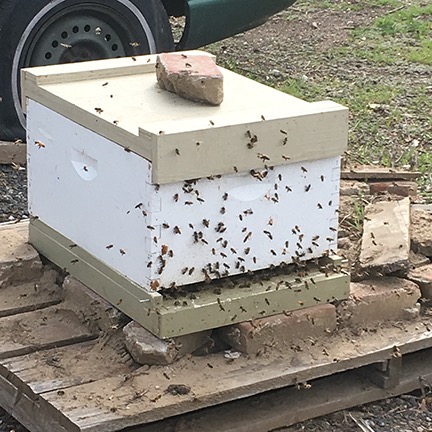
In less than 24 hours, bees had moved into my empty bee hive.

This afternoon, Tina texted me: “Look what you got!” And she sent a photo of the hive I’d placed near hers with bees all over the front of it.

It looked as if a swarm was moving in.

I texted back, asking if I could pick it up on Friday morning so they’d have enough time to settle in. She agreed. Then I suggested that she put a box where I had that one when I moved it. Maybe she’d catch another one.

Robber Bees?
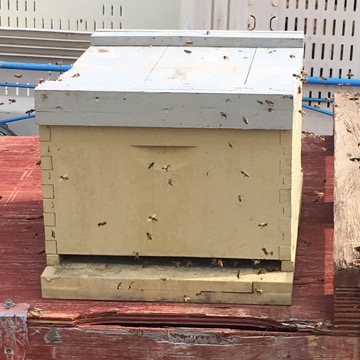
There aren’t enough bees around this hive box to assume a swarm has moved in. When I pick up the other one, I’ll take a peek inside this one.

She sent me a photo of my other hive, too. There was some activity around the front, but not much. Robber bees, perhaps, or maybe some bees just checking it out. Maybe she’ll send another photo tomorrow.

My beekeeping season has been off to a slow start. It only recently stayed in the 40s at night and we still have cool, rainy days. I checked the hives when I got home from my winter trip, just to see how many survivors I had and to seal up the dead hives so the other bees wouldn’t be tempted to rob. When I bring the new bees home, I’ll spend some time opening up my hives, shuffling frames, and seeing if I can spot the queens. I’ll do hive splits on my healthiest hives — I know that two are going like gangbusters — and put the splits on my little bee trailer. But rather than put four occupied hives on it before taking it up to Wenatchee Heights, I think I’ll try leaving one of them empty, just to see if I can attract any other migrants looking to settle down in the Wenatchee area.

FAR 107 Explained

I wrote a book last week and it’s available now.

Way back in 2012, I self-published three books. The first was the same kind of computer how-to book I’d been writing since 1991. It was about iBooks Author software and was the first book out about it. It sold about 3,000 copies and continues to sell to this day. The other two were less successful. One, about sorting data in Excel, sold a few hundred copies. The other, about making movies, sold about 500 copies. All of them were available in multiple formats, including print.

I was on track to release a book a month when the idiot I was married to decided he needed a mommy more than a wife and found one online. My life got thrown up into the air. Soon I was busy with a divorce and moving and building new home in another state. My goal of publishing a series of short books got put on the back burner. And then my flying business really took off and I didn’t see a real need to revisit that plan.

Until the other day.

I got a call from a local drone enthusiast — that’s what he called himself. He’d seen on Facebook that Flying M Air, my company, had begun doing drone photography. He had some questions about it. I had some time so we chatted on the phone.

During the course of the conversation, he asked me two regulation-related questions that I didn’t know the answer for. And that bothered me. You see, I’d done everything I was supposed to do to get a remote pilot certificate with a small unmanned aircraft system (small UAS) rating. I’d satisfied the FAA’s requirements and had a printout of my temporary certificate sitting on my desk. I should know the answers to his questions, but I didn’t.

So a few days later, when I found myself sitting around the house on a rainy day, I looked up the answers. And then I started a careful re-reading FAR Part 107, which is the FAA regulations for commercial small UAS (AKA drone) flying. And I realized that just like all the other FARs, Part 107 was written in the same government-style “legalese,” with the usual exceptions and cross-references that make them nearly impossible to understand.

And that’s when I realized that some folks might find it helpful to read a translation, in plain English, so they could actually understand the rules.

So I wrote one.

Part 107 Explained
Here’s the book cover. A friend asked how I got the photo. I basically flew my Mavic to face me on my deck early in the morning when the light was good. I’ll get a new shot when the fruit trees are in bloom for the next edition.

FAR Part 107 Explained: A Definitive Guide for Serious Drone Pilots is the result.

I started with the actual text of Part 107 and inserted my translation, in red type, beneath each section or paragraph. Along the way, I provided in-document links to other sections of Part 107 and web links to other FARs and documents that Part 107 refers to. I even included links to helpful web pages for registering a drone, reporting an accident, taking the course I did to satisfy training requirements, and changing your name or address in FAA records.

The resulting document isn’t long — after all, Part 107 is relatively short — but it is complete and works as a stand-alone guide to Part 107.

I generated two formats (so far): Apple iTunes bookstore and Amazon Kindle. I submitted to Apple on Friday and Amazon yesterday. (Guess which one was available first?)

In any case, if you’re interested in flying your small UAS/drone for compensation, I hope you’ll consider investing $6.99 for my book. Right now, it’s available as an ebook only; if there’s a big demand for it, I’ll consider a print version. You can buy it on Amazon.com or buy it from Apple.

And I have to admit that it feels good to be writing books again, even if they’re short ones like this.

The Credit Card I Never Asked For

A scam from Netspend.

Today, I received a credit card in the mail. Trouble is, I never asked for the credit card. I have enough credit cards and I certainly don’t want another one.

NetspendIt was a Small Business prepaid MasterCard from Netspend, a company I had never heard of. The accompanying paperwork told me about the related fees for use but not much else.

I called the number on the card to ask what it was all about. I was prompted for a card number, my social security number — which I, of course, did not enter — and my date of birth — which I purposely entered incorrectly. I was then prompted to agree with terms of service by pressing 1. There was no person. Just a machine taking down whatever I entered.

I tried pressing 0 and various keys. The system eventually hung up on me.

I tried calling another number on the Netspend website. It threw me into the same automated queue.

I tried again, this time using the option that the card had been lost or stolen. A prompt warned me that that option was only for lost or stolen cards. I stuck with it. When prompted for my social security number again, I entered all zeros.

Eventually I got a real person on the phone. I asked her what the card was all about and she told me I’d accepted a mail offer. I told her I hadn’t and that I wouldn’t have. I told her I didn’t want the card and that I wanted it all record of it removed from my name, including from my credit report. She apologized for the “inconvenience.” I told her that it wasn’t an inconvenience. It was an invasion of my privacy. I told her that if I saw the card on my credit report when I checked it next month, Netspend would hear from my lawyer.

And then I hung up on her before she could do any more explaining or apologizing.

Is this a scam? Sure seems like it to me. Hand out a credit card, use a toll-free number to gather social security number and date of birth information. Even if it is legit, it’s an unwanted hit to a person’s credit report, possibly damaging to a credit score. And what if someone had intercepted it on its way to my mailbox? Would I be on the hook for someone else’s transactions?

Is this an indication that I’m an identity theft victim? Should I be calling the credit services now? Are there other cards with my name on them in the hands of other people?

Or am I just being paranoid?

These days, you never know — until it’s too late.